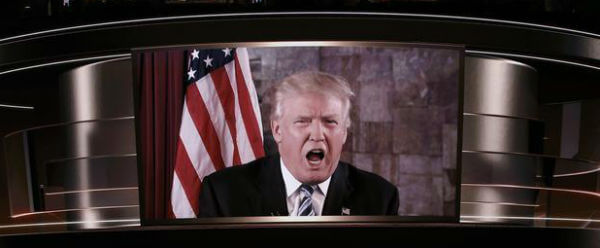
The New York Times reports: President Trump, who flew across the country on hundreds of nights during the 2016 campaign to sleep in his own bed, has now spent five straight days in the unfamiliar surroundings of the White House. His aides said privately that he seemed apprehensive about the move to his new home, but Mr. Trump has discovered there is a lot he likes.
“These are the most beautiful phones I’ve ever used in my life,” Mr. Trump said in a telephone interview Tuesday evening.
“The world’s most secure system,” he added, laughing. “The words just explode in the air.” What he meant was that no one was listening in and recording his words.
The president sat at his desk — the one used by former Presidents Barack Obama, George W. Bush, Bill Clinton, Ronald Reagan and John F. Kennedy, among others — at the end of his fourth full day in office.
His mornings, he said, are spent as they were in Trump Tower. He rises before 6 a.m., watches television tuned to a cable channel first in the residence, and later in a small dining room in the West Wing, and looks through the morning newspapers: The New York Times, The New York Post and now The Washington Post.
But his meetings now begin at 9 a.m., earlier than they used to, which significantly curtails his television time. Still, Mr. Trump, who does not read books, is able to end his evenings with plenty of television. [Continue reading…]
Music: Papik — ‘Open Eyes’
We are the last defense against Trump

Daron Acemoglu writes: America’s weakest point when it comes to resisting personal rule may lie in the executive’s unique relationship with the institution that makes up the very heart of government: the bureaucracy itself. In many other countries, such as the United Kingdom and Canada, where most of the bureaucracy and high-level positions in the judiciary are non-partisan civil servants, state institutions can go about the business of governing while remaining mostly immune to executive attempts to establish personal rule. Not so much in the United States, where Trump is appointing his people to oversee 4,000 high-level posts in the civil service and the judiciary, essentially shaping a bureaucracy ready to do his personal bidding. This is the sort of power that the likes Chavez, Putin, and Erdogan had to acquire more slowly. (Erdogan, for example, is still locked in an epic struggle to change the Turkish Constitution to officially assume the powers of an executive presidency, even if he has already acquired many of those powers in practice.)
Why is the United States so defenseless in the face of the Trump threat? Because, to a large extent, the Founding Fathers wanted it this way. As Woody Holton recounts in Unruly Americans and the Origins of the Constitution, despite the emphasis on the separation of power in the Federalist Papers, the main struggle that Alexander Hamilton, James Madison, and George Washington were engaged in was to build a strong federal government and reduce the excessive powers granted to the states in the Articles of Confederation, which had left the country in close to complete chaos. The separation of powers was meant only as a counterbalance to this strong presidency.
In this, they succeeded, but only partially. The U.S. president is indeed hugely powerful in the extent to which he can shape not only foreign but also domestic policy, especially if he can get Congress behind him. However, his hands are tied when it comes to the states’ rights, a concession that the framers had to give to powerful state representatives to garner enough support for the Constitution. This is the reason why some of the strongest resistance shaping up to Trump’s policies is already coming from states like New York and California, where governors have pledged to stand against his immigration policies.
But over time, the federal government has grown, as it has accrued, by necessity and choice, ever more responsibility in domestic and international politics. States, by contrast, have far less power than they did at the end of the 18th century. Massachusetts and Vermont can resist federal policies, creating, perhaps, little liberal policy bubbles. They can have very little impact, however, on the personalization of the country’s most powerful levers of government, including the federal judiciary, dozens of major agencies, trade and fiscal policy, and foreign affairs. Nor can they do much to influence the perception of the new direction of U.S. politics in the minds of Americans and the world.
This leaves us with the one true defense we have, which Hamilton, Madison, and Washington neither designed nor much approved of: civil society’s vigilance and protest. [Continue reading…]
Facing Trump, Mexicans think the unthinkable: Leaving Nafta
The New York Times reports: Not long ago, any suggestion that Mexico might walk away from the North American Free Trade Agreement would have been met with utter disbelief.
That was before Donald J. Trump was elected president of the United States.
Free trade is a mantra of Mexico’s political elite, the core of the country’s development strategy.
But now that Mr. Trump has said he wants to renegotiate Nafta, a growing number of Mexican officials and businesspeople are asking what price is worth paying to stay in it. Many of them are concluding that Mexico could have more to lose from years of haggling and economic uncertainty than from simply opting out.
“There could be no other option,” Mexico’s economy minister, Ildefonso Guajardo, said on Tuesday in a televised interview. “If we go for something that is less than what we have, well, then there is no sense in staying.”
About $1.4 billion in goods go back and forth across the Mexico-United States border every day. The United States buys almost 80 percent of Mexico’s exports, and Mexico is the second-largest market in the world for American goods.
Exactly how Mr. Trump’s government is proposing to renegotiate that flow is still unclear. The Mexican government says that Mr. Guajardo and Mexico’s foreign minister, Luis Videgaray, expect to get a first look when they arrive in Washington on Wednesday for two days of talks with officials in the Trump administration.
Mexico’s president, Enrique Peña Nieto, is then scheduled to meet Mr. Trump on Jan 31.
The Mexican government’s talk of walking away from Nafta if the Trump administration demands terms that are too tough could be strategic bluster, a tactic to begin the discussions on stronger footing.
To drive home Mexico’s importance to the United States, the Mexicans also intend to raise many other issues that bind the countries together, including migration, border security and drug trafficking.
The United States depends on Mexico to fight drug cartels and stop migrants from Central America and other regions who are trying to reach the United States. On Wednesday, Mr. Trump is expected to sign an executive order to build a wall on the border.
Mr. Peña Nieto’s government is trying to present “a package deal” to the Trump administration, in a tacit warning that the proposed wall would be an inadequate replacement for Mexico’s help on migration and security.
The message Mexico hopes to deliver is that “if you build your wall, the wall will have to substitute everything that we used to do,” said Jorge Castañeda, a former Mexican foreign minister. [Continue reading…]
As Trump orders wall, Mexico’s president considers canceling U.S. trip
The New York Times reports: When Donald J. Trump called some Mexican immigrants rapists, threatened to deport millions of them and promised to build a wall to keep others out, Mexican officials counseled caution, saying it was merely bluster from an unlikely candidate who, if elected, would never follow through.
Now, after just five days in office, President Trump is looking a lot like Candidate Trump — and the Mexicans are furious.
With just a few strokes of the pen on Wednesday, the new American president signed an executive order to beef up the nation’s deportation force and start construction on a new wall between the nations. Adding to the perceived insult was the timing of the order: It came on the first day of talks between top Mexican officials and their counterparts in Washington, and just days before a meeting between the two countries’ presidents.
The action was enough to prompt President Enrique Peña Nieto of Mexico to consider scrapping his plans to visit the White House on Tuesday, according to Mexican officials. In a video message delivered over Twitter on Wednesday night, Mr. Peña Nieto did not address whether he would cancel the meeting, saying only that future steps would be taken in consultation with the country’s lawmakers. Instead, he reiterated his commitment to protect the interests of Mexico and the Mexican people, and chided the move in Washington to continue with the wall.
“I regret and condemn the United States’ decision to continue with the construction of a wall that, for years now, far from uniting us, divides us,” he said.
It mattered little to Mexicans whether Mr. Trump’s order would receive congressional approval or the funding required to fulfill it.
The perceived insults endured during the campaign had finally turned into action. Decades of friendly relations between the nations — on matters involving trade, security and migration — seemed to be unraveling. [Continue reading…]
The Washington Post reports: President Trump’s proposed wall along the U.S.-Mexico border cannot be built with only the executive order he signed Wednesday and its construction will require congressional approval, border experts and former federal officials said.
While Trump can start the wall by shifting around existing federal funds, he will need Congress to appropriate the $20 billion — and perhaps significantly more — required to complete the massive structure, the experts and former officials said.
“How is he going to fund it? You need money!” Rand Beers, a former acting Department of Homeland Security secretary in the Obama administration, said Wednesday. “He’s got to have the money. And you can’t reprogram all that money without congressional authorization.” [Continue reading…]
Trump’s aides can’t keep quiet about his instability and temper tantrums
Eric Levitz writes: The president is a 70-year-old child whose TV time must be closely monitored — because any news story that upsets his ego will trigger a temper tantrum followed by irrational demands that his indulgent, overwhelmed guardians will be helpless to refuse.
Or so Donald Trump’s aides keep confiding to the nearest available reporter.
On Sunday, one of the president’s confidantes told Politico that his staffers have to “control information that may infuriate him,” a task made difficult by the fact that the leader of the free world “gets bored and likes to watch TV.”
That same day, some Trump aides provided the New York Times with a portrait of the president as a moody adolescent.
Mr. Trump grew increasingly angry on Inauguration Day after reading a series of Twitter messages pointing out that the size of his inaugural crowd did not rival that of Mr. Obama’s in 2009. But he spent his Friday night in a whirlwind of celebration and affirmation. When he awoke on Saturday morning, after his first night in the Executive Mansion, the glow was gone, several people close to him said, and the new president was filled anew with a sense of injury.
“The lack of discipline troubled even senior members of Mr. Trump’s circle,” the paper wrote, “some of whom had urged him not to indulge his simmering resentment at what he saw as unfair news coverage.”
And then, on Monday night, Trump’s staffers whispered an even more vivid account of his rough weekend to the Washington Post. [Continue reading…]
Jenna Johnson reports: The way President Trump tells it, the meandering, falsehood-filled, self-involved speech that he gave at the Central Intelligence Agency headquarters was one of the greatest addresses ever given.
“That speech was a home run,” Trump told ABC News just a few minutes into his first major television interview since moving into the White House. “See what Fox said. They said it was one of the great speeches. They showed the people applauding and screaming. … I got a standing ovation. In fact, they said it was the biggest standing ovation since Peyton Manning had won the Super Bowl, and they said it was equal. I got a standing ovation. It lasted for a long period of time.”
The most powerful man in the world continued: “You probably ran it live. I know when I do good speeches. I know when I do bad speeches. That speech was a total home run. They loved it. … People loved it. They loved it. They gave me a standing ovation for a long period of time. They never even sat down, most of them, during the speech. There was love in the room. You and other networks covered it very inaccurately. … That speech was a good speech. And you and a couple of other networks tried to downplay that speech. And it was very, very unfortunate that you did.”
Trump brushed off the suggestion that it was disrespectful to deliver Saturday’s speech — which included musings about magazine covers and crowd sizes — in front of a hallowed memorial to CIA agents killed in the line of duty. He insisted that the crowd was filled with “the people of the CIA,” not his supporters, and could have been several times larger than it was. Had a poll been taken of the 350-person audience to gauge the speech’s greatness, Trump said the result would have been “350 to nothing” in his favor.
The lengthy interview, which aired late Wednesday night, provided a glimpse of the president and his state-of-mind on his fifth full day in office. It revealed a man who is obsessed with his own popularity and eager to provide evidence of his likability, even if that information doesn’t match reality. [Continue reading…]
Trump’s new world disorder
Max Fisher writes: The Trump administration is preparing executive orders that would clear the way to drastically reduce the United States’ role in the United Nations and other international organizations, as well as begin a process to review and potentially abrogate certain forms of multilateral treaties, officials said.
The first of the two draft orders, titled “Auditing and Reducing U.S. Funding of International Organizations” and obtained by The New York Times, calls for terminating funding for any United Nations agency or other international body that meets any one of several criteria.
Those criteria include organizations that give full membership to the Palestinian Authority or Palestine Liberation Organization, or support programs that fund abortion or any activity that circumvents sanctions against Iran or North Korea. The draft order also calls for terminating funding for any organization that “is controlled or substantially influenced by any state that sponsors terrorism” or is blamed for the persecution of marginalized groups or any other systematic violation of human rights.
The order calls for then enacting “at least a 40 percent overall decrease” in remaining United States funding toward international organizations.
The order establishes a committee to recommend where those funding cuts should be made. It asks the committee to look specifically at United States funding for peacekeeping operations; the International Criminal Court; development aid to countries that “oppose important United States policies”; and the United Nations Population Fund, which oversees maternal and reproductive health programs. [Continue reading…]
Trump turns his xenophobic threats into executive orders
The New York Times reports: President Trump signed an order on Wednesday to start building a border wall with Mexico and was planning to indefinitely block Syrian refugees from entering the United States and to institute a temporary halt on all refugees from the rest of the world.
The refugee policies are part of an executive order he is expected to issue as soon as Thursday, according to an eight-page document, a copy of which was obtained by The New York Times.
The order would require tougher vetting of foreigners fleeing persecution and place a monthlong ban on allowing any person into the United States from Iraq, Syria, Iran, Sudan, Libya, Somalia or Yemen. Refugee admissions would be halted for 120 days while a review of screening procedures is completed. When it resumes, the program would be far smaller, with the total number of refugees resettled in the United States this year more than halved, to 50,000 from 110,000.
An early draft of an executive order that President Donald J. Trump is expected to issue as early as Thursday outlines his plans to indefinitely block Syrian refugees from entering the United States and institute a temporary halt on all refugees from the rest of the world.
White House officials declined to comment on the forthcoming plan, which emerged as Mr. Trump announced the construction of his long-promised Mexican border wall and aggressive new measures intended to crack down on undocumented immigrants inside the United States.
Through a pair of executive orders he signed at the headquarters of the Department of Homeland Security, Mr. Trump was laying out a new vision for fortifying the nation’s borders and sharply increasing efforts to round up and remove some of the estimated 11 million undocumented immigrants living in the United States — including by enlisting state and local officials to track and apprehend them.
“Federal agencies are going to unapologetically enforce the law — no ifs, ands or buts,” said Sean Spicer, the White House press secretary. “The American people get the final say who can and cannot enter our nation.”
The plans were a stark break with former President Barack Obama’s approach and what was once a bipartisan consensus to devise a path to citizenship for some of the nation’s undocumented immigrants. Mr. Trump, whose campaign rallies featured chants of “build the wall,” has instead described many undocumented immigrants as criminals who must be found and forcibly removed from the United States.
“They’re setting out to unleash this deportation force on steroids, and local police will be able to run wild, so we’re tremendously concerned about the impact that could have on immigrants and families across the country,” said Joanne Lin, senior legislative counsel at the American Civil Liberties Union. “After today’s announcement, the fear quotient is going to go up exponentially.” [Continue reading…]
Trump poised to lift ban on CIA ‘black site’ prisons
The New York Times reports: The Trump administration is preparing a sweeping executive order that would clear the way for the C.I.A. to reopen overseas “black site” prisons, like those where it detained and tortured terrorism suspects before former President Barack Obama shut them down.
President Trump’s three-page draft order, titled “Detention and Interrogation of Enemy Combatants” and obtained by The New York Times, would also undo many of the other restrictions on handling detainees that Mr. Obama put in place in response to policies of the George W. Bush administration.
If Mr. Trump signs the draft order, he would also revoke Mr. Obama’s directive to give the International Committee of the Red Cross access to all detainees in American custody. That would be another step toward reopening secret prisons outside of the normal wartime rules established by the Geneva Conventions, although statutory obstacles would remain. [Continue reading…]
The Daily Beast reports: “The President can sign whatever executive orders he likes. But the law is the law. We are not bringing back torture in the United States of America,” said Republican Senator John McCain, himself a victim of torture at the hands of his Vietnamese captors.
“We haven’t engaged in waterboarding since 2004…We haven’t used black sites since President Bush emptied the black sites, and we’ve somehow managed to keep our country safe,” said former CIA chief of staff Jeremy Bash, in answer to a Daily Beast question. “I have picked up precisely zero appetite for doing that again from intelligence officers,” a sentiment echoed by other former intelligence officers.
“With respect to torture, that’s banned,” Senate Republican Conference Chair John Thune told reporters Wednesday afternoon. “We view that to be a matter of settled law.” [Continue reading…]
Trump presidency turning into a bonanza for Trump Organization as Mar-a-Lago resort doubles its initiation fee to $200,000
The New York Times reports: The initiation fee at Mr. Trump’s Mar-a-Lago club in Florida — which the president himself has dubbed the Winter White House — has doubled to $200,000, after membership applications surged in the wake of Mr. Trump’s election, the head of membership there said.
Bernd Lembcke, the managing director at the Palm Beach, Fla., club, said the change in the initiation fee had been planned last fall, before the election, and that $200,000 had been the fee before 2010, when it was cut in half because of the recession.
But Mr. Lembcke, who has been at the club for 21 years, said that it also reflected the upswing in Mar-a-Lago’s popularity.
“We have had a sudden surge in requests,” he said, adding that new members must be recommended by someone who is already a member, as is the case at many private clubs.
Robert Weissman, president of Public Citizen, a nonprofit group that promotes government ethics, said the move showed that Mr. Trump and his family intended to profit from his status as president. [Continue reading…]
How Russia is filling the vacuum left by the United States in the Middle East
Akiva Eldar writes: Seeing the smiling face of Mousa Abu Marzouk, deputy head of Hamas’ political bureau, sitting comfortably in Moscow on Jan. 17 alongside senior Fatah official Azam al-Ahmed, it was hard not to recall the famous interview by Avigdor Liberman in April before his appointment as defense minister. In that interview, Liberman promised that if appointed, he would give Hamas 48 hours to hand over the bodies of two Israeli soldiers killed in Gaza during the 2014 Operation Protective Edge. The Yisrael Beitenu chairman threatened that if Hamas failed to acquiesce to his demand, he would recommend to Ismail Haniyeh, Hamas’ leader in Gaza, that he book himself a plot at a nearby cemetery. As far as anyone can tell, Haniyeh is doing well after Liberman’s first eight months in office. On the other hand, the romance between Israel and Russia, which the Moldova-born politician did everything in his power to broker, is in very bad shape.
The photo of the two senior Palestinian leaders, which did not get the coverage by Israeli media that it merited, was taken at a news conference held after three days of talks among representatives of Fatah, Hamas, the Islamic Jihad and other factions under the auspices of Russian Foreign Minister Sergey Lavrov. One can understand Israeli editors’ decision to play down the final communique from the Moscow talks announcing agreement on forming a Palestinian government of national unity and setting a date for elections in the Israeli-occupied territories. There are not enough fingers to count the number of similar announcements that ended in nothing being done. One usually says of such contacts that their importance lies in the fact that they took place. In this case, the importance of the meeting is in its venue and timing.
The official invitation to Hamas representatives to visit Moscow and prior to that Russia’s support for UN Security Council Resolution 2334, adopted unanimously Dec. 23 and affirming the illegality of Israel’s West Bank settlements, constitute failures of Israeli foreign policy. One can add to these the delivery of Russian S-300 missiles to Iran, despite efforts by Prime Minister Benjamin Netanyahu to thwart the deal. Russia supported the 2015 nuclear deal between the world powers and Iran and opposes Israel’s nuclear policy. Russian President Vladimir Putin said in September 2013 that Syria’s chemical weapons had been built in response to Israel’s nuclear weapons, and that given its technological superiority, Israel does not need to maintain nuclear weapons. Zvi Magen, former Israeli ambassador to Russia, even said that year that Russia is “dragging the Israeli nuclear issue into the Mideast negotiations” and that this could signal a “change in the Russian attitude to Israel.” [Continue reading…]
Report drafted by the late Jo Cox urges UK not to shy away from overseas intervention
The Guardian reports: The rise of unthinking pacifism and kneejerk isolationism in Britain have dangerous consequences for the safety of people around the world, according to a report started by Labour MP Jo Cox, who was murdered in June 2016.
The report, which was finished by Cox’s colleague and fellow MP Alison McGovern and Conservative MP Tom Tugendhat, makes the case that doing nothing can have a greater cost than intervention.
The findings are to be launched by the former prime minister Gordon Brown and former Tory foreign secretary William Hague on Thursday, at an event for the Policy Exchange thinktank in London.
The paper was intended to be jointly published by Cox, a former aid worker, and Tugendhat, a former soldier, before the Batley and Spen MP was shot and stabbed by far-right terrorist Thomas Mair.
It points to a number of global conflicts where intervention has been deemed successful, including a no-fly zone in Iraq in 1991 to protect Kurds from Saddam Hussein’s air attacks, the 1999 intervention in Kosovo to save civilians from ethnic cleansing and the British intervention in Sierra Leone in 2000 to help repel the Revolutionary United Front (RUF) advance. [Continue reading…]
That the world is not solid but made up of tiny particles is a very ancient insight
Carlo Rovelli writes: According to tradition, in the year 450 BCE, a man embarked on a 400-mile sea voyage from Miletus in Anatolia to Abdera in Thrace, fleeing a prosperous Greek city that was suddenly caught up in political turmoil. It was to be a crucial journey for the history of knowledge. The traveller’s name was Leucippus; little is known about his life, but his intellectual spirit proved indelible. He wrote the book The Great Cosmology, in which he advanced new ideas about the transient and permanent aspects of the world. On his arrival in Abdera, Leucippus founded a scientific and philosophical school, to which he soon affiliated a young disciple, Democritus, who cast a long shadow over the thought of all subsequent times.
Together, these two thinkers have built the majestic cathedral of ancient atomism. Leucippus was the teacher. Democritus, the great pupil who wrote dozens of works on every field of knowledge, was deeply venerated in antiquity, which was familiar with these works. ‘The most subtle of the Ancients,’ Seneca called him. ‘Who is there whom we can compare with him for the greatness, not merely of his genius, but also of his spirit?’ asks Cicero.
What Leucippus and Democritus had understood was that the world can be comprehended using reason. They had become convinced that the variety of natural phenomena must be attributable to something simple, and had tried to understand what this something might be. They had conceived of a kind of elementary substance from which everything was made. Anaximenes of Miletus had imagined this substance could compress and rarefy, thus transforming from one to another of the elements from which the world is constituted. It was a first germ of physics, rough and elementary, but in the right direction. An idea was needed, a great idea, a grand vision, to grasp the hidden order of the world. Leucippus and Democritus came up with this idea.
The idea of Democritus’s system is extremely simple: the entire universe is made up of a boundless space in which innumerable atoms run. Space is without limits; it has neither an above nor a below; it is without a centre or a boundary. Atoms have no qualities at all, apart from their shape. They have no weight, no colour, no taste. ‘Sweetness is opinion, bitterness is opinion; heat, cold and colour are opinion: in reality only atoms, and vacuum,’ said Democritus. Atoms are indivisible; they are the elementary grains of reality, which cannot be further subdivided, and everything is made of them. They move freely in space, colliding with one another; they hook on to and push and pull one another. Similar atoms attract one another and join.
This is the weave of the world. This is reality. Everything else is nothing but a by-product – random and accidental – of this movement, and this combining of atoms. The infinite variety of the substances of which the world is made derives solely from this combining of atoms. [Continue reading…]
Music: Mario Biondi — ‘Come to Me’
California is America — only more so. The white supremacists led by Trump are a relic of the past
Governor Jerry Brown’s California State of the State address given in Sacramento yesterday begins 20 minutes into this video:
Jerry Brown: The recent election and inauguration of a new President have shown deep divisions across America.
While no one knows what the new leaders will actually do, there are signs that are disturbing. We have seen the bald assertion of “alternative facts.” We have heard the blatant attacks on science. Familiar signposts of our democracy — truth, civility, working together — have been obscured or swept aside.
But on Saturday, in cities across the country, we also witnessed a vast and inspiring fervor that is stirring in the land. Democracy doesn’t come from the top; it starts and spreads in the hearts of the people. And in the hearts of Americans, our core principles are as strong as ever.
As we face the hard journey ahead, we will have to summon, as Abraham Lincoln said, “the better angels of our nature.” Above all else, we have to live in the truth.
We all have our opinions but for democracy to work, we have to trust each other. We have to strive to understand the facts and state them clearly as we argue our points of view. As Hugo Grotius, the famous Dutch jurist, said long ago, “even God cannot cause two times two not to make four.”
When the science is clear or when our own eyes tell us that the seats in this chamber are filled or that the sun is shining, we must say so, not construct some alternate universe of non-facts that we find more pleasing.
Along with truth, we must practice civility. Although we have disagreed — often along party lines — we have generally been civil to one another and avoided the rancor of Washington. I urge you to go even further and look for new ways to work beyond party and act as Californians first.
Democrats are in the majority, but Republicans represent real Californians too. We went beyond party when we reformed workers’ compensation, when we created a rainy day fund and when we passed the water bond.
Let’s do that again and set an example for the rest of the country. And, in the process, we will earn the trust of the people of California.
Let me end in the immortal words of Woody Guthrie:
This land is your land, this land is my land
From California to the New York Island
From the Redwood Forest, to the Gulf Stream waters
This land was made for you and me…Nobody living can ever stop me,
As I go walking that freedom highway;
Nobody living can ever make me turn back
This land was made for you and me.California is not turning back. Not now, not ever. His truth is marching on.
Syria deal draws Iran into alliance with Russia and Turkey
The Washington Post reports: Russia, Turkey and Iran agreed Tuesday to the outlines of a plan to reinforce a cease-fire in Syria, establishing the three most significant allies of the protagonists in the conflict as guarantors to a peace process.
The deal concluded two days of talks in Kazakhstan’s capital, Astana, that drew Iran into a burgeoning alliance with Russia and Turkey over ways to secure a settlement. It set broad but vague parameters for a cease-fire enforcement mechanism and committed the three countries to jointly fight the Islamic State and Syria’s al-Qaeda affiliate. It will also provide a test of Russia’s new role as the lead power broker in efforts to secure a sustainable, long-term solution to the war.
The United States, which is not a party to the emerging peace process, said it welcomed any “actions that sustainably de-escalate violence and reduce suffering in Syria,” according to a statement issued by the State Department in Washington. [Continue reading…]
Martin Chulov writes: Russia and Turkey had much on the line at the Astana peace talks, but at the end of the two-day summit on Syria, their returns were – at face value – modest. The gathering culminated in a predictable communique, endorsed by Iran, which aims to strengthen a nominal ceasefire in place since 30 December.
But other, more enduring, themes emerged from the gathering. First, Russia, one of the six-year war’s main protagonists, is serious about negotiating an end to the conflict and is prepared to do more than ever to achieve that. Second, although the Assad regime is winning on the battlefield with the robust backing of Moscow and Iran, it has a relatively weak diplomatic hand.
The long predicted moment when Russia will need to declare its intentions towards Bashar al-Assad is closer than ever. So too is a reckoning for the Syrian leader with his other patron, Iran, against whom Russia and Turkey have increasingly sided since Iranian-backed forces led the recapture of Aleppo.
For the first time, Russia broke ranks with the Assad regime at Astana, chiding it for claiming that al-Qaida was leading an assault on the Wadi Barada area near Damascus, and suggesting that Iranian and Syrian forces, not the opposition, were breaching the ceasefire. It also overtly legitimised two groups that Syrian officials had long labelled as terrorists, the conservative Ahrar al-Sham and Jaish al-Islam, both significant components of the armed opposition. [Continue reading…]
Kim Jong-un would be prepared to launch nuclear attack on U.S. says high-ranking defector
BBC News reports: In August last year, Thae Yong-ho became one of the highest-ranking officials ever to defect from North Korea. In a wide-ranging interview in Seoul, he tells the BBC’s Stephen Evans he believes leader Kim Jong-un would be prepared to attack the US with nuclear weapons, but that the regime will one day fall.
There are moments when the usually fluent English of the North Korean defector halts. His voice quivers and he pauses. His eyes grow moist.
These moments of silent emotion come when Thae Yong-ho thinks about his brother back in North Korea.
He told the BBC that he was sure that his family have been punished for his defection. This realisation both grieves him and steels him against the regime.
“I’m sure that my relatives and my brothers and sisters are either sent to remote, closed areas or to prison camps, and that really breaks my heart,” he said.
If he could imagine his brother shouting to him in anguish from prison in North Korea, what would he reply?
“That is really a question I don’t like to even think about. That is why I am very determined to do everything possible to pull down the regime to save not only my family members but also the whole North Korean people from slavery.” [Continue reading…]
Trump administration tells EPA to cut climate page from website, say sources
Reuters reports: U.S. President Donald Trump’s administration has instructed the Environmental Protection Agency to remove the climate change page from its website, two agency employees told Reuters, the latest move by the newly minted leadership to erase ex-President Barack Obama’s climate change initiatives.
The employees were notified by EPA officials on Tuesday that the administration had instructed EPA’s communications team to remove the website’s climate change page, which contains links to scientific global warming research, as well as detailed data on emissions. The page could go down as early as Wednesday, the sources said.
“If the website goes dark, years of work we have done on climate change will disappear,” one of the EPA staffers told Reuters, who added some employees were scrambling to save some of the information housed on the website, or convince the Trump administration to preserve parts of it. [Continue reading…]