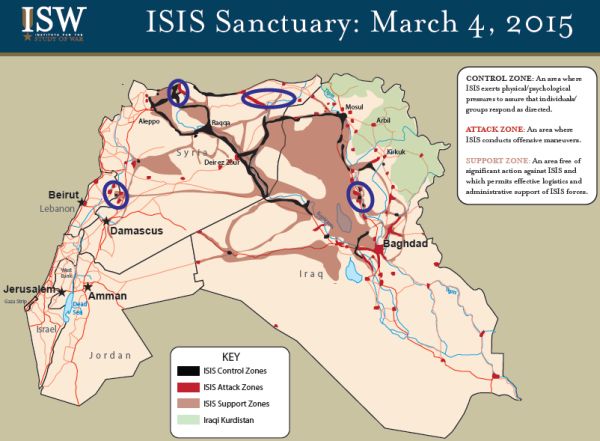
Click on image to view full-size map and ISW report (PDF).




Click on image to view full-size map and ISW report (PDF).
The New York Times reports: At a time when President Obama is under political pressure from congressional Republicans over negotiations to rein in Tehran’s nuclear ambitions, a startling paradox has emerged: Mr. Obama is becoming increasingly dependent on Iranian fighters as he tries to contain the Islamic State militant group in Iraq and Syria without committing American ground troops.
In the four days since Iranian troops joined 30,000 Iraqi forces to try to wrest Saddam Hussein’s hometown of Tikrit back from Islamic State control, American officials have said the United States is not coordinating with Iran, one of its fiercest global foes, in the fight against a common enemy.
That may be technically true. But American war planners have been closely monitoring Iran’s parallel war against the Islamic State, also known as ISIS or ISIL, through a range of channels, including conversations on radio frequencies that each side knows the other is monitoring. And the two militaries frequently seek to avoid conflict in their activities by using Iraqi command centers as an intermediary.
As a result, many national security experts say, Iran’s involvement is helping the Iraqis hold the line against Islamic State advances until American military advisers are finished training Iraq’s underperforming armed forces.
“The only way in which the Obama administration can credibly stick with its strategy is by implicitly assuming that the Iranians will carry most of the weight and win the battles on the ground,” said Vali R. Nasr, a former special adviser to Mr. Obama who is now dean of the School of Advanced International Studies at Johns Hopkins University. “You can’t have your cake and eat it too — the U.S. strategy in Iraq has been successful so far largely because of Iran.” [Continue reading…]

McClatchy reports: The Islamic State might be the best-funded radical Islamist group, perhaps in history, but the coalition air campaign that’s targeting its oil-refining operations and military assets has begun to damage its ability to earn.
And by denying the group additional territorial expansion, the airstrikes have limited the opportunities for it to profit from capturing new infrastructure and banks, according to a recent report by a money-laundering watchdog group, as well as U.S. officials and residents of Islamic State territory.
The Islamic State, a self-styled modern caliphate that controls much of northern and western Iraq and eastern Syria, turned itself into perhaps the richest and best-equipped military non-state actor last June after seizing tremendous amounts of money and equipment from the Iraqi government as it swept through Mosul and to the western and northern outskirts of Baghdad while the Iraqi army collapsed.
The Islamic State is thought to have at least 30,000 combatants and 5 million to 6 million people under its control, leaving a huge economy to be taxed and extorted.
Thousands of armored vehicles and thousands of tons of military equipment, much of it modern weaponry supplied to Iraq by the United States, were seized in the rout last June, along with cash reserves from government banks, mostly in local currency, of at least $500 million, according to the Financial Action Task Force, an international money-laundering body that examined the group’s complex financial operations in a report released in late February.
That windfall came as the group was already making millions of dollars a day pumping and refining oil and petroleum products from previously captured oil fields, mostly in eastern Syria, where the group has wrested control of at least 50,000 barrels per day of oil and refined petroleum output, according to the task force’s report, a number widely supported by reports from the area.
Although the task force notes recent efforts by Turkish and Kurdish officials to limit the Islamic State’s ability to export these products by smuggling, not all the exporting has been stopped. Even the group’s rudimentary oil-refining ability — a process commonly targeted by coalition airstrikes — while damaged, is probably sufficient to at least support the group’s huge military operation and provide some income stream. [Continue reading…]
The Los Angeles Times reports: In one image he calmly rubs elbows with Iran’s top leaders. In another, he bestows an avuncular gaze on a gaggle of militia fighters.
No matter where he appears, Gen. Qassem Suleimani, commander of Iran’s elite Quds force, remains the stuff of U.S. policymakers’ nightmares: a murky yet seemingly ubiquitous figure with a penchant for turning up in Middle Eastern trouble spots and proxy wars — often at several battlegrounds simultaneously, it would seem, judging by his outsized and at times fictitious presence on the Web and in breathless international press reports.
“Supermani” is the handle one wag has bestowed upon Tehran’s inscrutable point man.
His mission? Thwarting the goals of Washington and its allies at every turn, while adding to the revolutionary glory of the Islamic Republic of Iran.
The actual effectiveness of Tehran’s fabled emissary may be open to question. But in cyberspace, Suleimani — with a graying beard, steady mien and passing resemblance to “The Most Interesting Man in the World” of Dos Equis fame — has emerged as a kind of Iranian master manipulator, schemer and super-spy. His presence on any battlefield, according the ever-expanding if often apocryphal legend, is tantamount to victory for fighters fortunate to bask in his presence. [Continue reading…]
The Associated Press: Iran said Thursday that a team of special operatives has freed an Iranian diplomat abducted more than 19 months ago in Yemen, a rare acknowledgement by Tehran of an intel operation carried out on foreign soil.
The official IRNA news agency quoted deputy Foreign Minister Hossein Amirabdolahian as saying that intelligence officers undertook a “difficult and complicated operation” to secure Nour Ahmad Nikbakhat’s freedom from the “hands of terrorists.”
Amirabdollahian added that the operation took place “in a very special area in Yemen,” without elaborating or providing further details.
Aron Lund writes: In a recent report for Open Democracy, Dutch journalists Robert Dulmers and Teun Voeten tell of a recent trip through the parts of Syria still held by President Bashar al-Assad’s forces. Embedded with the Syrian military, they traveled by car from the capital Damascus via the reconquered city of Homs to Aleppo in the north, and back.
These cities, the country’s three largest, are at the core of Syria in every way: politically, culturally, economically, and, of course, demographically. Assad’s dominance over the Damascus-Homs-Aleppo axis, in addition to the coastal areas, Hama City, large parts of the south, and even a few small pockets in the northeast (Qamishli, Hasakah, and Deir ez-Zor), underscores that he remains the central actor of this war. He is the ruler of not exactly Syria, but of “useful Syria,” a potentially economically viable region encompassing at least two-thirds of the country’s population.
But what about the state of the regime itself? The most interesting part of Dulmers and Voeten’s account is their brief insider view of the pro-Assad forces. “In 12 days travelling some 1,200 km, except for special forces in Aleppo we hardly saw anything of the regular army,” they write, noting that most of the many checkpoints and bases along the road were manned by locally recruited militias.
The slow “militiafication” of Assad’s Syrian state has been going on since the start of the conflict in 2011, when so-called Popular Committees spawned spontaneously or were recruited by intelligence services and pro-Assad businessmen all over Syria, mirroring the mobilization of anti-government demonstrators. The opposition (and much of the international media, which at the time listened to no one else) called these militias “shabiha,” a vague term meaning approximately pro-Assad thugs, and dismissed them as a few thousand paid gangsters or members of the Alawite sect, the minority group to which Assad also belongs. But this was an underestimation of the Assad regime’s social roots. The “shabiha” phenomenon was no mere Alawite militia, but representative of a genuine popular mobilization of a significant minority of Syria’s population in favor of the regime, partly — but by no means exclusively — on a sectarian basis. [Continue reading…]
Deutsche Welle reports: It was a surprising confession. In an interview with the opposition Russian newspaper, Nowaja Gaseta, (from Monday, March 2) a wounded Russian tank operator confirmed what many have long assumed: That contracted Russian soldiers are fighting alongside the separatists in Eastern Ukraine against the Ukrainian army.
And not just a few soldiers. A day after the interview was published, US General Ben Hodges said in Berlin that the US military was working on the assumption of 12,000 Russian troops in the region.
It’s not the first time such reports have surfaced. On Feb. 19, the Russian newspaper Kommersant published a surprisingly frank feature about the deployment of Russian soldiers in Eastern Ukraine. The article appeared in the online version of the paper, which belongs to oligarch Alisher Usmanov, known to be loyal to the Kremlin. Reporter Ilja Barabanov recounts how he met three Russians who had until recently been professional soldiers. In the second half of January, they went to Eastern Ukraine to fight.
The men said they had fought since Jan. 20 on the front in various units of the separatist army of the “People’s Republic of Donetsk.” Before they left, they applied to end their army contracts and be officially discharged.
Whether or not they were actually discharged, and what their current status is, is unknown. [Continue reading…]
ASU News: The earliest evidence of our human genus – Homo – was found in Ethiopia by a team of Arizona State University scientists and students during field research in 2013.
The fossil, the left side of a lower jaw with five teeth, has been dated to 2.8 million years ago, which predates the previously known fossils of the Homo lineage by approximately 400,000 years.
The discovery is being published for the first time in the March 4 online version of the journal Science.
For decades, scientists who study the origins of modern-day humans have been searching for fossils documenting the earliest phases of the Homo lineage.
Researchers have found fossils that are 3 million years old and older. The most famous example of those human ancestors is the skeleton of Lucy, found in northeastern Africa in 1974 by ASU researcher Donald Johanson. Lucy and her relatives, though they walked on two feet, were smaller-brained and more apelike than later members of the human family tree.
Scientists have also found fossils that are 2.3 million years old and younger. These ancestors are in the genus Homo and are closer to modern day humans.
But very little had been found in between – that 700,000-year gap had turned up few fossils with which to determine the evolution from Lucy to the genus Homo. Because of that gap, there has been little agreement on the time of origin of the Homo lineage.
With this find, that mysterious time period has gotten a little clearer. [Continue reading…]
The Los Angeles Times adds: The significance of this discovery, according to some researchers, is that it firmly fixes the origins of Homo in East Africa and fits the hypothesis that climate change drove key developments in a variety of mammals, including our early forebears.
When Lucy roamed Ethiopia roughly 3.2 million years ago, the region enjoyed long rainy seasons that supported the growth of many trees and a wide variety of vegetation, according to researchers.
By the time of Homo’s first established appearance in the Horn of Africa, however, things had become much drier and the landscape had transformed into a vast, treeless expanse of grasslands with a few rivers and lakes — a scene very similar to today’s Serengeti plains or Kalahari.
It was an unforgiving climate when it came to survival.
But the hallmark of the genus that includes Homo sapiens is resourcefulness. Larger brains, the ability to fashion stone tools, and teeth suited to chewing a variety of foods would have given our early ancestors the flexibility to live in an inflexible environment, researchers say. [Continue reading…]
Jonathan Berger writes: One evening, some 40 years ago, I got lost in time. I was at a performance of Schubert’s String Quintet in C major. During the second movement I had the unnerving feeling that time was literally grinding to a halt. The sensation was powerful, visceral, overwhelming. It was a life-changing moment, or, as it felt at the time, a life-changing eon.
It has been my goal ever since to compose music that usurps the perceived flow of time and commandeers the sense of how time passes. Although I’ve learned to manipulate subjective time, I still stand in awe of Schubert’s unparalleled power. Nearly two centuries ago, the composer anticipated the neurological underpinnings of time perception that science has underscored in the past few decades.
The human brain, we have learned, adjusts and recalibrates temporal perception. Our ability to encode and decode sequential information, to integrate and segregate simultaneous signals, is fundamental to human survival. It allows us to find our place in, and navigate, our physical world. But music also demonstrates that time perception is inherently subjective — and an integral part of our lives. “For the time element in music is single,” wrote Thomas Mann in his novel, The Magic Mountain. “Into a section of mortal time music pours itself, thereby inexpressibly enhancing and ennobling what it fills.” [Continue reading…]
William Dalrymple writes: One of the very first Indian words to enter the English language was the Hindustani slang for plunder: “loot”. According to the Oxford English Dictionary, this word was rarely heard outside the plains of north India until the late 18th century, when it suddenly became a common term across Britain. To understand how and why it took root and flourished in so distant a landscape, one need only visit Powis Castle.
The last hereditary Welsh prince, Owain Gruffydd ap Gwenwynwyn, built Powis castle as a craggy fort in the 13th century; the estate was his reward for abandoning Wales to the rule of the English monarchy. But its most spectacular treasures date from a much later period of English conquest and appropriation: Powis is simply awash with loot from India, room after room of imperial plunder, extracted by the East India Company in the 18th century.
There are more Mughal artefacts stacked in this private house in the Welsh countryside than are on display at any one place in India – even the National Museum in Delhi. The riches include hookahs of burnished gold inlaid with empurpled ebony; superbly inscribed spinels and jewelled daggers; gleaming rubies the colour of pigeon’s blood and scatterings of lizard-green emeralds. There are talwars set with yellow topaz, ornaments of jade and ivory; silken hangings, statues of Hindu gods and coats of elephant armour.
Such is the dazzle of these treasures that, as a visitor last summer, I nearly missed the huge framed canvas that explains how they came to be here. The picture hangs in the shadows at the top of a dark, oak-panelled staircase. It is not a masterpiece, but it does repay close study. An effete Indian prince, wearing cloth of gold, sits high on his throne under a silken canopy. On his left stand scimitar and spear carrying officers from his own army; to his right, a group of powdered and periwigged Georgian gentlemen. The prince is eagerly thrusting a scroll into the hands of a statesmanlike, slightly overweight Englishman in a red frock coat.
The painting shows a scene from August 1765, when the young Mughal emperor Shah Alam, exiled from Delhi and defeated by East India Company troops, was forced into what we would now call an act of involuntary privatisation. The scroll is an order to dismiss his own Mughal revenue officials in Bengal, Bihar and Orissa, and replace them with a set of English traders appointed by Robert Clive – the new governor of Bengal – and the directors of the EIC, who the document describes as “the high and mighty, the noblest of exalted nobles, the chief of illustrious warriors, our faithful servants and sincere well-wishers, worthy of our royal favours, the English Company”. The collecting of Mughal taxes was henceforth subcontracted to a powerful multinational corporation – whose revenue-collecting operations were protected by its own private army.
It was at this moment that the East India Company (EIC) ceased to be a conventional corporation, trading and silks and spices, and became something much more unusual. Within a few years, 250 company clerks backed by the military force of 20,000 locally recruited Indian soldiers had become the effective rulers of Bengal. An international corporation was transforming itself into an aggressive colonial power. [Continue reading…]
John Gray writes: Considering the alternatives that are on offer, liberal societies are well worth defending. But there is no reason for thinking these societies are the beginning of a species-wide secular civilisation of the kind of which evangelical atheists dream.
In ancient Greece and Rome, religion was not separate from the rest of human activity. Christianity was less tolerant than these pagan societies, but without it the secular societies of modern times would hardly have been possible. By adopting the distinction between what is owed to Caesar and what to God, Paul and Augustine – who turned the teaching of Jesus into a universal creed – opened the way for societies in which religion was no longer coextensive with life. Secular regimes come in many shapes, some liberal, others tyrannical. Some aim for a separation of church and state as in the US and France, while others – such as the Ataturkist regime that until recently ruled in Turkey – assert state control over religion. Whatever its form, a secular state is no guarantee of a secular culture. Britain has an established church, but despite that fact – or more likely because of it – religion has a smaller role in politics than in America and is less publicly divisive than it is in France.
There is no sign anywhere of religion fading away, but by no means all atheists have thought the disappearance of religion possible or desirable. Some of the most prominent – including the early 19th-century poet and philosopher Giacomo Leopardi, the philosopher Arthur Schopenhauer, the Austro-Hungarian philosopher and novelist Fritz Mauthner (who published a four-volume history of atheism in the early 1920s) and Sigmund Freud, to name a few – were all atheists who accepted the human value of religion. One thing these atheists had in common was a refreshing indifference to questions of belief. Mauthner – who is remembered today chiefly because of a dismissive one-line mention in Wittgenstein’s Tractatus – suggested that belief and unbelief were both expressions of a superstitious faith in language. For him, “humanity” was an apparition which melts away along with the departing Deity. Atheism was an experiment in living without taking human concepts as realities. Intriguingly, Mauthner saw parallels between this radical atheism and the tradition of negative theology in which nothing can be affirmed of God, and described the heretical medieval Christian mystic Meister Eckhart as being an atheist in this sense.
Above all, these unevangelical atheists accepted that religion is definitively human. Though not all human beings may attach great importance to them, every society contains practices that are recognisably religious. Why should religion be universal in this way? For atheist missionaries this is a decidedly awkward question. Invariably they claim to be followers of Darwin. Yet they never ask what evolutionary function this species-wide phenomenon serves. There is an irresolvable contradiction between viewing religion naturalistically – as a human adaptation to living in the world – and condemning it as a tissue of error and illusion. What if the upshot of scientific inquiry is that a need for illusion is built into in the human mind? If religions are natural for humans and give value to their lives, why spend your life trying to persuade others to give them up?
The answer that will be given is that religion is implicated in many human evils. Of course this is true. Among other things, Christianity brought with it a type of sexual repression unknown in pagan times. Other religions have their own distinctive flaws. But the fault is not with religion, any more than science is to blame for the proliferation of weapons of mass destruction or medicine and psychology for the refinement of techniques of torture. The fault is in the intractable human animal. Like religion at its worst, contemporary atheism feeds the fantasy that human life can be remade by a conversion experience – in this case, conversion to unbelief. [Continue reading…]
Conversion can be thought of as an example of the miracle of neuroplasticity: that beliefs, firmly held, can in the right circumstances, suddenly be upturned such that the world thereafter is perceived in a radically different way.
That transition is usually described in terms of a bridge that leads from weak faith, no faith, or false faith, to conviction, but as Gray points out, that bridge could also be imagined to be traversable in the opposite direction.
The mistake that all evangelicals make (be they religious evangelicals or new atheists) is to imagine that they have the right and ability to march others across this bridge.
Real conversion, by its nature, cannot be coercive, since it entails some kind of discovery and no one discovers anything under pressure from others.
In a world that remains predominantly religious, the new atheists have ostensibly embarked on a mission of staggering proportions in their effort to purge humanity of its unreasonable superstitions.
This could be viewed as a heroically ambitious undertaking, but there seem to be plenty of reasons not to see it that way.
If the new atheists genuinely hope to persuade religious believers to see the error of their ways, how can they make any progress if they start out by viewing their prospective converts with contempt?
When was it ever the first step in a genuine process of persuasion, to start with the assumption that the person you are addressing is a fool?
As much as the new atheists may appear to be possessed by evangelical fervor, they’re appetite to condemn religion sometimes mirrors the religious fanaticism that condemns apostates.
“Some propositions are so dangerous that it may even be ethical to kill people for believing them,” writes Sam Harris in apparent agreement with the leaders of ISIS. Their only disagreement is over which propositions warrant a death sentence.
Still, much as the new atheists are often guilty of evangelical errors, I seriously doubt that their mission truly is to mount a challenge against the reign of religion.
On the contrary, I think their mission seems to have less to do with changing the world than it has with preaching to the converted. It’s about selling books, going on speaking tours, appearing on TV, amassing followers on Twitter, and doing everything else it takes to carve out a profitable cultural niche.
Who would have thought that it’s possible to pursue a career as a professional atheist? Sam Harris has, and I’m sure he has been rewarded handsomely and his success will continue, irrespective of the fate of religion.
RFE/RL reports: The U.S. military estimates some 12,000 Russian soldiers are supporting pro-Moscow separatists in eastern Ukraine.
U.S. Army Europe Commander Ben Hodges said the Russian forces are made up of military advisers, weapons operators and combat troops.
Hodges also said some 29,000 Russian troops are in Crimea, which Moscow annexed from Ukraine last year.
Hodges said in Berlin on March 3 that helping Ukraine with weapons would increase the stakes for Russian President Vladimir Putin at home.
He added that “when mothers start seeing sons come home dead, when that price goes up, then that domestic support begins to shrink.”
Hodges said what Ukraine wants “is intelligence, counterfire capability and something that can stop a Russian tank.”
The White House still hasn’t decided whether to send arms to Ukraine, and Hodges reiterated Washington wanted a diplomatic solution. [Continue reading…]
Alexey Navalny, the opposition leader and anti-corruption blogger, writes (translation by Catherine A. Fitzpatrick): 1. I believe that Nemtsov was killed by members of a government (intelligence) or pro-government organization on orders from the political leadership of the country (including Vladimir Putin).
It is a question only of how this order was formulated:
– You must kill Nemtsov.
– You must do a hugely sensational action.2. That’s enough repeating the nonsense about how “Boris was killed by an atmosphere of hatred.” What atmosphere, exactly, eh? We’ve had the atmosphere of hatred since 2007, and in recent months, we have seen the organized construction of pro-government extremist-terrorist groups, directly declaring as their goal combating the opposition where the police cannot. [Continue reading…]
Reuters reports: Leaders of Syria’s Nusra Front are considering cutting their links with al Qaeda to form a new entity backed by some Gulf states trying to topple President Bashar al-Assad, sources said.
Sources within and close to Nusra said that Qatar, which enjoys good relations with the group, is encouraging the group to go ahead with the move, which would give Nusra a boost in funding.
The exercise could transform Nusra from a weakened militia group into a force capable of taking on Islamic State at a time when it is under pressure from bombing raids and advances by Kurdish and Iraqi military forces.
It could also boost the influence of Qatar and its allies in the campaign to oust Assad, in line with the Gulf state’s growing diplomatic ambitions in the region. [Continue reading…]
Aimen Dean is a founder member of al-Qaeda, who changed tack in 1998 and became a spy for Britain’s security and intelligence services, MI5 and MI6. He spoke to the BBC: By the end of the Bosnian conflict I started to notice something else within my comrades. Those who survived started to adopt a rather more anti-Western, anti-globalisation feeling that the global community were conspiring against the Muslims in Bosnia because they were turning the tide of the war in their favour – so they wanted to end the war there and then before they score any more victories.
At least that’s the perception. And with that perception, I think they started to feel that the West is fighting Islam as a religion… and that led to further radicalisation that made it easy for them to make the transformation from being mujahideen into being jihad operatives.
Bosnia was a school in which many talented leaders of al-Qaeda were born. Khalid Sheikh Mohamed [accused of being the architect of the 9/11 attacks] was one of those people who were in Bosnia.
The impression I had at that time, was that he was there in Bosnia in order to spot talent, let’s put it this way, in order to you know scout for talents who will be useful for the later struggle.
I remember that one of the things he said, and it was in a wedding where we were seated next to each other basically, and one of the things he said, he said, “Well, the Bosnian war seems to be ending here, that you know the end is in sight but what will happen after the war? The question is are we going to roam the globe from one hopeless battle to another trying to save a Muslim population until someone else, and then someone else come and reap the reward?”
In other words, there will be a government that is secular and doesn’t rule by the rules of Sharia. He says that this cycle need to end and that we have to think about another front where we can serve Islam and basically resurrect the spirit of jihad within the Muslim world. I think that little speech was the first indication that things are moving from jihad being an instrument to defend Muslim populations on the frontiers to an instrument to bring down regimes and to fight a terror war… against the US interests in the region. [Continue reading…]
Christian Davenport writes: The closest it’s come to a public debut was a prime-time tease during a Super Bowl ad that showed its svelte outline veiled beneath a sheet, but revealed not a glimpse of the Pentagon’s most mysterious plane.
Highly classified, the program is one of the Air Force’s top priorities — and its most expensive. The service estimates it will cost $55 billion to build as many as 100 of what it calls the Long Range Strike Bomber, which is designed to fly deep into enemy territory undetected until the mushroom cloud begins to bloom.
In the coming months, the Air Force is expected to award a contract for the next-generation bomber, which would begin flying in the mid-2020s, have the potential to fly manned or unmanned and give the military the ability to hit any target “at any point on the globe.”
But that’s about all the Air Force will say about the program, which has been cloaked in a veil of secrecy rivaling the jet’s stealthy ability to creep past enemy lines. [Continue reading…]
Former CIA director General David Petraeus is getting a slap on the wrists for leaking classified information to his biographer and then lying about it to the FBI. Eli Lake notes the double standards that operate in Washington when it comes to its treatment of leakers.
If the decision of which leakers to investigate and charge seems arbitrary, then the punishments they receive are even more so. While Petraeus is unlikely to spend time behind bars, John Kiriakou, a former CIA employee who pleaded guilty to disclosing the identity of an undercover officer, was sentenced to 30 months in federal prison — even though the employee’s identity was never made public. Stephen Kim, a federal contractor, went to prison for a year after leaking secrets about North Korea to a Fox News reporter. Jeffrey Sterling, a former CIA officer, is facing a longer prison term for leaking secrets to a New York Times reporter.
Steve Aftergood, director of the project on government secrecy of the Federation of American Scientists, noted the disparity: “Petraeus is getting off much more easily than people who committed similar offenses. In the Kiriakou case, as in the Petraeus case, the identity of an undercover officer was disclosed without becoming public. But the outcomes of the two cases are radically different. Either they should both go to jail or they should pay a fine.”
Representative Adam Schiff, the ranking Democrat on the House Permanent Select Committee on Intelligence, praised Petraeus’s service. He also told me, “I am reminded every day of the critical importance of safeguarding classified information and all individuals — no matter how senior — must be held to account when they fail in this duty.”
But classified information hasn’t been safe in Washington for some time now. The Petraeus affair is in this sense a small scandal. The much larger one is that some leakers are punished mildly, others are punished harshly and most are not punished at all.