The New York Times reports: A year after the ouster of President Hosni Mubarak, the man responsible for rooting out government corruption, Gen. Mohamed Farid el-Tohamy, faced a very public barrage of allegations that he had deliberately covered up years of cronyism and self-dealing.
President Mohamed Morsi promptly fired the general, prosecutors opened an investigation, the news filled the papers and his career appeared to end in disgrace.
But now the general is back, and more powerful than ever. His protégé and friend, Gen. Abdul-Fattah el-Sisi, ousted Mr. Morsi about four months ago, and virtually the first move by the new government was to rehabilitate General Tohamy and place him in charge of the general intelligence service, one of the most powerful positions in Egypt.
Western diplomats and Egyptians close to the government say General Tohamy has emerged as the leading advocate of the lethal crackdown on Mr. Morsi’s Islamist supporters in the Muslim Brotherhood, in a drive to eviscerate the movement.
Any public trace of the corruption charges — leveled by one of the general’s own investigators — has disappeared.
“What happened to the prosecutors’ claim of evidence of his corruption and obstruction of justice?” asked Hossam Bahgat, one of the few Egyptian human rights advocates willing to publicly criticize General Tohamy. “Why was he ousted in that humiliating fashion? Why was he brought back from retirement the morning after the military takeover?” he continued. “There is zero public discussion of these very serious questions.” [Continue reading…]
High-ranking Muslim Brotherhood leader seized in Egypt
The New York Times reports: Egyptian security forces on Wednesday captured Essam el-Erian, one of the last few prominent leaders of the Muslim Brotherhood still at large after a crackdown on the group that began with the ouster of President Mohamed Morsi, its ally.
The seizure of Mr. Erian, a senior leader in the Brotherhood’s political arm and an adviser to the president, appears to complete the incarceration of the organization’s top leaders less than 18 months after they stood on the brink of consolidating power over the presidency and Parliament. He was among the most visible and outspoken leaders of the Brotherhood, Egypt’s mainstream Islamist movement, and his arrest caps a career that has traced the group’s evolution through years of repression, internal reforms, electoral victories and political failure.
The charges against Mr. Erian were not immediately clear, although many of his fellow Brotherhood leaders have been arrested on allegations of incitement to violence. [Continue reading…]
Sheldon Adelson’s proposal for a nuclear strike on Iran
Billionaire casino boss and supporter of Israel, Sheldon Adelson, speaking in New York City on October 22, 2013. Video by Philip Weiss.
Syria fires official who tried to broker peace
The New York Times reports: The Syrian government on Tuesday fired a deputy prime minister who has lately been its most outspoken voice in favor of reform and who recently held meetings with American and Russian officials about peace talks that world leaders are trying to arrange to end Syria’s civil war.
The official, Qadri Jamil, was dismissed for spending too much time outside Syria, neglecting his duties and holding meetings “without coordinating with the government,” state television said. Mr. Jamil was fired shortly after he told the Russian news media that he had met with United States officials. Meetings between Syrian and American officials have been rare since the Syrian uprising began in 2011.
A State Department spokeswoman confirmed on Tuesday that the United States ambassador to Syria, Robert S. Ford, met with Mr. Jamil on Saturday in Geneva, calling the encounter one in “a long list” of meetings with people directly or indirectly connected to the Syrian government to discuss the potential peace talks.
Mr. Jamil, a Soviet-educated economist, was one of two members of tolerated opposition parties appointed to the government last year in a move billed as broadening its base. In an interview last month in Damascus, the Syrian capital, he blamed corrupt people on both sides for prolonging the war, and he said that despite his post, he was part of the “patriotic opposition,” which has not supported the armed uprising.
Behind the scenes, American and Russian officials have been meeting with Syrians inside and outside government to set up the planned talks. But there is little sign of movement, with the main exile opposition group demanding the departure of President Bashar al-Assad as a precondition and Mr. Assad saying he will not talk with those bearing arms against him. [Continue reading…]
Meanwhile, Reuters reports: International powers are unlikely to meet their goal of convening peace talks on Syria in Geneva next month as differences emerge between Washington and Moscow over opposition representation, Arab and Western officials said.
Failure of the main Syrian National Coalition to take a clear stance over the talks, which aim to find a political solution to Syria’s 2-1/2 year civil war, are also expected to contribute to a delay of up to one month, the officials told Reuters.
“A clearer picture will emerge when the United States and Russia meet next week, but all indications show that the November 23 goal will be difficult to meet,” said one of the officials involved in preparing for the talks.
U.S., Russian and U.N envoys are due to meet in Geneva next Tuesday as part of the preparation for the long-delayed peace conference, which was first proposed back in May.
A main point of contention, the official said, is the role of the Western-backed opposition coalition – an issue which has flared up since a meeting in London last week of Western and Gulf Arab countries opposed to Assad.
Music: Salif Keita — ‘Madan’
Spying known at top levels of admininistration, intelligence officials say
The New York Times reports: The nation’s top spymaster said on Tuesday that the White House had long been aware in general terms of the National Security Agency’s overseas eavesdropping, stoutly defending the agency’s intelligence-gathering methods and suggesting possible divisions within the Obama administration.
The official, James R. Clapper Jr., the director of national intelligence, testified before the House Intelligence Committee that the N.S.A. had kept senior officials in the National Security Council informed of surveillance it was conducting in foreign countries. He did not specifically say whether President Obama was told of these spying efforts, but he appeared to challenge assertions in recent days that the White House had been in the dark about some of the agency’s practices.
Mr. Clapper and the agency’s director, Gen. Keith B. Alexander, vigorously rejected suggestions that the agency was a rogue institution, trawling for information on ordinary citizens and leaders of America’s closest allies, without the knowledge of its Washington overseers.
Their testimony came amid mounting questions about how the N.S.A. collects information overseas, with Republicans and Democrats calling for a congressional review, lawmakers introducing a bill that would curb its activities and Mr. Obama poised to impose his own constraints, particularly on monitoring the leaders of friendly nations. At the same time, current and former American intelligence officials say there is a growing sense of anger with the White House for what they see as attempts by the administration to pin the blame for the controversy squarely on them.
General Alexander said news media reports that the N.S.A. had vacuumed up tens of millions of telephone calls in France, Italy and Spain were “completely false.” That data, he said, is at least partly collected by the intelligence services of those countries and provided to the N.S.A.
Still, both he and Mr. Clapper said that spying on foreign leaders — even those of allies — was a basic tenet of intelligence tradecraft and had gone on for decades. European countries, Mr. Clapper said, routinely seek to listen in on the conversations of American leaders. [Continue reading…]
Obama orders curbs on NSA spying on UN headquarters
Reuters reports: President Barack Obama recently ordered the National Security Agency to curtail eavesdropping on the United Nations headquarters in New York as part of a review of U.S. electronic surveillance, according to a U.S. official familiar with the decision.
Obama’s order is the latest known move by the White House to limit the NSA’s vast intelligence collection, in the wake of protests by allies, including German Chancellor Angela Merkel, over U.S. spying on foreign heads of state.
The full extent of U.S. eavesdropping on the United Nations is not publicly known, nor is it clear whether the United States has stopped all monitoring of diplomats assigned to the U.N. in New York or elsewhere around the world.
“The United States is not conducting electronic surveillance targeting the United Nations headquarters in New York,” said a senior Obama administration official, who spoke on condition of anonymity.
The official did not address past surveillance of the world body. Such programs are highly classified, although some details have been leaked by former NSA contractor Edward Snowden. [Continue reading…]
How science is calling for a global revolution
Naomi Klein writes: In December 2012, a pink-haired complex systems researcher named Brad Werner made his way through the throng of 24,000 earth and space scientists at the Fall Meeting of the American Geophysical Union, held annually in San Francisco. This year’s conference had some big-name participants, from Ed Stone of Nasa’s Voyager project, explaining a new milestone on the path to interstellar space, to the film-maker James Cameron, discussing his adventures in deep-sea submersibles.
But it was Werner’s own session that was attracting much of the buzz. It was titled “Is Earth F**ked?” (full title: “Is Earth F**ked? Dynamical Futility of Global Environmental Management and Possibilities for Sustainability via Direct Action Activism”).
Standing at the front of the conference room, the geophysicist from the University of California, San Diego walked the crowd through the advanced computer model he was using to answer that question. He talked about system boundaries, perturbations, dissipation, attractors, bifurcations and a whole bunch of other stuff largely incomprehensible to those of us uninitiated in complex systems theory. But the bottom line was clear enough: global capitalism has made the depletion of resources so rapid, convenient and barrier-free that “earth-human systems” are becoming dangerously unstable in response. When pressed by a journalist for a clear answer on the “are we f**ked” question, Werner set the jargon aside and replied, “More or less.”
There was one dynamic in the model, however, that offered some hope. Werner termed it “resistance” – movements of “people or groups of people” who “adopt a certain set of dynamics that does not fit within the capitalist culture”. According to the abstract for his presentation, this includes “environmental direct action, resistance taken from outside the dominant culture, as in protests, blockades and sabotage by indigenous peoples, workers, anarchists and other activist groups”. [Continue reading…]
Intelligence officials confirm Obama misled Merkel

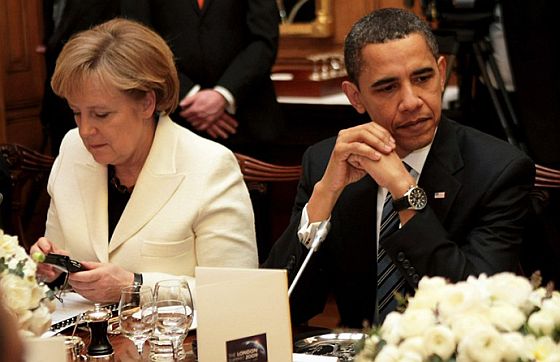
Obama pretending he can't see Merkel texting.
The Los Angeles Times reports: The White House and State Department signed off on surveillance targeting phone conversations of friendly foreign leaders, current and former U.S. intelligence officials said Monday, pushing back against assertions that President Obama and his aides were unaware of the high-level eavesdropping.
Professional staff members at the National Security Agency and other U.S. intelligence agencies are angry, these officials say, believing the president has cast them adrift as he tries to distance himself from the disclosures by former NSA contractor Edward Snowden that have strained ties with close allies.
The resistance emerged as the White House said it would curtail foreign intelligence collection in some cases and two senior U.S. senators called for investigations of the practice.
Precisely how the surveillance is conducted is unclear. But if a foreign leader is targeted for eavesdropping, the relevant U.S. ambassador and the National Security Council staffer at the White House who deals with the country are given regular reports, said two former senior intelligence officials, who spoke on condition of anonymity in discussing classified information.
Obama may not have been specifically briefed on NSA operations targeting a foreign leader’s cellphone or email communications, one of the officials said. “But certainly the National Security Council and senior people across the intelligence community knew exactly what was going on, and to suggest otherwise is ridiculous.”
If U.S. spying on key foreign leaders was news to the White House, current and former officials said, then White House officials have not been reading their briefing books.
Some U.S. intelligence officials said they were being blamed by the White House for conducting surveillance that was authorized under the law and utilized at the White House.
“People are furious,” said a senior intelligence official who would not be identified discussing classified information. “This is officially the White House cutting off the intelligence community.”
Any decision to spy on friendly foreign leaders is made with input from the State Department, which considers the political risk, the official said. Any useful intelligence is then given to the president’s counter-terrorism advisor, Lisa Monaco, among other White House officials.
When Angela Merkel phoned Barack Obama to tell him she didn’t appreciate being spied on by the NSA, it’s not as though Obama got blind-sided by the call. “You have a call on line one Mr President. It’s a woman with a German accent. She sounds pissed off.”
On the contrary, it’s reasonable to assume that Obama, in consultation with his staff, had time to craft a response, and if that response was not exactly crafted then it should at least have sounded halfway plausible.
Senior White House adviser: Just tell her you knew nothing about it but you promise it’ll never happen again.
Obama: But that’s going to sound like the lame excuse a 12-year-old would give in response to a reprimand from a school teacher.
Adviser: You got any better ideas?
The Most Powerful Man in the World: ….
What should he have said? How about:
I am aware of the reports you are referring to. I understand your concerns. I have ordered a comprehensive review of our surveillance policies and I am fully committed to taking whatever steps are necessary to restore trust between the United States and Germany. To that end, I’d like to invite you to send a team of your intelligence officials to meet their counterparts in Washington and in that context we will be able to address more specific issues and hopefully arrive at a common understanding.
You remain dear to my heart, Angela.
Well, maybe not the last bit.

A president who claims not to know much
Dana Milbank writes: The Associated Press’s Josh Lederman led off Monday’s White House briefing with an obvious question: “Was the president kept out of the loop about what the NSA was doing?”
“I am not going to get into details of internal discussions,” press secretary Jay Carney replied, repeating previous promises that “we do not and will not monitor the chancellor’s communications.” This formulation conspicuously omits the phrase “did not.”
CNN’s Jim Acosta cited the HealthCare.gov rollout and the IRS targeting, which Obama said he learned about through news reports. “Is there a concern,” Acosta asked, “that the president is being kept in the dark on some of these issues?”
Carney told Acosta he had “conflated a bunch of very disparate issues.”
“Republican critics,” Acosta said, “are making the case, though, that the president appears to be in the dark about some pretty significant stories that are swirling around this White House.”
“Well, Republican critics say a lot of things, Jim,” Carney replied icily.
That’s true. But in this case, the Republicans understated the number of issues on which the president has claimed to be in the dark. A compilation by the Republican National Committee titled “The Bystander President” cited the NSA spying on Merkel, the Obamacare rollout and an investigation of the IRS’s targeting of political groups (the White House counsel knew of the inquiry but said she didn’t inform Obama). The RNC also mentioned the failure of clean-energy company Solyndra, which had received government funding (Carney had said Obama read about it in “news accounts”), and the attempts to go after reporters’ phone and e-mail records (which the president also found out about from reading the news, Carney said).
The RNC didn’t mention that Obama had allegedly known nothing about an FBI investigation of an affair involving David Petraeus that led him to resign as CIA director. Neither did it mention two other claims that conservatives often question: Obama’s ignorance of a guns-on-the-border sting operation called “Fast and Furious” that went awry, and his unawareness of requests for additional diplomatic security in Libya before a U.S. outpost in Benghazi was attacked.
There’s no reason Obama should have known about Fast and Furious or diplomatic security requests. But how could he not know his spies were bugging the German chancellor?
“Is it believable that the president would not know about surveillance of the head of state of a close American ally?” ABC News’s Jon Karl asked Carney. “Does that sound plausible to you?”
This finally provoked a hint from Carney that Obama did, in fact, know that the NSA was bugging Merkel. “The Wall Street Journal probably doesn’t appreciate the suggestion that their story is wrong,” he said, referring to a report that said Obama learned of the activity in the summer, “but I would say simply that we’re not going to comment on specific activities reported in the press,” he said.
Video — Glenn Greenwald: U.S. spying on allies shows ‘institutional obsession’ with surveillance
The case for NSA reform
Sen. Patrick Leahy and Rep. Jim Sensenbrenner write: In the days and weeks following Sept. 11, 2001, we were the primary authors of the USA PATRIOT Act — legislation that responded to those attacks by enhancing the government’s ability to gather information to prevent terrorism. Some checks and balances that were proposed then were included in the final bill; others were not. The PATRIOT Act has been much debated these past 12 years, and we have not always been on the same side of those debates. But whatever our differences may have been in the past, we strongly agree that the dragnet collection of millions of Americans’ phone records every day — whether they have any connection at all to terrorism — goes far beyond what Congress envisioned or intended to authorize. More important, we agree it must stop.
Over the past five months, we have seen a slow trickle of additional disclosures that have only added to our concerns. Since the revelation that the National Security Agency is collecting the details of Americans’ phone calls on an unprecedented scale, it has come out that the government searches the content of huge troves of emails, collects in bulk the address books from email accounts and social networking sites, at least temporarily collected geolocation data from our cellphones, committed thousands of privacy violations and made substantial misrepresentations to courts and Congress.
Not only do many of these programs raise serious legal questions, they have come at a high cost to Americans’ privacy rights, business interests and standing in the international community. It is time for a new approach.
On Tuesday we will introduce bicameral, bipartisan legislation that will put an end to the National Security Agency’s indiscriminate collection of personal information. Our proposal, the USA FREEDOM Act, provides stronger privacy safeguards with respect to a range of government surveillance programs. [Continue reading…]
Former NSA supporters join critics in calling for reform
MSNBC reports: Even as President Obama’s administration seeks to stem the growing global outrage over its eavesdropping, a movement to curb government snooping is gaining ground in Congress.
Six members of Congress who voted against the effort to defund the National Security Agency’s communications data collection program late last July will now be among the co-sponsors of surveillance reform legislation meant to rein in the NSA. The proposal would outlaw the NSA’s bulk data collection program, make the secret Foreign Intelligence Surveillance court more transparent, and place new restrictions on the government’s handling of the data it collects.
According to a Republican House aide, Reps. Duncan Hunter of California, Lee Terry of Nebraska, and Darrell Issa of California, who chairs of the House government oversight committee, will be among those co-sponsoring the legislation. On the Democratic side, Rep. Sheila Jackson Lee of Texas, Rep. Hank Johnson of Georgia, and Mike Quigley of Illinois will co-sponsor. All six voted against an amendment in late July sponsored by two Michigan congressmen, Republican Justin Amash and Democrat John Conyers, that would have defunded the NSA’s bulk data collection program. Republicans Todd Rokita of Indiana and Howard Coble of North Carolina, who abstained from the Amash-Conyers vote, will also support the surveillance reform legislation.
The Amash-Conyers amendment was defeated by only 12 votes. [Continue reading…]
Max Blumenthal offers unfiltered view into Israel’s commitment to ethnic supremacy
Max Blumenthal talks about his new book, Goliath: Life and Loathing in Greater Israel:
Rania Khalek: Challenging the pro-Israel narrative, as your book does, isn’t the most lucrative career move for an American journalist. With that in mind, why did you write this book?
Max Blumenthal: I was following a really successful book called Republican Gomorrah that got me on MSNBC, Air America [and] NPR, and I had a big liberal Democrat-oriented audience who were eager for my analysis of the radical right. I could’ve leveraged that into another book deal about Republican racism, made loads of money and sold tons of books. But this isn’t why I’m in journalism. I don’t look at journalism as a career. I look at it both as a profession and a craft and also as a means for exposing injustice. I’ve been watching the increasing violence and racism of Israeli society for most of my adult life, especially in their treatment of Palestinians. Having been born in 1977, I came of age during the First Intifada and then watched during the Second Intifada as Israel destroyed the Jenin Refugee camp. And then the Second Lebanon invasion happened. Israel basically carpet-bombed southern Lebanon, turning one-quarter of the country into refugees. Then there was Operation Cast Lead, the three-week assault on the besieged Gaza Strip that left 1,400 dead. It was so hard to watch, and it occurred after Barack Obama had been elected, someone I was deeply skeptical of. During the slaughter, I went to midtown New York and filmed a few hundred Jewish-Americans celebrating the attack. They were dancing a hora line outside the Israeli consulate and offering very clearly genocidal statements about the need to eradicate the cancer in Gaza. I put this online as a video, and it went viral. Before long, I was contacted by all kinds of people from across the Middle East who are directly affected by the Israel-Palestine crisis, inviting me to come there to see the situation on the ground. I agreed, and I put a lot of my book advance into the first extended reporting trip there in May 2009. That’s what led to me getting the deal to write Goliath and to spending the last four to five years of my life writing about this situation. It definitely changed my life in a lot of ways that I never expected, and I don’t think I’ll ever be able to see things the same way again.
RK: Goliath came out October 1. What has the reception been like so far, compared with that for Republican Gomorrah?
MB: Pro-Israel partisans in the US typically get hysterical about books like this because the real Israel is really impossible for them to grapple with. It shatters the dream castle Israel that goes to the heart of their identity as tribalistic, secular American Jews. I really believe that they are determined to ignore this book for as long as they can. It may take me going on national TV with one of those foam giant fingers and twerking on Abe Foxman for them to pay attention.
The other more obvious and salient reason why I’m not getting the same mainstream attention I got with Republican Gomorrah is because people like Rachel Maddow and Terry Gross, who can really move books, are simply afraid of the Israel issue and what it can do to their careers and the kind of pushback they’ll get from pro-Israel partisans behind the scenes. What we’re seeing is cowardice at the top of a hollow media establishment that extends into public radio. I think if shows like “Fresh Air” were to host me about Goliath, the response would be massive and mostly positive because I’m presenting the facts on the ground. Even people who don’t agree with my conclusions about what should happen in Israel-Palestine are hungry for this kind of information. [Continue reading…]
NSA hinted Israel was behind cyberattack on French president
AFP reports: France believed the United States attempted to hack into its president’s communications network, a leaked US intelligence document published on Friday suggests.
US agents denied having anything to do with a May 2012 cyber attack on the Elysee Palace, the official residence of French presidents, and appeared to hint at the possible involvement of Mossad, Israel’s intelligence agency, a classified internal note from the US National Security Agency suggests.
Extracts from the document, the latest to emerge from the NSA via former contractor Edward Snowden, were published by Le Monde newspaper alongside an article jointly authored by Glenn Greenwald, the US journalist who has been principally responsible for a still-unravelling scandal over large-scale US snooping on individuals and political leaders all over the world.
The document is a briefing note prepared in April this year for NSA officials who were due to meet two senior figures from France’s external intelligence agency, the DGSE. The French agents had travelled to Washington to demand explanations over their discovery in May 2012 of attempts to compromise the Elysee’s communications systems.
The note says that the branch of the NSA which handles cyber attacks, Tailored Access Operations (TAO), had confirmed that it had not carried out the attack and says that most of its closest allies (Australia, Britain, Canada and New Zealand) had also denied involvement.
It goes on to note: “TAO intentionally did not ask either Mossad or (Israel’s cyber intelligence unit) ISNU whether they were involved as France is not an approved target for joint discussions.” [Continue reading…]
UN confirms polio outbreak in Syria
The New York Times reports: United Nations officials confirmed an outbreak of polio among children in Syria on Tuesday, lending urgency to plans for vaccination campaigns there and in nearby countries to try to halt the spread of the disease.
Tests confirmed polio in 10 out of 22 children in Deir al-Zour Province in northeastern Syria who became ill this month, Oliver Rosenbauer, a spokesman for the World Health Organization, said. Results of tests on the other 12 children are expected soon, he added.
“With population movements, it can travel to other areas, so the risk is high of spread across the region,” Mr. Rosenbauer said.
United Nations officials said last week they were launching a campaign to immunize 2.4 million children in Syria against polio and other diseases. With thousands of refugees fleeing daily from Syria’s civil war to neighboring countries, they are also intensifying immunization efforts in six countries, including Lebanon, Jordan, Iraq and Turkey, which have taken in more than two million Syrian refugees, as well as Egypt and Israel.
Most of the affected children in Syria are under two years old, Mr. Rosenbauer said, underscoring the impact of 31 months of conflict on Syria’s health infrastructure. The United Nations says half a million Syrian children have not been inoculated against polio in a country where, before the conflict, 95 percent of the country’s population was immunized.
Despite the difficulty of delivering vaccines in a country convulsed by war, the United Nations Children’s Fund said it had vaccinated about a million Syrian children this year, including 800,000 who were vaccinated against polio.
After confirming the presence of the disease, attention is turning to identifying the source, Mr. Rosenbauer said. Public health officials have speculated that a possible source may have been jihadists traveling to Syria from Pakistan which, with Afghanistan and Nigeria, are the only countries where the disease is still endemic. [Continue reading…]
Lebanon suffers under the strain of a refugee crisis now out of control
The Observer reports: As you come through the military checkpoints on the way into Wadi Khaled, local mobile phones bleep with an unsolicited text: “The Ministry of Tourism welcomes you to Syria.”
This part of northern Lebanon, which juts like a knucklebone into Syria, is so close to the war that the villagers can watch the rockets land and palls of smoke rising across the hillsides. Children have swarmed up on to the first floor of the shell of a half-built house and are pointing excitedly to where the outlying villages of Homs begin. “I can see our house,” shouts Satash, six.
His mother, Maro, 28, stands back with her eyes cast down. “The older girls come up here and spend hours and hours sitting and looking out at Syria. I cannot even look.”
Satash’s home is, in reality, long gone. He now lives in Lebanon, in what used to be a shed for slaughtering chickens, with his parents and grandparents, his three-year-old sister and six orphaned cousins. The cousins’ mother was killed by shelling that stopped the delivery of medicines to treat her sickness; their father died from shrapnel wounds.
After fleeing in the middle of the night when a shell landed in their yard, taking only the clothes they stood up in, the family walked south for seven hours before crossing into Lebanon. They wandered for several months looking for help and accommodation, and ended up in the village of Knaisse in Wadi Khaled, only three miles from their Syrian home.
The family live in a shed, the rent waived by a kindly Lebanese. They have one blanket between five people, and plastic bags stuffed along the flimsy roof to stop the rain coming in. The grandmother lies on a scrap of matting, suffering from afflictions for which there is no money to buy treatment.
Maro and family live on a small monthly cash handout from a UN agency. Like most of the 1.3 million Syrian refugees now in Lebanon, a country of just 4.2 million people, they are worried about the snow that will start falling on the hills of Wadi Khaled within weeks. This will be their second winter here. “The room becomes like a refrigerator in the winter, the water floods like a lake all around and the wind is so cold,” said Maro’s husband, Ahmad, who is clearly under strain. He shouts again and again: “The people who stayed are dead under the rubble!” [Continue reading…]
Obama may ban spying on heads of allied states — including Israel?
The New York Times reports: President Obama is poised to order the National Security Agency to stop eavesdropping on the leaders of American allies, administration and Congressional officials said Monday, responding to a deepening diplomatic crisis over reports that the agency had for years targeted the cellphone of Chancellor Angela Merkel of Germany.
The White House informed a leading Democratic lawmaker, Senator Dianne Feinstein of California, of its plans, which grew out of a broader internal review of intelligence-gathering methods, prompted by the leak of N.S.A. documents by a former contractor, Edward J. Snowden.
In a statement on Monday, Senator Feinstein, chairwoman of the Senate Intelligence Committee, said, “I do not believe the United States should be collecting phone calls or emails of friendly presidents and prime ministers.” Ms. Feinstein, who has been a stalwart defender of the administration’s surveillance policies, said her committee would begin a “major review of all intelligence collection programs.”
The White House said Monday evening that no final decision had been made on the monitoring of friendly foreign leaders. But the disclosure that it is moving to prohibit it marks a landmark shift for the N.S.A., which has had nearly unfettered powers to collect data on tens of millions of people around the world, from ordinary citizens to heads of state, including the leaders of Brazil and Mexico.
It is also likely to prompt a fierce debate on what constitutes an American ally. [Continue reading…]
The 2013 ‘black budget’ for the U.S. intelligence community, provided to the Washington Post by Edward Snowden and published at the end of August, states that although overall the budget was declining it was being increased in specific areas:
“[W]e are investing in target surveillance and offensive CI [counterintelligence] against key targets, such as China, Russia, Iran, Israel, Pakistan, and Cuba.”
Monitoring the communications of the leaders of Israel, a country that has repeatedly made explicit threats that it might trigger another major conflict in the Middle East, would appear to serve the interests of both the U.S. and most of its allies.
