
Daily Archives: December 22, 2007

FEATURE: Afghanistan is falling apart

Into the valley of death

By many measures, Afghanistan is falling apart. The Afghan opium crop has flourished in the past two years and now represents 93 percent of the world’s supply, with an estimated street value of $38 billion in 2006. That money helps bankroll an insurgency that is now operating virtually within sight of the capital, Kabul. Suicide bombings have risen eightfold in the past two years, including several devastating attacks in Kabul, and as of October, coalition casualties had surpassed those of any previous year. The situation has gotten so bad, in fact, that ethnic and political factions in the northern part of the country have started stockpiling arms in preparation for when the international community decides to pull out. Afghans—who have seen two foreign powers on their soil in 20 years—are well aware of the limits of empire. They are well aware that everything has an end point, and that in their country end points are bloodier than most.

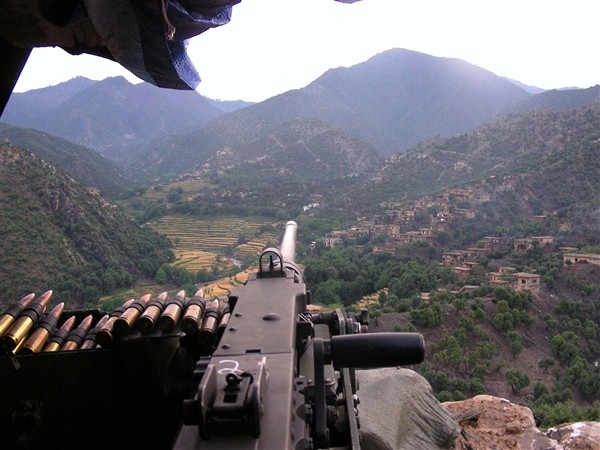
The Korengal is widely considered to be the most dangerous valley in northeastern Afghanistan, and Second Platoon is considered the tip of the spear for the American forces there. Nearly one-fifth of all combat in Afghanistan occurs in this valley, and nearly three-quarters of all the bombs dropped by nato forces in Afghanistan are dropped in the surrounding area. The fighting is on foot and it is deadly, and the zone of American control moves hilltop by hilltop, ridge by ridge, a hundred yards at a time. There is literally no safe place in the Korengal Valley. Men have been shot while asleep in their barracks tents.
korengal.jpg
[…]

The sun pries itself over the eastern ridges and half the platoon gets to work filling hescos while the other half mans the heavy weapons. The men work around the outpost in teams of three or four, one man hacking at the rock shelf with a pickax while another shovels the loose dirt into sandbags and a third drops the biggest chunks into an ammo can, then walks over to a half-full hesco, muscles the can over his head, and dumps the contents in.

“Prison labor is basically what I call it,” says a man I know only as Dave. Dave is a counter-insurgency specialist who spends his time at remote outposts, advising and trying to learn. He wears his hair longer than most soldiers, a blond tangle that after two weeks at Restrepo seems impressively styled with dirt. I ask him why the Korengal is so important.

“It’s important because of accessibility to Pakistan,” he says. “Ultimately, everything is going to Kabul. The Korengal is keeping the Pech River Valley safe, the Pech is keeping Kunar Province stable, and hence what we are hoping is all that takes the pressure off Kabul.”

While we are talking, some rounds come in, snapping over our heads and continuing on up the valley. They were aimed at a soldier who had exposed himself above a hesco. He drops back down, but otherwise, the men hardly seem to notice.

“The enemy doesn’t have to be good,” Dave adds. “They just have to be lucky from time to time.”

The Korengal is so desperately fought over because it is the first leg of a former mujahideen smuggling route that was used to bring in men and weapons from Pakistan during the 1980s. From the Korengal, the mujahideen were able to push west along the high ridges of the Hindu Kush to attack Soviet positions as far away as Kabul. It was called the Nuristan-Kunar corridor, and American military planners fear that al-Qaeda is trying to revive it. If the Americans simply seal off the valley and go around, Taliban and al-Qaeda fighters currently hiding near the Pakistani towns of Dir and Chitral could use the Korengal as a base of operations to strike deep into eastern Afghanistan. Osama bin Laden is rumored to be in the Chitral area, as are his second in command, Ayman Al-Zawahiri, and a clutch of other foreign fighters. While thousands of poorly trained Taliban recruits martyr themselves in southern Afghanistan, bin Laden’s most highly trained fighters ready themselves for the next war, which will happen in the East.

[…]

In my time in the Korengal, only one soldier told me that he joined the army because of September 11. The rest are here because they were curious or bored or because their fathers had been in the army or because the courts had given them the choice of combat or jail. No one I talked to seemed to have regretted the choice. “I joined the infantry to get out of people work and shit,” one soldier told me. “My main thing was partying. What was I going to do, keep partying and living with my mom?” [complete article]


Facebooktwittermail

NEWS: CIA obstructed 9/11 commission inquiry

9/11 panel study finds that CIA withheld tapes

A review of classified documents by former members of the Sept. 11 commission shows that the panel made repeated and detailed requests to the Central Intelligence Agency in 2003 and 2004 for documents and other information about the interrogation of operatives of Al Qaeda, and were told by a top C.I.A. official that the agency had “produced or made available for review” everything that had been requested.

The review was conducted earlier this month after the disclosure that in November 2005, the C.I.A. destroyed videotapes documenting the interrogations of two Qaeda operatives.

A seven-page memorandum prepared by Philip D. Zelikow, the panel’s former executive director, concluded that “further investigation is needed” to determine whether the C.I.A.’s withholding of the tapes from the commission violated federal law.

In interviews this week, the two chairmen of the commission, Lee H. Hamilton and Thomas H. Kean, said their reading of the report had convinced them that the agency had made a conscious decision to impede the Sept. 11 commission’s inquiry. [complete article]

No immediate ruling on judicial inquiry

A federal judge said Friday that he would not rule immediately on whether to hold a judicial inquiry into the destruction of C.I.A. videotapes that showed the harsh interrogation of two suspected operatives of Al Qaeda. [complete article]

CIA seeks investigation of ex-officer’s claims

The CIA has asked the Justice Department to investigate whether a former agency officer illegally disclosed classified information in describing the capture and waterboarding of an al-Qaeda terrorism suspect, officials said yesterday.

In interviews last week with The Washington Post and other news organizations, former CIA officer John Kiriakou discussed details of the capture of Zayn al-Abidin Muhammed Hussein alleging that he resisted cooperating with interrogators until he was subjected to waterboarding, which makes a captive believe he is being drowned.

Kiriakou, who participated in the capture of the man commonly known as Abu Zubaida in Pakistan in March 2002, said he did not see the waterboarding but was given details by others who were there. He said waterboarding was effective in Abu Zubaida’s case, though Kiriakou now regards the technique as torture.

Kiriakou’s attorney, Mark Zaid, a Washington lawyer whose clients include former CIA employees, said the CIA routinely refers such cases to the Justice Department, though only rarely do the referrals result in criminal charges.

“If they do pursue it, they will open a Pandora’s box that will put the spotlight on whether the interrogations were lawful, and the extent to which they have been fully revealed by federal officials,” Zaid said in an interview. [complete article]

Facebooktwittermail

NEWS & OPINION: Overcoming America’s fear of the world

The power of personality

I never thought I’d be in this position. There’s a debate taking place about what matters most when making judgments about foreign policy— experience and expertise on the one hand, or personal identity on the other. And I find myself coming down on the side of identity.

Throughout the campaign, Barack Obama and Hillary Clinton have been squabbling over who has the better qualifications to lead the world’s only superpower.

Hillary’s case is obvious and perfectly defensible. She’s been involved in foreign policy for eight years in the White House (though in a sideways fashion as First Lady) and then seven years as a senator. Most of the Democratic Party’s blue-chip foreign-policy advisers support her. Plus, she has Bill.

Obama’s argument is about more than identity. He was intelligent and prescient about the costs of the Iraq War. But he says that his judgment was formed by his experience as a boy with a Kenyan father—and later an Indonesian stepfather—who spent four years growing up in Indonesia, and who lived in the multicultural swirl of Hawaii.

I never thought I’d agree with Obama. I’ve spent my life acquiring formal expertise on foreign policy. I’ve got fancy degrees, have run research projects, taught in colleges and graduate schools, edited a foreign-affairs journal, advised politicians and businessmen, written columns and cover stories, and traveled hundreds of thousands of miles all over the world. I’ve never thought of my identity as any kind of qualification. I’ve never written an article that contains the phrase “As an Indian-American …” or “As a person of color …”

But when I think about what is truly distinctive about the way I look at the world, about the advantage that I may have over others in understanding foreign affairs, it is that I know what it means not to be an American. [complete article]

Strictures in U.S. prompt Arabs to study elsewhere

A generation of Arab men who once attended college in the United States, and returned home to become leaders in the Middle East, increasingly is sending the next generation to schools elsewhere. This year, Australia overtook the United States as the top choice of citizens of the United Arab Emirates heading abroad for college, according to government figures here.

Ten percent fewer students in the Emirates elected to go to the United States in 2006 than in 2005, according to the New York-based Institute of International Education.

In neighboring Oman, the drop was 25 percent. Jordan, Kuwait and Lebanon recorded single-digit falls, continuing a trend begun amid the crackdowns on visas and security that followed the Sept. 11, 2001, attacks. [complete article]

FBI prepares vast database of biometrics

The FBI is embarking on a $1 billion effort to build the world’s largest computer database of peoples’ physical characteristics, a project that would give the government unprecedented abilities to identify individuals in the United States and abroad.

Digital images of faces, fingerprints and palm patterns are already flowing into FBI systems in a climate-controlled, secure basement here. Next month, the FBI intends to award a 10-year contract that would significantly expand the amount and kinds of biometric information it receives. And in the coming years, law enforcement authorities around the world will be able to rely on iris patterns, face-shape data, scars and perhaps even the unique ways people walk and talk, to solve crimes and identify criminals and terrorists. The FBI will also retain, upon request by employers, the fingerprints of employees who have undergone criminal background checks so the employers can be notified if employees have brushes with the law. [complete article]

Facebooktwittermail

NEWS & OPINION: Suicidal stupidity

Arrogance and warming

The Bush administration’s decision to deny California permission to regulate and reduce global warming emissions from cars and trucks is an indefensible act of executive arrogance that can only be explained as the product of ideological blindness and as a political payoff to the automobile industry.

The decision, announced Wednesday by Stephen Johnson, the administrator of the Environmental Protection Agency, overrode the advice of his legal and technical staffs, misconstrued the law and defied both Congress and the federal courts. It also stuck a thumb in the eyes of 17 other state governors who have grown impatient with the federal government’s failure to regulate greenhouse gas emissions and wanted to move aggressively on their own. [complete article]

Schwarzenegger: California will sue federal government

California Gov. Arnold Schwarzenegger plans to sue the federal government over its decision not to allow a California plan to reduce greenhouse gas emissions, he announced Thursday.
[…]
“It’s another example of the administration’s failure to treat global warming with the seriousness that it actually demands,” the governor said at a news conference Thursday.
[…]
… Schwarzenegger said he would like to set a higher standard for California. “Anything less than aggressive action on the greatest environmental threat of all time is inexcusable,” he said. [complete article]

Cheney repeatedly met with auto execs before White House killed California’s emissions law

Before EPA administrator Stephen L. Johnson “answered the pleas of industry executives” by announcing his “decision to deny California the right to regulate greenhouse gases from vehicles,” auto executives directly appealed to Vice President Cheney. EPA staffers told the LA Times that Johnson “made his decision” only after Cheney met with the executives.

On multiple occasions in October and November, Cheney and White House staff members met with industry executives, including the CEOs of Ford Motor Co. and Chrysler. At the meetings, the executives objected to California’s proposed fuel economy standards [complete article]

Facebooktwittermail

NEWS & ANALYSIS: Iraq’s shifting alliances; diminishing authority; imperiled culture

Ruthless, shadowy — and a U.S. ally

“Abu Abed, you’re a hero,” the retired Shiite teacher shouted from the home she had fled last winter, when the bodies of Shiites were being dumped daily in the streets of her Amiriya neighborhood.

The fighter, wearing green camouflage and dark wraparound sunglasses, kept walking, his hand swinging a black MP-5 submachine gun.

No more than 5 feet 6, with a roll of baby fat, this Sunni Muslim gunman is an unlikely savior of Amiriya: a former intelligence officer in Saddam Hussein’s army, a suspected onetime insurgent, a man who has photos of his brothers’ mutilated corpses loaded in his cellphone.

To many Iraqis, Abu Abed is a Sunni warlord whose followers have spilled the blood of Shiite Muslim civilians and U.S. troops. But to the people in Amiriya, he is the man who has, with ruthless efficiency, restored order to a neighborhood where the insurgent group Al Qaeda in Iraq held sway. [complete article]

Shiite lauds, warns ‘Awakening Councils’

Former Sunni insurgents – wearing masks and wailing in grief – joined a funeral procession Friday for a leader killed for turning his guns on Islamic extremists instead of America in a contested city that al-Qaida in Iraq once considered its capital.

The burial of 29-year-old Naseer Salam al-Maamouri, placed in a casket draped with the Iraqi flag, also served as a show of resolve for the tribes that have chosen to back the U.S.-led struggle to regain control of Baqouba, the strategic urban hub of Diyala province northeast of Baghdad.

For the moment, the tribal militias – known as Awakening Councils, Concerned Citizens and other names – have given U.S. and Iraqi forces a key advantage in seeking to clear extremist-held pockets in and around Baghdad. But the Sunni militiamen are demanding something in return: permanent jobs and influence in Iraq’s security forces.

The Shiite-led government has been slow to respond, despite Washington’s fears that the tribal support could collapse into chaos without swift integration into the standing forces. [complete article]

Do U.S. prisons in Iraq breed insurgents?

American officials have detained thousands of insurgents in the months since the surge of forces began this spring, in an effort that most agree has improved security in Iraq. But now the commander of the American detention facilities in Iraq is wondering aloud if holding all those detainees is breeding a “micro-insurgency” and asking whether it’s time to begin releasing thousands of people.

The two main detention facilities operated by the US military in Iraq, at Camp Bucca near Basra and Camp Cropper in Baghdad, have swollen to hold nearly 30,000 detainees. That’s not the 40,000 individuals Army Gen. David Petraeus allotted for when American forces began to implement the Baghdad security plan this spring. But it may be too many, says Marine Maj. Gen. Doug Stone, who oversees detainees for the US-led force.

Holding thousands of “moderate” detainees runs counter to the notion of winning over a population in a classic counterinsurgency, he says. General Stone believes many of these Iraqi insurgents were never motivated by anything more than money and most only desire to live peacefully. Many can be safely released back to society, back to their families and in their neighborhoods without straining security or their communities, he says. [complete article]

Disaffected Iraqis spurn dominant Shiite clerics

Two years after helping to bring to power a government led by Shiite religious parties, Iraq’s paramount Shiite clerics find their influence diminished as their followers criticize them for backing a political alliance that has failed to pass crucial legislation, improve basic services or boost the economy.

“Now the street is blaming what’s happening on the top clerics and the government,” said Ali al-Najafi, the son of Bashir al-Najafi, one of four leading clerics collectively called the marjaiya. Speaking for his father, the white-turbaned Najafi said he wished that the government, all but paralyzed by factionalism and rival visions, was more in touch with ordinary Iraqis.

“We were hoping that it would have been better,” he said.

The marjaiya, led by Grand Ayatollah Ali Sistani, still wield enormous power in Iraq. But if a critical mass of Iraqis stops listening to them, it could hinder efforts toward political reconciliation and strain the fragile unity of the Shiite parties that head the government. The loss of clerical influence could also hurt the political fortunes of Abdul Aziz al-Hakim, one of Iraq’s most powerful Shiite politicians and America’s main Shiite ally, who has closely aligned himself with Sistani. [complete article]

Can Iraqi sites that have survived seventeen centuries survive the US military?

American soldiers in Iraq have been issued with thousands of packs of playing cards urging them to protect and respect the country’s archaeological sites, in an effort to curb the destruction and plunder of Iraq’s antiquities.

Each card in the deck is illustrated with an ancient artefact or site, with tips on how to preserve archaeological remains and prevent looting.

The seven of clubs, for example, is illustrated with a photograph of the great Ctesiphon arch in Iraq, with the words: “This site has survived for seventeen centuries. Will it survive you?” The seven of spades declares: “Taking pictures is good. Removing artefacts for souvenirs is not.” The jack of diamonds is even more blunt. Alongside a picture of the Statue of Liberty, it asks: “How would you feel if someone stole her torch?” The effort to induce greater cultural awareness among US troops comes amid dire warnings from international archaeologists that Iraq’s ancient heritage is in greater peril than ever. [complete article]

U.S. convoys struggle to adjust to policy change

In the first month that they were in Iraq, someone threatened, shot at or tried to blow up the soldiers of the Kentucky National Guard’s B Battery, 2nd Battalion, 138th Field Artillery 12 times. Last month, there were only three such incidents.

But confirmation that the roads have become safer came a few weeks ago when a flier went up in the 2-138’s office at this base 20 miles north of Baghdad.

“Effective immediately,” it read, “assume all civilian vehicles are friendly.” [complete article]

Facebooktwittermail

NEWS & OPINION: Pakistan bombing; Qaeda shift; nuclear vulnerabilities

Pakistan bombing toll rises above 50

As U.S. officials warned of a renewed focus by Islamic miliants on attacks in Pakistan, the death toll climbed above 50 on Friday in a suicide bombing that could herald a perilous election campaign and a harsh new confrontation between extremists and government forces.

Even at the close of a year that has seen dozens of suicide attacks across the country, Pakistanis were horrified by the circumstances of this one in Charsadda, in North-West Frontier Province. The attacker blew himself up in a mosque, killing and maiming worshipers as they gathered to mark one of the holiest days of the Muslim calendar. [complete article]

Gates warns of Al Qaeda shift

Defense Secretary Robert M. Gates said today that Al Qaeda insurgents who were launching attacks in Afghanistan have now shifted their emphasis to Pakistan, increasing the threat in that nation.

Gates said the number of Al Qaeda insurgents and other fighters coming into Afghanistan from Pakistan was down about 40% in Regional Command East, the volatile section of the country controlled by U.S. forces.

Al Qaeda, Gates said, maintains its base in the loosely governed tribal areas on Pakistan’s border with Afghanistan. But the Al Qaeda fighters, he said, were not focused on attacking Afghanistan from Pakistan. [complete article]

A nuclear site is breached

An underreported attack on a South African nuclear facility last month demonstrates the high risk of theft of nuclear materials by terrorists or criminals. Such a crime could have grave national security implications for the United States or any of the dozens of countries where nuclear materials are held in various states of security.

Shortly after midnight on Nov. 8, four armed men broke into the Pelindaba nuclear facility 18 miles west of Pretoria, a site where hundreds of kilograms of weapons-grade uranium are stored. According to the South African Nuclear Energy Corp., the state-owned entity that runs the Pelindaba facility, these four “technically sophisticated criminals” deactivated several layers of security, including a 10,000-volt electrical fence, suggesting insider knowledge of the system. Though their images were captured on closed-circuit television, they were not detected by security officers because nobody was monitoring the cameras at the time.

So, undetected, the four men spent 45 minutes inside one of South Africa’s most heavily guarded “national key points” — defined by the government as “any place or area that is so important that its loss, damage, disruption or immobilization may prejudice the Republic.” [complete article]

Facebooktwittermail

NEWS, ANALYSIS & OPINION: Working with Iran

The case for talking to Tehran

Israel is in state of strategic paralysis. Its longstanding policy on Iran — depict Tehran as a global threat, pressure Washington to prevent Iran from going nuclear, and evade an American-Iranian dialogue — has been dealt a severe blow by the recently released National Intelligence Estimate.

The Iran policy Israel has pursued to date must now be put aside and a genuine effort must be made to develop a Plan B that recognizes the new strategic realities in the region. A broad diplomatic opening between Washington and Tehran is increasingly likely, and it is a distinct probability that an American-Iranian deal will entail some level of enrichment on Iranian soil. Arab states can be expected to step up efforts at rapprochement in order to avoid lagging behind the United States in warming up to Iran, making a policy of containing and isolating Tehran more and more difficult to pursue.

Israeli interests, therefore, would best be served by Jerusalem throwing its weight behind genuine diplomacy with Tehran in order to ensure that it is not left out of an American-Iranian deal. [complete article]

Russia, Iran tighten the energy noose

Foreign ministers are busy people – especially energetic, creative diplomats like Russia’s Sergei Lavrov and Iran’s Manouchehr Mottaki, representing capitals that by tradition place great store on international diplomacy.

Therefore, the very fact that Lavrov and Mottaki have met no less than four times in as many months suggests a great deal about the high importance attached by the two capitals to their mutual understanding at the bilateral and regional level.

Moscow and Tehran have worked hard in recent months to successfully put behind them their squabble over the construction schedule of the Bushehr nuclear power plant in Iran. The first consignment of nuclear fuel for Bushehr from Russia under the International Atomic Energy Agency safeguards finally arrived in Tehran on Monday. “We have agreed with our Iranian colleagues a timeframe for completing the plant and we will make an announcement at the end of December,” said Sergei Shmatko, president of Atomstroiexport, which is building Bushehr. [complete article]

U.S. releases Iranian detained in Kurdish city in 2004

The American military has released an Iranian detainee, officials from the U.S. and Iran said Wednesday, as the two countries prepared for a new round of talks on security in Iraq.

The Iranian Embassy identified the man as Haydar Alawi, who was detained in the northern Kurdish city of Sulaymaniya in July 2004. The U.S. military gave a different version of the name, Sayed Hadir Alawi Mohammed, but provided no other information.

The detention of Iranian nationals by U.S. forces in Iraq has been an ongoing issue in relations between the three countries. [complete article]

Facebooktwittermail

NEWS: Fighting in Gaza; Israel moves forward while standing still

Gaza missiles and Israeli operations continue

Five Palestinian fighters were killed and an Israeli soldier was badly wounded Thursday in central Gaza, about a mile from the border with Israel, the Israeli Army and Palestinian medics said.

In the afternoon, Palestinian militants fired three rockets toward southern Israel. One hit about 40 yards from a school in downtown Sderot, and 12 students were treated for shock, the Israeli police said.

At least two other Israeli soldiers were slightly wounded Wednesday night, when the operation began, and about 20 Palestinians were wounded Thursday, including a Reuters television journalist and a 7-year-old boy. Another Palestinian fighter was critically wounded in the combat, which the Israeli Army described as a routine raid to suppress rocket and mortar fire into Israel.

The casualties occurred in a week when Israel has stepped up day-to-day operations against Palestinian militants, especially Islamic Jihad, which has fired most of the rockets from Gaza. The Israeli soldier was severely injured when the Palestinians fired an antitank rocket. A helicopter took him to a hospital in Beersheba, and his family was notified, the army said. An army news release said that seven Palestinian gunmen had been killed in the operation. But Dr. Muawiya Hassanein, director of emergency services in Gaza, said that only five had died. [complete article]

Rice welcomes ‘good step’ from Israel on settlements

Israel took a “good step” when it dropped plans for a new Jewish settlement in east Jerusalem, US Secretary of State Condoleezza Rice said Thursday, adding it would have undercut new peace talks.

“I think it’s a good step,” Rice said in an exclusive interview with AFP after Israel’s housing ministry abandoned the plans for the Atarot area in east Jerusalem, which the Palestinians want as the capital of their future state.

“I don’t know the calculations that went into it, but obviously it’s helpful that you don’t have that decision to contend with,” she said, noting such moves “undermine confidence.”

Rice did not say whether or not she had talked to Israeli government officials after Housing Minister Zeev Boim mentioned the plans on Wednesday, but suggested that they took heed of previous criticism over similar moves. [complete article]

Facebooktwittermail