Daily Archives: July 28, 2009

Anti-American Israeli demonstrator: “At some point, Israel will survive and America will fall”

Yitzhak Rabin’s killers target Obama

In October 1995, Likud Party leader Benjamin Netanyahu appeared before thousands of right-wing demonstrators in Jerusalem’s Zion Square to deliver a stinging denunciation of Israeli Prime Minister Yitzhak Rabin and the Oslo Accords he had signed two years earlier. “Death to Rabin! Nazis! Judenrat!” the demonstrators chanted. Many waved signs depicting Rabin dressed in Nazi regalia.

Concerned that Netanyahu would inflame an already dangerous climate, Israeli Housing Minister Benjamin Ben-Eliezer warned the hyper-ambitious politician, “You’d better restrain your people. Otherwise it will end in murder. They tried to kill me just now… Your people are mad. If someone is murdered, the blood will be on your hands… The settlers have gone crazy, and someone will be murdered here, if not today, then in another week or another month!”

Netanyahu ignored Ben-Eliezer, striding to the podium to chants of “Bibi! Bibi! Bibi!” and an eerily prescient introduction as Israel’s “next prime minister.”

One month later, Rabin was assassinated by Yigal Amir, a right-wing radical and student at Bar-Ilan University, the ideological training ground of Israel’s religious-nationalist front. Rabin’s wife, Leah, refused to forgive Netanyahu, insisting he was at least as responsible for her husband’s murder as the extremist who pulled the trigger. [continued…]

Israeli anthem kits in Arab schools

A leading Arab educator in Israel has described the decision of Gideon Saar, the education minister, to require schools to study the Israeli national anthem as “a kind of attempted rape” of the country’s one-in-four Arab pupils. […]

Mr Saar’s initiative is widely seen among Israel’s 1.3 million Arab citizens as a further indication of the rising nationalistic tide sweeping policymakers. [continued…]

Facebooktwittermail

Associating with anyone from the West is dangerous

Associating with anyone from the West is dangerous

Associating with anyone from the West is dangerous. In these times, those abroad play a delicate but vital role. Their assistance in disseminating information from Iran is crucial but any form of intervention, be it military (the bombing of nuclear facilities) or economic (increased sanctions), is only incredibly destructive. Each threat of military aggression or proposed negotiation deadline makes “green” efforts more difficult. And increased economic sanction deteriorates our lives and safety. Some think the two recent airplane crashes may have been affected by our country’s lack of access to parts and planes.

This is our movement. We appreciate and continue to ask for global solidarity but this struggle is for Iranians. I believe that Nobel Peace Price laureate Shireen Ebadi’s statements echo the wider sentiments of the Iranian people. While speaking in Germany, she stated: “I am against economic sanctions and military interventions… Diplomatic ties must not be severed, instead the embassies could be downgraded to consulates. This would not harm the Iranian people, but it would illustrate the government’s isolation.” Keeping the table open with no conditions and encouraging dialogue with all factions in Iran is vital. However, it must be done extremely carefully so as not to provide any means of leverage for Ahmadinejad. [continued…]

Strong words from Iran’s opposition

The Iranian opposition leader Mir Hussein Moussavi spoke out more strongly than ever before on Monday against the arrests and killings of protesters, hours before Iran’s supreme leader ordered the closing of a “nonstandard” prison apparently in an effort to deflect rising criticism over the issue.

“How can it be that the leaders of our country do not cry out and shed tears about these tragedies?” Mr. Moussavi said, in comments to a teachers’ association that were posted on his Web site. “Can they not see it, feel it? These things are blackening our country, blackening all our hearts. If we remain silent, it will destroy us all and take us to hell.”

Mr. Moussavi’s angry tone appeared to reflect the steadily rising toll of those killed — some after being beaten in prison — in the crackdown that followed the disputed June 12 presidential election. A funeral was held in Tehran on Monday for Amir Javadi-Far, a student activist who died in prison after being arrested, and reports emerged of still more deaths. [continued…]

Iran’s protesters: phase 2 of their feisty campaign

Phase 2 has begun. Six weeks after millions took to the streets to protest Iran’s presidential election, their uprising has morphed into a feistier, more imaginative and potentially enduring campaign.

The second phase plays out in a boycott of goods advertised on state-controlled television. Just try buying a certain brand of dairy product, an Iranian human-rights activist told me, and the person behind you in line is likely to whisper, “Don’t buy that. It’s from an advertiser.” It includes calls to switch on every electric appliance in the house just before the evening TV news to trip up Tehran’s grid. It features quickie “blitz” street demonstrations, lasting just long enough to chant “Death to the dictator!” several times but short enough to evade security forces. It involves identifying paramilitary Basij vigilantes linked to the crackdown and putting marks in green — the opposition color — or pictures of protest victims in front of their homes. It is scribbled antiregime slogans on money. And it is defiant drivers honking horns, flashing headlights and waving V signs at security forces. (See pictures of Iran’s presidential election and its turbulent aftermath.)

The tactics are unorganized, largely leaderless and only just beginning. They spread by e-mail, websites and word of mouth. But their variety and scope indicate that Iran’s uprising is not a passing phenomenon like the student protests of 1999, which were quickly quashed. This time, Iranians are rising above their fears. Although embryonic, today’s public resolve is reminiscent of civil disobedience in colonial India before independence or in the American Deep South in the 1960s. Mohandas Gandhi once mused that “even the most powerful cannot rule without the cooperation of the ruled.” That quotation is now popular on Iranian websites. [continued…]

Gates says U.S. overture to Iran is ‘not open-ended’

Strains between the United States and Israel surfaced publicly in Jerusalem on Monday, as Defense Secretary Robert M. Gates tried to reassure Israelis that American overtures to Iran were not open-ended, and as Defense Minister Ehud Barak of Israel expressed impatience with the Americans for wanting to engage Iran at all.

“I don’t think that it makes any sense at this stage to talk a lot about it,” Mr. Barak said at a joint news conference with Mr. Gates at the King David Hotel in Jerusalem, referring to the American offer to talk to Iran about giving up its nuclear program. Nonetheless, he said Israel was in no position to tell the United States what to do.

But, alluding to a potential Israeli military strike against Iran if it gains nuclear weapons capability, he added: “We clearly believe that no options should be removed from the table. This is our policy, we mean it, we recommend to others to take the same position, but we cannot dictate to anyone.”

Later, Prime Minister Benjamin Netanyahu met with Mr. Gates, and his office released a statement saying that he had pressed Mr. Gates on the need to use “all means” to keep Iran from gaining a nuclear weapon. [continued…]

Russia and Iran join hands

The United States may think of Russia as a strategic partner when it comes to Iran. In reality, the geostrategic tensions between Washington and Moscow are still powerful enough to warrant a common approach by Russia and its eastern neighbor Iran with respect to a deterrent strategy towards the intrusive Western superpower.

This week, a small but significant clue is on full display with joint Russia-Iran military exercises in the Caspian Sea involving some 30 vessels. This is partially disguised by a benign environmental cause.

The maneuver, dubbed “Regional Collaboration for a Secure and Clean Caspian”, combines security and maritime objectives in the Caspian Sea, the world’s largest lake and also a main energy hub that is now the scene of competing alternatives for energy transfer. It signals a new trend in Iran-Russia military cooperation that will most likely increase in the near and intermediate future in light of Iran’s observer status at the Shanghai Cooperation Organization. The continuing standoff over Iran’s nuclear program should affect this warming of relations. [continued…]

Facebooktwittermail

The rise of Ayatollah Moqtada al-Sadr

The rise of Ayatollah Moqtada al-Sadr

When Iraqi cleric Moqtada al-Sadr was a young seminary student during the country’s Baathist era, he preferred playing video games to attending theological courses. Now several years and a U.S. occupation later, that same Sadr is a major Iraqi political figure, studying to become an ayatollah at Shiite Islam’s most prominent religious center of Qom, Iran. Sadr reportedly resides in Tehran and travels weekly to the Iranian shrine-city to study major works of Shiite jurisprudence under an unknown but certainly high-ranking cleric. He will exit his studies as a mujtahid, or learned scholar, with the recognized ability to issue religious decrees.

Behind this remarkable transformation — from disinterested student to occupation-opposing cleric to serious scholar — are big ambitions. And if all goes according to plan, Sadr will have a golden opportunity to return and take Iraq’s political stage by storm. [continued…]

Facebooktwittermail

A century of frenzy over the North-West Frontier

A century of frenzy over the North-West Frontier

Despite being among the poorest people in the world, the inhabitants of the craggy northwest of what is now Pakistan have managed to throw a series of frights into distant Western capitals for more than a century. That’s certainly one for the record books.

And it hasn’t ended yet. Not by a long shot. Not with the headlines in the U.S. papers about the depredations of the Pakistani Taliban, not with the CIA’s drone aircraft striking gatherings in Waziristan and elsewhere near the Afghan border. This spring, for instance, one counter-terrorism analyst stridently (and wholly implausibly) warned that “in one to six months” we could “see the collapse of the Pakistani state,” at the hands of the bloodthirsty Taliban, while Secretary of State Hillary Clinton called the situation in Pakistan a “mortal danger” to global security.

What most observers don’t realize is that the doomsday rhetoric about this region at the top of the world is hardly new. It’s at least 100 years old. During their campaigns in the northwest in the late nineteenth and early twentieth centuries, British officers, journalists and editorialists sounded much like American strategists, analysts, and pundits of the present moment. They construed the Pashtun tribesmen who inhabited Waziristan as the new Normans, a dire menace to London that threatened to overturn the British Empire. [continued…]

Facebooktwittermail

Cheney’s plans for a military coup

Cheney’s plans for a military coup

On Saturday, Mark Mazetti and David Johnston of the New York Times, quoting sources close to former President Bush, revealed that former Vice President Dick Cheney had advocated deploying the military for domestic policing purposes. Bush apparently declined to take Cheney’s advice. The discussions occurred against the backdrop of the so-called “Lackawanna Six” case, involving a group of six Yemeni-Americans from the Buffalo area who later pleaded guilty to charges of providing material support to Al Qaeda and received prison sentences.

The disclosures shed considerable light on two memoranda prepared in the Justice Department’s Office of Legal Counsel by John Yoo (with the help of Robert J. Delahunty on the second memo) at the request of then-White House counsel Alberto Gonzales. The principal memo was part of a group published by the Obama Administration on May 16, provoking widespread public concern. In the memo, Yoo argued that the Fourth Amendment could be viewed as suspended in the event of domestic operations by the military in war time. The second memo, not yet released but discussed here by Prof. Kim Scheppele on the basis of references to it in other documents, apparently attempted to read the Posse Comitatus Act of 1878, which forbids the domestic deployment of the military for police functions, into oblivion. In “George W. Bush’s Disposable Constitution,” I argued that Yoo’s memo was the formula for a dictatorship. Yoo responded to this objection in the Wall Street Journal, arguing that the memo had been authored with a very narrow set of facts in mind, namely an invasion like the sort of attack that was launched on Mumbai on November 26, 2008. But the latest disclosures make clear, once more, that Yoo’s claims are dishonest. [continued…]

Facebooktwittermail

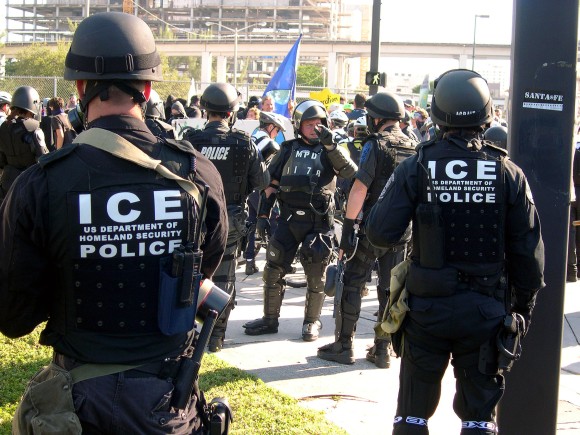
U.S. citizens wrongly detained, deported by ICE

U.S. citizens wrongly detained, deported by ICE

The son of a decorated Vietnam veteran, Hector Veloz is a U.S. citizen, but in 2007 immigration officials mistook him for an illegal immigrant and locked him in an Arizona prison for 13 months.

Veloz had to prove his citizenship from behind bars. An aunt helped him track down his father’s birth certificate and his own, his parents’ marriage certificate, his father’s school, military and Social Security records.

After nine months, a judge determined that he was a citizen, but immigration authorities appealed the decision. He was detained for five more months before he found legal help and a judge ordered his case dropped.

“It was a nightmare,” said Veloz, 37, a Los Angeles air conditioning installer.

Veloz is one of hundreds of U.S. citizens who have landed in the custody of U.S. Immigration and Customs Enforcement and struggled to prove they don’t belong there, according to advocacy groups and legal scholars, who have tracked such cases around the country. Some citizens have been deported. [continued…]

Facebooktwittermail

“I am both Muslim and Christian”

“I am both Muslim and Christian”

Shortly after noon on Fridays, the Rev. Ann Holmes Redding ties on a black headscarf, preparing to pray with her Muslim group on First Hill.

On Sunday mornings, Redding puts on the white collar of an Episcopal priest.

She does both, she says, because she’s Christian and Muslim.

Redding, who until recently was director of faith formation at St. Mark’s Episcopal Cathedral, has been a priest for more than 20 years. Now she’s ready to tell people that, for the last 15 months, she’s also been a Muslim — drawn to the faith after an introduction to Islamic prayers left her profoundly moved. [continued…]

Facebooktwittermail