
Is the war in Afghanistan in the interests of the United States and its allies?
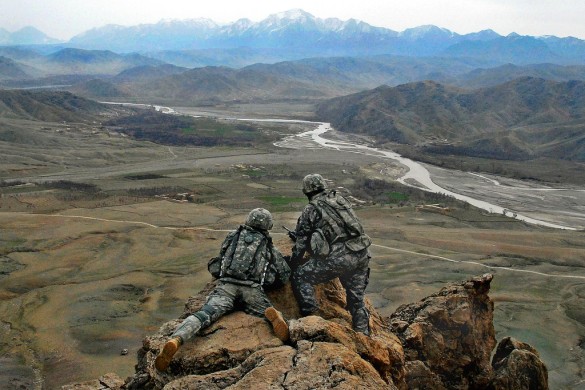
Operation Enduring Freedom [OEF], through the lens of vital national interests, was largely won but for some inexplicable reason we have not realized it. What is worse, we allowed our strategy to change before the initial, imperative mission was fully accomplished. Having to a great extent captured, killed, and seriously disrupted the al-Qaeda leadership and training infrastructure in Afghanistan, the necessity, and therefore strategy for this war, has gotten away from us. This is true for one reason and one reason alone: we have transferred the consequence of the very real threat of al Qaeda to the Taliban, to fields of Afghan poppies, and to the political and economic shambles that was and is Afghanistan. These things are not existential threats to our nation. With public debate and approval, they might be worthy of continued political and economic transformation and support through other aspects of national power, but not wholesale military intervention.
It is not a threat to the United States if the Islamic Republic of Afghanistan decides to live as if it were in the 15th century and create laws to mandate it. It is not a threat to the U.S. if they decide to ban women from attending school or stone them for adultery or not wearing a headscarf correctly. Nor is it a threat if poppies are their main cash crop. These are all variously horrible, unfortunate, and things we would like to see change, but do not constitute a direct, existential threat to the United States requiring a military response. Therefore, if the direct threats are not the Taliban (who was in power minding their own business since 1996), Sharia law (which has been used in various countries at various levels of fundamentalism for over 1400 years without being a threat to us), drugs, or necessarily even the failed or ungoverned state itself (of which examples have always been present on the global stage, also without being a threat to us), what are they? The direct threat was and is the loosely tied organization of al Qaeda and its affiliates. They are best destroyed just as we successfully prosecuted the early stages of OEF- through a combination of limited relationship building with local populations, deployments of Special Operations Forces [SOF], thorough intelligence, and targeted airstrikes. When we need to, our nation can call upon these assets to attack and defeat these threats. Then those assets can come home. Any continued presence should only be conducted by the occasional SOF, Foreign Service Officers, and/or USAID representatives (in permissive environments) to maintain networks of relationships when and where necessary and promote US interests. If al Qaeda were to again coalesce in Afghanistan, we would find, fix, and kill/capture them. This is the same strategy we follow when we find them anywhere else, be it Sudan, Yemen, Pakistan, or Newark, NJ. Why, then, does only Afghanistan warrant a total military-led effort to redesign their culture, system of government, and market-base based on US biases?
As Sun Tzu said, “Tactics without strategy is the noise before defeat.” What is facing us now is a series of tactics and operations with no overlying match of policy and strategy. Even if there is a higher strategy that is in line with national policy, this policy does not pass the “Family Factor” test that Kent Johnson defines in his article “Political-Military Engagement Policy: Casualty Avoidance and the American Public.” (Aerospace Power Journal, Spring 2001) Our limited war in early OEF quickly and silently evolved into something different with the intent of removing the Taliban in their entirety and ‘enabling’ a centralized democracy to exist where none has before. After the war for our vital national interests, we allowed our nation’s military to be the tool used to secure interests of a far less critical nature; to forcibly promote our beliefs of human rights, economic freedoms, and individual liberties. In our best Wilsonian imitation, we are determined to bestow the Peace of Westphalia upon Afghanistan, create a sovereign state in the best Western sense of the word, and allow them to move through the “majestic portal” to bring them into the family of evolved nations. Somehow, this will be better for America than whatever locally legitimate ruling authority rises to power in Kabul or the rest of Afghanistan’s provinces. In a utopian world, this might be fine, but in reality, where the native Pashtun, Tajik, Hazara, and Uzbek people get a vote, it yields the quagmire we face today. Not only is this outside of our initial (and again, largely complete) mission in Afghanistan, it is outside of both the pragmatism and necessity of realpolitik and realism on one side and any cost-benefit analysis of political idealism on the other. To think that to secure the US homeland from attack we must install an amenable democratic government in Kabul awakens definite parallels in Afghani history.
Field Marshall Frederick Roberts who, during the Second Anglo-Afghan War, led a successful attack against Kabul and the later 300-miles-in-3-weeks march from Kandahar to Kabul (to rescue an embattled British force) eventually said: “The less they see of us, the less they’ll dislike us.” In the end, he, and the British parliament, realized that after three consecutive wars in the same region for the same strategic purpose, Afghanistan wasn’t as strategically important to the British as they had supposed all along. In their effort to maintain varying levels of control or influence in Afghan affairs to counter supposed Russian aims on British India, the British fought three politically debilitating wars with the Afghans resulting in less regional influence, less control, and more loss of life each time. They would eventually conclude that if the Russians wanted to attack British India through Afghanistan, they, the British, should let them. The impossible task and effort of maintaining influence over the Afghans was inordinate compared to the cost of defending India at the gates of India, not at the Hindu Kush. Invading Afghanistan was easy; the follow-on governing was impossible. It would be far easier to let Russia try and stretch their LOCs [lines of communication] and expend their blood and treasure through unconquerable Afghan territory to get to India, not the reverse.
Something about Afghanistan must breed strategic overstretch. As British ‘Forward Policy’ of the 19th century delivered three strategically unwinnable wars, we similarly seem to think defense of the homeland begins at the Hindu Kush; that we must fight them there so we don’t have to fight them here. The British realized in their successive efforts that punitive strikes and raids when necessary into Afghanistan were far more effective in the long run than trying to maintain even a semi-permanent presence and installing British-friendly (malleable) governments.
Beyond the supposed and indefensible argument that the Taliban provides us with an existential threat, we have allowed something far more insidious to occur; we have enabled al Qaeda of the 21st century to replace Russia of the 19th century in the way we, and the Victorian British before us, looked at and dealt with the territory and peoples of Afghanistan. Academically, the parallel is illuminating; in reality, it is tragic. Al Qaeda, far from requiring a massive, conventional military deployment (nor a global war on terrorism), should in actuality warrant only local police actions. If that is not possible or within the capacity of local forces, a “low-intensity,” small footprint, or otherwise limited US response to negate that threat where present would suffice. This should be the modus operandi in Afghanistan, Yemen, central or northern Africa, Indonesia, or anywhere else. Large-scale deployments or nation building are not the answer. If for no other reason than to point out the fact that we do not see the need to try and “fix” every other un- or under-governed space across the world or forcibly promote our national interests everywhere else they might differ from our own. “Fixing” Afghanistan is not a vital national interest. [continued…]
Editor’s Comment — “Operation Enduring Freedom, through the lens of vital national interests, was largely won but for some inexplicable reason we have not realized it.”
An inexplicable reason? If George Bush had not been surrounded by neoconservative handlers, I dare say that rather than come up with an overblown “war on terror” he would have kept it simple. The task in hand was to “get bin Laden.” And that’s why the war has never ended: it has failed to accomplish its primary goal.
Of course, as any fool knows, a real man hunt requires stealth.




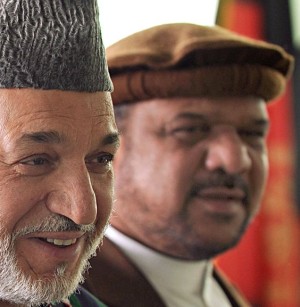 he real winner of Afghanistan’s presidential election will not be Hamid Karzai or his main rival, Abdullah Abdullah. It’s a man named Mohammad Qasim Fahim. He is Afghanistan’s senior-most military commander, with the lifetime rank of marshal, and was Karzai’s running mate during the campaign. Whether Karzai or one of his opponents wins, Fahim will hold and exercise extraordinary influence over the country’s military and security apparatus — more so than the elected president.
 e ran the Gaza Strip like the Godfather, dispensing brutal punishment and benevolent largess. But that was before his summer of disgrace, two years ago, when Hamas militants drove out his armed followers and allowed looters to pick apart his seaside villa.
