Daily Archives: November 8, 2009

Hezbollah gears up for new war

Hezbollah gears up for new war

Hezbollah is rapidly rearming in preparation for a new conflict with Israel, fearing that Benjamin Netanyahu’s government will attack Lebanon again prior to any assault on Iran’s nuclear facilities.

Last week, Israeli commandos seized a ship in the Mediterranean loaded with almost 400 tonnes of rockets and small arms – which Israel claimed was being sent from Iran to its Hezbollah allies. In dramatic further evidence of growing tensions, the Observer has learned that Hezbollah fighters have been busy reinforcing fixed defence positions north of the Litani river.

Having lost many of its bunkers in the south, Hezbollah is preparing a new strategy to defend villages there.

Although the organisation denied last week that the weapons were intended for its use, senior commanders have done little to disguise the scale of rearmament. “Sure, we are rearming, we have even said that we have far more rockets and missiles than we did in 2006,” said a Hezbollah commander, speaking on condition of anonymity. [continued…]

Editor’s Comment — “We expect the Israelis to come soon, if not this winter, then they will wait until spring, when the ground isn’t too soft for their tanks,” says a Hezbollah commander.

Israel’s readiness to launch an attack on Iran may hinge on its readiness to send tanks back into Lebanon.

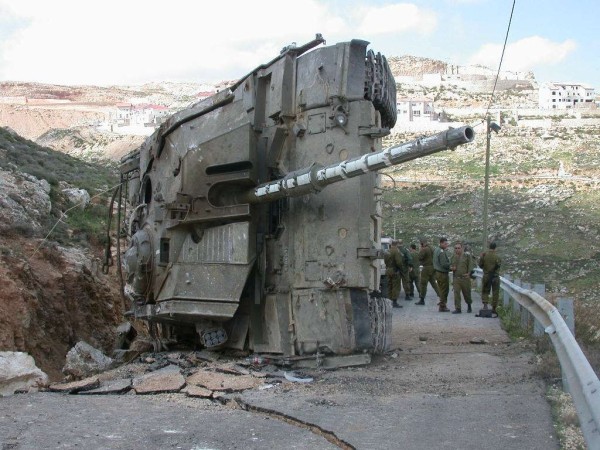
The war on Gaza, even to the extent that it may have served as a training exercise in preparation for another round of fighting with Hezbollah, probably did little to dispel the haunting memories of 2006. The Merkava tank, previously one of the IDF’s most potent symbols of invincibility, ended up exposing Israel’s military vulnerability.

Facebooktwittermail

Is using aid to Israel as leverage becoming a mainstream idea?

Is using aid to Israel as leverage becoming a mainstream idea?

Tom Friedman today has some very harsh words for both the Israelis and Palestinians, both of whom — he claims — are not serious about reaching a peace agreement. As a result, these are the principles which Friedman — rather surprisingly — advocates the U.S. should follow:

Let’s just get out of the picture. Let all these leaders stand in front of their own people and tell them the truth: “My fellow citizens: Nothing is happening; nothing is going to happen. It’s just you and me and the problem we own.”

Indeed, it’s time for us to dust off James Baker’s line: “When you’re serious, give us a call: 202-456-1414. Ask for Barack. Otherwise, stay out of our lives. We have our own country to fix.” …

If the status quo is this tolerable for the parties, then I say, let them enjoy it. I just don’t want to subsidize it or anesthetize it anymore. We need to fix America. If and when they get serious, they’ll find us.

The only specific course of action Friedman explicitly advocates to fulfill those principles is that the U.S. cease its efforts to forge a resolution of the Israeli-Palestinian conflict and stop trying to pressure them into concessions, instead leaving each side to stew in the status quo — in other words, do exactly that which the Netanyahu government would like most. That would be a perfectly fine suggestion if not for the fact that the U.S. is heavily invested in the outcome of that process and its interests substantially and directly impacted by what happens. That’s because we single-handedly enable Israeli behavior with our massive amounts of military aid, diplomatic protection, and weapons supplying, which means Israeli behavior is rationally perceived by much of the Muslim world as being one and the same as American behavior. Muslim anger towards Israel will inevitably translate into Muslim anger towards the U.S. for as long as we continue to flood Israel with aid and cover. [continued…]

Israel’s apartheid is worse than South Africa’s

Regardless of whether there is a Democrat or a Republican in the White House, the United States became a distinctly pro-Israel world power after the 1967 war. It has no intention of being a “balanced mediator” when it comes to the conflict with the Palestinians.

Barack Obama’s public relations moves in the Arab world have frightened many average Israelis. But Netanyahu and Ehud Barak, allies of the final takeover of the West Bank, know very well that U.S. policy has not changed. It doesn’t take a genius to read the working papers of past prime ministers.

The prevailing attitude of all U.S. administrations was drafted by Henry Morgenthau, and was later updated by Kenneth Waltz. One line guided all of them – Dennis Ross, Martin Indyk, George Mitchell – essentially, that any possible settlement must match the positions of the stronger party. [continued…]

Abbas charts new course by abandoning faith in the US

‘Who lost China?” was the battle cry of a witch-hunt conducted in the US State Department following the 1949 victory of Mao Zedong’s communists. The department’s “China hands”, critics charged, had been woefully ignorant of the dynamics at work on the ground in China after the Second World War, and undermined the US ally Chiang Kai-shek. While the purge that followed is unlikely to be repeated, Washington may soon be asking itself, albeit quietly, “Who lost Fatah?”

Last week’s announcement by the Palestinian president Mahmoud Abbas that he would not seek re-election next January was a warning to the Obama administration, which had put Mr Abbas in an untenable position. Having retreated from its own demand that Israel halt all construction in East Jerusalem and the West Bank, Washington expected Mr Abbas to open talks with the Israeli prime minister Benjamin Netanyahu without conditions.

For the Palestinians, however, the settlement-freeze demand was a test of Mr Obama’s willingness to pressure the Israelis into taking steps they won’t take by choice. Mr Abbas knows that Mr Netanyahu, if it were up to him, would not yield to a viable, independent Palestinian state based on the 1967 borders. If the US is not prepared to pressure Israel, negotiations would not only be fruitless, they would actually help sustain a reality that is relatively comfortable for the Israelis but intolerable for the Palestinians. [continued…]

U.N.’s Goldstone criticizes U.S. reaction to Gaza report

The head of a U.N. investigation that accused Israel of war crimes in Gaza, Richard Goldstone, has said he is disappointed there has been such a “lukewarm” reaction to his findings in the United States.

The report by Goldstone, a South African jurist, lambasted both sides in the December-January war, which killed up to 1,387 Palestinians and 13 Israelis, but was harsher toward Israel.

It gave Israel and Palestinian Hamas militants six months to mount credible investigations or face possible prosecution in The Hague. Both Israel and Hamas denied committing war crimes. [continued…]

Facebooktwittermail

Obama leaning toward 34,000 more troops for Afghanistan

Obama leaning toward 34,000 more troops for Afghanistan

President Barack Obama is nearing a decision to send more than 30,000 additional U.S. troops to Afghanistan next year, but he may not announce it until after he consults with key allies and completes a trip to Asia later this month, administration and military officials have told McClatchy.

As it now stands, the administration’s plan calls for sending three Army brigades from the 101st Airborne Division at Fort Campbell, Ky. and the 10th Mountain Division at Fort Drum, N.Y. and a Marine brigade, for a total of as many as 23,000 additional combat and support troops.

Another 7,000 troops would man and support a new division headquarters for the international force’s Regional Command (RC) South in Kandahar, the Taliban birthplace where the U.S. is due to take command in 2010. Some 4,000 additional U.S. trainers are likely to be sent as well, the officials said. [continued…]

British army wants to retreat in Afghanistan

Army chiefs are drawing up plans to withdraw British troops from outlying bases in Afghanistan.

In what would be a significant change of strategy against the growing Taliban insurgency, they are considering abandoning several bases including Musa Qala, the scene of bloody battles that claimed 15 British lives. Army forces would attempt to hold only the larger towns in Helmand province.

It is understood the new “retrenchment” strategy is backed by the head of the army, General Sir David Richards. [continued…]

Is it time for Britain to pull out of Afghanistan?

In a week where one of the policemen being trained by British soldiers to protect his own country turned on his mentors and shot dead five in cold blood, an increasing number of people are asking what we are doing in Afghanistan and whether it is worth it.

Public opposition to the war has risen sharply: in a ComRes survey for the BBC published today, 64% said the war was “unwinnable” and 63% thought British troops should be withdrawn “as soon as possible”. In a YouGov poll last week for Channel 4, 35% of people thought all UK troops should be withdrawn immediately, up from 25% two weeks ago.

On radio phone-in and news programmes, discussion has been of little else. “There is a real chance we will lose this struggle in the bars and front rooms of Britain,” warned Lord Ashdown, the former leader of the Liberal Democrats.

Among those now calling for a “fundamental rethink” is Kim Howells, chairman of the parliamentary intelligence and security committee and a former Foreign Office minister.

Howells last week wrote an article questioning whether spending £2.6 billion a year keeping troops in Afghanistan was the best way to protect national security. He called for a phased withdrawal and more focus on domestic spying.

Nobody doubts the courage and skill of the armed forces, or seeks to betray the memory of the fallen by walking away. But is it right to keep sending more? Or is it time we changed strategy or even pulled out? [continued…]

Facebooktwittermail

Fears of anti-Muslim backlash after Fort Hood massacre

Fears of anti-Muslim backlash after Fort Hood massacre

The shooting rampage by a US army psychiatrist, Major Nidal Malik Hasan, at Fort Hood in Texas, came almost six months after the Camp Liberty killings in Iraq where an American army sergeant killed five fellow soldiers at a combat stress centre.

Maj Hasan, one of only 408 psychiatrists serving 553,000 active-duty US troops around the world, was likely to have worked in such a centre when sent to Iraq or Afghanistan. Among the 13 killed on Thursday at the Fort Hood Readiness Centre, a soldier’s last stop before deployment, five were fellow therapists, the army said. [continued…]

Little evidence of terror plot in base killings

After two days of inquiry into the mass shooting at Fort Hood, investigators have tentatively concluded that it was not part of a terrorist plot.

Rather, they have come to believe that Maj. Nidal Malik Hasan, the Army psychiatrist accused in the shootings, acted out under a welter of emotional, ideological and religious pressures, according to interviews with federal officials who have been briefed on the inquiry.

Investigators have not ruled out the possibility that Major Hasan believed he was carrying out an extremist’s suicide mission. [continued…]

Facebooktwittermail

In an unstable Pakistan, can nuclear warheads be kept safe?

In an unstable Pakistan, can nuclear warheads be kept safe?

In the tumultuous days leading up to the Pakistan Army’s ground offensive in the tribal area of South Waziristan, which began on October 17th, the Pakistani Taliban attacked what should have been some of the country’s best-guarded targets. In the most brazen strike, ten gunmen penetrated the Army’s main headquarters, in Rawalpindi, instigating a twenty-two-hour standoff that left twenty-three dead and the military thoroughly embarrassed. The terrorists had been dressed in Army uniforms. There were also attacks on police installations in Peshawar and Lahore, and, once the offensive began, an Army general was shot dead by gunmen on motorcycles on the streets of Islamabad, the capital. The assassins clearly had advance knowledge of the general’s route, indicating that they had contacts and allies inside the security forces.

Pakistan has been a nuclear power for two decades, and has an estimated eighty to a hundred warheads, scattered in facilities around the country. The success of the latest attacks raised an obvious question: Are the bombs safe? Asked this question the day after the Rawalpindi raid, Secretary of State Hillary Clinton said, “We have confidence in the Pakistani government and the military’s control over nuclear weapons.” Clinton—whose own visit to Pakistan, two weeks later, would be disrupted by more terrorist bombs—added that, despite the attacks by the Taliban, “we see no evidence that they are going to take over the state.”

Clinton’s words sounded reassuring, and several current and former officials also said in interviews that the Pakistan Army was in full control of the nuclear arsenal. But the Taliban overrunning Islamabad is not the only, or even the greatest, concern. The principal fear is mutiny—that extremists inside the Pakistani military might stage a coup, take control of some nuclear assets, or even divert a warhead. [continued…]

Facebooktwittermail
