Daily Archives: November 22, 2009

Kahane tribute may damage peace talks

Kahane tribute may damage peace talks

A plan by right-wing legislators in Israel to commemorate the anniversary this month of the death of Meir Kahane, whose banned anti-Arab movement is classified as a terrorist organisation, risks further damaging the prospects for talks between Israel and the Palestinians, US officials have warned.
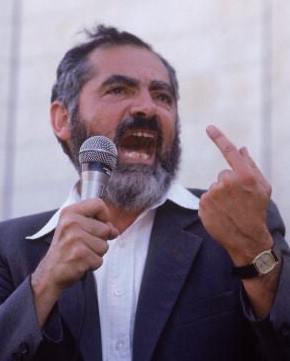
A move to stage the commemoration in Israel’s parliament, the Knesset, is being led by Michael Ben-Ari, who was elected this year and is the first self-declared former member of Kahane’s party, Kach, to become a legislator since the movement was banned 15 years ago.

The US Embassy, in Tel Aviv, has sent a series of e-mails to Reuven Rivlin, the parliamentary speaker, asking that he intervene to block the event.

According to US officials, pressure is being exerted on behalf of George Mitchell, the US president Barack Obama’s envoy to the region, who is concerned that it will add to his troubles as Israeli and Palestinian leaders clash over a possible move by the Palestinians to issue a unilateral declaration of statehood.

Some Israeli legislators have warned that Mr Ben-Ari and his supporters are gaining a stronger foothold in parliament, in an indication of the country’s increasing lurch rightwards.

“Ben-Ari and the advisers he has brought with him are unabashed representatives for Kach and Kahane’s ideas,” said Ahmed Tibi, an Arab legislator and the deputy speaker. “What we have is in effect a terrorist cell in the parliament.” [continued…]

Editor’s Comment — Beyond the fact that Rabbi Meir Kahane was bad for Israel’s international image and that he fomented hostility between Jews and Palestinians, Kahane no doubt antagonized moderate Zionists by unmasking the contradictions implicit in the notion of a Jewish democratic state.

The following videos contain a CBS 60 Minutes report on Kahane from 1984. (The second part of the report is followed by a song eulogizing Kahane. Whoever put this on YouTube is clearly a shameless Kahanist.)

Kahane was describing the “demographic threat” facing Israel well before that phrase and that concept was lent a veneer of political respectability by becoming the fact that, for Zionists, makes the realization of a two-state solution an imperative.

Interestingly, back in 1984, an American journalist — Mike Wallace — had no problem asserting on national television that Israel’s claim to be democratic would require accepting the possibility that Palestinians might at some point become the majority.

Wallace, in the setup for the interview clip says: “Kahane asks his Jewish opponents how they would react to an Arab majority in Israel?”

Rabbi Meir Kahane: In theory, do they [the Palestinians] have a right to be the majority? Yes or no? They [Kahane’s opponents] can’t answer that. They cannot answer that question.

Wallace: If Israel is a democratic state, then obviously they [the Palestinians] obviously do [have a right to be in the majority].

Kahane: Right. But if it’s a Zionist state then obviously they don’t.

Wallace: But you’re the one who finds it impossible to accept both Zionism and democracy in the same state.

Kahane: Anyone does, because Zionism — the very definition of it is: the creation of a Jewish state — and in fact, Israel is defined in its declaration of independence as the “Jewish” state. You think that that makes Arabs feel happy. You think that Arabs rush into the streets on Independence Day in Israel to celebrate their defeat.

I think that only liberals have such contempt for Arabs that they believe you can buy an Arab’s national pride by raising his living standards. Not by bread alone does an Arab live.

Because I respect the Arab, I want to throw him out.

Later in the 60 Minutes report, Kahane is shown outside city of Umm al-Fahm, the second largest Palestinian city within Israel, saying in reference to some of its residents who are protesting his presence: “I want to make it clear to those dogs that are standing there, there is no such thing as an Arab village in the state of Israel.”


Facebooktwittermail

Mourning uprooted olive trees in West Bank villages

Mourning uprooted olive trees in West Bank villages

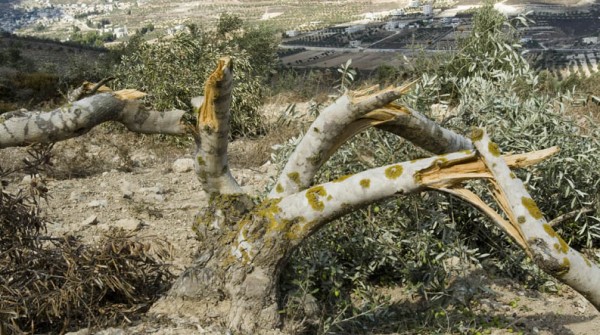
The old tractor sputtered up the hill, its engine seemingly about to expire, but its big wheels bumping across the rocky terrain. We stood in the back, swaying wildly, holding on for dear life. On the hilltop loomed the big antenna of the settlement of Yitzhar, whose houses lay on the other side of the hill. The very knowledge of their presence inspired dread. It was a glorious sunny day, the spectacular valley sprawling below. The houses of the Palestinian village of Burin lie in this valley, which lies between two hills: on one stands Yitzhar; on the other, Har Bracha, outside Nablus.

Burin is caught between a rock and hard place, between Har Bracha and Yitzhar. We have visited Burin often, most recently after settlers burned down some of its homes. Settlers once stole a horse from a villager, torched fields, demolished a home in the village and uprooted olive trees. We have frequently documented the uprooting of olive trees: Less than a month ago, in this space, we told the story of the beautiful vineyard belonging to the agriculture teacher Mohammed Abu Awad from the village of Mureir, whose 300 trees were felled by intruders – probably from the illegal outpost of Adei Ad – using buzz saws. Continue reading

Facebooktwittermail

J Street seeks to undermine BDS

J Street seeks to undermine BDS

We’ve been following J Street’s attempts to counteract the growing BDS movement. First there was its aborted release of a public letter criticizing the Toronto Declaration. Then there was the workshop at its student conference called “Reckoning with the Radical Left on Campus: Alternatives to Boycotts and Divestments.” The workshop didn’t go quite as planned either as many students who attended actually offered their support for divestment campaigns targeting the Israeli occupation. You would think these two initial missteps would lead J Street to reconsider which way the wind is blowing. Nope.

J Street is now working to undermine the National Campus Boycott, Divestment, Sanctions Conference that will be held this weekend at Hampshire College. The conference is being called to build “a coordinated national BDS campaign,” and J Street seems to feel threatened by this. Yesterday the organization sent the following email out to its student wing: [continued…]

Editor’s Comment — Strip a J Street statement of all its marketing filler and its use of slogans as a substitute for argumentation and you end up with nothing much at all.

In this case though, there is one important piece of news: “[The] Boycott, Divestment, and Sanctions (BDS) movement against Israel movement… is spreading like wild fire on campuses across the country…”

This is a major grassroots movement but J Street has the hubris and naivety to imagine it can co-opt and steer in the “right” direction. In the process J Street is increasingly coming to look like nothing more than the liberal wing of the Israel lobby.

Facebooktwittermail

For the Palestinians, all roads now lead to the UN

For the Palestinians, all roads now lead to the UN

It is hard to take seriously the threat by the Palestinian president Mahmoud Abbas to declare a Palestinian state in the West Bank and Gaza and demand recognition by the UN Security Council.

The cool response from the US and the European Union made clear that no such recognition would be forthcoming; and, as Hamas asked, what is the point of unilaterally declaring a state while those territories remain ultimately under Israeli control? Yasser Arafat already did that, in 1988.

Mr Abbas, of course, is a desperate man, because the strategy on which he has staked his political career – negotiating a two-state solution to the conflict with Israel under US auspices – is dead. The Obama administration was the last, best hope of the Palestinians for a change of course by America to deliver a credible peace. Mr Obama has been a massive disappointment, lacking either the will or the ability to compel Israel to do anything it doesn’t want to. [continued…]

‘Fatah officials warn of third Palestinian intifada’

atah had made a strategic decision to declare a third intifada against Israel, movement officials told Nazereth-based newspaper Hadith Anas, citing the failed peace talks as the reason for their resolution.

The newspaper report quoted Fatah Central Committee members as saying that the movement wished to implement a decision made during its sixth convention, which assembled last August in the West Bank city of Bethlehem.

One of the movement’s top officials interviewed by Hadith Anas said the third intifada will have a widespread popular base, adding, however, that unlike the previous popular struggle against Israel, which was sparked in September 2000, the movement will not endorse an armed struggle or the use of firearms. Continue reading

Facebooktwittermail

Hasan had intensified contact with cleric

Hasan had intensified contact with cleric

In the months before the deadly shootings at Fort Hood, Army Maj. Nidal M. Hasan intensified his communications with a radical Yemeni American cleric and began to discuss surreptitious financial transfers and other steps that could translate his thoughts into action, according to two sources briefed on a collection of secret e-mails between the two.

The e-mails were obtained by an FBI-led task force in San Diego between late last year and June but were not forwarded to the military, according to government and congressional sources. Some were sent to the FBI’s Washington field office, triggering an assessment into whether they raised national security concerns, but those intercepted later were not, the sources said.

Hasan’s contacts with extremist imam Anwar al-Aulaqi began as religious queries but took on a more specific and concrete tone before he moved to Texas, where he allegedly unleashed the Nov. 5 attack that killed 13 people and wounded nearly three dozen, said the sources who were briefed on the e-mails, speaking on the condition of anonymity because the case is sensitive and unfolding. One of those sources said the two discussed in “cryptic and coded exchanges” the transfer of money overseas in ways that would not attract law enforcement attention. [continued…]

Editor’s Comment — Finally, the real “terrorism” smoking gun: the money trail!

Problem is, in this case the trail seems to have been heading in the wrong direction: Hasan was sending the money — not receiving it. His choice for questionable donations is certainly not going to count in his favor but neither is it going to provide particularly compelling evidence of intent.

Facebooktwittermail

Three key lessons from Obama’s China tour

Three key lessons from Obama’s China tour

Russia may be engaged in a geopolitical chess game with the U.S. aimed at recovering from the demise of its great power status, but China is different. It pushes back against U.S. initiatives only when those are deemed inimical to its national interests. Iran is a good example. Beijing’s heavy investment in and reliance on Iran’s energy sector make it extremely averse to serious sanctions or strategies that create political turmoil in Tehran. While insisting on compliance with the non-proliferation regime, Beijing does not believe Iran represents an imminent nuclear weapons threat. And its response to North Korea going nuclear suggests that a nuclear armed Iran is something it could live with.

Obama went to China arguing that its emergence as a major power gives it greater responsibility, as a partner to the U.S., in helping run the world and tackle such global challenges as climate change and Iran. Indeed, there was a collective shudder in Europe’s corridors of power at the idea of global leadership being concentrated in a “G2” partnership between Washington and Beijing. They needn’t have worried. China’s response to Obama could be read as: “Running the world is your gig, we’re focused on running our own country, and ensuring security in our immediate neighborhood. We want harmonious relations with you, but don’t expect us to do anything that we deem harmful to our national interests.” That means no serious sanctions against Iran, regardless of what deals are struck between Washington and Moscow, because China’s national interests require growing Iran’s energy exports. [continued…]

Facebooktwittermail

Cleric wields religion to challenge Iran’s theocracy

Cleric wields religion to challenge Iran’s theocracy

For years, Grand Ayatollah Hossein Ali Montazeri criticized Iran’s supreme leader and argued that the country was not the Islamic democracy it claimed to be, but his words seemed to fall on deaf ears. Now many Iranians, including some former government leaders, are listening.

Ayatollah Montazeri has emerged as the spiritual leader of the opposition, an adversary the state has been unable to silence or jail because of his religious credentials and seminal role in the founding of the republic.

He is widely regarded as the most knowledgeable religious scholar in Iran and once expected to become the country’s supreme leader until a falling-out with Ayatollah Ruhollah Khomeini, the leader of the 1979 revolution and Iran’s supreme leader until his death in 1989.

Now, as the Iranian government has cracked down to suppress the protests that erupted after the presidential election in June and devastated the reform movement, Ayatollah Montazeri uses religion to attack the government’s legitimacy.

“We have many intellectuals who criticize this regime from the democratic point of view,” said Mehdi Khalaji, a former seminary student in Qum and now a senior fellow at the Washington Institute for Near East Policy. “He criticizes this regime purely from a religious point of view, and this is very hurtful. The regime wants to say, ‘If I am not democratic enough that doesn’t matter, I am Islamic.’

“He says it is not an Islamic government.” [continued…]

Facebooktwittermail