Daily Archives: November 27, 2009

Jerusalem’s Jewish bigots

Mouths filled with hatred

Father Samuel Aghoyan, a senior Armenian Orthodox cleric in Jerusalem’s Old City, says he’s been spat at by young haredi and national Orthodox Jews “about 15 to 20 times” in the past decade. The last time it happened, he said, was earlier this month. “I was walking back from the Church of the Holy Sepulchre and I saw this boy in a yarmulke and ritual fringes coming back from the Western Wall, and he spat at me two or three times.”

Wearing a dark-blue robe, sitting in St. James’s Church, the main Armenian church in the Old City, Aghoyan said, “Every single priest in this church has been spat on. It happens day and night.”

Father Athanasius, a Texas-born Franciscan monk who heads the Christian Information Center inside the Jaffa Gate, said he’s been spat at by haredi and national Orthodox Jews “about 15 times in the last six months” – not only in the Old City, but also on Rehov Agron near the Franciscan friary. “One time a bunch of kids spat at me, another time a little girl spat at me,” said the brown-robed monk near the Jaffa Gate.

“All 15 monks at our friary have been spat at,” he said. “Every [Christian cleric in the Old City] who’s been here for awhile, who dresses in robes in public, has a story to tell about being spat at. The more you get around, the more it happens.” [continued…]

Editor’s Comment — Larry Derfner underlines: “Every Christian cleric interviewed for this article stressed that they weren’t blaming Israeli Jewry as a whole for the spitting attacks; on the contrary, they said their general reception by Israeli Jews, both secular and religious, was one of welcome.”

Even so, the historical resonances of these particular expressions of Jewish bigotry, with their anti-Semitic European, segregated American and Apartheid South African counterparts, are inescapable:

A nun in her 60s who’s lived in an east Jerusalem convent for decades says she was spat at for the first time by a haredi man on Rehov Agron about 25 years ago. “As I was walking past, he spat on the ground right next to my shoes and he gave me a look of contempt,” said the black-robed nun, sitting inside the convent. “It took me a moment, but then I understood.”

Since then, the nun, who didn’t want to be identified, recalls being spat at three different times by young national Orthodox Jews on Jaffa Road, three different times by haredi youth near Mea She’arim and once by a young Jewish woman from her second-story window in the Old City’s Jewish Quarter.

But the spitting incidents weren’t the worst, she said – the worst was the time she was walking down Jaffa Road and a group of middle-aged haredi men coming her way pointed wordlessly to the curb, motioning her to move off the sidewalk to let them pass, which she did.

Derfner adds: “Christians in Israel are a small, weak community known for ‘turning the other cheek,’ so these Jewish xenophobes feel free to spit on them; they don’t spit on Muslims in the Old City because they’re afraid to, the clerics noted.”

The targets of such expressions of contempt are however not confined to members of the Christian clergy.

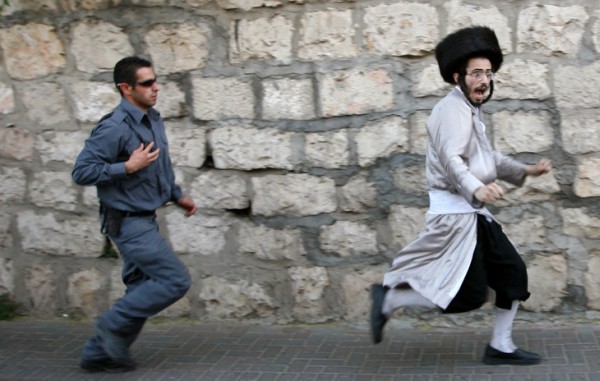
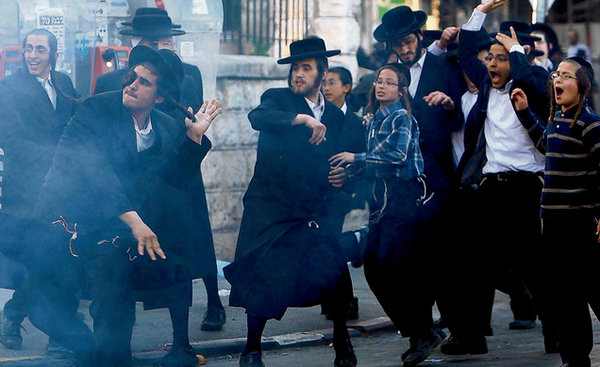
Anne Barker, a reporter for Australia’s ABC News, described an incident this summer in which she became a victim of ultra-Orthodox Jewish hatred while she covered what have become frequent demonstrations in Jerusalem by Jews intent on preserving the sanctity of the Shabbat which they see threatened by secularism.

I was mindful I would need to dress conservatively and keep out of harm’s way. But I made my mistake when I parked the car and started walking towards the protest, not fully sure which street was which.

By the time I realised I’d come up the wrong street it was too late.

I suddenly found myself in the thick of the protest – in the midst of hundreds of ultra-Orthodox Jews in their long coats and sable-fur hats.

They might be supremely religious, but their behaviour – to me – was far from charitable or benevolent.

As the protest became noisier and the crowd began yelling, I took my recorder and microphone out of my bag to record the sound.

Suddenly the crowd turned on me, screaming in my face. Dozens of angry men began spitting on me.

I found myself herded against a brick wall as they kept on spitting – on my face, my hair, my clothes, my arms.

It was like rain, coming at me from all directions – hitting my recorder, my bag, my shoes, even my glasses.

Big gobs of spit landed on me like heavy raindrops. I could even smell it as it fell on my face.

Somewhere behind me – I didn’t see him – a man on a stairway either kicked me in the head or knocked something heavy against me.

I wasn’t even sure why the mob was angry with me. Was it because I was a journalist? Or a woman? Because I wasn’t Jewish in an Orthodox area? Was I not dressed conservatively enough?

In fact, I was later told, it was because using a tape-recorder is itself a desecration of the Shabbat even though I’m not Jewish and don’t observe the Sabbath.

It was lucky that I don’t speak Yiddish. At least I was spared the knowledge of whatever filth they were screaming at me.


Facebooktwittermail

Intel Inside? Prove it.

Intel Inside? Prove it.

Here is a thought experiment. It is Sunday, and various employees of Intel’s R&D and consulting facility in Chantilly, VA, just outside of Washington, are working through the week-end. The facility is suddenly surrounded by several thousand evangelical Christians–mainly educated at Regent University, and led by the aged Pat Robertson–who demand that the company shut down the facility, so as not to violate the holy Sabbath. Windows are shattered by rock throwers. State police move in, but do not disband the mobs.

So Intel’s senior management go into a huddle. They authorize the local management team to meet with Robertson’s representatives, along with representatives from the Virginia governor’s office, now in the hands of rightist Republicans. At first Intel threatens to pull out of Virginia. But finally they approve a compromise agreement. The facility can stay open, the agreement states, but the shifts will be reduced. Also, on Sundays, only non-Christians can work there.

Imagine, in this fantasy, what the Intel board would face at the next shareholders’ meeting. Or imagine the employee emails the corporation’s global “Director of Diversity,” Rosalind Hudnell, would be fielding the next morning.

Well, if haven’t already heard, something quite like this just happened in Jerusalem.

A week ago Saturday, Intel’s facility on Har Ha’Hotzvim–a technology park in a belt of land near (but not at all in) the burgeoning ultraOrthodox neighborhood of Sanhedria–was surrounded and vandalized by acolytes of various Haredi rabbis, most notably, the leader of Eda, Rabbi Yitzhak Tuvia Weiss. Intel met with representatives of the Haredi groups, facilitated by Jerusalem Mayor Nir Barkat and Knesset Speaker Ruby Rivlin–both rightists tied to Haredi voters. The Sabbath shift, so the “compromise” stipulates, will be cut from 120 employees to 20. None of them will be Jews. (By the way, this absurd agreement may have satisfied most, but not Rabbi Weiss. His mobs were back yesterday demanding a complete shut down.) [continued…]

Editor’s Comment — The more exposed the conflict becomes between the forces of secularism and religious fundamentalism inside Israel, the more it would seem that Israel depends on durable external enemies as the indispensable means for forging national unity.

Bring an end to the Israeli-Arab conflict and Israel might well then rip itself apart.

Facebooktwittermail

South Africa: Israel actions in East Jerusalem akin to apartheid

South Africa: Israel actions in East Jerusalem akin to apartheid

The South African government has issued an unusually harsh statement condemning Israel for approving 900 new housing units in Gilo and evicting Palestinians from their East Jerusalem homes, comparing Israel’s actions to the “forced removals” of the apartheid era.

“We condemn the fact that Israeli settlement expansion in East Jerusalem is coupled with Israel’s campaign to evict and displace the original Palestinian residents from the City,” the statement said. “South Africa is deeply concerned that these activities by Israel will only serve only to deepen the cycle of violence in the region.”

Israeli officials and Jewish leaders in South Africa condemned the statement.

Foreign Ministry spokesman Yigal Palmor said: “We deeply regret this unexplainable statement, which ignores key facts while presenting as realities nonexistent matters. It is highly misleading not to take cognizance of Israel’s repeated calls to renew peace talks unconditionally and without deferral. It is simply unjust to call the neighborhood of Gilo a ‘settlement,’ or to conjure a phantasmagorical ‘campaign to evict Palestinians.'” Continue reading

Facebooktwittermail

Barghouti: Shalit abduction achieved what no dialogue could

Barghouti: Shalit abduction achieved what no dialogue could

Fatah strongman Marwan Barghouti said in an interview on Wednesday that he intends to run in the next Palestinian presidential election, and remarked that the abduction of Israel Defense Forces soldier Gilad Shalit by Gaza militants achieved what no negotiations could ever achieve.

Shalit was kidnapped in a cross border raid in 2006, and has been held prisoner by Hamas for over three years. Recent reports suggest that Israel and Hamas are closer than ever to reaching an agreement on a deal that would see hundreds of Palestinian prisoners released in exchange for Shalit’s freedom. It is unclear whether Barghouti will be among those prisoners, as he is currently serving five consecutive life sentences in an Israeli prison for his role in murderous terror attacks. Continue reading

Facebooktwittermail

Why can we talk to Hamas about Shalit, but not peace?

Why can we talk to Hamas about Shalit, but not peace?

hy is it permissible to talk to Hamas about the fate of one captive soldier and another several hundred prisoners, but forbidden to talk to them about the fate of two nations? Never has Israeli logic been so distorted. Now, when our hearts look forward to the deal’s implementation, when every human heart should look forward to Gilad Shalit’s release – and yes, to the release of hundreds of Palestinian prisoners, some of them political prisoners for all intents and purposes, not just “terrorists with blood on their hands” – now is the time to finally rid ourselves of some of the foolish prohibitions we have imposed on ourselves and the entire international community.

It is now clear that there is someone to talk to. In Gaza and Damascus sit tough but reasonable statesmen. They are also concerned, in their own way, about the fate of their people, they too aspire to bring them freedom and justice. When the deal is implemented we will also discover that they can be taken at their word. Were it not for the fact that Israel is holding tens of thousands of prisoners – some who used base means to achieve a just objective – who are judged differently from Jewish murderers and criminals, perhaps Hamas would not have had to use the weapon of kidnapping. Continue reading

Facebooktwittermail

West Bank settlers carry on building as new freeze is proposed

West Bank settlers carry on building as new freeze is proposed

At the small Jewish community of Revava in the northern West Bank, it was difficult to see yesterday what difference Israel’s freeze on settlement building would make. Construction continued on 20 housing units and the locals were apparently unperturbed by politicking between Jerusalem and Washington.

Under the proposal announced by Binyamin Netanyahu on Wednesday, no new residential permits will be issued and no new residential construction can start for ten months in the West Bank, excluding east Jerusalem. This was not stopping an American-Israeli homeowner and his family, who were working on the shell of their new house — one of 3,000 that have already been started and which will, therefore, continue.

The settlers of Revava admitted that existing curbs on building were beginning to bite. “It is a big problem,” said David, an armed private security guard. “There’s a great demand for housing here. There are lots of people applying for housing. My family lived in a three-room apartment but the family grew and now it is too small.”

The settlers, who call the West Bank area Judea and Samaria, said that they would do their best to continue building, despite the Government’s plans. “This is the heartland of our national claim, and the essence of Zionism is the return to the heartland where we once lived,” said David Ha-Ivry, a spokesman for the Jewish community in the northern West Bank. “There are things that can be done [by the Government] to make it difficult for us to proceed, but we find solutions. It’s part of the game. We’re doing pretty well.” [continued…]

Editor’s Comment — Anywhere else in the world, what the Israeli government calls a “freeze” would be called a development plan.

Even if this ten-month pause is actually enforced (and that, as the article above suggests, seems unlikely), to stop housing construction while continuing infrastructure and services expansion is transparently a plan to further entrench the policy of colonization.

Haaretz reports: “Defense Minister Ehud Barak on Thursday ordered the IDF to issue a temporary freeze order, but at the same time allowed the construction of 28 new public buildings in settlements.”

Perhaps the Israeli government should adopt a new expression for their practice of animated suspension: a fluid freeze.

Can Obama stand up to Israel?

President Obama urgently needs to distance Washington from the provocative – and illegal – actions the Israeli government has been undertaking in Jerusalem.

He needs to do this to save the two-state solution that he supports between Israelis and Palestinians. He needs to do it, too, because it will help protect US troops around the world. Jerusalem is a core concern for many of the world’s 1.5 billion Muslims, and with US forces now facing tense situations in several majority-Muslim countries, Washington has a stronger need than ever to keep the goodwill of the peoples of those lands. [continued…]

Facebooktwittermail

Approval of Obama on Afghan war dives

Approval of Obama on Afghan war dives

Public approval of President Obama’s handling of the war in Afghanistan has plummeted, a USA TODAY/Gallup Poll finds, amid rising pessimism about the course of the conflict.

The nation is divided over what to do next: Nearly half of those surveyed endorse deploying thousands of additional U.S. troops, while four in 10 say it’s time to begin withdrawing forces. [continued…]

Two sides of the Coin

The proponents of Coin – or “Coinistas”, as they have come to be known – point to the success of the 2007 US military “surge” in troop numbers in Iraq under the leadership of General David Petraeus, which they credit with reducing the levels of violence and insurgency across the country.

It is this “surge narrative” that has emboldened the Coinistas, but traditionalists, such as Colonel Gian Gentile, director of the military history programme at the US Military Academy at West Point, remain unconvinced.

The dramatic drop in violence in Iraq was the result of “a decision by senior American leaders in 2007 to pay large amounts of money to Sunni insurgents to stop attacking Americans and join the fight against al-Qaeda”, says Gentile, who remains an outspoken critic of Coin despite being an active-duty officer. “Coupled with this was the decision by the Shia militia leader Moqtada al-Sadr to refrain from attacking coalition forces.”

Gentile, who commanded a cavalry squad­ron in west Baghdad before the surge, says his “fundamental mission was to protect the people” and the “overall methods that the US army employed at the small-unit level where [he] operated were no different from the so-called new counter-insurgency methods used today”.

Aside from the Iraq surge, Coinistas also point to earlier examples from history where counter-insurgency methods seem to have succeeded – in particular, the British colonial experience in Malaya (now Malaysia) between 1948 and 1960.

“Malaya is the ‘gold standard’ for Coin,” says the historian Michael Vlahos, a member of the national security assessment team at Johns Hopkins University. But, he argues, this is a mistaken view: the Chinese Communist insurgents were a tiny and unpopular outside movement removed from the population, the British had a close and credible relationship with the ruling princes, and the local people were politically passive. And, it should be noted, it still took the British a dozen years to prevail. [continued…]

Merkel under fire as general resigns over Kunduz massacre

The head of Germany’s armed forces has resigned over allegations of a military cover-up following a Nato air strike in Afghanistan that killed dozens of civilians. General Wolfgang Schneiderhan’s resignation caps a deeply embarrassing episode for Chancellor Angela Merkel and her government over the country’s policy in Afghanistan.

The 4 September bombing of two oil tankers in the northern Afghan town of Kunduz caused carnage, and was the deadliest incident involving German troops since the Second World War. At first the German Nato forces, which had ordered the attack, claimed that all those killed in the incident were insurgents, although later the government in Berlin expressed regrets if innocent people had been among the victims.

Yesterday General Schneiderhan, the highest ranking official in the Germany armed forces, asked to be relieved of his duties for failing to pass on crucial information to ministers. Peter Wichert, a deputy defence minister who was in office at the time of the attack also stepped down. The resignations came after Bild newspaper published photographs from a secret army video indicating that civilian deaths were known about even as the then defence minister, Franz Josef Jung, was insisting that there was no evidence to show anyone but Taliban fighters had died. [continued…]

Taliban leader says U.S. faces defeat in Afghanistan

As President Obama prepares to unveil his long-deliberated war strategy, the Taliban’s supreme commander declared Wednesday that U.S.-led forces would find only defeat, dishonor and “a bed of thorns” in Afghanistan.

The statement came as the White House announced that Obama will deliver a televised speech about the war Tuesday from the U.S. Military Academy at West Point. He is expected to announce higher troop levels for Afghanistan and detail a plan for ultimately withdrawing U.S. forces. [continued…]

Pakistan Taliban regrouping outside Waziristan

Since the Pakistani army launched a long-awaited offensive last month to destroy the Taliban in South Waziristan, many militants have fled to nearby districts and begun to establish new strongholds, a strategy that suggests they will regroup and remain a potent threat to the country’s weak, U.S.-backed government.

Pakistani Taliban militants have escaped primarily to Kurram and Orakzai, districts outside the battle zone but still within Pakistan’s largely ungoverned tribal areas along the Afghan border, villagers there say. The military lacks a significant presence in much of these areas, making them an ideal environment for the Islamic militants to regroup.

Newly arrived militants have terrorized Pashtun residents and replenished their coffers through kidnappings and robberies, villagers said during interviews in the Kurram and Orakzai districts. With AK-47s and rocket launchers slung over their shoulders, the militants have begun patrols through the new territory and have set up checkpoints. [continued…]

Facebooktwittermail

Why we should still talk with Iran

Why we should still talk with Iran

Since I was released from Tehran’s notorious Evin Prison last month, the questions have come again and again: Can we still talk to these people? Should the Obama administration engage in dialogue with Iran? What should the West do in nuclear negotiations? After being jailed, interrogated and beaten by the Revolutionary Guards for 118 days for reporting honestly on the disputed June 12 presidential elections, I am often expected to oppose any dialogue. But the West still needs Iran and should continue talking to it — no matter what it has done to people like me.

Inside Evin, I was forced to confess that I was part of an insidious Western media conspiracy to overthrow the regime. I was forced to apologize to Iran’s supreme leader, Ayatollah Khamenei. I was released as suddenly as I was arrested, without explanation. But my interrogator told me to send a message to the world: “We are a superpower. America’s power is waning, and we will soon overtake them. Now that Americans have started this war against us, we will not let them rest in peace.” He paused, perhaps realizing that he sounded defensive. I was a jailed journalist wearing a blindfold, not some sort of spy. (I’m not even American.) He changed the subject to “soft” war, a term Tehran uses to refer to an imaginary war that it says is promoted by the media against the “holy government of the Islamic Republic.” “We will answer their attacks with all our might,” he said.

The Revolutionary Guards are a schizophrenic bunch, plagued by both deep insecurities and a superiority complex. They have ambitions to take over the government and expand their business empire in Iran. At the same time, they are terrified of individuals and groups that question their grip on power. The Guards are the real power base of Khamenei. They are the main supporters of his claim to be Allah’s representative on Earth. One of the most serious charges against me was insulting Khamenei. In a private e-mail I had wondered whether Khamenei has been blinded by power and had lost touch with his people, and if that was why he was answering people’s peaceful demands with brute force. That was enough for my interrogator to kick and punch me for days and to threaten me with execution. [continued…]

Iranian-American faces new spying charge

An Iranian-American scholar, Kian Tajbakhsh, already serving a 15-year prison sentence for spying, is facing a new charge of spying, a family member said Wednesday.

Mr. Tajbakhsh told his wife during a visit at Evin prison in Tehran that he was taken before the Revolutionary Court on Monday, where a judge read new charges against him of “spying for the George Soros foundation,” a reference to the Open Society Institute, a pro-democracy group founded by Mr. Soros, a prominent financier and philanthropist. The accusation was brought by the intelligence section of the Revolutionary Guards, said the family member, who spoke on condition of anonymity for fear of complicating the case.

Mr. Tajbakhsh, an urban planner with a doctorate from Columbia University, was arrested in June after protests broke out over that month’s disputed presidential election, which the opposition says was fraudulent. [continued…]

Hezbollah’s Man in Iran

Ever since his right arm was blown off in Iran’s Damascus embassy in the early 1980’s, he has become more careful about where he goes, and whom with. Some Iranians believe that the beautiful book on Shiite Islam which contained the bomb was sent by the Israelis to Iran’s embassy in Damascus, where he had been working. According to Mohtashamipour, he is lucky that he placed the book on the table first, and opened it sideways. Had he opened it in front of his face, his head would have been ripped off from the explosion.

Although it cannot be confirmed, there is reason to believe the accusations suggesting Israel’s involvement. Ali Akbar Mohtashamipour is, after all, the Iranian who established Hezbollah in Lebanon. The first man who tried and failed was Mostafa Chamran. The U.S.-educated Chamran had a Ph.D. in Electrical Engineering from the University of California, Berkeley. He was then hired as a senior research staff scientist at Bell Laboratories and NASA. However, once the Islamic opposition against the Shah grew, the religious Chamran found his calling back in Iran amongst his fellow revolutionaries. A fervent Islamist who later became Iran’s Defense Minister, he tried at the beginning of 1980 to establish a pro-Iranian group amongst Lebanon’s Shiites. His main target was the Amal movement, which back then was the main representative of the Shiites in Lebanon’s political arena. However, he found that he was unable to convince them to accept Iran’s Velayat-e Faqih (Guardianship of the Jurists) system, whereby Iran’s Supreme Leader would be accepted by them as God’s representative on earth to all the Shiites. Chamran was killed on the battlefront during the war against Iraq in 1981.

In 1982, Mohtashamipour succeeded where Chamran had failed by convincing the new Hezbollah movement to accept Ayatollah Khomeini’s religious authority. The rest, as they say, is history.

You would be forgiven for thinking that Mohtashamipour is treated like a hero in Iran, but the reality is quite different. Many conservatives hate him; despite the fact that he created what many believe is Islamic Iran’s most successful political and military ally in the Middle East. The reason is simple: he is a reformist. [continued…]

Facebooktwittermail

Switzerland to vote on Islamophobic plan to ban minarets

Switzerland to vote on plan to ban minarets

On Sunday Swiss voters will have their say on a controversial proposal to impose a constitutional ban on the building of minarets.

The proposal is backed by conservative Christian groups and by the biggest party in Switzerland’s parliament, the right-wing Swiss People’s Party (SVP), which says allowing minarets would lead to the Islamisation of the country.

There are an estimated 400,000 Muslims in Switzerland, most from the former Yugoslavia or Turkey. Islam is the country’s most widespread religion after Christianity, but although there are Muslim prayer rooms, proper mosques with minarets are few and far between.

There are just four across Switzerland, and in recent years, all applications to build minarets have been turned down. [continued…]

Facebooktwittermail

Turkey’s shifting diplomacy

Turkey’s shifting diplomacy

While the United States and Europe have been struggling to find a path forward in the Israel-Palestine conflict, Afghanistan and Iran, the strategic ground upon which their assumptions about the region rest has begun to shift dramatically.

Most significantly, Turkey has finally shrugged off the straightjacket of a tight U.S. alliance, grown virtually indifferent to E.U. membership and turned its focus toward its former Ottoman neighbors in Asia and the Middle East.

Though not primarily meant as a snub to the West, this shift does nonetheless reflect growing discomfort and frustration with U.S. and E.U. policy, from the support of Israel’s action in Gaza to Iran to the frustrated impasse of the European accession process. It also resonates more closely with the Islamic renaissance that has been taking place within Turkey. [continued…]

Editor’s Comment — Has Turkey grown virtually indifferent to EU membership? I don’t think so. Much more plausible is the likelihood that in pursuing its strategy “zero problems”, Turkey is merely following the paths of least resistance.

The indifference to Turkey’s EU membership is rooted inside Europe and among politicians who are pandering to the Christian right. Unless Europe utterly forgets its secular roots, sooner or later it will recognize that Turkish membership of the EU is in everyone’s interests.

Facebooktwittermail

Truth, if not justice – Britain’s Iraq Inquiry

Truth, if not justice

The trial of George W. Bush, Tony Blair, and the gang that got us into the Iraq War has now begun, after a fashion. It’s not taking place in the United States. And it doesn’t call itself a trial at all. There won’t be any convictions, nor even any conclusions likely until 2011. We won’t see ex-president Bush, or Dick Cheney, Donald Rumsfeld, or George Tenet in the dock. But Great Britain’s long-awaited Iraq Inquiry is about as close as we’ll get to an exhaustive investigation of the people and decisions that took the Americans, the British, and their motley Coalition of the Willing into dubious battle against Baghdad in 2003.

At its worst, the inquiry headed up by the mild-mannered former civil servant Sir John Chilcot will be a whitewash. At its best, it will be an exercise in truth and reconciliation. But any way you cut it, this exhaustively Webcast chronicle of misconceptions, misjudgments, malfeasance, and possible conspiracy will be a trial before the jury of public opinion. And if you have the patience to watch the hours of testimony, or read the voluminous pages of transcripts on the official site, the first two days of hearings already tell you a lot.

First up before the tribunal were three mandarins of the British civil service who have served in defense, diplomacy, and intelligence. When the highly ideological Bush administration came to power in 2001, they said, they knew that the Republicans had run on a platform supporting regime change in Iraq. The Bush “campaign manifesto” on national security, written by Condoleezza Rice, made that clear, according to Sir Peter Ricketts, who was chairman of Britain’s Joint Intelligence Council at the time. (Indeed, under pressure from Congress, the Clinton administration had made regime change official policy, too.) [continued…]

Editor’s Comment — Testimony by Sir Christopher Meyer, Britain’s former ambassador to the US, can be viewed here.

In Iraq, 2 attacks raise fears of sectarianism

During the darkest days of the sectarian bloodletting that swept Iraq several years ago, few terrors equaled the rise of the death squads — men in the guise of the Iraqi security forces who killed with impunity.

The death squad killings not only inflamed sectarian fighting but also undermined the public’s confidence in its own security forces. Since then, tens of thousands of members of the security forces have been purged, and the Iraqi Army and police have struggled to regain public confidence as the American military presence recedes.

But in the past two weeks, there have been two attacks by men wearing Iraqi Army uniforms that have revived the specter of the death squads, stirring concern at the highest levels of the Iraqi and American commands. [continued…]

Facebooktwittermail

Whatever happened to the CIA’s black sites?

Whatever happened to the CIA’s black sites?

Whatever happened to the so-called “black sites,” where suspected terrorists were held overseas by the CIA and submitted to harsh interrogations that included torture? On April 9, CIA chief Leon Panetta issued a statement notifying CIA employees that the agency “no longer operates detention facilities or black sites”—which were effectively shut down in the fall of 2006—”and has proposed a plan to decommission the remaining sites.” In the months since then, lawyers for several terrorism suspects have been trying to determine the status of these sites, as they seek evidence for their cases. But the US government has refused to disclose anything about what it has done with these facilities.

In his statement, Panetta noted, “I have directed our Agency personnel to take charge of the decommissioning process and have further directed that the contracts for site security be promptly terminated.” (He added that the suspension of these private security contracts would save the agency up to $4 million.) Though Panetta’s order might have seemed like good news to civil libertarians and critics of the Bush-Cheney administration’s detention policies, lawyers for several detainees who had been held in such sites immediately worried about one thing: “We thought they would be destroying further evidence,” says George Brent Mickum IV, a lawyer for Abu Zubaydah, a captured terrorism suspect whom President George W. Bush described (probably errantly) as “one of the top three leaders” of al Qaeda. (In 2007, the CIA disclosed that it had destroyed videotapes of interrogations of Zubaydah, who was waterboarded 83 times.) [continued…]

Facebooktwittermail