Daily Archives: February 2, 2010

Iran says ready to send uranium abroad as UN wants

From the Associated Press:

Iran said on Tuesday it was ready to send its uranium abroad for further enrichment as requested by the U.N.

President Mahmoud Ahmadinejad announced the decision in an interview with state Iranian television.

He said Iran will have “no problem” giving the West its low-enriched uranium and taking it back several months later when it is enriched by 20 percent.

The decision could signal a major shift in the Iranian position on the issue.

Facebooktwittermail

US missile test mimicking Iran strike fails

From Reuters:

A U.S. attempt to shoot down a ballistic missile mimicking an attack from Iran failed after a malfunction in a radar built by Raytheon Co (RTN.N), the Defense Department said.

The abortive test over the Pacific Ocean coincided with a Pentagon report that Iran had expanded its ballistic missile capabilities and posed a “significant” threat to U.S. and allied forces in the Middle East region.

The Missile Defense Agency said that in Sunday’s test both the target missile, fired from Kwajalein in the Marshall Islands, and the interceptor, from Vandenberg Air Force Base in California, had performed normally.

“However, the Sea-Based X-band radar did not perform as expected,” the agency said on its web site. Officials will investigate the cause of the failure to intercept, it said.

Facebooktwittermail

Reconsidering America’s place in the world

In Nader Mousavizadeh‘s interesting analysis on America’s failure to deal effectively with so-called “rogue states”, he begins by pointing out that the world that created such states is gone:

Obama came into office thinking that a more responsive diplomacy could rally global support for the old Western agenda, but that’s not enough. What’s needed, more than a change in tone or a U.S. policy review, is a new set of baseline global interests—neither purely Western nor Eastern—defined in concert with rising powers who have real influence in capitals like Rangoon, Pyongyang, and Tehran. This requires a painful reconsideration of America’s place in the world. But it promises real help from rising powers in shouldering the financial and military burden of addressing global threats.

Today countries large and small, well behaved and not, are looking for partners, not patrons. Where Washington looks to punish rogues, seeking immediate changes in behavior, rival powers are stepping in with investment and defense contracts, and offering a relationship based on dignity and respect. This is the story of China in Burma, Russia in Iran, Brazil in Cuba, and so on down the line. And given that the core institutions of global governance—the U.N. Security Council, the World Bank, and the IMF—are unwilling to grant the new powers a seat at the decision-making table, it’s not surprising that they feel no obligation to back sanctions they’ve had no say in formulating.

Far from being coy about their newfound independence, the rising powers are asserting their status with increasing strength. During a recent state visit, Brazilian President Luiz Inácio Lula da Silva stood beside President Mahmoud Ahmadinejad of Iran and declared bluntly: “We don’t have the right to think other people should think like us.” These words resonate more deeply outside the Western world than new calls for unity against the rogues. Days earlier, Ahmadinejad had been hosted by Turkey’s Prime Minister Recep Tayyip Erdogan, who had embraced his neighbor at a summit of Islamic nations and insisted that Iran’s nuclear program was “peaceful.” Predictably, the Western press attacked both Lula and Erdogan for betraying democratic values and solidarity, missing the point entirely. Established democrats like Lula and Erdogan are not siding with Ahmadinejad, supporting his government’s violent crackdown on protesters or its covert nuclear programs. Rather, they are demonstrating their intention—and, more important, their ability—to have a say in who the rogues are and how they should be dealt with.

Facebooktwittermail

Israeli officers get ‘slap on wrist’ for white phosphorus use in Gaza

From The Times:

Israel has reprimanded two senior army officers who were responsible for firing white phosphorus artillery shells at a UN compound during last year’s offensive in Gaza.

In the first admission of any wrongdoing the Israeli military found that Brigadier-General Eyal Eisenberg and Colonel Ilan Malka were guilty “of exceeding their authority in a manner that jeopardised the lives of others”.

The Israeli report was in response to a damning UN investigation into the Gaza war, which concluded that both Israel and Hamas, the Palestinian group, had committed war crimes and possible crimes against humanity and which called on both sides to investigate the conduct of their forces.

An Israeli defence official said that its internal investigation could lead to further disciplinary action against soldiers involved in the 22-day offensive. The two officers disciplined yesterday were served a mild reprimand and had a “note” placed in their personal files noting their involvement. One defence official described the punishment as a “slap on the wrist.”

Facebooktwittermail

The New Intifada

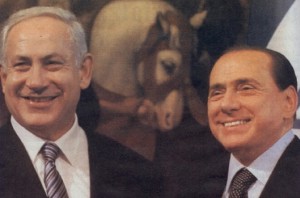
As one pompous ass said to another on Monday: “I can think of few peoples who have contributed more to Western civilization than our two peoples. In both Rome and in Jerusalem, the foundations of Western culture were laid.”

Italian Prime Minister Silvio Berlusconi, at the beginning of a three-day tour of Israel, responded to this self-flattering compliment from Israel’s Prime Minister Benjamin Netanyahu by saying: “We are here to show our recognition and our pride in the fact that we are part of a Judeo-Christian culture that is the basis for European culture.”

Many Israelis might express political contempt for Europe — a reputed well-pool of rising anti-Semitism — yet they still cling to European culture. To be told by a European, as an Israeli diplomat recently was, “we have nothing in common with you,” cuts right to the bone. Without its cherished European and Western identity, Israel has nothing.

This doesn’t say much about European virtues, yet the fact that with increasing frequency prominent Israelis struggle to maintain even a superficially civil bearing, is pushing them outside Europe’s cultural embrace. Israelis are becoming the new barbarians.

Aluf Benn writes:

In a speech at a conference not long ago, an Israeli diplomat serving in a European capital touted Israel’s hoary PR line, distinguishing between “the only democracy in the Middle East” and its autocratic Arab neighbors. “We share common values,” the Israeli told the Europeans. To his surprise, a member of the audience stood up and replied to him: “What common values? We have nothing in common with you.”

In diplomatic conversations, Europeans are critical of Israel because of the Gaza blockade, the construction in the Jewish settlements, the home demolitions in East Jerusalem, the pervasive loathing of the right-wing government and even the social gaps and the way Israel is moving away from the European welfare-state model.

The Netanyahu-Lieberman government is nearly always described as “hard-line” in the foreign media. This is not entirely fair: The government of Ehud Olmert and Tzipi Livni went to war in Lebanon and Gaza and built thousands of apartments for Jews in East Jerusalem and the West Bank settlement blocs – many more than did Netanyahu, who has refrained from employing military force and has declared a 10-month freeze on settlement construction. But they liked the Kadima government because Olmert and Livni made the right noises about their desire for peace and a final status agreement, whereas they don’t believe Netanyahu when he talks about “two states for two peoples.” The fact that Olmert and Livni achieved nothing in the negotiations makes no difference. It’s the intentions that count.

Netanyahu and his aides have answers to the accusations against Israel. The blame for the Gaza blockade lies squarely with the Palestinians, who chose Hamas to reign over them and kidnapped soldier Gilad Shalit. “You are worrying about the humanitarian rights of 1.5 million Palestinians in Gaza. You should be worrying about one Israeli who is being held there,” Netanyahu’s people tell UN representatives.

In East Jerusalem, the government is hiding behind Mayor Nir Barkat and the planning and construction institutions, which are approving building plans for Jews and home demolitions for Palestinians. And for the diplomatic stagnation, it is blaming Palestinian Authority President Mahmoud Abbas, who is refusing to renew the talks.

There is one little problem: The world isn’t buying Israel’s explanations and it isn’t prepared to condemn Palestinian obduracy.

Political scientists Shaul Mishal and Doron Mazza warn of a “white intifada” — apparently they didn’t notice: the West isn’t white anymore — but even if their warning is misnamed, their fear is not misplaced.

The threats to Israel’s legitimacy emanating from the West, may well turn out to be much potent than loudly heralded threats to Israel’s existence coming from the East.

Facebooktwittermail

Greedy bastards

Michael Kinsley, smart as always:

[Rush Limbaugh] said on his radio show that President Obama may be appealing to anti-Semitism with his recent populist criticism of banks and bankers. “There are a lot of people,” Limbaugh said, “when you say banker, people think Jewish.” He didn’t mention Goldman Sachs. Abe Foxman, longtime head of the B’nai Brith Anti-Defamation League, declared that Limbaugh’s remark was “offensive and inappropriate” and “borderline anti-Semitic.” Limbaugh and his defenders protest that Limbaugh clearly was referring to other people, “people who have–what’s the best way to say–a little prejudice about them,” and not endorsing such views himself. And the transcript bears him out.

By Foxman’s standard, even to mention that many bankers are Jewish is anti-Semitic (even though it’s true), and attributing this view to others (while professing to be worried about it) is no excuse This may be over-the top. We live in a culture of umbrage, in which everybody seems to be taking offense at something somebody else says. Foxman is one of the nation’s foremost umbragists.

However, Limbaugh’s supporters make too much of the fact that, read literally, his remarks took the form of defending Jews against unfair maligning. There can be something creepy about “philo-semitism,” or a professed special fondness for Jews. Even when it is sincere (as it may well be in Limbaugh’s case), it rests on an acute feeling of “otherness” about Jews that makes many Jewish Americans rightly uncomfortable.

Sometimes the stereotype about Jews and money takes a harsher form: Jews are greedy, they lie, cheat and steal for money, they have undue influence with the government, which they cultivate and exploit ruthlessly, and so on. In recent weeks, many have said this sort of thing about Goldman Sachs, but with no reference to Jews. Are they all anti-Semites? No. It ought to be possible to criticize Goldman in the harshest possible terms–if you think that’s warranted–without being tarred as an anti-Semite. (Many of Goldman’s harshest critics, unsurprisingly, are Jewish. Jews can be anti-Semites, too.)

Yesterday, I made the pointed observation that Goldman Sach’s CEO, Lloyd Blankfein, appears to meet the CIA’s requirements for becoming the target of a Predator attack: that such an individual poses “a continuing threat to US persons or interests.”

That observation deserves three points of clarification:

1. No, I am not suggesting that the CIA or anyone else “take out” Blankfein. I neither support extrajudicial killing nor even the death penalty.

2. I freely confess that I harbor a prejudice – but it’s not against Jews; it’s against greedy bastards. I don’t give a fig whether any particular greedy bastard happens to be a Jew or a Gentile.

3. My loathing for greedy bastards does not rest on a simple Marxist belief in a need for the equitable distribution of material wealth. Rather, it springs from seeing the corrosive effect on human culture that derives from attaching excessive value to material things.

Yes, we have been fleeced by men like Blankfein, but much worse we have been led to believe that they are models of success – that they and their values deserve the power to shape the society in which we live and the culture that we create. We have been led to forget that the things of real value are things we can certainly lose, but never buy or own.

Facebooktwittermail

Rabbi Yitzhak Shapira’s Jewish supremacism

Rabbi Yitzhak Shapira, was detained for questioning by the Shin Bet (Israel Security Agency) in connection with the burning of a mosque in Yasuf, a village near Nablus, in December. He is head of the Od Yosef Chai Yeshiva in Yitzhar, and is a disciple of Rabbi Yitzhak Ginsberg. The Jerusalem Post reports:

While religious Zionists are primarily concerned with the issue of evacuating settlements, the students at Od Yosef Chai also see IDF ethics as problematic because they are based on “western” or “Christian” morality that equates Jewish lives with those of non-Jews.

In sharp contrast to the Goldstone Report, which criticizes the IDF for purportedly committing “war crimes” against Palestinians during Operation Cast Lead, Od Yosef Chai’s criticism of the IDF is totally different.

IDF battlefield ethics are seen as immoral not because they allow for the killing of innocent bystanders but because they force Jewish soldiers to needlessly endanger themselves to protect gentiles.

The measures taken by the IDF to protect non-combatants, such as using ground forces to weed out terrorists embedded in highly populated civilian areas so as to minimize collateral damage, are viewed by Shapira as downright evil, because they lead to the needless injury or death of Jewish soldiers.

In his preface to the controversial book Torat Hamelech [The King’s Torah], authored by Shapira and Rabbi Yosef Elitzur, Ginsberg points out the tremendous need to illuminate the fundamental differences between Jew and gentile “at a time when we are obligated to conquer [the land of Israel] from our enemies so that we can act as we need to in the spirit of Torah and so that we can strengthen the spirit of the nation and its soldiers.”

Some of the guidelines mentioned at the back of the book in a section entitled “Conclusions – Chapter Five: The Killing of Gentiles in War,” include the following: “There is a reason to kill babies [on the enemy side] even if they have not transgressed the seven Noahide Laws [to believe in God, not to commit idolatry, murder, theft or adultery, to set up a legal system, and not to tear a limb from a live animal] because of the future danger they may present, since it is assumed that they will grow up to be evil like their parents….”

Facebooktwittermail

Turkey’s Prime Minister Erdogan interviewed on Euronews

Euronews, Ali Ishan Aydin: How do you see the future of Turkey-Israel relations? After all that has happened, do you still think Turkey can mediate between Israel and Syria, and other Arab states?

Prime Minister, Recep Tayyip Erdoğan: Israel should give some thought to what it would be like to lose a friend like Turkey in the future. The way they recently treated our ambassador has no place in international politics. We have done our best for Israel-Syria relations. But now we see Benjamin Netanyahu saying ‘I do not trust Erdoğan, but I trust Sarkozy’. Do you have to give a name? This is diplomatic inexperience, too. Because when you say this… How can I trust you if you say you don’t trust me? We have important ongoing agreements between us. How can these agreements be kept going in this climate of mistrust? I think Israel had better take another look at its relations with its neighbours if it believes it is a world power.

Euronews Nial O’Reilly: In recent days the Israeli foreign ministry has accused you of being a cause of the rising tension between your two countries. In fact, it has accused you of anti-semitism. When you review how you handled this incident, do you feel YOU could have handled it more diplomatically?

Prime Minister, Recep Tayyip Erdoğan: I am telling the truth…And I will keep telling the truth. Turkey has an age-old history as a state. When you talk to such a state you must be careful. When innocent civilians are ruthlessly killed, struck by phosphorus bombs, infrastructure is demolished in bombing and people are forced to live in an open-air prison… we can not see this as compatible with the Universal Declaration of Human Rights, simply human rights, and we can not close our eyes to all this happening. 1-30-10

Facebooktwittermail