Monthly Archives: December 2010

Nigeria to charge Dick Cheney in pipeline bribery case

Bloomberg reports:

Nigeria will file charges against former U.S. Vice President Dick Cheney and officials from five foreign companies including Halliburton Co. over a $180 million bribery scandal, a prosecutor at the anti-graft agency said.

Indictments will be lodged in a Nigerian court “in the next three days,” Godwin Obla, prosecuting counsel at the Economic and Financial Crimes Commission, said in an interview today at his office in Abuja, the capital. An arrest warrant for Cheney “will be issued and transmitted through Interpol,” the world’s biggest international police organization, he said.

Peter Long, Cheney’s spokesman, said he couldn’t immediately comment when contacted today and said he would respond later to an e-mailed request for comment.

Facebooktwittermail

Cables from Beirut

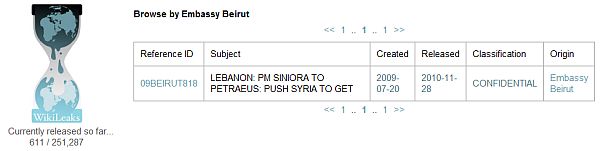
Is WikiLeaks diversifying its cable supply line? As of 8.00PM US Eastern, the WikiLeaks Cablegate site lists just one cable originating from the US Embassy in Beirut.

The Lebanese newspaper Al Akhbar however, has published two other cables from Beirut, here and here. This might imply that WikiLeaks has picked out a handful of cables that it is going to feed to news outlets other than The Guardian, El País, Le Monde, and Der Spiegel.

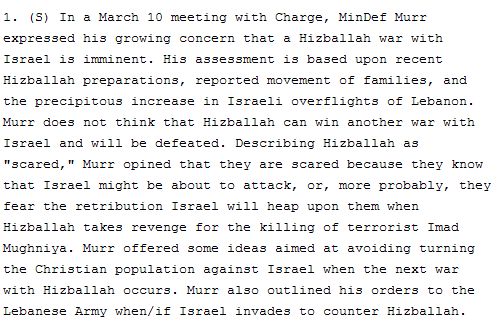
The summary below comes from a March 2008 secret cable and describes a meeting with Elias Murr, then Lebanon’s defense minister and now also deputy prime minister:

Lebanon's Defense Minister Elias Murr told the US the Lebanese army would remain in their bases if Israel launched an assault on Hezbollah

Elias Muhanna on his blog Qifa Nabki, writes:

In the cable mentioned, the Lebanese Minister of Defense Elias al-Murr discusses with U.S. Embassy officials his preparations for an impending war with Israel, which involved sequestering the Lebanese Army in its bases until Hizbullah is destroyed…

What makes this leak especially damning is the fact that al-Murr specifically mentions his meeting with General Michel Sleiman (who, in March 2008, was still the commander of the Lebanese Army, and not yet the President of Lebanon) and talks about sharing his plans with him. Today, al-Murr is considered to be one of the President’s key ministers, so it’s quite possible that the toxic nature of this scandal will spread beyond the Ministry of Defense all the way to the Presidential Palace.

There has been a lot of noise over the past few weeks from March 8 circles to the effect that President Sleiman is no longer considered a “consensual” president (because of his support for Hariri’s bid to table the false witness file until after the STL indictment is released). The Wikileaks scandal is going to provide the perfect excuse for Hizbullah and Aoun to go on the offensive again against the STL and the March 14 camp. I would not be surprised if Sleiman demands al-Murr’s resignation, just to save his own position.

As for whether Hezbollah or anyone else in Lebanon would actually find these machinations surprising, one of Qifa Nabki‘s commenters, “Shai,” is probably right on target when saying:

Seems to me Hezbollah is perfectly happy when the Lebanese Army stays out of the game. What better than to be deemed the sole “defender of Lebanon”? Who could ask such a defender to put down their arms, when the so-called “official army” stays indoors to watch the war on TV?

For Hezbollah, it’s a win-win.

Facebooktwittermail

US State Department now afraid of its own shadow

Craig Murray, former British Ambassador to Uzbekistan, notes:

[D]iplomats as a class very seldom tell unpalatable truths to politicians, but rather report and reinforce what their masters want to hear, in the hope of receiving preferment.

There is therefore [in the cables released by WikiLeaks] a huge amount about Iran’s putative nuclear arsenal and an exaggeration of Iran’s warhead delivery capability. But there is nothing about Israel’s massive nuclear arsenal. That is not because wikileaks have censored criticism of Israel. It is because any US diplomat who made an honest and open assessment of Israeli crimes would very quickly be an unemployed ex-diplomat.

WikiLeaks’ Julian Assange when asked by Time magazine what effect he is seeing from the publication of the diplomatic cables said, among other things:

[W]e can see the Israeli Prime Minister [Benjamin] Netanyahu coming out with a very interesting statement that leaders should speak in public like they do in private whenever they can. He believes that the result of this publication, which makes the sentiments of many privately held beliefs public, are promising a pretty good [indecipherable] will lead to some kind of increase in the peace process in the Middle East and particularly in relation to Iran.

But if Assange actually believes Netanyahu is rallying to the cause of transparency, he’ll be disappointed to read this from Sami Moubayed:

Last summer, Israeli Prime Minister Benjamin Netanyahu signed off on a law extending classification of state archives related to the early years of the Jewish State’s foundation. That means all documents related to the war of 1948 and its monumental aftermath will remain under lock and key until 2018, exactly 70 years after what the Arabs refer to as the Palestinian Nakba, or “Catastrophe.”

Documents about the 1967 Arab-Israeli war will, therefore, remain classified until 2037, while anything related to the 1982 siege of Beirut will remain off-limits until 2052. Records of Yasser Arafat’s 2004 death will not be opened until 2074 while Israeli archives of what happened in Beirut on that fateful day in February 2005, when a massive bomb killed Lebanon’s Prime Minister Rafiq al-Hariri, will hauntingly remain labeled “top secret”” until 2075.

Meanwhile, US government employees are being instructed to shield their eyes from the corrupting influence of US government documents. Christian Science Monitor reports that both State and Defense department employees have been instructed not to visit the WikiLeaks website.

At The Nation, Tom Hayden writes:

Informed sources say that the current deluge of Wikileaks documents will continue for another week and grow in significance.

Leading US human rights lawyers Leonard Weinglass and Michael Ratner have joined the defense team for Julian Assange and Wikileaks. US officials are employing cyber-warfare and prosecutorial steps to deny any safe haven for the Wikileaks operation with a fervor comparable to their drone attacks on Al Qaeda havens in Pakistan and Yemen. WikiLeaks’ Julian Assange was placed on Interpol’s “most wanted” list as US authorities intensified efforts to suppress the whistleblower organization’s deluge of classified US diplomatic cables. Assange’s location was not immediately known. His choices are to turn himself in or be tracked down by local police. If outside of Sweden, he could face extradition on charges to stand trial there. Or the US could seek his extradiction on charges of espionage or theft of classified documents.

Two cyber-attacks have been reported against WikiLeaks servers this week. The Justice Department is seeking indictments on espionage charges from a grand jury quietly impaneled this week in arch-conservative Alexandria, Virginia. Assange is in London, facing rape and sexual harrassment charges in Sweden, which he denies. Extradition could be sought by the United States at any time from either venue.

Why is this drama important? Not because of “life-threatening” leaks, as claimed by the establishment, but because the closed doors of power need to be open to public review. We live increasingly in an Age of Secrecy, as described by Garry Wills in Bomb Power, among recent books. It has become the American Way of War, and increasingly draws the curtains over American democracy itself.

Facebooktwittermail

Controversial drug given to all Guantanamo detainees akin to “pharmacologic waterboarding”

At Truthout, Jason Leopold and Jeffrey Kaye report:

The Defense Department forced all “war on terror” detainees at the Guantanamo Bay prison to take a high dosage of a controversial antimalarial drug, mefloquine, an act that an Army public health physician called “pharmacologic waterboarding.”

The US military administered the drug despite Pentagon knowledge that mefloquine caused severe neuropsychiatric side effects, including suicidal thoughts, hallucinations and anxiety. The drug was used on the prisoners whether they had malaria or not.

The revelation, which has not been previously reported, was buried in documents publicly released by the Defense Department (DoD) two years ago as part of the government’s investigation into the June 2006 deaths of three Guantanamo detainees.

Army Staff Sgt. Joe Hickman, who was stationed at Guantanamo at the time of the suicides in 2006, and has presented evidence that demonstrates the three detainees could not have died by hanging themselves, noticed in the detainees’ medical files that they were given mefloquine. Hickman has been investigating the circumstances behind the detainees’ deaths for nearly four years.

Interviews with mefloquine and malaria experts and a review of peer-reviewed journals and government documents show there were no preexisting cases where mefloquine was ever prescribed for mass presumptive treatment of malaria.

Facebooktwittermail

WikiLeaks reveals British government colluded with the US to deceive the British parliament and evade cluster bomb ban

The Guardian reports:

British and American officials colluded in a plan to hoodwink parliament over a proposed ban on cluster bombs, the Guardian can disclose.

According to leaked US embassy dispatches, David Miliband, who was Britain’s foreign secretary under Labour, approved the use of a loophole to manoeuvre around the ban and allow the US to keep the munitions on British territory.

Unlike Britain, the US had refused to sign up to an international convention that bans the weapons because of the widespread injury they cause to civilians.

Seumas Milne writes:

[B]eyond the dispatches on Prince Andrew’s crass follies and Colonel Gaddafi’s “weirdness”, the leaks do paint a revealing picture of an overstretched imperial system at work, as its emissaries struggle to keep satraps in line and enemies at bay.

Much has been made of the appalling damage supposedly done to the delicate business of diplomacy. No doubt the back channels will survive the shock of daylight. But in any case the United States is the centre of a global empire, a state with a military presence in most countries which arrogates to itself the role of world leader and policeman.

When genuine checks on how it exercises that entirely undemocratic power are so weak at home, let alone in the rest of the world it still dominates, it’s both inevitable and right that people everywhere will try to find ways to challenge and hold it to account.

After the Russian revolution, the secret tsarist treaties with Britain and France were published to expose and challenge the colonial carve-ups of the day. In the 1970s, the publication of the Pentagon papers cut the ground from beneath the US case for the Vietnam war. Now technology is allowing such exposures on a far grander scale.

Clinton complained this week that the leaks “tore at the fabric” of government and good relations between states. Far more damaging is her own instruction to ordinary US diplomats to violate the treaties the US government has itself signed and spy on UN officials, along with any other public figure they happen to meet: down to their credit card details, biometric records – and even frequent-flyer account numbers.

Not surprisingly, US allies and client states come out badly from the leaks.

Facebooktwittermail

WikiLeaks shows America’s imperious attitude to Pakistan

Simon Tisdall writes:

Pakistan was already under the American hammer before the WikiLeaks crisis blew. But leaked US diplomatic cables published by the Guardian show the extraordinary extent to which Pakistan is in danger of becoming a mere satrapy of imperial Washington.

The US assault on Pakistani sovereignty, which is how these developments are widely viewed in the country, is multipronged. At one end of the spectrum, in the sphere of “hard power”, US special forces are increasingly involved, in one way or another, in covert military operations inside Pakistan.

These troops are being used to help hunt down Taliban and al-Qaida fighters in the tribal areas and co-ordinate drone attacks, as revealed by the Guardian’s Pakistan correspondent, Declan Walsh. Their activities come in addition to previous air and ground cross-border raids; and to the quasi-permanent basing of American technicians and other personnel at the Pakistani air force base from which drone attacks are launched.

The US hand can be seen at work in Pakistan’s complex politics, with the standing and competence of President Asif Ali Zardari seemingly constantly under harsh review.

The Guardian reports:

Pakistan’s army chief, General Ashfaq Kayani, considered pushing President Asif Ali Zardari from office and forcing him into exile to resolve a political dispute, the US embassy cables reveal.

Kayani aired the idea during a frantic round of meetings with the US ambassador Anne Patterson in March 2009 as opposition leader Nawaz Sharif rallied thousands of supporters in a street movement that threatened to topple the government.

Kayani said that while he disliked Zardari, he distrusted Sharif even more, and appeared to be angling for a solution that would prevent the opposition leader from coming to power.

Syed Saleem Shahzad reports that a decision on a major military operation that the US is pressing Pakistan to launch in North Waziristan now rests in Kayani’s hands.

The real American pressure on Pakistan to mount a military operation in North Waziristan began in October 2009, but Pakistan stalled.

In the meantime, the US tried to initiate talks with the Taliban, which gave Pakistan further reason to delay taking action. By October this year, the US had come to realize that the wish to talk to the Taliban was a mirage, and in a strategic dialogue in Washington the US made a clear demand for Kiani to let loose his men.

In November, Richard Holbrooke, the US’s special representative for Afghanistan and Pakistan, announced the US would reallocate US$500 million in aid funds to benefit flood victims – a clear encouragement for Pakistan.

Kiani could not be that easily swayed – the reality remained that even firing a single shot in North Waziristan would mean opening up a battle front. He advocated that such a momentous decision should be taken by parliament.

Kiani put out feelers for this. First, he contacted the president of the second-largest political party, the Pakistan Muslim League, and the chief minister of Punjab, the largest province, Shebaz Sharif, the younger brother of former premier Nawaz Sharif. He is a progressive politician and committed against militancy, especially since the recent attacks on shrines in Punjab. However, Shebaz said it would not be wise for Pakistan to exhibit such a political will. He, however, assured the army chief of his support.

Minister of Interior Rahman Malik, a close aid of President Asif Ali Zardari, expressed the same sentiment. Similarly, Prime Minister Yousuf Raza Gilani, when asked about an operation in North Waziristan, threw the ball into the army’s court. “The military chief is fully empowered to take any decision regarding military operations.”

A Pakistani counter-terrorism official involved in the recent unsuccessful peace overtures with the Taliban commented, “The Pakistan army was trying to make ground with the Taliban for negotiations, but now the Americans have abandoned everything and are pushing for an operation.

“They had said they wanted to speak to the ‘good’ Taliban, but the Haqqani network is no longer defined as good. If an operation is begun in North Waziristan, no matter how low-intensity, any chance for an end game through peace negotiations is gone. They cannot be switched on again and off again at will,” the official said.
Kiani is in an unenviable position – damned if he mobilizes his troops, damned if he does not, and abandoned by his political masters.

Facebooktwittermail

When lives are at stake and governments choose to guard our ignorance

Gary Anderson, a retired US Marine colonel, says that Julian Assange is an enemy combatant and is “as much an enemy to the United States as any Al Qaeda operative.”

Not long ago an Esquire headline writer posed the question: “Should we execute Julian Assange?” “We” being the national American vigilante?

“Lives are at risk” is one of those fire-alarm imperatives that drains blood from the brain. It sets arms and legs and vocal chords in motion, fixes the mind on red-light conclusions and turns quiet deliberation into an unaffordable luxury.

A few years ago in Reader’s Digest, Michael Crowley rang the same alarm bell when he demanded that life-threatening websites like Cryptome (a sibbling of WikiLeaks) be shutdown.

To understand what nuts and zealots can do with this sort of information [available through sites like Cryptome], recall what happened in the early 1990s when three abortion doctors were killed after pro-life extremists created “wanted” posters displaying the physicians’ names and photographs. A few years later, a website showed pictures of other abortion doctors, and listed the murdered ones with their names crossed out. Eventually the site’s Web server shut it down.

Having been an outlet for State Department and CIA propaganda in the 1940s and 50s, Reader’s Digest was already on shaky ground positioning itself as a champion of public interest, but it was the Department of Justice which revealed that on occasions Reader’s Digest itself had been a source of dangerous information.

A 1997 DoJ report on the availability of bombmaking information made it evident that the necessary know-how was not hard to come by.

Stories of crimes contained in popular literature and magazines also constitute a rich source of bombmaking information. For example, the August 1993 edition of Reader’s Digest contains an account of efforts by law enforcement officers to track down the killer of United States Court of Appeals Judge Robert S. Vance and attorney Robert Robinson. That article contained a detailed description of the explosive devices used by the bomber in committing the murders, including such information as the size of the pipe bombs, how the bombs were constructed, and what type of smokeless powder was used in their construction. According to the Arson and Explosives Division of the Bureau of Alcohol, Tobacco and Firearms, in a bombing case originating in Topeka, Kansas, the devices were patterned after the bomb used to kill Judge Vance. Upon questioning, the suspect admitted to investigators that he constructed the bomb based on information contained in the Reader’s Digest article.

As Daniel Ellsberg notes, in its efforts to clamp down on embarrassing leaks, the government’s first recourse is invariably to declare that “lives are at stake”

That’s a script that they roll out — every administration rolls out — every time there’s a leak of any sort. The best justification they can find for secrecy is that lives are at stake. Actually lives are at stake as a result of silence and lies which a lot of these leaks reveal.

In the latest revelations from WikiLeaks, the dangers of secrecy are no more clearly evident than in what we now learn about the vulnerability of Pakistan’s nuclear stockpiles — an issue we have previously been repeatedly assured poses no immediate risk. Secretly, we now learn, America’s leading diplomats in Pakistan did not share the confidence that the administration wanted to instill among Americans whose ignorance it preferred to guard.

Less than a month after President Obama testily assured reporters in 2009 that Pakistan’s nuclear materials “will remain out of militant hands,” his ambassador here sent a secret message to Washington suggesting that she remained deeply worried.

The ambassador’s concern was a stockpile of highly enriched uranium, sitting for years near an aging research nuclear reactor in Pakistan. There was enough to build several “dirty bombs” or, in skilled hands, possibly enough for an actual nuclear bomb.

In the cable, dated May 27, 2009, the ambassador, Anne W. Patterson, reported that the Pakistani government was yet again dragging its feet on an agreement reached two years earlier to have the United States remove the material.

She wrote to senior American officials that the Pakistani government had concluded that “the ‘sensational’ international and local media coverage of Pakistan’s nuclear weapons made it impossible to proceed at this time.” A senior Pakistani official, she said, warned that if word leaked out that Americans were helping remove the fuel, the local press would certainly “portray it as the United States taking Pakistan’s nuclear weapons.”

The fuel is still there.

It may be the most unnerving evidence of the complex relationship — sometimes cooperative, often confrontational, always wary — between America and Pakistan nearly 10 years into the American-led war in Afghanistan. The cables, obtained by WikiLeaks and made available to a number of news organizations, make it clear that underneath public reassurances lie deep clashes over strategic goals on issues like Pakistan’s support for the Afghan Taliban and tolerance of Al Qaeda, and Washington’s warmer relations with India, Pakistan’s archenemy.

The issue here, however, is more complex than transparency vs secrecy. While the dangers posed by nuclear stockpiles in Pakistan — and for that matter anywhere else — should concern everyone, the overbearing relationship between the US and a client state which it has turned into a theater for remote war, has fed popular and well-founded suspicion about the intentions of the US government. Pakistanis widely believe that the United States is intent on stealing the Islamic republic’s nuclear crown jewels. Those suspicions will now be further compounded as Pakistan’s government struggles to placate competing international and domestic fears.

If transparency is the buzzword of this political moment, maybe it should be seen as a signal that a larger issue is in desperate need of remedying — an issue that WikiLeaks cannot address: that the need for transparency is symptomatic of a global deficit in trust.

We have repeatedly been given reason to expect that government leaders, corporations and other powerful institutions cannot be trusted. WikiLeaks now fuels that mistrust and those who feel threatened can either shrink behind the barricades of secrecy or acknowledge that they must address the monumental task of building confidence in the fragile idea of public service.

Facebooktwittermail

Is Yossi Melman linking WikiLeaks to Mossad?

In The Independent yesterday, Yossi Melman made an intriguing statement. Melman is the intelligence and military affairs correspondent for Haaretz and generally regarded as well informed on the operations of Mossad. He wrote:

Three events – not seemingly related – took place yesterday. The leaking of State Department documents, many of which deal with the world’s concerns about Iran’s nuclear programme; the mysterious assassination in Tehran of a top Iranian nuclear scientist and the wounding of another, and the appointment of Tamir Pardo as the new head of Mossad, Israel’s foreign espionage agency.

But there’s a link between them. They are part of the endless efforts by the Israeli intelligence community, together with its Western counterparts including Britain’s MI6 and America’s CIA, to sabotage, delay and if possible, to stop Iran from reaching its goal of having its first nuclear bomb.

In the rest of his article he focused on the assassins in Tehran and says that it is “obvious” that “Israel was behind it.” He does not amplify on this part of his opening assertion, namely, that the leaking of State Department cables is part of the effort to stop Iran developing nuclear weapons. However you read it, he seems to be suggesting that WikiLeaks is in some way part of the effort.

Interestingly, a request for a debate on WikiLeaks in the Israeli parliament has been rejected.

The Knesset will not hold a debate on WikiLeaks, despite a request by a number of parliamentarians for a session on leaked U.S. cables that has rocked the diplomatic world.

The Knesset Presidium, the body which regulates plenary debates in Israel’s parliament, turned down a request from a number of members for a session on the consequences of the leaks for national security.

Among the WikiLeaks disclosures were an Israeli plan to coordinate its 2008 invasion of Gaza with Palestinian President Mahmoud Abbas and details of Israel’s covert ties with governments in the United Arab Emirates.

Facebooktwittermail

“Terrorism” is now a fabrication of a national security state

This is not a conspiracy theory. To say that terrorism is a fabrication of a national security state is to say that when the label “terrorist” starts being indiscriminately applied to anyone who threatens the government we have taken another step towards totalitarianism.

Rep. Peter King, R-N.Y., the incoming chairman of the House Committee on Homeland Security, is calling for WikiLeaks to be designated a terrorist organization.

At Slate, David Weigel writes:

As Republicans come into power, they’re going to explore what can be done. They can’t do much. But let’s be honest. The quest to find some way to define Assange’s group as terrorists is not about fighting terrorism. It’s about indulging the fantasy, well put by Cornell law professor William Jacobson, of Assange being hunted down like a Robert Ludlum villain and possibly “killed while resisting arrest.”

And all of this assumes there’s something talismanic about declaring someone a “terrorist.” In reality, American agents could capture any boogeyman they wanted and prosecute him in the United States. The 1992 decision in U.S. v. Alvarez-Machain affirmed that the government was within its rights when a Mexican citizen was abducted and brought to the U.S. to be tried for the murder of a Drug Enforcement Administration agent. “We have kidnapped people to bring them to justice,” explains David Cole, a law professor at Georgetown. “Whether it applies in this case, I don’t know.”

It probably doesn’t. What’s being lost in the James Bond scenarios about taking down WikiLeaks is that its current, highly embarrassing leaks don’t actually threaten American intelligence assets. They create problems for diplomats, and by extension they embarrass the United States. They cause the State Department to lose face. That’s not terrorism as we define it.

So how does King or anyone else turn Julian Assange into a terrorist? They either have to define terrorism in some real way that would eventually open up media organizations to terror charges of their own, or WikiLeaks actually has to do something materially to benefit terrorists. Neither scenario seems likely. What is likely: None of this gets past the shouting stage.

Weigel’s analysis may be sound in the short term but the broader question is not legal. It is whether in American popular discourse the term “terrorist” continues to acquire legitimacy in broader and broader applications or whether those who criticize the term’s flagrant abuse are able to shout louder and get more widely heard. So far the terrorists are winning.

Facebooktwittermail

Real hope is about doing something

Chris Hedges writes:

On Dec. 16 I will join Daniel Ellsberg, Medea Benjamin, Ray McGovern and several military veteran activists outside the White House to protest the futile and endless wars in Iraq and Afghanistan. Many of us will, after our rally in Lafayette Park, attempt to chain ourselves to the fence outside the White House. It is a pretty good bet we will all spend a night in jail. Hope, from now on, will look like this.

Hope is not trusting in the ultimate goodness of Barack Obama, who, like Herod of old, sold out his people. It is not having a positive attitude or pretending that happy thoughts and false optimism will make the world better. Hope is not about chanting packaged campaign slogans or trusting in the better nature of the Democratic Party. Hope does not mean that our protests will suddenly awaken the dead consciences, the atrophied souls, of the plutocrats running Halliburton, Goldman Sachs, ExxonMobil or the government.

Hope does not mean we will halt the firing in Afghanistan of the next Hellfire missile, whose explosive blast sucks the oxygen out of the air and leaves the dead, including children, scattered like limp rag dolls on the ground. Hope does not mean we will reform Wall Street swindlers and speculators, or halt the pillaging of our economy as we print $600 billion in new money with the desperation of all collapsing states. Hope does not mean that the nation’s ministers and rabbis, who know the words of the great Hebrew prophets, will leave their houses of worship to practice the religious beliefs they preach. Most clerics like fine, abstract words about justice and full collection plates, but know little of real hope.

Hope knows that unless we physically defy government control we are complicit in the violence of the state. All who resist keep hope alive. All who succumb to fear, despair and apathy become enemies of hope.

Facebooktwittermail