Monthly Archives: December 2010

The racist wave overflowing Israel

Ynet reports:

After a rabbis’ letter instructing Jews to not sell or rent apartments to Arabs, racist behavior reaches new low: An organization called Jews for a Jewish Bat Yam is expected to protest on Monday against the “assimilation of young Jewish women with Arabs living in the city or in nearby Jaffa.”
[…]
During the past week, posters have been hung around the city calling residents to come out and protest. Some of the posters explain: “I will not allow them to hit on my sister! What would you do if an Arab hit on your sister? Put an end to it! Recently we have learned of a grave phenomenon: Hundreds of girls from Bat Yam and the center get together with Arabs, they are integrated amongst us, their confidence rising. Put an end to it! Lower their confidence!”

Another poster reads: “Keeping Bat Yam Jewish. Arabs are taking over Bat Yam, buying and renting apartments from Jews, taking and ruining Bat Yam girls! Around 15,000 Jewish girls have been taken to villages! Jews, come on, let’s win!”

Facebooktwittermail

Why a nuclear Iran could be good for the US

Chan Akya presents an interesting argument — even if no one in Washington would be so bold as to articulate such thoughts.

Most of the hijackers on September 11, 2001, were of Saudi origin and despite nominally falling under the leadership of Osama bin Laden it stands to reason that they were mainly disenchanted due to the stifling anti-democracy of Saudi Arabia and the inherent hypocrisy of Wahhabism in a country that spent most of its time kowtowing to the Americans.

Fearing the tactical nightmare of dealing with hundreds if not thousands of these disaffected youth, America and Europe chose to make the strategic blunder of supporting the crumbling monarchies as long as they attacked their own youth. This was a stupid bargain, to put it mildly.

A sustainable situation would be to engender wider regime change in the Middle East by booting out the creaking and corrupt monarchies, to be replaced progressively with Islamic leaders capable of taking a development-oriented approach to their countries. To ensure this new generation of Middle East leaders do not get overly tempted by the possibilities of attacking America or Israel, it would be necessary to have a “natural” check in the region – namely Iran.

Facebooktwittermail

WikiLeaks and the hypocrisy of the Obama administration

Maximilian Forte writes:

A regime that banishes truth, shuts down accountability, and ignores its own laws, is a regime that invites anything but peace.

Soon after taking office, President Barack Obama declared on the White House website, on a page devoted to “Transparency and Open Government,” that his,

Administration is committed to creating an unprecedented level of openness in Government. We will work together to ensure the public trust and establish a system of transparency, public participation, and collaboration. Openness will strengthen our democracy and promote efficiency and effectiveness in Government.

Obama then clearly stated, in a section headed by “Government should be transparent,” that, “Transparency promotes accountability and provides information for citizens about what their Government is doing.”

This was not a once-off statement, an accident. It was repeated. On 20 January 2009, on the White House blog, his administration stated, in a section titled “Transparency”: “President Obama has committed to making his administration the most open and transparent in history.” (Unlike the blog of Iranian President Ahamdinejad, the White House blog is closed to comments—and I would have linked to Ahmadinejad’s, except American hackers believe you should not be allowed to see his blog.)

What “transparency” there has been comes in the form of a massive deluge of data that should always be publicly accessible—being about the public itself, and hardly about Obama’s government. Moreover, it is data in such quantity, unsorted and out of context, that no one except one dedicated computer scientist has been able to make much use of, and it proves to be pretty banal stuff.

When it comes to Freedom of Information Access requests, one year into his presidency, with its promise of greater government transparency, “the Obama administration is more often citing exceptions to the nation’s open records law to withhold federal records even as the number of requests for information declines” (source). Major government agencies cited an executive exemption from FOIA at least 70,779 times during the 2009 budget year, up from 47,395 times during President George W. Bush’s final full budget year (source)—the most transparent government in American history is in fact more secretive than Bush’s. Indeed, as AP reported, “the administration has stalled even over records about its own efforts to be more transparent” (source).

Facebooktwittermail

History is repeating itself in Afghanistan

Patrick Cockburn writes:

During the mid-1960s, America’s goal during a crucial stage in the Vietnam war was to defeat the enemy militarily. But it had no realistic political strategy to underpin the goal, and it was this which ultimately led to failure.

America’s strategy in Afghanistan is now suffering from a similar weakness. Barack Obama made the edgy claim this week that the US army is stabilising the military situation, but neither he nor his national security advisers show any signs of understanding the speed at which,politically, the US is losing ground.

Again and again in Kabul one hears Afghans say that the Taliban may not be liked, but that the Afghan government and its US allies are increasingly distrusted, even hated, by the mass of the population. It is this rapidly increasing disaffection, underestimated by foreign governments, that enables a maximum of 25,000 Taliban to hold their own against 140,000 US-led foreign troops in addition to the Afghan government’s army and police. Instead of giving priority to seeking a feasible political approach, the current US strategy is to eliminate the Taliban as an effective military organisation. American generals claim they are beginning to turn the tide by an offensive against enemy strongholds in southern Afghanistan and through the systematic killing of local Taliban commanders by US special forces.

Body counts of enemy dead, a notorious and discredited measure of success in Vietnam, are back in favour. The US military proudly announced this week that it had killed 952 Taliban and captured 2,469 in the 90 days up to the beginning of December. One general boasted: “Every 24 hours on average, we’re killing three to five mid-level enemy leaders.”

Bizarrely, it is the US commander in Afghanistan, David Petraeus, who is leader of this campaign which aims for success through military force alone. Yet it was General Petraeus, lauded as the architect of the military surge in Iraq, who emphasised that in counter-insurgency the US cannot kill its way to victory. As the author of the much-praised field manual for the US armed forces, he stated that success in counter-insurgency is four-fifths political and only one-fifth military action.

Facebooktwittermail

Enforcing ignorance by design

Agence France Presse reports:

The Pentagon has banned journalists with the popular defense daily Stars and Stripes from consulting leaked diplomatic cables published by WikiLeaks, prompting charges of censorship.

“The editorial independence of Stars and Stripes and its readers’ right to news free of censorship are being threatened by an overly broad and misdirected response to the Wikileaks debacle,” the daily wrote.
“Amazingly, the government wants to bar this newspaper’s journalists — along with most federal workers — from reading information already plastered all over the public square.”

In the article, the daily’s ombudsman Mark Prendergast revealed that the Pentagon communications department had advised that “access to any classified information hosted on non-DoD systems from any government-owned system is expressly prohibited” even if it was now in the public arena.

Although Stars and Stripes is officially authorized by the Pentagon it is editorially independent and its journalists are guaranteed the right of freedom of expression contained in the US Constitution.

Mark Prendergast writes:

Putting reporters and editors under strictures intended for keepers of the nation’s secrets contradicts the fundamental purpose of journalism: to seek information, not avoid it.

More pointedly, this action imperils the editorial independence and First Amendment freedoms that Congress demanded of the Pentagon for Stars and Stripes two decades ago and then acted to ensure by authorizing an ombudsman to provide “aggressive and objective oversight.”

Journalists are supposed to report before they write. That means gathering as much information as they can – in breadth and depth – and consulting primary sources whenever feasible.

That might mean an editor clicking on Wikileaks to verify information in a wire story. Or an art director doing a screen grab to illustrate that story. Or a reporter reading a document in full for context in assessing a statement about it.

This newspaper needs to report more, not less.

Yet the government is demanding the opposite – less reporting. That’s enforcing ignorance by design, and that’s not just troubling by journalism standards. It imperils the “free flow of news and information” promised to Stars and Stripes readers.

Facebooktwittermail

Your right to protest is under threat

Johann Hari writes:

So now we know. When our politicians complained over the past few decades, in a low, sad tone, that our young people were “too apathetic” and “disengaged”, it was a lie. A great flaring re-engagement of the young has take place this year. With overwhelmingly peaceful tactics, they are demanding policies that are supported by the majority of the British people – and our rulers are trying to truncheon, kettle and intimidate them back into apathy.

Here’s one example of the intimidation of peaceful protest by the young that is happening all over Britain. Nicky Wishart is a 12-year-old self-described “maths geek” who lives in the heart of David Cameron’s constituency. He was gutted when he found out his youth club was being shut down as part of the cuts: there’s nowhere else to hang out in his village. He was particularly outraged when he discovered online that Cameron had said, before the election, that he was “committed” to keeping youth clubs open. So he did the right thing. He organized a totally peaceful protest on Facebook outside Cameron’s constituency surgery. A few days later, the police arrived at his school. They hauled him out of his lessons, told him the anti-terrorism squad was monitoring him and threatened him with arrest.

The message to Nicky Wishart and his generation is very clear: don’t get any fancy ideas about being an engaged citizen. Go back to your X-Box and X-Factor, and leave politics to the millionaires in charge.

This slow constriction of the right to protest has been happening for decades now. Under New Labour, protesters outside parliament started to have to ask permission and suddenly found themselves prosecuted for “anti-social behaviour.” In 2009, a man who had committed no violence or threats at all died after being attacked by a police officer on the streets of London at a protest – and nobody has ever been punished. Now the Metropolitan Police’s instinctive response to any group of protesters is to surround them and ‘kettle’ – that is, arbitrarily imprison – them for up to ten hours in the freezing cold, with no food, water, or toilets. It doesn’t matter how peaceful you were. You are trapped.

In the past few weeks police officers have been caught responding to a disabled young man with cerebral palsy – who was protesting because his 16 year old brother is now too scared of debt to go to university – by hauling him out of his wheelchair and throwing him to the ground. They even tried to block a severely injured protester in need of brain surgery from being treated at the nearest hospital, on the grounds that police officers were being treated there too and it was ‘upsetting’ to have injured protesters in the same place. Now Sir Paul Stephenson, head of the Met, says a total ban on protests by students is “one of the tactics we will look at.”

These protesters are not defying the will of the British people; they are expressing it.

Facebooktwittermail

Israel/West Bank: separate and unequal

Human Rights Watch:

Israeli policies in the West Bank harshly discriminate against Palestinian residents, depriving them of basic necessities while providing lavish amenities for Jewish settlements, Human Rights Watch said in a report released today. The report identifies discriminatory practices that have no legitimate security or other justification and calls on Israel, in addition to abiding by its international legal obligation to withdraw the settlements, to end these violations of Palestinians’ rights.

The 166-page report, “Separate and Unequal: Israel’s Discriminatory Treatment of Palestinians in the Occupied Palestinian Territories,” shows that Israel operates a two-tier system for the two populations of the West Bank in the large areas where it exercises exclusive control. The report is based on case studies comparing Israel’s starkly different treatment of settlements and next-door Palestinian communities in these areas. It calls on the US and EU member states and on businesses with operations in settlement areas to avoid supporting Israeli settlement policies that are inherently discriminatory and that violate international law.

“Palestinians face systematic discrimination merely because of their race, ethnicity, and national origin, depriving them of electricity, water, schools, and access to roads, while nearby Jewish settlers enjoy all of these state-provided benefits,” said Carroll Bogert, deputy executive director for external relations at Human Rights Watch. “While Israeli settlements flourish, Palestinians under Israeli control live in a time warp – not just separate, not just unequal, but sometimes even pushed off their lands and out of their homes.”

By making their communities virtually uninhabitable, Israel’s discriminatory policies have frequently had the effect of forcing residents to leave their communities, Human Rights Watch said. According to a June 2009 survey of households in “Area C,” the area covering 60 percent of the West Bank that is under exclusive Israeli control, and East Jerusalem, which Israel unilaterally annexed, some 31 percent of Palestinian residents had been displaced since 2000.

Human Rights Watch looked at both Area C and East Jerusalem and found that the two-tier system in effect in both areas provides generous financial benefits and infrastructure support to promote life in Jewish settlements, while deliberately withholding basic services, punishing growth, and imposing harsh conditions on Palestinian communities. Such different treatment on the basis of race, ethnicity, and national origin that is not narrowly tailored to legitimate goals violates the fundamental prohibition against discrimination under human rights law.

Israeli policies control many aspects of the day-to-day life of Palestinians who live in Area C and East Jerusalem. Among the discriminatory burdens imposed on Palestinians that Human Rights Watch found are Israeli practices of expropriating land from Palestinians for settlements and their supporting infrastructure; blocking Palestinians from using roads and reaching agricultural lands; denying access to electricity and water; denying building permits for houses, schools, clinics, and infrastructure; and demolishing homes and even entire communities. Such measures have limited the expansion of Palestinian villages and imposed severe hardships on residents, including leaving them with limited access to medical care.

By contrast, Israeli policies promote and encourage Jewish settlements to expand in Area C and East Jerusalem, often using land and other resources that are effectively unavailable to Palestinians. The Israeli government grants numerous incentives to settlers, including funding for housing, education, and infrastructure, such as special roads. Those benefits have led to the consistent and rapid expansion of settlements, the population of which grew from approximately 241,500 inhabitants in 1992 to roughly 490,000 in 2010, including East Jerusalem.

“While Israeli policy makers are fighting for the ‘natural growth’ of their illegal settlements, they’re strangling historic Palestinian communities, forbidding families from expanding their homes, and making life unlivable,” Bogert said. “The policies surrounding Israel’s settlements are an affront to equality and a major obstacle to ordinary Palestinian life.”

One of the Palestinian communities that Human Rights Watch examines in the report is Jubbet al-Dhib, a village with 160 residents southeast of Bethlehem that dates from 1929. The village is often accessible only by foot because its only connection to a paved road is a rough, 1.5 kilometer-long dirt track. Children from Jubbet al-Dhib must walk to schools in other villages several kilometers away because their own village has no school.

Jubbet al-Dhib lacks electricity despite numerous requests to be connected to the Israeli electric grid, which Israeli authorities have rejected. Israeli authorities also rejected an international donor-funded project that would have provided the village with solar-powered street lights. Any meat or milk in the village must be eaten the same day due to lack of refrigeration; residents often resort to eating preserved foods instead. Villagers depend for light on candles, kerosene lanterns, and, when they can afford to fill it with gasoline, a small generator.

Approximately 350 meters away is the Jewish community of Sde Bar, founded in 1997. It has a paved access road for its population of around 50 people and is connected to Jerusalem by a new, multi-million-dollar highway – the “Lieberman Road” – which bypasses Palestinian cities, towns, and villages, like Jubbet al-Dhib. Sde Bar operates a high school, but Jubbet al-Dhib students may not attend. Settlements are designated closed military areas that may be entered only with special military permits. Residents of Sde Bar have the amenities common to any Israeli town, such as refrigerators and electric lights, which Jubbet al-Dhib villagers can see from their homes at night.

“Palestinian children in areas under Israeli control are studying by candlelight while watching the electric lights in settlers’ windows,” Bogert said. “Pretending that depriving Palestinian kids of access to schools or water or electricity has something to do with security is absurd.”

In most cases where Israel has acknowledged differential treatment of Palestinians – such as when it bars them from “settler-only” roads – it has asserted that the measures are necessary to protect Jewish settlers and other Israelis who are subject to periodic attacks by Palestinian armed groups. But no security or other legitimate rationale can explain the vast scale of differential treatment of Palestinians, such as permit denials that effectively prohibit Palestinians from building or repairing homes, schools, roads, and water tanks, Human Rights Watch said.

Moreover, in addressing security concerns, Israel often acts as if all Palestinians pose a security threat by virtue of their race, ethnicity, and national origin, rather than narrowly tailoring restrictions to specific individuals who are shown to pose a threat. The legal prohibition of discrimination prohibits such broad-brush restrictions.

“The world long ago discarded spurious arguments to justify treating one group of people differently from another merely because of their race, ethnicity, or national origin,” Bogert said. “It’s time for Israel to end its policies of discrimination and stop treating Palestinians under its control markedly worse than Jews in the same area.”

Israel’s highest court has ruled that certain measures against Palestinian citizens of Israel were illegal because they were discriminatory. However, Human Rights Watch is not aware that the courts have adjudicated whether any Israeli practice in the West Bank discriminated against Palestinians, although petitioners have raised such claims in a number of cases.

Human Rights Watch said that the blatantly discriminatory practices make it an urgent matter for donor countries to avoid contributing to or being complicit in the violations of international law caused by the settlements. These countries should take meaningful steps encourage the Israeli government to abide by its obligations, Human Rights Watch said.

Human Rights Watch reiterated its recommendation that the United States, which provides US$2.75 billion in aid to Israel annually, should suspend financing to Israel in an amount equivalent to the costs of Israel’s spending in support of settlements, which a 2003 study estimated at $1.4 billion. Similarly, based on numerous reports that US tax-exempt organizations provide substantial contributions to support settlements, the report urges the US to verify that such tax-exemptions are consistent with US obligations to ensure respect for international law, including prohibitions against discrimination.

Human Rights Watch called on the EU, a primary export market for settlement products, to ensure that it does not provide incentives for settlement exports through preferential tariff treatment, and to identify cases where discrimination against Palestinians has contributed to the production of goods. For example, the report documents how crops exported from settlements using water from Israeli-drilled wells have dried up nearby Palestinian wells, limiting Palestinians’ ability to cultivate their own lands and even their access to drinking water.

The report also describes cases in which businesses have contributed to or benefited directly from discrimination against Palestinians, for example through commercial activities on lands that were unlawfully confiscated from Palestinians without compensation for the benefit of settlers. These businesses also benefit from Israeli governmental subsidies, tax abatements, and discriminatory access to infrastructure, permits, and export channels. Human Rights Watch called on businesses to investigate, prevent and mitigate such violations, including ending any operations that cannot be separated from discriminatory Israeli practices.

“Discrimination of the kind practiced daily in the West Bank should be beyond the pale for anyone,” Bogert said. “Foreign governments and businesses at risk of being tainted by Israel’s unlawful practices should identify and end policies and actions that support them.”

Facebooktwittermail

The campaign to demonize WikiLeaks

Glenn Greenwald writes:

It’s really not an overstatement to say that WikiLeaks and Julian Assange are the new Iraqi WMDs because the government and establishment media are jointly manufacturing and disseminating an endless stream of fear-mongering falsehoods designed to depict them as scary villains threatening the security of The American People and who must therefore be stopped at any cost. So often, the government/media claims made in service of this goal are outright false, which is why I have focused so much on the un-killable, outright lie that WikiLeaks indiscriminately dumped 250,000 diplomatic cables without regard to the consequences (on Thursday, The New York Times, in its article on Assange’s release from prison, re-printed the lie by referencing “Mr. Assange’s role in the publication of some 250,000 American diplomatic documents” only to delete it without any indication of a correction in the final version of the article, while the always-conventional-wisdom-spouting Dana Milbank in The Washington Post — in the course of condemning “the absurd secrecy of the Obama administration, in some ways worse than that of George W. Bush” — today wrote of “Assange’s indiscriminate dump of American government secrets over the last several months – with hardly a care for who might be hurt or what public good was served”).

But this new example from Joe Biden is extraordinary, and reveals how government officials are willing to say absolutely anything — even things they know are false — to demonize WikiLeaks.

Facebooktwittermail

Bradley Manning’s pre-trial punishment

Forbidden to lie down in his cell between 5am to 8pm; forbidden from exercising in the cell inside which he is confined 23 hours a day — these are just two features of the barbaric conditions in which Private First Class Bradley Manning is being confined as he awaits trial. His lawyer describes Manning’s detention.

PFC Manning is currently being held in maximum custody. Since arriving at the Quantico Confinement Facility in July of 2010, he has been held under Prevention of Injury (POI) watch.

His cell is approximately six feet wide and twelve feet in length.

The cell has a bed, a drinking fountain, and a toilet.

The guards at the confinement facility are professional. At no time have they tried to bully, harass, or embarrass PFC Manning. Given the nature of their job, however, they do not engage in conversation with PFC Manning.

At 5:00 a.m. he is woken up (on weekends, he is allowed to sleep until 7:00 a.m.). Under the rules for the confinement facility, he is not allowed to sleep at anytime between 5:00 a.m. and 8:00 p.m. If he attempts to sleep during those hours, he will be made to sit up or stand by the guards.

He is allowed to watch television during the day. The television stations are limited to the basic local stations. His access to the television ranges from 1 to 3 hours on weekdays to 3 to 6 hours on weekends.

He cannot see other inmates from his cell. He can occasionally hear other inmates talk. Due to being a pretrial confinement facility, inmates rarely stay at the facility for any length of time. Currently, there are no other inmates near his cell.

Facebooktwittermail

CIA gave waterboarders $5M legal shield

The Associated Press reports:

The CIA agreed to cover at least $5 million in legal fees for two contractors who were the architects of the agency’s interrogation program and personally conducted dozens of waterboarding sessions on terror detainees, former U.S. officials said.

The secret agreement means taxpayers are paying to defend the men in a federal investigation over an interrogation tactic the U.S. now says is torture. The deal is even more generous than the protections the agency typically provides its own officers, giving the two men access to more money to finance their defense.

It has long been known that psychologists Jim Mitchell and Bruce Jessen created the CIA’s interrogation program. But former U.S. intelligence officials said Mitchell and Jessen also repeatedly subjected terror suspects inside CIA-run secret prisons to waterboarding, a simulated drowning tactic.

The revelation of the contractors’ involvement is the first known confirmation of any individuals who conducted waterboarding at the so-called black sites, underscoring just how much the agency relied on outside help in its most sensitive interrogations.

Facebooktwittermail

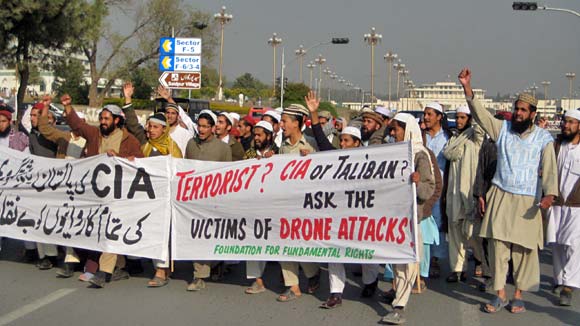
How a secret gets revealed and then becomes secret again

On November 30, The Express Tribune, Pakistan’s first internationally affiliated newspaper (partnered with The International Herald Tribune – the global edition of The New York Times) reported:

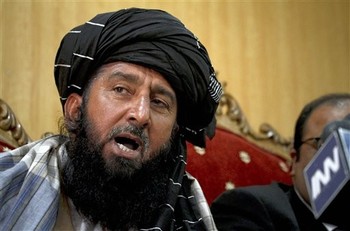
A North Waziristan tribesman, whose brother and teenage son were killed in a drone strike last year, said on Monday that he would sue all those US officials supposedly in control of the predator’s operations in Pakistan.

Karim Khan, a local journalist from Mirali town of the lawless tribal district, had sent a $500 million claim for damages to the US Defence Secretary Robert Gates, CIA chief Leon Panetta and its station head in Islamabad Jonathan Banks.

On December 10, a report appearing in the Miami Herald repeated the same claims:

The lawsuit, which stands little chance of being won, is lodged against the CIA station chief in Islamabad, identified as Jonathan Banks; CIA Director Leon Panetta; and Defense Secretary Robert Gates. There’s speculation that the publicity has compromised the position of the CIA chief in Pakistan. The U.S. Embassy in Islamabad refused to confirm that Banks was the right person.

“What CIA station chief? I can’t talk about employees,” embassy spokesman Alberto Rodriguez said.

But yesterday, the New York Times started reporting like a newspaper that takes directions from the government censors.

Just as in Israel, where secrecy can be imposed through censorship even when the “secret” has been made known everywhere else in the world, the New York Times is now following government directions by refusing to reprint the CIA station chief’s name even though it has been widely reported outside and inside the United States.

The Central Intelligence Agency’s top clandestine officer in Pakistan’s capital, Islamabad, was removed from the country on Thursday amid an escalating war of recriminations between American and Pakistani spies, with some American officials convinced that the officer’s cover was deliberately blown by Pakistan’s military intelligence agency.

The American spy’s hurried departure is the latest evidence of mounting tensions between two uneasy allies, with the Obama administration’s strategy for ending the war in Afghanistan hinging on the cooperation of Pakistan in the hunt for militants in the mountains that border those two countries. The tensions could intensify in the coming months with the prospect of more American pressure on Pakistan.

As the cloak-and-dagger drama was playing out in Islamabad, 100 miles to the west the C.I.A. was expanding its covert war using armed drones against militants. Since Thursday, C.I.A. missile strikes have killed dozens of suspects in Khyber Agency, a part of the tribal areas in Pakistan that the spy agency had largely spared until now because of its proximity to the sprawling market city of Peshawar.

American officials said the C.I.A. station chief had received a number of death threats since being publicly identified in a legal complaint sent to the Pakistani police this week by the family of victims of earlier drone campaigns.

So, before his cover was blown and this cloak-and-dagger drama started playing out, are we to suppose that the CIA station chief was happily cruising round Islamabad in an open-top Cadillac proudly flying the Stars and Stripes on the hood?

Even if the station chief who must now not be named was less exposed before a name which might be his name appeared in print, let’s not pretend he operated in Pakistan with anything less than maximum security.

The Washington Post confirms: “Ordinarily, station chiefs in Islamabad rarely stray beyond the sprawling American diplomatic compound, living and working in a warren of apartments and offices set deep inside the embassy complex’s walls.”

Maybe the issue is not threats to the station chief’s life as much as threats to his liberty. Pakistan’s judicial system, unlike its government, has at times displayed what American officials might regard as an irksome level of independence.

A report in Pakistan’s Daily Mail, published on December 1 (part of which appears below without corrections — the English and editing are rough, but the story is strong), provides interesting background on the legal action being brought by Kareem Khan.

Kareem Khan challenged the precision of drone attacks and specifically questioned the precision of 31st December 2009 attack where in three innocent lives were taken by CIA in a secretive mode. He further challenged that if CIA can establish involvement of any of victims of 31st December attack in terrorism he will pay damages to United States instead.

While talking about the catastrophe he told The Daily Mail how his18 years old son Zaenullah, his young brother Asif Iqbal and a mason who was working on construction of village masque and had came from another village of Khyber Pakhtunkhawa were killed.

Kareem Khan told The Daily Mail that “his family is one of few educated families from the North Waziristan .He himself is M .Phil while his son was employee of Government school in town and his brother was graduate of National University of Modern languages from Islamabad .After compilation of his studies he went back to his town to add his positive contribution in educational uplifting of tribal area. They were innocent Pakistani citizen of Islamic Republic Of Pakistan whose fundamental rights have been guaranteed under the Constitution of Islamic Republic of Pakistan

In the response of one question about the families of victims he told Asif Iqbal left two years old son Muhammad Kafeel and a widow. Mohammad Kafeel has no one to look after as his mother is suffering great emotional and mental trauma. . “I lost my son and brother and now family’s full responsibility is now on me now we are living in uncle’s house waiting for justice or compensation”. He told The Daily Mail

Kareem Khan told the Daily Mail after this tragedy “I went here and there for Justice but all in vain because of undefined and so called system in tribal areas than one of my good friend suggested me to ask for Justice through legal way”. On November 29 2010 I through my lawyer Mirza Shahzad Akbar issued a legal notice to United States Secretary Defence Mr. Robert Gates, Director CIA Leon Panetta CIA Islamabad Station Chief Jonathan Banks for damages of $ 500 Million .he added

He also told that Drone attacks in tribal areas are carried out by CIA in langly, Virginia USA with co-ordination of local intelligence gathered by spies on ground in tribal area. CIA, s Islamabad station Chief, Jonathan Banks coordinates such intelligence through the network of on ground spies, who are paid a hefty amount for pointing out any militant. On these uncorroborated reports, CIA is executing people of tribal areas.

He stated that “CIA Director Leon Panetta has been reported in media saying that ‘Drone attacks are precise and limited in terms of collateral damage’.

“CIA officials are not part of United States armed forces, therefore under international law they are civilians directly participating in hostilities. Furthermore being non-diplomat and non-armed forces members CIA officials, who are operating drone attacks have no immunity and therefore are liable for murder and damages under laws of Pakistan and principles of natural justice throughout the world’ Kareem Khan explained

Kareem Khan also grumbled that media is not playing vibrant role and journalists even don’t bother to find ground realities. Every time we watched in media that numbers of militants are killed in the result of drone attacks. All the time they go for figures they don’t even bother to differentiate the innocent people and militants. Unfortunately they just rely on people who are present there and love to create hype for their own purpose.Kareem Khan gave the example of Hakeem Ullah Mehsood, Jalal Din ,Aimen Alzwari and Sheikh Usamma and told that according to so called reliable sources media published news regarding their, several times deaths . Which is very funny situation because in my limited knowledge a person died once in his or her life .

Shahzad Mirza Akbar ,the legal representative of Kareem khan who was present during the interview told The Daily Mail Drone attacks on house of his client is in clear violation of United Nations declaration of Human Rights ,International Covenant on Civil and Political Rights(ICCRP) and the citizens of Pakistan through the constitution of Islamic Republic of Pakistan .Those who have committed this atrocity are liable to be charged under the Penal Code of Pakistan and no law custom or authority gives CIA the permission to carry out killing in the sovereign territory of another country .So this is illegal act of United States and CIA and cannot be recognized as legal at any judicial or legal forum .The UN special report on extra –judicial ,summery and executions declared in 2004

“Empowering Government to identify and kill “known terrorists” places no verifiable obligation upon them to demonstrate in any way that those against whome lethal force is used are indeed terrorists, or to demonstrate that every other alternative had been exhausted”.

He told Court issued the notice on November 29, 2010 and count down has been started from today .He also talked about next step is to go in American court for justice.

So what’s the story here? Is it about the life of a CIA station chief being placed at risk? Or is it about the struggle among the victims of drone warfare who believe that tribal people should be afforded the same political, legal and human rights and protections as anyone else?

Strangely, the Washington Post and the Wall Street Journal, while acceding to a CIA request not to reprint the station chief’s name, nevertheless provide additional identifying information about him which I have not included here, nor has it appeared in the Pakistani press. That information was, no doubt, provided to them by the CIA!

Facebooktwittermail

The devil’s in the discourse

Nadia Hajib writes:

Three aspects of Secretary of State Hillary Clinton’s Saban Center speech on Friday have escaped general notice. First, though she spoke boldly of asking “tough questions and expecting substantive answers” on the core issues of the conflict, the process will not culminate in a “just, lasting and comprehensive peace” as Clinton claimed, but rather a framework agreement. What is a framework agreement? As defined by United States peace envoy George Mitchell in early September at the short-lived revival of direct Israeli-Palestinian talks, this peculiar American innovation is said to be more than a declaration of principles but less than a full-fledged treaty. It is supposed to establish “the fundamental compromises” that would then be fleshed out in a comprehensive agreement to end the conflict.

This bodes ill for the Palestinians, who have already signed a declaration of principles as well as a dozen other compromise-filled agreements with Israel between 1993 and 2000. Worse, it sounds like they would now be expected to compromise on their right of return, while actual freedom awaits a peace treaty that would then still have to be implemented — who knows when? A second Obama term? Or his successor’s? And meanwhile, Israel would continue to colonize.

Then Clinton, perhaps unwittingly, further exposed the U.S. pretense of even-handedness. She claimed that the Obama administration, like its predecessors, does not accept the “legitimacy of continued settlement activity.” However, some of those predecessors defined all settlements as illegal. This administration’s phrasing, which it has used before, suggests that some settlements are more legitimate than others: it is “continued” activity that is said not to have legitimacy rather than the entire illegal enterprise. This puts the Obama administration in the same camp as George W. Bush, who also supported Israel’s territorial and other ambitions in his April 2004 exchange of letters with former Israeli Prime Minister Ariel Sharon.

Finally, Clinton illustrated how completely the administration has bought into the Israeli discourse. In her eagerness to support an Israel that is both Jewish and democratic, she skated perilously close to racism. She warned that “the long-term population trends that result from the occupation” were endangering the Zionist vision. In other words, that another four million Palestinians might soon demand equal rights in an Israel that has effectively controlled all of mandate Palestine from the Jordan River to the Mediterranean Sea since 1967.

These are murky waters indeed. One cannot imagine a political leader in any real democracy applying the same reasoning to their country. Would U.S. leaders speak of long-term Black, Hispanic, or Muslim population trends that endanger America as a “white and democratic” or as a “Christian” state? In the modern era, democratic states are expected to be constructs in which all citizens are equal under the law, irrespective of race or creed. [Continue reading.]

Facebooktwittermail

If President Obama is sincere …

The Popular Struggle Coordination Committee comments on the Obama administration’s silence on the continued imprisonment of a Palestinian champion of non-violence.

Amid a flurry of European diplomatic attention over the imprisonment of Bil’in’s Abdallah Abu Rahmah, the United States has stayed strangely silent on the issue. Abu Rahmah, a non-violent leader from the West Bank village of Bil’in, has been in an Israeli military jail for over one year stemming from a charge of incitement and illegal protest levied against him after he was arrested in a night raid on his house on December 10th, 2009. After serving his sentence in full, the Israeli military prosecution demanded that he stay in jail while they file an appeal asking for a harsher sentence in order to ‘make an example’ of him.

On Friday, 10 December, AP reporter Matt Lee directly addressed Abdallah Abu Rahmah’s case during a US State Department briefing. US State department spokesman PJ Crowley responded that he was unable to provide a comment on the trial. When Matt Lee pushed, arguing that the EU and other foreign dignitaries had labeled Abu Rahmah a human rights defender, Crowley responded that he will “[find] out what we know.”
At his appeal hearing at the Ofer military court of appeals on 6 December 2010, a dozen European diplomats from France, Spain, the United Kingdom, Germany, Denmark, and Malta were on hand to observe the trial. Sir Vincent Fean gave a short statement to the press, noting his support of EU Foreign Policy Chief Catherine Ashton’s statement labeling Abu Rahmah as a human rights defender. He also pointed out that last month Abu Rahmah had already finished serving his sentence. Last month, British Foreign Minister, William Hague, met with leading Palestinian grassroots organizers in an unprecedented show of support in the face of ongoing Israeli repression.

The current US administration has made repeated statements on the need to support civil society activists, such as the one made by Secretary of State Clinton in July, 2010 the Krakow Community of Democracies meeting, in which she saluted “civil society activists around the world who have recently been harassed, censored, cut off from funding, arrested, prosecuted, even killed.” Clinton explained that when we defend civil society activists “we are defending an idea that has been and will remain essential to the success of every democracy.” She called for action to “protect civil society,” “to do more to defend the freedom of association,” and to “coordinate our diplomatic pressure” “to address situations where freedom of association comes under attack.”

Despite such statements, absent from the diplomatic core were representatives of the United States. In fact, the United States has not yet made any public statements on Abdallah’s imprisonment.

Yesterday, 15 December 2010, the issue of Abu Rahmah was followed up by the AP. Crowley answered that the case is ‘watched closely’ by US representatives in Israel. Far from releasing a statement on Abdallah Abu Rahmah, Crownly confirmed the silent position on Palestinian non-violence that the United States has maintained in recent months.

Facebooktwittermail

How the Afghan counterinsurgency threatens Pakistan

Anatol Lieven writes:

By now, almost all the likely outcomes of US strategy in Afghanistan are bad ones. They range from unending civil war, with government forces barely managing to hold their own against the Taliban, to de facto partition of the country. There is a chance that the Taliban would accept a settlement involving a timetable for the complete withdrawal of US forces and a neutral central government of respected Muslim figures, together with de facto Taliban control of the Pashtun heartland in the south and Western economic aid. In return they would have to promise to exclude Al Qaeda and crack down on opium cultivation in their areas (as they did in 2000).

Given that most ordinary Taliban fighters, as expressed in a survey organized by Graeme Smith of the Toronto Globe and Mail, want the exit of Western troops and a Muslim (but not necessarily Taliban) government, it’s likely that the rejection of such terms by the Taliban leadership would undermine their support on the ground. This solution would, however, be heavily dependent on the help of Pakistan as a mediator and as one of the regional guarantors of the subsequent settlement.

The top leadership of the Afghan Taliban is based in Pakistani Baluchistan under the protection of Pakistani military intelligence, and Pakistan has prevented the United States from launching drone attacks on them there (in contrast with the intensive campaign against targets in the Federally Administered Tribal Areas to the north). Taliban forces use Pakistani territory for rest and recuperation, with the support of the local Pashtun population. Pakistan also has close ties to the two other Afghan Pashtun Islamist forces allied to the Taliban, the Hizb-e-Islami of Gulbuddin Hekmatyar and the Haqqani network in the Afghan region of Greater Paktika. All of this gives Pakistan considerable influence over the Afghan Taliban—though it must be stressed that this influence is also limited. Any settlement brokered by Pakistan would have to be one the Taliban could accept without humiliation.

But if Pakistan is vital to a settlement, Pakistan is also vital in itself. It cannot be emphasized too strongly that the survival of Pakistan, not Afghanistan, is the most important issue for Western and global security in that region. With six times Afghanistan’s population, plus nuclear weapons, a highly trained 500,000-man army and a huge diaspora (especially in Britain), Pakistan would increase the international terrorist threat by orders of magnitude if it collapsed. There is a widespread (though exaggerated) view in the West that the weakness of the Pakistani state and the strength of Islamist support makes the country’s collapse a real possibility. Leaving aside the danger (as exposed by WikiLeaks) of nuclear materials and skills reaching terrorist groups, the disintegration of the Pakistani army, with its highly trained engineers and anti-aircraft forces, would vastly increase the “conventional” terrorist threat to India and the West.

Facebooktwittermail

Israel leaves us no choice but to boycott

Ali Abunimah writes:

Israel’s deputy minister of foreign affairs, Danny Ayalon, paints a picture of an innocent Israel yearning for peace, virtually begging the intransigent Palestinians to come negotiate so there can be a “two-states-for-two-peoples solution” (“Who’s stopping the peace process?” Dec. 14). But it’s one that bears no resemblance to the realities Palestinians experience and much of the world sees every day.

Ayalon claims that the settlements Israel refuses to stop building on occupied land are a “red herring” and present no obstacles to peace because in the “43 years since Israel gained control of the West Bank, the built-up areas of the settlements constitute less than 1.7% of the total area.”

But let us remind ourselves of a few facts that are not in dispute. Since the Palestine Liberation Organization and Israel signed the Oslo peace agreement in 1993, the number of Israeli settlers in the occupied West Bank, including East Jerusalem, has tripled to more than half a million. Ayalon’s deceptive focus on the “built-up areas” ignores the reality that the settlements now control 42% of the West Bank, according to a report last July from the Israeli human rights group B’Tselem.

B’Tselem points out that there are now more than 200 Israeli settlements “that are connected to one another, and to Israel, by an elaborate network of roads.” These roads, along with various “security zones” from which Palestinians are excluded, cut across Palestinian land and isolate Palestinians in miserable and often walled, ghetto-like enclaves.

Facebooktwittermail

Threat of civil war looms in Lebanon

The Guardian reports:

More than six months of menacing political rhetoric is likely to reach a potent day of reckoning in Lebanon soon when indictments are handed down after a five-year investigation to determine who killed the fragile state’s former leader Rafik Hariri.

The indictments are almost certain to implicate at least three members of the militia group and political powerhouse Hezbollah in the 2005 assassination of the elder statesman and patron to the country’s Sunni Muslims.

The potential implications of that have taken Lebanon to a point that veterans of the country’s civil war had vowed never to allow again.

Tensions are palpable on the streets of Beirut, which has cast itself as a city that rose from the ashes of the 15-year conflict as a cosmopolitan and tolerant capital. Now, a generation on, residents of the city and enclaves around the country are demonstrably falling in behind sectarian positions. Many fear that bloodshed cannot be avoided.

“You are not wrong,” said a former president, Amin Gemayel, when asked about a sense of foreboding. “This is the most dangerous period in Lebanon for many, many years.”

“Israel cannot defeat Hezbollah in a direct engagement and the Lebanese guerrilla group would inflict heavy damage on the Israeli home front if war broke out, a former Israeli national security adviser said Thursday,” Reuters reports.

“Israel does not know how to beat Hezbollah,” said Giora Eiland, an army ex-general who served as national security adviser to former prime ministers Ariel Sharon and Ehud Olmert.

“Therefore a war waged only as Israel-versus-Hezbollah might yield better damage on Hezbollah, but Hezbollah would inflict far worse damage on the Israeli homefront than it did 4-1/2 years ago,” he told Israel Radio.
Echoing serving Israeli officials, Eiland said:

“Our only way of preventing the next war, and of winning if it happens anyway, is for it to be clear to everyone … that another war between us and Hezbollah will be a war between Israel and the state of Lebanon and will wreak destruction on the state of Lebanon.

Eiland went on to say: “Our only way of preventing the next war, and of winning if it happens anyway, is for it to be clear to everyone … that another war between us and Hezbollah will be a war between Israel and the state of Lebanon and will wreak destruction on the state of Lebanon.”

He calls this “effective deterrence,” but it can also be viewed as an effort to incite civil war by suggesting to Hezbollah’s enemies that if they don’t break Hezbollah’s power, then everyone in Lebanon will suffer the consequences.

The latest evidence of Israel’s efforts to interfere in Lebanese affairs was revealed yesterday.

Haaretz reports:

Lebanese television published Thursday photos of spy installations that the Lebanese Army had found in mountainous areas near Beirut, showing one of the devices bearing Hebrew writing.

The Lebanese Army said Wednesday it had uncovered two Israeli spy installations in mountainous areas near Beirut and the Bekaa Valley – one on Sannine mountain and another on Barouk mountain.

The photos released Thursday show a device bearing the words “mini cloud” in Hebrew, along with the name of the manufacturer – “Beam Systems Israel Ltd.” – in English.

According to reports, the installations included photographic equipment as well as laser and broadcast equipment.

Earlier Thursday, the Voice of Lebanon radio station reported that the explosion heard in Lebanon late Wednesday was an Israel Air Force operation aimed at destroying an espionage device it had installed off the coast of the city of Sidon.

Amos Harel and Avi Issacharoff add:

Since the beginning of 2009, Lebanese intelligence, with the aid of Hezbollah and apparently Iran, have been trying to uncover what has been called an extensive spy network operating on Israel’s behalf.

More than 100 Lebanese civilians and soldiers have been arrested as part of this effort, including fairly senior Lebanese Army officers.

According to Hezbollah, eavesdropping equipment was planted in the cars of the senior Hezbollah leadership.

Israel has never responded to the reports from Lebanon.

Reports from Lebanon need to be understood in the context of rising political tensions as The Hague’s Special Tribunal for Lebanon prepares to announce an indictment against senior Hezbollah officials in connection with the death of Prime Minister Rafik Hariri, the father of the current premier, Saad Hariri.

The discovery of further supposed Israeli spy activity in Lebanon serves Hezbollah interests by reminding the Lebanese public that Israel, not Hezbollah, is the real enemy.

Facebooktwittermail

The legal assault on WikiLeaks and press freedom

As the Justice Department develops a legal strategy for attacking WikiLeaks it will be looking for political cover to defend itself from the charge that it is attacking the First Amendment rights of a free press and will do so by arguing that what WikiLeaks does is not journalism.

The administration’s lack of interest in defending the Constitution is transparent. The question is, where will the pillars of the American mainstream media establishment take their stand? In defense of a free press? Or will they equivocate because they attach greater value to the privilege of government access than they do to their obligation to serve the public?

Wired reports:

The Justice Department would have no problem distinguishing WikiLeaks from traditional media outlets, if it decides to charge WikiLeaks founder Julian Assange with violating the Espionage Act, a former federal prosecutor told lawmakers Thursday.

“By clearly showing how WikiLeaks is fundamentally different, the government should be able to demonstrate that any prosecution here is the exception and is not the sign of a more aggressive prosecution effort against the press,” said Kenneth Wainstein (pictured at right), former assistant attorney general on national security, during a House Judiciary Committee hearing about WikiLeaks and the Espionage Act on Thursday.

The hearing was the first to publicly address WikiLeaks. It consisted of testimony from legal scholars and attorneys as well as former Green Party presidential candidate and consumer advocate Ralph Nader. Testimony focused primarily on whether the 1917 Espionage Act should be revised to make it easier to prosecute recipients of classified information.

But Wainstein’s remarks, coming from a former prosecutor, hint at arguments the Justice Department is likely to make if it proceeds with prosecuting Assange under the existing Espionage Act.

Facebooktwittermail

The United States: imperial by design

In The National Interest, John Mearsheimer writes:

In the first years after the Cold War ended, many Americans had a profound sense of optimism about the future of international politics. President Bill Clinton captured that mood when he told the UN General Assembly in September 1993:

It is clear that we live at a turning point in human history. Immense and promising changes seem to wash over us every day. The Cold War is over. The world is no longer divided into two armed and angry camps. Dozens of new democracies have been born. It is a moment of miracles.

The basis of all this good feeling was laid out at the time in two famous articles by prominent neoconservatives. In 1989, Francis Fukuyama argued in “The End of History?” that Western liberal democracy had won a decisive victory over communism and fascism and should be seen as the “final form of human government.”1 One consequence of this “ideological evolution,” he argued, was that large-scale conflict between the great powers was “passing from the scene,” although “the vast bulk of the Third World remains very much mired in history, and will be a terrain of conflict for many years to come.” Nevertheless, liberal democracy and peace would eventually come to the Third World as well, because the sands of time were pushing inexorably in that direction.

One year later, Charles Krauthammer emphasized in “The Unipolar Moment” that the United States had emerged from the Cold War as by far the most powerful country on the planet.2 He urged American leaders not to be reticent about using that power “to lead a unipolar world, unashamedly laying down the rules of world order and being prepared to enforce them.” Krauthammer’s advice fit neatly with Fukuyama’s vision of the future: the United States should take the lead in bringing democracy to less developed countries the world over. After all, that shouldn’t be an especially difficult task given that America had awesome power and the cunning of history on its side.

U.S. grand strategy has followed this basic prescription for the past twenty years, mainly because most policy makers inside the Beltway have agreed with the thrust of Fukuyama’s and Krauthammer’s early analyses.

The results, however, have been disastrous. The United States has been at war for a startling two out of every three years since 1989, and there is no end in sight. As anyone with a rudimentary knowledge of world events knows, countries that continuously fight wars invariably build powerful national-security bureaucracies that undermine civil liberties and make it difficult to hold leaders accountable for their behavior; and they invariably end up adopting ruthless policies normally associated with brutal dictators. The Founding Fathers understood this problem, as is clear from James Madison’s observation that “no nation can preserve its freedom in the midst of continual warfare.” Washington’s pursuit of policies like assassination, rendition and torture over the past decade, not to mention the weakening of the rule of law at home, shows that their fears were justified.

To make matters worse, the United States is now engaged in protracted wars in Afghanistan and Iraq that have so far cost well over a trillion dollars and resulted in around forty-seven thousand American casualties. The pain and suffering inflicted on Iraq has been enormous. Since the war began in March 2003, more than one hundred thousand Iraqi civilians have been killed, roughly 2 million Iraqis have left the country and 1.7 million more have been internally displaced. Moreover, the American military is not going to win either one of these conflicts, despite all the phony talk about how the “surge” has worked in Iraq and how a similar strategy can produce another miracle in Afghanistan. We may well be stuck in both quagmires for years to come, in fruitless pursuit of victory.

The United States has also been unable to solve three other major foreign-policy problems. Washington has worked overtime—with no success—to shut down Iran’s uranium-enrichment capability for fear that it might lead to Tehran acquiring nuclear weapons. And the United States, unable to prevent North Korea from acquiring nuclear weapons in the first place, now seems incapable of compelling Pyongyang to give them up. Finally, every post–Cold War administration has tried and failed to settle the Israeli-Palestinian conflict; all indicators are that this problem will deteriorate further as the West Bank and Gaza are incorporated into a Greater Israel.

The unpleasant truth is that the United States is in a world of trouble today on the foreign-policy front, and this state of affairs is only likely to get worse in the next few years, as Afghanistan and Iraq unravel and the blame game escalates to poisonous levels. Thus, it is hardly surprising that a recent Chicago Council on Global Affairs survey found that “looking forward 50 years, only 33 percent of Americans think the United States will continue to be the world’s leading power.” Clearly, the heady days of the early 1990s have given way to a pronounced pessimism.

This regrettable situation raises the obvious questions of what went wrong? And can America right its course? [Continue reading.]

Facebooktwittermail