Monthly Archives: November 2011

The real cost of Israel’s occupation of the Palestinians

Amira Hass reports: The Israeli occupation is exacting a high price on the Palestinian economy, according to a report by the Palestinian Ministry of National Economy and the Applied Research Institute – Jerusalem – which puts the damage at $6.9 billion a year – what it calls a conservative estimate. The figure is about 85% of the Palestinian GDP for 2010, $8.124 billion.

The calculation includes the suspension of economic activity in the Gaza Strip because of Israel’s blockade, the prevention of income from the natural resources Israel is exploiting because of its direct control over most of the territory and the additional costs for the Palestinian expenses due to restrictions on movement, use of land and production imposed by Israel.

The introduction to the report states that the blocking of Palestinian economic development derives from the colonialist tendency of the Israeli occupation ever since 1967: exploitation of natural resources coupled with a desire to keep the Palestinian economy from competing with the Israeli one.

The report was published at the end of September, a few days after Palestinian President Mahmoud Abbas applied for full membership at the United Nations.

Its publication during the period of the High Holidays meant that it was hardly mentioned in the Israeli media.

By quantifying the losses caused by the Israeli occupation, the authors of the report wished to dispel the mistaken impression that has developed over the past two or three years that the Palestinian economy is flourishing naturally, whereas it is in fact supported by donations that make up the cost of the occupation.

The largest chunk of losses to the Palestinian economy is due to the policy of the blockade on Gaza, which is preventing all production and exports. The calculation was made on the basis of a comparison of the rate of growth in the GDP in the West Bank, which in the years prior to the blockade was similar to the growth rate in Gaza. Thus, the authors of the report estimate that in 2010 the gap between the potential GDP in Gaza (nearly $3 billion ) and the actual GDP was more than $1.9 billion. The Palestinian economy, and especially the agriculture sector, is losing a similar sum because of Israel’s discriminatory distribution of water between Palestinians and Israelis. Relying on a 2009 World Bank report, the authors of the current study find that not only did the Oslo accords freeze in place a situation of unequal distribution of water pumped in the West Bank (a ratio of 80:20 ), but also that Israel is pumping more from the western aquifer than was alloted it in the agreement.


Facebooktwittermail

Gaddafi’s son Seif al-Islam seized in southern Libya

The Associated Press reports: Moammar Gadhafi’s son Seif al-Islam was captured in a southern Libyan city along with two of his aides who were trying to smuggle him out of the country, a militia commander said on Saturday.

Bashir al-Tlayeb of the Zintan brigades said that Seif al-Islam was caught in the desert town of Obari, near the southern city of Sabha about 400 miles (650 kilometers) south of Tripoli.

He didn’t elaborate on how Seif al-Islam was captured, but said that he was brought to the city of Zintan, the home of one of the largest revolutionary brigades in Libya.

Al-Tlayeb said that it would be up to the Libya’s ruling National Transitional Council to decide on where the former Libyan leader would be tried.

He also said that there was still no information about wanted former intelligence director Abdullah Senoussi or where he is located.

Seif al-Islam is the last of Moammar Gadhafi’s sons to remain unaccounted for.

Facebooktwittermail

The democratization of drones

Spencer Ackerman writes: In the video above, protesters in Warsaw got a drone’s eye view of a phalanx of police in riot gear during a heated Saturday demonstration. The drone — spotted by Wired editor-in-chief and drone-builder Chris Anderson — was a tiny Polish RoboKopter equipped with a videocamera.

As Chris observes, no more do citizens need to wait for news choppers to get aerial footage of a major event. With drones, they can shoot their own overhead video. But the implications run deeper than that.

The Occupy events around the country gained initial notoriety by filming and uploading incidents of apparent police brutality. Anyone with a cellphone camera and a YouTube account could become a videographer, focusing attention on behavior that cops or banks might not want broadcasted or that the media might not transmit. When the New York Police Department cleared out Zuccotti Park on Tuesday, out came the cellphones to document it.

Getting an aerial view is the next step in compelling DIY citizen video.

The developer and operator of the RoboKopter is Artur Książek and whether his aim was to gather intelligence for the protesters or to market his invention is unclear. The video below shows how the aircraft operates.

Facebooktwittermail

Tested on Palestinians, perfected on #OWS protesters: Introducing the LRAD Sound Cannon

Max Blumenthal writes: Yesterday, the New York Police Department deployed a strange new weapon against the tens of thousands of demonstrators who converged downtown for the largest protest in Occupy Wall Street’s two month history: the LRAD sound cannon. NYPD officers reportedly blasted Occupy protesters with rays from the LRAD cannon while they sang the American national anthem near Lower Manhattan’s Zuccotti Park (photos here), establishing an atmosphere of fear and intimidation that lasted throughout the evening.

Designed and manufactured by the San Diego-based LRAD Corporation, which was formerly known as the American Technology Corporation, the Long Range Acoustic Device sound weapon is the latest innovation in crowd suppression technology. It is portable and powerful, capable of transmitting a focused ray of 140 decibels of sound at a crowd of people, generating painful cranial vibrations so profound ear plugs become useless. According to LRAD promotional material, the sonic weapon “provides military personnel with a powerful, penetrating warning tone that can be followed by clear voice broadcasts in host nation languages to warn and shape the behavior of potential threats.”

In June, LRAD sold $293,000 worth of its 100X and 500X sound canon systems to the Israeli Ministry of Defense. The contract was part of Israeli Army Commander Maj. Gen. Avi Mizrahi’s investment in $35 million in suppression systems in anticipation of widespread unrest in the occupied West Bank that would supposedly be prompted by the Palestinian Authority’s statehood bid at the United Nations.

The Israeli Army has refined the use of LRAD systems on the civilian population of Palestinian villages engaged in the unarmed popular struggle against Israel’s illegal military occupation. Demonstrators in the village of Beit Ummar have been repeatedly assaulted by Israeli forces armed with LRAD systems, including on October 7, when the Israeli army used the LRAD to attack unarmed demonstrators protesting against the abuse and isolation of Palestinian prisoners held in Israeli jails.

Facebooktwittermail

Time to unplug the human microphone

As the Balinese Monkey Chant beautifully demonstrates, timing is everything.

Without timing, we not only lose the ability to dance and make music, but we even impair our ability to speak.

The human microphone had its moment — but it was brief.

Once it passed from being an ingenious adaptation to a prohibition on the use of bullhorns in Ziccotti Park and then became an inflexible emblem of collectivity, it had outlived its usefulness.

Two days ago, Arundhati Roy addressed the People’s University at Judson Memorial Church in New York. The hall was electrically illuminated and, as one would expect in any church, had its own built-in sound system. The podium at which Roy stood had positions for electrically-powered microphones. Even so, in honor of what has quickly become a seemingly sacrosanct form, Roy had to conform to the dictates of the movement and slice her speech into the bite size portions that the human microphone requires.

Roy: Thank you Judson Church, and thank you all for being here.
Audience: Thank you Judson Church, and thank you all for being here.

Roy: Yesterday morning the police cleared Zuccotti Park, but —
Audience: Yesterday morning the police cleared Zuccotti Park…

Roy: but today the people are back.
Audience: but today the people are back.

Roy: The police should know that this protest…
Audience: The police should know that this protest…

Roy: is not a battle for territory.
Audience: is not a battle for territory.

Roy: We are not fighting for the right to occupy a park here or there.
Audience: We are not fighting for the right to occupy a park here or there.

Roy: We are fighting for justice.
Audience: We are fighting for justice.

Roy: Justice, not just for the people of the United States, but —
Audience: Justice, not just for the people of the United States…

Roy: but for everybody.
Audience: but for everybody.

Roy: What you have achieved since September 17…
Audience: What you have achieved since September 17…

Roy: when the Occupy movement began in the U.S…
Audience: when the Occupy movement began in the U.S…

Roy: is to introduce a new imagination…
Audience: is to introduce a new imagination…

Roy: a new political language…
Audience: a new political language…

Roy: into the heart of empire.
Audience: into the heart of empire.

Roy: You have reintroduced…
Audience: You have reintroduced…

Roy: the right to dream…
Audience: the right to dream…

Roy: in a system that tried to turn everybody into zombies…
Audience: in a system that tried to turn everybody into zombies…

Roy: mesmerised into equating mindless consumerism…
Audience: mesmerised into equating mindless consumerism…

Roy: with happiness and fulfilment.
Audience: with happiness and fulfilment.

Roy: As a writer, let me tell you…
Audience: As a writer, let me tell you…

Roy: this is an immense achievement.
Audience: this is an immense achievement.

Roy: And I cannot thank you enough.
Audience: And I cannot thank you enough.

And that was just the introduction.

Just imagine if 48 years ago Martin Luther King Jr had found himself in front of a human microphone stretching down the National Mall in Washington DC. He could have been amplified through the voices of 200,000 people.

But in such repetition, where would the musicality, the cadence, the passion and the perfect timing have been, as his words got squeezed through the mangle of the human microphone?

We each have our own voice and what we utter are much more than strings of words. Our words have rhythm, pitch, and volume as with our tongue and breath we fashion time and express feeling. A carefully chosen pause, a deeply drawn breath, a rising voice — these are not mere embellishments to our words but the very things that make our language human.

Facebooktwittermail

Lessons of the Luddites

Eliane Glaser writes: Two hundred years ago this month, groups of artisan cloth workers began to assemble at night on the moors around towns in Nottinghamshire. Proclaiming allegiance to the mythical King Ludd of Sherwood Forest, and sometimes subversively cross-dressed in frocks and bonnets, the Luddites organised machine-wrecking raids on textile factories that quickly spread across the north of England. The government mobilised the army and made frame breaking a capital offence: the uprisings were subdued by the summer of 1812.

Contrary to modern assumptions, the Luddites were not opposed to technology itself. They were opposed to the particular way it was being applied. After all, stocking frames had been around for 200 years by the time the Luddites came along, and they weren’t the first to smash them up. Their protest was specifically aimed at a new class of manufacturers who were aggressively undermining wages, dismantling workers’ rights and imposing a corrosive early form of free trade. To prove it, they selectively destroyed the machines owned by factory managers who were undercutting prices, leaving the other machines intact.

The original Luddites enjoyed strong local backing as well as high-profile support from Lord Byron and Mary Shelley, whose novel Frankenstein alludes to the industrial revolution’s dark side. But in the digital age, Luddism as a position is barely tenable. Just as we assume that the original Luddites were simply technophobes, it’s become unthinkable to countenance any broader political objections to contemporary technology’s direction of travel.

The promoters of internet technology combine visionary enthusiasm and like-it-or-not realism. So dissent is dismissed as either an irrational rejection of progress or a refusal to face the inevitable. It’s the realism that’s particularly hard to counter; the notion that technology is an unstoppable and non-negotiable force entirely separate from human agency. There’s not much time for political critique if you’re constantly being told that “the world is changing fast and you have to keep up”. Which is a bit rich given that politics infuses the arguments of even technology’s purest advocates.

As Slavoj Žižek has noted, the language of internet advocacy – phrases like “the unlimited flow of information” and “the marketplace of ideas” – mirrors the language of free-market economics. But techno-prophets also use the lingo of leftwing revolution. It’s there in books such as James Surowiecki’s The Wisdom of Crowds and Clay Shirky’s Here Comes Everybody, and in Vodafone’s slogan, “Power to You”; in the notion that blogs, Twitter and newspaper comment threads create a level playing field in the public debate; and it’s there in the countless magazine features about how the internet fosters grassroots protest, places the tools of cultural production in amateurs’ hands, and allows the little guy immediate access to information that keeps political leaders on their toes. This is not Adam Smith, it’s Marx and Mao.

In fact, both rhetorics – of the free market and of bottom-up emancipation – serve to conceal the rise of crony capitalism and the concentration of power and money at the top. Google is busily acquiring “all the world’s information”. Facebook is gathering our personal data for the coming world of personalised advertising. Amazon is monopolising the book trade. The abandonment of net neutrality means corporate control of the web. Once all our books, music, pictures and information are stored in the cloud, it will be owned by a handful of conglomerates.

Facebooktwittermail

Liberty Park can be anywhere

At Open Democracy, Todd Gitlin writes: Since Sept. 17, there have been so many moving parts in the evolving ensemble known as Occupy, each rubbing against the others in a whole ecology of protest, that predictions are foolhardy. But there’s a good chance that the great sprawling hard-to-pin-down Occupy movement is well along in the learning process and that it can gain more than it loses by leaving the Zuccotti/Liberty campground.

The urban planner Peter Marcuse, a strong supporter of the movement, has cautioned against “fetishizing” Zuccotti Park. He usefully distinguishes among seven functions of the movement:

  1. A confrontation function: “taking the struggle to the enemy’s territory, confronting, potentially disrupting, [its] operations.” That means the Wall Street area, for which Zuccotti Park was and remains, obviously, a convenient launch-pad.
  2. A symbolic function as a visible testimonial to a line of argument and a way of looking at the world.
  3. An educational function, promoting debate and clarification, toward the end of clarifying what the 1 percent and the 99 percent mean, and how that infernal cleavage developed.
  4. A glue function, “creating a community of trust and commitment to the pursuit of common goals.”
  5. An umbrella function, “creating a space … in which quite disparate groups can work together in pursuit of ultimately consistent and mutually reinforcing goals — … a political umbrella, an organizing base for an on-going alliance, not just a temporary coalition, of the deprived and discontented.”
  6. An activation function, “inspiring others to greater militancy and sharper focus on common goals and specific demands … providing space for … cross discussions among supporting groups and interests, organizing … events in support of … reforms that point [toward] Occupy’s own ultimate goals of change.”
  7. A model function, “showing, by its internal organization and methods of proceeding, that an alternative form of democracy is possible.”

Hey, whoever said that organizing movements is simple or mindless?

Marcuse goes on to say that only the confrontation function required Zuccotti Park as such, and even that is far from clear. There do need to be meeting places, sites where people of different dispositions brush up against each other and stay in touch. Zuccotti offered advantages — Wall Street proximity, for one — but at a cost: very limited sunlight, leading one prominent supporter I know to publicly call it “hell’s half-acre.” There are other public places, even ones with symbolic resonance. (By some accounts, after all, on Sept. 17, when the occupation began, Zuccotti Park wasn’t the first choice — it was Plan B.) As Peter Marcuse writes, “the defense of the permanent and round-the-clock occupancy of a specific space can lead to a fetishization of space that make the defense of that space the overwhelming goal of the movement, at the expense of actions furthering the broader goals that that space is occupied to advance.”

As for the model function, the utopian, communitarian spirit, it can thrive in many spaces. Now that the symbolism has been established in the public mind, some token encampment through the winter probably makes sense, but Liberty Square can be movable; Zuccotti has no patent on liberty. Anyway, it would be foolhardy to think that the tent-city way of life Zuccotti has promoted is a way of life that the 99 percent cottons to. It’s that 99 percent that needs, continually, to be assured that the movement speaks to and for them.

Facebooktwittermail

A world in protest

At Open Democracy, Paul Rogers writes: The authorities are undertaking a legal and judicial counter-offensive against the “occupy” camps that have sprung up in central locations in New York and London. But scores of camps remain across north America and western Europe, part of a diffuse and dispersed phenomenon that has acquired a life of its own within a few short weeks.

These protests echo others earlier in 2011, including the turbulent actions in Greece and the extensive mobilisations in Spain (see “A time of riot: England and the world”, 11 August 2011). They also connect with developments elsewhere: the mass student demonstrations in Chile that moved from opposition to a failing education system to a much wider campaign against marginalisation, and the protests by middle-class Israelis against their more restricted life-chances (albeit such conditions are still far outranked by the great poverty in the nearby occupied territories, notably Gaza).

This upsurge of demonstrations is largely a response to the renewed economic crisis and to the enduring spectacle of financial institutions paying huge salaries and even larger bonuses to their elites while the majority of populations bear the brunt of government-imposed cuts. More broadly it recalls the large-scale anti-globalisation movement of the late 1990s, not least around the Seattle (1999) and Genoa (2001) summits. This movement receded after 9/11 and the launch of the wars in Afghanistan and Iraq – but it has now returned, albeit in a different guise, as a result of the accumulating economic crises of 2007-11.

These protests, demonstrations and movements may well be sustained or they may (at least in the short term) recede. Yet in a global perspective they reflect two processes that lend them deep importance. [Continue reading…]

Facebooktwittermail

Syria needs mediation, not a push into all-out civil war

Jonathan Steele writes: Syria is on the verge of civil war and the Arab League foolishly appears to have decided to egg it on. The spectre is ugly, as Qatar and Saudi Arabia, the hawks of the Gulf, are joined by the normally restrained King Abdullah of Jordan in taking sides with opponents of Syria’s Assad regime.

Where common sense dictates that Arab governments should seek to mediate between the regime and its opponents, they have chosen instead to humiliate Syria’s rulers by suspending them from the Arab League.

It is no accident that the minority of Arab League members who declined to go along with that decision includes Algeria, Lebanon and Iraq. They are the three Arab countries that have experienced massive sectarian violence and the horrors of civil war themselves. Lebanon and Iraq, in particular, have a direct interest in preventing all-out bloodshed in Syria. They rightly fear the huge influx of refugees that would pour across their borders if their neighbour collapses into civil war.

That war has already begun. The image of a regime shooting down unarmed protesters, which was true in March and April this year, has become out of date. The so-called Free Syrian Army no longer hides the fact that it is fighting and killing government forces and police, and operating from safe havens outside Syria’s borders. If it gathers strength, the incipient civil war would take on an even more overt sectarian turn with the danger of pogroms against rival communities.

Moderate Sunnis in Syria are worried by the increasing militancy of the Muslim Brotherhood and the Salafis who have taken the upper hand in opposition ranks. The large pro-regime demonstrations in Damascus and Aleppo over the past week cannot simply be written off as crowds who were intimidated or threatened with loss of jobs if they did not turn out.

Meanwhile, Syria’s large Christian minority cowers in alarm, fearing to share the fate of Iraqi Christians who were forced to flee when sectarian killing heightened the significance of every citizen’s religious identity and began to overwhelm non-Muslims too. In northern Syria the Kurds are also nervous about the future. In spite of the regime’s long-standing refusal to accept their national rights, most fear the Muslim Brotherhood more.

The Assad regime has made mistake after mistake. Stunned by the first protests this spring, it turned too quickly to force. It blocked international media access and censored its own press and TV, thereby leaving the field free for rumour, exaggeration and the distortions of random footage uploaded on to YouTube. Its offers of dialogue with the opposition were hesitant and seemed insincere. The attacks on Arab embassies in Damascus in recent days were stupid.

As a result, the situation has become increasingly polarised. The regime denounces the externally based opposition, the Syrian National Council which came into existence last month, as a puppet of foreign governments. For its part the council refuses to talk to the regime, insisting that Assad must go. It has started to call for a no-fly zone and foreign intervention on the Libyan model, both of which are a further incitement to civil war. The internal opposition has not gone so far but may be pushed in that direction if the situation continues to sharpen.

The need now is for international mediation before it is too late, with an agenda for a democratic transition that would include guarantees of status and protection for all minorities, including the Alawites from whom the ruling elite comes. The risk of a vengeful takeover by the Sunni majority is too great.

Facebooktwittermail

Armed groups on the rise is Syria as fear of civil war grows

The New York Times reports: For the second day in a row, deserters from the Syrian Army carried out attacks on symbols of the Assad government’s centers of power, targeting the youth offices of the ruling Baath Party on Thursday after firing rocket-propelled grenades on a military intelligence base on Wednesday, activists said.

The attacks, along with fraying relations among Syria’s religious communities, growing international pressure and a relentless crackdown, prompted Russia, Syria’s closest ally, to say that the country was moving closer to a civil war.

The attacks may have been more symbolic than effective, but could mark the increased ability of a growing number of defectors to publicize their exploits. Attacks on government installations — in the southern town of Dara’a and the central city of Homs, for instance — have been reported since the start of the uprising.

The attacks themselves paled before the bloodiest episodes of Syria’s last uprising in the late 1970s and early 1980s. Then, insurgents stormed the office of the Aleppo Artillery School, killing 32 cadets. It was unclear whether anyone was killed or wounded in these attacks, but the constituency of armed strikes and the bold choice of targets has heightened the profile of Syria’s armed insurgency.

The Syrian government did not mention either attack, which activists reported, citing the accounts of local residents. But even without a firm picture of any damage, the attacks were, at a minimum, indicative of determination on the part of military defectors in the face of a crackdown that the United Nations says has killed more than 3,500 people.

Tony Karon writes: [While] the regime is unable to crush the uprising, the opposition still appears to lack the power to topple the regime. The core of Assad’s military remains intact, and willing to carry out the regime’s plan to shoot its way out of the crisis. In the major cities, much of the Sunni urban middle class has remained on the sidelines, while Assad maintains a substantial support base primarily among Syria’s Allawite and Christian minorities, many of whom accept the regime’s portrayal of the opposition as a sectarian Sunni lynch mob.

To the extent that Assad’s repression has pushed the opposition towards an increasingly militarized response, that actually reinforces the regime’s narrative that Syria is in the throes of a sectarian civil war, with Assad casting himself as the protector of Allawites and Christians. On that basis, the regime also appears to have divided the region, with Lebanon, Iraq and Yemen — countries with significant Shi’ite populations, and in the case of Iraq, substantial Iranian influence — having declined to back the original Arab League suspension of Syria. Also, many key leaders of Christian communities in other Arab countries appear to have come out in support of Assad.

Assad can also count on solid backing from Russia, for whom Assad’s Syria is a key geostrategic asset because it provides the Russian navy’s only Mediterranean port, and also from Iran, for which Syria has been the key Arab ally.

But other regional players are raising their pressure on Damascus. The Arab League, with Turkey in attendance, on Wednesday gave Syria three (more) days to act on a deal it claimed to have accepted two weeks ago — but ignored on the ground — to halt repression, withdraw its army from restive towns, and accept Arab monitors. The League suspended Syria’s membership, and sanctions should Damascus fail to comply. Al Jazeera’s Rula Amin reported that last-minute diplomacy by Russia and Iran averted harsher and more immediate measures by the League.

Turkey had a more menacing message ahead of the summit, with officials warning that Syria would “pay a heavy price” for continue killing of its “oppressed people”, and threatening to cut off electrical supplies following an attack on its embassy in Damascus by a pro-Assad mob. Officials in Ankara have begun to speak openly about creating a “buffer zone” inside Syria where it could protect refugees from the crackdown without having to admit them to Turkish territory. That, of course, would mean sending Turkish troops into Syria, and might presage a territorial breakup of Syria into rebel- and regime-controlled areas. But Turkey is waiting for international authorization to take such a step. “It seems out of the question for us to do that on our own,” said an adviser to President Abdullah Gul.

Prime Minister Recep Tayyip Erdogan, who once counted Assad as a personal friend, is now sending a message that the Syrian leader can’t be trusted. “No one any longer expects [Assad’s regime] to meet the expectations of the people and of the international community,” he said Tuesday. “Our wish is that the Assad regime, which is now on a knife edge, does not enter this road of no return, which leads to the edge of the abyss.”

Facebooktwittermail

The Occupy movement now has its iconic image of martyrdom

Occupy activist Dorli Rainey, 84, after being hit with pepper spray during a protest in Seattle. Photograph: Joshua Trujillo - AP

Jonathan Jones writes: Every nascent political movement needs martyrs. Even the sensible British labour movement, whose history is mostly peaceful and overwhelmingly parliamentary, has its memories of the Tolpuddle Martyrs and the Peterloo massacre. Revolutionary traditions fervently venerate their political saints: Irish republicanism has an especially rich pantheon from Pearse and Connolly to Bobby Sands. The Egyptian revolution, less than a year old, already has martyrs including the artist Ahmed Basiony who was shot dead by security forces on 28 January, and whose life and work have since been commemorated at the Venice Biennale.

This week the Seattle police provided the Occupy movement a powerful image of martyrdom. Dorli Rainey was not killed – let’s not overdo any analogies between economic protests in western democracies and the desperate struggle for freedom in Egypt or Syria. She was “only” pepper-sprayed. But she happens to be 84, and photographer Joshua Trujillo happened to be on hand to take a haunting photograph of her reddened eyes and shellshocked expression that subtly and strongly portrays Rainey as a modern martyr.

I am not suggesting this lightly. The martyrdom in Seattle conforms, in Trujillo’s photograph, to the deep religious roots of the idea of suffering for a cause. Rainey resembles a humiliated Christ in this picture. She is supported by two men, one on either side, who both lower their faces – one has his eyes closed in self-protection, the other wears defensive goggles – in what may be a sensible precaution to avoid getting sprayed themselves, but which also looks like a gesture of compassion, of quiet rage and dignified sorrow. It is at once a real moment – the men shielding their eyes while showing her hurt to the camera – and an image straight out of a Christian Renaissance painting.

Facebooktwittermail

Why not break up Citigroup?

Simon Johnson writes: Earlier this week, Richard Fisher, the president of the Federal Reserve Bank of Dallas, captured the growing political mood with regard to very large banks, observing, “I believe that too-big-to-fail banks are too dangerous to permit.”

Market forces don’t work with the biggest banks at their current sizes, because they have great political power and receive almost unlimited, implicit subsidies in the form of protection against downside risks — particularly in times like these, with Europe’s financial situation looking precarious. Mr. Fisher added:

Downsizing the behemoths over time into institutions that can be prudently managed and regulated across borders is the appropriate policy response. Then, creative destruction can work its wonders in the financial sector, just as it does elsewhere in our economy.

Mr. Fisher is a senior public official and also someone with a great deal of experience in financial markets, including running his own funds-management company. I increasingly meet leading figures in the financial sector who share Mr. Fisher’s views, at least in private.

Facebooktwittermail

The threat of solidarity — when power becomes afraid of the people

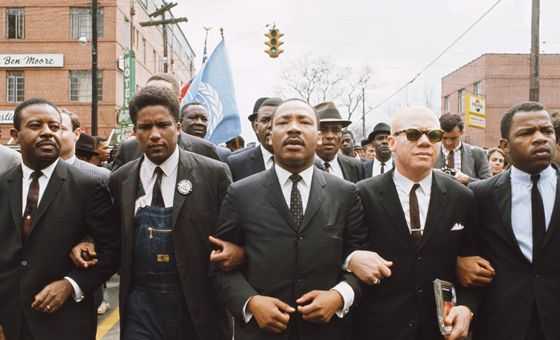
Martin Luther King Jr leading civil rights march from Selma to Montgomery, 1965

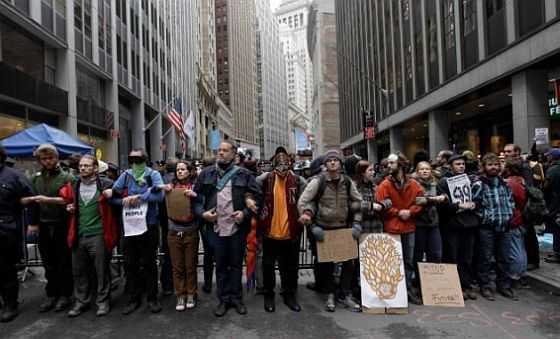
The 99% shut down Wall Street, November 17, 2011

Students lock arms before police assault, University of California at Berkeley, November 9, 2011

After a police assault (shown in the video above) on non-violent student protesters — whose only arms were the ones they interlocked — Robert Birgeneau, the chancellor at Berkeley, issued a statement saying:

It is unfortunate that some protesters chose to obstruct the police by linking arms and forming a human chain to prevent the police from gaining access to the tents. This is not non-violent civil disobedience. By contrast, some of the protesters chose to be arrested peacefully; they were told to leave their tents, informed that they would be arrested if they did not, and indicated their intention to be arrested. They did not resist arrest or try physically to obstruct the police officers’ efforts to remove the tent. These protesters were acting in the tradition of peaceful civil disobedience, and we honor them.

What Birgeneau objects to is resistance in any form and interlocking arms in defiance of an advancing line of police is indeed an act of resistance.

But more than that, it is an act of solidarity and nothing threatens institutional power more than unity among ordinary people.

When burly police officers thrust night sticks into the chests of young students, this is not simply what is euphemistically called a “show of force,” but instead seems to be a display of “forward panic.”

In the kind of police violence that sociologist Randall Collins has dubbed forward panic, a cauldron of pent up tension suddenly erupts. Among Collins’ insights is that because people (including police and soldiers) universally have high-threshold inhibitions that restrain them from becoming violent, when those inhibitions suddenly fall away, the targets of violence will most often be those who are perceived as weak, unwilling or incapable of hitting back. Fear targets the easiest opponent.

This is the micro-social context in which the police lash out, but at the same time there is a broader context that fuels the fear of those who have been invested with the power of the state.

In the face of mass resistance, the primary line of defense for the police is not their weapons or shields — it is an idea already under challenge: that the state is more powerful than the people. And once the fault-lines in that idea have been exposed, the power equation is in jeopardy of suddenly being reversed.

Over the last twelves months, in the Middle East, in Europe, and now in the United States, the seeds have already been planted which could grow into the most dangerous idea that ever swept the world: that we have a greater interest in uniting than we do in being set apart; that what we might gain together will far exceed what we can achieve alone.

Human solidarity — this is what now threatens governments, corporations and every concentration of power.

* * *

Protesters in New York today were joined by one former police officer who sees that it his duty to stand with the people: Retired Police Captain Raymond Lewis from Philadelphia.

This afternoon, Captain Lewis was marched away in cuffs after being arrested by the NYPD.

Facebooktwittermail

Mother of two gets jail for food-stamp fraud; Wall Street fraudsters get bailouts

Matt Taibbi writes: Last week, a federal judge in Mississippi sentenced a mother of two named Anita McLemore to three years in federal prison for lying on a government application in order to obtain food stamps.

Apparently in this country you become ineligible to eat if you have a record of criminal drug offenses. States have the option of opting out of that federal ban, but Mississippi is not one of those states. Since McLemore had four drug convictions in her past, she was ineligible to receive food stamps, so she lied about her past in order to feed her two children.

The total “cost” of her fraud was $4,367. She has paid the money back. But paying the money back was not enough for federal Judge Henry Wingate.

Wingate had the option of sentencing McLemore according to federal guidelines, which would have left her with a term of two months to eight months, followed by probation. Not good enough! Wingate was so outraged by McLemore’s fraud that he decided to serve her up the deluxe vacation, using another federal statute that permitted him to give her up to five years.

He ultimately gave her three years, saying, “The defendant’s criminal record is simply abominable …. She has been the beneficiary of government generosity in state court.”

Compare this court decision to the fraud settlements on Wall Street. Like McLemore, fraud defendants like Citigroup, Goldman Sachs, and Deutsche Bank have “been the beneficiary of government generosity.” Goldman got $12.9 billion just through the AIG bailout. Citigroup got $45 billion, plus hundreds of billions in government guarantees.

All of these companies have been repeatedly dragged into court for fraud, and not one individual defendant has ever been forced to give back anything like a significant portion of his ill-gotten gains. The closest we’ve come is in a fraud case involving Citi, in which a pair of executives, Gary Crittenden and Arthur Tildesley, were fined the token amounts of $100,000 and $80,000, respectively, for lying to shareholders about the extent of Citi’s debt.

Neither man was forced to admit to intentional fraud. Both got to keep their jobs.

Anita McLemore, meanwhile, lied to feed her children, gave back every penny of her “fraud” when she got caught, and is now going to do three years in prison. Explain that, Eric Holder!

Facebooktwittermail

America’s new robber barons

Jeff Madrick writes: With early Tuesday’s abrupt evacuation of Zuccotti Park, the City of New York has managed—for the moment—to dislodge protesters from Wall Street. But it will be much harder to turn attention away from the financial excesses of the very rich—the problems that have given Occupy Wall Street such traction. Data on who is in the top 1 percent of earners further reinforces their point. Here’s why.

Though the situation is often described as a problem of inequality, this is not quite the real concern. The issue is runaway incomes at the very top—people earning a million and a half dollars or more according to the most recent data. And much of that runaway income comes from financial investments, stock options, and other special financial benefits available to the exceptionally rich—much of which is taxed at very low capital gains rates. Meanwhile, there has been something closer to stagnation for almost everyone else—including even for many people in the top 20 percent of earners.

This may seem counterintuitive at first. After all, analysts have long painted a picture of growing inequality over the past few decades in which the top quintile’s share of the national income has risen while the share of the other 80 percent has fallen. But almost all the gains for the top 20 percent was for the top 1 percent. And half of that is accounted for by a tiny group within the top percent—those earners in the top 0.1 percent. Meanwhile, for the four quintiles below the 80 percent level, the share of total income fell significantly. For those from the 80th to the 99th percentile, the share rose only slightly (a little more rapidly as you go higher up).

In other words, Occupy Wall Street’s claim that “We are the 99 percent” is dead on right.

Facebooktwittermail