Author Archives: News Sources

Erdogan transcends complex politics of Turkey

Anthony Shadid reports:

The cries tumbled from a balcony as Prime Minister Recep Tayyip Erdogan swaggered down the campaign trail in this picturesque industrial city and former Ottoman capital. “Papa Tayyip!” went the refrain, drawing a wry smile from the man himself.

The words may have lacked the weight of “Father of the Turks,” the title given Mustafa Kemal Ataturk after he established modern Turkey in 1923. But it said much about Mr. Erdogan — arrogant and populist to detractors, charismatic and visionary to supporters — who will soon enter his second decade as leader of a country he has helped transform.

As Turkey heads to an election on June 12 — the size of Mr. Erdogan’s majority the only question — the country faces an Arab Spring, which took it by surprise; ambitions that stretch beyond its means; and growing fears that Mr. Erdogan’s eight years in office have decisively shifted power from the old secular elite and toward his party and the merchant class, migrants and downtrodden that it courts.

But even his critics acknowledge that this country of 79 million is a far different place from the one he inherited, emerging as a decisive power in a region long dominated by the United States.

Though Turkey is still dogged by unemployment, its businesses are booming. In foreign policy, it is acting like the heir of the Ottoman Empire that preceded it, building relationships with Iran and Arab neighbors at the expense of Israel.

Facebooktwittermail

Inflaming Iran

Doug Bandow writes:

Defense Secretary Robert Gates must want Iran to build nuclear weapons. He didn’t say that directly. But how else should one interpret his latest threat against the embattled Persian Gulf state?

In what he said was his last major policy address, Secretary Gates expressed hope that Iraq would allow U.S. troops to remain. In fact, that’s a really bad idea, since America’s mission is over and Washington can’t afford to occupy the entire globe. Once defeated, forever occupied appears to be the secretary’s slogan. We are lucky that the Pentagon doesn’t still have army garrisons in Mexico, defeated back in 1848.

Secretary Gates talked about redeeming America’s blood “investment” and demonstrating that Washington planned to stay engaged in the region. He added: “It would be reassuring to the Gulf States. It would not be reassuring to Iran, and that is a good thing.”

Is it?

There obviously is much to dislike about Iran. An authoritarian theocracy with little sympathy for individual liberty. A troublesome meddler backing brutal Syria and aggressive Hezbollah. A regime with grudges against America’s favorite totalitarian theocracy, Saudi Arabia, and favorite democracy, Israel. A geopolitical adversary with strong connections in Iraq, which the Bush administration had hoped would become a base for American military operations. An untrustworthy government apparently developing nuclear weapons.

Obviously, none of these are good. But will failing to reassure Iran—in fact, doing the utmost to unsettle Iran—make the region safer? The fact that the regime is odious does not mean that it has no legitimate security concerns, concerns constantly exacerbated by Washington. If the United States does not reassure Tehran, the mullahs, and whoever might replace them, would be foolish to abandon their presumed nuclear program.

Facebooktwittermail

Israel won’t withstand war in wake of strike on Iran, ex-Mossad chief says

Haaretz reports:

Israel would not withstand a regional conflict ignited by an Israeli strike of Iran’s nuclear facilities, former Mossad chief Meir Dagan said on Wednesday, adding that Israel did not have the capability to stop Tehran’s nuclear ambitions, just to delay them.

In his first public appearance since leaving the post in September, Dagan said earlier this month that the possibility a future Israel Air Force attack on Iranian nuclear facilities was “the stupidest thing I have ever heard.”

Speaking during a conference in Tel Aviv on Wednesday, Dagan continued his public rejection of a military move against Iran, saying that Israel didn’t “have the capability to stop the Iranian nuclear program, only to delay it.”

“If anyone seriously considers [a strike] he needs to understand that he’s dragging Israel into a regional war that it would not know how to get out of. The security challenge would become unbearable,” Dagan said.

The former Mossad chief reiterated his position, saying that the “military option is the last alternative, not preferred or possible, but a last resort. Every other alternative must be weighed before the use of force.”

Referring to those who criticized him for speaking out on these matters soon after his retirement, Dagan said: “I feel obligated to express my opinion on certain matters. The prime minister and defense minister are the ones in charge, but sometimes good sense and a good decision don’t have anything to do with being elected.”

Facebooktwittermail

Israel’s foundation myths

Joseph Dana writes:

On May 15, five days after Israel’s Independence Day, Palestinians rallied around the Nakba—the Arabic word for catastrophe, used to mark the displacement of as many as 750,000 Palestinians in 1948. It was a bid to reiterate their opposition to Israel’s occupation of the West Bank and control of the Gaza Strip. For the first time in years, every Israeli newspaper carried the word “Nakba” on its front page, albeit not in reference to the historical event but to demonstrations that consumed the West Bank and Israel’s border towns. The episode highlighted an important truth: Sooner or later, Israel will be forced to incorporate the Palestinian Nakba narrative into the larger Israeli societal discourse. There can be a Zionist narrative of 1948 that includes the tragic and violent Palestinian experience of displacement—but it must be predicated on the acceptance of the Nakba in Israeli society.

My first experience with the history of the Nakba came as a young Jewish Studies student at the University of Maryland. One graduate seminar I attended was led by Benny Morris, the prominent Israeli historian responsible for revolutionizing his country’s historiography pertaining to the founding period. The subject of the seminar was 1948, and the course material—army reports from the field, personal letters, radio transcripts—came directly from Morris’ influential first book, The Birth of the Palestinian Refugee Problem, published in 1988.

Early on in the seminar, I asked Morris, a short man with a fiery personality, if it was difficult to be a post-Zionist—an adherent of a movement that strives to replace Israel’s Zionist identity with a liberal cosmopolitan one—in Israel. He responded, almost snapping at me, that he was not a post-Zionist and never had been. As I would see in the seminar, Morris had exposed one of Israel’s darkest chapters without abandoning a strong allegiance to Zionism.

Facebooktwittermail

Most American Jews have starry-eyed view of Israel, poll finds

JTA reports:

American Jews strongly believe in Israel’s commitmitment to peace, and largely think the Palestinian leadership and people are opposed to it, according to a new poll.

Eighty-four percent of respondents in the survey released last week said the Israeli government is committed to a lasting peace, compared to just 20 percent who said the same about the Palestinian Authority. More than half think the Palestinian people are opposed to peace with Israel.

Sponsored by the Committee for Accuracy in Middle East Reporting in America, the poll sampled more than 1,000 American Jews several days before President Obama called for the 1967 borders to be used as the basis for negotiations for a future Palestinian state.

More than 75 percent of those polled said the biggest obstacle to peace in the region is the Palestinians’ “culture of hatred” and promotion of anti-Israel sentiment.

Seventy-eight percent said it was essential for the Palestinian Authority to recognize Israel as a Jewish state and 62 percent did not believe that Israelis would be free from Palestinian terror attacks even if a Palestinian state were created in the West Bank and Gaza.

Facebooktwittermail

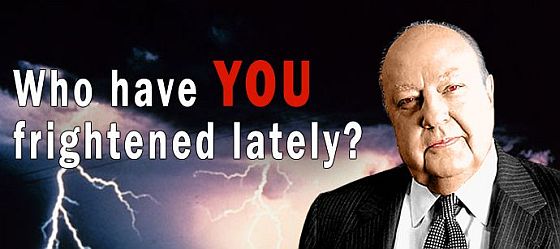
How Roger Ailes built the Fox News fear factory

For Rolling Stone, Tim Dickinson writes:

At the Fox News holiday party the year the network overtook archrival CNN in the cable ratings, tipsy employees were herded down to the basement of a Midtown bar in New York. As they gathered around a television mounted high on the wall, an image flashed to life, glowing bright in the darkened tavern: the MSNBC logo. A chorus of boos erupted among the Fox faithful. The CNN logo followed, and the catcalls multiplied. Then a third slide appeared, with a telling twist. In place of the logo for Fox News was a beneficent visage: the face of the network’s founder. The man known to his fiercest loyalists simply as “the Chairman” – Roger Ailes.

“It was as though we were looking at Mao,” recalls Charlie Reina, a former Fox News producer. The Foxistas went wild. They let the dogs out. Woof! Woof! Woof! Even those who disliked the way Ailes runs his network joined in the display of fealty, given the culture of intimidation at Fox News. “It’s like the Soviet Union or China: People are always looking over their shoulders,” says a former executive with the network’s parent, News Corp. “There are people who turn people in.”

The key to decoding Fox News isn’t Bill O’Reilly or Sean Hannity. It isn’t even News Corp. chief Rupert Murdoch. To understand what drives Fox News, and what its true purpose is, you must first understand Chairman Ailes. “He is Fox News,” says Jane Hall, a decade-long Fox commentator who defected over Ailes’ embrace of the fear-mongering Glenn Beck. “It’s his vision. It’s a reflection of him.”

Ailes runs the most profitable – and therefore least accountable – head of the News Corp. hydra. Fox News reaped an estimated profit of $816 million last year – nearly a fifth of Murdoch’s global haul. The cable channel’s earnings rivaled those of News Corp.’s entire film division, which includes 20th Century Fox, and helped offset a slump at Murdoch’s beloved newspapers unit, which took a $3 billion write-down after acquiring The Wall Street Journal. With its bare-bones news­gathering operation – Fox News has one-third the staff and 30 fewer bureaus than CNN – Ailes generates profit margins above 50 percent. Nearly half comes from advertising, and the rest is dues from cable companies. Fox News now reaches 100 million households, attracting more viewers than all other cable-news outlets combined, and Ailes aims for his network to “throw off a billion in profits.”

The outsize success of Fox News gives Ailes a free hand to shape the network in his own image. “Murdoch has almost no involvement with it at all,” says Michael Wolff, who spent nine months embedded at News Corp. researching a biography of the Australian media giant. “People are afraid of Roger. Murdoch is, himself, afraid of Roger. He has amassed enormous power within the company – and within the country – from the success of Fox News.”

Fear, in fact, is precisely what Ailes is selling: His network has relentlessly hyped phantom menaces like the planned “terror mosque” near Ground Zero, inspiring Florida pastor Terry Jones to torch the Koran. Privately, Murdoch is as impressed by Ailes’ business savvy as he is dismissive of his extremist politics. “You know Roger is crazy,” Murdoch recently told a colleague, shaking his head in disbelief. “He really believes that stuff.”

Facebooktwittermail

UK training Saudi forces used to crush Arab spring

The Guardian reports:

Britain is training Saudi Arabia’s national guard – the elite security force deployed during the recent protests in Bahrain – in public order enforcement measures and the use of sniper rifles. The revelation has outraged human rights groups, which point out that the Foreign Office recognises that the kingdom’s human rights record is “a major concern”.

In response to questions made under the Freedom of Information Act, the Ministry of Defence has confirmed that British personnel regularly run courses for the national guard in “weapons, fieldcraft and general military skills training, as well as incident handling, bomb disposal, search, public order and sniper training”. The courses are organised through the British Military Mission to the Saudi Arabian National Guard, an obscure unit that consists of 11 British army personnel under the command of a brigadier.

The MoD response, obtained yesterday by the Observer, reveals that Britain sends up to 20 training teams to the kingdom a year. Saudi Arabia pays for “all BMM personnel, as well as support costs such as accommodation and transport”.

Bahrain’s royal family used 1,200 Saudi troops to help put down demonstrations in March. At the time the British government said it was “deeply concerned” about reports of human rights abuses being perpetrated by the troops.

Facebooktwittermail

U.S. yanks diplomat from Bahrain after he’s threatened

McClatchy reports:

The United States pulled its human rights officer from Bahrain last week after he’d become the subject of a weeks-long campaign of ethnic slurs and thinly veiled threats on a pro-government website and in officially sanctioned newspapers.

Ludovic Hood left the island nation on Thursday. During his final days in Bahrain, Hood was given security protection equal to that of an ambassador, U.S. officials said.

“The safety and security of our diplomatic personnel is our highest priority,” the State Department in Washington said in a statement in response to inquiries from McClatchy. “It is unacceptable that elements within Bahrain would target an individual for carrying out his professional duties.”

Hood’s early departure from Bahrain — five human rights and U.S. officials confirmed that he had not been scheduled to leave Bahrain last week — underscores the serious tensions that have arisen between the U.S. government and Bahrain, the home port of the U.S. Navy’s 5th Fleet.

Facebooktwittermail

Egyptian general admits ‘virginity checks’ conducted on protesters

CNN reports:

A senior Egyptian general admits that “virginity checks” were performed on women arrested at a demonstration this spring, the first such admission after previous denials by military authorities.

The allegations arose in an Amnesty International report, published weeks after the March 9 protest. It claimed female demonstrators were beaten, given electric shocks, strip-searched, threatened with prostitution charges and forced to submit to virginity checks.

At that time, Maj. Amr Imam said 17 women had been arrested but denied allegations of torture or “virginity tests.”

But now a senior general who asked not to be identified said the virginity tests were conducted and defended the practice.

Facebooktwittermail

Yemeni military battles opponents on two fronts

The New York Times reports:

The government pounded a major coastal city on Monday with airstrikes to dislodge Islamic militants and, to the west, smashed the country’s largest antigovernment demonstration in overnight clashes that killed at least 20 protesters, according to witnesses reached by phone.

In Zinjibar, along the country’s southern coast, residents said warplanes attacked militant positions with repeated bombing runs beginning early Monday afternoon, a day after Islamists of uncertain affiliation took control, seizing banks and a central government compound. The compound was hit in the airstrikes and also shelled by the army, witnesses said.

It is unclear how many people have died in the Zinjibar fighting, which began Friday. The city has few medical services left, and no electricity or water, people there say. Hundreds have fled; others have taken refuge in local mosques, residents said.

In the city of Taiz, west of Zinjibar, security forces and plainclothes gunmen swept through a main square, driving out the thousands of protesters seeking the ouster of President Ali Abdullah Saleh. Witnesses said that security forces descended from three directions in a thick cloud of tear gas late Sunday afternoon, and that the clashes continued until after midnight with security forces firing water cannons and setting the protesters’ tents ablaze with Molotov cocktails. Video posted on social networking sites by opposition groups showed protesters scattering as plainclothes gunmen fired from doorways and from rooftops. Bulldozers and tractors demolished remnants of the sit-in. Sporadic gunfire echoed through the city on Monday, witnesses said.

Facebooktwittermail

Karzai calls for end to NATO air strikes on Afghan homes

The Wall Street Journal reports:

Afghan President Hamid Karzai called Tuesday for an immediate halt to coalition air strikes on civilian homes and threatened to take unilateral action to block such attacks if international forces don’t take him seriously.

Three days after an errant U.S. air strike killed as many as 12 Afghan women and children in southern Afghanistan, Mr. Karzai called a press conference to criticize the international alliance.

“The Afghan people can no longer tolerate these attacks on their homes,” Mr. Karzai said during the televised news conference. “Nobody has the right to take the life of an Afghan child.”

While Mr. Karzai has no significant authority to block the air strikes, his threats could inflame passions across Afghanistan and undermine the fragile working relationship with Western leaders as the U.S. military prepares to begin withdrawing thousands of troops this summer.

Western officials in Kabul said that relations between Mr. Karzai and the U.S.-led coalition have been deteriorating and the Afghan president took repeated jabs at military leaders during his hour-long press conference.

“We must clearly demonstrate our understanding that Afghanistan is an ally, not an occupied country,” Mr. Karzai told reporters. “And our treatment with NATO is from the point of view of an ally. If it turns to the other, to the behavior of an occupation, then of course the Afghan people know how to deal with that.”

Facebooktwittermail

‘Land swaps’: is there enough land to swap?

Nathan Jeffay reports:

It is the magic formula that could end the occupation while letting the majority of settlers stay put. But how would an Israeli-Palestinian land swap, the basis of President Obama’s Middle East vision, outlined on May 19, actually work?

The main practical problem of an Israeli withdrawal from the West Bank is the fact that some 300,000 Israeli settlers live there. Not only would a full evacuation be hazardous for any Israeli government on the domestic political front, but it also would be logistically difficult and exceedingly costly.

The solution Obama talked about, one that is “based on the 1967 lines with mutually agreed swaps,” means that Israel would hold on to some settled areas that it captured in 1967 and compensate the Palestinians with land that currently falls under Israeli sovereignty.

Even if Israeli Prime Minister Benjamin Netanyahu endorses the principle, a problem remains. Every Israeli leader insists on retaining the large settlement blocs — usually defined at a minimum as the Etzion Bloc, Modi’in Illit, Ma’ale Adumim, and Givat Ze’ev and its surroundings — and the national consensus in support of this position is strong. But in Israel, many experts say there simply isn’t enough free land under Israeli sovereignty to exchange for them.

Facebooktwittermail

Threat of violence keeps police out of Jerusalem Haredi neighborhood

Haaretz reports:

Police are reluctant to enter the ultra-Orthodox Jerusalem neighborhood of Mea She’arim because of residents’ violence, a police spokesman said during a recent court hearing over the remand of a neighborhood resident.

A police official said in court Thursday that the reason the police had not arrested a wanted man for more than a month, despite knowing where in Mea She’arim he was, was that every time they go into the neighborhood police property is damaged and they do not want unnecessary confrontations.

Police issued an arrest warrant on April 13 for Shalom Baruch Roset, who is accused of assault, property damage and making threats.

The official said police have “often tried to detain suspects for questioning” who belong to the same group as Roset, with the result that “we were attacked and the station chief sustained a head injury as a result of a stone thrown at him.”

He added that efforts to send police patrols into the neighborhood have “failed.”

Facebooktwittermail

Egypt-Gaza border opening turns out to be less than billed

McClatchy reports:

Mufid al Masry, 46, was so excited about his first trip to Egypt that he couldn’t sleep the night before he set out for the Rafah border crossing, which Egypt’s ruling military council ordered opened Saturday under new hours and fewer restrictions for Palestinian travelers.

So when Egyptian border guards rejected him, citing security concerns, Masry grew belligerent as other Palestinians at the terminal watched in sympathetic silence. An officer ordered him to stop shouting, which only made Masry angrier.

“I’ve been locked in Gaza for the past seven years and just wanted a breath of fresh air!” he said. “If you were locked up for seven years, wouldn’t you be yelling like me?”

The Egyptian government’s decision to permanently open its border with Hamas-controlled territory was heralded — or feared — as a sign of a new Egypt, one willing to risk U.S. and Israeli rebukes to provide a lifeline to Gaza’s 1.5 million residents and to break from the policies of toppled President Hosni Mubarak.

But Saturday’s landmark opening of the Rafah crossing ended with a fizzle.

By dusk, just 400 Palestinians had crossed into Egypt, and another 30 were turned back because their names appeared on a security “blacklist,” according to a senior Egyptian border officer who spoke on condition of anonymity because he wasn’t authorized to make public statements. About 150 Palestinians returned to Gaza from Egypt.

Facebooktwittermail

Surprise turn against Gaddafi is Russia’s latest westward step

Max Fisher writes:

Russia, a quasi-democracy and an imperial power that never quite gave up all of its colonial holdings, has dedicated much of its post-Soviet foreign policy to resisting everything that the NATO intervention in Libya stands for. It shrugs at human rights violators, abhors military intervention, enshrines the sovereign right of states to do whatever they want internally without fear of outside meddling, and above all objects to the West imposing its ideology on others. NATO itself, after all, is a military alliance constructed in opposition to the Soviet Union. But Russian President Dmitri Medvedev took a surprising break from Russian foreign policy precedent on Friday when, in the middle of a G8 summit in France, he declared that Libyan leader Muammar “Qaddafi has forfeited legitimacy” and that Russia plans “to help him go.”

For Libya, Russia’s call for Qaddafi to go is more than just symbolic. Russia abstained from the original UN Security Council resolution authorizing the no-fly zone, but was reportedly upset that NATO states stretched the resolution to launch an extended bombing campaign. Russia’s angry reaction, it was widely assumed, meant it might outright veto any future Security Council measures on Libya. But Medvedev’s recent statement makes clear that his government supports the implicit goal of the air strikes — regime change in Libya — and would not block further action toward that end. If Qaddafi had hoped that he might outlast the Security Council’s will to fight, he is clearly nowhere close. The window for him to leave the country peacefully remains open, but is clearly closing quickly.

Facebooktwittermail

Libya’s Goldman dalliance ends in losses, acrimony

The Wall Street Journal reports:

In early 2008, Libya’s sovereign-wealth fund controlled by Col. Moammar Gadhafi gave $1.3 billion to Goldman Sachs Group to sink into a currency bet and other complicated trades. The investments lost 98% of their value, internal Goldman documents show.

What happened next may be one of the most peculiar footnotes to the global financial crisis. In an effort to make up for the losses, Goldman offered Libya the chance to become one of its biggest shareholders, according to documents and people familiar with the matter.

Negotiations between Goldman and the Libyan Investment Authority stretched on for months during the summer of 2009. Eventually, the talks fell apart, and nothing more was done about the lost money.

An examination of the strange episode casts light on a period of several years when Goldman and other Western banks scrambled to do business with the oil-rich nation, now an international pariah because of its attacks on civilians during its current conflict. This account of Goldman’s dealings with Libya is based on interviews with close to a dozen people who were involved in the matter, and on Libyan Investment Authority and Goldman documents.

Libya was furious at Goldman over the nearly total loss of the $1.3 billion it invested in nine equity trades and one currency transaction, people involved in the matter say. A confrontation in Tripoli between a top fund executive and two Goldman officials left the bankers so rattled that they made a panicked phone call to their bosses, these people say. Goldman arranged for a security guard to protect them before they left Libya the next day, they say.

Facebooktwittermail

Cyber combat: act of war

The Wall Street Journal reports:

The Pentagon has concluded that computer sabotage coming from another country can constitute an act of war, a finding that for the first time opens the door for the U.S. to respond using traditional military force.

The Pentagon’s first formal cyber strategy, unclassified portions of which are expected to become public next month, represents an early attempt to grapple with a changing world in which a hacker could pose as significant a threat to U.S. nuclear reactors, subways or pipelines as a hostile country’s military.

In part, the Pentagon intends its plan as a warning to potential adversaries of the consequences of attacking the U.S. in this way. “If you shut down our power grid, maybe we will put a missile down one of your smokestacks,” said a military official.

Recent attacks on the Pentagon’s own systems—as well as the sabotaging of Iran’s nuclear program via the Stuxnet computer worm—have given new urgency to U.S. efforts to develop a more formalized approach to cyber attacks. A key moment occurred in 2008, when at least one U.S. military computer system was penetrated. This weekend Lockheed Martin, a major military contractor, acknowledged that it had been the victim of an infiltration, while playing down its impact.

The Associated Press reports:

This cyber attack didn’t go after people playing war games on their PlayStations. It targeted a company that helps the U.S. military do the real thing.

Lockheed Martin says it was the recent target of a “significant and tenacious” hack, although the defense contractor and the Department of Homeland Security insist the attack was thwarted before any critical data was stolen. The effort highlighted the fact that some hackers, including many working for foreign governments, set their sights on information far more devastating than credit card numbers.

Information security experts say a rash of cyber attacks this year — including a massive security breach at Sony Corp. last month that affected millions of PlayStation users — has emboldened hackers and made them more willing to pursue sensitive information.

“2011 has really lit up the boards in terms of data breaches,” said Josh Shaul, chief technology officer at Application Security, a New York-based company that is one of the largest database security software makers. “The list of targets just grows and grows.”

Facebooktwittermail

