Author Archives: News Sources

‘Perfect storm’ looms for world’s food supplies

AFP reports:

Oxfam called on Tuesday for an overhaul of the world’s food system, warning that in a couple of decades, millions more people would be gripped by hunger due to population growth and climate-hit harvests.

A “broken food system” means that the price of some staples will more than double by 2030, battering the world’s poorest people, who spend up to 80 percent of their income on food, the British-based aid group predicted.

“The food system is buckling under intense pressure from climate change, ecological degradation, population growth, rising energy prices, rising demand for meat and dairy products and competition for land from biofuels, industry, and urbanization,” Oxfam said in a report.

It added: “The international community is sleepwalking into an unprecedented and avoidable human development reversal.”

Facebooktwittermail

Obama’s mental bookkeeping

David Bromwich writes:

Minutes before midnight last night [on May 26], President Obama, in Paris, by a species of teleportable pen signed into law a four-year extension of the Patriot Act: the central domestic support of the security apparatus devised by the Bush administration, after the bombings of 11 September 2001 and the ‘anthrax letters’ a week later. The first Patriot Act passed the senate on 25 October 2001, by a vote of 98-1 – the opposing vote coming from Senator Russ Feingold of Wisconsin. In the years that followed, a minority view developed, which said that the Patriot Act ‘went too far’; but its steadiest opponents have come from outside the mainstream media: the American Civil Liberties Union, the Cato Institute, and libertarian columnists such as Glenn Greenwald and Nat Hentoff.

In the last few days, two senators, Ron Wyden of Oregon and Mark Udall of Colorado, took up the mantle of Senator Feingold (who lost his bid for re-election in the anti-Obama midterm disaster of 2010). Both spoke against a government interpretation of the new Patriot Act which has not yet been shared with the American people.

The senate as a whole voted (this time 72-23) to renew a law that citizens have had no opportunity to understand, as Wyden and Udall present it, and that few members of Congress have looked into, even to the limited extent allowed. The Patriot Act controls secret investigations. The government, however, according to Wyden, has a private understanding of the law. This interpretation has been classified. So the meaning of a law about secrets is hidden because the government’s view of the law is itself a secret.

Facebooktwittermail

CIA prisons in Poland ‘illegal’

SAPA reports:

Secret prisons operated by the US Central Intelligence Agency (CIA) on Polish territory violated international law and the Polish constitution according to legal experts, reported the daily Gazeta Wyborcza on Monday, citing sources close to an investigation.

The CIA held terror suspects inside a military intelligence training base in Stare Kiejkuty, north-eastern Poland from 2002 to 2005, anonymous Polish intelligence officers have said.

Public prosecutor Jerzy Mierzewski had wanted to charge officials from the 2001-2005 Democratic Left Alliance government with violating the constitution, unlawful detention and participation in crimes against humanity, the daily reported.

The left-wing party is today Poland’s second largest opposition party. Polish politicians who were in power when the prisons allegedly operated have denied allegations that CIA prisons were located in the country.

Mierzewski, however, was withdrawn from the case two weeks ago, the daily wrote. His supervisor, Dariusz Korneluk, declined to comment on the reason for the dismissal.

Facebooktwittermail

A post-9/11 registration effort ends, but not its effects

The New York Times reports:

In the jittery months after the 9/11 attacks, the federal government created a program that required thousands of Arab and Muslim men to register with the authorities, in an effort to uncover terror links and immigration violations.

After complaints that the practice, known as special registration, amounted to racial profiling, the Homeland Security Department scaled back the program in 2003, and ended it late last month, saying it “no longer provides a unique security value.”

But for Mohammed G. Azam, a 26-year-old Bangladeshi native who came to the United States when he was 9, its legacy lives on. When he registered in Manhattan in 2003, officials began deportation proceedings, and now, eight years and numerous hearings later, his case has outlasted the program.

Mr. Azam is one of hundreds, or perhaps thousands, of people still caught in the program’s net, immigration experts say.

Facebooktwittermail

Syria in fragments: divided minds, divided lives

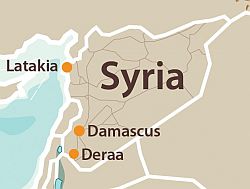
At Syria Comment, Joshua Landis has posted an article written by a contributor from Damascus — “the best piece of writing on Syria since the uprising began,” says Landis. The author requested that his identity not be disclosed and that the piece simply be given the byline “From Damascus.” He writes:

About a week ago I sat with a good friend from the muhafiza (governorate or county) of Dera’a. The raw account of events in Dera’a that he presented to me bore striking contrast to the opinions of people outside that area, people of Damascus, confused people trying to weigh the injustices vs. necessity of the military action in Dera’a.

Details of our conversation that might have been news at the time I spoke with him are now known by most readers at this late date: electricity, water, mobile phone service, land line telephone service, all cut off; rooftop water tanks, common in this area, are shot by military personnel; anyone who moves in the streets is shot. Furthermore, people who have used their own generators to provide power to their homes are visited by the military and the generators are promptly confiscated.

This friend (let’s call him Adham) has a sister and brother who both live in the city of Dera’a with their families. For weeks, they have had no word from them. They don’t even know if they or their children are alive. Adham’s brother was working in Damascus when the occupation of Dera’a began. He was unable to return home to his family. He cannot communicate with or receive any news from his wife or children. He has traveled recently to the city, hoping that after these weeks he would finally be allowed to reunite with his family, but has been prevented from doing so by the military that is keeping the city sealed off.

News that does trickle out of Dera’a seems to be coming from people who have Jordanian cell phones that sometimes find coverage in the area. People are using their car batteries to charge their cell phones, among other devices.

Many Damascenes continue to look me in the eye and tell me that “There’s nothing happening in Syria! Everything is fine!” Consider that Adham’s village in the muhafiza of Dera’a is closer to Damascus than it is to the city of Dera’a, and yet his family is without cell phone service, or even land-line service. Phone service of all types has been cut off from the entire muhafiza. When he comes to work in Damascus, he and his family have no way of checking on each other. This treatment is having the effect of galvanizing oppositional sentiment in the muhafiza and the growing sense of Dera’an separateness.

Adham is an atheist whose family is of Shia background. Being an atheist and coming from a Shia family, he is in no way sympathetic to Sunni Islamism. Therefore, it’s telling when he affirms that “there are no Salafiin in Dera’a. I can say for sure that any group of such people that exists is very, very small.”

Rather, he explains that the government’s siege has been effective in unifying the muhafiza of Dera’a against it. By treating the entire muhafiza as criminal, the sentiments of most of its inhabitants (not just those inside the city of Dera’a) have turned against the regime. It’s interesting that identity runs not only along religious, ethnic, and tribal lines, but also along geographical lines, in that the people of Dera’a—not only the city, but the entire muhafiza—are viewing themselves as a unit, separate from those who comprise the leadership of Syria. “I can say that 90% of people in the entire muhafiza are against the government,” Adham says. Rather than viewing the uprising as one of sectarian character, he explains that “my brother’s family in the city of Dera’a has Christian neighbors. There are many Christians in the city of Dera’a and in other villages who have joined in the protests.”

Dera’a is becoming a unit—I hesitate to say almost separate from Syria—not only in how people there are beginning to view themselves as separate from the state (an understandable effect after feeling attacked by the state), but in the way many other Syrians are reacting to Dera’ans. Adham tells me that in the hospital where he works in Damascus, he is experiencing a new, unmistakable resentment and coldness from his coworkers. “They say nothing, but I can see in their faces that they blame us for the current situation in Syria.” He says that he doesn’t feel safe responding to the opinions voiced by people in his workplace. He believes that people’s opinions are misled and mistaken, but if he defends “his own” Dera’ans, he fears reprisal.

“One Alawi girl who works in the hospital was very happy about the army entering the city. She said, ‘They must destroy the entire city and should kill everyone demonstrating.’” Her comments reflect the result of the government’s successful campaign to demonize the protesters; many people simply believe that there is an insidious cancer of extremism growing inside Syria, that threatens all life, security, and humane values, and that drastic measures are needed to thoroughly wipe it out.

In stark contrast to Adham’s understanding of the situation, I witnessed unreserved approval for the government crack down on a Thursday a week after the siege on Dera’a began. I visited some close Christian friends in Damascus who we can call Samer and Najwah. It was impossible not to broach the subject of the situation in Dera’a, knowing that the next day, Friday, would likely produce significant casualties. This household however, grimly viewed the army’s cordoning off and occupation of the city as necessity. I couldn’t help but begin to argue with them that even if there was a poisonous “Salafi” threat in the town, the siege and suppression would mean the suffering, trauma, and even killing of many innocent people as well. If some people from that area had indeed called for the establishment of an Islamic emirate (and it’s no surprise that some there would be oriented this way), I was just not convinced that the entire city, the many thousands protesting there, were all seeking such a goal.

For Najwah, however, the city of Dera’a has become a single entity containing one kind of people: bad. For her, the terrorist persuasion of the people in that community now justifies virtually any action against them. From her attitude, I felt that if the city was to be wiped off the map, she wouldn’t mind. I began to mention reports of the more grisly examples of violent killings there. “Good!” was her angry response.

I tried to think back and remember if I’d ever been in a country where serious atrocities were taking place and had looked in the eye of someone who rejoiced in them. I couldn’t, and I realized that I was witnessing the kind of passive approval for massacre that one reads about in history books, when individuals or groups become convinced of the evil of another and of the necessity of wiping them out. Najwah is not an evil woman, but the people of Dera’a have become completely vilified in her mind, and she fears them. [Continue reading…]

(H/t Helena Cobban.)

Facebooktwittermail

Apparent torture of boy reinvigorates Syria’s protest movement

The Washington Post reports:

The boy’s head was swollen, purple and disfigured. His body was a mess of welts, cigarette burns and wounds from bullets fired to injure, not kill. His kneecaps had been smashed, his neck broken, his jaw shattered and his penis cut off.

What finally killed him was not clear, but it appeared painfully, shockingly clear that he had suffered terribly during the month he spent in Syrian custody.

Hamza Ali al-Khateeb was 13 years old.

And since a video portraying the torture inflicted upon him was broadcast on the al-Jazeera television network Friday, he has rapidly emerged as the new symbol of the protest movement in Syria. His childish features have put a face to the largely faceless and leaderless opposition to President Bashar al-Assad’s regime that has roiled the country for nine weeks, reinvigorating a movement that had seemed in danger of drifting.

Facebooktwittermail

Dreaming spooks in search of digital metaphors

Michael Rosen writes:

News that a US government intelligence body is going to start analysing the metaphors used in various languages will have brought wry smiles to the faces of writers and critics. Presumably, “Metaphor Program” agents won’t restrict themselves to metaphors as that particular word is often used metonymically for the whole of figurative language – similes, symbols or indeed any use of language that appears to be standing in for something else or representing something else. That in itself is no simple matter, as we shall see, but let it stand for the moment.

“I wandered lonely as a cloud …” to which we are entitled to ask, “What’s lonely about a cloud?” It’s a pretty rare Lake District sky that gives us one cloud on its own. But who says a lonely cloud would have to be on its own to be lonely? Maybe clouds are just lonely things – full of a sense of their isolation in an alienated world. If we find ourselves grasping at straws here, Wordsworth gives us help: “… that floats on high o’er vales and hills”, which suggests that he’s talking about the cloud’s detachment from the earth. It’s the higher-than-hills-ness, floatiness of the cloud that is important.

This is the kind of speculation that metaphor-divining specialises in and it’s fun to think of US spooks chewing over such matters – though presumably they will hire patriotic literature graduates to do the job.

Such servants to the US cause will be able to take their masters on a trip through a forest of suggestion, resonance and ambiguity in their quest to find the hidden value-systems in speakers’ and writers’ use of metaphor. We now know that Wordsworth’s idea of a writer being detached from the world, wrapped up in thoughts about nature and the imagination, was indeed ideological – as he warned us:

“The world is too much with us; late and soon,
Getting and spending, we lay waste our powers.
Little we see in Nature that is ours.”

So, straight away, our US allies can label early Wordsworth an anti-bourgeois subversive – someone who will need to be watched.

But what of Shakespeare? He poses the problem that we can never know for certain that this is Shakespeare talking or one of his many characters through whom he speaks: “Whether ’tis nobler in the mind to suffer/The slings and arrows of outrageous fortune …” This is dense stuff: a cast of thought has to compress our interactions and outcome into one notion: “fortune”, which then has to be personified into a form that can “behave” or have appurtenances, as in this case “slings and arrows”. Aha, militaristic metaphor! Fortune is armed and aggressive. Clearly, Hamlet is a potential terrorist. And indeed he was. Or tried rather ineffectually to be. But the writer who conjured him up? Probably not.

Facebooktwittermail

Gaddafi snatch squads took hundreds of men and boys from Misrata

The Independent reports:

The lifting of the siege of the embattled Libyan city of Misrata has revealed the disappearance of hundreds of people with many of them suspected victims of snatch squads loyal to the Gaddafi regime, relatives and rights workers said yesterday.

A desperate search has begun for “the disappeared”, many of whom were reported to have been taken away to regime prisons or killed during some of the fiercest fighting of a three-month rebel uprising that has reduced parts of the city to rubble.

Witness accounts gathered by The Independent and rights groups indicate that there was a systematic attempt to kidnap men from parts of the city.

Facebooktwittermail

Hundreds of women report rapes by Gaddafi forces

The Associated Press reports:

At first, the responses to the questionnaire about the trauma of the war in Libya were predictable, if tragic: 10,000 people suffering post-traumatic stress, 4,000 children with psychological problems. Then came the unexpected: 259 women said they had been raped by militiamen loyal to Moammar Gadhafi.

Dr. Seham Sergewa had been working with children traumatized by the fighting in Libya but soon found herself being approached by troubled mothers who felt they could trust her with their dark secret.

The first victim came forward two months ago, followed by two more. All were mothers of children the London-trained child psychologist was treating, and all described how they were raped by militiamen fighting to keep Gadhafi in power.

Sergewa decided to add a question about rape to the survey she was distributing to Libyans living in refugee camps after being driven from their homes. The main purpose was to try to determine how children were faring in the war; she suspected many were suffering from PTSD.

To her surprise, 259 women came forward with accounts of rape. They all said the same thing.

“I was really surprised when I started visiting these areas, first by the number of people suffering from PTSD, including the large number of children among them, and then by the number of women who had been raped from both the east and west of the country,” Sergewa said in an interview with The Associated Press.

Facebooktwittermail

Remember Srebrenica? The west’s intervention in Libya is a no-brainer

Peter Preston at The Guardian writes:

It’s fashionable already to cluck apprehensively over Libya. Another botched adventure, another unwanted war. Look how much it’s costing – at this rate, more or less your standard Ministry of Defence project overrun before 2011’s out. Why isn’t it over long since? Why, for all his soaring rhetoric, has Barack Obama decided to rest on his oars? David Cameron broods over sending in four Apache helicopters while the BBC lugubriously reminds us that helicopters can get shot down. If you want to confect a stew of gloom, then any old ingredients will do.

But mix a pinch of foresight with your hindsight, and sprinkle lightly with added realism. Libya isn’t Afghanistan or Iraq. It isn’t even a proper war, more a series of skirmishes strung out along a long coastal strip. Oh! TV reporters talk excitedly as though this was some mighty contest between opposing armies, but they don’t even seem to look at their own pictures. In fact, it’s rag-tag stuff on both sides. There are casualties, of course; but the numbers involved seem relatively small. The colonel’s mercenary regiments are brutal, but militarily feeble. Take away air cover and they’re going nowhere. Will four British Apaches – count them again, yes just four! – make a big difference this week? Merely posing the question helps define this mini-conflict. Its costs and its risks aren’t worth so much rumbling angst.

Recent history tells us Muammar Gaddafi is a menace (especially if you’re in a jumbo jet over Scotland). When he vowed to take revenge on the insurgents, these were no idle threats. His first reaction when the citizens of his second city marched for change was to shoot them down. The chief prosecutor in The Hague already thinks that, just like Ratko Mladic, Gaddafi has a case to answer. On 18 March, as the allies finally prepared to move, his troops were driving into the outer suburbs of Benghazi. No hindsight necessary: it was five minutes to midnight. And no shucking off our own leaders’ responsibility, either.

After Tunisia, after Egypt, the word was the same from Obama to Nicolas Sarkozy to Cameron. The US Senate, the European parliament, the Arab League and the UN security council all knew what had to be done. So did Gaddafi’s man at the UN. There was massacre pending. All the usual recourses had been duly employed: sanctions, seizing overseas assets and the rest. But it wasn’t enough. Hundreds – probably thousands – of Libyan protesters we’d directly encouraged were about to get shot. Do nothing? Then or now, with or without hindsight, it’s a no-brainer.

Facebooktwittermail

How America screws its soldiers

Andrew J. Bacevich writes:

Riders on Boston subways and trolleys are accustomed to seeing placards that advertise research being conducted at the city’s many teaching hospitals. One that recently caught my eye, announcing an experimental “behavioral treatment,” posed this question to potential subjects: “Are you in the U.S. military or a veteran disturbed by terrible things you have experienced?”

Just below the question, someone had scrawled this riposte in blue ink: “Thank God for these Men and Women. USA all the way.”

Here on a 30 x 36 inch piece of cardboard was the distilled essence of the present-day relationship between the American people and their military. In the eyes of citizens, the American soldier has a dual identity: as hero but also as victim. As victims—Wounded Warriors —soldiers deserve the best care money can buy; hence, the emphasis being paid to issues like PTSD. As heroes, those who serve and sacrifice embody the virtues that underwrite American greatness. They therefore merit unstinting admiration.

Whatever practical meaning the slogan “support the troops” may possess, it lays here: in praise expressed for those choosing to wear the uniform, and in assistance made available to those who suffer as a consequence of that choice.

From the perspective of the American people, the principal attribute of this relationship is that it entails no real obligations or responsibilities. Face it: It costs us nothing yet enables us to feel good about ourselves. In an unmerited act of self-forgiveness, we thereby expunge the sin of the Vietnam era when opposition to an unpopular war found at least some Americans venting their unhappiness on the soldiers sent to fight it. The homeward-bound G.I. spat upon by spoiled and impudent student activists may be an urban legend, but the fiction persists and has long since trumped reality.

Facebooktwittermail

Turkey’s Great Leap Forward risks cultural and environmental bankruptcy

The Guardian reports:

Every springtime Pervin Çoban Savran takes her camels and sheep up into the Taurus mountains of southern Turkey, following the same routes along the Goksu river that Yoruk people like her have taken for more than 1,000 years. To many Turks these last nomadic tribes are symbols of the soul of their nation.

Their way of life – and that of millions of small farmers – is being threatened by Turkey’s Great Leap Forward, one of the most dramatic and potentially devastating rushes for economic development and prosperity Europe has seen in decades.

Thousands of dam and hydropower schemes are being built on almost all of the main rivers in a pharaonic push to make Turkey a world economic power by the centenary of the republic in 2023.

The ruling AK party, expected to win a record third term in next month’s elections, is forcing through a series of gigantic public works projects that include three nuclear power plants – despite Turkey being one of the most seismically active nations on earth.

Facebooktwittermail

Israel braces for border clashes in coming days

The Associated Press reports:

The Israeli military is preparing for the possibility of violent protests along its borders in the coming days, aiming to avoid a repeat of deadly unrest that erupted earlier this month, a senior military official told The Associated Press on Sunday.

Facebook-organized activists have called for demonstrations next weekend in Lebanon, Syria, and Jordan to mark the anniversary of the 1967 Mideast war, in which Israel captured the West Bank, Gaza Strip east Jerusalem and Golan Heights.

The official said the army also is planning to counter possible unrest in the West Bank in September after an expected U.N. vote to recognize Palestinian independence.

The official said the army hopes to avoid civilian casualties but would set “red lines” for the demonstrations. That means Israel will not allow demonstrators to burst across the borders during the coming week’s protests — as they did on the Syria-Israel border on May 15 — or to enter Jewish settlements in the West Bank in September.

Facebooktwittermail

Police detain 7-year-old Palestinian boy and accost relatives, family members say

Haaretz reports:

Jerusalem policemen arrested a Palestinian seven-year-old child, relatives said on Sunday, claiming that the boy was battered by police officers during his arrest.

The boy’s parents, residents of the East Jerusalem village of Silwan, said they searched for their son for two hours at several police stations, without the police providing any information as to his whereabouts.

According to family members, the second grader was arrested during play. His father, who noticed policemen arresting his son, attempted to intervene, and in the ensuing scuffle was sprayed in his face with pepper spray and was evacuated to receive medical care.

Facebooktwittermail

Thousands protest against Mladic arrest

Al Jazeera reports:

At least 10,000 Serbian nationalists are estimated to have gathered in central Belgrade to protest against the arrest of Ratko Mladic, the former Bosnian Serb general accused of war crimes.

Sporadic clashes erupted at the rally on Sunday, with several dozen protesters throwing stones at riot police wielding batons.

Supporters of the ultranationalist Serbian Radical Party and other similar organisations had been brought by bus from across the country for the evening rally in the Serbian capital.

Facebooktwittermail

Where Egypt is at

Issandr El Amrani writes:

The #May 27 “Second Revolution” came and went this weekend without the drama that many had expected. Turnout was pretty good — good enough to show that the ranks of those unsatisfied with the current state of affairs is plenty big, and big enough to show that the Muslim Brothers’ participation is not essential to getting a decent number of people protesting. Impressive also was that the protests took place across the country, as Zeinobia points out with her gallery of videos. Get more videos and an account at Jadaliyya. It may not be a second revolution but it’s enough to keep the SCAF [Supreme Council of the Armed Forces] on its toes and give media traction to multiple grievances: high-ranking corruption, insecurity, slow justice, heavy-handedness of the military, etc.

Although many of these grievances are indeed worthwhile, this opposition movement should start coalescing over one or two core demands with regards to the transition. It has already been a tragedy of Egypt’s revolution that the revolutionaries did not have a clear aim beyond the removal of Mubarak and that the post-Mubarak transition has been handled poorly, to say the least, by a SCAF that is guilty of bumbling incompetence perhaps more than malice. In particular, the transition process could have been more along the lines of Tunisia’s, with an elected constituent assembly rather than one appointed by parliament and independent commissions to investigate corruption as well as violence. The real drama, it seems to me, is that right now transitional justice consists of immediately going after certain persons (those close to Gamal Mubarak) yet only going after older apparatchiks (NDP apparatchiks, etc.) after popular pressure forced the SCAF to. And, most of all, a piecemeal approach to trying former officials: consider that Hosni Mubarak has just been fined for cutting off the internet, and may only be tried for the violence during the revolution, while not being held accountable for 30 years of autocracy.

To me, this should be the focus of the opposition: obtaining a real truth and reconciliation process that holds the regime, as a system, accountable and features the televised testimony of both its victims and participants. If Egyptians try to gloss over the Mubarak era as a question of a few bad apples and then quickly move on, they risk losing a more important understanding of what was the Mubarak regime (and institutions like State Security) and lose the chance of making a clean break. The other demand may be about postponement of elections, but then it has to make on sound grounds (as I discussed a few days ago) with concrete proposals on who will rule in the meantime — including explaining what would make a transitional presidential council more legitimate than the SCAF.

Facebooktwittermail