Author Archives: News Sources

Egypt to open Rafah crossing permanently

The Associated Press reports:

Egypt’s decision Wednesday to end its blockade of Gaza by opening the only crossing to the Hamas-ruled Palestinian territory this weekend could ease the isolation of 1.4 million Palestinians there. It also puts the new Egyptian regime at odds with Israel, which insists on careful monitoring of people and goods entering Gaza for security reasons.

The Rafah crossing will be open permanently starting Saturday, Egypt’s official Middle East News Agency announced. That would provide Gaza Palestinians their first open border to the world in four years, since Egypt and Israel slammed their crossings shut after the Islamic militant Hamas overran the Gaza Strip in 2007.

During the closure, Egypt sometimes opened its border to allow Palestinians through for special reasons such as education or medical treatment. But with Israel severely restricting movement of Palestinians through its Erez crossing in northern Gaza, residents there were virtual prisoners.

Reuters reports on differences of opinion in Hamas’ leadership. Does this suggest a possible split in the group? Wrong question. Perhaps more significantly it suggests that the long-held assumptions about who is more radical and ideological and who is more pragmatic got the labels the wrong way round. Contrary to common opinion, the voice of moderate pragmatism tends to come out of Damascus more often than Gaza.

Divisions in Hamas have been brought to the surface by a reconciliation agreement with rival group Fatah, exposing splits in the Palestinian Islamist movement that could complicate implementation of the deal.

It is the first time differences between Hamas leaders in Gaza and the movement’s exiled politburo in Damascus have been aired so openly in public, supporting a view that the group is far from united.

The disagreements have embarrassed a movement that has always denied talk of internal divisions. But analysts do not believe they signal an imminent fracture: neither wing of the Hamas movement can survive without the other.

Signs of strain began to show in the Hamas response to the killing of Osama bin Laden, declared a holy warrior by the head of the Hamas-run Gaza government in remarks described by a member of the exiled leadership as “a slip of the tongue.” Khaled Meshaal, head of the movement in exile, then became the focus of criticism by Gaza-based leaders who said they were surprised by remarks suggesting a degree of support for peace talks between the Palestinian Authority and Israel.

Meshaal had said Hamas was willing to give “an additional chance” to the peace process always opposed by his group, which is deeply hostile to Israel and has routinely declared negotiations a waste of time.

Mahmoud Al-Zahar, a senior figure in the Gaza administration, said the comments had surprised the entire Hamas movement and contradicted its strategy based on armed conflict with Israel.


Facebooktwittermail

Senate Democrats expected to side with Republicans against Obama on Israel border issue

The Hill reports:

Senate Democrats are expected to support a resolution intended as a rebuff to President Obama’s call for basing Middle East peace talks on the 1967 Israeli-Palestinian borders.

It would be a rare rebuke of the president by the upper chamber and a sign that Democrats are worried about the impact of last week’s speech on the U.S.-Israel relationship and pro-Israel constituents.

Democrats in both chambers are scrambling to fix the damage caused when Obama called for the 1967 borders and land swaps as a basis for peace.

Some Democrats have tried to downplay the rift, but Israel’s strongest supporters in Congress say there’s no denying that Obama made a tactical mistake in handling the relationship.

“I wish that the president had not made the speech on Thursday, particularly not made it — I gather — without much consultation” with Israel, said Sen. Joe Lieberman (Conn.), an Independent who caucuses with Democrats. “So I think it was a tactical mistake.”

Lieberman said he was reassured by the president’s follow-up speech to the American Israel Public Affairs Committee (AIPAC) on Sunday but thinks additional steps need to be taken.

He is working with Sen. Orrin Hatch (R-Utah) on a resolution that would show broad consensus within Congress that the 1967 Israeli-Palestinian borders are not only “indefensible,” as Israeli Prime Minister Benjamin Netanyahu stated, but also contrary to U.S. national security interests.

Draft language of the resolution states “it is contrary to the U.S. policy and national security to have the borders of Israel return to the boundaries of 1949 or 1967.”

Facebooktwittermail

Day after Netanyahu addresses Congress, his ministers inaugurate East Jerusalem settlement

Haaretz reports:

One day after Prime Minister Benjamin Netanyahu declared that Jerusalem will not be divided, the speaker of the Knesset and several other government ministers attended a dedication ceremony for the new Jewish settlement of Ma’aleh Zeitim, in East Jerusalem’s Ras al-Amud neighborhood.

Knesset Speaker Reuven Rivlin, Jerusalem Mayor Nir Barakat, Education Minister Gideon Sa’ar, Environmental Protection Minister Gilad Erdan, Interior Minister Eli Yishai, and Information Minister Daniel Hershkovitz all participated in the ceremony – this despite the fact that the Jewish neighborhood has already been inhabited for several years.

A group of tens of left-wing activists gathered outside the site of the ceremony, shouting “Jews and Arabs against Ma’aleh Zeitim” and “There is no shame in the holy city.”

Rivlin delivered a speech at the ceremony, where he made a warning based on the recent Mideast policy speech laid out by United States President Barack Obama.

“Until today, despite a difference of opinions, there were relations between Israel and the U.S. based on mutual interests, shared democratic values, and recognition of the right of the Jewish people in their country,” Rivlin said.

“But this time, I hear another note from the U.S. president…. That Israel doesn’t need to be strict on the conditions that will protect her existence, that the U.S. will be responsible for [Israel’s] security and existence. And what happens if one day there is a president that thinks that Israel’s existence contradicts Americans’ interests?”

Facebooktwittermail

Feeling the ignorance at AIPAC 2011

Max Blumenthal writes:

On May 22, thousands of supporters of America’s most powerful pro-Israel lobbying group, the America-Israel Public Affairs Committee, or AIPAC, converged on Washington for the group’s annual conference. For two days they watched Democratic and Republican congressional leaders pledge their undivided loyalty to the state of Israel, and by extension, to AIPAC’s legislative agenda. Speeches by President Barack Obama and Prime Minister Benjamin Netanyahu highlighted the conference, with Obama attempting to clarify his statement demanding that 1967 borders be the “starting point” for negotiations between Israel and the Palestinian Authority.

I interviewed several AIPAC delegates in the streets outside the conference. While few, if any, were able to demonstrate any degree of sophistication in the understanding of the Israel-Palestine crisis, they had been briefed inside on how to respond to critics. No one I spoke to would concede that Israel occupied any part of Palestinian territory; none would concede that Israel had committed acts of indiscriminate violence or that it had transferred Palestinians by force; one interviewee could not distinguish Palestine from Pakistan. With considerable wealth and negligible knowledge — few had spent much time inside Israel — the delegates were easily melded by the cadre of neoconservative and Israeli “experts” appearing in AIPAC’s briefing sessions.

As the day wore on, many delegates waded into confrontations with members of Code Pink and Palestine solidarity demonstrators who had set up a protest camp across the street. With conflict intensifying on the sidewalk, Code Pink’s Medea Benjamin invited AIPAC delegates to express themselves from the protest stage. There, their most visceral feelings and deeply held views about Israel-Palestine crisis were revealed. See it for yourself.

Facebooktwittermail

Gaddafi — our best enemy

A documentary on the West’s conflicted relationship with Muammar Gaddafi by Antoine Vitkine. The complete film appears at the bottom of this post, but depending on the speed of your internet connection, it may be easier to watch in segments.

Facebooktwittermail

The fight for Libya

The New York Times reports:

In the heaviest attack yet on the capital since the start of the two-month-old NATO bombing campaign, alliance aircraft struck at least 15 targets in central Tripoli early Tuesday, with most of the airstrikes concentrated on an area around Col. Muammar el-Qaddafi’s command compound.

The strikes, within a 30-minute period around 1 a.m., caused thunderous explosions and fireballs that leapt high into the night sky, causing people in neighborhoods a mile or more away to cry out in alarm.

Just as one strike ended, the sound of jet engines from low-flying aircraft in the stormy skies above the capital signaled the imminence of another. Huge plumes of black smoke rose and converged over the darkened cityscape.

“We thought it was the day of judgment,” one enraged Libyan said.

The intensity of the attacks, and their focus on the area of the Bab al-Aziziya command compound in central Tripoli, appeared to reflect a NATO decision to step up the tempo of the air war over the Libyan capital, perhaps with a view to breaking the stalemate that has threatened to settle over the three-month-old Libyan conflict.

As NATO intensified its airstrikes, the American State Department’s highest-ranking Middle East official, Jeffrey D. Feltman, was in Benghazi on Tuesday on a visit aimed at providing fresh impetus to the rebel cause. Speaking at a news conference, Mr. Feltman said that the Obama administration had invited the Libyan opposition to open an office in Washington, but stopped short of offering the formal recognition the rebels have been seeking.

From an Awac flying over the Mediterranean, the New York Times reports:

Just after midnight on Sunday, an allied Mirage 2000 fighter jet prowling the Libyan coastline attacked a Libyan missile patrol boat that military officials said threatened NATO and humanitarian aid vessels in nearby waters.

The strike on the Libyan warship in the harbor at Sirt came at the end of a convoluted chain that started with political orders from Brussels, passed through two military command centers in Italy and concluded with controllers aboard this Awacs command-and-control plane 50 miles off the Libyan coast authorizing the Mirage to bomb the boat.

Two months into the Libya air campaign, allied officers insist they have worked out the kinks in an operation initially plagued by NATO’s inexperience in waging a complex air war against moving targets and botched communications with the ragtag rebel army. The confusion resulted in at least two accidental bombings that killed over a dozen rebel fighters.

As Tuesday’s heavy airstrikes in the Libyan capital, Tripoli, underscored, NATO is escalating the pace and intensity of attacks on Col. Muammar el-Qaddafi’s forces, trying to break an apparent stalemate in the three-month-old conflict. Yet the alliance is still short on reconnaissance planes to identify hostile targets and refueling planes to allow fighter-bombers to conduct longer missions, a senior NATO diplomat said.

French and British officials said this week that they were sending more than a dozen attack helicopters to allow for more precise ground attacks, particularly around Misurata, where loyalist forces continue to fire mortars and artillery despite rebel gains and heavy air attacks.

With no troops on the ground, NATO planners and pilots acknowledge that they often cannot pinpoint the shifting battle lines in cities like Misurata. “The front lines are more scattered,” said Col. L. S. Kjoeller, who commands four Danish F-16s flying eight daily strike missions from Sigonella air base in Sicily.

Information on Libyan forces filters up from Central Intelligence Agency officers and allied special operations troops working with the rebels on the ground, as well as from the rebels themselves. But NATO planners say they have no direct contact with anyone on the ground to help coordinate the roughly 50 allied attack missions every night.

Instead, they rely on an array of imagery and electronic intercepts collected by drones, spy planes and satellites, as well as news media reports and other whispers of intelligence. These are used to build a round-the-clock campaign that allied officers say is preventing Colonel Qaddafi from making sustained attacks on rebel fighters and driving him deeper into hiding.

Reuters reports:

African migrants, captured and jailed by the rebels they were fighting in Libya’s Western Mountains, say they were tricked or coerced into the army of Muammar Gaddafi in the belief they faced an al Qaeda invasion.

In rare first-hand accounts from a group branded “mercenaries” by the rebels, five men from Sudan’s western Darfur region and Chad told Reuters how they were working in Libya as builders and decorators when they became embroiled in the conflict unleashed by an uprising to end Gaddafi’s four-decade rule.

They spoke last week at a makeshift jail in a secondary school in the rebel-held town of Zintan. They have had no contact with their families or aid groups, and medical workers in the town say they have had only limited access to the men.

Some of what they said about their treatment in the prison appeared aimed at pleasing their captors. At one point, a guard outside the cell loaded two cartridges into a double-barrelled shotgun and motioned as if to shoot the prisoners.

Mohammed, who said he was a decorator from Darfur, said he enlisted in April in the capital, Tripoli.

“In Tripoli I went to military camp 77. They trained me in how to use weapons and told us we were only going to guard checkpoints. They told us there were Algerians, French and al Qaeda in Maghreb fighting in Libya,” he said.

Al Qaeda in the Islamic Maghreb (AQIB) is al Qaeda’s north African branch.

“We found nothing like that,” he said. “We’ve been tricked. It wasn’t true.”

Facebooktwittermail

Mubarak to face trial for killing of protesters

The New York Times reports:

Former President Hosni Mubarak will be put on trial for conspiring to kill unarmed protesters, Egypt’s top prosecutor announced Tuesday, yielding to public demands for accountability and setting an example that could rattle autocrats around the region.

The charge could incur the death penalty. Mr. Mubarak was also accused of obtaining his seaside mansion in Sharm el Sheik as a kickback from a friend for a corrupt land deal, and prosecutors accused his two sons, Gamal and Alaa, of receiving a total of four other villas there as part of the same kickback. And in a third charge, prosecutors said the former president allowed the same friend to siphon $714 million in public money out of a deal to sell natural gas to Israel.

The charges — brought by prosecutors Mr. Mubarak had appointed — included hints that former subordinates might testify against him, as onetime allies and government insiders turn on one another.

A Cairo criminal court is expected to set a trial date within days, and the Egyptian people could soon see the leader whose iron fist ruled them for nearly three decades seated in the steel cage that serves as a docket in Egyptian courtrooms.

Facebooktwittermail

Europe’s Obamaphilia says more about its own weakness than the US president

Gary Younge writes:

In his book Audacity of Hope, Barack Obama described himself as a Rorschach test – the famous psychological experiment where people are shown a series of ink blots and asked to identify what they see in them. There is no right answer. But each response in its own way, is thought to reveal the patient’s obsessions and anxieties.

So it is with Obama. In the last week he has been disparaged as the “most successful food stamp president in history” by Newt Gingrich and a spineless “black mascot” of Wall Street by the prominent black academic Cornel West.

“I serve as a blank screen on which people of vastly different political stripes project their own views,” he said. “As such I am bound to disappoint some if not all of them.”

But one of the most curious things about those who support him most is not their disappointments – given their high hopes for him, that’s to be expected – but their enduring devotion in the face of those disappointments. It’s as though each single disillusionment is consumed as its own discrete letdown. String them together and you have not a narrative of failing to deliver on promises, but a litany of isolated, separate chapters – each with its own caveats, exceptions and explanations.

Facebooktwittermail

Saudi women are being driven to rebellion

Nesrine Malik writes:

While all eyes are on Libya, Syria and Yemen, a different kind of rebellion is taking place in Saudi Arabia. A group of Saudi women have set up Women2Drive, a right-to-drive campaign, with a launch date of 17 June.

Last week one of its members, Manal al-Sharif, took to the streets and drove a car for a couple of hours, filming her trip (her father assisted) and posting it on YouTube. On Sunday, she was arrested along with her brother, who reportedly has now been released.

This isn’t the first time that there has been a push to drive in the kingdom. In the early 1990s, members of a similar campaign were arrested and some were fired from their jobs.

Against the backdrop of the Arab uprisings, it might seem like a frivolous thing to ask, especially when we are told that Saudi women do not need to drive, as they are so covetously protected and provided with drivers to save them the trouble.

The irony is that although the entire system is constructed to prevent men and women finding khalwa, or privacy, together, it is permissible to be alone in a car with one’s non-Saudi driver – the perfect confluence of racism and patronage that exposes the absurdity and confusion behind arbitrary laws of public female deportment in Saudi Arabia.

Facebooktwittermail

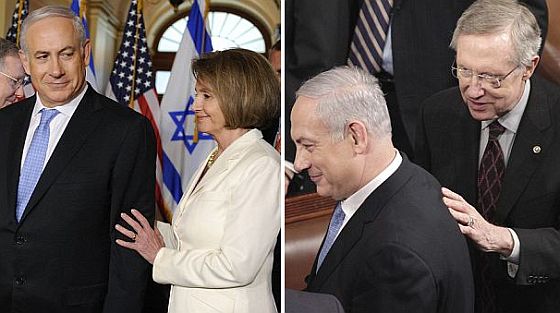
Netanyahu’s Congress

Benjamin Netanyahu being caressed in Congress this morning by Nancy Pelosi and Harry Reid

Josh Ruebner writes:

Gliding down the aisle of the House of Representatives like a popular president about to deliver the State of the Union address, escorted by a phalanx of dozens of ebullient Members of Congress, Israeli Prime Minister Benjamin Netanyahu entered a joint meeting of Congress today to a round of hearty handshakes and a thunderous standing ovation.

In a post-speech press conference, Senate Majority Leader Harry Reid gushed that Netanyahu delivered an “all-star” address, and Netanyahu proclaimed it a “great day” for Israel. And, in the self-contained world that is Capitol Hill, who could blame them for believing it to be so?

For in a world in which Israel finds itself as isolated as ever by a growing and successful Palestinian civil society-led international movement of boycott, divestment, and sanctions (BDS) against its apartheid policies; in which Palestinians are taking matters into their own hands diplomatically and pushing to have the United Nations admit the State of Palestine as a full member of the organization this fall; and in which even the President of the United States appears disgruntled by Israel’s intransigent ongoing colonization of Palestinian land, at least on Capitol Hill, Netanyahu can still play the ace up his sleeve to aplomb and then chum around like the king of the castle.

There on Capitol Hill, Netanyahu still has friends like Senator Chuck Schumer, who told a Jewish radio program that “One of my roles, very important in the United States Senate, is to be a shomer [guard]—to be a or the shomer Yisrael [guard of Israel]. And I will continue to be that with every bone in my body.” With friends like these wrapped around his little finger, no wonder Netanyahu’s forcible denunciations of international law were met with such rapturous approbation by Members of Congress who applauded his rejectionism dozens of times.

Justin Elliot lists the lines of Netanyahu’s speech that won 29 standing ovations.

Facebooktwittermail

The Zionist US Congress


(H/t Glenn Greenwald)

If anyone was in any doubt that Capitol Hill is Israeli occupied territory, the adulation Benjamin Netanyahu received from Republicans and Democrats in Congress today makes it obvious where the loyalties of most of our so-called representatives lie.

“In Judea and Samaria [the West Bank], the Jewish people are not foreign occupiers,” Netanyahu declared as members of Congress stood, clapped and cheered.

Well, if that’s what Washington really believes then it’s time to toss the two-state solution out of the window.

ABC News reports:

Prime Minister Benjamin Netanyahu’s speech before a joint meeting of Congress today had all trappings of a state of the union address by a U.S. president with sky-high approval ratings.

Speaking to a packed House chamber with Speaker of the House John Boehner and Vice President Joe Biden over his shoulders, Netanyahu was interrupted at least 53 times by applause, including at least 29 standing ovations.

To put those numbers in perspective, 29 standing ovations eclipse the total that President Obama received at the State of the Union this year. Obama, in a speech that lasted much longer than Netanyahu’s, garnered 79 applause interruptions, but his remarks were met by only 25 standing ovations.

One of Netanyahu’s biggest applause lines was aimed directly at President Obama.

“Israel will not return to the indefensible boundaries of 1967,” Netanyahu said, prompting a big standing ovation.

Later the prime minister added: “Israel under 1967 lines would be only nine miles wide. So much for strategic depth. So it’s therefore vital — absolutely vital — that a Palestinian state be fully demilitarized, and it’s vital — absolutely vital — that Israel maintain a long-term military presence along the Jordan River.”

As Netanyahu himself pointed out, the President has not called on Israel to return to the exact 1967 borders. The President has said that a peace agreement should be “based on 1967 lines with mutually agreed swaps.”

Nevertheless, Netanyahu speech – and the thunderous bi-partisan response – was a clear challenge to the idea of using the 1967 boundaries – with or without “swaps” — as a basis for a peace deal.

Netanyahu also got big ovations with hard-line statements on two other perennial sticking points to Israeli-Palestinian peace agreements: No right of return for Palestinian refugees, and “Jerusalem will never again be divided. Israel must remain the united Capital of Israel.”

Netanyahu arguably got a warmer reception than President Obama received during his last state of the union and certainly a warmer reception than he’d receive at the Knesset. When the speech was over, he lingered for a while at the podium as it seemed he didn’t want to leave.

Facebooktwittermail

Exposing Netanyahu

Paul Pillar writes:

Probably the most significant take-away from the past few days of U.S.-Israeli dialog is to shed light on the true intentions of Israeli Prime Minister Benjamin Netanyahu regarding peace with the Palestinians. Although Netanyahu finally allowed the phrase “Palestinian state” to pass his lips for the first time almost two years ago, this past week in Washington provided further confirmation of what had been apparent all along: that whatever conception Netanyahu may have of such a “state,” it is not a formula having any chance of becoming the basis for—to use Netanyahu’s own words from his joint appearance with President Obama on Friday—“a peace that will be genuine, that will hold, that will endure,” or probably even what most of the rest of the world would consider a state. Netanyahu is smart enough to realize this, which is to say he is content to let the status quo endure indefinitely. Israel will maintain that status quo through brute force—military force within the territories, and political force in Washington.

The drop-the-veil moment during this past week was the importunate lobbying by Netanyahu’s government before President Obama delivered his Middle East speech on Thursday at the State Department (and doesn’t that say something right there—where else would one see a foreign government get in the last lobbying licks on a president’s speech, even at the expense of delaying the speech?) to omit any mention of the 1967 borders as the basis for negotiating land swaps and an eventual territorial settlement. The president mentioned that anyway, and in the joint appearance on Friday Netanyahu said nothing about land swaps, instead denouncing the 1967 borders as not being a suitable basis for anything. As Mr. Obama correctly noted in his address to AIPAC on Sunday, there was nothing new in his mention of 1967-borders-with-swaps. It has long been recognized as the only formula that has any hope of being the basis for a successful negotiation. It has been the basis for several official proposals, including one by Israeli Prime Minister Ehud Olmert in 2008. It also has been at the center of several unofficial proposals, including ones from people whose concern for Israel cannot be doubted (such as a plan offered by David Makovsky of the Washington Institute for Near East Policy).

So for Netanyahu, not only is the land allotted to the Jewish state in the UN partition plan of the 1940s not enough, and not only is the larger territory that became the State of Israel with what we call the 1967 borders not enough. Even with land swaps that would extend Israel farther into the West Bank and include the large majority of the settlements Israel has constructed on land seized in the 1967 war, that would still not be enough for him. How much would be enough? One can speculate on what crumbs of land would be left to the Palestinians, but speculation is not required to have an idea based on Netanyahu’s own statements of what such a “state” would entail: Israeli control of the airspace, no military of its own, and, as the prime minister mentioned on Friday, a “long-term” Israeli military presence along the Jordan River. It sounds like a bantustan that would make Bophuthatswana look like a paragon of sovereignty. But trying to envision the details of such an entity is pointless because it is a non-starter very likely intended to be rejected.

Facebooktwittermail

Welcome Hamas’s conciliation with Fatah

Musa Abumarzuq, deputy head of Hamas’s political bureau in Damascus, writes:

The birth of the Cairo reconciliation agreement between Fatah and Hamas was slow and painful. But Palestinians welcomed its arrival. The tragic division which occurred in our national movement constituted a chapter we hope will never happen again. It never occurred to us that a time would come when we would turn against fellow Palestinians.

Today, the reconciliation exposes the Israeli occupation as the real spoiler of peace. The Israelis have reneged on every agreement signed with the Palestinian Authority. Now we have forged this historic agreement and buried the hatchet, they are threatening our people with dire consequences.

While we were ensconced in Cairo trying to finalise the agreement, Israel embarked on a diplomatic offensive to persuade European governments to withdraw economic assistance to the Palestinian Authority.

As western governments have, individually and collectively, welcomed the democratic changes taking place in the Middle East, they should support a similar transformation in Palestine. Any attempt to short change my people would have no legitimacy. The events marking the 63rd anniversary of the Nakba have shown that no amount of victimisation, wars and blockade will deter us from the path of freedom. The world must remember the core issue of our cause is the right of every refugee to return to their home – a right enshrined in international law. As others were allowed to exercise this right, we demand the same for our people.

Facebooktwittermail

US Congress controlled by AIPAC

Press TV reports:

A pro Israeli advocate knocked a camera out of the hands of Alison Weir, President of the Council for the National Interest Foundation. The group just finished their press conference on what they call unjustifiable US Aid to Israel.

The two sides met when the Press Club scheduled a pro Israeli news conference to follow held in the same room. The altercation illustrates heightened tensions on differing views regarding America’s relationship with Israel.

The Council for the National Interest Foundation wants Americans to know how much of their tax dollars are going to Israel.

Facebooktwittermail

NATO concern over Pakistan nuclear arsenal

Al Jazeera reports:

The head of NATO has admitted that the security of Pakistan’s nuclear weapons is a matter of concern, the day after the worst assault on a Pakistani military base in two years.

Anders Fogh Rasmussen was speaking in Afghanistan on Tuesday, where he met Hamid Karzai, the Afghan president, to discuss the transition of security from NATO-led troops to Afghan security forces, which is due to begin in July.

“Based on the information and intelligence we have, I feel confident that Pakistan’s nuclear arsenal is safe and well protected,” Rasmussen said. “But of course, it is a matter of concern and we follow the situation closely.”

Pakistani forces battled Taliban fighters for 17 hours before reclaiming control of a naval base in Karachi on Monday.

The attack, the worst on a base since the army headquarters was besieged in October 2009, piled further embarrassment on Pakistan three weeks after al-Qaeda leader Osama bin Laden was found living in the city of Abbottabad, close to the country’s military academy.

The Los Angeles Times reports:

The team of Islamist militants knew exactly where the naval base’s weak spot was.

Dressed in black and armed with AK-47 rifles, grenades and rocket launchers, they crept up to the back wall of Mehran Naval Station in Karachi, keeping clear of security cameras. Then, with just a pair of ladders, they clambered over the wall, cutting through barbed wire at the top, to launch a 17-hour siege that would renew disturbing questions about the Pakistani military’s ability to defend sensitive installations, including its nuclear arsenal.

The team, believed to consist of four to six militants, destroyed two U.S.-supplied maritime surveillance aircraft and engaged security forces in hours of pitched firefights. It was not until late Monday afternoon that Pakistani forces regained full control of the facility.

Interior Minister Rehman Malik said 10 Pakistani security personnel were killed and 15 were injured. Four militants died and two were believed to have escaped, he said.

The Pakistani Taliban, the country’s homegrown insurgency with ties to Al Qaeda, claimed responsibility for the attack, which it said was meant to avenge the May 2 killing of Osama bin Laden in the military city of Abbottabad.

Facebooktwittermail

David Headley, witness in terror trial, ties Pakistani spy agency to militant group

Sebastian Rotella reports:

A confessed Pakistani American terrorist took the stand in a Chicago courtroom Monday and described a close alliance between Pakistan’s intelligence service and the Lashkar-i-Taiba terrorist group, alleging that Pakistani officers recruited him and played a central role in planning the 2008 Mumbai attacks.

David Coleman Headley’s long-awaited testimony at the start of a trial with international repercussions resolved one question at the outset: Federal prosecutors did not hesitate to connect Pakistan’s Inter-Services Intelligence Directorate (ISI) to the attacks that killed 166 people, including six Americans.

Headley has pleaded guilty to doing reconnaissance in Mumbai and is the star government witness against his alleged accomplice, Tahawwur Rana. Headley testified that Lashkar “operated under the umbrella of the ISI” even after the group was banned in Pakistan in 2001.

The ISI and Lashkar “coordinated with each other,” Headley testified. “And ISI provided assistance to Lashkar: financial, military and moral support.”

After he trained three years with Lashkar, Headley said, a “Major Ali” of the ISI recruited him when he was briefly detained near the Afghanistan border in 2006. Ali referred him to an officer known as Major Iqbal, who became Headley’s handler and worked separately but in coordination with Lashkar chiefs, directing Headley’s reconnaissance in India and providing $25,000 to fund his mission.

Facebooktwittermail

Al Qaeda’s leadership

At Jihadica, Vahid Brown writes:

In light of the widely reported news that Sayf al-‘Adl (also spelled Saif al-Adel) has taken the reins of operational leadership within al-Qa’ida in the wake of the death of Osama bin Laden, I thought it would be useful to Jihadica’s readers to provide a bit of context about this man and about the significance, if any, of these reports (see, e.g., Musharbash and Bergen), all of which rely on the testimony of Noman Benotman, a former leader of the Libyan Islamic Fighting Group.

First of all, it would be more correct to say that Sayf al-‘Adl remains the operational leader of al-Qa’ida rather than that he has lately assumed this rank. (Nor is this the first time that Benotman has called attention in the press to Sayf’s operational re-emergence in al-Qa’ida. He discussed Sayf’s release from Iran and return to headquarters, as it were, with Der Speigel last October) Several al-Qa’ida insiders have reported since 2009 that Sayf took the top slot in al-Qa’ida’s military committee after the 2001 death of Abu Hafs al-Masri (Muhammad Atef). These sources also evidence long standing tensions within the organization about Zawahiri being AQ’s second-in-command, next in line to lead should Bin Laden exit the scene.

This much can be gleaned from Abu Jandal (Nasser al-Bahri), the Yemeni former bodyguard of Bin Laden, who has much to say on both points in his 2010 memoir. Abu Jandal broke with al-Qa’ida after 9/11, but according to him up to that point the chain of command in operational terms was clearly Bin Laden, Abu Hafs, Sayf, and then Abu Muhammad al-Masri (Abdullah Ahmad Abdullah). With Abu Hafs dead, Sayf took the operational lead as head of the military committee. As for the doubts about Zawahiri, at the end of his book Abu Jandal asks himself what would happen if Bin Laden died, and answers that while Zawahiri would theoretically replace him, “to me, Zawahiri does not possess the requisite qualities to lead the organization.” He goes on to say (translating from the French here):

“Bin Laden is a born leader. He commanded al-Qa’ida with a certain transparency, rendering him universally acceptable; he is open to dialogue; and he has historical legitimacy. Zawahiri, though, conducts his affairs in secret. There are numerous members of al-Qa’ida that would not accept Zawahiri taking over. His behavior and that of the Egyptians have generated a great deal of reserve, sometimes very harsh criticism. All of this has left its mark. His statements, as we have seen, are sometimes dismissed. I doubt he has sufficient authority for such a position, even with his well-known authoritarianism and his penchant for centralizing power in himself” (p. 281).

Facebooktwittermail

Bin Laden’s gone. Can my son come home?

John Walker Lindh’s father calls for his son’s release.

In November 2000, John left Yemen for Pakistan, and the next April, he wrote to me and his mother to say he was going into the mountains of Pakistan for the summer. That was the last we heard from him. Throughout the summer, and especially after 9/11, our family became increasingly worried about John’s whereabouts and his welfare. In December 2001 we were shocked to learn from the news that John had been found among a group of Taliban prisoners who had survived an uprising and massacre at an old fortress near Mazar-i-Sharif.

Like Ernest Hemingway during the Spanish Civil War, John had volunteered for the army of a foreign government battling an insurgency. He thought he could help protect Afghan civilians against brutal attacks by the Northern Alliance warlords seeking to overthrow the Taliban government. His decision was rash and blindly idealistic, but not sinister or traitorous. He was 20 years old.

Before 9/11, the Bush administration was not hostile to the Taliban; barely four months before the attacks it gave $43 million in humanitarian aid to Afghanistan. There was nothing treasonous in John’s volunteering for the Afghan Army in the spring of 2001. He had no involvement with terrorism.

Facebooktwittermail