Author Archives: News Sources

4 things Western democracies need to understand to stop hostile Kremlin meddling

Jakub Janda writes: In 2015, I started the Kremlin Watch Program at a think-tank in Prague. My team analyzes Russian influence and disinformation operations, and we have helped the Czech government tailor a national strategy. We publish papers, propose strategies, and have been invited to consult in 16 countries—mostly European—so far. These are four lessons I have learned from my experience.

#1. Putin’s regime wants to call itself a superpower and to be respected as such. Apart from having nuclear weapons and large territory, Russia has nothing that makes it anything more than a regional dictatorship with living standards of a developing country. Freedom of speech in Russia is worse than in Zimbabwe, political opponents are shot or poisoned, journalists are assassinated, history is systematically falsified, and most major media outlets are controlled by the regime. Putin suppresses domestic opposition—from both political groups and independent media—because he has failed to deliver solid living standards for ordinary Russians over the course of the 17 years he has ruled. Russia has a lower GDP than Italy, and its average wages are lower than Romania’s.

On the international stage, there isn’t much to respect Russia for—apart from its status of a doping superpower; its occupation of Ukraine, Georgia and Moldova; and its covering up for bloody dictators like Syrian President Bashar al-Assad. Western leftists need to wake up from their naïve dream of Russia being a champion of socialist ideals, and Western rightists should recognize that Russia is not a champion of conservative values; it suppresses individual freedoms and has the highest abortion rate in the world. Putin’s regime kills and bullies to get respected. Democracies need to denounce this paradigm. It worked at the end of 1980s, and it will work again if we stop buying into the Soviet dictatorship’s fear game. [Continue reading…]


Facebooktwittermail

Will Trump’s spiraling constitutional crisis end up saving the Paris climate deal?

Joe Romm writes: Will President Donald Trump’s surprise move to fire FBI director James Comey this week change the dynamics that had appeared to be leading toward a decision by the Trump administration to exit the landmark Paris climate accord?

Some say yes. “Every president in the modern era who gets into trouble at home, looks to opportunities to engage other leaders on the world stage publicly and cooperatively to demonstrate their legitimacy,” Andrew Light, senior fellow at World Resources Institute and former U.S. State Department climate official, told me.

Exiting the Paris agreement would make it all but impossible for Trump to work with other world leaders on a global stage.

Backing up a couple of weeks, before the stunning Comey decision and constantly-shifting rationale behind it, things were looking very bad for global climate action. [Continue reading…]

Facebooktwittermail

Trump said he was thinking of Russia controversy when he decided to fire Comey

The Washington Post reports: President Trump on Thursday said he was thinking of “this Russia thing with Trump” when he decided to fire FBI Director James B. Comey, who had been leading the counterintelligence investigation into Russia’s interference in the 2016 election.

Recounting his decision to dismiss Comey, Trump told NBC News, “In fact, when I decided to just do it, I said to myself, I said, ‘You know, this Russia thing with Trump and Russia is a made up story, it’s an excuse by the Democrats for having lost an election that they should have won.’”

Trump’s account flatly contradicts the White House’s initial account of how the president arrived at his decision, undercutting public denials by his aides that the move was influenced in any way by his growing fury with the ongoing Russia probe. [Continue reading…]

Facebooktwittermail

In a private dinner, Trump demanded loyalty. Comey demurred

The New York Times reports: Only seven days after Donald J. Trump was sworn in as president, James B. Comey has told associates, the F.B.I. director was summoned to the White House for a one-on-one dinner with the new commander in chief.

The conversation that night in January, Mr. Comey now believes, was a harbinger of his downfall this week as head of the F.B.I., according to two people who have heard his account of the dinner.

As they ate, the president and Mr. Comey made small talk about the election and the crowd sizes at Mr. Trump’s rallies. The president then turned the conversation to whether Mr. Comey would pledge his loyalty to him.

Mr. Comey declined to make that pledge. Instead, Mr. Comey has recounted to others, he told Mr. Trump that he would always be honest with him, but that he was not “reliable” in the conventional political sense.

The White House says this account is not correct. And Mr. Trump, in an interview on Thursday with NBC, described a far different dinner conversation with Mr. Comey in which the director asked to have the meeting and the question of loyalty never came up. It was not clear whether he was talking about the same meal, but they are believed to have had only one dinner together.

By Mr. Comey’s account, his answer to Mr. Trump’s initial question apparently did not satisfy the president, the associates said. Later in the dinner, Mr. Trump again said to Mr. Comey that he needed his loyalty.

Mr. Comey again replied that he would give him “honesty” and did not pledge his loyalty, according to the account of the conversation.

But Mr. Trump pressed him on whether it would be “honest loyalty.”

“You will have that,” Mr. Comey told his associates he responded. [Continue reading…]

Facebooktwittermail

Trump just decimated the White House’s entire Comey narrative


Aaron Blake writes: I wrote Wednesday that the White House’s explanations for firing James B. Comey were crumbling. Well, President Trump just exploded them.

In one fell swoop, Trump totally contradicted his three top spokespeople and offered a polar-opposite version of events than they had provided.

After they had spent the past 45 hours emphasizing that this was a decision Trump arrived at after receiving a memo and recommendation from Deputy Attorney General Rod J. Rosenstein, Trump just blurted out that he was going to fire Comey all along. Basically, he admitted the memo was a ruse and a political ploy. [Continue reading…]

Facebooktwittermail

Trump cancels visit to FBI headquarters after being told he’s unwelcome

NBC News reports: The White House has abandoned the idea of President Trump visiting FBI headquarters after being told he would not be greeted warmly, administration officials told NBC News.

Amid the continuing fallout over his decision to fire FBI Director James Comey, Trump was considering an appearance at the FBI’s J Edgar Hoover Building in downtown Washington, DC. The White House publicly floated the idea as recently as Thursday morning.

Spokeswoman Sarah Huckabee Sanders, asked by a reporter whether such a visit was imminent, replied, I believe that it’s very likely that takes place sometime in the next few days.”

But that idea was dropped later Thursday, administration officials said, after the FBI told the White House the optics would not be good. FBI officials made clear that the president would not draw many smiles and cheers, having just unceremoniously sacked a very popular director.

And FBI agents said that, while many of them voted for Trump, after the president unceremoniously fired a very popular director, few were ready to meet him at the bureau with open arms.

“My sense is most FBI employees feel a loyalty to Comey,” one person who works at headquarters told NBC News. “And whether they agree or disagree with the way he handled the email case, like and respect him … Trump would not be well-received at headquarters.” [Continue reading…]


Facebooktwittermail

White House views Comey’s removal as a step towards conclusion of Russia investigation

CNN reports: The White House said Thursday that removing FBI Director James Comey from his post may hasten the agency’s investigation into Russian meddling.

“We want this to come to its conclusion, we want it to come to its conclusion with integrity,” said deputy press secretary Sarah Sanders, referring to the FBI’s probe into Moscow’s interference in last year’s election. “And we think that we’ve actually, by removing Director Comey, taken steps to make that happen.”

The statement was a surprising admission from the White House that Comey’s sudden dismissal on Tuesday may have an effect on the Russia probe. Officials have insisted the removal came because of Comey’s handling of an investigation into Hillary Clinton’s email server, and was unrelated to his oversight of the look into Russia’s election hacking and possible ties between Trump advisers and Russian operatives.

Sanders said Thursday that Trump would “love nothing more for this investigation to continue to its completion.”

But Trump himself has cast doubt on the investigation, suggesting any question of ties between his campaign and Russia are a “hoax.”

Earlier in her briefing Thursday, Sanders claimed that Comey’s firing had not altered the Russia investigation at all. [Continue reading…]

Facebooktwittermail

FBI Russia investigation may continue while starved of necessary resources

Julia Ioffe writes: The abrupt and strange way Comey was fired, as well as the lack of a nominee to replace him, “is a very political decision, and the message it sends seems to be to back off the investigation,” said Amy Zegart, the co-director for Stanford’s Center for International Security and Cooperation and senior fellow at the conservative Hoover Institution.

If that’s the case, there are many ways the bureau could “back off” without actually looking like it has backed off or even stopped investigating Russian interference. According to the former FBI agent Clinton Watts, the limbs of the beheaded bureau will keep doing their work. “The investigative part is independent,” said Watts. But even if the work goes on, what will that work look like? “The investigation will go forward in the short run,” said Jack Goldsmith, a professor at Harvard Law School and an assistant attorney general under George W. Bush. “The question is how vigorous it will be.”

One factor that may determine the answer is money. According to multiple reports, which a spokeswoman from the Department of Justice denied, Comey had asked the department for more resources to pursue the Russia investigation right before he was fired. What happens to the FBI’s resources now? A new FBI director “can’t shut the investigation down,” said Watts, “but can decide how resources are allocated and how time is spent.” Eric Columbus served from 2009 to 2014 in the office of the deputy attorney general—a position now occupied by Rod Rosenstein, whose letter describing Comey’s handling of the Clinton email investigation was cited by Trump as the reason for Comey’s dismissal. Columbus said that though a new director would have the legal authority to shut the Russia investigation down, “the smarter ploy would be to slow walk it and starve it of resources and not have it be the focus of leadership. … You can investigate things forever and have it never go anywhere. If you want to kill something, the most effective way to kill it is to just have it on a slow simmer rather than a rolling boil.”

In other words, the investigation could keep going but be so starved of money and manpower that it is not much of an investigation at all. [Continue reading…]

Facebooktwittermail

Uncertain future for FBI Russia investigation

McClatchy reports: The FBI-led probe into whether Russian influence operations helped put Donald Trump in the White House is on a knife’s edge and could easily veer into either of two distinct directions.

One possibility is that investigators will feel galvanized by President Donald Trump’s abrupt firing of FBI director James Comey and burrow ever deeper into a probe in which they see the reputation of the bureau at stake.

Or, with the FBI temporarily rudderless, Trump loyalists in the Justice Department could put the brakes on the investigation in multiple ways.

“They could just say, ‘We’ve got 60 days to tie this up. I’m not spending more person power inside the bureau. . . . Let’s just say wrap it up unless we’ve got a smoking gun,’ ” said Christopher H. Schroeder, a former assistant attorney general who headed the Office of Legal Policy.

Agents could be reassigned, Schroeder said, “and you could slow walk it by starving it.”

New indications arose Wednesday that Comey, whom Trump axed Tuesday, ostensibly for the way he handled the probe into Hillary Clinton’s use of a private email server while serving as secretary of state, was seeking to expand the investigation into Trump’s inner circle and its ties to Russia. [Continue reading…]

Facebooktwittermail

Trump official: We ‘let the biggest perpetrator of fake news into the Oval Office’ (apart from Trump himself)

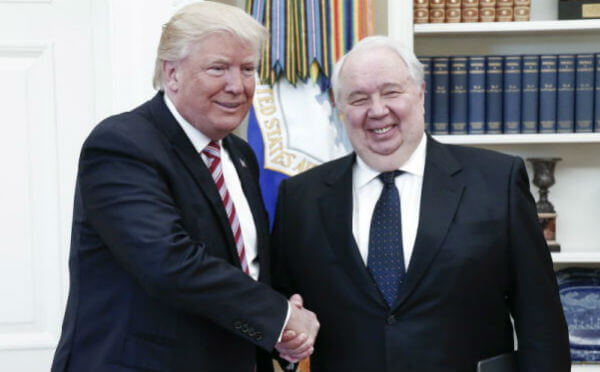
The Daily Beast reports: Senior members of the Trump administration are livid that the White House allowed the Russian government to steer the narrative of the president’s Wednesday meeting with top Russian diplomats by giving Kremlin-backed media exclusive access to the event.

The White House did not allow American press into the meeting between President Donald Trump, Russian foreign Minister Sergey Lavrov, and Russia’s ambassador to Washington, Sergey Kislyak. But it did admit a photographer from TASS, a state-owned Russian news service. Its photos were subsequently posted on TASS’s website, giving that outlet a monopoly on publishable visuals of the meeting.

Russian government Twitter accounts shared photos of the event shortly after its conclusion. They revealed Kislyak’s presence—a fact that was not even mentioned in the official White House readout of the meeting. Some U.S. officials suspect Kislyak, whose conversations with Trump’s former National Security Adviser have fed an FBI investigation of his campaign, is a Kremlin spy—or at least spy-adjacent.

Two senior administration officials, one an Obama holdover and the other a Trump appointee, told The Daily Beast that the resulting reliance of U.S. media on a propaganda arm of a foreign government let Russia set the public tone of the meeting and embarrassed the administration amid already contentious discussions with Russian diplomats.

Both officials spoke on condition of anonymity in order to candidly express their views. The White House did not immediately respond to a request for comment.

“This isn’t an ‘America First’ policy,” one of the officials fumed of the White House’s decision “to let the biggest perpetrator of fake news into the Oval Office.” Trump, the official added, is “either in bed with the Russians or too stupid to understand the severity of this mistake. Either way, the implications are truly terrifying.” [Continue reading…]

Facebooktwittermail

Europeans are less likely to share fake news. Here’s why

PRI reports: If you picked up a newspaper in the UK on Monday, you might have encountered an unusual advertisement offering tips on how to spot “false news.”

Facebook published the full-page ads in major newspapers — including the Guardian and the Times of Londn — ahead of the country’s general elections next month. Last month, it published the same ads in Germany and France, ahead of elections in those countries.

“People want to see accurate information on Facebook and so do we. That is why we are doing everything we can to tackle the problem of false news,” Simon Milner, Facebook’s Director of Policy for the UK, wrote in a statement.

Research indicates that Internet users in some European countries are less likely than Americans to share fake news online. Still, Facebook and other social media companies have been facing mounting pressure from European leaders to address fake news, as well as other hateful, racist and violent posts.

“I think Europe has within living memory much more understanding of the consequences of letting hateful propaganda spread,” said Zeynep Tufekci, an associate professor at the University of North Carolina who studies the effect of technology on politics and society. “They lived through World War I and World War II, and they have a deeper visceral reaction to the consequences of letting hate speech, incitement to violence, misinformation, propaganda — the whole range of things that we see online today — going unchecked.” [Continue reading…]

Facebooktwittermail

Acting FBI Director McCabe refutes White House claim that rank and file FBI employees had ‘lost confidence’ in Comey

In hearings before the Senate Intelligence Committee today, when asked about claims that Director Comey had “lost the confidence of rank and file FBI employees,” Acting FBI Director McCabe responded, “No, sir. That is not accurate.” He added, “Director Comey enjoyed broad support within the FBI. And still does to this day.”


On Tuesday night, Deputy White House Press Secretary Sarah Huckabee Sanders claimed Comey was fired because he had “lost the confidence” of the “rank-and-file” FBI employees.


Facebooktwittermail

By his actions (or inaction) Deputy Attorney General Rod Rosenstein will now demonstrate his true loyalties

In an open letter, the New York Times editorial board says: Dear Deputy Attorney General Rod Rosenstein:

It’s rare that any single person has to bear as much responsibility for safeguarding American democracy as you find yourself carrying now. Even before President Trump’s shocking decision on Tuesday to fire the F.B.I. director, James Comey, a dark cloud of suspicion surrounded this president, and the very integrity of the electoral process that put him in office. At this fraught moment you find yourself, improbably, to be the person with the most authority to dispel that cloud and restore Americans’ confidence in their government. We sympathize; that’s a lot of pressure.

Given the sterling reputation you brought into this post — including a 27-year career in the Justice Department under five administrations, and the distinction of being the longest-serving United States attorney in history — you no doubt feel a particular anguish, and obligation to act. As the author of the memo that the president cited in firing Mr. Comey, you are now deeply implicated in that decision.

It was a solid brief; Mr. Comey’s misjudgments in his handling of the F.B.I. investigation of Hillary Clinton’s private email server were indeed serious. Yet you must know that these fair criticisms were mere pretext for Mr. Trump, who dumped Mr. Comey just as he was seeking more resources to investigate ties between the Trump campaign and the Russian government.

You must also know that in ordering you to write the memo, Mr. Trump exploited the integrity you have earned over nearly three decades in public service, spending down your credibility as selfishly as he has spent other people’s money throughout his business career. We can only hope that your lack of an explicit recommendation to fire Mr. Comey reflects your own refusal to go as far as the president wanted you to.

In any case, the memo is yours, and that has compromised your ability to oversee any investigations into Russian meddling. But after Attorney General Jeff Sessions recused himself from these matters, because of his own contacts during the campaign with the Russians, the power to launch a truly credible investigation has fallen to you, and you alone. [Continue reading…]

Facebooktwittermail

Inside Trump’s anger and impatience — and his decision to fire Comey

The Washington Post reports: Every time FBI Director James B. Comey appeared in public, an ever-watchful President Trump grew increasingly agitated that the topic was the one that he was most desperate to avoid: Russia.

Trump had long questioned Comey’s loyalty and judgment, and was infuriated by what he viewed as the director’s lack of action in recent weeks on leaks from within the federal government. By last weekend, he had made up his mind: Comey had to go.

At his golf course in Bedminster, N.J., Trump groused over Comey’s latest congressional testimony, which he thought was “strange,” and grew impatient with what he viewed as his sanctimony, according to White House officials. Comey, Trump figured, was using the Russia probe to become a martyr.

Back at work Monday morning in Washington, Trump told Vice President Pence and several senior aides — Reince Priebus, Stephen K. Bannon and Donald McGahn, among others — that he was ready to move on Comey. First, though, he wanted to talk with Attorney General Jeff Sessions, his trusted confidant, and Deputy Attorney General Rod J. Rosenstein, to whom Comey reported directly. Trump summoned the two of them to the White House for a meeting, according to a person close to the White House.

The president already had decided to fire Comey, according to this person. But in the meeting, several White House officials said Trump gave Sessions and Rosenstein a directive: to explain in writing the case against Comey.

The pair quickly fulfilled the boss’s orders, and the next day Trump fired Comey — a breathtaking move that thrust a White House already accustomed to chaos into a new level of tumult, one that has legal as well as political consequences.

Rosenstein threatened to resign after the narrative emerging from the White House on Tuesday evening cast him as a prime mover of the decision to fire Comey and that the president acted only on his recommendation, said the person close to the White House, who spoke on the condition of anonymity because of the sensitivity of the matter. [Continue reading…]

Facebooktwittermail

Trump meets Russia’s foreign minister at Vladimir Putin’s insistence

Susan Glasser writes: When President Donald Trump hosted Russian Foreign Minister Sergey Lavrov in the Oval Office Wednesday just hours after firing the FBI director who was overseeing an investigation into whether Trump’s team colluded the Russians, he was breaking with recent precedent at the specific request of Russian President Vladimir Putin.

The chummy White House visit—photos of the president yukking it up with Lavrov and Russian Ambassador to the United States Sergey Kislyak were released by the Russian Foreign Ministry since no U.S. press was allowed to cover the visit—had been one of Putin’s asks in his recent phone call with Trump, And indeed the White House acknowledged this to me later Wednesday. “He chose to receive him because Putin asked him to,” a White House spokesman said of Trump’s Lavrov meeting. “Putin did specifically ask on the call when they last talked.”

The meeting was Lavrov’s first in the White House since 2013—and came after several years of the Obama administration’s flat-out refusal to grant him an Oval Office audience, two former senior White House officials told me. “The Russians were begging us for years to do that,” one of the former officials said. “They were constantly pushing for it and we were constantly saying no.”

The images of Trump putting his arm genially on Lavrov’s back—and a later White House official readout of the meeting that said Trump “emphasized his desire to build a better relationship between the United States and Russia”—couldn’t have come at a more fraught political moment for Trump, amid a barrage of bipartisan criticism of his firing of FBI director James Comey. On Wednesday morning before meeting with Trump, Lavrov even cracked a joke about his hosts’ political predicament, laughingly claiming not to have heard of the Comey firing while standing alongside Trump’s Secretary of State Rex Tillerson.

In other words, Lavrov was right where he has always wanted to be Wednesday: mocking the United States while being welcomed in the Oval Office by the president himself. [Continue reading…]

Facebooktwittermail

Senate Intelligence Committee subpoenas Flynn

Politico reports: The Senate Intelligence Committee has subpoenaed any Russia-related documents from former national security adviser Michael Flynn for its continuing probe into the Kremlin’s efforts to manipulate the 2016 election.

The legal order, announced by the panel’s bipartisan leaders Sens. Richard Burr (R-N.C.) and Mark Warner (R-Va.), went out Wednesday after Flynn’s attorneys informed the panel they would not cooperate with the probe unless the embattled former general was granted immunity, a congressional source told POLITICO.

Flynn had been asked, along with a spate of other former and current Trump associates, at the end of last month to provide the Intelligence Committee with any documents potentially related to the panel’s Russia probe. The investigation is examining, among other questions, whether Flynn or other Trump associates had improper contact with the Russian government throughout the course of the campaign or the transition period. [Continue reading…]

Facebooktwittermail

White House lawyers warned Trump: Stay away from Michael Flynn

The Daily Beast reports: White House lawyers have had to warn President Donald Trump repeatedly against reaching out to his fired National Security Adviser Michael Flynn, two people familiar with the matter tell The Daily Beast.

Trump, angered by press coverage of the Russia investigation and Gen. Flynn, has asked senior staff and the White House counsel’s office multiple times if it was appropriate to reach out to the fired National Security Adviser, according to a source close to Flynn and a Trump administration official with direct knowledge of the exchanges.

“While the president does not regret firing Gen. Flynn, he feels he is a good man who served his country bravely and honorably and who is being treated unfairly by the press and the Democrats on Capitol HIll,” another Trump administration official said. These officials requested anonymity as a condition of discussing legal advice to the president.

A White House staffer also stressed Trump’s personal affinity for his former aide. The president “clearly feels bad about how things went down,” the staffer said, referring to Flynn’s firing in February. [Continue reading…]

Facebooktwittermail

Days before firing, Comey asked for more resources for Russia inquiry

The New York Times reports: Days before he was fired, James B. Comey, the former F.B.I. director, asked the Justice Department for a significant increase in resources for the bureau’s investigation into Russia’s interference in the presidential election, according to four congressional officials, including Senator Richard J. Durbin.

Mr. Comey made his appeal to Rod J. Rosenstein, the deputy attorney general, who also wrote the Justice Department’s memo that was used to justify the firing of Mr. Comey this week, the officials said.

“I’m told that as soon as Rosenstein arrived, there was a request for additional resources for the investigation and that a few days afterwards, he was sacked,” said Mr. Durbin, a Democrat of Illinois. “I think the Comey operation was breathing down the neck of the Trump campaign and their operatives, and this was an effort to slow down the investigation.” [Continue reading…]

Facebooktwittermail