BuzzFeed reports: The white nationalist Richard Spencer is partnering with two Swedish outfits to create a company they hope will become a media giant and keep race at the center of the new right wing.
It is envisioned, one co-creator said, as a “more ideological Breitbart.” Called the AltRight Corporation, it links Spencer with Arktos Media, a publishing house begun in Sweden to print English-language editions of esoteric nationalist books from many countries. The other Swedish partner is Red Ice, a video and podcast platform featuring white nationalists from around the globe.
It was natural for Spencer to turn to Swedes as partners in the new enterprise, given the country’s history as an exporter of white nationalist ideas. But forging formal bonds between nationalists across the Atlantic makes even more sense today, when the politics of Northern Europe is heavily driving the politics of immigration and Islam in the United States.
Sweden has been a key center of white nationalism for decades. In the 1990s, it was a world capital of “white power” heavy metal bands; today, it teems with websites and podcasts promoting a new language of white identity. Nationalists have built this network in a country that immigration opponents worldwide have been closely watching with the belief that it will be the first Western nation to collapse beneath the weight of Muslim immigration. [Continue reading…]
Author Archives: News Sources
Kremlin critic Aleksei Navalny says attack left him mostly blind in an eye
The New York Times reports: Aleksei A. Navalny, the Russian opposition leader, said on Tuesday that a doctor told him he had lost 80 percent of the sight in one eye after suffering a chemical burn when an assailant threw a green liquid in his face last week.
The eye’s vision may improve, but the outlook is unclear, Mr. Navalny wrote on his website, citing his doctor.
Initially, the attack had appeared less serious; dousing opposition figures with green dye is a common occurrence and often attributed to pro-Kremlin activists. Typically, a type of topical medical disinfectant has been used. It is difficult to wash out but harmless.
Mr. Navalny, who has declared his intention to run in Russia’s presidential election next year, had already been splashed in the face with green dye once this spring, without any adverse affects.
But after the attack on Thursday, in which a man threw the green liquid in the opposition leader’s face and then ran away, Mr. Navalny was taken to a hospital to treat burning in his right eye.
In a post on his website on Tuesday, Mr. Navalny said his ophthalmologist had told him that he had a “chemical burn on the right eye” caused by something other than the green-colored disinfectant. “There was clearly a mix of disinfectant and another, caustic chemical,” Mr. Navalny wrote. [Continue reading…]
Two-thirds of Canada’s electricity now comes from renewable energy
The Canadian Press reports: Two-thirds of Canada’s electricity supply now comes from renewable sources such as hydro and wind power, the National Energy Board said in a report released Tuesday.
Renewable energy production jumped 17 per cent between 2005 and 2015. The portion of all electricity in Canada generated by renewables is now 66 per cent, up from 60 per cent a decade earlier.
“I think people don’t understand just how much of our generation is the renewables,” said NEB chief economist Shelley Milutinovic. “Probably very few people would know Canada produces the second most hydro in the world.” [Continue reading…]
South Korea’s likely next president asks the U.S. to respect its democracy
The Washington Post reports: South Korea is on the brink of electing a liberal president with distinctly different ideas than the Trump administration on how to deal with North Korea — potentially complicating efforts to punish Kim Jong Un’s regime.
He is also a candidate who fears that the U.S. government has been acting to box him in on a controversial American missile defense system and circumvent South Korea’s democratic process.
“I don’t believe the U.S. has the intention [to influence our election], but I do have some reservations,” Moon Jae-in told The Washington Post in an interview.
Barring a major upset, Moon will become South Korea’s president Tuesday, replacing Park Geun-hye, who was impeached in March and is on trial on bribery charges. Because Park was dismissed from office, Moon will immediately become president if elected, without the usual transition period.
With Moon pledging to review the Park government’s decision to deploy the Terminal High Altitude Area Defense (THAAD) antimissile system, the U.S. military has acted swiftly to get it up and running. This has sparked widespread criticism here that the United States is trying to make it difficult, if not impossible, for Moon to reverse it. [Continue reading…]
The Associated Press reports: The anger is palpable on a narrow road that cuts through a South Korean village where about 170 people live between green hills dotted with cottages and melon fields. It’s an unlikely trouble spot in the world’s last Cold War standoff.
Aging farmers in this corner of Seongju county, more than 200 kilometers (125 miles) south of the capital Seoul, spend the day sitting by the asphalt in tents or on plastic stools, watching vehicles coming and going from a former golf course where military workers are setting up an advanced U.S. missile-defense system.
“Just suddenly one day, Seongju has become the frontline,” said a tearful Park Soo-gyu, a 54-year-old strawberry farmer. “Wars today aren’t just fought with guns. Missiles will be flying and where would they aim first? Right here, where the THAAD radar is.” [Continue reading…]
As U.S. and China find common ground on North Korea, is Russia the wild card?

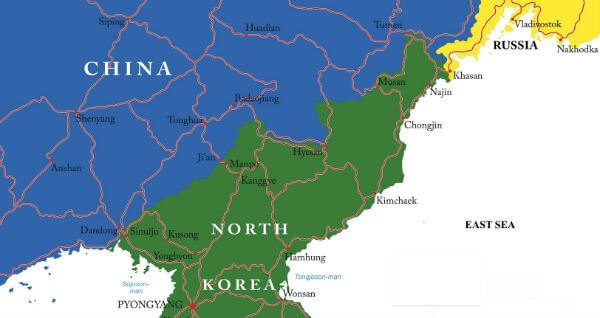
Reuters reports: When North Korean leader Kim Jong Un sent Lunar New Year greetings this year, the first card went to Russian President Vladimir Putin, ahead of leaders from China and other allies of the isolated country, according to its official news agency.
Some academics who study North Korea argue Kim could be looking for Russia to ease any pain if China, which accounts for about 90 percent of North Korea’s trade, steps up sanctions against the isolated country as part of moves to deter its nuclear and missile programmes.
U.S. President Donald Trump lavished praise on Chinese President Xi Jinping last week for Beijing’s assistance in trying to rein in Pyongyang. A day later, U.S. Secretary of State Rex Tillerson pressed the United Nations Security Council to impose more sanctions to further isolate Pyongyang.
There is no sign of any sustainable increase in trade between Russia and North Korea, but business and transport links between the two are getting busier.
A new ferry service starting next week will move up to 200 passengers and 1,000 tonnes of cargo six times a month between North Korea and the Russian port of Vladivostok. [Continue reading…]
In the Trump White House, the momentum has turned against the Paris climate agreement
The Washington Post reports: Foes of the Paris climate agreement have gained the upper hand in the ongoing White House debate over whether the U.S. should pull out of the historic pact, according to participants in the discussions and those briefed on the deliberations, although President Trump has yet to make a final decision.
Senior administration officials have met twice since Thursday to discuss whether the United States should abandon the U.N. accord struck in December 2015, under which the United States pledged to cut its greenhouse gas emissions 26 percent to 28 percent below 2005 levels by 2025.
The president’s aides remain divided over the international and domestic legal implications of remaining party to the agreement, which has provided a critical political opening for those pushing for an exit.
On Thursday several Cabinet members — including Environmental Protection Agency Administrator Scott Pruitt, who’s called for exiting the accord, Energy Secretary Rick Perry, who wants it renegotiated, and Secretary of State Rex Tillerson, who advocates remaining a party to it — met with top White House advisers, including Trump’s daughter Ivanka Trump and her husband, Jared Kushner, and Chief of Staff Reince Priebus. Both Ivanka Trump and Kushner advocate remaining part of the U.N. Framework Convention on Climate Change, even though the president has repeatedly criticized the global warming deal. [Continue reading…]
Trump’s conviction in ‘deals’ betrays his lack of conviction in anything else
Jamelle Bouie writes: From Missouri to Nullification to the fierce battles over the Mexican War and the strife of the 1850s and last-ditch efforts to avoid conflict, slavery was the defining domestic concern of the antebellum United States, the dilemma that consumed the energy of the nation’s most able lawmakers and statesman, up until tensions exploded in open warfare. Donald Trump is apparently ignorant of all of this, but his alt-history musings aren’t necessarily unreasonable. Given what we know, what would Andrew Jackson have done in 1860 and 1861? Could it all have been “worked out,” to borrow the president’s words?
If you believe that slavery constituted an irrepressible moral and political conflict in the United States, then a war of some sort was likely inevitable. But that doesn’t mean it couldn’t have been postponed. There’s a case to make that a President Jackson in 1861 could have done just that, by bolstering the planter class and its search for new territories and new markets. This, in fact, was a live option in the timeline as it exists; unionist Democrats like Stephen Douglas, Lincoln’s chief opponent in the 1860 election, sought to preserve the United States through alliance with slaveholders and maintenance of a pro-slavery status quo. As chairman of the Senate committee on territories, Douglas helped craft the 1854 Kansas-Nebraska Act, which effectively undid a key provision of the Missouri Compromise (banning slavery in territories north of that state’s southern border) and organized two new territories—Kansas and Nebraska—that could choose to be slave or free. An almost unambiguous win for Southern slaveholders, Kansas-Nebraska would help push the sectional crisis to its breaking point. Likewise, as a presidential candidate, Douglas stood against Lincoln’s talk of a “house divided.” To talk about the end of slavery, he argued, was “revolutionary and destructive to the existence of this Government.” As Douglas declared in one debate, “I would not endanger the perpetuity of this Union. I would not blot out the great inalienable rights of the white men for all the negroes that ever existed.”
It is easy to imagine a President Jackson in 1860 who followed Douglas’ path. Who, in keeping with his sympathies and beliefs about Americans democracy, forestalled war by advancing the interests of slaveholders and Southern elites even further than Douglas proposed, opening new territories to the expansion of slavery, and organizing the nation’s foreign policy around new markets and opportunities for slave-produced commodities. Jackson may well have prevented the war, at the cost of 4 million black Americans, held in bondage.
That gets to the rub of it all. Trump isn’t wrong to think there was a deal that could have prevented the Civil War. There was. But the price of that deal was the maintenance of slavery; in fact, the strengthening of a monstrous system of violence and exploitation.
That this wasn’t obvious to President Trump—that, judging from his continued tweets on the issue, it still isn’t—is as revealing as it is troubling. It suggests a worldview in which everything can be resolved by deals, where there are no moral stakes or irreconcilable differences, where there aren’t battles that have to be fought for the sake of the nation and its soul. Slavery had to be eradicated, and war was the only option. Any deal that was achievable would have been an immoral maintenance of an abominable status quo.
Likewise, Trump seems to see presidential leadership as a game of dealmaking, where the best and most effective presidents are those that make the most “deals.” But this just isn’t true. Dealmaking and negotiation are part of the job of the presidency, but they have to happen with a purpose in mind; with an idea of the good within reach. [Continue reading…]
Trump enables despotism
Roger Cohen writes: So the threats were no more than bluster, and all is well. That is one view of President Trump’s foreign policy at the 100-day-or-so mark.
Wrong.
Yes, there’s no sign of the Wall, and NATO is no longer “obsolete,” and the “One China” policy has not been scrapped, and the Iran nuclear agreement endures despite Trump’s dismissal of it as “the worst deal ever,” and the United States embassy is still in Tel Aviv, and neither the Paris climate deal nor the North American Free Trade Agreement has been abandoned.
Defense Secretary Jim Mattis and H.R. McMaster, the national security adviser, have ring-fenced Trump’s recklessness and bellicosity. They have neutralized his ignorance even if nobody can help the president grasp its extent. Some of the loonier members of the president’s entourage have been fired or marginalized. Adults have taken charge. There is still a lot of noise, but “America First” has not upended the world.
Except that it has. A disaster is unfolding whose consequences for humanity and decency will be devastating.
The United States under Trump has embarked on a valueless foreign policy. The president has not met a strongman whose machismo does not beguile him. He prefers guns to diplomats. Militarism and mercantilism constitute a new policy, unconstrained by any consideration of what the United States stands for in the world or the values its alliances have defended since 1945.
This is a radical departure. America is also an idea. That idea is inextricable — whatever the country’s conspicuous failings — from the defense of liberty, democracy, human rights, open societies and the rule of law. Realist, neoconservative and liberal internationalist schools have different interpretations of how this may be achieved, and what limits exist on America’s capacity to extend the reach of freedom. But the unblushing, public embrace of the torturer for mutual gain does not appear in any pre-Trump foreign policy manual I know.
A “very friendly” conversation with President Rodrigo Duterte of the Philippines leads to a White House invitation for a man accused of waging a brutal extrajudicial drug war. President Recep Tayyip Erdogan of Turkey cements his repressive and increasingly imperious rule in a dubious referendum and gets a congratulatory call from Trump. The red carpet rolls out for Egypt’s autocratic president, Abdel Fattah el-Sisi, who becomes Trump’s “great friend.” President Xi Jinping of China goes from currency manipulator to “terrific person” and seems to inspire in Trump an embarrassing awe. President Vladimir Putin of Russia, having been lumped early on with Chancellor Angela Merkel of Germany as somebody Trump may or may not be able to trust, basks still in Trump’s agnosticism on brutality.
The message is clear: The United States has granted carte blanche for despots. [Continue reading…]
Russian election hacking ‘wildly successful’ in creating discord, says former U.S. lawmaker
Reuters reports: Russia succeeded in its goals of sowing discord in U.S. politics by meddling in the 2016 presidential election, which will likely inspire similar future efforts, two top former U.S. voices on intelligence said on Tuesday.
Former Director of National Intelligence James Clapper and former House Intelligence Committee Chairman Mike Rogers agreed at a panel at Harvard University that Russia likely believed it had achieved its goals and could attempt to repeat its performance in elections in other countries.
“Their purpose was to sew discontent and mistrust in our elections they wanted us to be at each others’ throat when it was over,” Rogers said at the panel at Harvard’s Kennedy School of Government. “It’s influencing, I would say, legislative process today. That’s wildly successful.” [Continue reading…]
The extremely reactionary, burn-it-down-radical, newfangled far right
New York magazine reports: When did the right wing get so bizarre? Consider: For a brief and confusing moment earlier this year, milk somehow became a charged symbol of both white supremacy and support for Donald Trump. The details are postmodern, absurdist, and ominous — not unlike the forces that brought them about. In January, the actor Shia LaBeouf mounted an art installation designed to protest the president. The next month, neo-Nazis who organized on the message board 4chan crashed the show, where they started chugging from milk jugs — because northern Europeans digest milk well, or because milk is … white. In other words, an innocent dairy beverage as old as time had been conscripted as a Donald Trump surrogate on the internet. It was yet another message-board in-joke — freighted with political meaning — suddenly in the news.
But weirdness, perhaps, is what happens when a movement grows very quickly and without any strong ideological direction — from a disciplined party, from traditional institutions like churches and chambers of Congress, from anything more organized than the insurrectionist internet.
Here in America, in trying to describe our brand of the reactionary wave currently tsunami-ing the entire developed world, we’ve leaned on the term alt-right, which had been coined by white supremacists. Richard Spencer, the most press-hungry of that group, takes credit for it. For much of last year, the term was often used as shorthand for “racists, but … young?” Which is helpful, as far as it goes, but the full reality is much more complicated. The alt-right — or the new right, if you prefer to sound more like Tom Wolfe than Kurt Cobain, or the radical right, to properly acknowledge its break from mainstream conservatism — is a coalition comprised of movements like neo-reaction, certain strands of libertarianism, tech triumphalism, and even the extreme-populist wing of the Republican Party. All share with Spencer’s white-ethno-nativism the ideals of isolationism, protectionism, and nationalism: a closed nation-state. Along the way, the coalition swept up “men’s rights” advocates and anti-Semites and cruel angry teenagers and conspiracy theorists and a few fiendishly clever far-right websites and harassing hashtags and even a U.S. congressman or two. Not to mention the White House. [Continue reading…]
Why the world banned chemical weapons
Mark Perry writes: On the late afternoon of April 22, 1915—in the midst of World War I—Algerian and French soldiers in trenches along the Western Front, near the Belgian town of Ypres, noticed a yellowish-green fog drifting toward them. Believing the cloud masked advancing German infantrymen, the soldiers prepared for an attack. In fact, the cloud was chlorine gas, released by the Germans from 6,000 pressurized cylinders. The gas crept forward, then lapped into the allied trenches in a ghostly tide. The effect was immediate: Thousands of soldiers choked and clutched at their throats, unable to breathe, before falling dead; thousands more fled in panic, opening a four-mile gap in the allied lines.
The Ypres attack was not the first time gas was used in the conflict (both the French and Germans had used tear gas earlier in the war), but it was the first time in the conflict that a poisonous gas was used in mass quantities. The effects of the attack were horrific, causing “a burning sensation in the head, red-hot needles in the lungs, the throat seized as by a strangler,” as one soldier later described it. More than 5,000 soldiers were killed in this first gas attack, while thousands more, stumbling to the rear and frothing at the mouth, suffered the debilitating aftereffects for decades.
What took place earlier this month, in Syria’s Idlib province, had the same effect as the gas used at Ypres, as Syrian-flown SU-22 jets released bombs filled with sarin gas near the town of Khan Shaykhun. The attack killed dozens of Syrian civilians, including 11 children. The effects of the sarin, a deadly nerve agent, were similar to those of 1915: The victims choked and vomited as their lungs constricted, then suffered through tormenting muscle spasms and eventual death.
In both cases, the use of gas was nearly universally condemned. After the Ypres attack became public knowledge, London’s Daily Mirror issued a banner headline describing the horror—“Devilry, Thy Name Is Germany”—then repeated the theme in bold type more than 100 years later, after Khan Shaykhun: “Assad Gassing Kids Again.” The “again” was a not-so-veiled editorial comment, for Khan Shaykhun marked the second time Assad had used sarin to kill civilians; the first incident took place in August 2013, when the Syrian regime used the nerve agent in an attack on Ghouta, a suburb of Damascus, killing an estimated 281 to 1,700 civilians (the numbers remain uncertain) while injuring thousands. The pictures of the victims, caught in the throes of their final moments, shocked the world. [Continue reading…]
Trump pick for Army secretary says citizens should be able to possess any weapon in the government’s arsenal
Huffington Post reports: Tennessee state Sen. Mark Green (R), President Donald Trump’s nominee for Army secretary, strongly believes that citizens should be armed ― and not just with any ol’ guns. They should be able to possess whatever weapons the military has, because an armed citizenry is the “ultimate checks and balances” against the federal government.
“The Second Amendment, while it allows citizens to protect themselves from other citizens, goes well beyond just allowing us to defend ourselves from a criminal,” Green said at a pro-gun rally in 2013.
“The men who penned and ratified this document gave us the right to keep and bear arms as an ultimate checks and balances against the federal government,” he added. “When considering magazine size and weapon type, comments like, ‘You don’t need a 10-round magazine to hunt deer’ completely misses the point of the Second Amendment.”
There are plenty of other checks and balances in the Constitution, which are spelled out far more explicitly. Citizens can amend the Constitution, Congress can impeach the president and lawmakers have to stand for re-election.
Green did not return a request for comment on when it would be appropriate for a citizen to take up arms against a federal official.
The Tennessee state senator also said that “the citizenry should be allowed to maintain whatever weapon the federal government has. If they can have an aircraft carrier, I ought to be able to have an aircraft carrier.”
Members of the general public then, presumably, would be allowed to possess nuclear weapons as well. [Continue reading…]
Top ethics officer challenges Trump over secret waivers for ex-lobbyists
The New York Times reports: The federal government’s top ethics officer is challenging the Trump administration’s issuance of secret waivers that allow former lobbyists to handle matters they recently worked on, setting up a confrontation between the ethics office and President Trump.
The move by Walter M. Shaub Jr., the director of the Office of Government Ethics, is the latest sign of rising tension between Mr. Shaub and the Trump White House. Mr. Shaub has tried several times to use his limited powers to force Mr. Trump to broadly honor federal ethics rules as well as the ethics order that Mr. Trump himself signed in late January.
Historically, the Office of Government Ethics — a tiny operation that has just 71 employees but that supervises an ethics program covering 2.7 million civilian executive branch workers — has maintained a low profile. Created in 1978 after the Watergate scandal, it does not have subpoena power or its own investigators. [Continue reading…]
Trump’s comments on the Civil War resonate among white supremacists
Politico reports: The president’s comments [on Andrew Jackson and the Civil War] on Monday struck some historians as darker than a history goof, with the president seeming to minimize the painful history of slavery in the United States and to talk up Jackson’s role as a strongman leader who proudly owned many slaves.
“It’s the kind of comment that will get applause from neo-Confederate circles in the South,” said Douglas Brinkley, a presidential historian at Rice University.
Confederate flags were a common sight at Trump rallies during the 2016 campaign, and monuments to Confederate leaders are common in Southern states.
Some in Trump’s circle, including chief strategist Steve Bannon, have sought to liken Trump to Jackson, a populist. In March, Trump visited Jackson’s gravesite in Nashville, Tennessee, where he declared himself “a fan.”
“Steve Bannon has made Jackson the epitome of the hardscrabble, American folk hero,” added Brinkley. “And Trump has bought into Steve Bannon’s version of Andrew Jackson.”
On Monday night, the president tweeted: “President Andrew Jackson, who died 16 years before the Civil War started, saw it coming and was angry. Would never have let it happen!“
Jackson, who was a slaveholder, threatened to use federal military force against South Carolina when the state sought to nullify federal tariffs. He died in 1845, 16 years before the Civil War erupted at Fort Sumter.
“What I saw in that comment was his belief, his attraction to a kind of strongman history,” said David Blight, a Civil War historian at Yale University. “It’s so completely out of any knowledge or context to suggest that somehow Jackson would have headed off the Civil War.”
The broad consensus among historians is that the secession of 11 Southern states, and the resulting war, was driven by slavery and the racial order that slavery represented. The Confederacy’s vice president, Alexander H. Stephens, said himself that the South’s “foundations are laid, its cornerstone rests, upon the great truth that the Negro is not equal to the white man; that slavery, subordination to the superior race, is his natural and moral condition.”
The myth that the Civil War was fought over not slavery, but states’ rights, has become an article of faith for some in the South and those in the white supremacist movement. [Continue reading…]
Trump keeps praising international strongmen, alarming human rights advocates
Philip Rucker writes: It’s no longer just Vladimir Putin.
As he settles into office, President Trump’s affection for totalitarian leaders has grown beyond Russia’s president to include strongmen around the globe.
Egyptian President Abdel Fatah al-Sissi has had his opponents gunned down, but Trump praised him for doing “a fantastic job.” Thailand’s Prime Minister Prayuth Chan-ocha is a junta chief whose military jailed dissidents after taking power in a coup, yet Trump offered to meet with him at the White House. Turkish President Recep Tayyip Erdogan has eroded basic freedoms, but after a recent political victory, he got a congratulatory call from Trump.
Then there’s the case of Philippines President Rodrigo Duterte. He is accused of the extrajudicial killing of hundreds of drug users, and he maligned President Barack Obama as a “son of a whore” at an international summit last year. Yet on Sunday, in what the White House characterized as a “very friendly conversation,” Trump invited Duterte to Washington for an official visit.
In an undeniable shift in American foreign policy, Trump is cultivating authoritarian leaders, one after another, in an effort to reset relations following an era of ostracism and public shaming by Obama and his predecessors. [Continue reading…]
Roy Gutman writes: Erdoğan essentially pocketed Trump’s endorsement of the referendum, and apparent lack of concern about human rights violations, but continues to pursue national security policies that directly conflict with Washington’s agenda—even as he prepares to meet with Trump at the White House on May 16.
By any measure, Erdoğan’s actions appear provocative for a NATO ally who has been hoping to inaugurate a new era of improved relations with the United States after bitter enmity in the last years of the Obama administration. [Continue reading…]
Budget agreement includes several provisions designed to rein in Trump
Politico reports: Congressional members didn’t just snub Donald Trump on his border wall: They also used the $1 trillion spending deal hatched over the weekend to rein in the president’s powers.
Lawmakers want the Trump administration to lay out a detailed plan to deal with the Islamic State and Syria’s Bashar Assad. So they tucked in a provision in the 1,665-page spending plan to withhold $2.5 billion in defense funds until the proposal to battle ISIS is produced.
Because Republicans and Democrats don’t want Attorney General Jeff Sessions and his Justice Department to muck around with states that allow medical marijuana, they included language in the bill barring the anti-pot attorney general from interfering with those laws.
The measure also contains three separate reminders for Trump, who did not seek congressional approval before launching missile strikes against the Syrian government last month, that he must obey the War Powers Act. That law limits his ability to send U.S. troops into combat without a congressional vote.
“It’s an assertion, I think, of Congress’ power to appropriate and to set the tone,” said Sen. Shelley Moore Capito (R-W.Va.), a member of the Appropriations Committee. “I don’t see it as a finger in the eye so much as just a reassertion of our ability to put our own imprint on what’s going on.” [Continue reading…]
Afghan warlord Gulbuddin Hekmatyar calls on Taliban to end ‘this pointless holy war’
The Washington Post reports: Fugitive warlord Gulbuddin Hekmatyar on Saturday made his first public appearance in Afghanistan after nearly two decades underground, calling on Taliban insurgents to “join the peace caravan and stop this pointless holy war.” He also urged all political parties to reconcile and seek change “without bloodshed.”
The return of Hekmatyar, 69, who spoke at an outdoor ceremony in a government compound in Laghman province, represented a sorely needed success for the beleaguered government of President Ashraf Ghani, who invited him to return home peacefully last fall in hopes it would encourage the Taliban to follow suit.
A brief statement from the presidential palace said Ghani “welcomes Gulbuddin Hekmatyar’s return to Afghanistan as a result of the Afghan-led peace process. The deal shows that Afghans have the capacity to resolve the conflict through dialogue.”
But Hekmatyar’s homecoming was fraught with tension, and his expected arrival in Kabul was delayed by disputes over the release of prisoners from his former antigovernment militia. Also, his remarks had a strong anti-Western theme and were critical of the U.S.-led military campaign against the Taliban, which he compared to the Vietnam War and the Soviet quagmire in Afghanistan. [Continue reading…]
‘Mark Green’s naked bigotry disqualifies him for the job of Army Secretary’
The Hill reports: A prominent Muslim civil rights group is joining the growing opposition to President Trump’s Army secretary nominee, Mark Green.
Muslim Advocates on Monday issued a statement calling past rhetoric from Green, a Tennessee state senator, against Muslims and the LGBT community “deplorable.”
“You can’t lead a diverse Army while having contempt for diversity,” said Scott Simpson, the group’s public advocacy director.
“Our armed forces are filled with patriotic Americans of all faiths, races, sexual orientations and gender identities, and Mark Green’s naked bigotry disqualifies him for the job of Army Secretary.” [Continue reading…]