Simon Tisdall writes: The risk that military operations to expel Islamic State terrorists from Mosul in northern Iraq could morph into a new frontline in the wider conflict between the Sunni and Shia branches of Islam has intensified with Turkey’s disputed entry into the fray.
Binali Yıldırım, Turkey’s prime minister, confirmed reports that Turkish troops based in the contested Bashiqa area outside Mosul were firing on Isis positions with artillery, tanks and howitzers. Yıldırım said the bombardment followed a request from Kurdish peshmerga forces.
But Iraq’s joint operations command flatly denied Turkish involvement. “[Iraq] denies Turkish participation of any kind in operations for the liberation of Nineveh,” it said on Monday, referring to the Iraqi province of which Mosul is the capital.
Iraq’s obfuscation reflects deep anxiety in Baghdad about predominantly Sunni Muslim Turkey’s intentions. The Shia-led, Iranian-backed government of Iraq’s prime minister, Haider al-Abadi, is under pressure not to tolerate the presence on Iraqi soil of troops from a country alleged to have previously aided the Sunni jihadis of Isis. [Continue reading…]
Author Archives: News Sources
Mosul battle to extend as far as Syria and Yemen, former Iraqi PM Maliki says
Middle East Eye reports: Former Iraqi prime minister Nouri al-Maliki said that the campaign to liberate Islamic State-occupied Mosul would be only the first step to liberating other cities as far away as Syria and Yemen.
“Today, Iraq has launched an operation to liberate Mosul, but it is also one to liberate other cities,” Maliki said at a conference in Baghdad. “The ‘We are coming Nineveh’ operation also means, ‘We are coming Raqqa’; ‘We are coming Aleppo’; ‘We are coming Yemen’.”
The ex-prime minister was referring to the northern Iraqi province of Nineveh where Mosul is located.
“We are coming to all places where Muslims are being killed, where Islamic thought is being renounced,” he said. [Continue reading…]
Why it’s taking so long for the U.S. and its allies to finish off the ISIS in Libya
The Washington Post reports: A U.S. air campaign against Islamic State militants in Libya, which was supposed to be a brisk illustration of the effectiveness of U.S. support for local forces, has turned into an extended operation with no clear end in sight.
About 100 militants are believed to remain in the coastal city of Sirte, which in 2015 became the most important Islamic State stronghold outside of Iraq and Syria. They are holed up in a small, densely packed residential area. For months, U.S.-backed local militia fighters have struggled against militant defenses and sniper attacks; last week, 14 fighters were killed on one day alone.
The elusiveness of victory in Sirte underscores the challenges that continue to face U.S. efforts to defeat extremists from North Africa to Afghanistan: the limitations of local fighting forces, including inadequate battlefield support and poor morale, and the corrosive effects of local political feuds. [Continue reading…]
German terrorism case highlights Europe’s security challenges
The New York Times reports: The warning came to the German security authorities in early September from “our best partners,” as they euphemistically refer to the American intelligence agencies: A terrorist assault might be in the works.
In the weeks that followed, the Germans identified a suspect, a refugee from Syria. They unearthed evidence that he had been casing a Berlin airport for an attack, and they recovered powerful explosives from his apartment, only to see him slip through their fingers. When they eventually captured him, the suspect promptly hanged himself in his jail cell.
The case was notable for its dramatic turns. But it also underscored two central challenges facing the Continent: getting a handle on the security risk related to the arrival of more than a million migrants last year, and addressing the continued reliance of European governments on intelligence from the United States to avert attacks.
Both issues have been plaguing Europe since the high-profile attacks in France and Belgium over the past two years. Governments have scrambled to counter the threat even as migrants, many with little or no documentation of their identity or country of origin, came over their borders in previously unheard-of numbers. The challenge has become more pressing in Germany in recent months after a spate of arrests and attacks, some linked to migrants.
“In a way, we have outsourced our counterterrorism to the United States,” said Guido Steinberg, a terrorism expert at the German Institute for International and Security Affairs. “The Germans are not ready to build up their intelligence capabilities for political reasons, so this will continue.” [Continue reading…]
Clinton’s careful courtship of Muslim voters
The Atlantic reports from Alexandria, Virginia: This Democratic headquarters one warm October night could have been practically anywhere in the country. Volunteers crammed into a dingy, decrepit office suite, complete with fake wood paneling from the era when Hillary Clinton still wore bell-bottoms, filling up every space—crouched over rickety tables or into corners, reciting a script as they called worked through long lists of voters, checking to see if people were supporting Hillary Clinton and whether they’d be willing to volunteer.
The only clue that this was an unusual event was sartorial: Several women wore headscarves, and a man sported a stylish kaffiyeh. The phone bank is one of dozens of Muslims for Hillary events that the Clinton campaign has arranged this year, part of what the campaign contends is an unprecedented effort to court a small but growing population.
On Friday, the Clinton campaign released an ad featuring Khizr Khan, the father of U.S. soldier Humayun Khan, who was slain fighting in Iraq. The ad, set to air in seven battleground states, is notable for its direct invocation of Islam. Telling the story of his son’s death saving comrades, Khan says, “He was 27 years old, and he was a Muslim American. I want to ask Mr. Trump, would my son have a place in your America?”
Such an ad would have been unthinkable as recently as four years ago, as Barack Obama grappled with false rumors that he was a secret Muslim. It’s surprising even now, amid a national campaign that has seen direct demonization of Muslims. But Donald Trump’s decision to demonize Islam has created what the Clinton team sees as an opening, leading the Democrat to court Muslim votes more boldly and methodically than any predecessor. [Continue reading…]
Inside the strange, paranoid world of Julian Assange
James Ball, who worked for Assange at WikiLeaks, writes: To an outsider, the WikiLeaks of 2016 looks totally unrelated to the WikiLeaks of 2010. Then it was a darling of many of the liberal left, working with some of the world’s most respected newspapers and exposing the truth behind drone killing, civilian deaths in Afghanistan and Iraq, and surveillance of top UN officials.
Now it is the darling of the alt-right, revealing hacked emails seemingly to influence a presidential contest, claiming the US election is “rigged”, and descending into conspiracy. Just this week on Twitter, it described the deaths by natural causes of two of its supporters as a “bloody year for WikiLeaks”, and warned of media outlets “controlled by” members of the Rothschild family – a common anti-Semitic trope.
The questions asked about the organisation and its leader are often the wrong ones: How has WikiLeaks changed so much? Is Julian Assange the catspaw of Vladimir Putin? Is WikiLeaks endorsing a president candidate who has been described as racist, misogynistic, xenophobic, and more?
These questions miss a broader truth: Neither Assange nor WikiLeaks (and the two are virtually one and the same thing) have changed – the world they operate in has. WikiLeaks is in many ways the same bold, reckless, paranoid creation that once it was, but how that manifests, and who cheers it on, has changed. [Continue reading…]
Iran is enjoying the U.S. presidential election
Robin Wright writes: The first season of “House of Cards,” the Netflix series about the demonic American politician Frank Underwood and his duplicitous wife, Claire, recently made its début on Iranian television, just in time for the finale of the American elections. The show has been dubbed in Farsi — as “Khaneh Poushaly,” or “House of Straw” — by a state-run television channel. It ran every night for two weeks. The timing seemed deliberate, and authorized from the top: the Islamic Republic vigorously censors most American programs, and the director of Iran’s broadcasting authority, I.R.I.B., is appointed by the Supreme Leader.
Among hard-liners, the response to the series has been gleeful. It fits their profile of the United States as the Great Satan. Mashregh, a Web site linked to the Revolutionary Guards, commented, “House of Cards has skillfully shown the deception in the complicated political sphere of liberal American civilization, as well as the treason, power-hungriness, promiscuities and crimes behind those ruling in the country.”
Iran’s media has generally been obsessed with the upcoming American contest, even more than with the country’s own Presidential election, scheduled for next May. Mashregh has an entire page devoted to it. For the first time, Iranian television broadcast an American Presidential debate live, in simultaneous translation — the October 9th encounter, in which Donald Trump denied sexually assaulting women and threatened to put Hillary Clinton in prison if he is elected. [Continue reading…]
Syria’s forgotten revolutionaries
Murtaza Hussain reports: As Naji Jerf stepped out of an office building in the southern Turkish city of Gaziantep last December, a man walked up to him and fired two shots from a silenced pistol, striking Jerf in the head and chest and killing him instantly.
Jerf, 38, was a Syrian filmmaker and journalist who had become a popular activist during the revolution. A fierce critic of both the Assad regime and the Islamic State, he had received numerous death threats in the months before he was killed. Shortly after his murder, the Islamic State issued a statement claiming responsibility and Turkish authorities arrested three men in connection with the shooting.
Jerf is only one of the innumerable Syrian revolutionary activists who have lost their lives over the past five years. An editor and documentarian, he helped train a generation of young Syrians to continue the fight for democracy in their country. But his story, and the stories of those like him who continue the spirit of the 2011 uprising, rarely register in broader narratives of the conflict. For all they have sacrificed, their struggles have gone largely ignored, in a framing of the conflict that has been convenient for the Assad government.
Leila Shami, co-author of the book “Burning Country: Syrians in Revolution and War,” told me, “The Syrian government has taken huge efforts to frame the conflict as one solely between themselves and extremist groups. People are not aware that there is a third option in Syria, that there are many Syrians from a wide range of backgrounds who are still fighting for the original goals of the revolution.”
Shami added, “Syria has had so many heroes, but people often don’t know who they are.” [Continue reading…]
ISIS after Mosul
Hassan Hassan writes: As an alliance of Iraqi and Kurdish forces pushes to retake the city of Mosul from the Islamic State, there should be no doubt about what the group plans to do next. It will fight to the bitter end to defend its most populous and symbolic stronghold. After all, it was in Mosul that Abu Bakr al-Baghdadi — the city’s leader for two years before he became the Islamic State’s leader in 2010 — declared a caliphate from the pulpit of an iconic 12th-century mosque.
If the Islamic State loses Mosul, the group has a clearly articulated contingency plan, a strategy it has frequently broadcast on multiple platforms for the past five months: inhiyaz, or temporary retreat, into the desert.
The word “inhiyaz” appeared in May, in the last speech delivered by Abu Muhammad al-Adnani, the group’s spokesman who was killed by an American airstrike in August. Mr. Adnani explained that territorial losses did not mean defeat and that militants would fight until the end and then retreat to the desert, preparing for a comeback, just as they did between 2007 and 2013.
Various Islamic State outlets picked up the theme. Al-Naba, the group’s newsletter, ran an article about the subject in August, recalling how the militants of the Islamic State of Iraq, the Islamic State’s predecessor, survived after they were driven out of Iraqi cities following the 2007 American troop surge and the tribal insurrection known as the Awakening. [Continue reading…]
From French soldier to ISIS spymaster
Michael Weiss writes: The photograph is nearly a decade old, but it is not difficult to imagine that the young man staring inscrutably into the camera, his face bathed in the white light of a flash, now looks much older. The clean-shaven teenager, about 16 or 17, with close-cropped black hair, probably has a long beard now. Gone will be the stylish patterned T-shirt he’s wearing, which looks like it was picked up at a local H&M. Ditto the blingy chain around his neck. If the ravages of time have been accelerated on this young face in the nine years since this portrait was taken then it is because the young man has got the blood of hundreds on his hands, blood that has been spilled in two capital cities of Europe.
The boy in the photograph, which a Western intelligence source shared exclusively with The Daily Beast on the condition that it is not published, is Abdelilah Himich, who U.S. and French intelligence officials have identified as the mysterious Abu Suleyman al-Firansi, the terror operative believed to have been a prime mover of the Paris and Brussels attacks over the last year, and arguably the single most important European in ISIS.
Much that was speculated about Abu Suleyman, pieced together from testimony of active informants inside the ISIS security branch he allegedly heads as well as from defectors from the organization—a game of terrorist telephone—missed some nuances, but otherwise was close to the mark. [Continue reading…]
The battle for Mosul: A precarious alliance takes on ISIS
Christoph Reuter reports: A thundercloud, heavy and dark gray. That is what it looks like from a distance. But the closer you get to Mosul from the south, the bigger and darker this cloud becomes. Instead of floating in the sky, it grows out of the ground, ultimately becoming a towering, opaque wall that swallowing entire villages, making them disappear into the darkness.
Driving to Mosul is a drive into the apocalypse. Or at least that’s what it feels like, with the gigantic clouds of smoke coming from burning oil wells, reservoirs and ditches — laid out by Islamic State over the last two years and now set alight one after the other. Although it would normally be a sunny midday in fall, the military jeeps coming from the other direction have their lights on.
The dark curtain is meant to keep the attackers’ jets and helicopters at bay; the smoke irritates the throat and causes headaches. An armada of over 30,000 soldiers and fighters from at least a half-dozen countries began a major offensive against the de-facto capital of the “caliphate” in northern Iraq last Monday. It is not only the biggest coalition to have assembled in the fight against Islamic State (IS), it is also the least predictable.
The jihadists can be expected to commit any number of heinous acts in the hopes of holding onto their most important city, which is home of many of its leaders. The attackers, meanwhile, are part of an extremely fragile alliance: The US Air Force and Special Forces are contributing enormous firepower that can react quickly to realities on the ground. On the ground, meanwhile, the two strongest forces eye each other with suspicion: The Peshmerga fighters from the Kurdish Regional Government and the primarily Shiite militias of the so-called Popular Mobilization Forces. They forces were recently declared by decree to be Iraqi state troops, but are ultimately controlled by the Iranian Revolutionary Guards. The Shiite militias are feared, and have been accused of systematically expulsing, torturing and killing Sunnis. Furthermore, under the guise of fighting IS, they are suspected of conducting large-scale sectarian cleansing. [Continue reading…]
Turkey’s push to join battle for Mosul inflames tension with Iraq
The New York Times reports: A dispute between Iraq and Turkey has emerged as a dramatic geopolitical sideshow to the complicated military campaign to retake Mosul, Iraq’s second-largest city, from the Islamic State.
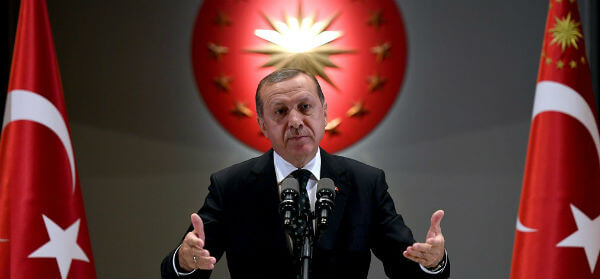
President Recep Tayyip Erdogan of Turkey has insisted on a role in the battle for Mosul, trying to ramp up an involvement in Iraq that has already alarmed the Iraqi government.
“We have a historical responsibility in the region,” Mr. Erdogan said in a recent speech, drawing on his country’s history of empire and defeat, from Ottoman rule of the Middle East to its loss in World War I. “If we want to be both at the table and in the field, there is a reason.”
In response, the normally mild-mannered Iraqi prime minister, Haider al-Abadi, warned last week of a military confrontation between Turkey and Iraq. If Turkish forces intervene in Mosul, he said, they will not “be in a picnic.”
“We are ready for them,” Mr. Abadi said. “This is not a threat or a warning, this is about Iraqi dignity.”
The rift between Turkey and Iraq is no mere diplomatic row; it is a stark example of the complete breakdown in sovereignty of not just Iraq but Syria as well. The Islamic State has erased the borders between the two countries, while Turkey has stationed troops in both countries without the permission of either government. [Continue reading…]
How Ataturk became a model for Erdogan

Mustafa Akyol writes: Since he was elected as Turkey’s president in August 2014, Recep Tayyip Erdogan has been hoping to redesign the Turkish Constitution to introduce an executive presidential system. The July 15 failed coup put that discussion aside for a moment, but not for long. Last week, the leader of the opposition Nationalist Action Party, Devlet Bahceli, who has lately emerged as a political ally of Erdogan, announced that his party could help the ruling Justice and Development Party (AKP) take the presidential system to a referendum. As a result, political observers began to expect a referendum in early 2017. In fact, government spokesman Hayati Yazici made the plan clear by noting that a constitutional amendment may come to the parliament in January and that a referendum could be held in April.
Given Erdogan’s popularity, which was only boosted with the public reaction to the coup attempt, the referendum would very likely get a “yes” vote. This would be followed by an election to choose the new president, a second ballot that Erdogan could easily win. Erdogan, in other words, may well be the first leader of the second Turkish Republic whose political system will revolve around an executive presidency.
What kind of presidency would this be? An answer to this question came from Justice Minister Bekir Bozdag, an Erdogan confidant, last week. “[Mustafa Kemal] Ataturk’s era was presidential system in action,” he said, asking, “Can you name any prime minister of that era with the exception of [Ismet] Inonu? You can’t.” This reference to Ataturk surprised some observers, because the conservative/Islamic political camp that Erdogan and his party comes from has traditionally not been a fan of Ataturk and his staunchly secularist era. Turkish-American academic Timur Kuran noted the irony here, tweeting: “Turkish Islamists have treated Ataturk’s regime as a destructive dictatorship. Now AKP uses Ataturk to justify its own monopoly of power.” [Continue reading…]
Aleppo erupts in protests following temporary ceasefire
Riad Alarian reports: After the ceasefire negotiated by the United States and Russia collapsed on September 19, 2016, the Syrian regime and its Russian allies steadily intensified their ongoing bombing campaign against Aleppo. Since then, as many as 740 civilians have been killed, while at least 1900 others have been injured, according to the Syrian Observatory for Human Rights.
On October 20, 2016, the Syrian and Russian governments instituted another (extremely short-lived) ceasefire. According to Reuters, the “unilateral ceasefire backed by Russia had come into force to allow people to leave besieged eastern Aleppo, a move rejected by rebels who say they are preparing a counter-offensive to break the blockade.”
The purpose behind this ostensibly humanitarian gesture is, however, deeply sinister, and will likely end in even more bloodshed. Sharif Nashashibi, a London-based Syria analyst, argues in News Deeply that “as with previous cease-fires, this is an escalation – part of an overall military solution to the conflict – masquerading as diplomacy and humanitarianism.”
In Nashashibi’s view, the ceasefire’s purpose “is to facilitate the capture of eastern Aleppo by encouraging rebels to abandon their positions, before ramping up the previous onslaught under the pretext that those remaining in rebel-held areas are either fighters or sympathizers.” It should come as absolutely no surprise, therefore, that rebels and residents of the city alike are holding their ground and choosing not to leave.
The city’s residents not only refused to evacuate, but also mobilized a series of protests echoing the very same demands that sparked the uprising against President Bashar Al-Assad five years ago, namely, for freedom and liberty from the tyranny of the regime and its allies.
While these protests have received little attention, they are hardly new. During periods of calm in besieged areas of Syria, protests usually break out. In March of this year, for example, Aleppo, Idlib, and Hama were engulfed in mass protests calling for the fall of the Assad regime, both in between and during periods of constant shelling. [Continue reading…]
Bring Syria’s Assad and his backers to account now
John Allen and Charles R. Lister* write: For 5½ years, the Syrian government has tortured, shot, bombed and gassed its own people with impunity, with the resulting human cost clear for all to see: nearly 500,000 dead and 11 million displaced. Since Russia’s military intervention began one year ago, conditions have worsened, with more than 1 million people living in 40 besieged communities. Thirty-seven of those are imposed by pro-government forces.
While subjecting his people to unspeakable medieval-style brutality, Syrian President Bashar al-Assad has sabotaged diplomatic initiatives aimed at bringing a lasting calm to his country. The most recent such diplomatic scheme was trashed not just by Assad, but also Russia, whose aircraft were accused of subjecting a U.N.-mandated aid convoy to a ferocious two-hour attack in September.
Since then, at least 2,500 people have been killed and wounded in eastern districts of Aleppo, amid horrendous bombardment by Syrian and Russian aircraft, and Russia cynically vetoed a U.N. resolution that would have prohibited further airstrikes in the city.
It is time for the United States to act more assertively on Syria, to further four justifiable objectives: to end mass civilian killing; to protect what remains of the moderate opposition; to undermine extremist narratives of Western indifference to injustice; and to force Assad to the negotiating table. The United States should not be in the business of regime change, but the Assad clique and its backers must be brought to account before it is too late. The world will not forgive us for our inaction.
The consequences of continued inaction are dreadful. U.S. policy has never sought to decisively influence the tactical situation on the ground. Unrealistic limitations on vetting and a policy that prohibited arming groups to fight the regime left us unable to effectively fight the Islamic State or to move Assad toward a transition. U.S. policy and strategy on Syria had a major disconnect, in being focused militarily on a group that was a symptom of the civil war without any means to achieve the stated policy objective: Assad’s departure. [Continue reading…]
*John Allen, a retired U.S. Marine general, led the International Security Assistance Force in Afghanistan from 2011 to 2013 and the international coalition to counter the Islamic State from 2014 to 2015. Charles R. Lister is a senior fellow at the Middle East Institute and author of The Syrian Jihad: Al-Qaeda, the Islamic State and the Evolution of an Insurgency.
Iranian human rights activist given six years in prison for hand-written unpublished story
Iran Human Rights Activist sentenced to 7 years in prison for writing a story – that was not even published: https://t.co/PJfk8ri3q4
— IranWire (@IranWireEnglish) October 22, 2016
IranWire reports: On Tuesday, October 4, writer and human rights activist Golrokh Ebrahimi received a strange phone call ordering her to present herself at Evin Prison by noon on Wednesday evening to start serving her prison sentence. By law, authorities much convey such an order by way of a written summons. But that was not the only unusual thing about the call.
“The arresting officer used the phone of Navid Kamran, a codefendant of mine,” Ebrahimi told IranWire hours before presenting herself at Evin. “They had gone to his shop to arrest him and used his phone. When I answered the call, the man who introduced himself as an agent of the Centre for the Implementation of Sentences said that I must present myself to serve the sentence. I said that I had received no official summons or a call from Evin Court. ‘You are using my friend’s phone to call me and it might be a joke,’ I said. ‘I don’t know you and I have no idea who is talking to me.’ He answered back that ‘you might think this is a joke but we are here to arrest your friend and you must present yourself at Evin’s court right away.’ I said that I could not get there by the end of business hours but perhaps I could do it the next day. He said that I would be arrested if I did not present myself by the next day.”
Ebrahimi’s ordeal began when the Revolutionary Guards arrested her along with her husband, Arash Sadeghi, at his workplace in Tehran on September 6, 2014. The Guards had no arrest warrant, but took the couple to their home, ransacked the place, and confiscated their computers, CDs, and notes. Among the confiscated items was a story about the punishment, under Islamic law, of death by stoning. According to a report from Amnesty International, “The story describes the emotional reaction of a young woman who watches the film, The Stoning of Soraya M, which tells the true story of a young woman stoned to death for adultery — and becomes so enraged that she burns a copy of the Quran.” [Continue reading…]
Donald Trump’s threat to reject election results alarms scholars
Max Fisher writes: Donald J. Trump’s suggestions that he might reject the results of the American election as illegitimate have unnerved scholars on democratic decline, who say his language echoes that of dictators who seize power by force and firebrand populists who weaken democracy for personal gain.
“To a political scientist who studies authoritarianism, it’s a shock,” said Steven Levitsky, a professor at Harvard. “This is the stuff that we see in Russia and Venezuela and Azerbaijan and Malawi and Bangladesh, and that we don’t see in stable democracies anywhere.”
Throughout October, Mr. Trump has claimed, without evidence, that the vote will be “rigged” and “taken away from us.” At the final presidential debate, he refused to say he would accept the election’s outcome, and later joked at a rally that he would accept the results “if I win.”
In weak democracies around the world, scholars warned Friday, political leaders have used the same language to erode popular faith in democracy — often intending to incite violence that will serve their political aims, and sometimes to undo democracy entirely.
The United States is not at risk of such worst-case scenarios. American democratic norms and institutions are too strong for any one politician to destabilize. But Mr. Trump’s language, the scholars say, follows a similar playbook and could pose real, if less extreme, risks. [Continue reading…]
Trump Organization is using horribly insecure email servers
Zack Whittaker reports: If you thought Former Secretary of State Hillary Clinton’s private email server was a mess, Donald Trump’s company is running email servers that look like a dumpster fire by comparison.
Security researcher Kevin Beaumont said in a tweet on Monday that the Trump Organization, the parent company of the alleged billionaire’s portfolio of realty, steaks, golf, and hotels, is running a set of email servers that are horribly outdated and long past the end-of-life, meaning they haven’t received security patches in over a year.
Beaumont said he found that the company’s email system is running the decade-old Windows Server 2003 and Internet Information Servers 6, both of which haven’t been supported in over a year.
Both sets of software are so old that Microsoft no longer patches even known security vulnerabilities. Instead, users should upgrade. Patches remain as one of the best ways for preventing hackers from exploiting security flaws.
A spokesperson for Trump, now the Republican presidential candidate, could not be reached on Tuesday. [Continue reading…]