Author Archives: News Sources

Former Petraeus adviser, Lt Col David Kilcullen: ‘No ISIS if we didn’t invade Iraq’

In a review of Kilcullen’s new book, Blood Year: Islamic State and the Failures of the War on Terror, David Gardner writes: “The greatest strategic screw-up since Hitler’s invasion of Russia” is how David Kilcullen describes George W Bush’s invasion of Iraq in 2003. If anyone thinks that is a throwaway line they should read on. For it comes from one of the architects of the 2007-08 “surge” into Iraq that sought to restore security to a society the US-led occupation broke, and to create space to rebuild a state it destroyed.

Kilcullen was a young lieutenant colonel in the Australian army who had served in Iraq and Afghanistan, a scholar steeped in counter-insurgency theory, “watching closely and keeping notes as this enormous slow-motion train wreck took place”. In 2007 he was seconded to US forces as chief adviser to General David Petraeus, commander of the surge. This strategy combined a big influx of American troops with co-opted Sunni tribal fighters to defeat al-Qaeda. The jihadis, later to transmute into the far greater threat of Isis, had virtually no presence in Iraq prior to the invasion — but used it to turn the country into a charnel house and trigger the region-wide war between Sunni and Shia Islam that has now ripped Syria apart.

Put simply, Kilcullen argues we should never have gone into Iraq, with the job still unfinished in Afghanistan after 9/11. But the US and its allies were morally and legally obliged afterwards to try to “halt the carnage and restore some normality”. Like many soldiers, Kilcullen does not do gore. So when he mentions, in the sparest of prose given the depravity of the sectarian bloodletting, the “commercial kidnapping gangs auctioning off terrified children for slaughter, in a makeshift night market that operated under lights near the soccer stadium”, it is a kick in the stomach.

The surge sharply reduced the violence. But the US, now under President Barack Obama, had exhausted its attention span. Meanwhile, Iraqi leaders twisted by sectarianism would not use the space this success created for reconciliation.

Mr Obama, to be fair, was elected on a pledge to extract Americans from Middle East wars. Yet in Kilcullen’s judgment, he left Iraq irresponsibly early. He failed to register how Nouri al-Maliki, the Shia Islamist premier and joint protégé of the US and Iran, was stampeding Iraq’s Sunni minority into jihadi arms by his sectarian power grab. With al-Qaeda wounded by its “near death experience” with the surge, few noticed its rebirth in the ashes of Syria. Recklessness in Iraq was followed by fecklessness in Syria — “passivity in the face of catastrophe” that spells strategic disaster for the US and the west. [Continue reading…]


Facebooktwittermail

From Trump to Merkel: How the world is divided between fear and openness

shadow16

Ulrich Speck writes: Two major concepts define the political struggle in the west today. One can be termed “globalism”, which is currently most prominently represented by the German chancellor, Angela Merkel. The other is “territorialism”, a view that the very likely Republican candidate for the US elections in November, Donald Trump, represents.

At the core of the debate is the meaning of borders: should they be porous or tightly controlled? Are they mainly an obstacle to the free and productive flow of ideas, people, goods and information and should therefore be largely dismantled? Or are massive borders welcome and indispensable as a protection against all kinds of real or perceived threats such as competition and terrorism?

For globalists such as Merkel, interconnectedness is a good thing because it is what drives progress towards more prosperity and freedom everywhere. For territorialists such as Trump, interconnectedness is mainly a threat. What is good and healthy is attributed to the natives and what is dangerous comes from outside: unfair Chinese competition, dangerous Mexican immigrants and Middle Eastern terrorists. [Continue reading…]

Facebooktwittermail

The violence Trump incites

Peter Beinart writes: Asked last August about a Bernie Sanders event in which Black Lives Matters protesters spoke at length from the stage, Trump called the senator from Vermont’s response “disgusting.” He added: “That will never happen with me! I don’t know if I’ll do the fighting myself or other people will, but that was a disgrace. I felt badly for him. But it showed that he was weak. Believe me, that’s not going to happen to Trump.”

It’s no coincidence that Trump raised the specter of violence. The Black Lives Matter disruptions had been peaceful. But as Trump’s campaign took off in the summer and fall of last year, he began depicting entire categories of overwhelmingly peaceful people as a physical threat. Undocumented Mexican immigrants were potential “rapists.” Syrian refugees were “strong, powerful men” who might be a “trojan horse” for ISIS.

Trump’s supporters exhibit high levels of what political scientists call “authoritarianism.” Authoritarians are unusually fearful of disorder and favor simple, brutal methods of quashing it. As Amanda Taub has noted, “When many Americans perceived imminent physical threats, the population of authoritarians could seem to swell rapidly.” So by fanning popular fears of chaos, especially violent chaos, Trump wins yet more votes.

He does this, in part, by turning his treatment of the activists who seek to disrupt his events into a parable for how he would restore order in society at large. [Continue reading…]

Facebooktwittermail

Decoding the changing nature of ISIS’s insurgency

ISIS-instructor-bw

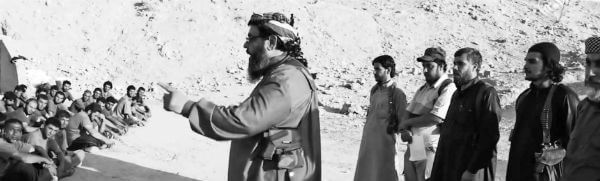
Hassan Hassan writes: The war against ISIL is changing, and how its opponents adapt will be a key test of the group’s ability to achieve its goals.

A string of attacks and counter-attacks over the course of this year so far signal a major shift in the way the group is conducting its military operations, leaning back on insurgency tactics it used when US troops were still present in Iraq.

The change comes amid widespread perception in western capitals that the group is now on the back foot. But it also follows a variety of crises – financial and political – that may cause deeper western involvement in the Syrian and Iraqi conflicts.

Last Sunday, the group launched an assault inside the city of Abu Ghraib, 15 kilometres from Baghdad International Airport. More than 50 people were killed and the attack was repelled. In the process, the militants reportedly controlled the grain silo in Khan Dhari and took with them a dozen lorries full of badly needed grain into besieged Fallujah, which is around 30 kilometres away. [Continue reading…]

Facebooktwittermail

U.S. planning to strike ISIS in Libya based on ‘faulty intelligence’

The Telegraph reports: The United States is basing plans for military intervention in Libya on faulty intelligence, Western officials and country experts have told the Sunday Telegraph.

American intelligence agencies assess that the Islamic State of Iraq and the Levant (Isil) has doubled in size in Libya, with between 5,000 and 6,500 fighters in the country.

Privately, however, some US officials say they believe these estimates to be overblown. Independent experts have come to the same conclusion.

“The estimates of the number of jihadists is grossly exaggerated,” said Karim Mezran, a Libya expert with the Atlantic Council in Washington.

Whilst Mr Mezran and other analysts were loathe to put a number on the size of the organisation, citing the chaos and lack of access to Isil areas in Libya, all said they believed the real figure to be only 20 to 40 per cent of the US estimate. [Continue reading…]

Facebooktwittermail

Russia freezes delivery of S-300 missile defense to Iran, reports Kuwaiti newspaper

The Times of Israel reports: ssian President Vladmir Putin reportedly froze the transfer of the S-300 anti-aircraft missile system to Iran after receiving evidence from Israel that Tehran had transferred advanced weapons to Hezbollah.

The Kuwaiti newspaper al-Jarida published the unconfirmed report on Saturday, citing an unnamed source allegedly “familiar” with Putin.

The source said that Putin scuppered the delivery after Israel showed that Iran had repeatedly attempted to transfer the SA-22 Greyhound short-range air defense system to the Lebanese-based terrorist group.

The report also said that Russian pilots claimed to have detected the presence of advance anti-aircraft systems in Hezbollah-controlled territory straddling the Syria-Lebanon border.

Israel, according to the report, has turned a blind eye to the Iranian-backed group’s possession of the Soviet-made SA-5 Gammon surface-to-air missile system, known also as the S-200. [Continue reading…]

Facebooktwittermail

Israel employs legal principle of collective punishment used by Nazi Germany

In an editorial, Haaretz says: Over the past few months, Israel has adopted the principle known in German as sippenhaft – meaning a family’s shared responsibility for a crime committed by one of its members. Its origins lie in ancient times, when an offender’s entire tribe would be punished for his crimes. In the modern era, this principle was characteristic of totalitarian regimes, when the relatives of “enemies of the state” were punished by exile, imprisonment or execution. Today, this method is common in North Korea.

The Netanyahu government’s response to shooting, knifing and car-ramming attacks is based on the same principle: The family that “supports and assists” the terrorist, as Netanyahu put it, is as guilty of terror as the offender. That is why house demolitions have been renewed. According to figures by the nonprofit B’Tselem, 31 Palestinian homes have been demolished whose relatives were involved in attacks, with other demolitions planned. That is also why Israel is holding the bodies of attackers from East Jerusalem and punishing their families by delaying burials. Israeli advocates of sippenhaft argue that it’s the only way to deter the Palestinians, citing cases in which families gave up suspects as proof that the method works. To them, the deportation of families to Gaza seems the ultimate weapon against lone-wolf attacks.

But the Palestinians are not the only ones who’ll pay the price for punishing the families; Israel will, too. Because a state that adopts the legal methods and laws of totalitarian states begins to look like those countries, even if it calls itself “the only democracy in the Middle East.” [Continue reading…]

Facebooktwittermail

Police homicides in the United States

Patrick Ball writes: Americans are afraid of many threats to their lives – serial killers, crazed gunmen, gang bangers, and above all terrorists – but these threats are surprisingly unlikely. Approximately three-quarters of all homicide victims in America are killed by someone they know. And the real threat from strangers is quite different from what most fear: one-third of all Americans killed by strangers are killed by police.

This is the story of the hidden numbers of police homicides in the United States. The killings of Michael Brown, Eric Garner and Walter Scott have increased the world’s attention to US police violence, yet most Americans underestimate the threat posed by the people charged with keeping them safe.

Let’s turn to the facts.

There is no national registry of civilians killed by police and corrections officers in the United States. Several states, including Texas, Connecticut and California, maintain complete records, but in most parts of the United States, local law enforcement chooses whether to report officer-involved homicides to the federal government. The lack of systematic data poses a challenge both for those who wish to hold police accountable for their actions and for those who want to propose reform measures to reduce police violence. How many killings are committed by police? [Continue reading…]

Facebooktwittermail

The right to sue the gun industry

In an editorial, the New York Times says: The world recoiled in horror in 2012 when 20 Connecticut schoolchildren and six adults were killed at Sandy Hook Elementary School by a deranged teenager using a military-style assault rifle to fire 154 rounds in less than five minutes. The weapon was a Bushmaster AR-15 semiautomatic rifle adapted from its original role as a battlefield weapon. The AR-15, which is designed to inflict maximum casualties with rapid bursts, should never have been available for purchase by civilians.

This is the eminently reasonable point that the parents of the 6- and 7-year-old students cut down at the school are now pressing in Connecticut state court. They are attempting to sue the gun manufacturer, Remington; the wholesaler; and a local retailer for recklessness in providing the weapon to the consumer marketplace “with no conceivable use for it other than the mass killing of other human beings.”

The question of whether the lawsuit will be allowed to proceed is at issue because Congress, prodded by the gun lobby, in 2005 foolishly granted the gun industry nearly complete immunity from legal claims and damages from the criminal use of guns.

The Sandy Hook parents argue that their suit should continue because that law, the Protection of Lawful Commerce in Arms Act, allows claims against companies — gun shop dealers, for example — if they knew or should have known that the weapons they sold were likely to risk injury to others. The parents contend that the maker of the Bushmaster is no less culpable because it knowingly marketed a risky war weapon to civilians. [Continue reading…]

Facebooktwittermail

As airstrikes ease, Syrian revolution continues

The New York Times reports: Street protests erupted across insurgent-held areas of Syria on Friday, as demonstrators took advantage of the relative lull in airstrikes during a partial truce, coming out in the largest numbers seen in years to declare that even after five punishing years of war they still wanted political change.

Under the slogan “The Revolution Continues,” demonstrators waved the green, white and black pre-Baathist flag adopted during the early, largely peaceful stages of the revolt, before the proliferation of armed Islamist factions with black jihadist banners.

It was impossible to gauge what percentage of Syrians the demonstrators represented, out of the millions living in insurgent-held areas or, for that matter, in government-held areas or living as refugees abroad. But many protesters, reached by telephone and text message, said they aimed to show that they were determined to resume demonstrations asking for the ouster of President Bashar al-Assad as soon as there was even a partial respite from airstrikes by the government and its Russian allies.

The protests were all the more surprising in that the insurgency is on the back foot militarily, squeezed between pro-government forces and those of the extremist group Islamic State. [Continue reading…]

Facebooktwittermail

The EU risks major ructions if Greece is offered no help with its refugees

Costas Lapavitsas writes: he current influx of refugees into Greece has major humanitarian implications but it also poses a direct threat to the European Union. Together with the neverending eurozone crisis and the Brexit referendum, it could throw the EU into an existential crisis in 2016. Visionary leadership is called for, which at present looks in short supply.

According to the UNHCR, in 2014 Syria was the main source of refugees in the world, and 95% of Syrian refugees were located in surrounding countries. Turkey held the largest number at roughly 1.6 million. It is worth noting that developing countries took 86% of the world’s refugees in 2014. The poor proved more compassionate and generous than the rich yet again.

In 2015 Greece became the main point of entry into the EU of refugees and migrants from Turkey; it is believed 850,000 people undertook the perilous crossing of the Aegean. In January and February more than 120,000 have arrived – far more than the same period last year. At this rate there will be millions of men, women and children who will risk their lives in shoddy rubber dinghies between Turkey and Greece in 2016. Up to 90% are likely to be from Syria, Afghanistan and Iraq.

These are not economic migrants. There is absolutely no doubt that the wave of refugees and migrants into Europe is a direct result of the destruction of the three countries largely due to western intervention during the last three decades. [Continue reading…]

Facebooktwittermail

Europe’s harsh new message for refugees: ‘Do not come’

The Washington Post reports: A senior European Union official carried a stark warning Thursday to the front lines of the migrant crisis, telling those seeking to flee poverty and unrest that Europe is no longer the answer, even as about 1 million migrants have now poured into Europe in the past year.

“Do not come to Europe,” said Donald Tusk, president of the European Council, after meeting with the Greek prime minister in Athens. “Do not believe the smugglers. Do not risk your lives and your money. It is all for nothing.”

Tusk’s comments came as a top U.N. official also warned Thursday that as many as 70,000 people could be “trapped” in Greece in the coming weeks because Macedonia and other European countries are shutting their borders, transforming Greece into a holding pen for migrants desperate to leave.

Tusk also said it was up to Turkey, not its European neighbors, to decide how to manage a reduction in refugee numbers — a stance that Turkish Prime Minister Ahmet Davutoglu quickly rebuffed. Turkey is under pressure to reduce the numbers of migrants crossing into Greece as a March 7 summit meeting between Turkey and the European Union approaches to discuss the issue. [Continue reading…]

Facebooktwittermail

Europe’s border crossings become economic choke points

The New York Times reports: Traffic along one of Europe’s busiest highways, which used to flow unimpeded, now often backs up for miles at a newly installed checkpoint, where a phalanx of German police officers screens trucks and cars for hidden migrants.

At this border crossing, as a result, Austrians who work in Germany have trouble getting to their jobs. Many companies in Germany must wait days longer for deliveries of food, machine parts and other goods. Shoppers who made quick weekend jaunts to Freilassing’s stores now mostly stay away.

“It’s really bad,” said Karl Pichler, the owner of a large gardening center here in Freilassing, whose sales of tulips, rose bushes and other plants has slumped as longtime customers from Austria have stopped coming.

More than two decades after much of Europe began abolishing border controls under the so-called Schengen Agreement, the free movement of people and products between countries has helped transform the European Union into the world’s largest economy. [Continue reading…]

Facebooktwittermail

Trump admires leaders like Putin — even if they murder their opponents

Leon Neyfakh writes: Marco Rubio attacked Donald Trump at Thursday’s debate for expressing admiration for Vladimir Putin. “Wrong, wrong, wrong!” Trump said, before explaining that it had been the other way around.

“Putin said about me — I didn’t say about Putin — Putin said very nice things about me. And I say, very nicely, ‘Wouldn’t it be nice if actually we could get along with Russia?’ ”

First of all, Trump has most certainly spoken glowingly about Putin. In December 2015, on MSNBC’s Morning Joe, he said, “I’ve always felt fine about Putin. He’s a strong leader, he’s a powerful leader. … He’s actually got popularity within his country.”

Trump was impressed with Putin’s popularity: “I think he’s up in the 80s. You see where Obama’s in the 30s and low 40s and [Putin’s] up in the 80s.”

Morning Joe host Joe Scarborough brought up the fact that Putin has been accused of ordering the killing of journalists and political rivals. “He’s running his country, and at least he’s a leader, unlike what we have in this country,” Trump replied. [Continue reading…]

Facebooktwittermail

Russian ultranationalist Aleksandr Dugin: ‘Vote for Trump’

At the Russian site, Katehon.com, the ultranationalist ideologue, Aleksandr Dugin, writes:

[Donald Trump] is an extremely successful ordinary American. He is crude America, without gloss and the globalist elite. He is sometimes disgusting and violent, but he is what he is. It is true America.

Most likely, Donald Trump is another designed product, a virtual figure. However, it is him who makes people feel fresh and hopeful. He is trustworthy: the black peacekeeper promised to change everything, but was unable to change anything, nothing at all, and Hilary Clinton, with a quickly aging poker face, doesn’t promise to change anything, maybe Trump will be able to get America’s natural borders back.

Maybe, that redhead rude Yankee from the saloon will get back to the problems inside the country and will leave humanity alone, which is tired of American hegemony and its destructive policy of chaos, bloody rivers and color revolutions?

Trump is a leader. Most likely, he is fake, but even if he is not fake, he has no chance of winning, as the globalist elites and financial oligarchy control practically everything in the USA.

But we want to put trust in Donald Trump.

Vote for Trump, and see what will happen.

Max Fisher adds:

[I]n spring 2015, when I traveled to Moscow, I found the once-triumphant Duginists and ultranationalists no longer saw Putin as an ally, and even considered him a traitor to the cause. Some had been pressured by security services, which they took as a sign that their views were no longer tolerated. Meanwhile, Putin had largely dropped his grand Eurasianist rhetoric.

In retrospect, it seems likely that Putin’s short-lived embrace of Duginism was opportunistic and superficial. In other words, Putin decided to invade Ukraine for narrow political reasons, then reached for Eurasianism and neo-imperialism in order to justify his actions and to whip up public support.

But when Putin’s Novorossiya project floundered — his actions in eastern Ukraine succeeded in destabilizing the country but not in dominating it outright — he shifted strategies, seeking to maintain a low-level conflict rather than to escalate. The neo-imperialist ideological justifications no longer fit the strategy. And far-right movements, newly empowered, were pushing Putin to go further than he wanted to. So Putin turned on them.

It turned out that Dugin’s apparent importance to the Kremlin’s ideology had been overstated. This is not to criticize those who considered Dugin important — it was a reasonable conclusion to draw at the time — but rather just to say that we now know Dugin’s ideas were never all that important, and that today he is at the nadir of his influence.

Therefore, we should probably not conclude that Dugin’s Trump endorsement tells us anything useful about the Kremlin’s view of the US presidential race. It’s true that Trump has praised Putin and that Putin has returned the favor, but Trump likely appeals to these two Russians on different grounds and for different reasons.

Facebooktwittermail

Turkey: Zaman newspaper taken over as government steamrolls press freedom

Amnesty: Today’s government takeover of Zaman newspaper is the latest deeply troubling episode in the Turkish authorities’ ongoing onslaught on dissenting media, Amnesty International said today.

“By lashing out and seeking to rein in critical voices, President Erdogan’s government is steamrolling over human rights,” said Andrew Gardner, Amnesty International’s Turkey expert.

“A free and independent media, together with the rule of law and independent judiciary, are the cornerstones of internationally guaranteed freedoms which are the right of everyone in Turkey.”

Just last week, the TV channel IMCTV was taken off air, silencing the only national news channel reporting a counter view of the situation in south-eastern Turkey, where round-the-clock curfews were imposed as armed clashes devastated entire towns. [Continue reading…]

Facebooktwittermail