Author Archives: News Sources

Death toll from war in Syria now 470,000, group finds

The New York Times reports: As waves of heavy Russian airstrikes edged closer to the Turkish border on Thursday, a Syrian research group issued a report saying the impact of five years of war in Syria has been even more devastating than already thought.

The report from the Syrian Center for Policy Research said that at least 470,000 Syrians had died as a result of the war, almost twice the 250,000 counted a year and a half ago by the United Nations until it stopped counting because of a lack of confidence in the data.

Life expectancy has dropped 14 years, to 56 from 70, since the war began, with an even deeper plunge for Syrian men, says the report, which the group compiled from its longtime base in the capital, Damascus. It put the war’s economic cost at $255 billion, essentially wiping out the nation’s wealth.

The report stood out because it shows a state in collapse in many ways even though it comes from an organization that was, until recently, based in Damascus, the seat of a government that seeks to control tightly how it is portrayed. The report was released on a day that world leaders were scheduled to meet in Munich, even though hopes that Russia and the United States could agree on a cease-fire were sinking. [Continue reading…]


Facebooktwittermail

Aiding disaster: How the United Nations’ OCHA helped Assad and hurt Syrians in need

Annie Sparrow writes: Syria, the world’s largest humanitarian crisis, is also the most expensive. OCHA, shorthand for the Office for the Coordination of Humanitarian Affairs, is the UN agency tasked with managing such crises, along with determining the global humanitarian budget, more than $20 billion in 2016, and allocating funds received from donor governments. OCHA’s forecast for 2016 is $3.2 billion for Syria alone, where it estimates that 13.5 million people are in need of humanitarian aid. Another $4.8 billion is solicited for the regional cost of putting up some four million refugees in Jordan, Lebanon, and Turkey.

Yet five years into the Syrian crisis, long-festering concerns over OCHA’s lack of neutrality are growing. Characteristic of many agencies of the United Nations, OCHA places a premium on maintaining good relations with the Syrian government, a position fueled by its desire to stay in Damascus. With no end to the conflict in sight, though, it is worth asking whether OCHA’s bottom line is harming the agency’s efforts to alleviate the catastrophic consequences of Damascus’ anti-civilian strategy. Indeed, the 2016 UN plan for Syria provides a real-time illustration of what happens when a UN agency loses sight of humanitarian principles and prioritizes relations with a government intent on violating them.

The UN plan must be understood in the context of Syria’s incredibly complicated humanitarian situation. The most recent estimates place 800,000 civilians under siege, denied access to safe water, food, health care, fuel, and warmth. Of these, more than 600,000 civilians are besieged by the government. An additional 200,000 civilians are held by the self-proclaimed Islamic State (also known as ISIS) in the city of Deir ez-Zor. OCHA relies on permission from the government to gain access to these people, but the government rarely grants it. Madaya, for example, is less than an hour’s drive from Damascus, yet between July 1, 2015, and January 12, 2016, OCHA could arrange only a single convoy, which contained expired food aid. The last convoy to Duma, where 175,000 civilians have been under siege since November 2012, was on July 2, 2015. Duma is barely ten miles from the Four Seasons in Damascus, where Yacoub El Hillo, OCHA’s resident/humanitarian coordinator, is based. [Continue reading…]

Facebooktwittermail

Residents in Syria’s Aleppo fear blockade as regime advances

AFP reports: Shop shelves are bare and prices have doubled in Syria’s Aleppo as the threat of a blockade looms after advancing regime forces cut off the second city’s main supply route last week.

“What will happen when food runs out? We’ll die of hunger,” said Abu Mohammed, who has seven children.

“Everybody here fears a blockade. We can feel it unavoidably coming,” said the 42-year-old salesman from the southeastern Fardoss neighbourhood.

Some 300,000 people are at risk of being placed under siege in Aleppo, a city that has been divided since 2012, with government forces controlling the west and rebels the east. [Continue reading…]

Facebooktwittermail

Inside the Syrian provincial capital where 200,000 face starvation

The Daily Beast reports: Deir Ezzor, a once relatively prosperous city of more than 300,000 people, is modern-day Syria in a microcosm. When anti-government protests broke out in 2011, the government sent in tanks. When rebels occupied the city, the ideals of those who protested state repression were betrayed by the arbitrary arrests and Islamist repression of al-Qaeda’s Syrian affiliate, Jabhat al-Nusra. Now, half the city is occupied by the Islamic State, which for more than a year has been besieging and starving the other half controlled by the Syrian government led by Bashar al-Assad — with the complicity, current and former residents say, of the government itself.

What’s left today of government-controlled Deir Ezzor is a poor and tired population. Some of those people are stubborn, or proud: having survived nearly five years of a war that has killed more than 250,000 of their fellow Syrians, they refuse to abandon their homes. Most, however — the vast majority — are there not because they choose to be, but because they have no choice. Many are refugees from other areas of Deir Ezzor province or from the city’s other half, taken over by the Islamic State in July 2014, on the other side of the Euphrates River. [Continue reading…]

Facebooktwittermail

Turkish president threatens to send millions of Syrian refugees to EU

AFP reports: Turkish President Recep Tayyip Erdoğan has threatened to send the millions of refugees in Turkey to EU member states, as Nato agreed to deploy ships to the Aegean Sea to ease the migrant crisis.

In a speech in Ankara on Thursday, Erdoğan stepped up his denunciations of western policy in the refugee crisis, confirming he had threatened EU leaders at a summit meeting in November that Turkey could say “goodbye” to the refugees.

But in a separate move, Nato agreed to send a naval group “without delay” to the Aegean to crack down on the people smugglers who have helped hundreds of thousands of migrants cross to EU territory in the last year.

Alarm is growing in EU capitals that thousands of refugees are still crossing the Aegean daily from Turkey after over a million made the perilous journey last year.

But Turkey, already home to some 3 million refugees, is also under EU and UN pressure to take in tens of thousands of Syrian refugees fleeing regime advances in the Aleppo region.

Erdoğan sought to turn the tables on the EU by saying Turkey had every right to send the refugees out of the country if it so wished. [Continue reading…]

Facebooktwittermail

Putin is a bigger threat to Europe’s existence than ISIS

George Soros writes: Putin is a gifted tactician, but not a strategic thinker. There is no reason to believe he intervened in Syria in order to aggravate the European refugee crisis. Indeed, his intervention was a strategic blunder because it embroiled him in a conflict with Turkey’s president, Recep Tayyip Erdoğan, which has hurt the interests of both.

But once Putin saw the opportunity to hasten the EU’s disintegration, he seized it. He has obfuscated his actions by talking of cooperating against a common enemy, Isis. He has followed a similar approach in Ukraine, signing the Minsk agreement but failing to carry out its provisions.

It is hard to understand why US and EU leaders take Putin at his word rather than judging him by his behaviour. The only explanation I can find is that democratic politicians seek to reassure their publics by painting a more favourable picture than reality justifies. The fact is that Putin’s Russia and the EU are engaged in a race against time: the question is which one will collapse first.

The Putin regime faces bankruptcy in 2017, when a large part of its foreign debt matures, and political turmoil may erupt sooner than that. The president’s popularity, which remains high, rests on a social compact requiring the government to deliver financial stability and a slowly but steadily rising standard of living. Western sanctions, coupled with the sharp decline in the price of oil, will force the regime to fail on both counts. [Continue reading…]

Facebooktwittermail

As species migrate to escape climate change, plants get left behind

mt-tam

Climate Central reports: Willis Linn Jepson encountered a squat shrub while he was collecting botanical specimens on California’s Mount Tamalpais in the fall of 1936. He trimmed off a few branches and jotted down the location along the ridge trail where the manzanita grew, 2,255 feet above sea level.

The desiccated specimen is now part of an herbarium here that’s named for the famed botanist. It was among hundreds of thousands of specimens of thousands of different species that were used recently to track the movement of plant species up the state’s many hills.

The results of the analysis warn that native plants are struggling to keep up with changes around them as pollution from fuel burning and deforestation continues to warm the planet. Earlier research into the movement of Californian animals shows they’re shifting more quickly than the native plants.

“The big takeaway is that species are on the move, and they’re moving at different rates,” said Jon Christensen, a scientist and historian at the University of California, Los Angeles. “Which raises the concern that the ecosystems of California could be unraveling.” [Continue reading…]

Facebooktwittermail

Why the time is again ripe for American socialism

By Michael Espinoza, UCL

Vermont Senator Bernie Sanders has handily beaten Hillary Clinton to win the New Hampshire primary – and after being dismissed as more or less an ideological sideshow when it first began, his campaign has become an unlikely but remarkable movement.

With the Republican Party in a seemingly unstoppable rightward spiral, as the likes of Ted Cruz and Donald Trump dominate its race, the seemingly unexpected rise of as such a proud left-wing candidate as Sanders might seem inconsistent with every trend in recent American politics. At the beginning of the race, he was unknown to many voters outside his home state of Vermont. He is also the Senate’s only self-proclaimed socialist, a label that many once thought would make him utterly unelectable.

But Sanders’s support for “democratic socialism” hasn’t just been surprisingly popular: it’s rapidly changing the way America perceives socialism and all it stands for.

A major strength of Sanders’s campaign is an economic argument against income inequality. This message is at the heart of Sanders’s self-described democratic socialism, but the “revolution” he’s advocating isn’t a Marxist seizure of the means of production; it’s a democratic political uprising.

But this in itself is hardly anything new by the standards of American politics, even at the presidential level.

Continue reading

Facebooktwittermail

Bernie Sanders’ universalism

Haaretz reports: One of [Richard Sugarman’s] duties seems to be explaining Sanders’ Jewish identity – or lack thereof – to the media. [Sugarman is an Orthodox Jewish academic and longtime friend of Sanders.] In October, Sugarman told the Jewish Telegraphic Agency that his friend is not “embarrassed or ashamed” of being Jewish, but he is a “universalist” and “doesn’t focus on those issues.” In November, Sugarman made a similar point to NPR – that Sanders is “not into identity politics, and I don’t think … this campaign is going to change him.”

His prediction has held true. Sanders has never referred to his Judaism except in jest – as in his Saturday Night Live appearance – or when asked directly about it by a reporter. In the latter circumstance, he usually refers to his family’s history with the Holocaust and his commitment to social justice and economic equality, but avoids talk of theology or observance.

When, last fall, Sanders was asked on-camera whether he believed in God – by, of all people, late-night host Jimmy Kimmel, he avoided directly answering the question, and invoked none other than the Pope in his answer: “I am who I am, and what I believe in and what my spirituality is about is that we’re all in this together. I think it is not a good thing to believe as human beings we can turn our backs on the suffering of other people, And this is not Judaism. This is what Pope Francis is talking about, that we cannot worship just billionaires and the making of more and more money.”

More recently, Sanders shook off the whispers that he may well be an atheist simply afraid to say the word, by telling the Washington Post that “I think everyone believes in God in their own ways,” he said. “To me, it means that all of us are connected, all of life is connected, and that we are all tied together.” [Continue reading…]

Facebooktwittermail

After Bernie Sanders landslide in New Hampshire, team Hillary plans fightback on Israel

The Forward reports: Tuesday night will go down in history as the first time a Jew won a presidential primary.

A jubilant Sanders, who describes himself as a democratic socialist, repeated his call for eradicating income inequality, breaking up the big banks and providing free college tuition.

“Together we have sent the message that will echo from Wall Street to Washington, from Maine to California, and that is that the government of our great country belongs to all of the people and not just a handful of wealthy campaign contributors,” Sanders said in his victory speech.

For the Clinton campaign it was a night that made clear that it is time to increase pressure on the Vermont socialist — including a harsher message to Jewish American voters.

“Hillary Clinton has been a very strong friend of Israel and that is something that should not be lost on the American Jewish community,” said Paul Hodes, a former New Hampshire congressman who came to rally for Clinton at her post-primary event. Hodes, who is Jewish and from New Hampshire, told the Forward: “Senator Sanders hasn’t showed himself to be the kind of friend of Israel that Secretary Clinton is.”

Clinton, the former U.S. secretary of state and former U.S. senator, now looks wounded, trailing Sanders by 60 to 39% based on 86% of the returns. [Continue reading…]

Who can suck up to Israel, is a game that only works when everyone plays and the shamelessness is mutual as the Goyim compete as Zionists.

In that respect, the fact that Sanders is Jewish and the fact that he isn’t fishing for large donations, both serve to his advantage. When questioned about his loyalty to Israel, he can reasonably wave off such challenges by pointing out that he’s running in an American presidential election.

Facebooktwittermail

Bernie Sanders has raised $5.2 million since the polls closed in New Hampshire

BuzzFeed reports: The Money Bomb is a short, online-driven fundraising drive tied to a specific event or date. It’s a mainstay of modern, internet-driven politics.

Bernie Sanders has unleashed a new kind of fundraising weapon the world has never seen.

In the hours since polls closed in New Hampshire Tuesday at 7 p.m. ET, the Sanders campaign raised $5.2 million, aides told reporters Wednesday. The average contribution was just $34. [Continue reading…]

Facebooktwittermail

Since the war began, 177 hospitals have been destroyed in Syria

AFP reports: An airstrike hit a hospital in southern Syria that is supported by Médecins Sans Frontières, killing three people and wounding six, the medical charity has said.

“The strike on Tafas field hospital, some 12 km (seven miles) from the Jordanian border, took place on the night of 5 February,” MSF said in a statement on Tuesday, adding that a nurse was among the casualties. “It caused partial damage to the hospital building, and put its heavily used ambulance service out of action.

“The hospital is the latest medical facility to be hit in a series of airstrikes in southern Syria, which have been escalating over the past two months.”

In addition to the Syrian government, Russia and a US-led coalition targeting the Islamic State group are also carrying out raids in the war-torn country.

A Syrian aid group in January said 177 hospitals had been destroyed and nearly 700 health workers killed since the outbreak of the country’s civil war in March 2011.

It is not the first time MSF-supported facilities in Syria have been hit.

“Since the start of this year alone, 13 health facilities in Syria have been hit, confirming that hospitals and clinics are no longer places where patients can recover in safety,” the charity said. [Continue reading…]

Facebooktwittermail

The cheap, brutally effective medieval tactic shaping the Syrian civil war

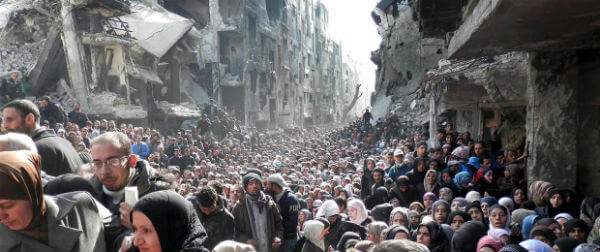
yarmouk-palestinians

Annia Ciezadlo writes: On Feb. 3, the United Nations suspended talks between the regime of Syrian President Bashar al-Assad and representatives of the Syrian opposition. The Geneva talks, which were aimed at ending the five-year-old civil war, had bogged down in distrust and regional politics before they even got underway.

The UN mediator, Staffan de Mistura, hinted that the initial round of discussions collapsed because the Syrian regime refused to lift the sieges that are slowly starving hundreds of thousands of people across the country. Assad’s regime has been using starvation as a weapon — technically a war crime, when used against civilians — for the past four years.

As the war has progressed, various rebel factions, like Islamic State and Nusra Front, have also adopted the strategy. But the vast majority of the people under siege in Syria are being starved by their own government. Today, up to a million people are being slowly and deliberately starved to death in the heart of the Fertile Crescent, many of them a stone’s throw away from grain silos full of wheat. [Continue reading…]

Facebooktwittermail

France’s Fabius accuses U.S. of ‘ambiguous’ Syria policy

Reuters reports: French Foreign Minister Laurent Fabius on Wednesday questioned the commitment of the United States to resolving the crisis in Syria, saying its “ambiguous” policy was contributing to the problem.

“There are ambiguities, including among the actors of the coalition … I’m not going to repeat what I’ve said before about the main pilot of the coalition,” Fabius told reporters, in a clear reference to the United States.

“But we don’t have the feeling that there is a very strong commitment that is there.” [Continue reading…]

Facebooktwittermail

Syrian opposition see Obama’s support having been worthless

The New York Times reports: The United States and its allies have spent many millions of dollars backing Syrian opposition fighters they deem relatively moderate and secular, and civilian groups whose work on small businesses and local councils they billed as the cornerstone of Syria’s future.

But the very Syrians who benefited — and risked their lives in the process — now say that investment is in danger of going down the drain, and they see little urgency from Washington, diplomatic or military, to save it.

“What are you going to do, other than statements?” Zakaria Malahifji, the political chief of one of the largest rebel groups given weapons and salaries by the C.I.A. and its counterparts in several European and Arab states, demanded in a recent message to contacts at the French Embassy.

In nearly five years of war and insurrection, many Syrians have been repeatedly disillusioned by what they saw as a mismatch between tough American rhetoric against the Syrian government and comparatively modest efforts to aid some of its opponents. President Obama said President Bashar al-Assad must go, and drew a red line over the use of chemical weapons, but backed off on both, diminishing anti-government Syrians’ trust.

But the confusion and despair has reached a new level over the last week, as forces backing Mr. Assad have pushed farther north into Aleppo Province, sending tens of thousands of new refugees to the Turkish border. With insurgent groups losing troops and territory, their villages shattered by Russian warplanes, civilians and fighters have in recent days used phrases like “no hope,” “it’s finished” and “it’s over.”

“Bye-bye, revolution,” Abu al-Haytham, a spokesman for Thuwwar al-Sham, another rebel group supported through the C.I.A. program, said in a text message on Friday from Tal Rifaat, a town in northern Aleppo that is increasingly threatened by the government advance.

American-backed insurgents have long been used to the American stance in recent years, that the United States did not want them to actually win the war — lest a sudden toppling of Mr. Assad lead to Islamist rule — but wanted to prevent them from losing for long enough to pressure the government to negotiate for a political solution.

Now they fear that the United States and its allies may actually let them lose. [Continue reading…]

Facebooktwittermail

Why are Russian engineers working at an ISIS-controlled gas plant in Syria?

Foreign Policy reports: The Syrian government originally awarded the contract to construct the Tuweinan facility [the largest such facility in Syria, located 60 miles southwest of Raqqa] to Stroytransgaz in 2007. The construction utilized a Syrian subcontractor, Hesco, which was owned by Russian-Syrian dual national George Haswani. Last November, the Treasury Department sanctioned Haswani for allegedly brokering oil sales between the Islamic State and the Assad regime, charges he denies.

The partnership between Hesco and Stroytransgaz goes far beyond this one deal. The companies have worked in joint projects in Sudan, Algeria, Iraq, and the UAE since 2000, according to Haswani’s son-in-law, Yusef Arbash, who runs Hesco’s Moscow office.

Construction continued slowly until a coalition of Syrian rebel groups seized the facility in a joint operation with the al Qaeda-affiliated al-Nusra Front in January 2013. Abu Khalid, a member of the Qwais al-Qarani brigade, which was a part of the rebel coalition, said that when they entered the area, Russian engineers and advisors had already fled, leaving Syrian employees behind. “We decided to protect this plant; we thought it is belonging to Syrian people since it was owned by the Syrian state,” he said.

The Islamic State has been in control of the facility since early 2014. A senior Turkish official said that after its seizure, Stroytransgaz, through its subcontractor Hesco, continued the facility’s construction with the Islamic State’s permission. He also claimed that Russian engineers have been working at the facility to complete the project.

Syrian state-run newspaper Tishreen published a report appearing to corroborate this claim. In January 2014, after the facility was captured by the Islamic State, the paper cited Syrian government sources, saying that Stroytransgaz had completed 80 percent of the project and expected to hand over the facility to the regime during the second half of the year. The article didn’t mention that the facility was under the control of the Islamic State. [Continue reading…]

Facebooktwittermail