Louay Hussein writes: Syrians did not build their state in the second quarter of the past century according to the usual struggles, or agreements that go into building states; we inherited state institutions established by the French mandate. Thus, it was easy for successive military coups, which swept the country a few years after independence, to turn the state into a tool of control rather than an institution that organises the common interests of all Syrians.
Is it not up to the people now to pick up the pieces? No. Instead it is the responsibility of those who have appointed themselves their political leaders: all their programs, attitudes and statements must focus on issues like national unity and central authority. This does not contradict the administrative de-centralisation that was necessary in order to build the new modern Syrian state, based on justice and equality for all Syrians, if by any chance one day this Syrian crisis comes to an end.
This became much clearer when Hafez Al-Assad ascended to power, and especially after he had consolidated his authority—which lasted for a long time. Political and military authorities quickly turned state institutions into agencies to oppress citizens and transform them into subjects, in the economic sense, but also socially and politically.
After three decades of Hafez Al-Assad’s rule, and over ten years of his son’s, Syrians saw the state as something alien, an entity which they might appease, con, abuse, fear, and from which they hide their opinions—everything that reinforces the dynamics separating a state from society.
Thus, receiving any services from a public office is considered an act of “generosity” by the official, since according to regulations he can do whatever he wants with public money, including leaving it to his relatives and entourage. For ordinary Syrians, even public property is considered state property—meaning the regime’s property—not a commons. We can understand why Syrians show no interest in taking care of, or protecting, public property. Public property was seen as a resource to exploit, rob and misuse when possible. In short, Syrians have not experienced a state. This has serious implications and requires extensive research. [Continue reading…]
Author Archives: News Sources
Understanding the drivers of radicalization in Syria
Syria Deeply: Syria has not traditionally been a seat of extremist Islam. What has contributed to the radicalization of the country? What’s driving it now?
Nader Hashemi: First and foremost, it’s the conflict itself. It’s not a coincidence that we are seeing the spread of Islamic radicalism in Syria as a direct result of the barbarity of the Assad regime, and as a result of a conflict that in my view is borderline genocidal.
In the midst of the chaos, mayhem, bloodshed and crimes against humanity, you don’t produce liberal, democratic opinion. You produce the antithesis of it: an environment that reflects the social conditions of chaos and anarchy.
There is also an ideological battle taking place in the Middle East today with respect to different political currents of Islamism, and it’s not a coincidence that we are seeing the upsurge and the rise of radical Islamism of various forms, with the most radical being ISIS and Jabhat al-Nusra, after the crushing of the Arab Spring and the democratic openings it unleashed.
Syria is a case study of the deep and intimate relationship between the closure of political opportunities and democratization, and in the aftermath of their demise, the upsurge of the rise of radical Islamic tendencies. In the early days of the revolution, in the first six months of 2011, ISIS and Jabhat al-Nusra weren’t present inside Syria. The early formation of radical jihadism in Syria started to take root and gain currency as political openings and possibilities for political change started to diminish. Human-rights violations and repression feed into a narrative of radical extremism and they undermine the prospects for more democratic and more moderate expressions of political Islam. [Continue reading…]
Syria: The view from Moscow
Christopher Phillips writes: Of all the states involved in the Syria crisis, Russia has arguably been the most insulated from its fallout. Western states and their regional allies have been frustrated as their policies to topple President Bashar al-Assad repeatedly fail, while threatening jihadists such as ISIS have thrived in the chaos. Refugees have flooded Syria’s neighbours. Even Assad’s other ally, Iran, has seen its hard-earned regional reputation shattered. In contrast, the costs to Moscow have been limited.
However, the conflict’s echoes are finally being felt. In early December, Islamist gunmen fought Russian forces in Grozny, killing 20, prompting fears of ISIS-inspired violence in the northern Caucasus. The oil price has plummeted to $65, partly the result of Saudi Arabian machinations to punish both Iran and Russia. This is 35 percent below the Kremlin’s budgeted price and, along with western sanctions over Ukraine and the tumbling value of the Ruble, looks set to cripple Russia’s economy. However, contrary to some claims, this seems unlikely to prompt any major reconsideration of President Vladimir Putin’s Syria policy.
It is important to understand the view of Syria from Moscow. At the beginning of the crisis, Western analysts mistakenly believed Putin’s support was about preserving Russia’s interests in Syria: a tiny naval installation in Tartous and a modest arms market. Yet such material interests are, in reality, marginal. Instead, Putin sees Syria primarily through a geo-strategic lens. While Qatar, Saudi Arabia and Turkey have all taken leading roles in the campaign against Assad, Russia sees the West and particularly the US as chief instigator. [Continue reading…]
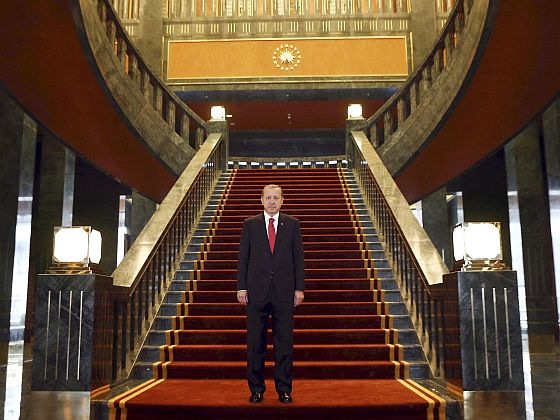
Is Erdogan on the path to dictatorship?

Jenny White writes: Something substantially different is shaping up in today’s Turkey. Given the many variables in play, no one can be sure what the country will look like in 10 years. The recent autocratic turn of the pious former prime minister and now president, Recep Tayyip Erdoğan, cannot be explained simply as a form of Islamic radicalization. After more than a decade of economic growth and social reform under the Justice and Development Party (AKP), Muslim and Turkish identities have been transformed to such an extent that it is nearly impossible to assign people to one end or the other of a secular-Islamist divide, particularly that half of the population that is under 30. Many young people have heterogeneous identities, composed of seemingly contradictory positions and affiliations. Turkey is now split along more complex lines, pitting Sunni against Sunni, Sunni against Alevi (a heterodox Shia sect that makes up more than 10 percent of the population), and both pious and secular nationalists against Kurds. It could be argued that a lust for power and profit on the part of one man and his inner circle, rather than a wider cohort, has driven recent events as much as religion. This is no novelty in the world of dictators, which may well be the direction Turkey is taking.
Part of the answer to what is happening in the present lies in the past, in Kemalist practices (the legacy of Mustafa Kemal Atatürk, who founded the modern Turkish state in 1923) that still powerfully shape social and political life today. Erdoğan, threatened by recent street protests and the actions of a rival Islamic movement, has returned to the fearmongering and aggressive political paternalism that were ingrained in the Turkish psyche for much of the twentieth century, making them powerful tools for social manipulation. Kemalism has been largely dethroned, but the levers of power it developed remain in place. In the absence of Kemalist symbolism, AKP rule has taken on an Ottoman and Sunni Muslim veneer.
What is fundamentally different, though, is that Erdoğan has begun, for the first time, to dismantle the democratic structures that, creaky and biased though they were, provided a balance of power among institutions. Under Erdoğan, these institutions, from universities and the media to police, prosecutors, and judges, have been forced to answer not to a party, but essentially to one man who has taken control of most mechanisms of rule. This is a new and worrisome development, out of step with the AKP’s (and Erdoğan’s) accomplishments over the previous decade. Those who claim to have seen this coming could have done so only by closing their eyes to what the party accomplished — and what these newest developments put at risk. [Continue reading…]
Syrian rebels see U.S. abandoning them
Josh Rogin writes: As Congress struggles to pass a bill to fund the government for the rest of the year, one curious and significant item was left on the cutting room floor: a request from the Barack Obama administration for $300 million to expand the secret CIA program to arm the “moderate” Syrian rebels.
The request, which administration officials had been lobbying for in recent weeks, was held up by the House Intelligence Committee, which has serious doubts about the Free Syrian Army and other rebel groups that for years have been receiving arms secretly from the U.S. and its allies, two administration officials told me. Without the money, Syrian opposition leaders say, the FSA will struggle to hold its remaining positions in northern Syria, much less make progress against Islamic State and the Bashar al-Assad regime.
“The requested funds are a crucial indication of the partnership between the United States and Syrian freedom fighters. This comes at a particularly important time,” said Oubai Shahbandar, a senior adviser for the Syrian National Coalition.
Nonetheless, not everyone in the White House will lament the decision to drop it from the spending bill: Congress’s disenchantment with the Syrian rebels is shared by many officials inside the administration, following the rebels’ losses to Assad, IS and the al-Nusra Front in northern Syrian cities such as Idlib. There is particular frustration that these setbacks resulted in some advanced American weaponry falling into extremist hands.
Reflecting that dissatisfaction, the Obama administration has taken a series of steps in recent weeks to distance the U.S. from the moderate rebels in the north, by cutting off their weapons flow and refusing to allow them to meet with U.S. military officials, right at the time they are struggling to survive in and around Aleppo, Syria’s largest city. [Continue reading…]
U.S. concern grows over ISIS fighters training in Libya
The Los Angeles Times reports: Fighters for the Islamic State militant group have been training in remote areas of Libya, heightening the Obama administration’s concern about a country that U.S. officials have largely ignored since its 2011 revolution.
Training camps with several hundred Islamic State fighters have been spotted in parts of eastern Libya, and some U.S. intelligence reports suggest a new presence for the militant group near Tripoli, in the country’s west, U.S. officials disclosed in recent days.
Although the officials say no immediate military response is planned, the appearance of the camps is giving new impetus to a debate about whether the United States eventually will need to expand its campaign against the militants beyond Iraq and Syria.[Continue reading…]
Syria’s military and ISIS have been ‘ignoring’ each other on battlefield, data suggests
NBC News reports: Syria’s military and ISIS may be sworn enemies but instead of wiping each other off the battlefield they have been delicately dancing around each other, according to new data exclusively obtained by NBC News.
Both sides in the bloody conflict appear to be eliminating smaller rivals ahead of a possible final showdown.
Around 64 percent of verifiable ISIS attacks in Syria this year targeted other non-state groups, an analysis of the IHS Jane’s Terrorism and Insurgency Center’s (JTIC) database showed. Just 13 percent of the militants’ attacks during the same period — the year through Nov. 21 — targeted Syrian security forces. That’s a stark contrast to the Sunni extremist group’s operations in Iraq, where more than half of ISIS attacks (54 percent) were aimed at security forces. [Continue reading…]
Israeli missile found in Syria after airstrikes
IHS Jane’s Defence Weekly reports: Syria’s claims that Israel carried out airstrikes on 7 December appear to have been confirmed by amateur video footage and images of the wreckage of an Israeli munition recovered in the southwest of the Arab country.
The Syrian authorities have claimed that Israel carried out two airstrikes: one at Damascus International Airport, the other near Al-Dimas, a town near the Lebanese border.
The claim was corroborated by the Syrian Observatory for Human Rights, a London-based group that monitors the conflict in Syria using a network of sources. It reported that 10 explosions were heard near Al-Dimas and that a warehouse area was targeted at the airport. [Continue reading…]
ISIS shoots down Iraqi helicopter
The Associated Press reports: Islamic State group militants shot down an Iraqi military helicopter, officials said Saturday, killing the two pilots onboard and raising fresh concerns about the extremists’ ability to attack aircraft amid ongoing U.S.-led coalition airstrikes.
The attack happened late Friday in the Shiite holy city of Samarra, about 95 kilometers (60 miles) north of Baghdad. A senior Defense Ministry official told The Associated Press the Sunni militants used a shoulder-fired rocket launcher to shoot down the EC635 helicopter on the outskirts of the city.
An army official corroborated the information. Both spoke on condition of anonymity as they weren’t authorized to speak to journalists. [Continue reading…]
U.S.-led warplanes hit militants in Syria and Iraq 27 times this week
The Los Angeles Times reports: U.S.-led warplanes launched 27 airstrikes against Islamic State militants in Iraq and Syria this week, officials said Friday.
The three-day attack by jets and drones was focused on militants in Syria’s second-largest city, Aleppo; the embattled Syrian city of Kobani and several cities in Iraq: Ramadi and Rutba to the west; Samarra and Mosul to the north.
In Aleppo and Kobani, U.S. officials claim to have destroyed Islamic State bunkers and fortified structures. In Iraq, the airstrikes destroyed armored vehicles as well as bulldozers and an excavator, they said.
President Obama has described the airstrike campaign as an effort to “degrade and ultimately destroy” Islamic State, which rose to prominence during the summer when its fighters crossed the border from Syria into Iraq and conquered large swaths of territory, including Mosul, one of Iraq’s largest cities. [Continue reading…]
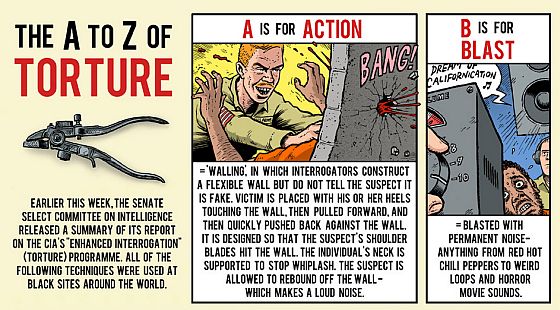
An illustrated A-to-Z of torture
Does torture work?
"Does torture work?" as a question needs to be put in the bin with "Is slavery commercially feasible?" & "Can genocide help overpopulation?"
— Hend (@LibyaLiberty) December 10, 2014
ISIS fanboy @ShamiWitness outed by Channel 4 News
Channel 4 News: He spent his mornings, afternoons and evenings sending thousands of tweets of propaganda about the Islamic State militant group, acting as the leading conduit of information between jihadis, supporters, and recruits.
His tweets, written under the name Shami Witness, were seen two million times each month, making him perhaps the most influential Islamic State Twitter account, with over 17,700 followers.
Shami Witness cheered when people were beheaded – but when outed by the news, he begged for privacy claiming his life would be endangered.
— Shiraz Maher (@ShirazMaher) December 11, 2014
BBC News reports: The unmasking of an English-speaking online jihad supporter based in India, who was popular among foreign fighters in Syria, casts light on the decentralised nature of the media operations of the group known as Islamic State (IS).
The Twitter activist Shami Witness played an important role in amplifying the message of IS and had over 17,000 followers before he disappeared – more than some of the key jihadist media groups.
But he was just one of an army of online supporters the group relies on to spread its message in a range of languages – none of whom operate officially on behalf of the group.
Poverty&grievances as "the root cause" of extremism? Shami Witness: an upwardly mobile,well off Bangalore-executive,ISIL cheerleading coward
— Maajid Nawaz (@MaajidNawaz) December 12, 2014
Shami Witness couldn't join ISIS b/c his "family needs" him. But all the people ISIS slaughtered, their family didn't need them.
— BSyria (@BSyria) December 12, 2014
State Dept: Rebels are never going to defeat Assad militarily
Foreign Policy reports: In a grim assessment of the U.S.-backed Syrian rebels, a senior State Department official said on Wednesday that the country’s armed opposition will not be able to topple the regime of Syrian President Bashar al-Assad now or in the foreseeable future, despite the existence of a Pentagon program to train and equip 5,000 rebels per year.
“We do not see a situation in which the rebels are able to remove him from power,” Brett McGurk, one of the State Department’s point men in managing the ad hoc international coalition battling the Islamic State, told the House Foreign Affairs Committee. “It will have to be a diplomatic process.”
In recent weeks, the situation for Syria’s beleaguered moderate opposition has gone from bad to worse, as they continue to lose ground in the crucial northern provinces of Idlib and Aleppo. The near-extinction of many moderate rebel groups has coincided with increasing gains by Salafist groups tied to al Qaeda or the Islamic State. For the remaining “moderates,” aligning with Washington poses a deadly risk, as U.S. airstrikes against al Qaeda-aligned militant groups in Syria fuel conspiracies that Washington tacitly supports Assad.
That’s a problem for the Obama administration’s Syria policy, which relies in part on recruiting and training moderate rebels to combat Islamic State militants before taking the fight to the Syrian government. [Continue reading…]
Nineveh’s police: A force to fight ISIS has manpower, but little firepower
The New York Times reports: Smoking cigarettes in a tent with a dirt floor just outside an isolated village in northern Iraq, the police officers recalled the heady days working alongside American forces and launching dozens of operations to kill and capture Qaeda militants in Mosul, Iraq’s second-largest city.
The Americans are long gone, Al Qaeda in Mesopotamia has morphed into the Islamic State and the Iraqi government has not paid their salaries in months, leaving the officers grappling with their fate in a cold tent in what is supposed to be a training camp.
“We are in a camp like refugees, without work or salaries,” said Seif Ahmed, a SWAT team member wearing a “U.S. Army” T-shirt. “ISIS is our target, but what are we supposed to fight it with?”
As the United States dispatches military advisers to help Iraq build a force to fight the Islamic State, often referred to as ISIS, the police of Nineveh Province, who have experience and self-interest in actually battling the jihadists, have been largely abandoned. In a region that the Islamic State now controls, lingering distrust by the Shiite-led central government has stymied efforts by provincial officials to turn the former police into a local force. The central government fears that the police officers, who are mostly Sunni, will sell their weapons to the jihadists — or join them.
The marginalization of Nineveh’s police force is one example of how the key to rebuilding Iraq may rest less in the airpower and bombing runs of the United States and its allies than in bridging the differences between the Shiite-led central government and Sunni communities. Shortly after the jihadists seized most of the province in June, the Iraqi government was so distrustful it cut off the officers’ salaries, rendering most of them destitute. [Continue reading…]
CIA director: U.S. spies raised questions about 9/11 intelligence ahead of Iraq War
The Washington Post reports: CIA officials questioned in the run-up to the Iraq War in 2003 whether key intelligence cited by President George W. Bush’s administration as a reason for a military invasion was faulty, according to a newly declassified CIA letter released Thursday by the chairman of the Senate Armed Services Committee.
The letter was sent March 13 of this year from CIA Director John Brennan to Sen. Carl Levin, the outgoing committee chairman, and introduced on the Senate floor on Thursday. Brennan confirmed that CIA field operatives “expressed significant concern” whether Muhammad Atta, one of the airliner hijackers in the Sept. 11, 2001, terrorist attacks, could have met with a former Iraqi intelligence officer, Ahmad Khalil Ibrahim Samir al-Ani, in Prague about five months earlier.
The so-called “Prague connection” was used by the Bush administration as a way of tying the 9/11 attacks to Iraqi President Saddam Hussein. The intelligence has been questioned for years, but the new CIA letter raises anew questions about why the Bush administration took the United States into the Iraq War despite concerns repeatedly being raised by U.S. intelligence officers about whether there was a tie between 9/11 and the Iraqi government. [Continue reading…]
I interrogated the top terrorist in U.S. custody. Then the CIA came to town
Ali Soufan writes: In the middle of my interrogation of the high-ranking terrorist Abu Zubaydah at a black-site prison 12 years ago, my intelligence work wasn’t just cut short for so-called enhanced interrogation techniques to begin. After I left the black site, those who took over left, too – for 47 days. For personal time and to “confer with headquarters”.
For nearly the entire summer of 2002, Abu Zubaydah was kept in isolation. That was valuable lost time, and that doesn’t square with claims about the “ticking bomb scenarios” that were the basis for America’s enhanced interrogation program, or with the commitment to getting life-saving, actionable intelligence from valuable detainees. The techniques were justified by those who said Zubaydah “stopped all cooperation” around the time my fellow FBI agent and I left. If Zubaydah was in isolation the whole time, that’s not really a surprise.
One of the hardest things we struggled to make sense of, back then, was why US officials were authorizing harsh techniques when our interrogations were working and their harsh techniques weren’t. The answer, as the long-awaited Senate Intelligence Committee report now makes clear, is that the architects of the program were taking credit for our success, from the unmasking of Khalid Sheikh Mohammed as the mastermind of 9/11 to the uncovering of the “dirty bomber” Jose Padilla. The claims made by government officials for years about the efficacy of “enhanced interrogation”, in secret memos and in public, are false. “Enhanced interrogation” doesn’t work. [Continue reading…]
U.S. hid U.K. links in CIA torture report at request of British spy agencies
The Guardian reports: References to Britain’s intelligence agencies were deleted at their request from the damning US report on the CIA’s use of torture after 9/11, it has emerged.
A spokesman for David Cameron acknowledged the UK had been granted deletions in advance of the publication, contrasting with earlier assertions by No 10. Downing Street said any redactions were only requested on “national security” grounds and contained nothing to suggest UK agencies had participated in torture or rendition.
However, the admission will fuel suspicions that the report – while heavily critical of the CIA – was effectively sanitised to conceal the way in which close allies of the US became involved in the global kidnap and torture programme that was mounted after the al-Qaida attacks.
On Wednesday, the day the report was published, asked whether redactions had been sought, Cameron’s official spokesman told reporters there had been “none whatsoever, to my knowledge”.
However, on Thursday, the prime minister’s deputy official spokesman said: “My understanding is that no redactions were sought to remove any suggestion that there was UK involvement in any alleged torture or rendition. But I think there was a conversation with the agencies and their US counterparts on the executive summary. Any redactions sought there would have been on national security grounds in the way we might have done with any other report.” [Continue reading…]