The Washington Post: On Tuesday, a single event happened that could change the course of the the Syrian war. At least a dozen commanders of Ahrar al-Sham, including leader Hassan Aboud, were wiped out in an instance by what has been described as a suicide bomb during a high-level meeting in Ram Hamdan in Syria’s Idlib province.
Less than 24 hours after the explosion, the group announced new leaders, but relatively little is known about them. In a video, its new leadership announced that the group will continue on the same course as before.
Analysts have their doubts, however, on whether that will be true – or even if Ahrar al-Sham can survive at all. “This will be a turning point of sorts,” Syrian journalist and analyst Hassan Hassan tweeted shortly after the news spread.
Could one explosion really change the Syrian war?
Formed in 2011 by former Islamist prisoners – including a number of al-Qaeda alumni – Ahrar al-Sham pushed a Salafist agenda and called for a Sunni Islamist state, but steered clear of calls for a global jihad and focused on the Syrian state. Over the course of the Syrian civil war, the group (whose name means “The Free Men of Syria”) gained a reputation as one of the strongest and best organized forces among the rebel groups. [Continue reading…]
Author Archives: News Sources
Countering ISIS will be hard in Iraq and harder in Syria, officials say
The Washington Post reports: President Obama’s strategy to beat back Islamic State militants spread across Iraq and Syria will depend on far more than U.S. bombs and missiles hitting their intended targets.
In Iraq, dissolved elements of the army will have to regroup and fight with conviction. Political leaders will have to reach compromises on the allocation of power and money in ways that have eluded them for years. Disenfranchised Sunni tribesmen will have to muster the will to join the government’s battle. European and Arab allies will have to hang together, Washington will have to tolerate the resurgence of Iranian-backed Shiite militias it once fought, and U.S. commanders will have to orchestrate an air war without ground-level guidance from American combat forces.
“Harder than anything we’ve tried to do thus far in Iraq or Afghanistan” is how one U.S. general involved in war planning described the challenges ahead on one side of the border that splits the so-called Islamic State.
But defeating the group in neighboring Syria will be even more difficult, according to U.S. military and diplomatic officials. The strategy imagines weakening the Islamic State without indirectly strengthening the ruthless government led by Bashar al-Assad or a rival network of al-Qaeda affiliated rebels — while simultaneously trying to build up a moderate Syrian opposition.
All that “makes Iraq seem easy,” the general said, speaking on the condition of anonymity to share views on policy. “This is the most complex problem we’ve faced since 9/11. We don’t have a precedent for this.” [Continue reading…]
Turkey refuses U.S. permission for combat missions against ISIS
AFP reports: Turkey will refuse to allow a U.S.-led coalition to attack jihadists in neighboring Iraq and Syria from its air bases, nor will it take part in combat operations against militants, a government official told Agence France Presse Thursday.
“Turkey will not be involved in any armed operation but will entirely concentrate on humanitarian operations,” the official said on condition of anonymity.
The decision echoes the country’s refusal to allow the U.S. to station 60,000 troops in Turkey in 2003 to invade Iraq from the north, which triggered a crisis between the two allies.
Ankara then also refused Washington permission to use its air bases to attack Saddam Hussein’s regime.
Turkey has come under fire by some critics for indirectly encouraging the formation of the Islamic State because of its support of Islamist opponents of Syrian President Bashar Al-Assad, and its loose control of its borders.
But Ankara vehemently denies its strategy has backfired. [Continue reading…]
Obama promises a long and limited war on ISIS
Tony Karon writes: President Barack Obama used the broadest of brushstrokes on Wednesday night to describe his “comprehensive strategy to degrade and ultimately destroy” the Islamic State insurgency, providing few details and skirting discussion of key dilemmas facing any such plan.
The United States will lead a “broad coalition,” Obama said, but its war plan “will not involve American combat troops fighting on foreign soil.” Instead, the campaign would rely on U.S. air power and support for “partner forces on the ground” to put the Islamic State (IS) to flight. The U.S. would supply intelligence, weapons and logistics and training. But it would be up to those forces to drive out the IS.
It was telling that the example he cited as the model for confronting the IS was the approach “we have successfully pursued in Yemen and Somalia for years.” That comparison underscores the message that “ultimately” is the operative word in Obama’s promise to “ultimately destroy” the IS. In both Yemen and Somalia, America’s enemy remains very much intact and active, and the U.S. approach has thus far succeeded in managing and containing the threat, but not in destroying it.
If anything, the challenge of confronting the Islamic State movement in Iraq and Syria is more complex. That’s because the IS is a symptom of the current state of play in regional power struggles that have raged with unprecedented intensity over the past decade; it is not their cause. Yet it is on the warring regional proxy powers that the U.S. must now rely to roll back the IS.
The insurgency’s impressive recent success “is due only in small part to IS itself,” wrote International Crisis Group analyst Peter Harling last week.
“The way has been paved for it by its enemies, who make an impressive roll-call of major players in the region,” he added. [Continue reading…]
Obama ready to strike at ISIS in Syria, he tells policy experts
The Washington Post reports: President Obama is prepared to use U.S. military airstrikes in Syria as part of an expanded campaign to defeat the Islamic State and does not believe he needs formal congressional approval to take that action, according to people who have spoken with the president in recent days.
Obama discussed his plans at a dinner with a bipartisan group of foreign policy experts this week at the White House and made clear his belief that he has the authority to attack the militant Islamist group on both sides of the Iraq-Syria border to protect U.S national security, multiple people who participated in the discussion said. The move to attack in Syria would represent a remarkable escalation in strategy for Obama, who has sought during his presidency to reduce the U.S. military engagement in the Middle East.
Administration officials have been working in recent days to enlist the support of the nation’s political establishment to help sell their strategy to the American public, which Obama will address in a prime-time speech Wednesday night. The president met with the top four congressional leaders Tuesday, while his aides held briefings on Capitol Hill. [Continue reading…]
What drives Westerners to join the jihadist fight?
New Scientist: It’s a question being asked around the world. How can you stem the flow of foreign jihadis making their way to Syria and Iraq? As New Scientist went to press, politicians on both sides of the Atlantic were finalising their game plans to tackle the rise of Sunni jihadist group Islamic State, but the issue of homegrown fighters won’t be far from their minds.
The answers will be based partly on research that a handful of counter-terrorism scientists have carried out since 9/11. But piecing together the mindset of a jihadi hasn’t been easy because of a scarcity of field data, which means that much foreign policy, and media coverage, is underpinned by speculation rather than hard data. In recent months, several researchers have called on the US government to allow academics access to intelligence data, such as intercepted communications and transcripts of interviews, to help them understand how fighters become radicalised.
Despite the shortage of first-hand material, some things seem clear. For instance, the idea that hundreds of British and other European Muslims fighting for IS were brainwashed or coerced by jihadist recruiters into joining is almost certainly wrong.
Those who study terrorist behaviour claim that the vast majority of fighters originating in the West are radicalised at home, influenced largely by their own circle of friends. “The brainwashing theory is baloney,” says Scott Atran of France’s National Centre for Scientific Research in Paris. This is more about “young people hooking up with their friends and going on a glorious mission”.
Evidence collected by the International Centre for the Study of Radicalisation (ICSR) at King’s College London supports this view. The ICSR has been following about 450 foreign fighters in Syria and Iraq, communicating with dozens of them through social media tools such as Facebook and WhatsApp and conducting interviews on the Syrian border. It estimates that 80-85 per cent of them mobilised with their peer group. [Continue reading…]
The criminal shape of terror to come
Christopher Dickey writes: He is the very model of a modern ISIS terrorist: not very smart, not very religious, certainly sadistic, hugely egotistical, a minor criminal most of his life who’s looking to kill whoever he can whenever he can to make a name for himself. The territories now held by the so-called Islamic State (aka ISIS or ISIL) were his training ground but not his battleground: He was a jailor alternately torturing Western hostages and singing to them. But his sights were set on bigger Western targets. And he became such a loose Kalashnikov that, in the view of some European counterterrorism experts, even ISIS wanted to be rid of him.

Such a man, according to his victims and his prosecutors, is 29-year-old Mehdi Nemmouche. On May 24, the young Frenchman allegedly walked into a Jewish museum in Brussels and killed four people.
At the time, before ISIS had conquered Mosul, the second-largest city in Iraq, the attack evoked outrage but not hysteria. Today, amid the furor created by the realization that ISIS is redrawing the map of the Middle East, and after the horror evoked by the beheadings of American journalists James Foley and Steven Sotloff, such an attack would have much more dramatic repercussions.
Over the weekend the French press published reports, unconfirmed, that when Nemmouche acted as one of the jailors for French hostages held in Syria in 2013, and possibly for the Americans James Foley and Steven Sotloff, as well, he bragged about ambitious plans to attack the July 14 Bastille Day parade in Paris.
There are many reasons to worry that ISIS will, at some point, try to carry out a major terrorist attack in Europe or the United States. (It will claim it was forced to do so by the American bombing campaigns, just as it says it was forced to behead American journalists James Foley and Steven Sotloff.) But the immediate risk is from disorganized, undisciplined, and nonetheless very deadly characters who want to see their names go down in their own half-assed version of history.
Maybe like Nemmouche they’ve spent some “jihad tourism” time in Syria or Iraq—many hundreds of Europeans and a substantial number of Americans are believed to have done so. Or perhaps they’ve only been “inspired” by ISIS from afar. All can claim the black banner of “the Caliphate,” and in the emotionally fraught environment of today, a little terrorism goes a long way.
When President Barack Obama addresses the nation on Wednesday, not the least of his goals will be to rein in the rampant rhetoric surrounding ISIS. But it won’t be easy. Obama would rather talk about “managing” ISIL than “destroying” or “defeating” it—words he has used but with obvious reluctance. In classic Obama fashion, he wants to keep his options open, only to discover he’s lost control of the narrative altogether.
Veteran terrorism expert Brian Jenkins notes the alarmism in Washington has reached such proportions, there’s a kind of “shock and awe in reverse.” Thus, as Jenkins writes, Defense Secretary Chuck Hagel proclaims ISIS is an “imminent threat to every interest we have.” A congressional staffer argues that it is “highly probable ISIS will…obtain nuclear, chemical, biological or other weapons of mass death…to use in attacks against New York [or] Washington.” Texas Governor Rick Perry claims there is a “very real possibility” that ISIS forces may have crossed the U.S.-Mexican border. Senator James Inhofe asserted, “We are in the most dangerous position we’ve ever been in as a nation,” and retired Marine four-star Gen. John Allen goes so far as to say, “World War III is at hand.” [Continue reading…]

NYT Baghdad bureau chief: White House ignored the collapse of Iraq
Tim Arango answering questions at Reddit: it’s not my job to rate the obama administrations actions in iraq. but i will tell you that after 2011 the administration basically ignored the country. and when officials spoke about what was happening there they were often ignorant of the reality. they did not want to see what was really happening because it conflicted with their narrative that they left iraq in reasonably good shape. In 2012 as violence was escalating i wrote a story, citing UN statistics, that showed how civilian deaths from attacks were rising. Tony Blinken, who was then Biden’s national security guy and a top iraq official, pushed back, even wrote a letter to the editor, saying that violence was near historic lows. that was not true. even after falluja fell to ISIS at the end of last year, the administration would push back on stories about maliki’s sectarian tendencies, saying they didn’t see it that way. so there was a concerted effort by the administration to not acknowledge the obvious until it became so apparent — with the fall of mosul — that iraq was collapsing.
Effort continues to see 9/11’s secret 28-page history released
Lawrence Wright writes: On the bottom floor of the United States Capitol’s new underground visitors’ center, there is a secure room where the House Intelligence Committee maintains highly classified files. One of those files is titled “Finding, Discussion and Narrative Regarding Certain Sensitive National Security Matters.” It is twenty-eight pages long. In 2002, the Administration of George W. Bush excised those pages from the report of the Joint Congressional Inquiry into the 9/11 attacks. President Bush said then that publication of that section of the report would damage American intelligence operations, revealing “sources and methods that would make it harder for us to win the war on terror.”
“There’s nothing in it about national security,” Walter Jones, a Republican congressman from North Carolina who has read the missing pages, contends. “It’s about the Bush Administration and its relationship with the Saudis.” Stephen Lynch, a Massachusetts Democrat, told me that the document is “stunning in its clarity,” and that it offers direct evidence of complicity on the part of certain Saudi individuals and entities in Al Qaeda’s attack on America. “Those twenty-eight pages tell a story that has been completely removed from the 9/11 Report,” Lynch maintains. Another congressman who has read the document said that the evidence of Saudi government support for the 9/11 hijacking is “very disturbing,” and that “the real question is whether it was sanctioned at the royal-family level or beneath that, and whether these leads were followed through.” Now, in a rare example of bipartisanship, Jones and Lynch have co-sponsored a resolution requesting that the Obama Administration declassify the pages.
The Saudis have also publicly demanded that the material be released. “Twenty-eight blanked-out pages are being used by some to malign our country and our people,” Prince Bandar bin Sultan, who was the Saudi Ambassador to the United States at the time of the 9/11 attacks, has declared. “Saudi Arabia has nothing to hide. We can deal with questions in public, but we cannot respond to blank pages.”
The effort to declassify the document comes at a time when a lawsuit, brought ten years ago on behalf of the victims of the attacks and their families, along with the insurers who paid out claims, is advancing through the American court system. [Continue reading…]
The humanitarian future
Paul Currion writes: I became an aid worker in the 1990s, just as the break-up of Yugoslavia and the genocide in Rwanda cast a long shadow over the humanitarian sector. Those highly visible political failures were a major influence on my decision. I was possessed of a distressingly youthful belief that we could do better in the core humanitarian mission of saving lives, feeding the starving, healing the sick, and sheltering the displaced from natural disasters and armed conflicts.
I worked on co-ordination with the United Nations and non-governmental organisations (NGOs): identifying gaps and overlaps in the delivery of aid, then persuading humanitarian organisations to avoid those overlaps and fill those gaps, a slow and frustrating process of herding cats. Co-ordination had become increasingly important as the humanitarian sector expanded dramatically following the end of the Cold War. In Kosovo, after the NATO bombing campaign of 1999, we registered one NGO for every day of the year. A decade later, after the 2010 earthquake near Port-au-Prince, an estimated 3,000 NGOs descended on Haiti.
It wasn’t just the size of the humanitarian sector that was increasing – the scope of humanitarian work was widening as well. In the post-Cold War world, humanitarian organisations were increasingly enlisted as government sub-contractors in a larger political project: the post-conflict reconstruction of entire countries. After Kosovo I found myself in Afghanistan, where Secretary of State Colin Powell referred to NGOs as a ‘force multiplier’ for the US military; then Iraq, where Andrew Natsios, then head of US overseas aid, asserted without apparent irony, that NGOs were ‘an arm of the US government’. [Continue reading…]
Domestic violence kills far more people than wars
Reuters reports: Domestic violence, mainly against women and children, kills far more people than wars and is an often overlooked scourge that costs the world economy more than $8 trillion a year, experts said on Tuesday.
The study, which its authors said was a first attempt to estimate global costs of violence, urged the United Nations to pay more attention to abuse at home that gets less attention than armed conflicts from Syria to Ukraine.
“For every civil war battlefield death, roughly nine people … are killed in inter-personal disputes,” Anke Hoeffler of Oxford University and James Fearon of Stanford University wrote in the report.
From domestic disputes to wars, they estimated that all violence worldwide cost $9.5 trillion a year, mainly in lost economic output and equivalent to 11.2 percent of world gross domestic product.
In recent years, about 20-25 nations suffered civil wars, devastating many local economies and costing about $170 billion a year. Homicides, mainly of men unrelated to domestic disputes, cost $650 billion.
But those figures were dwarfed by the $8 trillion annual cost of domestic violence, mostly against women and children.
The study said about 290 million children suffer violent discipline at home, according to estimates based on data from the United Nations Children’s Fund, UNICEF. Based on estimated costs, ranging from injuries to child welfare services, the study estimated that non-fatal child abuse sapped 1.9 percent of GDP in high income nations and up to 19 percent of GDP in sub-Saharan Africa where severe discipline was common.
Bjorn Lomborg, head of the Copenhagen Consensus Center which commissioned the report, said household violence was often overlooked, just as car crashes attracted less attention than plane crashes even many more died in road accidents. [Continue reading…]
International response to Syria failing on ‘every front’ says Oxfam
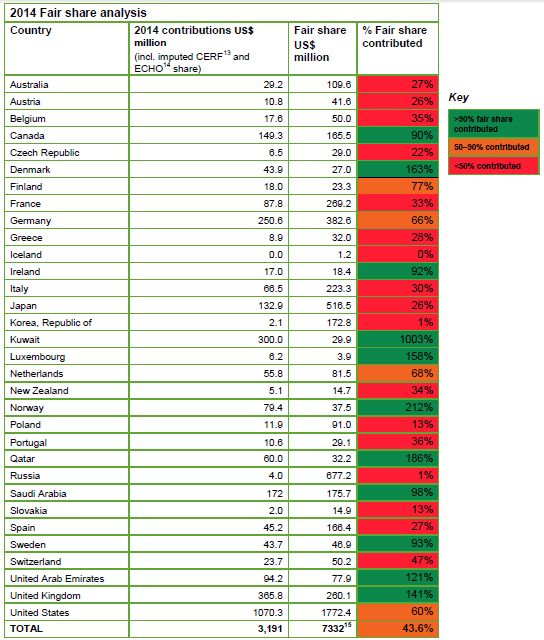
Oxfam: The international response to Syria is failing on three fronts – insufficient aid, meager resettlement offers and continued arms transfers – Oxfam warns in a report published today.
Oxfam is calling on the UN to impose an arms embargo on all warring parties in Syria and is urging governments to provide their fair share of aid, and offer a haven to greater numbers of refugees fleeing violence.
The report, A Fairer Deal for Syrians, details how the $7.7 billion humanitarian appeals are less than half funded, while a continued supply of arms is fuelling widespread violations and undermining peace efforts. Rich countries are offering a safe haven to a paltry number of refugees from Syria while neighboring countries are struggling to support more than 3 million people who have fled the conflict.
Russia, a major arms exporter to Syria, has committed only one percent of its fair share of aid. France and the USA have provided just 33 percent and 60 percent of their fair share respectively and are continuing to supply arms, undermining efforts to stop the conflict. Many Gulf countries are giving more than their fair share but need to do more to stop arms flowing. Other generous donors include the UK and Denmark. [Continue reading…]

New Iraqi Shiite militia copycats ISIS atrocities
France 24 reports: The Islamic State organisation (IS), a jihadist group that controls parts of Syria and Iraq, is infamous for releasing gory images of the atrocities its fighters commit. But now, a newly-formed Shiite militia fighting IS in Iraq has committed a similar act by recording a video where its combatants pose with severed heads.
This video shows a group of Shiite militiamen holding up two severed heads, which they describe as belonging to IS fighters. Mugging for the camera, the men chant: “We are coming for you! We’ll behead you and make mountains with your skulls!” The men’s clothing, armbands and flag show that they belong to the “Islamic Movement of Iraq”, a little-known militia that was recently formed, and which documents its activities on a Facebook page. The video’s caption indicates it was filmed when the city of Amerli was taken back from IS earlier this month. It was captured by Iraqi soldiers, Kurd peshmerga fighters and Shiite militias, who were aided by US air strikes.
According to the group’s Facebook page, its leader is Alhaj Abou Jabar Alasadi, a man unknown on Iraq’s political scene. Strangely enough, on his own Facebook page, he recently posted a photo of himself posing with Iraq’s former prime minister, Nuri al Maliki, just two weeks after the Shiite politician stepped down. He had been accused of being too sectarian. [Continue reading…]
For Gaza’s children, ‘safety’ is just a word
Samer Badawi writes: As the smoke clears over Gaza and its residents begin to assess the damage of Israel’s 50-day war, no group has been more traumatized than this enclave’s children. They represent roughly half of Gaza’s population and, according to a report released on August 27, died at a rate of twelve a day, every day, during the conflict. Their parents, too, have perished in unprecedented numbers, leaving more than 1,500 of Gaza’s children orphaned.
Alaa Balata is one of them.
I met Alaa during one of the war’s temporary ceasefires. Israeli drones buzzed overhead, and the 17-year-old was surrounded by relatives who had been keeping a close eye on him since his parents perished. It had been fewer than two weeks since the incident, and Alaa spoke in the steady understatement of a person in shock, damming the sadness — at least for now.
When I asked him what happened, Alaa gestured toward the heap of rubble that was his uncle’s home. We were sitting on plastic chairs in a dirt alley flanked by cinder-block walls — a familiar scene in any Palestinian refugee camp. But here, in the heart of Jabalia, the path was strewn with shrapnel—the same dense metal that tore through every member of Alaa’s immediate family on the afternoon of July 29.
“It was the second day of Eid,” Alaa told me. A day earlier, on the first day of the Muslim feast marking the end of Ramadan, Alaa’s father decided to move the family to his brother’s house, which was was deep inside the camp and farther from the Israeli tanks shelling everywhere along Gaza’s border.
“He thought we would be safer here,” Alaa said. [Continue reading…]
After Syria and Iraq, ISIS makes inroads in South Asia
Reuters reports: Islamic State pamphlets and flags have appeared in parts of Pakistan and India, alongside signs that the ultra-radical group is inspiring militants even in the strongholds of the Taliban and al Qaeda.
A splinter group of Pakistan’s Taliban insurgents, Jamat-ul Ahrar, has already declared its support for the well-funded and ruthless Islamic State fighters, who have captured large swathes of territory in Iraq and Syria in a drive to set up a self-declared caliphate.
“IS (Islamic State) is an Islamic Jihadi organization working for the implementation of the Islamic system and creation of the Caliphate,” Jamat-ul Ahrar’s leader and a prominent Taliban figure, Ehsanullah Ehsan, told Reuters by telephone. “We respect them. If they ask us for help, we will look into it and decide.”
Islamist militants of various hues already hold sway across restive and impoverished areas of South Asia, but Islamic State, with its rapid capture of territory, beheadings and mass executions, is starting to draw a measure of support among younger fighters in the region.
Al Qaeda’s ageing leaders, mostly holed up in the lawless region along the Pakistan-Afghanistan border, are increasingly seen as stale, tired and ineffectual on hardcore jihadi social media forums and Twitter accounts that incubate potential militant recruits. [Continue reading…]
ISIS will not be beaten by a kneejerk reaction from the West
Jane Kinninmont writes: Isis’s viciousness makes it all too easy to portray the group as an evil force that has come out of the blue, which could be defeated by decisive western military action. But it is essential to remember the recent history of Iraq and Syria, and the west’s involvement there, and to understand the factors that have enabled the group to expand from a few thousand extremists to a wealthy movement controlling swaths of territory.
There are two factors. The first is the chronic deficit of government legitimacy in Iraq and Syria, where systematically marginalised and excluded people create a supportive environment for radical groups promising change. The second is the brutality of recent politics in both those countries, which has been fuelled by regional and international proxy wars and by decades of coalition of support from disaffected tribes and de-facto disenfranchised Iraqi Sunnis. Outgoing prime minister Nouri al-Maliki bears much of the blame for this; Iraq’s Sunni tribes were his best ally against al-Qaida militants, but he squandered this by treating them as terrorists and locking up their sons.
But pinning all the blame on Maliki conveniently absolves the US and UK of responsibility for helping to create a political system where violence and sectarianism are the usual mechanisms for staying in power. Over the past 30 years, the west first supported and armed a genocidal dictator, then crippled the country with sanctions that failed to remove him, then invaded the country and dismantled the state and army. After 2003, the US and UK helped design a system of sectarian “power-sharing” where “power-sharing” means carving up government ministries – made extremely lucrative by raging corruption – between a tiny elite drawn from each ethnicity and sect.
Meanwhile, anti-western sentiment has been spiralling in Syria, not only among supporters of the government, but among the opposition. By saying Assad had to go, the west promised them change, but it did not stop Assad staying in power and killing many thousands of people. Western policymakers may doubt their capacity to resolve the crisis, but in the region, where the US in particular is seen as incredibly powerful, people simply think it lacked the will. [Continue reading…]
Anjem Choudary: The British extremist who backs the caliphate
The Observer reports: Anjem Choudary is well practised in the art of making contentious or provocative statements. An acolyte of the extremist cleric Omar Bakri Muhammed, who fled the UK for Lebanon, the 47-year-old former lawyer was a founding member of Al-Muhajiroun, which celebrated the 9/11 attacks, and was proscribed along with several other groups that Choudary has fronted, including Islam4UK.
So it’s no surprise that when I spoke to him last week he dismissed all allegations of Islamic State (Isis) atrocities, defended the use of crucifixion, and acknowledged Isis leader Abu Bakr al-Baghdadi as “the caliph of all Muslims and the prince of the believers”.
Because of his large claims and small following, Choudary has often been derided, not least by fellow Muslims, as a joke figure of no significance. Yet he is known to have had links with a number of people convicted under anti-terrorism laws, as well as the killer of Lee Rigby, Michael Adebolajo.
His views may be unpalatable but, with as many as several hundred British-born Muslims thought to be fighting in Syria and Iraq with Isis and other jihadi groups, they cannot be ignored. Some reports suggest that many of the British jihadis want to return home, having grown disillusioned with the internecine warfare between rebel forces – which prompts the question of what or who inspired them to go in the first place. [Continue reading…]
For Israel, the beginning of wisdom is to admit its mistakes
Avi Shlaim writes: Israel has a habit of justifying its actions in the occupied Palestinian territories, however illegal and indecent, in the name of security. But denying any security to the other side only perpetuates the conflict.
Five days after reaching a ceasefire with Hamas to end the latest round of fighting in Gaza, the Israeli cabinet decided to appropriate 988 acres of land on the West Bank, near the place where three Israeli teenagers were recently abducted and murdered, to make way for another illegal Jewish city. This is the biggest land grab in three decades. As the justice minister, Tzipi Livni, pointed out: “It was a decision that weakens Israel and damages its security.” What it proves, if further proof is needed, is that Israel’s leaders are determined to prevent a two-state solution to the conflict.
Operation Protective Edge, which came to an end after 50 days of fighting, was the third and deadliest war in six years between Israel and Hamas, the Islamic resistance movement that rules Gaza. Israel lost 66 soldiers and six civilians. On the Palestinian side, the war left 2,104 dead, mostly civilians, and 12,656 injured; 17,000 houses were destroyed or damaged; 520,000 people, out of a population of 1.8 million, were displaced. The damage to buildings and to the civilian infrastructure, estimated at $6bn, will take many years to repair.
What did Israel gain by unleashing the deadly firepower of the IDF against the caged population of this tiny coastal enclave? Virtually nothing. [Continue reading…]

Such a man, according to his victims and his prosecutors, is 29-year-old Mehdi Nemmouche. On May 24, the young Frenchman allegedly walked into a Jewish museum in Brussels and killed four people.