Author Archives: News Sources

Failure in Gaza

Assaf Sharon writes: The Israeli-Palestinian conflict has long ago become a shouting match over moral superiority. With seventy Israelis and more than two thousand Palestinians, most of them civilians, dead, the latest round of violence in Gaza, too, is being analyzed and discussed mostly on ethical grounds. But as fighting goes on, moral condemnation will likely do little to prevent the next round. Understanding how we got to this point — and, more importantly, how we can move beyond it — calls for an examination of the political events that led up to the operation and the political context in which it took place.

In Israel, endless controversy over Gaza has overlooked one question: How did we get here in the first place? Why, after a considerable period of relative calm, did Hamas resume rocket fire into Israel?

Before the current operation began, Hamas was at one of the lowest points in its history. Its alliance with Syria and Iran, its two main sources of support, had grown weak. Hamas’s ideological and political affinity with the Muslim Brotherhood turned from an asset into a burden, with the downfall of the Brotherhood in Egypt and the rise of its fierce opponent, General Abdel Fatah el-Sisi. Egypt’s closure of the Rafah crossing and the tunnels on its border with Gaza undermined Hamas’s economic infrastructure. In these circumstances, Hamas agreed last April to reconciliation with its political rival Fatah, based on Fatah’s terms. For example, the agreement called for a government of technocrats largely under the control of the Palestinian Authority led by Mahmoud Abbas.

But Benjamin Netanyahu viewed the reconciliation as a threat rather than an opportunity. While the separation of Gaza from the West Bank may not serve Israel’s interest (namely, effective government in the Palestinian Territories), it benefits Netanyahu’s policy of rejecting solutions that would lead to a separate Palestinian state. The reconciliation agreement robbed him of the claim that in the absence of effective rule over Gaza, there is no point in striking a deal with Abbas. [Continue reading…]

Facebooktwittermail

In the fight against ISIS, a coalition of rivals

The Washington Post reports: The urgent fight to keep Islamic State forces­ from taking over more of Iraq has led the Obama administration to tolerate, and in some cases even approve, things it once would have loudly protested.

When Iraqi Shiite militias, backed by Iran and long branded illegal by the administration, retook the town of Amerli from the Sunni Muslim militants last week, U.S. officials breathed a sigh of relief.

Qassem Suleimani, the head of the Iranian Revolutionary Guard Corps’ Quds Force and usually described as an arch­enemy of the United States, reportedly was present during the battle and was seen days later in an Internet-posted photo shaking hands with a militia fighter.

Farther north, Kurdish fighters have occupied the oil-rich city of Kirkuk, a prize the Kurds have long claimed but which lies outside the borders — recognized by both Baghdad and Washington — of Iraq’s semiautonomous Kurd­i­stan region. Far from insisting the fighters withdraw, the administration is glad that someone is defending the city from the Islamic State.

Such legal and policy niceties have become a luxury in the battle to push back the militants whom President Obama on Friday called “a savage organization” that “poses­ a significant threat” to the United States and its allies.

It is not, as one administration official said with significant under­statement, an ideal situation, and there is widespread recognition that facts are being created on the ground that are likely to cause problems in the future. [Continue reading…]

Facebooktwittermail

Iranian-Saudi agreement on Iraq may be near

Al-Monitor reports: A UN diplomatic source in Beirut told Al-Monitor that an Iranian-Saudi agreement on the formation of the next Iraqi government was almost done. The source, who spoke on condition of anonymity, revealed that the visit by the Iranian Assistant Foreign Minister Hussein Amir Abdul Lahian to Saudi Arabia on Aug. 26 was the move that crowned the agreement.

The source said that some felt a few weeks ago that removing Nouri al-Maliki from the Iraqi Prime Ministry and designating Haider al-Abadi on Aug.11 was the final sign of a Tehran-Riyadh agreement on Baghdad. But this impression was not true.

According to the diplomatic source, the move followed mutual attempts by the two parties to raise their negotiating ceilings. For its part, Iran tried to harden its stance for known reasons; it gave the impression that removing Maliki happened more because of internal Iraqi Shiite calculations linked to the position of Shiite cleric Ali al-Husseini al-Sistani, rather than a Shiite concession to the Sunnis or an Iranian concession to Saudi Arabia in Iraq. These calculations include compensating Maliki’s removal by strengthening his and his team’s position in governing and in the next government, as well as getting paid by the Sunni-Saudi team as a compensation. [Continue reading…]

Facebooktwittermail

As ISIS advances in Syria, Israel tightens its grip on the Golan Heights

The Economist: IS’s advance is prompting the 20,000 Druze who inhabit the Golan Heights, alongside a similar number of Israelis, to shift their allegiance. For decades under Israeli occupation they professed their loyalty to Syria. But now, as adherents of an esoteric offshoot of Islam that IS and Jabhat al-Nusra excoriate, they are quietly loosening their ties to Syria. They have stopped exporting their apples there—and their brides. Druze applications for Israeli citizenship have risen sharply, says the Israeli-appointed mayor of Majdal Shams, the biggest of the four Druze towns. Many Druze now look to Israel (and particularly to its Israeli Druze soldiers stationed on the heights) to protect their secular world, where women walk and drive their cars unveiled.

This raises the hopes of those in Israel’s hawkish government who want to extend the annexation of the Golan Heights indefinitely. Whereas a more dovish Israeli government in 1999 came close to a land-for-peace deal with Syria, few Israelis nowadays contemplate such a thing. Indeed, Israel’s current leaders often remind their voters how vulnerable Israel would have been to the threat of jihadists if its border with Syria had been realigned along the shore of Lake Galilee, as was mooted.

An army division, newly equipped with drones, and a new iron fence, are meant to secure the border. The nearby vineyards look set to provide Israel with excellent, if expensive, wine for some years to come.

Facebooktwittermail

The Hannibal Directive: How Israel killed its own troops and massacred Palestinians to prevent soldiers’ capture

Max Blumenthal writes: In the southern city of Rafah in the Gaza Strip, Aug. 1, 2014 is known as Black Friday. This was the day the Israeli military bombarded the city with almost every mode of destruction available to it, from F-16 missiles to Apache rockets to naval shelling to drone strikes and mortars.

Bulldozers ripped down homes at random while tanks barreled through neighborhoods, shelling anything in sight. In a matter of hours, at least 500 artillery shells and hundreds of missiles were dumped on the city, almost entirely in civilian areas. By the end, at least 190 people had been killed, so many that unequipped local hospitals were forced to store their corpses and body parts in ice cream coolers.

The target of the operation was not necessarily Rafah’s civilian population, though attacking it was part of the Israeli military’s underlying logic. Instead, the army apparently aimed to kill one of its own. Indeed, Israeli forces had invoked the Hannibal Directive, opening up an indiscriminate assault on the entire circumference of the area where one of its soldiers, Lt. Hadar Goldin, was allegedly taken captive by an ambush team from the Hamas military wing known as the Qassam Brigades.

It was one of possibly three instances during Israel’s 51-day war with Hamas that it initiated the Hannibal Directive. [Continue reading…]

Facebooktwittermail

Visiting the ODNI: A day of speaking truth to power

Quinn Norton: “It’s called ‘the crackpot realism of the present’” someone said to me, and handed me a note. I folded up the note, and stuffed it in my purse. This was a phrase used to explain, much more clearly than I was doing at the time, the bias of thinking that now is right, forgetting that the future will look back on our ideas with the same curious and horrified amusement we watch the human past with. It’s believing, without any good reason, that right now makes sense.

The present I was in right then didn’t make a lot of sense.

I was sitting in a cleared facility near Tyson’s Corner in Virginia, the beating heart of the industrial-military-intelligence-policing complex, the Office of the Director of National Intelligence. I was there to help the government. Of the places I did not expect to ever go, at least not of my free will, the ODNI would be up there.

A few weeks ago, a friend from the Institute for the Future [IFTF] asked me if I would fly to DC for a one day workshop on the future of identity with the Office of the Director of National Intelligence. “What?” I sputtered, “Did they google me?” and then, mentally: Duh. The ODNI can do a lot more than google me.

I knew IFTF had intel clients, with whom I have occasionally chatted at events in the past. My policy when confronted with spooks asking questions about how the world works is to give them as much information as I can — one of my biggest problems with how security services work is their lack of wisdom. If I can reach people in positions of power and persuade them to critically examine that power, I consider that a win. I also consider it a long shot.

An invite from the ODNI is a strange thing. I’ve been publicly critical of them, sometimes viciously so. A few days earlier I tweeted that their director should be publicly tried for lying to Congress. I’ve written about the toxicity of the NSA spying (under ODNI direction), the corrupt fictions of Anonymous staged by the FBI (FBI/NSB is within ODNI’s area) and spoken out countless times in the last eight years against warrantless spying. I have even less love for the FBI and DOJ.

I turned the offer over in my head. I was influenced by a few things –yes it was paid, but not well paid. It was what I normally get from IFTF for a day of my time, and given the travel commitment, a bit low. I weighed the official imprimatur of involvement, and that was a factor. I am afraid of being pursued and harassed by my government. This has never happened to me in relation to my work, though I have been turned down for housing by people who feared I might bring police attention. It has to my friends, sources and associates. I know what it feels like, what they do when you’re a target, because I have been subject to terrorizing tactics and harassment because of whom I chose to love. I have publicly acknowledged that I self-censor because of this fear. I have a child to raise, and you can’t do that while you fight for your life and freedom in court. Raising my profile with the government as an expert probably makes me harder to harass.

I told my IFTF contact I don’t sign NDAs (which he already knew) and that I’d have to be public about my attendance and write about it. He told me they were publicly publishing their work for the ODNI too. “Huh,” I said to my screen. The organizers were on board with all of it. They wanted me in particular.

Finally, I thought about the hell I would get from the internet — like government harassment, internet harassment is part of the difficult and hated process of self-censorship for me.

In the end, I said yes, because you only get so far talking to your friends. [Continue reading…]

Facebooktwittermail

England is dysfunctional, corrupt and vastly unequal. Why would Scotland want to be tied to such a country?

George Monbiot writes: Imagine the question posed the other way round. An independent nation is asked to decide whether to surrender its sovereignty to a larger union. It would be allowed a measure of autonomy, but key aspects of its governance would be handed to another nation. It would be used as a military base by the dominant power and yoked to an economy over which it had no control.

It would have to be bloody desperate. Only a nation in which the institutions of governance had collapsed, which had been ruined economically, which was threatened by invasion or civil war or famine might contemplate this drastic step. Most nations faced even with such catastrophes choose to retain their independence – in fact, will fight to preserve it – rather than surrender to a dominant foreign power.

So what would you say about a country that sacrificed its sovereignty without collapse or compulsion; that had no obvious enemies, a basically sound economy and a broadly functional democracy, yet chose to swap it for remote governance by the hereditary elite of another nation, beholden to a corrupt financial centre?

What would you say about a country that exchanged an economy based on enterprise and distribution for one based on speculation and rent? That chose obeisance to a government that spies on its own citizens, uses the planet as its dustbin, governs on behalf of a transnational elite that owes loyalty to no nation, cedes public services to corporations, forces terminally ill people to work and can’t be trusted with a box of fireworks, let alone a fleet of nuclear submarines? You would conclude that it had lost its senses. [Continue reading…]

Facebooktwittermail

Al Qaeda’s new front: Jihadi rap

Amil Khan writes: Abdel Majed Abdel Bary, the rapper suspected of murdering American journalist James Foley somewhere between Syria and Iraq, is the product of a British youth culture that has managed to merge two seemingly contradictory lifestyles: gangsta rap and jihad. Like Douglas McAuthur McCain — an American hip-hop fan who was recently killed fighting for the Islamic State — Abdel Bary represents a new and very scary evolution in modern jihadi history.

U.S. Secretary of Defense Chuck Hagel recently described the Islamic State as a threat “beyond anything we’ve ever seen.” Yet we are only just beginning to grasp what is different about this group. One reason is that it includes men in its ranks whom you might expect to see in a nightclub rather than fighting in the desert for an organization that would, traditionally, whip you for listening to music.

As a result of this cultural elasticity, the Islamic State has succeeded in attracting supporters outside its natural recruiting pool. Both McCain and another Westerner, Denis Mamadou Cuspert, a German citizen who died fighting with the Islamic State — and had a previous life as rapper Deso Dogg with three albums to his name — became converts as part of this broader appeal.

I first began to look into this hybrid phenomenon in 2008 when I was a journalist researching a subculture that had fused the extremism and violence of gangsta rap with that of al Qaeda — or at least a version of it. During a months-long investigation for British television station Channel 4, I met dozens of young men across London who tended to have three things in common: a history of criminal activity, an ambition to be a gangsta rapper and a fixation with the terrorist group begun by Osama bin Laden. [Continue reading…]

Facebooktwittermail

British hostage David Haines held by ISIS ‘helped thousands of people’

The Telegraph reports: The wife of the British hostage David Haines has described him as “everything to us” in her first comments since terrorists threatened to behead him.

Mr Haines, 44, is a father of two described by his wife as a “fantastic man and father”.

He made his home in Croatia after spending five years helping local people, including Muslim families, rebuild their homes after the Balkans war, and the town of Petrinja, where he helped put up 800 houses, was “in shock” over his seemingly hopeless plight.

Mr Haines, who was born on Humberside but raised in Scotland, has a 17-year-old daughter by his first wife Louise and a four-year-old daughter by his second wife Dragana, who is Croatian.

Speaking at the family’s home near Zagreb, Dragana Haines, 44, said: “He’s everything to us. He’s our life. He’s a fantastic man and father.

“Nobody can understand how we are feeling. My daughter keeps asking about him every day. She hasn’t seen her father for a year and a half. She has gone through so much. She sees me crying all the time.

“My daughter was on a play date and I had to bring her home when I got the news.

“I just can’t digest it right now. We just don’t want to do anything to endanger his life.”

Mr Haines and his wife, whom he met when she worked as his translator, were due to celebrate their fourth wedding anniversary in November, having married in Croatia in 2010, when Mr Haines wore a kilt.

He was known as the “Crazy Scotsman” by locals whom he helped during several spells working for aid agencies in parts of Croatia torn apart by civil war.

When he worked for the German aid agency Arbeiter-Samariter-Bund from 1999 to 2004 Mr Haines’s landlady in the Croatian town of Petrinja was Nena Skoric, 67, to whom he affectionately referred as “Mama”.

Sitting at her kitchen table, surrounded by photographs and memories of Mr Haines, Mrs Skoric said: “To me, it was like God had sent David to this place.

“It didn’t matter to him whether people were Croats, Serbs or Muslims, as long as they needed help.

“Many of the people from all sides had destroyed each other’s houses during the war. There were many families who had lost everything.

“But they all loved David. For years after he left they would come here and ask how he was. He was such a good man and he was like one of my family.

“I don’t know what is wrong with the kidnappers. Don’t they know he was helping Muslims? They don’t seem to care about that.”

Mr Haines helped “thousands” of local people as he led efforts to build new homes and schools for refugees returning to their shattered villages, and became so frustrated at the lack of available funds that he would donate a large slice of his salary to pay for materials and other essentials. [Continue reading…]

Facebooktwittermail

Disillusioned British jihadists seek amnesty

The Times reports: Dozens of British jihadists have become so disillusioned with fighting in Syria that they have contacted Britain begging to come home.

One jihadist, claiming to represent 30 Britons, approached an intermediary to complain of growing despondency among the men in his group. They had gone to fight against President Bashar al-Assad’s regime but were instead engaged primarily in fierce combat with rival rebel groups, he said.

The man contacted researchers from the International Centre for Study of Radicalisation and Political Violence at King’s College London in the past two weeks. He effectively sought amnesty, saying the group feared long prison terms but would be willing to enrol on a deradicalisation program and submit to surveillance.

The militants are from a group affiliated with Islamic State. More than 500 British citizens are believed to have travelled to the region since 2011. Most have joined Islamic State.

The British man told researchers: “We came to fight the regime and instead we are involved in gang warfare. It’s not what we came for, but if we go back we will go to jail.

“Right now we are being forced to fight — what option do we have?”

Shiraz Maher, who runs a research unit at ICSR that is in intermittent contact with about 50 British jihadists, said the man regretted being involved in the conflict. [Continue reading…]

Facebooktwittermail

Is the PKK becoming a new Middle East power?

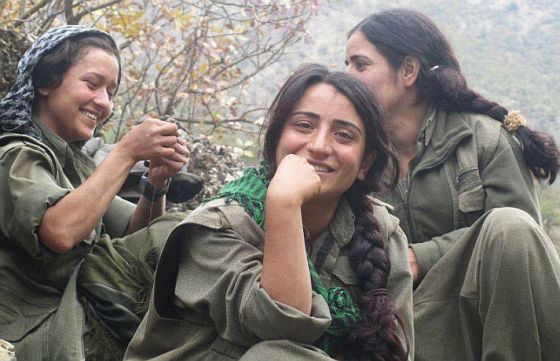
30% of PKK fighters are women.

30% of the PKK’s fighters are women.

The Turkish columnist, Kadri Gursel, writes: [T]he PYD [the Democratic Union Party, the PKK’s Syrian branch] has been able to hold on to these three regions [Ras al-Ain, Kobani and Afrin, in northern Syria] and resist the jihadists for more than two years. Hence, long before IS’ capture of Mosul, the PKK already deserved to be recognized as the Middle East’s only fighting force to defy and resist IS for the struggle it has waged in Rojava [Syrian Kurdistan].

The Kurdish forces in Syria have surprised the world not only with their resolve against the jihadists but also with their female fighters. Against a barbarian mindset that enslaves and sells women as concubines, the PYD has displayed a secular mindset embracing gender equality, which has enormously contributed to its international image.

In Iraq, on the other hand, the PKK has put aside disagreements with the Kurdistan Democratic Party (KDP) to form a national military alliance against the jihadist threat to Iraqi Kurdistan.

That the Western public is already discussing the prospect of the PKK’s removal from the lists of terrorist organizations is a clear indication of how much the PKK’s struggle against the jihadists has contributed to its international standing.

Lauren Bohn reports: Standing in a parched field far from any roads in Turkey’s southeastern mountains, a teary-eyed Sokrun Gunduz clutched photographs of her two absent sons.

Mazlum, 15, is in a Turkish prison under suspicion of collaborating with the Kurdistan Workers Party (PKK), a group branded a terrorist organization by Turkey, the European Union and the United States.

Agit, 22, is in northern Iraq battling the jihadist Islamic State in Iraq and Syria (ISIS) with the same group. The young man is one of thousands of PKK soldiers who have joined the war against ISIS in Kurdish areas of Syria and Iraq, and who have become vital to the international community’s battle against the powerful Islamist insurgency.

“The Kurdish fight has spread,” the 43-year-old grocer said at a recent rally marking the anniversary of the PKK’s armed struggle against Turkey. The group has battled the Turkish state for cultural and political rights and Kurdish self-rule for 30 years in a conflict that has claimed more than 30,000 lives.

“We must protect our Kurdish brothers and sisters,” she said amid a crowd of thousands of PKK fighters and supporters celebrating the 30th anniversary of the group’s struggle. “In doing so, we will finally get our own Kurdish state.”

Many of Turkey’s Kurds – a disenfranchised minority that makes up a fifth of the country’s population – feel revitalized by the PKK’s role in Syria and Iraq, and hope their successes on the battlefield will produce political victories such as greater autonomy, more rights and perhaps even an independent state.

“In a way, we have to thank the Islamic State. They’ve united us, reviving the great Kurdish cause,” said Seyid Narin, a municipal mayor in Diyarbakir, long the center of the Kurdish resistance and separatist movement in southeast Turkey. Ten months ago he lost a son who was fighting in Syria — a second one is now in northern Iraq with the PKK.

“Our struggle is reborn,” he said.

This struggle poses a potential threat to Turkey’s ruling Justice and Development Party (AK Party) which has spearheaded efforts to restart peace talks with the terror group and now tolerates its military role in Turkey.

“Both the (ruling party) and PKK know that ISIS must be stopped … if anything, this fight will bring the AK party and Kurds closer together,” said Bedirhan Akyol, a Kurdish Justice and Development official in Diyarbakir. “The PKK is becoming stronger through this fight, but that won’t have a bad effect on peace talks.”

But Akyol’s positive spin belies a deep unease in Turkey about the PKK’s role fighting ISIS in Syria and its place in society at large. That the long reviled organization has been cast as the hero in the war against homicidal Islamist fighters has prompted alarm and anger in some circles.

The ruling party and the PKK are essentially creating laws that would result in the break- up of Turkey, said Oktay Vural, a leading Turkish opposition politician.

“The terrorists failed to divide Turkey for 30 years, but the country is now being brought to the brink of partition in the name of [Recep Tayyip] Erdogan’s political future,” he wrote in an editorial, referring to the country’s powerful prime minister and president elect.

Even some who do not consider talks with the PKK treasonous, like Vural does, worry that Turkey already has enough on its plate with the regional threat posed by ISIS and a teeming Syrian refugee population, before dealing with the legitimization of a group long branded as terrorists. [Continue reading…]

Facebooktwittermail

Syria may have hidden chemical arms, U.S. says

The New York Times reports: The United States expressed concern on Thursday that Syria’s government might be harboring undeclared chemical weapons, hidden from the internationally led operation to purge them over the past year, and that Islamist militant extremists now ensconced in that country could possibly seize control of them.

The assertions by Samantha Power, the United States ambassador to the United Nations and current president of the Security Council, were made after the Council received a private briefing on the Syria chemical weapons disarmament effort from Sigrid Kaag, the United Nations official appointed last year to coordinate it. Under Ms. Kaag, 96 percent of Syria’s declared chemical weapons stockpile, including all of the most lethal materials, have been destroyed.

But Ms. Kaag told reporters after the briefing that Syria had yet to address what she described as “some discrepancies or questions” about whether it had accounted for all of the chemical weapons in its arsenal. She also said Syria had yet to destroy seven hangars and five tunnels used for mixing and storing the weapons — which is required under the chemical weapons treaty that Syria has signed. The Organization for the Prohibition of Chemical Weapons, the Hague-based group that collaborated with the United Nations in overseeing the Syrian chemical disarmament, is now responsible for ensuring that Syria honors its promise. [Continue reading…]

Facebooktwittermail

Israeli Arabs reported to have joined ISIS

Israel Hayom reports: Shin Bet security service officials believe that at least 10 Israeli Arabs have joined the Islamic State terrorist group and are currently fighting with the organization in Iraq and Syria, officials briefed Israeli leaders recently. The information has been discussed at length behind closed doors.

The Shin Bet assessment rests on the fact that since the outbreak of the civil war in Syria in March 2011, dozens of Israeli Arabs have joined various rebel groups currently fighting the Syrian army. The Shin Bet’s intelligence suggests that since the beginning of the civil war at least 25 individuals — Israeli Arabs known to hold radical views — have left Israel to join the “jihad” or holy war.

Meanwhile Thursday, 18 foreign fighters from the Islamic State, including an American jihadist, were killed in a Syrian air raid on a town near the militant group’s main stronghold city of Raqqa in eastern Syria, the Syrian Observatory for Human Rights reported.

The Syrian human rights group, which has tracked violence on all sides of the three-year-old conflict, said reliable sources reported that top Islamic State leaders who happened to be in the municipal building of Gharbiya at the time of the raid were among the foreign fighters killed. [Continue reading…]

Facebooktwittermail

How some Israeli leaders are promoting war crimes

Bethan Staton writes: Just over a week ago, a young Long Islander called Yochanan Gordon published a blog in the Times of Israel. It argued – poorly – that the only way to deal with the “enemy” facing the Israeli people was to “obliterate them completely.” The headline – “When genocide is permissible” – left little doubt over precisely what this meant.

The outcry that followed the publication – and the Times’ swift removal and apology – showed the sentiment was far from representative of wider society. Because the paper operates an open blog policy the piece hadn’t been seen by any editors before being uploaded. Gordon was a total unknown who in his pompous bio listed a family connection to journalism as his only professional qualification. For many reasons, Yochanan’s argument looked a lot like an aberration.

Except it wasn’t. In the heightened tension following the abduction and murder of three settler teenagers in the West Bank and the Gaza war that followed, Gordon’s blog was merely the crudest note in a chorus of calls for war crimes, of the grimmest hue, against the Palestinian people.

After the bodies of missing teens Gilad, Naftali and Eyal were found, the secretary general of the world’s largest youth Zionist movement, Rabbi Noam Perel, called for a murderous revenge that would “not stop at 300 Philistine foreskins.” At the end of July, Chief Rabbi of the Kiryat Arba settlement Dov Lior used religious texts to justify the potential “destruction of Gaza,” writing that in wartime a “nation under attack” could punish its adversaries in any way, including “taking crushing deterring steps to exterminate the enemy.”

Such words demand a response. “When it comes to language that incites to hatred and violence, it’s a human rights obligation on the state to take action,” explains Michael Kearney, a law lecturer at Sussex University who researches propaganda and incitement in international law. “Direct and public incitement to genocide is, in itself, what we’d call a crime in customary international law. Basically it’s binding on all states to live up to that obligation to prevent genocide and to deal with people who do explicitly incite to genocide.”
advertisement

Precisely how that obligation might manifest itself is up to the state in question: often symbolic steps to demonstrate that such incitement is not acceptable, Kearney says, might be appropriate.

There has been much outcry among Israeli, Jewish and American communities over statements like these: After widespread condemnation, indeed, Rabbi Perel retracted his statements and apologized. But few measures have been taken against the writers and commentators in question here. Worse, incitement from Israeli politicians hasn’t resulted in serious consequences. At the beginning of July, Knesset member Ayelet Shaked posted an extract from an article by Uri Elitzur on her Facebook page. It defined the “enemy” as the “entire Palestinian people,” and wrote that the “mothers of terrorists” should be destroyed, “as should the physical homes in which they raised the snakes.” Aside from the condemnation of commentators, Shaked received no official censure: a day after, three Israeli men kidnapped 16-year-old Mohamed Abu Khdeir and burned him to death. [Continue reading…]

Facebooktwittermail

ISIS is a disgrace to true fundamentalism

Slavoj Zizek writes: Long ago Friedrich Nietzsche perceived how Western civilization was moving in the direction of the Last Man, an apathetic creature with no great passion or commitment. Unable to dream, tired of life, he takes no risks, seeking only comfort and security: “A little poison now and then: that makes for pleasant dreams. And much poison at the end, for a pleasant death. They have their little pleasures for the day, and their little pleasures for the night, but they have a regard for health. ‘We have discovered happiness,’ say the Last Men, and they blink.”

It may appear that the split between the permissive First World and the fundamentalist reaction to it runs more and more along the lines of the opposition between leading a long satisfying life full of material and cultural wealth and dedicating one’s life to some transcendent cause. Is this antagonism not the one between what Nietzsche called “passive” and “active” nihilism? We in the West are the Nietzschean Last Men, immersed in stupid daily pleasures, while the Muslim radicals are ready to risk everything, engaged in the struggle up to their self-destruction. William Butler Yeats’ “Second Coming” seems perfectly to render our present predicament: “The best lack all conviction, while the worst are full of passionate intensity.” This is an excellent description of the current split between anemic liberals and impassioned fundamentalists. “The best” are no longer able fully to engage, while “the worst” engage in racist, religious, sexist fanaticism.

But are the terrorist fundamentalists really fundamentalists in the authentic sense of the term? Do they really believe? What they lack is a feature that is easy to discern in all authentic fundamentalists, from Tibetan Buddhists to the Amish in the United States — the absence of resentment and envy, the deep indifference towards the nonbelievers’ way of life. If today’s so-called fundamentalists really believe they have found their way to Truth, why should they feel threatened by nonbelievers. Why should they envy them? When a Buddhist encounters a Western hedonist, he hardly condemns. He just benevolently notes that the hedonist’s search for happiness is self-defeating. In contrast to true fundamentalists, the terrorist pseudo-fundamentalists are deeply bothered, intrigued and fascinated by the sinful life of the nonbelievers. One can feel that, in fighting the sinful other, they are fighting their own temptation. This is why the so-called fundamentalists of ISIS are a disgrace to true fundamentalism. [Continue reading…]

Facebooktwittermail

ISIS gains in Syria alarm some Assad allies

Reuters reports: A mounting death toll in President Bashar al-Assad’s armed forces is causing alarm among some government loyalists who are worried about Islamic State’s territorial gains and are turning their anger on the authorities in Damascus.

The execution of scores of Syrian soldiers taken captive by Islamic State at an air base in Raqqa province has triggered unusually harsh social media criticism of the Damascus government by people who have taken its side in the civil war.

Some, including one of Assad’s cousins, have called for the resignation of the defense minister, blaming him for the loss of the Tabqa air base that represented the government’s last foothold in a province otherwise controlled by Islamic State.

With the flow of information from Syria greatly restricted, it is not possible to gauge how widely such sentiment is felt. And it is not the first time the Syrian government has faced criticism from its supporters during the three-year conflict.

But it points to a potential pressure point for Assad, who draws support from minority groups including his own Alawite community for whom Islamic State is an existential threat.

“I demand the resignation of the minister of defense, the chief of staff, the air force commander, the minister of information, and whoever is responsible for the fall of the Tabqa military airport,” Duraid al-Assad, the cousin of Bashar al-Assad, wrote on his Facebook page.

Duraid is a son of Rifat al-Assad, who left Syria after being accused of attempting a coup in the 1980s against the late president Hafez al-Assad. Contacted by Reuters via his Facebook page, Duraid said he currently lives in Syria.

His status was endorsed more than a thousand times. Dozens of people wrote comments expressing their agreement. [Continue reading…]

Facebooktwittermail