Author Archives: News Sources

Morsi defiant in brief court appearance

The New York Times reports: Held incommunicado for the four months since his overthrow as president, Mohamed Morsi of the Muslim Brotherhood walked into a makeshift courtroom on Monday for his new role as a defendant in a murder trial.

But Mr. Morsi, dressed in a blue suit, refused even to wear the usual all-white prisoner’s costume.

“I want a microphone so I can talk to you,” Mr. Morsi shouted three times from a special defendant’s cage constructed to obscure him from public view. “There is a military coup in the country,” he shouted, adding, “I am the president of the republic, according to the Constitution of the state, and I am forcibly detained!”

Repeatedly cited by the new government as evidence of its adherence to the rule of law, the trial instead threatened to embarrass its leadership, with the defendants and their lawyers seizing a rare platform to question the military takeover. Islamists around Egypt were galvanized by Mr. Morsi’s show of defiance as the judge failed to gavel him into silence and instead adjourned the trial for two months.

And the timing, analysts said, also proved awkward for Secretary of State John Kerry. On a visit to Cairo just a day before, he had said that — despite a series of mass killings of protesters, the shutdown of opposition news media outlets and apparently politicized trials like Mr. Morsi’s — “there are indications” that the generals who ousted Egypt’s first freely elected president intended to restore democracy.

The visit was “unbelievable timing,” said Michael Wahid Hanna, an Egypt scholar at the Century Foundation in New York. He argued that opponents of the Islamists would see the trip as an American effort to protect Mr. Morsi, while Islamists would hear Mr. Kerry’s “soft and optimistic statements as a U.S. blessing to the new military-led political order.”

It was the second criminal prosecution of an ousted Egyptian president in the same venue within less than three years. But in a reversal of the dynamic during the live broadcast of Hosni Mubarak’s trial in 2011, on Monday the hearing quickly devolved into a tug of war over just how much attention Mr. Morsi could receive.

“Mubarak was hiding from the cameras, and now they are hiding the cameras from Morsi,” said Emad Shahin, a political scientist at the American University in Cairo, who called the new government’s rush to trial “a miscalculation” because “this will increase the perception of him as a hero, an icon for the resistance.”

Ahmed el-Arainy, 42, a Brotherhood organizer, called the opening of the trial “a good day.”

“They just wanted to show him shaken in a cage, a defendant in prison clothes, but, God bless him, he stood in defense of his cause and not theirs,” he said. “What is on trial is the country, and its will to change,” he added. [Continue reading…]

Earlier this week, two Canadians, Toronto filmmaker John Greyson, and emergency room medical doctor Tarek Loubani, described their experiences in Egypt where they were recently released after 50 days in detention.

Facebooktwittermail

Egypt’s Muslim Brotherhood finds havens abroad

The Washington Post reports: Very few of the leaders of Egypt’s Muslim Brotherhood escaped the recent military-led crackdown on their movement. Some of those who did flew out of Cairo after paying thousands of dollars in bribes to airport security officials, while others took more convoluted routes, boarding planes in distant airports en route to friendlier nations.

One of those friendly nations is Qatar, the tiny, oil-rich Persian Gulf state that helped bankroll rebels and Islamist democracy advocates throughout the Arab Spring and is now quietly absorbing the exiles that one country’s stumbling experiment in democracy has generated.

Cast out by — or, perhaps, saved from — the harshest political crackdown in recent Egyptian history, a handful of Muslim Brotherhood and other Islamist leaders found refuge here in the Qatari capital, while others traveled to Istanbul, London and Geneva.

The exiles’ community is small, disorganized and ideologically diverse, ranging from fairly liberal Islamist politicians to hard-line Salafists — groups that less than two years ago competed against each other in Egypt’s parliamentary and presidential elections.

Now, as they push back against the July coup that toppled their country’s first democratically elected president, Mohamed Morsi, they are on the same team.

At the same time, an exile leadership is starting to take shape here among the shimmering high-rises of Doha. Several of the exiles are living temporarily in hotel suites paid for by Qatar’s state-run Arabic satellite network Al Jazeera — and it is in those suites and hotel lobbies that the future of Egypt’s Muslim Brotherhood and, more broadly, the strategy and ideology of political Islam in the country may well be charted.

“We are not the kind to escape. We do not prefer exile. We have a task: to communicate the crisis and deliver the message to the world,” said Ehab Shiha, the chairman of the Egyptian Salafist al-Asala party, as he sat in a hotel lobby in Doha. [Continue reading…]

Facebooktwittermail

Barack Obama: Suspected war criminal

Shuaib Almosawa writes: Arfag al-Marwani finished his last minute shopping for the Eid al Fitr holiday by midnight, just enough time to enjoy a few hours of rest before the holiday’s dawn Fajr prayers. A 28-year-old laborer, Arfag had recently returned from working in Saudi Arabia and planned on spending the time with his family. It was August 8.

Just before making his final holiday preparations, he received a troubling phone call. Before the holiday celebrations could begin, he would have to carry out one final task.

There had been some sort of car accident involving his brothers: 24-year-old Abdullah, 17-year-old Hassan and 16-year-old Hussein. They too were on their way to the family home after finishing some last minute Eid shopping. Arfag’s thoughts drifted to news reports of the seven U.S. drone strikes in the past 11 days — one of which already targeted al Qaeda suspects in his home province of Marib. Arfag hoped that his young brothers weren’t somehow caught in the drone crossfire.

It took Arfag half an hour to reach the wreckage. Amidst the eerie quiet of the Maribi countryside, smoke still rose from the smoldering remains of his brothers’ mangled vehicle.

The strike that killed Arfag’s three brothers was the eighth out of nine total air attacks launched between July 27 and August 10. It was part of a spastic attempt to thwart what U.S. officials claimed was an al Qaeda plot to attack American interests. But the drone campaign may have only created more support for the militants, if Arfag and his grieving family are to be believed.

Government officials told the press that the strike’s targets were all al Qaeda militants. But the victims’ families say just the opposite was true: that the two teenagers and their older brother were innocent bystanders.

“Everything inside the car seemed to have been flung out of the windows by the force of the blast,” said Arfag, describing what he found at the wreckage that night.

“I found their bodies lying nearby — decapitated.”

Arfag carried the bodies of Abdullah, Hassan and Hussein to the trunk of his car one by one along with what remained of Eid gifts his brothers’ had purchased just a few hours earlier.

“They purchased two outfits for their little nieces, deserts, and a lot of fireworks. We all enjoy the Eid fireworks — they weren’t just for the boys,” said Arfag.

Arfag notified the rest of his family before he began the 50 mile drive north where the family would prepare the bodies for burial in a nearby cemetery the following day.

“Mom took pictures with her mobile phone of all of them, along with the [charred] gifts they had bought,” Arfag continued.

The August 8 strike has outraged the residents of Marib, a governorate where al Qaeda maintains a strong presence. According to some security analysts, that outrage over drone strikes directed toward the U.S. may do more harm than good in a long term struggle against AQAP, as the local Qaeda affiliate is known.

“This case gets at what I believe to be the Achilles heel of the U.S. in a place like Yemen: a lack of good, on-the-ground human intelligence,” said Gregory Johnsen, a former Fulbright Fellow in Yemen and author of The Last Refuge: Yemen, al Qaeda and American’s War in Arabia. [Continue reading…]

Jeffrey Bachman asks: Is President Obama a suspected war criminal?

If you have read the recent reports on drone strikes by Ben Emmerson, UN special rapporteur on the promotion and protection of human rights and fundamental freedoms while countering terrorism, Christof Heyns, UN special rapporteur on extrajudicial, summary or arbitrary executions, Amnesty International and Human Rights Watch, there is only one answer to this question … and it is not the answer most would want to hear.

If you have not read the reports, let me provide you with a brief summary of the common themes. The reports repeatedly criticized President Obama for what has been a near complete lack of transparency. Lack of transparency, according to the reports, impedes accountability. By failing to acknowledge responsibility for drone strikes in Pakistan and Yemen, there can be no accountability to those who have wrongfully had their innocent loved ones killed in attacks.

Frank La Rue, special rapporteur on the promotion and protection of the right to freedom of opinion and expression, noted the role the right to information plays in promoting good governance. La Rue added that there exists a right to know the truth because the truth enables access to other rights: in this case, the right to reparations and accountability for the wrongful deaths of loved ones. [Continue reading…]

Facebooktwittermail

NSA official cites ‘stop and frisk’ in effort to explain searches of phone records

McClatchy reports: The general counsel of the National Security Agency on Monday compared the agency’s telephone metadata collection program to the highly controversial “stop-and-frisk” practice used by law enforcement officers, saying the agency uses that same standard to choose which phone numbers to query in its database.

“It’s effectively the same standard as stop-and-frisk,” Rajesh De said in an attempt to explain the evidentiary use of “reasonable and articulable suspicion” to identify which phone numbers to target from the agency’s huge database of stored cellphone records.

De made the comment during a rare hearing of an obscure government body, the Privacy and Civil Liberties Oversight Board, which Congress created in 2004 to oversee the government’s expanded intelligence collection operations but which until Monday had never held a substantive hearing.

De’s comparison was perhaps unfortunate. Stop and frisk, after all, is the subject of its own string of controversies. A federal judge ruled in August that the New York City Police Department had used racial profiling in its stops and disproportionately targeted blacks and Latinos. Last month, a video of a Philadelphia police officer stopping and frisking a young black male went viral on YouTube. Complaints about stop and frisk have reached a crescendo among civil liberties groups. The American Civil Liberties Union recently said the practices “raise serious concerns over racial profiling, illegal stops and privacy rights.”

Sensing that De may have opened a new door of debate, Robert Litt, the general counsel of the Office of the Director of National Intelligence, noted that the NSA’s dive into phone metadata, which includes numbers called and the length of calls, is “considerably less” intrusive than a physical search. [Continue reading…]

Hmmm… Less intrusive? Would that be in the same sense as House Intel Committee Chair Rep. Mike Rogers’ claim that “you can’t have your privacy violated if you don’t know your privacy is violated, right?”?

I guess one could say a pick-pocket isn’t intrusive if he manages to steal your wallet but you don’t realize you were robbed.

Facebooktwittermail

Britain’s ‘secret listening post in the heart of Berlin’

The Independent reports: Concerns were raised tonight that Britain operates a top-secret listening post from its Berlin embassy to eavesdrop on the seat of German power.

Documents leaked by the US National Security Agency whistleblower Edward Snowden show that GCHQ is, together with the US and other key partners, operating a network of electronic spy posts from diplomatic buildings around the world, which intercept data in host nations.

An American intercept “nest” on top of its embassy in Berlin – less than 150 metres from Britain’s own diplomatic mission – is believed to have been shut down last week as the US scrambled to limit the damage from revelations that it listened to mobile phone calls made by Chancellor Angela Merkel.

But the NSA documents, in conjunction with aerial photographs and information about past spying activities in Germany, suggest that Britain is operating its own covert listening station within a stone’s throw of the Bundestag, Germany’s parliament, and Ms Merkel’s offices in the Chancellery, using hi-tech equipment housed on the embassy roof.

The potentially toxic allegation that Britain has a listening station in the capital of a close European Union ally will test relations between London and Berlin only days after the row between Germany and the US about its own clandestine activities. Jan Albrecht, an MEP for Germany’s Green Party and a leading campaigner on privacy and data protection, told The Independent: “If GCHQ runs a listening post on the top of the UK’s Berlin embassy, it is clearly targeting politicians and journalists. Do these people pose a threat?

“The EU has asked David Cameron’s Government to explain the activities of GCHQ in Europe but it has declined to do so, saying it does not comment on activities in the interest of national security. This is hardly in the spirit of European co-operation. We are not enemies.” [Continue reading…]

Facebooktwittermail

Imploding the myth of Israel

Chris Hedges writes: Israel has been poisoned by the psychosis of permanent war. It has been morally bankrupted by the sanctification of victimhood, which it uses to justify an occupation that rivals the brutality and racism of apartheid South Africa. Its democracy—which was always exclusively for Jews—has been hijacked by extremists who are pushing the country toward fascism. Many of Israel’s most enlightened and educated citizens—1 million of them—have left the country. Its most courageous human rights campaigners, intellectuals and journalists—Israeli and Palestinian—are subject to constant state surveillance, arbitrary arrests and government-run smear campaigns. Its educational system, starting in primary school, has become an indoctrination machine for the military. And the greed and corruption of its venal political and economic elite have created vast income disparities, a mirror of the decay within America’s democracy.

And yet, the hard truths about Israel remain largely unspoken. Liberal supporters of Israel decry its excesses. They wring their hands over the tragic necessity of airstrikes on Gaza or Lebanon or the demolition of Palestinian homes. They assure us that they respect human rights and want peace. But they react in inchoate fury when the reality of Israel is held up before them. This reality implodes the myth of the Jewish state. It exposes the cynicism of a state whose real goal is, and always has been, the transfer, forced immigration or utter subjugation and impoverishment of Palestinians inside Israel and the occupied territories. Reality shatters the fiction of a peace process. Reality lays bare the fact that Israel routinely has used deadly force against unarmed civilians, including children, to steal half the land on the West Bank and crowd forcibly displaced Palestinians into squalid, militarized ghettos while turning their land and homes over to Jewish settlers. Reality exposes the new racial laws adopted by Israel as those once advocated by the fanatic racist Meir Kahane. Reality unveils the Saharonim detention camp in the Negev Desert, the largest detention center in the world. Reality mocks the lie of open, democratic debate, including in the country’s parliament, the Knesset, where racist diatribes and physical threats, often enshrined into law, are used to silence and criminalize the few who attempt to promote a civil society. Liberal Jewish critics inside and outside Israel, however, desperately need the myth, not only to fetishize Israel but also to fetishize themselves. Strike at the myth and you unleash a savage vitriol, which in its fury exposes the self-adulation and latent racism that lie at the core of modern Zionism.

There are very few intellectuals or writers who have the tenacity and courage to confront this reality. This is what makes Max Blumenthal’s “Goliath: Life and Loathing in Greater Israel” one of the most fearless and honest books ever written about Israel. Blumenthal burrows deep into the dark heart of Israel. The American journalist binds himself to the beleaguered and shunned activists, radical journalists and human rights campaigners who are the conscience of the nation, as well as Palestinian families in the West Bank struggling in vain to hold back Israel’s ceaseless theft of their land. Blumenthal, in chapter after chapter, methodically rips down the facade. And what he exposes, in the end, is a corpse. [Continue reading…]

Facebooktwittermail

Chomsky slams Canada’s tar sands energy plans

The Guardian reports: Canada’s rush to exploit its tar sands and shale gas resources will destroy the environment “as fast as possible”, according to Noam Chomsky.

In an interview with the Guardian, the linguist and author criticised the energy policies of the Canadian government under Prime Minister Stephen Harper.

He said: “It means taking every drop of hydrocarbon out of the ground, whether it’s shale gas in New Brunswick or tar sands in Alberta and trying to destroy the environment as fast as possible, with barely a question raised about what the world will look like as a result.”

But indigenous peoples in Canada blocking fossil fuel developments are taking the lead in combatting climate change, he said. Chomsky highlighted indigenous opposition to the Alberta tar sands, the oil deposit that is Canada’s fastest growing source of carbon emissions and is slated for massive expansion despite attracting international criticism and protest.

“It is pretty ironic that the so-called ‘least advanced’ people are the ones taking the lead in trying to protect all of us, while the richest and most powerful among us are the ones who are trying to drive the society to destruction,” said Chomsky. [Continue reading…]

Facebooktwittermail

The U.S. plan to build a Libyan army

Frederic Wehrey writes: Last month, discussing the Obama administration’s plans for a more modest Middle East policy, National Security Adviser Susan Rice noted that Washington “can’t just be consumed 24/7 by one region, important as it is.” From now on, she implied, countries in the region, including Libya, would be relegated to second-tier priority.

As she spoke, the U.S. military’s Africa Command (AFRICOM) was preparing to step up its assistance in Libya to help the country rebuild its weak security sector. Over the summer, AFRICOM, along with the militaries of Italy, Turkey, and the United Kingdom committed to help train, advise, and equip a new Libyan army — a “general purpose force,” in formal military terms — with the United States responsible for approximately 5,000 to 8,000 soldiers. The plan seems reasonable on paper. Trained at overseas bases outside Libya, the new force will allow the government to project its own authority, protect elected officials and institutions from the militias operating within the country, and compel the militias to demobilize and disarm. Washington sees the effort as a crucial step in Libya’s democratic transition and as a way to halt extremism and prevent the country’s lawlessness from spilling over its borders.

But the force’s composition, the details of its training, the extent to which Libyan civilians will oversee it, and its ability to deal with the range of threats that the country faces are all unclear. And the stakes are enormous. There are signs that some militias within Libya are trying to bloody the new army’s nose before it even enters the fight: a campaign of shadowy assassinations against military officers, particularly in the east, is likely half vendetta against representatives of the old order and half attempt to deter the central government’s monopolization of military force.

The case of a separate and underreported U.S. effort to train a small Libyan counterterrorism unit inside Libya earlier this year is instructive. The unit, set up by U.S. special operations forces, was hardly representative of Libya’s regional makeup: recruitment appeared to be drawn overwhelmingly from westerners to the exclusion of the long-neglected east. In addition, the absence of clear lines of authority — nearly inevitable given Libya’s fragmented security sector — meant that the force’s capabilities could just have easily ended up being used against political enemies as against terrorists.

Things came to a head in August, when a tribal militia launched a pre-dawn raid on the poorly guarded training camp near Tripoli. No U.S. soldiers were there, but the militia did make off with sensitive U.S. military equipment. And that spelled the end of the mission; the effort was aborted and U.S. forces went home. (The Libyan government and U.S. special operations forces are currently searching for a new training site inside Libya to restart it.) Drawing lessons from this fiasco, the United States and its NATO partners have wisely decided that the new training mission for the general purpose force will take place outside Libya — in Bulgaria, Italy, Turkey, and the United Kingdom. But that alone won’t be enough to ensure that the effort doesn’t face more significant hurdles. [Continue reading…]

Reuters reports: Heavy fighting between militias using rifles, grenades and anti-aircraft weapons erupted in several parts of Tripoli on Tuesday in the worst violence in the Libyan capital for weeks.

Fighting started in Tripoli’s eastern Suq al-Juma district and a central area where two burned out pick-ups belonging to a militia on the government payroll could be seen. Libyan news websites said at least one person had been wounded.

The shooting started after a member of a militia was detained at a checkpoint after which fellow fighters arrived trying to free him, a militia source said.

Reuters reporters in Tripoli could hear shots from rocket propelled-grenades and anti-aircraft guns throughout the night. Tripoli was quiet on Tuesday morning but occasional rifle shots could still be heard.

Facebooktwittermail

Syria: A war with no end in sight

Stuart Montgomery writes: The Syrian Civil War has been raging for two years. Countless casualties have been sustained on each side, and the humanitarian problem continues to worsen.

So how do you end a civil war?

There are three potential outcomes: regime victory, rebel victory and a negotiated settlement. Currently, the last option is the championed outcome in the international context of the Syrian Civil War. Recently, the United States and Russia, reeling on the recent success of the chemical weapons deal, announced plans to convene an international conference to negotiate peace. Turkey, France and the United Kingdom, countries once considering military action, now support a peace settlement. Political pundits point to the example of Kosovo, as they argue for a quick, clean and negotiated peace. Respected strategist Edward Luttwak argued that a negotiated settlement would best serve U.S. interests. This option has appeal, because it avoids a messy military intervention. However, a negotiated peace is not risk-free.

Historically, negotiated settlements ending civil wars, are temporary at best. Angola, Sudan and Lebanon provide unfortunate examples of civil wars that were only temporarily halted by a negotiated peace. Another example, Kosovo is now relatively stable, but has been governed by a large, expensive, U.N. force for over a decade.

Why do negotiated settlements break apart?

Conflict reignites, because the issues that are at the root of the war are never truly resolved. Monica Duffy Toft, professor at Oxford’s Blavatnik School of Government, argues that rebel victories result in a more stable peace in her book Securing the Peace, on civil war termination. Shouldn’t the choice be clear? Unfortunately supporting Syrian rebels is unpalatable, because of their fractious nature and key groups’ affiliation with Al Qaeda. Supporting Bashar al-Assad is equally unattractive, and unrealistic. Therefore, wouldn’t a negotiated settlement, even if temporary, best protect U.S. security interests?

A negotiated peace is not without problems. First, both Assad’s regime and Al Qaeda affiliates would continue to exist and be armed in some power sharing structure in Syria. Without the presence of a large peacekeeping force, which is unlikely with the lack of support and enthusiasm in the United States and abroad, each side would have little incentive to disarm and cooperate. Instead, these factions would focus on outmaneuvering each other for survival, rather than rebuilding Syria. [Continue reading…]

CNN reports: Al Qaeda has swept to power with the aim of imposing a strict Islamist ideology on Syrians across large swathes of Syria’s rebel-held north, according to a CNN survey of towns, activists and analysts that reveals an alarming increase in al Qaeda-linked control in just the past month.

Al Qaeda-backed militants known as the Islamic State of Iraq and Syria (ISIS) are the predominant military force in northern Syria, according to activists and seasoned observers, and have a powerful influence over the majority of population centers in the rebel-held north.

Rami Abdul Rahman, from the Syrian Observatory for Human Rights, said: “ISIS is the strongest group in Northern Syria — 100% — and anyone who tells you anything else is lying.”

CNN conducted dozens of interviews with activists, local and international observers and residents of the towns affected by ISIS in preparing this study. Many of the Syrians CNN spoke to talked anonymously for fear of angering ISIS, saying ISIS has in some areas made it a crime punishable by flogging to even say their name.

The swift al Qaeda expansion poses a severe policy dilemma for the United States and its European allies who have long delayed their promised armed assistance to rebel groups as they struggled with fears that the weapons could end up in the hands of al Qaeda-backed extremists.

Observers say the delay has provided a vacuum in the often chaotic rebel ranks that the organized and fearless Islamists have moved to fill.

Many observers explain that the extent of ISIS’s discipline and resources — they are said to have considerable cash at their disposal — means that the other rebel groups operating in the north do not seek to confront them.

Charles Lister, analyst at IHS Jane’s Terrorism and Insurgency Centre, said: “Although not a numerically dominant force, ISIS is playing an increasingly pre-eminent role in the northern Syrian insurgency.

“Much of this is a result of its capability to exploit superior levels of financing and resources — essentially, to spread itself thinly enough to exert influence and/or control, but not too thin as to be overpowered by rivals.”

Most activists point to a clear strategy by ISIS — which aims to dominate a large swathe of the north from the north-western town of Idlib to the north-eastern city of Raqqa and beyond — of focusing on population centers on the edges of rebel-held territory and slowly choking off central areas. Some ISIS figures have described a broader aim of trying to link the Sunni province of Anbar in Iraq to the Mediterranean coast, near the Syrian town of Latakia.

Reuters reports: The international body tasked with eliminating Syria’s chemical weapons has raised only enough money so far to fund its mission through this month, and more cash will have to be found soon to pay for the destruction of poison gas stocks next year.

The Organisation for the Prohibition of Chemical Weapons, which won the Nobel Peace Prize last month, is overseeing the destruction of Syria’s nerve agent stocks under a U.S.-Russian agreement reached in September.

It has so far raised about 10 million euros ($13.5 million) for the task.

“It is the assessment of the Secretariat that its existing personnel resources are sufficient for operations to be conducted in October and November 2013,” said an October 25 OPCW document seen by Reuters. At the time, its account held just 4 million euros.

Lally Weymouth interviews Saudi Arabia’s Prince Turki:

What do you and your country think is the best outcome in Syria?

The best outcome is to stop the killing.

How?

We had a proposal, put forth by our foreign minister, that you have to level the playing field. And that means Bashar’s military superiority has to be checked by giving the opposition the means to defend themselves. You’re not talking about sending troops on the ground. Over the past two and half years, if anti-tank, anti-aircraft defensive weapons had been distributed to the opposition—and not all the opposition, [but] the opposition that is for an inclusive Syria—then they would have been able to checkmate the military superiority of Bashar al-Assad and force him to come to the negotiating table. Unfortunately, that did not happen. While Europe and America continued to deny the opposition the means to defend against Bashar’s lethal weapons, the Russians and the Iranians continued to supply Bashar with whatever he needed.

So it’s up to the United States and the Europeans to arm the opposition?

Absolutely. The Europeans put an embargo on arms to Syria. They could see … that that embargo wasn’t affecting Assad but it was definitely denying his opponents … weapons. It took the Europeans two and a half years to change their view and finally say “OK, we can afford to sell these weapons to the opposition.” But none of these countries did. The Americans have not only not sold them, but they have declared they have no intention of providing these weapons to the opposition. So how can you level the playing ground if one side is continually supplied with what it needs by the Russians and the Iranians, and the other side is continually denied those things?

Do you think your country will sit by?

My country has been trying to push not just the United States but the Europeans as well.

Do you feel Saudi explanations fall on deaf ears with the Obama administration?

Every day there are more than 50 to 100 people killed in Syria. And the world sits back and watches.

Do you feel President Obama just doesn’t get it?

I don’t know if he gets it or not. But I think the world community is definitely at fault here. The Russians because they are supporting Bashar and allowing him to do the killing. The Chinese because they have vetoed any measures in the United Nations to prevent him from doing that. The Europeans for not supplying the opposition with weapons. The United States for continually not supplying the opposition with what they need. It’s a worldwide apathy—a criminally negligent attitude toward the Syrian people.

So what do you think will happen in Syria?

They are going to continue the killing.

And Assad will stay in power as things stand now?

As things stand now, Bashar al-Assad is under the protection of the Security Council because of the chemical weapons resolution.

Facebooktwittermail

40 percent of Syrian population need humanitarian assistance, says UN

Reuters reports: The United Nations estimates that around 9.3 million people in Syria or about 40 percent of the population need humanitarian assistance due to the country’s 2-1/2-year, the U.N. humanitarian office said on Monday.

“The humanitarian situation in Syria continues to deteriorate rapidly and inexorably,” U.N. humanitarian chief Valerie Amos told the U.N. Security Council behind closed doors, according to her spokeswoman Amanda Pitt.

“The number of people we estimate to be in need of humanitarian assistance in Syria has now risen to some 9.3 million,” Pitt said, summarizing Amos’ remarks to the 15-nation council. “Of them, 6.5 million people are displaced from their homes, within the country.” [Continue reading…]

Facebooktwittermail

Did Israel, under the Shah, help start Iran’s nuclear program?

The Times of Israel reports: Sometime in the late 1970s, Yaakov Nimrodi, who served as military attaché in Israel’s unofficial embassy in Iran, hosted a number of high-ranking army officers at his Tehran home. Trying to impress his esteemed guests, Nimrodi asked his son Ofer to show them his skills on the piano. At first the child hesitated, but his father insisted, so he played a little bit. The Iranian generals loved the performance, and applauded heartily. Then Iran’s chief of staff, Gen. Fereydoun Djam, speaking in Persian, called little Ofer over to him.

“He took off his gold watch and gave it to me as a present,” Ofer Nimrodi, now 56, remembered. “I’m an 8-year-old boy, I have no idea what’s happening. But [Djam] said, ‘You played really nicely, you deserve it.’ I looked at my dad and he said, ‘No, General Djam, this is inappropriate, please.’ But the Iranian general insisted, and more than 30 years later Nimrodi, a prominent businessman and former publisher of the Maariv daily, still possesses the watch.

There are countless such anecdotes that illustrate the close ties between the State of Israel and the Iranian regime of Shah Mohammad Reza Pahlavi before he was deposed in 1979 — a relationship utterly unthinkable in the current political climate.

Before the Islamic Revolution, thousands of Israelis, mostly diplomats and businessmen, sought and found their fortunes in Iran. A gripping documentary, by Dan Shadur and Barak Heyman, tells this “untold story of the Israeli paradise in Iran.”

Before the Revolution” reminds viewers that there used to be daily El Al flights connecting Tehran with Tel Aviv; that there was an Israeli school in the Iranian capital — one of only two outside Israel; and that some Israelis made so much money in Iran in a few years that upon their return they could afford to buy large houses in fancy Tel Aviv suburbs without mortgages. Over 8mm video footage from the 1970s, the 54-minute film quotes Israelis saying their years in Iran were “the happiest times in our lives.” They recall Purim parties in Tehran that “felt like Tel Aviv.” Former kibbutzniks talk of suddenly having maids to cook and clean for them.

“Before the Revolution” — which is now being screened at film festivals, was shown on Israel’s YES satellite TV, and will hit international television screens later this year — does not ignore the more dubious aspects of Israel’s close ties with the dictatorial regime. The film contains some chilling quotes of Israelis who say they were aware of the regime’s human rights abuses (including torture of dissidents) but couldn’t be bothered with that, as they were busy making money and partying in the shah’s splendid palaces. It details the massive arms deals (Yaacov Nimrodi sold the Iranians advanced missile systems and 50,000 Uzi submachine guns). And it depicts a controversial framework of military and intelligence cooperation that likely included helping set up what became Tehran’s rogue nuclear program. [Continue reading…]

Facebooktwittermail

Report: CIA made doctors torture suspected terrorists after 9/11

Institute on Medicine as a Profession: An independent panel of military, ethics, medical, public health, and legal experts today charged that U.S. military and intelligence agencies directed doctors and psychologists working in U.S. military detention centers to violate standard ethical principles and medical standards to avoid infliction of harm. The Task Force on Preserving Medical Professionalism in National Security Detention Centers (see attached) concludes that since September 11, 2001, the Department of Defense (DoD) and CIA improperly demanded that U.S. military and intelligence agency health professionals collaborate in intelligence gathering and security practices in a way that inflicted severe harm on detainees in U.S. custody.

These practices included “designing, participating in, and enabling torture and cruel, inhumane and degrading treatment” of detainees, according to the report. Although the DoD has taken steps to address some of these practices in recent years, including instituting a committee to review medical ethics concerns at Guantanamo Bay Prison, the Task Force says the changed roles for health professionals and anemic ethical standards adopted within the military remain in place.

“The American public has a right to know that the covenant with its physicians to follow professional ethical expectations is firm regardless of where they serve,” said Task Force member Dr. Gerald Thomson, Professor of Medicine Emeritus at Columbia University. “It’s clear that in the name of national security the military trumped that covenant, and physicians were transformed into agents of the military and performed acts that were contrary to medical ethics and practice. We have a responsibility to make sure this never happens again.”

The Task Force report, supported by the Institute on Medicine as a Profession and the Open Society Foundations, calls on the DoD and CIA to follow medical professional standards of conduct to enable doctors and psychologists to adhere to their ethical principles so that in the future they be used to heal, not injure, detainees they encounter. The Task Force also urges professional medical associations and the American Psychological Association to strengthen ethical standards related to interrogation and detention of detainees.

The report, Ethics Abandoned: Medical Professionalism and Detainee Abuse in the War on Terror, is based on two years of review of records in the public domain by a 19-member task force. The report details how DoD and CIA policies institutionalized a variety of interventions by military and intelligence agency doctors and psychologists that breach ethical standards to promote well-being and avoid harm. [Continue reading…]

Facebooktwittermail

CIA secret prisons: a decade later, justice in Africa?

John Sifton writes: I have just arrived here in the Gambia, in westernmost Africa, to testify before the African Commission of Human Rights about a CIA rendition case involving Djibouti, 4,000 miles east at the mouth of the Red Sea.

The case against Djibouti was brought by Mohammed Abdullah Saleh al-Asad, a Yemeni citizen who was arrested in 2003 in Tanzania and taken on a private flight to Djibouti. There the CIA — with help from Djibouti authorities — detained him short term and then flew him to another CIA facility in Afghanistan. His petition provides evidence that he was subjected to beatings and torture in both locations. The CIA appears to have realized later that al-Asad was not involved in terrorism or al-Qaeda, and returned him to Yemen in 2005.

The al-Asad case is one of several brought to hold the US government and its co-perpetrators accountable for unlawful arrests, detentions, and interrogations carried out by the CIA during the Bush administration — serious abuses that my colleagues and I documented for Human Rights Watch in numerous reports in 2004 to present. Known CIA interrogation techniques included severe sleep deprivation, forced standing, exposure to cold, slapping and hitting, confining detainees in small boxes, and throwing detainees against the wall. Some were waterboarded. [Continue reading…]

Facebooktwittermail

NSA’s YouTube PR blunder

Alphaville Herald: Strategic blunder is probably the best description of the last week’s decision to publish Jessica Tozer’s 30 minute interview with General Keith Alexander on YouTube [below]. What were they thinking?

After the strangely-edited video was placed in the free-fire zone of open public YouTube ratings, the General has been subjected to continuous withering enemy fire from viewers. Apparently Keith “collect-it-all” Alexander’s vision of NSA unconstitutional blanket surveillance is not popular. As of this writing, the video has 247 “likes” and 14,889 dislikes.

Doesn’t Alexander have someone in PR to advise against this sort of doomed propaganda social media outreach? With a 98% downvote rating, the NSA will need more than a oddly-staged video with narco-ambient background music to persuade the public.

Facebooktwittermail

No to asylum, but Germans want to hear what Snowden has to say

Deutsche Welle reports: Chancellor Angela Merkel’s government has again ruled out granting asylum to NSA whistle-blower Edward Snowden. This comes amid growing calls for a way to be found for Snowden to meet with German parliamentarians.

The chancellor’s spokesman on Monday took great pains to stress the need to avoid a break with Washington over allegations of the mass surveillance of German citizens by the US National Security Agency (NSA), and possibly even the tapping of Merkel’s mobile phone.

“The trans-Atlantic alliance remains for us Germans of exceptional importance,” Merkel’s spokesman, Steffen Seibert told reporters in Berlin. He added that Germany had benefitted more than virtually any other nation from its friendly relations with the United States and that this was a major factor to be weighed up in any and all decisions the government made.

Seibert also ruled out the idea of Berlin granting former NSA subcontractor Edward Snowden asylum in Germany, so that he could testify before a parliamentary committee looking into the US spying allegations. Snowden’s situation, he said, did not meet the criteria for such a move.

Hermann Gröhe, the general secretary of Chancellor Merkel’s Christian Democratic Union (CDU), made a similar statement, noting that the United States, which wants to put Snowden on trial on espionage charges, has a valid extradition agreement with Germany.

Meanwhile, a senior member of the Social Democrats (SPD), with whom the CDU aims to form the next government, has called for German officials to question Snowden in Moscow. Speaking on ARD public television on Sunday evening, Thomas Oppermann also didn’t rule out the possibility of talking to Snowden in Germany. Whatever happened, he said, there needed to be a humanitarian solution to Snowden’s status, while at the same time keeping German-US relations in tact.

Facebooktwittermail

NSA hack is blatantly illegal and they know it

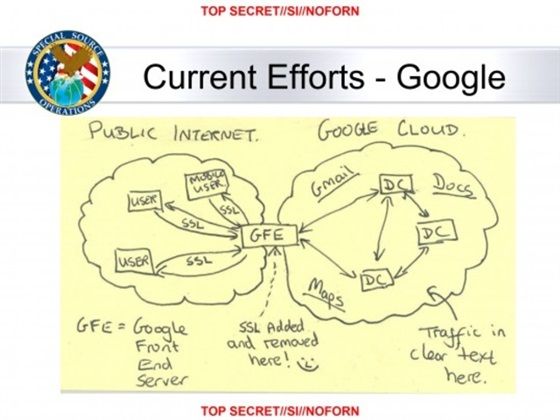
current-efforts-google

Robert X. Cringely writes: The latest Edward Snowden bombshell that the National Security Agency has been hacking foreign Google and Yahoo data centers is particularly disturbing. Plenty has been written about it so I normally wouldn’t comment except that the general press has, I think, too shallow an understanding of the technology involved. The hack is even more insidious than they know.

The superficial story is in the NSA slide (above) that you’ve probably seen already. The major point being that somehow the NSA — probably through the GCHQ in Britain — is grabbing virtually all Google non-spider web traffic from the Google Front End Servers, because that’s where the SSL encryption is decoded.

Yahoo has no such encryption.

The major point being missed, I think, by the general press is how the Google File System and Yahoo’s Hadoop Distributed File System play into this story. Both of these Big Data file systems are functionally similar. Google refers to its data as being in chunks while Hadoop refers to blocks of data, but they are really similar — large flat databases that are replicated and continuously updated in many locations across the application and across the globe so the exact same data can be searched more or less locally from anywhere on Earth, maintaining at all costs what’s called data coherency.

Data replication, which is there for reasons of both performance and fault tolerance, means that when the GCHQ in London is accessing the Google data center there, they have access to all Google data, not just Google’s UK data or Google’s European data. All Google data for all users no matter where they are is reachable through any Google data center anywhere, thanks to the Google File System.

This knocks a huge hole in the legal safe harbor the NSA has been relying on in its use of data acquired overseas, which assumes that overseas data primarily concerns non-U.S. citizens who aren’t protected by U.S. privacy laws or the FISA Court. The artifice is that by GCHQ grabbing data for the NSA and the NSA presumably grabbing data for GCHQ, both agencies can comply with domestic laws and technically aren’t spying on their own citizens when in fact that’s exactly what they have been doing. [Continue reading…]

Facebooktwittermail

Google’s Eric Schmidt lambasts NSA over spying

The Wall Street Journal reports: Google Inc. Executive Chairman Eric Schmidt slammed reports that the U.S. government allegedly spied on the company’s data centers, describing such an act as “outrageous” and potentially illegal if proven.

“It’s really outrageous that the National Security Agency was looking between the Google data centers, if that’s true. The steps that the organization was willing to do without good judgment to pursue its mission and potentially violate people’s privacy, it’s not OK,” Mr. Schmidt told The Wall Street Journal in an interview. “The Snowden revelations have assisted us in understanding that it’s perfectly possible that there are more revelations to come.”

Mr. Schmidt said Google had registered complaints with the NSA, as well as President Barack Obama and members of the U.S. Congress.

“The NSA allegedly collected the phone records of 320 million people in order to identify roughly 300 people who might be a risk. It’s just bad public policy…and perhaps illegal,” he said.

When contacted Monday, the NSA referred to its statement last week that said recent press articles about the agency’s collection had misstated facts and mischaracterized the NSA’s activities. [Continue reading…]

Facebooktwittermail