
Author Archives: News Sources

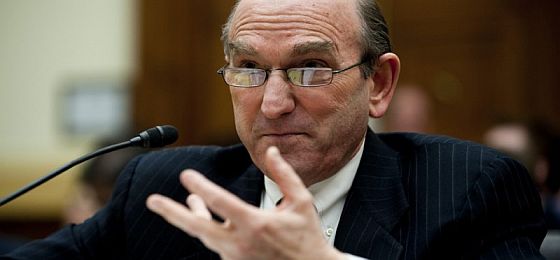
Can Elliott Abrams be stopped?

Jordan Michael Smith reports: Though secretary of defense nominee Chuck Hagel’s confirmation hearings were bruising, thanks to aggressive questioning from Sens. John McCain and Lindsey Graham, it could have been worse. His staunchest critic was absent.

More than anyone else, it is Elliott Abrams who has questioned the former Nebraska senator’s qualifications and character. Abrams twice called Hagel an outright anti-Semite, a smear other neoconservatives hinted at but couldn’t bring themselves to utter. So outrageous was Abrams’ slur that the head of the Council on Foreign Relations, where Abrams is a senior fellow, publicly criticized it.

Neoconservatives deploy baseless accusations of anti-Semitism as frequently as they indulge in nepotism, of course. But that Abrams has, once more, pushed himself to the center of a foreign policy debate is remarkable: The man is, after all, a convicted criminal. And yet, not only was Abrams exempt from serving prison time for his misconduct — he was later pardoned by President George H.W. Bush, in the days after his loss to Bill Clinton — but he has since been fully accepted back into the highest echelons of the Republican foreign-policy community. Abrams’ bizarre reincarnation as a pseudo-statesman shows that even committing crimes counts as insufficient to merit excommunication from government service.

Abrams seems cooked from a neoconservative recipe. Born to a Jewish New York home, he was once a reliable Democrat. He opposed the Vietnam War and criticized police handling of student protesters in the 1960s. But he rejected the counterculture and began writing for Commentary and the Public Interest, magazines themselves alienated from the New Left and on a trajectory from left to right. He joined the staff of hawkish Washington Sen. Henry “Scoop” Jackson, a key influence on so many neocons, from Abrams to Paul Wolfowitz to Richard Perle, and later went to work in New York Sen. Daniel Patrick Moynihan’s office.

1980 was a big year for Abrams. He married the daughter of Norman Podhoretz, the longtime Commentary editor before his son succeeded him. And he joined Democrats for Reagan, having been disgusted by Jimmy Carter’s foreign policy and personally offended by being shut out of Carter’s government. “Carter never had a human rights philosophy except that the U.S. was generally a bad place going around the world doing bad things,” he complained to a reporter. Abrams was tapped for the innocuous-sounding post of assistant secretary of state for international organization — but there was nothing innocuous about Abrams. [Continue reading…]


Facebooktwittermail

Victim of Egyptian police torture says ‘officers were helping me’

Al Ahram reports: Hamada Saber, the man who was dragged and beaten by Central Security Forces (CSF) as recorded on a video aired by Al-Hayat satellite TV on Friday night, told prosecutors on Saturday that protesters and not security forces “initiated” the assault against him, according to a report on Ahram Arabic news website.

The one-and-a-half minute video that shocked Egypt and the world showed an unarmed, naked Saber repeatedly kicked by police officers, dragged on the asphalt and beaten with batons as CSF officers battled anti-Morsi protesters in the vicinity of the presidential Palace on Friday night.

Speaking from a police hospital where he is recieving medical treatment, the 50 year old house-painter told investigators that the CSF officers protected him, adding that “the ministry of interior is standing by my side and they are providing me with medical care.”

However, late on Friday night, in a phone call also to ONTV, Reda Sobhi, Saber’s nephew, had condemned the police attack on his uncle saying Saber was peacefully attending the protest with his wife and children.

“God is our only saviour,” Sobhi told the Satellite channel ONTV in desperation saying he and lawyers failed to locate his uncle’s whereabouts in the hours after the video of the assault was aired as police declined to give them exact information of where they took Saber.

However, in a shocking turnaround of events on Saturday, Saber and his wife, speaking from the same police hospital the CSF transferred Saber to in the wake of their assault on him, seemed to blame the protesters for the bulk of the suffering he was subjected to on the previous night.

“I was standing at Roxy Square [near the palace] drinking a soda, when a large number of protesters who mistook me for a CSF officer because of my black attire attacked me and stripped me of my clothes,” said Saber.

“The protesters were angered by the fact that I tried to dissuade them from firing bird shots at the police,” claimed Saber.

Fathya, the assaulted man’s wife who was by his bedside at the police hospital, sent a message of gratitude to the ministry of interior.

“The police are very respectful and are standing by our side, and the minister’s assistant for human rights has passed by and will come again tomorrow [Saturday],” Fathya told ONTV.

Moreover, on Saturday night, Saber, told state TV that he was caught in the fight between protesters and the police.

“The protesters fired an unknown bullet at me and robbed me. When I saw the CSF soldiers coming at the crowd, I was scared and I ran. The soldiers chased after me yelling they wanted to help me. When I fell, they caught me and said: ‘you gave us a hard time, man.'”

Police and presidency conduct immediate damage control

Immediately after the gruesome assault video hit channels and social media outlets worldwide on Friday night, the ministry of interior issued a statement condemning the attack, and vowed to open an immediate inquiry.

As the Minister of Interior Mohamed Ibrahim faced angry calls for him to resign, the statement assured the public that “the ministry rejects the involvement of its officers in such assaults which affect the relationship between the people and the police.”

As many activists held President Morsi politically responsible for the assault on Saber because of his publicly stated, unconditional support for police actions against protesters, the presidency also issued a statement condemning the assault.

Facebooktwittermail

Egypt protests galvanised by video of police beating naked man

The Guardian reports: A video of a protester being beaten and stripped naked has galvanised protests against the police and government in Egypt.

Hamada Saber, a middle-aged man, remained in a police hospital on Saturday, the morning after he was shown on television, dragged over naked tarmac and beaten by half a dozen policemen who had pulled him to an armoured vehicle near the presidential palace.

President Mohamed Morsi’s office promised an investigation into the incident, which followed the deadliest wave of bloodshed of his seven-month rule. His opponents say it proves that he has chosen to order a brutal crackdown like that carried out by Hosni Mubarak against the uprising that toppled him in 2011.

Another protester was shot dead on Friday and more than 100 were injured, many seriously, after running battles between police and demonstrators who attacked the palace with petrol bombs.

That unrest followed eight days of violence that saw dozens of protesters killed in the Suez Canal city of Port Said and Morsi respond by declaring a curfew and state of emergency there and in two other cities.

“Stripping naked and dragging an Egyptian is a crime that shows the excessive violence of the security forces and the continuation of its repressive practices – a crime for which the president and his interior minister are responsible,” the liberal politician Amr Hamzawy said on Twitter.

The incident recalled the beating of a woman by riot police on Tahrir Square in December 2011. Images of her being dragged and stomped on – her black abaya cloak torn open to reveal her naked torso and blue bra – became a rallying symbol for the revolution and undermined the interim military rulers who held power between Mubarak’s fall and Morsi’s rise.

Facebooktwittermail

Exposing the myths of America’s shadow war

Dr. Loch K. Johnson writes: The United States faces a world of constantly shifting circumstances, as underscored by the Arab Spring uprisings. To shield the nation in a global setting where uncertainty and hostilities are commonplace, officials in Washington have crafted a range of responses to international events that includes diplomacy and the use of armed force. The most hidden and least understood of these responses is covert action — a tightly held operational secret in the U.S. government. This secrecy has yielded several myths that have misled the American people about a controversial, and sometimes lethal, approach to foreign policy.

MYTH #1: The meaning of covert action is clearly delineated.

With the Intelligence Authorization Act of 1991, the government did craft a formal statutory definition of covert action as “an activity or activities of the United States government to influence political, economic, or military conditions abroad, where it is intended that the role of the United State Government will not be apparent or acknowledged publicly.” Put simply, covert action attempts to influence world events through the secret use of propaganda, political, economic, and paramilitary activities. The concept of “secret influence” is spongy, though, and can blur the distinction between activities carried out by the Central Intelligence Agency (CIA) or by the military. Take the training of foreign covert forces by U.S. Special Operations Forces. The SOF consists of soldiers out of uniform, acting on an unacknowledged basis — precisely the kind of operation engaged in by the CIA. By calling such activities “traditional military operations,” the Pentagon is able to sidestep the legal procedures for reporting covert actions to Congress.

MYTH #2: Covert action offers a quiet approach to America’s foreign relations.

An appealing aspect of covert action is the promise that it may allow the United States to address vexing problems overseas in a quiet manner. Indeed, one of the euphemisms for covert action is “the quiet option.” Yet consider such CIA operations as the failed attempt in 1961 to overthrow the Castro regime with an invasion of Cuba at the Bay of Pigs; or the use of mines to blow up shipping in Nicaraguan harbors during the Reagan administration. Nothing quiet about these “secret” activities. Today drones can fly silently, but there is nothing quiet about the explosions of Hellfire missiles as they strike targets on the ground. [Continue reading…]

Facebooktwittermail

Israel: Iran slowing nuclear program, won’t have bomb before 2015 or 2016

McClatchy reports: Israeli intelligence officials now estimate that Iran won’t be able to build a nuclear weapon before 2015 or 2016, pushing back by several years previous assessments of Iran’s nuclear ambitions.

Intelligence briefings given to McClatchy over the last two months have confirmed that various officials across Israel’s military and political echelons now think it’s unrealistic that Iran could develop a nuclear weapons arsenal before 2015. Others pushed the date back even further, to the winter of 2016.

“Previous assessments were built on a set of data that has since shifted,” said one Israeli intelligence officer, who spoke to McClatchy only on the condition that he not be identified. He said that in addition to a series of “mishaps” that interrupted work at Iran’s nuclear facilities, Iranian officials appeared to have slowed the program on their own.

“We can’t attribute the delays in Iran’s nuclear program to accidents and sabotage alone,” he said. “There has not been the run towards a nuclear bomb that some people feared. There is a deliberate slowing on their end.” [Continue reading…]

Facebooktwittermail

Over $1 million spent on anti-Hagel advertising

Eli Clifton reports: While the Sunlight Foundation estimates the ad blitz by anti-Hagel astroturf at over $100,000, research by Lobe Log suggests that the actual total probably exceeds $1 million.

Sunlight based its conclusions on FCC-required disclosures on ad buys by two groups who hide their donors’ identities: Americans for a Strong Defense and Use Your Mandate. But that barely scratches the surface of the anonymously funded media campaign aimed against Hagel’s nomination as the next secretary of defense.

Anti-Hagel advertising — including tv and newspaper ads, website banner ads, and direct mailing — paid for by the American Future Fund (AFF), the Emergency Committee for Israel (ECI), Log Cabin Republicans, and Use Your Mandate brings the estimated total to over $1 million, according to Lobe Log’s research. [Continue reading…]

Facebooktwittermail

U.S.-Israeli exceptionalism: above the law

Rami G Khouri writes: For anyone who wonders why so many people around the world criticize American and Israeli foreign policy and militarism, this has been a valuable learning week. I refer to the U.S. Senate Foreign Relations Committee hearings on Chuck Hagel’s nomination to be the next U.S. defense secretary, and the twin Israeli attacks against military targets in Syria.

The juxtaposition of these two events clarifies again two core trends in American and Israeli foreign policy: their insistence that they are above international law and can use their military anytime, anywhere in the world, if they feel this serves their security interests, regardless of the credibility of the evidence to justify their attacks; and, the unwritten rule that American policies in the Middle East should conform above all else to the dictates of Israel, before considering the interests of the U.S. itself or the nearly 600 million other people who live in the Middle East.

My gut reaction to watching some of the Hagel confirmation hearings is to thank the American Founding Fathers for implementing the doctrine of the separation of powers and checks-and-balances among the different branches of government. For if some of the ideological zealots, intellectual wrecks, and pro-Israel songbirds who sit on the Senate foreign relations committee were ever to assume executive power, the world would be a much more violent and dangerous place. [Continue reading…]

Facebooktwittermail

Is Israel heading towards yet another war?

Following an Israeli strike on Syria this week, the Wall Street Journal reports: Inside Syria, rebels and members of the opposition pointed to the lack of an immediate retaliatory strike as proof that the Syrian regime is impotent against enemies even as it is quick to target its own people.

“It’s a disgrace when Israeli war planes attack Syria and your jets have no other job but to attack bakeries, mosques, universities and civilians,” Mouaz al-Khatib, head of the Western-backed Syrian opposition umbrella group known as the National Coalition, wrote Thursday on his Facebook account, addressing President Bashar al-Assad.

On Wednesday, Mr. Khatib said he was willing to start a dialogue with representatives of the Syrian regime provided it releases 160,000 opposition detainees, prompting a sharp rebuke from other members of the coalition.

Most members of the Syrian opposition consider Hezbollah and Iran accomplices in the suppression of their quest to topple Mr. Assad. On the ground Thursday, clashes raged on the outskirts of Damascus, the northern city of Aleppo and other flash points around Syria as the regime continued to use heavy artillery and aerial bombardment, according to residents and opposition activists.

Iran’s Foreign Minister Ali Akbar Salehi condemned the attack on Syria, calling it a blatant violation of sovereignty. Mr. Salehi’s deputy announced Tehran would give Syria a $200 million aid package that included funds to rebuild a damaged electrical plant and hospital, according to Iranian state media.

In an analysis, Fars News Agency, which is affiliated with Iran’s Revolutionary Guard Corps and is considered a mouthpiece for the group’s views, said Israel’s military strike had several goals, among them weakening Syria’s military and weapons stocks, demoralizing Syria’s army and preparing public opinion for foreign military intervention in Syria. The agency suggested that the best way to retaliate against Israel would be to better arm and fund Hezbollah in Lebanon.

There was little apparent anxiety in Israel a day after the attack. The prevailing view in Israel, as well as among many regional analysts, is that Syria and its allies currently have no stomach for an open conflict with the Jewish state.

“Syria is in a process of disintegration. It can’t afford to escalate with Israel, because Israel is capable of destroying a large part of the military in a short time, and it will make the job of the rebels easier,” said Shlomo Brom, a fellow at Tel Aviv University’s Institute for National Strategic Studies and a former senior military planner.

“It is difficult for Hezbollah to respond in an open way,” he continued. “They are weaker. They moved from a situation in which they were adored by the Arab states, to a situation in which they are the bad guys because they are cooperating with those who are oppressing the people,” he said, referring to Hezbollah’s ties to Mr. Assad.

But Israel shouldn’t risk a strategically costly entanglement in Syria’s civil war for a tactical goal of blocking weapons transfers, cautioned Guy Bechor, head of the Middle East department at the Herzliya Interdisciplinary Center. He said Israel should continue to watch from the sidelines, like most foreign powers, while its enemy is embroiled in a debilitating internal conflict.

“This is not our war,” he told Israel Radio. “We’ve sat on the sidelines for two years. No one else is intervening, so why are we?”

AFP adds: There was still no official Israeli comment on Syrian claims that Israeli warplanes bombed a military site near Damascus on Wednesday or on separate reports that its aircraft struck a weapons convoy along the Syria-Lebanon border.

[Israeli] Newspapers, however, seemed to have little doubt on what had happened or the likely consequences.

“Complete restraint over the long term to Israel’s actions could be considered weakness by Hezbollah, so we should expect some form of response, even if not immediately and not necessarily a broad rocket and missile attack on Israel,” defence commentator Amos Harel wrote in the left-leaning Haaretz daily.

“The Hezbollah convoy, which according to foreign reports was attacked from the air while travelling from Syria to the Bekaa Valley in Lebanon, laden with explosives, will not be the last,” Nahum Barnea wrote in Yediot Aharonot.

“It would seem, from a pessimistic view, that we are on the way to a military confrontation on at least one of the two northern fronts,” he added, referring to Israel’s borders with Syria and Lebanon.

Facebooktwittermail

Syria: how we can end the bloodshed

Jonathan Steele writes: The motives behind Israel’s attack on Syria on Wednesday are still as obscure as the nature of the target. But two things seem clear. It was related to Israel’s long war with Hezbollah in Lebanon rather than any desire to intervene in the fighting in Syria. Yet the attack was also a reminder that Syria’s turmoil is having dangerously unpredictable consequences across the region.

Finding a viable political solution is therefore all the more urgent. So it was good to hear that Moaz al-Khatib, who leads the Syrian National Coalition – the group of exiles who support armed intervention against the Syrian government and are backed by western and Gulf Arab states – now advocates talks with Basher al-Assad’s people. This is not the view of French, British and US leaders or most of Khatib’s Syrian colleagues, who talk vaguely of a political outcome but only mean Assad’s unilateral surrender.

Their unrealistic line was on display again on Monday, when France hosted the so-called Friends of Syria. Its analysis was gloomy. State institutions are collapsing, Islamist groups are gaining ground, more and more Syrians are dying, and there is no breakthrough in sight. “We cannot let a revolution that started as a peaceful and democratic protest degenerate into a conflict of militias,” said Laurent Fabius, the French foreign minister, even as he talked of more aid on the battlefield.

Several civic groups that reject the armed struggle were equally pessimistic at a meeting in Geneva. Theirs is the voice of Syria’s secular intelligentsia, who oppose foreign military intervention and favour a ceasefire and a negotiated solution on the lines that Lakhdar Brahimi, the UN/Arab League mediator, is trying to broker. Because they do not support the western line, they tend to be ignored by foreign politicians. [Continue reading…]

Facebooktwittermail

John Kerry and the restraint of American power in U.S. foreign policy

Stephen Kinzer writes: In some parts of the world, especially in the volatile region that stretches from the Persian Gulf to Central Asia, [newly confirmed Secretary of State, John] Kerry is already a familiar figure in the corridors of power. He has also established an evidently strong working relationship with Obama. Even the fact that his friends in the Senate brutally crushed his main rival for the job, Susan Rice, who is one of Obama’s close and trusted advisers, was not enough to sour the president on his nomination.

One fundamental aspect of American foreign policy making will not change as Kerry takes over the job Hillary Clinton has held for the last four years. Major policy decisions will be made in the White House, not at the State Department – and the secretary of state may not even be in the room when they are made.

Nonetheless, Kerry will be a key figure as the United States confronts the crises of the moment. His most encouraging credential is that he truly believes diplomacy is preferable to war – hardly a unanimous view in Washington. Whether this will result in a serious change in America’s approach to the world, however, is far from certain.

The first test will be Iran. Kerry is less prone than some others in Washington to throw around threats about war being an option that is “on the table”, and it is hard to imagine him blithely reminding Iranians, as Clinton did, that the United States has the power “to totally obliterate them”. Yet, the essence of American policy toward Iran – shaped around threats, sanctions, and demands that Iran submit to western power without expecting much in return – is unlikely to change.

Kerry will also be unable, and quite possibly unwilling, to rein in the ever-expanding US drone war, which is not run by the State Department but feeds the anti-Americanism that will make his job ever more difficult. Nor is there much prospect that he will be able to calm the fundamentalist radicalism that is surging through Egypt, Syria, and Israel.

The area in which Kerry may be able to have the greatest impact is redefining the meaning of national security for Americans. He recognizes that the main threats to the United States no longer come from foreign armies or what George W Bush liked to call “evil-doers”. His most encouraging statements are those that suggest he recognizes the enormous security challenges posed by climate change, global energy politics, and economic troubles at home. [Continue reading…]

Facebooktwittermail

Milan appeals court convicts 3 Americans in CIA kidnap case, throwing out earlier acquittals

The Associated Press reports: A Milan appeals court on Friday vacated acquittals for a former CIA station chief and two other Americans, and instead convicted them in the 2003 abduction of an Egyptian terror suspect from a Milan street as part of the CIA’s extraordinary rendition program.

The appeals court sentenced former CIA Rome station chief Jeffrey Castelli to seven years, and handed sentences of six years each to Americans Betnie Medero and Ralph Russomando. All three were tried in absentia at both levels. A lower court that convicted 23 other Americans in 2009 had previously acquitted the three citing diplomatic immunity.

The November 2009 convictions, which were held up on two levels of appeal, were the first anywhere in the world against CIA actors involved in a practice alleged to have led to torture.

None of the Americans tried in Italy have ever been in Italian custody, but they risk arrest if they travel to Europe and lawyers have in the past suggested that final verdicts would open the way for the Italian government to seek their extradition. No such action has yet been taken.

Facebooktwittermail

Tahrir Square: Where some people demand dignity for themselves even as they violently strip it from others

Last Sunday, Tom Dale, Egypt Independent‘s news editor, wrote: A woman was sexually assaulted with a bladed weapon on Friday night, leaving cuts on her genitals, in central Cairo, in the midst of what was purportedly a revolutionary demonstration.

Read that line over again a few times, and think on it.

If you have any more room in your mind for horror after the past 24 hours: After the deliverance of death sentences to 21 civilian fans of the Port Said football club (themselves accused of brutal crimes), after stadiums full of other fans cheered those same death sentences in Cairo, after the death toll in the resultant clashes surpassed 30, then keep thinking on it.

She was one among at least 19 women sexually assaulted in and around Tahrir Square on Friday night, according to accounts collated by Operation Anti-Sexual Harassment, an activist group. Several women were stripped, and raped, publicly, as men pushed their fingers inside them. There were other attacks involving bladed weapons. Six women required medical attention. No doubt there were more assaults, uncounted.

One brave survivor of such an attack last November published her story on the website of the Nazra feminist group.

“All that I knew was that there were hundreds of hands stripping me of my clothes and brutally violating my body. There is no way out, for everyone is saying that they are protecting and saving me, but all I felt from the circles close to me, sticking to my body, was the finger-rape of my body, from the front and back; someone was even trying to kiss me… I was completely naked, pushed by the mass surrounding me to an alley close to Hardee’s restaurant … I am in the middle of this tightly knit circle. Every time I tried to scream, to defend myself, to call on a savior, they increased their violence,” she wrote.

At 6 pm last Friday (25 January) I was walking in the square, in the area where the large stage normally is, just as dark was falling, when I saw another such incident.

Perhaps 30 meters away, an eddy in the crowd had formed, with a woman of perhaps 40, apparently Egyptian, at its center. Concentric rings of men swirled around her as she screamed. I tried to get close to her, pushing my way through.

The crowd around her eventually moved her to the green railings, as she continued to scream. I was just a few meters away when she disappeared from view, pushed to the floor. When I regained sight of her, she had been stripped naked, and the terror was visible on her face.

As I pushed forward it was all but impossible to work out who was part of the assault, and who was trying to help. Many claimed to be trying to help, only to become part of the attack.

I identified one young man who was certainly an attacker, grabbed him, and pulled him back. He turned to me; I expected a punch, or at least a snarl. Instead he just grinned.

At one point, her naked body was folded face forward over the green railings which divide the pavements of the square from the road.

I lost sight of her again, believed she had been pulled over the railings, and went to make my way round to the other side. I don’t know if I was mistaken, or how or why she ended up going back, but when I saw her again she was on the tarmac, finally being defended by two or three large guys using belts as whips. An ambulance eventually made its way to her, through the crowd, and she was bundled in.

As I walked away, a few people asked me what had happened: I told them, “sexual assault, very ugly, very serious.” Each time, someone chipped in to deny what had happened just a few meters away.

If evidence were needed, five minutes later it began again a few dozen meters away, the whorl, the scream, the fingers pushing. This time, a few of us managed to get one woman away, a girl in her teens, but she had been separated from her mum, and was sobbing uncontrollably.

We hid by a kiosk to try and calm her but the kiosk owners asked us to leave because we were blocking the refrigerator. Eventually, she ended up hidden behind the metal shutter of a restaurant, still without her mum.

It is neither my place nor my wish to draw conclusions about “the revolution” from all this: I do not believe that is possible or wise. But I can say that as the familiar chants resonated in the square, the demands for justice, a new government and new constitution, I felt a little sick. Tahrir Square and its environs are not just a revolutionary space, they are also the terrain of brutal sexual assault.

It is both a place in which people both demand dignity for themselves and, in some cases, violently strip it from others. [Continue reading…]

Facebooktwittermail

Rights allegations in Mali cloud visit by France’s Hollande

Reuters reports: Human rights groups said on Friday a French-led offensive against Islamists in Mali had led to civilian deaths in airstrikes and ethnic reprisals by Malian troops, a day before President Francois Hollande was due to visit the country.

France has deployed more than 3,500 ground forces in a lightning three-week campaign that has wrested control of northern Mali’s towns from an al Qaeda-linked alliance.

The aim is to prevent the Islamist fighters from using Mali’s ungoverned desert north to launch attacks in neighboring African countries and the West.

Residents in the ancient caravan town of Timbuktu have greeted their liberation by French troops with joy, after Islamist radicals had destroyed the town’s sacred Sufi mausoleums, burned ancient manuscripts and imposed a harsh form of sharia law, including whippings and amputations.

Amnesty International and Human Rights Watch, however, cited eyewitness reports of extrajudicial killings by Malian government soldiers of dozens of civilians in the central towns of Sevare and Konna.

They said the troops targeted light-skinned Arab and Tuareg ethnic groups associated with the rebels. The Malian military has denied any reprisal killings by its soldiers and the government in Bamako has publicly warned against revenge attacks.

Facebooktwittermail

Sexual violence in Mali casts shadow over peace efforts

Bloomberg reports: Rebels who had conquered northern Mali offered to pay the equivalent of $14 for a 13-year-old girl. When her family said no, they took her anyway.

A week later, she died in captivity, after she was repeatedly raped by a group of armed men.

That incident in April is one of hundreds of documented cases compiled by the United Nations in the past year that shed light on the sexual violence unleashed by insurgents — mostly Touareg separatists rather than al-Qaeda-linked Islamists — during their occupation of a sparsely populated and inhospitable Mali region the size of Texas.

Nine months later, the rebels have melted away into the desert as French intervention troops advance. For the women of the farming and cattle-herding communities, the prospect is that yet another peace deal will ignore the record of rape used as a weapon of war.

“The question of sexual violence is not treated as an urgent question, unfortunately,” Hannah Armstrong, an analyst on security in West Africa. The same Touareg fighters now clamoring for negotiations “carried out raid-style attacks during which animals were stolen, slave-caste women raped repeatedly,” she said in an interview in Bamako, the Malian capital.

A total of 211 cases of sexual violence — including gang rape, sexual slavery, forced marriages and torture — were committed during house-to-house operations or at checkpoints during 2012, according to the Office of the UN Special Representative on Sexual Violence in Conflict. [Continue reading…]

Facebooktwittermail

Historic Timbuktu texts saved from burning

The Wall Street Journal reports: French tanks were closing in on this storied caravan city on the night of Jan. 23, when the al Qaeda-backed militants who had governed Timbuktu since April left a departing blow. They broke into one of the world’s most valuable libraries, ripping centuries-old manuscripts from shelves.

Then they torched these priceless artifacts, in a scene of destruction that horrified scholars around the world.

But in a relief for this beleaguered city, and in a triumph for bibliophiles, the vast bulk of the library was saved by wily librarians and a security guard—with an assist from modern technology.

An estimated 28,000 of the library’s artifacts were smuggled out of town by donkey cart, said Prof. Abdoulaye Cissé and security guard Abba Alhadi, who worked to relocate the documents. Gunmen managed to burn only a few hundred papers, but even those were backed up digitally, said the library’s bookkeepers.

“We knew that what we had here was threatened,” said Mr. Cissé, a history professor and acting director for Timbuktu’s Ahmed Baba Institute for Higher Studies and Islamic Research. “So I said, ‘We’re going to have to start moving them out.’ ”

The rescue mission for some of Africa’s most precious written history represents the latest example of Timbuktu’s collective determination to preserve its heritage, amid a long line of threats to these irreplaceable artifacts. Aside from its 14th-century mud mosques, and a fabled name, Timbuktu houses at least 100,000 ancient manuscripts that date from the 11th century, and account for some of the medieval world’s most sophisticated scholarship. Subjects include medicine, law, astronomy and botany.

Still, the treasures of Timbuktu have been looted and smashed by a succession of invading armies, the most recent being al Qaeda in the Islamic Maghreb, or AQIM. [Continue reading…]

Facebooktwittermail

Israel must withdraw all settlers or face International Criminal Court, says UN report

The Guardian reports: Israel must withdraw all settlers from the West Bank or potentially face a case at the international criminal court (ICC) for serious violations of international law, says a report by a United Nations agency that was immediately dismissed in Jerusalem as “counterproductive and unfortunate”.

All settlement activity in occupied territory must cease “without preconditions” and Israel “must immediately initiate a process of withdrawal of all settlers”, said the UN Human Rights Council (UNHRC). Israel, it said, was in violation of article 49 of the fourth Geneva convention, which forbids the transfer of civilian populations to occupied territory.

The settlements were “leading to a creeping annexation that prevents the establishment of a contiguous and viable Palestinian state and undermines the right of the Palestinian people to self-determination,” it said.

The UNHRC report broadly restated international consensus on the illegality of Israeli settlements. But its conclusions are likely to bolster the Palestinians following their admission last November to the UN as a non-member state, which potentially gives them recourse to the ICC. [Continue reading…]

Facebooktwittermail