The Associated Press reports: Israel is considering resuming its contentious practice of assassinating militant leaders in the Hamas-ruled Gaza Strip in an effort to halt intensified rocket attacks on Israel’s south, according to defense officials.
That Israel might renew a practice that brought it harsh international censure is evidence of the tight spot Prime Minister Benjamin Netanyahu is in. With Israeli elections two months away, rocket barrages from Gaza are disrupting the lives of 1 million residents of southern Israel, pressuring the government to come up with an effective response.
In the latest flare-up, Gaza militants have fired more than 100 rockets at Israel in recent days, triggering retaliatory Israeli airstrikes that have killed six people in Gaza.
Some Israelis are demanding a harsh military move, perhaps a repeat of Israel’s bruising incursion into Gaza four years ago. Others believe Israel should target Hamas leaders, a method it used to kill dozens of militants nearly a decade ago. [Continue reading…]
Author Archives: News Sources
Video: Probing Yasser Arafat’s death
Afghanistan seeks India’s help as West pullout nears
Reuters reports: India will step up training of the Afghan police and military after a request on Monday by President Hamid Karzai, who also urged Indian businesses to invest in his battle-weary nation as it gears up for the departure of NATO troops.
The extra help is likely to be welcomed by the United States, which sees India as a stabilizing power in South Asia. But it may unnerve Pakistan, which frets about losing influence in neighboring Afghanistan.
“We do want to expand that as required and wished by Afghanistan. We will respond,” said India’s Foreign Minister Salman Khurshid when asked about the security program following a lecture given by the Afghan president in New Delhi.
In June, U.S. Secretary of Defense Leon Panetta called on India to do more to support both the Afghan economy and security forces as Western nations prepare to end their combat missions there in 2014.
Al Jazeera reports: The European Union has announced that it is suspending $25million in aid for Afghanistan, warning that aid will be increasingly conditional on the government sticking to agreed reforms.
Payment of the $25 million aimed at reforming the justice system was deferred because of a lack of progress on the issue, EU ambassador Vygaudas Usackas said on Monday.
Usackas was speaking at the signing of a $76 million financing agreement on “efficient and effective governance” and “justice for all” with Afghan Finance Minister Omar Zakhiwal.
“If the European Union is deeply committed in supporting Afghanistan, it needs to stress that in the spirit of the Tokyo agreement, support will be increasingly conditional of the delivery of the Afghan government on the agreed reform agenda,” Usackas said.

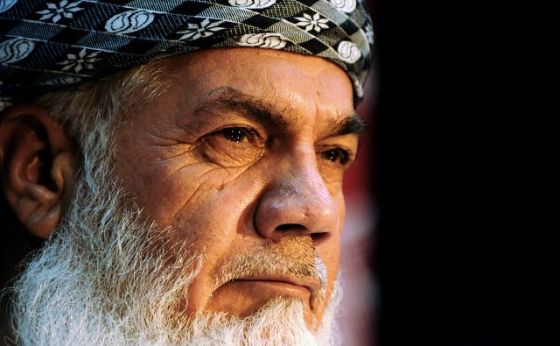
Ismail Khan
Meanwhile, the New York Times reports: One of the most powerful mujahedeen commanders in Afghanistan, Ismail Khan, is calling on his followers to reorganize and defend the country against the Taliban as Western militaries withdraw, in a public demonstration of faltering confidence in the national government and the Western-built Afghan National Army.
Mr. Khan is one of the strongest of a group of warlords who defined the country’s recent history in battling the Soviets, the Taliban and one another, and who then were brought into President Hamid Karzai’s cabinet as a symbol of unity. Now, in announcing that he is remobilizing his forces, Mr. Khan has rankled Afghan officials and stoked fears that other regional and factional leaders will follow suit and rearm, weakening support for the government and increasing the likelihood of civil war.
This month, Mr. Khan rallied thousands of his supporters in the desert outside Herat, the cultured western provincial capital and the center of his power base, urging them to coordinate and reactivate their networks. And he has begun enlisting new recruits and organizing district command structures.
“We are responsible for maintaining security in our country and not letting Afghanistan be destroyed again,” Mr. Khan, the minister of energy and water, said at a news conference over the weekend at his office in Kabul. But after facing criticism, he took care not to frame his action as defying the government: “There are parts of the country where the government forces cannot operate, and in such areas the locals should step forward, take arms and defend the country.”
President Karzai and his aides, however, were not greeting it as an altruistic gesture. The governor of Herat Province called Mr. Khan’s reorganization an illegal challenge to the national security forces. And Mr. Karzai’s spokesman, Aimal Faizi, tersely criticized Mr. Khan.
“The remarks by Ismail Khan do not reflect the policies of the Afghan government,” Mr. Faizi said. “The government of Afghanistan and the Afghan people do not want any irresponsible armed grouping outside the legitimate security forces structures.”
In Kabul, Mr. Khan’s provocative actions have played out in the news media and brought a fierce reaction from some members of Parliament, who said the warlords were preparing to take advantage of the American troop withdrawal set for 2014.
“People like Ismail Khan smell blood,” Belqis Roshan, a senator from Farah Province, said in an interview. “They think that as soon as foreign forces leave Afghanistan, once again they will get the chance to start a civil war, and achieve their ominous goals of getting rich and terminating their local rivals.”
Indeed, Mr. Khan’s is not the only voice calling for a renewed alliance of the mujahedeen against the Taliban, and some of the others are just as familiar. [Continue reading…]
How Petraeus seduced America
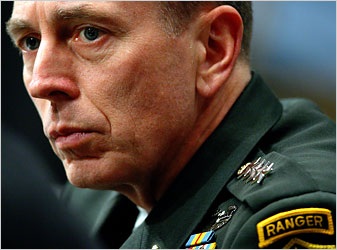
Michael Hastings writes: The fraud that General David Petraeus perpetrated on America started many years before the general seduced Paula Broadwell, a lower-ranking officer 20 years his junior, after meeting her on a campus visit to Harvard.
More so than any other leading military figure, Petraeus’ entire philosophy has been based on hiding the truth, on deception, on building a false image. “Perception” is key, he wrote in his 1987 Princeton dissertation: “What policymakers believe to have taken place in any particular case is what matters — more than what actually occurred.”
Yes, it’s not what actually happens that matters — it’s what you can convince the public it thinks happened.
Until this weekend, Petraeus had been incredibly successful in making the public think he was a man of great integrity and honor, among other things. Most of the stories written about him fall under what we hacks in the media like to call “a blow job.” Vanity Fair. The New Yorker. The New York Times. The Washington Post. Time. Newsweek. In total, all the profiles, stage-managed and controlled by the Pentagon’s multimillion dollar public relations apparatus, built up an unrealistic and superhuman myth around the general that, in the end, did not do Petraeus or the public any favors. Ironically, despite all the media fellating, our esteemed and sex-obsessed press somehow missed the actual blow job.
Before I lay out the Petraeus counter-narrative — a narrative intentionally ignored by most of the Pentagon press and national security reporters, for reasons I’ll soon explain — let me say this about the man once known as King David, General Betray-Us, or P4, by his admirers, his enemies, and his fellow service members, respectively. He’s an impressive guy, a highly motivated individual, a world-class bullshit artist, a fitness addict, and a man who spent more time in shitty places over the past 10 years than almost any other American serving his or her country has. I’ve covered him for seven years now, and he’ll always have my respect and twisted admiration.
So it’s fair to say that P4 probably deserves something a little better than the public humiliation he’s about to endure. Sources who long feared him have already begun to leak salacious details; one told me this weekend that he took Broadwell along with him on a government-funded trip to Paris in July 2011. And questions about his role in the Benghazi debacle are also likely to deepen.
And Broadwell, too, is about to get slandered in a way no woman deserves. She’s the Pentagon’s Monica Lewinksy — and, despite Team Petraeus’ much advertised lip service to courage and integrity, it didn’t take long for his allies to swarm the press with anonymous quotes smearing the West Point graduate and married mother of two: that she wore “tight clothes,” as The Washington Post reported, or that she had her “claws in him.” In other words, how could Old Dave have resisted that slut’s charms?
Pretty shitty behavior, all around. As Petraeus ally and counterinsurgency scholar Dr. Andrew Exum might put it, stay classy! [Continue reading…]
When a CIA director had scores of affairs
Stephen Kinzer writes: Walking through the lobby of the Central Intelligence Agency headquarters in Langley, Va., after handing in his resignation on Friday, David H. Petraeus passed a bas-relief sculpture of Allen Dulles, who led the agency in the 1950s and early ’60s. Below it is the motto, “His Monument Is Around Us.”
Both men ran the C.I.A. during some of its most active years, Dulles during the early cold war and Mr. Petraeus during the era of drone strikes and counterinsurgency operations. And both, it turns out, had high-profile extramarital affairs.
But private life for a C.I.A. director today is apparently quite different from what it was in the Dulles era. Mr. Petraeus resigned after admitting to a single affair; Allen Dulles had, as his sister, Eleanor, wrote later, “at least a hundred.”
Indeed, the contrast between Dulles’s story and that of Mr. Petraeus reflects how fully the life of public servants has changed in the United States.
Dulles ran the agency from 1953 to 1961, and he had a profound effect on America’s role in the cold war. Together with his brother, Secretary of State John Foster Dulles, he exercised enormous power and helped overthrow governments from Iran to Guatemala to Congo.
He was also a serial adulterer. Dulles was married in 1920, but he and his wife, Clover, had a difficult home life. She was sensitive and introverted, while he was handsome and charming — and a skilled seducer. [Continue reading…]
If Assad goes, Hezbollah will be alone in the Levant — much to the delight of Israel
Robert Fisk writes: Hezbollah was once the Lebanese “resistance”, the tough, courageous, self-sacrificing guerrilla army which drove Israel’s occupation soldiers out of Lebanon 12 years ago.
Today, it looks more like yet another Arab “security” institution – or insecurity institution – as it flies drones over Israel and continues to support, to the increasing condemnation of many Lebanese, the Syrian regime of President Bashar al-Assad.
Walid Jumblatt, the Druze leader – famous for wind-milling between Syria and its opponents – is one of several Lebanese politicians to ask why Hezbollah does not give its military and political support to the Syrian “resistance” rather than the regime it is fighting. Hezbollah is not, as the US State Department claims, fighting alongside Assad’s men: but it has assumed “security” duties on the Syrian side of the Lebanese border – effectively keeping the Lebanese-Syrian frontier out of rebel hands – and uses its formidable intelligence services in the regime’s favour. At least four Hezbollah “martyrs” have been returned from Syria for burial in Lebanon. [Continue reading…]
Iran prosecutor: Blogger died in police custody
The Associated Press reports: Iran’s state prosecutor confirmed Monday that a jailed blogger died in police custody last week and that wounds were found on his body, the first official confirmation of his death while being held.
The U.S. State Department and a press freedom group have called for investigation of the “suspicious death.”
The prosecutor’s statement came a day after Iran’s parliament announced it would probe reports on the circumstances of Sattar Beheshti’s death.
Prosecutor Gholam Hossein Mohseni Ejehi told reporters that Beheshti was detained Oct. 30 for alleged cybercrimes and taken to Evin prison in north Tehran the next day. Beheshti was handed over to cyber police for interrogation the same day, He died Nov. 3.
“The coroner’s office has provided a detailed report saying that signs of wounds were found in five places on this person’s body, including foot, hand, back and one of his thighs, but no broken bones,” the semiofficial Mehr news agency quoted Ejehi as saying.
Ejehi said a final report on the cause of Beheshti’s death may take as long as 45 days to release. He said copy of a letter of complaint in Beheshti’s name against his interrogator was found.
The semiofficial ISNA news agency quoted Ejehi as saying that Beheshti charged in the letter that he was subject to “threats, insults and beatings.”
Ejehi said Iran’s judiciary chief, Ayatollah Sadeq Larijani, has ordered a full inquiry into the death.
The government-owned Iran Network news website said three interrogators involved in the case have been arrested.
Syrian National Mess
Robin Yassin-Kassab writes: George Sabra has been elected new head of the Syrian National Council. He seems like a good man and his first interviews suggest he’s an effective talker. But his election comes as the SNC loses the last of its relevance. Despite the gravity of its historic responsibility, the Council failed to connect properly with revolutionaries on the ground, it failed to do enough to reassure minorities, or to aid refugees, it put all its eggs in the basket of a foreign military intervention which was never going to happen, it overrepresented the Muslim Brotherhood, it was bedevilled by factional and ego-based conflict, and its self-renewal process ended up with no women in the leadership. Foreign governments have lost interest in it. Crucially the grassroots Local Coordination Committes say the SNC no longer represents them. Other opposition bodies and individuals outside the SNC (some of them doubtless secretly backed by the regime) have added to the sniping and backstabbing.
Today the news is that a new, broader body has been formed to coordinate the fight against Asad, to implement law in liberated areas, and to oversee the post-Asad transition. It’s called the National Coalition of the Syrian Revolutionary Forces and the Opposition, or the Syrian National Coalition. Perhaps this initiative will be more successful than others; we’ll see. Very sadly, it took Qatari and American badgering and perhaps promises of better weaponry (at this late stage with the country in flames and the resistance finally capturing heavy weaponry for itself) to force the ‘opposition’ to coalesce. You’d think Syria’s elite politicians would have been self-motivated to compromise and act by the destruction and mass slaughter in their homeland, by the urgency of the tragedy, by the vacuum allowing nihilists and potential warlords to call shots. But no. While Syria’s grassroots revolutionaries are unparalleled heroes, seemingly capable of endless self-sacrifice, Syrian political elites have failed their people massively. [Continue reading…]
Israeli army scores ‘direct hits’ on Syrian target
Reuters reports: Israel’s army fired tank shells into Syria on Monday and scored “direct hits” in response to a Syrian mortar shell that struck the Israeli-controlled Golan Heights, the Israeli military said in a statement.
Israeli military sources said Syrian mobile artillery was directly hit in the incident.
It was the second time in two days that Israel has responded to what it said was errant Syrian fire. On Sunday the military said it had a fired a “warning shot” across the disengagement line, while on Monday it said it had fired back at “the source”.
Military sources would not say if the mortar bomb was fired by Syrian army forces or by the rebels they are battling in and around the United Nations’ patrolled area of separation.
“A short while ago, a mortar shell hit an open area in the vicinity of an (Israeli Defense Forces) post in the central Golan Heights, as part of the internal conflict inside Syria, causing no damage or injuries,” the military statement said.
“In response, IDF soldiers fired tank shells towards the source of the fire, confirming direct hits. The IDF has filed a complaint with the UN forces operating in the area, stating that fire emanating from Syria into Israel will not be tolerated and shall be responded to with severity.”
Why Israel should trade its nukes
Uri Bar-Joseph writes: On September 19, to nobody’s surprise, Shaul Chorev, the director-general of Israel’s Atomic Energy Commission, announced that his government would not attend an upcoming conference devoted to establishing a nuclear-free Middle East. The announcement reaffirmed Israel’s long-standing position that a nuclear-free zone can come about only as a consequence of a lasting regional peace. Until such a peace is achieved, Jerusalem will not take any tangible steps toward eliminating its nuclear weapons.
At least on the face of it, this stand is sensible. For 45 years, Israel has been the only nuclear power in the Middle East, enjoying a formidable strategic safety net against any existential threat. Since 1957, Israel has invested tremendous resources in building up a solid nuclear arsenal in Dimona. Today, according to various estimates, this stockpile comprises some 100–300 devices, including two-stage thermonuclear warheads and a variety of delivery systems, the most important of which are modern German-built submarines, which constitute the backbone of Israel’s second-strike capability. For Israel to give up these assets in the midst of an ongoing conflict strikes most Israelis as irrational.
This consensus, however, overlooks the fact that Israel’s nuclear capability has not played an important role in the country’s defense. Unlike other nuclear-armed states, Israel initiated its nuclear project not because of an opponent’s real or imagined nuclear capability but because of the worry that, in the long run, Arab conventional forces would outstrip the power of the Israel Defense Forces (IDF). As early as the 1950s, Israeli Prime Minister David Ben-Gurion sought to manage the threat of modernizing Arab armies, which were inspired by pan-Arab sentiment and backed by the Soviet Union, by developing the ultimate deterrent. Shimon Peres, the architect of Israel’s nuclear program and now Israel’s president, relentlessly argued in public speeches and writings that Israel needed to compensate for the large size of the Arab armies with “science” — a code word for nuclear arms.
As it turned out, however, Arab conventional superiority never materialized. Ever since Israel crossed the nuclear threshold on the eve of the 1967 war, the qualitative gap between Israel’s conventional forces and those of its Arab neighbors has only grown. Today, particularly as the Syrian army slowly disintegrates, the IDF could decisively rout any combination of Arab (and Iranian) conventional forces. This advantage, combined with the United States’ support for Israel, is what has kept Arab countries from taking up arms against the Jewish state — not the fear of nuclear retaliation. [Continue reading…]
Facebook attempts to shut down the voice of “The Uprising of Women in the Arab World”
Jadaliyya: [The following statement was issued by activists involved in The Uprising of Women in the Arab World on 7 November 2012 in response to attempts by Facebook to suppress their online activities. It was originally issued in Arabic, English, and French. This English version has been slightly edited for style. The Arabic version, along with an introduction and background to the issue, can be found on Beirut Walls.]
On the morning of 7 November 2012, the five admins of The Uprising of Women in the Arab World Facebook Page logged onto Facebook to find out that one’s account had been blocked for thirty days, another for three days, two others for twenty-four hours, and one other received a warning notification.
According to Facebook, those persons had violated its policy by sharing a post asking Twitter followers to support Dana Bakdounes. The message that was sent to the admins explaining the reasoning for the ban from Facebook read as follows: “You have posted a content that violates Facebook Community Rules. The post says: Follow us on Twitter @UprisingOFWomen. Support Dana with hashtag #WindToDana”
Dana Bakdounes is one of the hundreds of women and men who participated in the Uprising of Women in the Arab World campaign, holding a sign expressing the reason why they support this uprising. Dana’s slogan stated: “I am with the uprising of women in the Arab world because for twenty years I was not allowed to feel the wind in my hair and on my body.” Her picture showed an unveiled woman carrying her passport with a picture of when she was veiled.
Dana’s picture was initially posted on 21 October 2012, among many other photos and statements of women and men of various religious beliefs and practices. Some women were veiled, some unveiled, some in niqab, and all were demanding women’s rights and equal enjoyment of freedom of speech, in a secular space that promotes tolerance and embraces differences. But on 25 October, Facebook chose to censor Dana’s image and to suspend the account of the admin who posted it for twenty-four hours. This incident provoked an outrage among the defenders of freedom of speech who started sharing Dana’s picture all over Facebook, Twitter, and other media outlets.
On 28 October, having been persuaded that Facebook had mistakenly taken down the photo due to abusive reports of haters of the Page, that the photo held no offensive content, as well as seeing that it was all over the web, we uploaded it again. A few hours later, Facebook removed it again and blocked another admin’s account for seven days.
However, on 31 October, Facebook restored Dana’s censored photo to The Uprising of Women in the Arab World Page without any notice or explanation. However, it did not lift the ban on the admin’s account, which ended only on 5 November.
On 7 November, all five admins of The Uprising of Women in the Arab World Page received threats by Facebook for the earlier cited reasons that their accounts may be permanently deleted. The repeated temporary blocks on the admins’ personal accounts with no clear motive or explanation constitute a direct attack on The Uprising of Women in The Arab World’s Page. It also raises serious questions about the true intentions behind Facebook’s policies and whether Dana’s “controversial” image is a mere excuse to shut down the voice of The Uprising of Women in The Arab World. [Continue reading…]
Lost to history: Missing war records complicate benefit claims by Iraq, Afghanistan veterans (part one)
By Peter Sleeth, Special to ProPublica, and Hal Bernton, The Seattle Times , November 9, 2012
A strange thing happened when Christopher DeLara filed for disability benefits after his tour in Iraq: The U.S. Army said it had no records showing he had ever been overseas.
DeLara had searing memories of his combat experiences. A friend bled to death before his eyes. He saw an insurgent shoot his commander in the head. And, most hauntingly, he recalled firing at an Iraqi boy who had attacked his convoy.
The Army said it could find no field records documenting any of these incidents.
DeLara appealed, fighting for five years before a judge accepted the testimony of an officer in his unit. By then he had divorced, was briefly homeless and had sought solace in drugs and alcohol.
DeLara’s case is part of a much larger problem that has plagued the U.S. military since the 1990 Gulf War: a failure to create and maintain the types of field records that have documented American conflicts since the Revolutionary War.
A joint investigation by ProPublica and The Seattle Times has found that the recordkeeping breakdown was especially acute in the early years of the Iraq war, when insurgents deployed improvised bombs with devastating effects on U.S. soldiers. The military has also lost or destroyed records from Afghanistan, according to officials and previously undisclosed documents.
The loss of field records — after-action write-ups, intelligence reports and other day-to-day accounts from the war zones — has far-reaching implications. It has complicated efforts by soldiers like DeLara to claim benefits. And it makes it harder for military strategists to learn the lessons from Iraq and Afghanistan, two of the nation’s most protracted wars.
Lost to history: Missing war records complicate benefit claims by Iraq, Afghanistan veterans (part two)
(Part one can be read here.)
‘They Couldn’t Find It’
Chris DeLara is not the type of soldier to wear his heart on his sleeve, but the 1st Cavalry Division’s shoulder patch is tattooed on his right forearm in a swirling piece of body art. Beneath it are the words: “Baghdad, Iraq.”
DeLara, 38, grew up in Albany, N.Y., never dreaming he might someday fight a war. Now, his tour in 2004 and 2005 haunts his every day. Since winning his appeal in March 2011, he is classified as fully disabled by post-traumatic stress and cannot work. He was awarded a stipend of about $30,000 a year and has moved near Knoxville, Tenn., where he recently bought a modest house.
Getting to a stable point wasn’t easy.
DeLara was an administrative specialist, essentially a personnel clerk. But he was repeatedly pulled out of his scrivener’s life for missions as a roof gunner on convoys. It was a time of insurgency and exploding factional violence in Baghdad.
“They told us, ‘This may be your job, but guess what? You’re going to be doing everything,'” he said. “We had many hats. You go to combat, your job is secondary. Combat is first.”
DeLara did not want to discuss his combat experiences, but they are described in part by a judge in the Board of Veterans’ Appeals ruling that approved his PTSD claim.
In the years after his deployment, DeLara told psychiatrists and others who treated him at various times that two of his friends were killed in an insurgent attack on his convoy, and that he was unable to stop one of them from bleeding to death from a ruptured artery.
He said that one his commanders was shot in the head in front of him by insurgents, and reported that he had killed an Iraqi youth who had tried to attack his convoy after it was stopped because of a roadside bomb, according to the judge’s summary.
After his return in 2005, DeLara was diagnosed several times with PTSD or its symptoms, according to VA exam records cited by the appeals judge. He drank and used drugs even though he’d abstained from them in the Army. In 2006, he overdosed on prescription drugs.
DeLara said he lived for a time in a shelter for troubled vets. He and his wife eventually divorced, but he credits her for helping him fight for his claim when he might have given up.
A global progressive agenda for Obama’s second term
Mark LeVine writes: Barack Obama’s re-election offers progressives a short window of opportunity to lay out a vision for his second term which, if deftly presented, could win broader public support, especially among the millions of young, women, and Latino voters who were crucial to his victory. Here are five issues that progressives, both in the United States and abroad, should push the President to address at the start of his second term in order to meet the so-far unfulfilled hopes for a transformative change in foreign and domestic policies that accompanied his historic political ascendance.
All five have the advantage of being issues which have the increasing attention and even support of important members of the Republican establishment in the US as well political leaders abroad and global civil society, increasing the possibility of their impacting administration policies if enough pressure can be deployed from a variety of angles in support of them.
1. Stop the drones. Drones have become Obama’s water boarding, only worse, and are the single biggest threat to US standing in the international community today. They have killed at least 176 children in Pakistan alone – that’s right, President Obama has killed sixteen times the number of children that Osama bin Laden killed on 9/11, including at least one American citizen. This number is a greater stain on the United States than the use of torture, secret renditions or Guantanamo. And the children represent only a small share of the many hundreds of civilians – perhaps as many as a thousand – who’ve been killed by US drones.
The President has directly supervised the programme, lauding its “surgical precision” even though a comprehensive report has revealed the number of high value al-Qaeda targets killed (the original purpose and still the primary justification for the programme) to be as low as two percent of the total killed. Moreover, the attacks have included patently illegal “double strikes” which have killed first responders who arrived to tend to the wounded only to themselves be blown to bits from the sky.
Even conservatives are worried about the legal and diplomatic ramifications of the drone programme, offering a unique opportunity to create a political and policy-making consensus drastically to curtail and perhaps even end their use. [Continue reading…]
Climate change: Lessons from Ronald Reagan
Cass R. Sunstein writes: The re-election of President Obama, preceded by the extraordinary damage done by Hurricane Sandy, raises a critical question: In the coming years, might it be possible for the United States to take significant steps to reduce the risks associated with climate change?
A crucial decision during Ronald Reagan’s second term suggests that the answer may well be yes. The Reagan administration was generally skeptical about costly environmental rules, but with respect to protection of the ozone layer, Reagan was an environmentalist hero. Under his leadership, the United States became the prime mover behind the Montreal Protocol, which required the phasing out of ozone-depleting chemicals.
There is a real irony here. Republicans and conservatives had ridiculed scientists who expressed concern about the destruction of the ozone layer. How did Ronald Reagan, of all people, come to favor aggressive regulatory steps and lead the world toward a strong and historic international agreement?
A large part of the answer lies in a tool disliked by many progressives but embraced by Reagan (and Mr. Obama): cost-benefit analysis. Reagan’s economists found that the costs of phasing out ozone-depleting chemicals were a lot lower than the costs of not doing so — largely measured in terms of avoiding cancers that would otherwise occur. Presented with that analysis, Reagan decided that the issue was pretty clear. [Continue reading…]
Obama faces expanding conflicts across the Middle East
Patrick Cockburn writes: President Obama is lucky in his opponents, particularly when it comes to explaining why America’s influence is waning in the Middle East. The issue was hardly mentioned in the election, aside from a botched attempt by Mitt Romney to blame the administration for the death of Chris Stevens, the US ambassador to Libya, and for the burning of the US consulate in Benghazi.
Romney soon steered away from his initial posture of attacking Obama for “apologising for America” and failing to assert US power. He recognised that the one thing the US electorate does not want is another war in the Middle East. By beating the patriotic drum too hard, Romney risked voters remembering that it was the Republicans who, not so long ago, led them into failed wars in Iraq and Afghanistan. On a more prosaic level, Romney may have sensed he would be vulnerable on topics he knew nothing about.
This near immunity from effective criticism during the campaign does not mean that Obama is not facing dangers across the region with which he has previously failed to grapple successfully.
Afghanistan is a good example. The “surge”, which preoccupied the White House when Obama first took office in 2009, led to an extra 33,000 soldiers being sent to Afghanistan, where they wholly failed to eliminate the Taliban. The remaining 112,000 Nato troops will be withdrawn by the end of 2014, bringing to an end one of the more disastrously unproductive wars in American history. The US and its allies are supposedly training up Afghan security forces to take their place, but so many American and British soldiers have been killed by Afghan soldiers and police that the transition is turning into a debacle. [Continue reading…]
Obama faces Latin America revolt over drugs, trade
Reuters reports: President Barack Obama will face an unprecedented revolt by Latin American countries against the U.S.-led drug war during his second term and he also may struggle to pass new trade deals as the region once known as “America’s backyard” flexes its muscles like never before.
Washington’s ability to influence events in Latin America has arguably never been lower. The new reality is as much a product of the United States’ economic struggles as a wave of democracy and greater prosperity that has swept much of the region of 580 million people in the past decade or so.
It’s not that the United States is reviled now – far from it. Although a few vocally anti-U.S. leaders like Venezuela’s Hugo Chavez tend to grab the media spotlight, Obama has warm or cordial relations with Brazil, Mexico and other big countries in the region.
Most Latin American leaders were rooting, either privately or publicly, for his re-election on Tuesday.
That said, even close allies are increasingly emboldened to act without worrying about what “Tio Sam” will say or do. Nowhere is that more evident than on anti-narcotics policy. [Continue reading…]