Reuters reports: Syrian opposition leaders struck a hard-won deal on Sunday under intense international pressure to form a broad, new coalition to prepare for the fall of President Bashar al-Assad.
Delegates, who had struggled for days in the Qatari capital Doha to find the unity their Western and Arab backers have long urged, said the new body would ensure a voice for religious and ethnic minorities and for the rebels fighting on the ground, who have complained of being overlooked by exiled dissident groups.
Some details remain outstanding, including who will head the new Syrian National Coalition for Opposition and Revolutionary Forces and the final assent of some leaders not present in Doha.
Diplomats and officials from the United States and Qatar, the tiny Gulf emirate whose oil and gas wealth has helped fund the 20-month-old uprising, have particularly been pressing the Syrian National Council (SNC), whose leaders mostly live abroad, to drop fierce objections to joining a wider body.
“An initial deal has been signed. A final formulation has been agreed and signed,” Ali Sadreddine al-Bayanouni, a delegate for the Islamist group the Muslim Brotherhood, told reporters.
“The evening session will be for electing the president of the body and his deputy,” he added. The meeting was due to resume around 6 p.m. (1500 GMT).
Delegates said there would be specific representation for women and ethnic Kurds as well as for Christians and Alawites, the religious minority to which Assad belongs and from which he has drawn much of the leadership of his security forces.
It was not entirely clear whether full agreement had been reached, however. [Continue reading…]
Author Archives: News Sources
Israel fires warning shot within Syria
The following Haaretz report doesn’t make clear exactly where the latest Syrian mortar fell or the position of the IDF when it fired warning shots, but it’s reasonable to assume that both locations were in the Israeli-occupied Golan Heights which legally remains part of Syria.
The Israel Defense Forces fired a warning shot at Syria on Sunday, after an errant mortar shell landed in Israeli territory. This was the first time Israel has directed weaponry at its northern neighbor since the Yom Kippur War in 1973.
The errant shell marked the fourth time in just over a week that the infighting from Syria has spilled into Israel.
An Israeli security source said the military fired in the direction of a Syrian army mortar crew that had launched a shell which overshot the Golan disengagement fence on Sunday, exploding near a northern Israeli community without causing casualties.
In a statement, the Israeli military said soldiers had “fired warning shots towards Syrian areas”.
“The IDF has filed a complaint through the UN forces operating in the area, stating that fire emanating from Syria into Israel will not be tolerated and shall be responded to with severity,” the statement said.
Defense Minister Ehud Barak earlier Sunday warned that Israel would respond should stray Syrian ordnance continue to strike the Golan Heights, highlighting international concerns that the civil war in Syria could ignite a wider regional conflict.
Northern Syria awash with advanced weapons

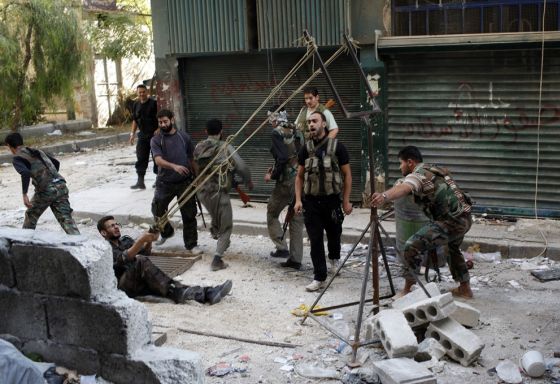
Members of the Free Syrian Army use a catapult to launch a homemade bomb during clashes with pro-government soldiers in the city of Aleppo, on October 15, 2012 - Reuters
“Northern Syria is awash with advanced antitank and antiaircraft weapons. The situation has changed very quickly,” said a Syrian involved in coordinating weapons procurement with regional states, the Wall Street Journal reported on October 17.
Video: Embracing a changing Syrian opposition
Talking to foreign media is forbidden: Saudi Grand Mufti

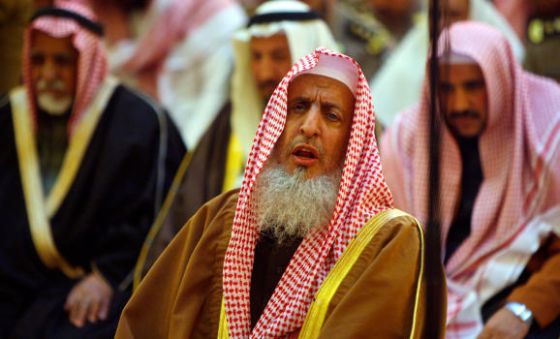
Saudi Arabia's Grand Mufti, Sheikh Abdul Aziz Al-Asheikh
Al Arabiya reports: Saudi Arabia’s Grand Mufti has issued a religious edict prohibiting contact and cooperation with foreign media outlets seeking to “spread chaos and strife in Muslim lands.”
He urged people instead to address their concerns through writing directly to responsible authorities.
Sheikh Abdul Aziz Al-Asheikh told worshipers during a Friday sermon held in a mosque in the capital Riyadh that people should not contact foreign media outlets to “divulge the country’s secrets or address various matters” because these outlets “are only concerned with dividing people and striking the unity of the nation.”
He said doing so was tantamount to “treason and major crime.”
On the timing of Petraeus’ resignation
The Washington Post reports: The timing of the resignation has caused a controversy, with members of Congress and others questioning why the disclosure was not made until after Tuesday’s election. Some have also complained that the FBI did not notify the White House and senior members of Congress earlier that the CIA director was under investigation.
The law enforcement officials did not provide an exact timeline for the investigation, but they said that the inquiry started at least several weeks ago. They said investigators thought they were dealing with a routine harassment case until they discovered the e-mails were traced to a private e-mail account belonging to Petraeus.
The initial concern was that someone had broken into the CIA director’s e-mail account, leading to concerns about potential security breaches, according to the officials. As the investigation proceeded and more e-mails emerged, along with [Paula] Broadwell’s role, FBI investigators realized they had uncovered an affair between Petraeus and Broadwell, the officials said.
The investigators first interviewed Petraeus about two weeks ago, the officials said. Petraeus was told at the time that no criminal charges would be forthcoming and the idea of him resigning was not raised, the officials said.
One of the law enforcement officials said Justice Department officials were unclear on what steps to take next because they had determined that there had been no crime and no breach of security.
It was not until Tuesday that the Justice Department notified James Clapper, the director of national intelligence, that compromising material about Petraeus had been uncovered as part of an investigation, according to a senior intelligence official. Clapper then spoke with Petraeus and told him to resign.
“Director Clapper learned of the situation from the FBI on Tuesday evening around 5 p.m.,” the intelligence official said. “In subsequent conversations with Director Petraeus, Director Clapper advised Director Petraeus to resign.”
The official declined to say whether Petraeus had considered resigning at that point, but he said it was quickly clear to Clapper that stepping down was “the right thing to do” for Petraeus.
The official said that Clapper has been fully briefed on all aspects of the FBI investigation and has not called for the DNI or CIA to conduct a follow-on probe or damage assessment — indicating that Clapper does not see the case as a security threat.
Climate change report outlines perils for U.S. military
The New York Times reports: Climate change is accelerating, and it will place unparalleled strains on American military and intelligence agencies in coming years by causing ever more disruptive events around the globe, the nation’s top scientific research group said in a report issued Friday.
The group, the National Research Council, says in a study commissioned by the C.I.A. and other intelligence agencies that clusters of apparently unrelated events exacerbated by a warming climate will create more frequent but unpredictable crises in water supplies, food markets, energy supply chains and public health systems.
Hurricane Sandy provided a foretaste of what can be expected more often in the near future, the report’s lead author, John D. Steinbruner, said in an interview.
“This is the sort of thing we were talking about,” said Mr. Steinbruner, a longtime authority on national security. “You can debate the specific contribution of global warming to that storm. But we’re saying climate extremes are going to be more frequent, and this was an example of what they could mean. We’re also saying it could get a whole lot worse than that.”
Mr. Steinbruner, the director of the Center for International and Security Studies at the University of Maryland, said that humans are pouring carbon dioxide and other climate-altering gases into the atmosphere at a rate never before seen. “We know there will have to be major climatic adjustments — there’s no uncertainty about that — but we just don’t know the details,” he said. “We do know they will be big.”
The study was released 10 days late: its authors had been scheduled to brief intelligence officials on their findings the day Hurricane Sandy hit the East Coast, but the federal government was shut down because of the storm. [Continue reading…]
America’s new mandate on climate change
Richard Schiffman writes: For Americans concerned about the environment, disaster was avoided on Tuesday. President Obama – with his somewhat lackluster record, if decidedly more exalted rhetoric, on global warming – defeated the Republican challenger who had vowed to gut federal emissions standards, and kill loan programs and tax breaks for green energy companies.
But activists say that it would be wrong to read the election as a stamp of approval for four more years of business as usual. They argue that voters have sent a clear signal that they want more aggressive action on the environment during the president’s second term.
The League of Conservation Voters (LCV) cites the defeat of three members of their “Flat Earth Five” – Anne Marie Buerlke (Republican, New York), Francisco Canseco (Repub;lican, Texas) and Joe Walsh (Republican, Illinois) – Republican representatives who were outspoken for their anti-science stance on climate change. (One race remains too close to call.) And ten of the League’s “dirty dozen” candidates – targeted for “consistently voting against clean energy and conservation” – lost their election bids.
Meanwhile, 11 out of 12 of the office-seekers dubbed “climate heroes” by a coalition led by environmental activist Bill McKibben, prevailed in Tuesday’s vote. The 12th “hero”, Jay Inslee, a gubernatorial candidate in Washington state who wants to jump-start the state’s lagging economy by transforming it into a national green-tech hub, continues to hold a small lead over Republican Rob McKenna and looks poised to win that race.
The election results overturn the conventional wisdom that voters don’t care about green issues, according to LCV’s spokesperson Jeff Gohringer:
“We went into this election cycle and the notion was that environmental champions were going to be wiped off the map. We did $3m-worth of advertising on climate change in places like Texas, and we won.”
This sentiment was echoed by Frances Beinecke, the president of the Natural Resources Defense Council who wrote to her members on Wednesday that:
“By rejecting Big Oil’s candidates, voters sent a message loud and clear that they want more clean energy, less climate denial and an end to the $4bn in taxpayer subsidies for fossil fuels.”
Some environmentalists have characterized Obama’s very re-election as a mandate for strong action on climate change. This is a hard argument to make given that the topic scarcely came up during the presidential race. [Continue reading…]
Syrian National Council picks a Christian to be its new leader

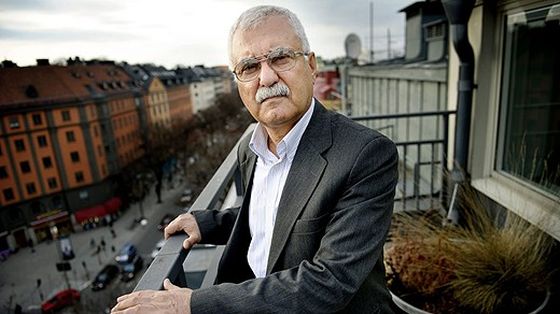
George Sabra, newly-elected president of the Syrian National Council.
McClatchy reports: Syria’s biggest political opposition bloc Friday elected a Christian, George Sabra, as president, a move Sabra said showed that the Muslim-majority nation will not allow its national uprising to descend into sectarian war.
Sabra, a geography teacher who once wrote for the Arabic version of “Sesame Street,” immediately demanded that the international community provide arms to the rebels so that they can protect Syrian civilians from regime attack.
Western nations, he told reporters after the vote by the Syrian National Council, should “support our right to survival.” He added, “To protect ourselves, we need weapons.”
Tens of thousands of Syrians have died in the uprising, which began as peaceful demonstrations against the government of President Bashar Assad. But it has become a bloody civil war pitting the Syrian army and air force against rebels who despite a lack of heavy weapons have seized large swaths of Syrian countryside and have fought loyalist forces to a standstill in Aleppo, the country’s largest city.
Sabra seemed stunned by his sudden elevation to the council’s top post. “It is an unbelievable moment in my life,” he told reporters. “I promise to become a representative for all the Syrian people.”
It was uncertain whether Sabra’s selection would rehabilitate the Syrian National Council in the eyes of the United States. Last week, Secretary of State Hillary Clinton announced that the U.S. no longer would recognize the council as the primary anti-Assad organization, saying too many of its members had lived in exile for decades and that a new opposition group should include more representation from people fighting inside Syria.
Sabra may help fit that requirement. A longtime member of Syria’s communist party, which renamed itself the Syrian Democratic People’s Party in 2005, Sabra went into exile only in October after serving two months in prison for inciting dissent. Previously, he had served eight years in prison during the regime of Bashar Assad’s father, Hafez Assad.
Sabra credited his election to the intervention of a conservative Islamist from Homs, a Sunni Muslim city that has been the scene of brutal fighting between rebels and pro-Assad forces for most of this year.
Until the Islamist, Wasal al Shamali, who was here representing the Supreme Council for Revolutionary Commands, a collection of rebel-held cities in Syria, spoke on Sabra’s behalf, Sabra wasn’t even a member of the group’s top governing committee, the general secretariat. The Syrian National Council has been criticized because its 41-member secretariat includes no women or Alawites, the religious offshoot of Shiite Islam to which Assad belongs.
Shamali, however, said that Sabra should have his place on the general secretariat.
“I didn’t even know his name,” Sabra told McClatchy. “He was in tears.”
Added Sabra: “After that, who can talk about sectarianism when a Muslim sacrifices his place for a Christian?”
The group later elected Sabra its president, 28-13, over Hisham Marwah, an Islamic legal scholar.
Sabra said his selection should signal to the international community: “Look at Syria. There is no sectarianism inside Syria. All the people here, Muslims, voted for Christians.”
He said the Syria that he and others are fighting for “doesn’t have minorities and majorities. We have citizenship. And as I am a citizen, my colleagues elected me.” [Continue reading…]

Video — Tavis Smiley & Cornel West: Why calling Obama ‘progressive’ ignores his record
Israelis eat humble pie
CNN: Israel is signaling a major change in tone toward U.S. President Barack Obama now that he has won reelection.
In an interview with CNN’s Christiane Amanpour on Thursday, Israel’s Deputy Foreign Minister, Danny Ayalon, gave what could only be described as a ringing endorsement of the Obama administration’s handling of Iran’s nuclear program. It has been a very contentious issue between the two allies, with the U.S. fearing Israel might unilaterally strike Iran’s nuclear sites and drag the U.S. into an regional war.
But Ayalon told Amanpour that despite past differences with the Obama administration over Iran, “I think today we can safely say that we are very much on the same page and will continue to follow the lead of the U.S.”
Over the course of his first term in office, Obama and Israeli Prime Minister Benjamin Netanyahu have had a fraught relationship. They have disagreed on major issues, ranging from the Iranian nuclear program to a peace agreement with the Palestinians.
Netanyahu’s relationship with Obama’s challenger, Mitt Romney, dates back to the 1970s, when they worked at the same company in the United States – Netanyahu’s preference for a President Romney had been an open secret.
Ayalon admitted “there was a special kinship between Mr. Romney and Mr. Netanyahu,” but said Israel cannot afford to be meddling in U.S. politics.
Still, many Israelis are worried about payback against their leader for backing the wrong horse in the U.S. presidential sweepstakes. On Thursday, the leading Israeli newspaper Yedioth Ahronoth even carried the headline “Bibi gambled. We’ll pay.”
But Ayalon expressed no doubts that the relationship would get back on track. “I have full confidence knowing not only the president’s commitment, but also his team” he said. “In a way I see an advantage by the continuity of the administration being very seasoned, knowing very well the Iran file and portfolio, to continue and make sure Iran won’t become nuclear.”
Iran’s strike on U.S. drone demonstrates the fragility of uneasy peace
The Guardian reports: A mid-air incident in which Iranian warplanes opened fire on a US surveillance drone high over the Persian Gulf has brought home how nuclear tensions and increased military hardware in a confined area can lead to a clash that could escalate out of control.
Western officials are concerned that minority elements on both sides of the confrontation in the region have a vested interest in triggering such a clash. Some Israeli leaders would like to see Washington drawn in so that superior US forces could strike a crippling blow to Iranian nuclear facilities, while a “war party” in Tehran sees a conflict as a means of rallying support for the regime and cracking down yet further on dissent, officials say.
They believe the risk of a “spoiler” incident will rise if a new diplomatic push aimed at reaching a peaceful settlement of the Iranian nuclear crisis appears to show progress.
The Pentagon said that on 1 November two Sukhoi 25 jet fighters flown by Iranian Revolutionary Guards, fired at the Predator drone carrying out a routine but “classified surveillance mission”, 16 miles off the Iranian shore – four miles outside its territorial waters. [Continue reading…]
Video: The Obama drone doctrine
After Obama’s re-election, liberals need to drop the blind devotion
Gary Younge writes: As a community organiser in Chicago’s south side, Barack Obama once managed to secure an event with the city’s first and only black mayor, Harold Washington. He primed the women he was working with to press the mayor to attend their forthcoming rally to improve conditions in the run-down area.
But instead they fawned and got their picture taken with him. Afterwards he asked if they had extracted a promise about the rally. “What rally?” said one. Obama stormed off in frustration. “Here we are with a chance to show the mayor that we’re real players in the city,” he told a colleague. “A group he needs to take seriously. So what do we do? We act like a bunch of starstruck children.”
As a community organiser Obama was well aware that it was only by making demands on the powerful that the powerless could further their interests. As president he must be delighted to realise that all too few of his progressive supporters have grasped that reality.
The last week has felt very familiar. Just like four years ago, black people in Chicago have been swapping knowing smiles, liberals are watching Fox News to gloat and Democrats have been revelling in the charisma, eloquence and intelligence of their candidate. Their affection for him is rooted in politics but their assessment of him owes more to psychoanalysis. At the celebrations in Chicago on Tuesday most believed he would be more radical in the second term. Ask them what that expectation is based on and they shrug. Ask them what they will do to make sure he meets it and they shrug again. If the devotion is not blind then, at the very best, it is not clear-sighted. [Continue reading…]
Greek democracy now teeters on the edge
An editorial in The Guardian says: In spring 2010, as Athens wrangled with the IMF and the rest of Europe for what would turn out to be a €110bn emergency loan, a revealing, chilling phrase slipped out. When Greece’s then-premier, George Papandreou, begged for easier borrowing terms, he was told by Angela Merkel that the deal had to hurt. According to a well-sourced report in the Wall Street Journal, the German chancellor said: “We want to make sure nobody else will want this.”
She certainly made good on her side of the deal: Greece has spent the past two years on a financial life-support that has kept its government ticking over, but which has destroyed its economy and pushed its entire democracy to the brink of collapse. This week, Athens re-enacted what has become a traditional ritual. Under duress from its troika of creditors (the IMF, the European commission and the European Central Bank), the government identified more areas for cuts and deregulation: another 8,000 civil servants to be sacked by next Christmas, yet more slashing of pensions and wages and of the minimum wage. Meanwhile, the country went on a general strike and petrol bombs were lobbed at the Vouli, the parliament, even as MPs voted through the package. If the government also passes its 2013 budget this Sunday, it will get another chunk of cash to keep paying salaries and other bills.
The price of the severest austerity programme ever imposed on postwar western Europe has been severe. Greece’s economy is in severe depression: this year its annual national income is projected to be 23% below what it was in 2009, that is to say that nearly a quarter of everything the economy used to produce has disappeared over three years. Partly as a result, the debt burden will soon be three times GDP. Unemployment has skyrocketed, with one in two young people out of work.
Extreme policies in; extremist politics out. From being a rump just three years ago, the neo-Nazi Golden Dawn now effectively polices parts of Athens and has infiltrated the official police force. The centre has collapsed: after acceding to Mrs Merkel’s terms, Mr Papandreou’s Pasok has gone from being a reliable centre-left party of government to a husk of its former self. Journalists who threaten to show any independence of mind, such as the admirable Kostas Vaxevanis are hounded by officials.
In the heart of Europe, a democracy now teeters on the edge. True, most of the blame for this is that of a corrupt Greek elite that has dominated politics, business and media for many decades. But the rest of the eurozone is also guilty: first for enforcing impossible austerity, then for turning a blind eye to the predictable results. Mrs Merkel was surely right: no other country – in Europe or elsewhere – would want this.
Syria opposition seen uniting after U.S., Qatari push
Reuters reports: Syria’s fractious opposition, under pressure from the United States and Qatar to unite, looked likely on Friday to agree to form an inclusive new opposition body that would serve as a unity government if Bashar al-Assad falls.
Qatar, which has bankrolled the opposition to Assad and played a leading role in Arab diplomacy against him, is hosting an opposition meeting, with senior U.S. diplomats hovering on the sidelines, prodding the opposition to make a deal.
Rebel advances on the ground and increasing economic and social disintegration within Syria have added to the pressure on the opposition to form a body that can rule after Assad.
A source inside meetings that lasted into the early hours of Friday morning said members of the Syrian National Council (SNC), a group made up mainly of exiled politicians, had shifted views and were coming to accept the need to form a wider body.
“We will not leave today without an agreement,” the source said. “The body will be the sole legitimate representative of the Syrian people. Once they get international recognition, there will be a fund for military support.”
The new body would mirror the Transitional National Council that united the opposition to Muammar Gaddafi in Libya last year and then took power after he was ousted, the source suggested.
“They will create a ‘temporary government’, which could take control of embassies around the world and take Syria’s seat at the U.N., because the regime would have lost its legitimacy.”
An outline agreement could see the SNC and other opposition figures agree on a 60-member political assembly, or congress, as well as a military and a judicial council.
The SNC, which has previously been the main opposition group on the international stage, may have around a third of the seats in the new body but would otherwise lose much of its influence.
Though it was not yet clear whether the groups meeting in Doha will name members to the new body or broach the thorny issue of its leadership, its creation would mark an advance long sought by the United States and Qatar.
Meanwhile, Reuters also reports: Thousands of Syrians fled their country on Friday in one of the biggest refugee exoduses of the 20 month war after rebels seized a border town.
Syria’s fractious opposition was meeting in Qatar, under increasing pressure from the United States and Qatar to unite and form a credible body capable of ruling the country effectively if President Bashar al-Assad falls.
The United Nations said 11,000 refugees had fled in 24 hours, most to Turkey. The exodus is testing the patience of Ankara, the most militarily capable of Syria’s neighbors and a strong opponent of Assad. Ankara has long said a full-blown refugee emergency would demand robust intervention.
Chomsky: Gaza, the world’s largest open-air prison
Noam Chomsky writes: Even a single night in jail is enough to give a taste of what it means to be under the total control of some external force.
And it hardly takes more than a day in Gaza to appreciate what it must be like to try to survive in the world’s largest open-air prison, where some 1.5 million people on a roughly 140-square-mile strip of land are subject to random terror and arbitrary punishment, with no purpose other than to humiliate and degrade.
Such cruelty is to ensure that Palestinian hopes for a decent future will be crushed, and that the overwhelming global support for a diplomatic settlement granting basic human rights will be nullified. The Israeli political leadership has dramatically illustrated this commitment in the past few days, warning that they will “go crazy” if Palestinian rights are given even limited recognition by the U.N.
This threat to “go crazy” (“nishtagea”)–that is, launch a tough response–is deeply rooted, stretching back to the Labor governments of the 1950s, along with the related “Samson Complex”: If crossed, we will bring down the Temple walls around us.
Thirty years ago, Israeli political leaders, including some noted hawks, submitted to Prime Minister Menachem Begin a shocking report on how settlers on the West Bank regularly committed “terrorist acts” against Arabs there, with total impunity.
Disgusted, the prominent military-political analyst Yoram Peri wrote that the Israeli army’s task, it seemed, was not to defend the state, but “to demolish the rights of innocent people just because they are Araboushim (a harsh racial epithet) living in territories that God promised to us.”
Gazans have been singled out for particularly cruel punishment. Thirty years ago, in his memoir “The Third Way,” Raja Shehadeh, a lawyer, described the hopeless task of trying to protect fundamental human rights within a legal system designed to ensure failure, and his personal experience as a Samid, “a steadfast one,” who watched his home turned into a prison by brutal occupiers and could do nothing but somehow “endure.”
Since then, the situation has become much worse. The Oslo Accords, celebrated with much pomp in 1993, determined that Gaza and the West Bank are a single territorial entity. By that time, the U.S. and Israel had already initiated their program to separate Gaza and the West Bank, so as to block a diplomatic settlement and punish the Araboushim in both territories.
Punishment of Gazans became still more severe in January 2006, when they committed a major crime: They voted the “wrong way” in the first free election in the Arab world, electing Hamas. [Continue reading…]
Occupy Sandy’s spirit of solidarity resonates with Latino values
Arturo Conde reports: In the aftermath of Superstorm Sandy, community-based volunteers led by Occupy Wall Street supporters have emerged to fill the void left by FEMA, and The American Red Cross. In less than a week, the Occupy Sandy grassroots movement has raised over $264,000 in relief for New York’s hardest hit neighborhoods, and have established a network of volunteers and materials that is empowering people to rebuild their communities.
Supporters of Occupy Wall Street credit their ability to respond quickly to the needs of people in the Lower East Side of Manhattan, Red Hook and Coney Island in Brooklyn, Astoria and Rockaway in Queens, and Staten Island, to the profound sense of solidarity that their community-based network has promoted for over a year, bringing people to work together from different places and social backgrounds. But for a group of activists who helped organize Occupy’s relief effort from a hub in Sunset Park, Brooklyn, this solidarity is also emblematic of their Latino identity and heritage.
When Occupy organizers approached the Mexican community leader Juan Carlos Ruiz, 43, a week ago to ask for permission to use the basement of St. Jacobi Church in Sunset Park as a distribution hub for dispensing water, food, clothing, and other materials to people in areas that were damaged by the storm, he saw it as a natural extension of the volunteer work that he carries out at the Lutheran temple, which was originally founded by German immigrants in 1889.
While churches are often perceived as conservative institutions, many temples have become refuges and meeting places throughout American history, where people could address economic, political, and social injustices. And for Ruiz, who was ordained as a Catholic priest, these parishes are much more than a destination where believers commute to feel closer to God. For Latinos, he explained in an interview with Univision News, they are also places where they can reaffirm their cultural and religious values, and channel the spirit of God to promote a greater sense of solidarity in their immigrant communities.
“If you do not find God out there,” he said referring to the immigrant communities in Sunset Park, “you will not find him in here. The spirit of God is present in your neighbors, when you live day to day in solidarity.” And this communal spirit, Ruiz upholds, is the essence, the soul, of both Latino immigrants and Occupy Wall Street. [Continue reading…]