
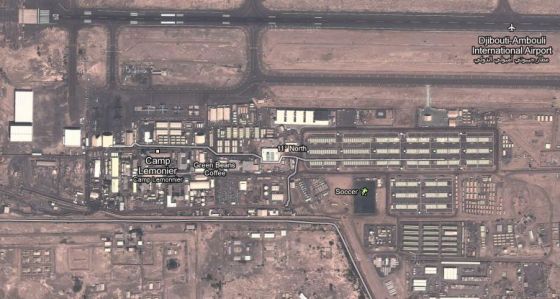
The Washington Post reports: Around the clock, about 16 times a day, drones take off or land at a U.S. military base here, the combat hub for the Obama administration’s counterterrorism wars in the Horn of Africa and the Middle East.
Some of the unmanned aircraft are bound for Somalia, the collapsed state whose border lies just 10 miles to the southeast. Most of the armed drones, however, veer north across the Gulf of Aden to Yemen, another unstable country where they are being used in an increasingly deadly war with an al-Qaeda franchise that has targeted the United States.
Camp Lemonnier, a sun-baked Third World outpost established by the French Foreign Legion, began as a temporary staging ground for U.S. Marines looking for a foothold in the region a decade ago. Over the past two years, the U.S. military has clandestinely transformed it into the busiest Predator drone base outside the Afghan war zone, a model for fighting a new generation of terrorist groups.
The Obama administration has gone to extraordinary lengths to conceal the legal and operational details of its targeted-killing program. Behind closed doors, painstaking debates precede each decision to place an individual in the cross hairs of the United States’ perpetual war against al-Qaeda and its allies.
Increasingly, the orders to find, track or kill those people are delivered to Camp Lemonnier. Virtually the entire 500-acre camp is dedicated to counterterrorism, making it the only installation of its kind in the Pentagon’s global network of bases.
Secrecy blankets most of the camp’s activities. The U.S. military rejected requests from The Washington Post to tour Lemonnier last month. Officials cited “operational security concerns,” although they have permitted journalists to visit in the past.
After a Post reporter showed up in Djibouti uninvited, the camp’s highest-ranking commander consented to an interview — on the condition that it take place away from the base, at Djibouti’s lone luxury hotel. The commander, Army Maj. Gen. Ralph O. Baker, answered some general queries but declined to comment on drone operations or missions related to Somalia or Yemen.
Despite the secrecy, thousands of pages of military records obtained by The Post — including construction blueprints, drone accident reports and internal planning memos — open a revealing window into Camp Lemonnier. None of the documents is classified and many were acquired via public-records requests.
Taken together, the previously undisclosed documents show how the Djibouti-based drone wars sharply escalated early last year after eight Predators arrived at Lemonnier. The records also chronicle the Pentagon’s ambitious plan to further intensify drone operations here in the coming months. [Continue reading…]
Author Archives: News Sources
Britain rejects U.S. request to use U.K. bases in nuclear standoff with Iran
The Guardian reports: Britain has rebuffed US pleas to use military bases in the UK to support the build-up of forces in the Gulf, citing secret legal advice which states that any pre-emptive strike on Iran could be in breach of international law.
The Guardian has been told that US diplomats have also lobbied for the use of British bases in Cyprus, and for permission to fly from US bases on Ascension Island in the Atlantic and Diego Garcia in the Indian Ocean, both of which are British territories.
The US approaches are part of contingency planning over the nuclear standoff with Tehran, but British ministers have so far reacted coolly. They have pointed US officials to legal advice drafted by the attorney general’s office which has been circulated to Downing Street, the Foreign Office and the Ministry of Defence.
This makes clear that Iran, which has consistently denied it has plans to develop a nuclear weapon, does not currently represent “a clear and present threat”. Providing assistance to forces that could be involved in a pre-emptive strike would be a clear breach of international law, it states.
“The UK would be in breach of international law if it facilitated what amounted to a pre-emptive strike on Iran,” said a senior Whitehall source. “It is explicit. The government has been using this to push back against the Americans.”
Israel’s real demographic problem
As used by Israel and its supporters, “demographic problem” is a racist concept — it simply means, as candid Jewish Israelis would put it: too many Arabs. But as the latest polling makes clear, Israel has too many racists. Now that’s a real demographic problem.
In his latest column, “Meet the Israelis,” Gideon Levy writes: Nice to make your acquaintance, we’re racist and pro-apartheid. The poll whose results were published in Haaretz on Tuesday, conducted by Dialog and commissioned by the Yisraela Goldblum Fund, proved what we always knew, if not so bluntly. It’s important to recognize the truth that has been thrown in our faces and those of the world (where the survey is making waves ). But it’s even more important to draw the necessary conclusions from it.
Given the current reality, making peace would be an almost anti-democratic act: Most Israelis don’t want it. A just, egalitarian society would also violate the wishes of most Israelis: That, too, is something they don’t want. They’re satisfied with the racism, comfortable with the occupation, pleased with the apartheid; things are very good for them in this country. That’s what they told the pollsters.
Until a courageous leadership arises here, the kind that appears only rarely in history, and tries to change this nationalist, racist mood, there’s no point in hoping for change to come from below. It won’t come; indeed, it can’t come, because it is contrary to the desires of most Israelis. This fact must be recognized.
The world must also recognize this. Those who long to reach an agreement and draw up periodic peace plans must finally recognize that Israelis are plainly telling them, “No thanks, we’re not interested.” [Continue reading…]
Non-Jewish majority: The beginning of the end or the end of the beginning?
Mark LeVine writes: “The Jewish majority is history.”
So declared Haaretz columnist Akiva Eldar in the space of Palestine/Israel in his most recent column, published on October 16. Eldar learned the news not from a public pronouncement to that effect by the Israeli government, which naturally has little interest to disseminate information of such “unparalleled importance”.
Rather, the new data, revealing that Jews now account for approximately 5.9 million out of the 12 million residents of Israel and the Occupied Territories was published in Haaretz’s economic magazine, The Marker, in an article dealing with government attempts to raise the bar for obtaining tax benefits.
A Ministry of Finance memorandum on the proposed changes to the law revealed the population figures without comment. But the implications are crucial. Not merely because of the demographic ceiling that has now been broken, but also because of what the structure of the tax law in question tells us about how Israelis have long considered the territory of Israel/Palestine – as one unit.
The Ministry of Finance wants to increase the threshold for companies to obtain tax breaks based on the number of consumers they sell to. The existing minimum market is 12 million people, and now that the population of Israel/Palestine as a whole has reached that level, any company that serves the Israeli/Palestinian market would be eligible for the tax break, when the law was intended to encourage exports outside the home market.
Fair enough. But what’s not fair is the fact that Israel and the Occupied Territories are considered as a single market from the perspective of Israeli enterprises, which have long had the West Bank and Gaza as a captive market, while Palestinian industries and agriculture have been severely restricted by Israel for decades in order to prevent them from competing with Israel.
The process of de-development and de-industrialisation has been a marked feature of Israeli rule over the Occupied Territories. Thanks to the weakness of Palestinian negotiators, the incompetence and corruption of the political leadership, and the connivance of the American and EU as “honest brokers”, it was institutionalised into the Oslo-era economic relationship through various agreements, most notably the Paris Protocol of 1994, which severely restricted the ability of Palestinians to develop any new industries which might challenge existing Israeli industries. [Continue reading…]
The Qatar conundrum: The emirate that arms Syria’s rebels also embraces Hamas
Tony Karon writes: Mindful of its declining appetite for projecting power in the Middle East, the U.S. is relying on more activist partners in the region such Qatar, Saudi Arabia and Turkey to arm the Syrian rebellion. But Tuesday’s visit to Gaza by Qatar’s Sheikh Hamad bin Khalifa al-Thani — to the delight of the territory’s Hamas rulers and Egypt’s Muslim Brotherhood, while Israel and Fatah fumed — was a reminder that U.S. allies in the region often pursue goals quite different from those of Washington, despite many shared objectives and common enemies. And the relative decline of U.S. influence in the Middle East has seen some of those independently-minded allies grow more assertive in pressing their agendas.
In Monday’s presidential campaign foreign policy debate, Gov. Mitt Romney rejected U.S. military intervention in Syria, noting instead that “The Saudis and the Qataris and the Turks are … willing to work with us. We need to have a very effective leadership effort in Syria, making sure that the insurgents there are armed, and that the insurgents that become armed are people who will be the responsible parties.” President Obama also talked up cooperation with regional allies, but warned that “we have to [make] absolutely certain that we know who we are helping; that we’re not putting arms in the hands of folks who eventually could turn them against us or allies in the region.”
But the Emir’s visit to Gaza makes clear that Qatar, the tiny Emirate whose massive natural gas reserves give it the world’s highest per capita income as well as geopolitical punching power way above its weight, has sharply different ideas from Washington’s about just who the ”responsible parties” will be in a changing Middle East. Hamas, after all, is formally shunned by the U.S. and European powers as a terrorist organization, and Washington has shown little enthusiasm for efforts by Arab governments, including Qatar, to promote reconciliation between the Islamists and the Fatah movement of President Mahmoud Abbas. Abbas was reportedly furious at the Qatari leader’s decision to become the first foreign head of state to visit the Hamas-controlled Gaza, effectively blessing the Islamist’ rule there. The Emir’s purpose was to inaugurate Qatar’s $400 billion investment in rebuilding infrastructure smashed in repeated confrontations with Israel — a massive stimulus to an economy choked off by a five-year siege imposed by Israel with Egyptian compliance. [Continue reading…]
U.S. rushes to stop Syria from expanding chemical weapon stockpile
Noah Shachtman reports: The regime of embattled Syrian dictator Bashar Assad is actively working to enlarge its arsenal of chemical weapons, U.S. officials tell Danger Room. Assad’s operatives have tried repeatedly in recent months to buy up the precursor chemicals for deadly nerve agents like sarin, even as his country plunges further and further into a civil war. The U.S. and its allies have been able to block many of these sales. But that still leaves Assad’s scientists with hundreds of metric tons of dangerous chemicals that could be turned into some of the world’s most gruesome weapons.
“Assad is weathering everything the rebels throw at him. Business is continuing as usual,” one U.S. official privy to intelligence on Syria says. “They’ve been busy little bees.”
Back in July, the Assad regime publicly warned that it might just use chemical weapons to stop “external” forces from interfering in its bloody civil war. American policy-makers became deeply concerned that Damascus just might follow through on the threats. Since the July announcement, however, the world community — including Assad’s allies — have made it clear to Damascus that unleashing weapons of mass destruction was unacceptable. The message appears to have gotten through to Assad’s cadre, at least for now. Talk of direct U.S. intervention in Syria has largely subsided.
“There was a moment we thought they were going to use it — especially back in July,” says the U.S. official, referring to Syria’s chemical arsenal. “But we took a second look at the intelligence, and it was less urgent than we thought.”
That hardly means the danger surrounding Syria’s chemical weapons program has passed. More than 500 metric tons of nerve agent precursors, stored in binary form, are kept at upward of 25 locations scattered around the country. If any one of those sites falls into the wrong hands, it could become a massively lethal event. And in the meantime, Assad is looking to add to his already substantial stockpile. [Continue reading…]
Syria’s cease-fire: A peace process for pessimists
Tony Karon writes: Few expect that the four-day truce in Syria‘s civil war scheduled to take effect Friday will hold, much less serve as the prelude to a more sustained peace process (activists have already reported that fighting was occuring near a military base in Syria’s north). But the cease-fire proposed by U.N. Special Envoy Lakhdar Brahimi, to coincide with this weekend’s Eid al-Adha Muslim holiday, is likely an attempt to lay down a marker for a future mechanism to end a war that neither side is currently ready to stop. The veteran Algerian diplomat could take some small consolation in the fact that even if they have no intention of implementing the agreement, both sides felt obliged to agree to his plan rather than be seen to be saying no to the U.N. Instead, each side will seek to blame the other for thwarting Brahimi’s mission.
The regime of President Bashar al-Assad and some of the major rebel commanders on Thursday signed on to Brahimi’s plan, but each side set conditions that leave it plenty of room to keep fighting. The Syrian military announced it would “cease military operations” from Friday until Monday, but reserves the right to respond if attacked — and also to take action to prevent rebels reinforcing their current positions. It’s harder to pin down a rebel position because there are literally hundreds of insurgent groups fighting the regime. There is no single military chain of command, much less clear political leadership. Many rebel commanders have reportedly questioned the value of the truce, and a number of the Islamist battalions made clear they will fight on — which, of course, is what Assad is assuming. Still, a number of officials speaking for the Free Syrian Army, a loose umbrella of rebel forces headquartered in Turkey, indicated that they, too, would observe the Eid al-Adha truce, but set unlikely conditions of their own, including a demand for the release of prisoners on Friday, and withdrawal of government forces from key cities. “We will observe it as long as the regime does,” Col. Qassim Saad Eddine of the FSA told the LA Times, but “we don’t expect them to observe it for even one minute.”
Previous cease-fire agreements have been violated by both sides, and neither appears ready to stop a fight both believe is their best way forward. The absence of any external monitoring personnel or established protocols for disengagement, much less any enforcement mechanism, is a clear sign that the Eid al-Adha truce plan is largely an effort to have the combatants make a symbolic commitment to the idea of a future political settlement. Having honed his reputation in decades of mediating such intractable conflicts as the civil wars Lebanon and Afghanistan, Brahimi is not so naive as to believe Syria’s can be ended any time soon; instead, he’s establishing lines of communication with all sides, making sure that the Syrian combatants and their foreign sponsors will know where to turn when one or the other is ready to sue for peace. That moment, though, will likely be some time in coming. [Continue reading…]
Greek police aligned with neo-fascists
Paul Mason writes: Newsnight’s report on the Greek far-right party Golden Dawn made headlines across Europe last week. [See video above.]
In it, MP Ilias Panagiotaros claimed Greece was “in civil war” and indeed advocated a new kind of civil war, pitting the far-right against migrants, anarchists, etc.
Within 24 hours Mr Panagiotaros had retracted his claim that Greece was “in civil war”, saying instead “there is no civil war” and accusing Newsnight of “paraphrasing” his words. We had simply broadcast them, un-edited and in English.
Now three new reports cast light on the substance of our story – which was: alleged police torture of anti-fascist detainees, Golden Dawn’s influence inside the Greek police force, and its potential influence on the operational behaviour and priorities of the police in the Attica region around Athens.
Today, lawyers for 15 protesters who claim they were mistreated and abused in police detention, have shown Newsnight coroners’ reports on eight of the detainees.
The most serious of the coroners’ documents confirms “grievous bodily harm caused by a sharp and blunt object,” requiring the victim to be off work for a month.
Another describes a kind of injury that is consistent with being caused by a taser, as claimed in the original Guardian report.
Fifteen protesters have told us they intend to bring a case against the Athens police.
In Afghan war, enter Sir Mortimer Durand
Myra MacDonald writes: When the British decided to define the outer limits of their Indian empire, they fudged the question. After two disastrous wars in Afghanistan, they sent the Foreign Secretary of India, Sir Mortimer Durand, to Kabul in 1893 to agree the limits of British and Afghan influence. The result was the Durand Line which Pakistan considers today as its border and Afghanistan refuses to recognise. Then, rather than extend the rule of the Raj out to the Durand Line, the British baulked at pacifying the tribes in what is now Pakistan’s Federally Administered Tribal Areas (FATA). Instead, they used the still-extant Frontier Crimes Regulation of 1901 to keep them at bay, if necessary through collective punishment. The Pashtun tribes living on either side of the Durand Line continued to move back and forth, resenting outside interference and rejecting an arbitrary division of their lands by a foreign power.
The situation remains as nebulous to this day. Pakistan, like the British Raj before it, wants a secure western frontier and has been ready to back Islamist militants in Afghanistan to obtain it. Indeed, its emphasis on Islam has been used as a means of countering ethnic Pashtun nationalism, lest the Pashtun lay claim to a Pashtunistan covering both sides of the Durand Line. Meanwhile, remembering the days when Peshawar was a fabled Afghan city, some Afghans hanker after a Greater Afghanistan, incorporating the lands of all Pashtun (or Afghan) tribes as far as the Indus river. (Historically, the identification of Afghanistan with the Pashtun was such that the words “Afghan” and “Pashtun” were treated as synonyms.) And even those Afghans who recognise how unrealistic it would be to claim a sizeable chunk of modern-day Pakistan retain a proprietary sense over the Pashtun living on the other side of the Durand Line. Meanwhile the Pashtun themselves resent their arbitrary separation between two countries, which has reduced their capacity to exercise political power.
Chas Freeman on al Qaeda
In a keynote address delivered this morning at the National Council on U.S. Arab Relations in Washington DC, Ambassador Chas W. Freeman Jr. (USFS, ret.) said:
The fanatics who carried out the atrocities of 9/11 went out of their way to describe their motivations and outlined their objectives to anyone who would listen. America turned off its hearing aid. It’s still off. The grievances that catalyzed 9/11 remain not simply unaddressed but ignored or denied by Americans.
Al Qaeda saw 9/11 as a counterattack against American policies that had directly or indirectly killed and maimed large numbers of Muslims. Some of those enraged by our policies were prepared to die to achieve revenge. Still, there were few in the Muslim world in 2001 who sympathized with al Qaeda’s attack on us. There are many more now. It is not our values that they hate. It’s what we have done and continue to do. We won’t stop terrorists by trying to impose our narrative on them while ignoring theirs, however politically expedient it may be to do so. We can’t fight anti-American extremists effectively or otherwise fend off the menace they present if we refuse to consider why they attacked us and why they still want to do so.
The chief planner of 9/11, Khalid Sheikh Mohammed, testified under oath that a primary purpose of al Qaeda’s criminal assault on the United States was to focus “the American people . . . on the atrocities that America is committing by supporting Israel against the Palestinian people . . . .” In so-called “fatwas” in 1996 and 1998, Osama Bin Ladin justified al Qaeda’s declaration of war against the United States by reference to the same issue, while levying other charges against America. Specifically, he accused Americans of directly murdering one million Muslims, including 400,000 children, through the U.S. siege and sanctions against Iraq, while “occupying” the Muslim heartland of Saudi Arabia.
Al Qaeda members have described the war strategy they ultimately adopted as having five stages. Through these, they projected, the Islamic world could rid itself of all forms of aggression against it.
In stage one, al Qaeda would produce massive American civilian casualties with a spectacular attack on U.S. soil in order to provoke American retaliation in the form of the invasion of one or more Muslim countries. In stage two, al Qaeda would use the American reaction to its attack to incite, energize, and organize expanding resistance to the American and Western presence in Muslim lands. In stage three, the U.S. and its allies would be drawn into a long war of attrition as conflict spread throughout the Muslim world.
By stage four, the struggle would transform itself into a self-sustaining ideology and set of operating principles that could inspire continuing, spontaneously organized attacks against the U.S. and its allies, impose ever-expanding demands on the U.S. military, and divide America’s allies from it. In the final stage, the U.S. economy would, like that of the Soviet Union before it, collapse under the strain of unsustainable military spending, taking the dollar-dominated global economy down with it. In the ensuing disorder, al Qaeda thought, an Islamic Caliphate could seize control of Saudi Arabia, Egypt, and the rest of the Middle East.
This fantastic, perverted vision reflected al Qaeda’s belief that if, against all the odds, faith-based struggle could bring down the Soviet Union, it could also break the power of the United States, its Western allies, and Israel. This strategy seemed ridiculous when al Qaeda first proclaimed it. It is still implausible but, frankly, has come to sound a bit less preposterous than it once did.
The immediate objective of the 9/11 attacks was explicitly to provoke the United States into military overreactions that would enrage and arouse the world’s Muslims, estrange Americans from Arabs, stimulate a war of religion between Islam and the West, undermine the close ties between Washington and Riyadh, curtail the commanding influence of the United States in the Middle East, and overthrow the Saudi monarchy. The aftershocks of Al Qaeda’s 9/11 terrorist operation against the United States have so far failed to shake the Saudi monarchy but – to one degree or another – it has realized all its other immediate goals. Among other things, it has burdened future generations of Americans with about $5 trillion in debt from the Afghan and Iraq wars, helping to thrust the United States into fiscal crisis.
Mao Zedong observed that “a single spark can start a prairie fire.” His point was that, when conditions arise that can be exploited to favor a cause, it can spread with frightening speed and ferocity. The U.S. response to 9/11 has inflamed Islamist anti-Americanism in a widening swath of the Muslim world. By the time he died, Osama Bin Ladin surely felt entitled to pronounce the first stages of his mission accomplished. Islamist terrorism did not die with him. It lives on. One cannot decapitate a network. Nor can one shrivel an ideology by military means alone.
John O. Brennan: Architect of Obama’s plans for permanent war
The Washington Post reports: In his windowless White House office, presidential counterterrorism adviser John O. Brennan is compiling the rules for a war the Obama administration believes will far outlast its own time in office, whether that is just a few more months or four more years.
The “playbook,” as Brennan calls it, will lay out the administration’s evolving procedures for the targeted killings that have come to define its fight against al-Qaeda and its affiliates. It will cover the selection and approval of targets from the “disposition matrix,” the designation of who should pull the trigger when a killing is warranted, and the legal authorities the administration thinks sanction its actions in Pakistan, Yemen, Somalia and beyond.
“What we’re trying to do right now is to have a set of standards, a set of criteria, and have a decision-making process that will govern our counterterrorism actions — we’re talking about direct action, lethal action — so that irrespective of the venue where they’re taking place, we have a high confidence that they’re being done for the right reasons in the right way,” Brennan said in a lengthy interview at the end of August.
A burly 25-year CIA veteran with a stern public demeanor, Brennan is the principal architect of a policy that has transformed counterterrorism from a conventional fight centered in Afghanistan to a high-tech global effort to track down and eliminate perceived enemies one by one.
What was once a disparate collection of tactics — drone strikes by the CIA and the military, overhead surveillance, deployment of small Special Forces ground units at far-flung bases, and distribution of military and economic aid to threatened governments — has become a White House-centered strategy with Brennan at its core.
Four years ago, Brennan felt compelled to withdraw from consideration as President Obama’s first CIA director because of what he regarded as unfair criticism of his role in counterterrorism practices as an intelligence official during the George W. Bush administration. Instead, he stepped into a job in the Obama administration with greater responsibility and influence.
Brennan is leading efforts to curtail the CIA’s primary responsibility for targeted killings. Over opposition from the agency, he has argued that it should focus on intelligence activities and leave lethal action to its more traditional home in the military, where the law requires greater transparency. Still, during Brennan’s tenure, the CIA has carried out hundreds of drone strikes in Pakistan and opened a new base for armed drones in the Arabian Peninsula.
Although he insists that all agencies have the opportunity to weigh in on decisions, making differing perspectives available to the Oval Office, Brennan wields enormous power in shaping decisions on “kill” lists and the allocation of armed drones, the war’s signature weapon.
When operations are proposed in Yemen, Somalia or elsewhere, it is Brennan alone who takes the recommendations to Obama for a final sign-off.
As the war against al-Qaeda and related groups moves to new locations and new threats, Brennan and other senior officials describe the playbook as an effort to constrain the deployment of drones by future administrations as much as it provides a framework for their expanded use in what has become the United States’ permanent war. [Continue reading…]
Rethinking open checkbook for America’s security colossus
The New York Times reports: Last week, a Bangladeshi student was charged in an F.B.I. sting operation with plotting to blow up the Federal Reserve Bank in New York. A Somali-American man was convicted of sending young recruits from Minneapolis to a terrorist group in Somalia. In Libya, extremists responsible for the killing of four Americans last month in Benghazi remained at large.
The drumbeat of terrorism news never quite stops. And as a result, for 11 years since the Sept. 11 attacks, the security colossus constructed to protect the nation from Al Qaeda and its ilk has continued to grow, propelled by public anxiety, stunning advances in surveillance technology and lavish spending — about $690 billion over a decade, by one estimate, not including the cost of the wars in Iraq and Afghanistan.
Now that may be changing. The looming federal budget crunch, a sense that major attacks on the United States are unlikely and new bipartisan criticism of the sprawling counterterrorism bureaucracy may mean that the open checkbook era is nearing an end.
While the presidential candidates have clashed over security for American diplomats in Libya, their campaigns have barely mentioned domestic security. That is for a reason: fewer than one-half of 1 percent of Americans, in a Gallup poll in September, said that terrorism was the country’s most important problem.
But the next administration may face a decision: Has the time come to scale back security spending, eliminating the least productive programs? Or, with tumult in the Arab world and America still a prime target, would that be dangerous?
Many security experts believe that a retrenchment is inevitable and justified. [Continue reading…]
Lebanon’s troubles don’t include civil war
Rami G Khouri writes: Following events in Lebanon from the United States, as I have done during the past week, leaves one with the impression that most media in the U.S. are eager to see a resumption of the devastating and wasteful civil war that ravaged Lebanon for 15 years until 1990. Virtually every story on Lebanon is framed in the lens of the possible return to sectarian civil strife as a result of the spillover of the Syrian conflict.
The reality seems rather different to me, despite the many weaknesses and dysfunctional aspects of Lebanese governance. The international press corps and many in the political classes should wise up and see the country as something more than a bomb waiting to explode repeatedly.
The political tensions and a handful of local clashes following the assassination last Friday of Internal Security Forces Intelligence Bureau head Brig. Gen. Wissam al-Hasan reflected a tragic but rather routine sequence of sentiments and events, in this country where political assassinations have occurred regularly for half a century.
Millions of Lebanese instantly feared a recurrence of the serial political killings that followed the assassination of the late Prime Minister Rafik Hariri in early 2005. Some took to the streets to express themselves in the time-tested manner of burning tires and blocking a few streets.
At the Hasan funeral Sunday, the weaknesses and amateurism of some Lebanese politicians surfaced. Understandably angry members of the March 14 coalition in opposition fired up the crowd by demanding the resignation of the government of Prime Minister Najib Mikati.
Former Prime Minister Fouad Siniora, normally a rational man who shouldered the responsibility of power with great dignity and resolve in the difficult years following the Hariri assassination, succumbed to a moment of reckless silliness when he said Sunday that Mikati’s Cabinet was a “government of assassination,” given the numerous assassinations that occurred during the years when March 14 and Siniora ran the government.
His and other fiery statements prompted a small crowd of excited youth to try and storm the government headquarters in central Beirut, and they were quickly dispersed by some forceful work by the internal security forces.
After this incident, senior March 14 leaders, including former Prime Minister Saad Hariri, called for calm, insisting that their desire to topple the government should be achieved through peaceful and democratic means. So they are now boycotting all contacts with the government, which is most unimpressive.
While most media coverage of Lebanon that I have seen in the U.S. tends to fall into narrative and hysterical categories that describe clashes and see them in the context of possibly returning to civil war, my sense is that the historian’s perspective of identifying new trends and political factors is much more useful today to grasp what is going on in Lebanon. [Continue reading…]
Libya: Bani Walid falls
The Libya Herald reports: Forces from the national army together with allied brigades have taken control of Bani Walid, the last pro-Qaddafi stronghold in Libya.
The announcement was made today by Chief of Staff General Yusuf Mangoush, following reports that the army and allied brigades had succeeded in entering and holding the centre of the town early this morning.
Sporadic fighting was reported between the opposing forces today, but only in certain small pockets of the hilltop town.
“The army is controlling Bani Walid and I can announce that military operations have now concluded”, Mangoush said this afternoon. “But that does not mean we don’t have follow-up operations and some resistance here and there.”
Well over 25,000 civilians are said to have been displaced, with scores killed and wounded on both sides, in a conflict that first began on 2 October.
Mangoush failed to respond to allegations that he had lost control of his forces at several points over the course of the conflict, but said that reports of a breached 48-hour ceasefire declared last week to enable the evacuation of civilians were incorrect. “We didn’t announce it was a ceasefire”, he said. “We said it was the end of the main military operation.”
The general also defended the use of heavy weapons, including Grad rockets, in civilian areas, saying that the force deployed against Bani Walid was necessary and proportionate. “They [the armed forces] used the appropriate weapons to fight. When some fighters use certain weapons, we have to use the same weapons to stop the fight. It is a practical point.”
In the past few days, the military succeeded in taking control of the populated districts surrounding Bani Walid but had hitherto failed to achieve more than temporary raids into the centre.
Both sides have deployed light and heavy weapons against one another, resulting in large numbers of civilian as well as military casualties.
PLO briefs Europe on U.N. upgrade plans
The Ma’an news agency reports: The PLO began distributing a position paper to European governments on Wednesday, detailing plans to seek an upgrade of Palestine’s status at the United Nations in November.
In the document, obtained by Ma’an, the PLO emphasizes that membership in the UN is no substitute for negotiations with Israel. But it says Palestine’s right to self-determination does not require Israeli approval.
The text underscores concerns about how the United States and Israel will respond if the UN bid succeeds, and it asks European countries not to go along with possible sanctions against the Palestinian Authority.
“Palestine asks the world to reaffirm that the Palestinians are not the exception to the international rule; that they will not be punished for pursuing a peaceful, political and diplomatic initiative on the basis of international law,” the document says.
The message followed a private US memo sent to European diplomats in early October warning that any UN upgrade of Palestine’s status “would be extremely counterproductive” for the Palestinians and threatening “significant negative consequences”.
If the UN bid succeeds, Palestine’s “observer entity” status would change to “observer state”, granting access to bodies such as the International Criminal Court.
The PLO has sought to reassure Europe and the US, key financiers of the Palestinian Authority, that it does not seek to isolate Israel, which has threatened to respond with sanctions.
“The Palestinian initiative intends to protect the prospects of peace and accelerate its realization. This step reaffirms and protects the internationally-endorsed two-state solution,” the document says. [Continue reading…]
For Sheldon Adelson ‘Israel is at the core of everything he does’
The Washington Post reports: When casino magnate Sheldon Adelson switched his support from Newt Gingrich to Mitt Romney during the spring primaries, the billionaire and the candidate were eager to shed their skepticism of each other. If Adelson was going to give a political campaign more money than anyone ever had, he wanted to be certain Romney would join him in steadfast support of Israel. And Romney, according to friends of both, sought assurance that Adelson wouldn’t embarrass him.
Since then, Adelson has joined Romney during the candidate’s visit to Israel this summer, attended presidential debates and gotten together with Romney so often that their wives have become friends, according to confidants of the two men.
Although Adelson, 79, has said he will give $100 million to help Romney and quash President Obama’s “socialist-style” approach to the economy, he remains skeptical, believing that politicians don’t deliver on promises and can’t be trusted.
“Many people who give very significant donations to political campaigns come to me afterwards very frustrated that they don’t get what they wanted once the person is elected,” says Morton Klein, president of the Zionist Organization of America, which Adelson has supported for years. “Sheldon doesn’t expect people to change. He’s very realistic about politics.”
Adelson — whose gambling operations span the globe from Las Vegas to casinos open or planned in Macau, Singapore and Spain — tells friends he finds the way U.S. elections are funded to be abhorrent, putting too much power in the hands of a wealthy few. So as one of those wealthy few, why would he pour more money into a campaign than 65 average Americans will earn in their combined lifetimes?
Adelson would not agree to an interview unless he could screen all questions in advance, a condition The Washington Post declined to meet. But more than 20 friends, critics, colleagues and beneficiaries portray a man with several motives for his massive donations to political, religious and medical causes.
He’s a scrappy fighter who defends what is his, a self-made man who held more than 50 jobs before striking gold with his Venetian casino on the Vegas Strip, and he has developed a powerful aversion to taxes and unions. He is the 12th-richest person in the nation, according to Forbes magazine, with a fortune valued at $21 billion. Under Obama, Adelson has achieved a larger increase in his wealth than anyone else in the country. In the past two decades, he has also undergone a political conversion, from a Massachusetts Democrat who considered Republicans to be the establishment that resisted newcomers like him, to a Nevada Republican who believes that his former party coddles the idle and has fallen captive to identity politics.
Adelson is driven by the idea of Israel as a muscular riposte to the Holocaust. Based on his experience as a Jewish kid who would get insulted and roughed up in a tough Boston neighborhood, Adelson believes Jewish Americans should back an Israel that puts security first and resists compromise with Arabs who do not accept its existence.
“Israel is at the core of everything he does,” says Fred Zeidman, a friend of Adelson, fellow Romney backer and former chairman of the U.S. Holocaust Memorial Museum. [Continue reading…]
U.S. on track to become ‘the new Middle East’
The Associated Press reports: U.S. oil output is surging so fast that the United States could soon overtake Saudi Arabia as the world’s biggest producer.
Driven by high prices and new drilling methods, U.S. production of crude and other liquid hydrocarbons is on track to rise 7% this year to an average of 10.9 million barrels per day. This will be the fourth straight year of crude increases and the biggest single-year gain since 1951.
The boom has surprised even the experts.
“Five years ago, if I or anyone had predicted today’s production growth, people would have thought we were crazy,” says Jim Burkhard, head of oil markets research at IHS CERA, an energy consulting firm.
The Energy Department forecasts that U.S. production of crude and other liquid hydrocarbons, which includes biofuels, will average 11.4 million barrels per day next year. That would be a record for the U.S. and just below Saudi Arabia’s output of 11.6 million barrels. Citibank forecasts U.S. production could reach 13 million to 15 million barrels per day by 2020, helping to make North America “the new Middle East.”
Meanwhile Bloomberg reports: Mecca, which hosts millions of pilgrims a year visiting Islam’s most holy shrine, is working toward becoming the first city in Saudi Arabia to operate a utility-scale plant generating electricity from renewables.
The city on Jan. 5 plans to select from a group of at least 20 bidders competing to build and operate facilities producing 385 gigawatt-hours per year of power including 100 megawatts of solar capacity, said Mayor Osama al-Bar.
“No city in Saudi Arabia owns power-generation assets, and we want to be first city that owns power plants and hopefully the first in the Muslim world,” al-Bar said in an interview on Sept. 16 in the nation’s capital, Riyadh.
The plans are the latest indication that the desert kingdom is stepping up efforts to diversify its sources of energy as economic and population growth threaten to erode Saudi Arabia’s status as the world’s biggest oil exporter.
The central government is seeking $109 billion of investment for building a solar industry, aiming to get a third of Saudi Arabia’s power from the sun by 2032 compared with almost none now. The target is almost as much as the $136 billion invested worldwide in solar energy last year, according to Bloomberg New Energy Finance.
So, even while most Americans are finally waking up to the reality of global warming and Saudi Arabia is grappling with the challenge of breaking its dependence on oil, the United States is turning itself into a petro-state that wrecks the environment through fracking and tar sands oil extraction.
The 5 percent whose need is greatest
David Runciman writes: There is some competition to be the person who inspired the slogan of Occupy Wall Street: ‘We are the 99 per cent.’ Joseph Stiglitz thinks it might be him, on the back of an article he wrote for Vanity Fair in 2011 entitled: ‘Of the 1 per cent, by the 1 per cent, for the 1 per cent.’ Others think it was the economist Emmanuel Saez, who helped popularise the idea that 99 per cent of American households have been watching their incomes stagnate or fall while the top 1 per cent pulled away. As Saez reported back in 2007, since the 1970s half of all income growth has been captured by just 1 per cent of the population, leaving everyone else to get by on what’s left. But Rolling Stone magazine identified the originator of ‘We are the 99 per cent’ as David Graeber, the anthropologist and activist, who first spotted its potential as an organising tool.[*] You can see why people might want to lay claim to ‘We are the 99 per cent’: it’s a brilliant slogan and an increasingly successful brand, doing its work on T-shirts and banners around the world. But it’s a half-baked idea.
The problem is that 99 per cent is far too many. Majorities on that scale sound overwhelming, but they always come apart on closer scrutiny. There is nothing on which so many people will ever be able to agree. You often find polling questions to which only 1 per cent of the sample are willing to give their assent – flailing candidates for office can easily plumb those depths – but it would be a big mistake to assume that the other 99 per cent are united on anything at all, even on their dislike of the unpopular candidate (many will never have heard of him). The only time the figure 99 per cent appears in polling data is when the poll is a fraudulent one. It’s a number I still associate with elections in the old Soviet bloc, or with the last remaining dictatorships. Kim Jong Un can get the backing of 99 per cent of his electorate. No one else can.
Occupy Wall Street is not trying to get 99 per cent of the population to vote for anyone or anything. The movement is simply highlighting an experience that the 99 per cent have in common, which is to have been stiffed by the current system. But this is another way in which 99 per cent is too many. Something must have gone very wrong with democracy when so many can be outwitted by so few. The implication of the slogan ‘We are the 99 per cent’ is that we have all been duped. If we had known what was going on we wouldn’t have let it happen. Now that we know about it we can stop it. But how? Any system in which 99 per cent of the population can be duped at the same time is not merely a defective democracy; it is no democracy at all. ‘We are the 99 per cent’ is intended as an accommodating idea, but really it’s a revolutionary one. It implies that we have been the victims of a giant confidence trick. You can’t work to improve a system like that, any more than you can work to improve a Ponzi scheme; you need to scrap it and start again. Some prominent figures associated with Occupy Wall Street are quite happy with this line of thought. Slavoj Žižek is unabashed about the movement’s revolutionary implications. He sees it as a harbinger of the coming transformation, ‘a message from the communist future’. But for all Žižek’s brilliance as a sloganeer, he would be hard-pressed to get many of the 99 per cent to agree with him on that. They don’t want to scrap the democracy we have. They just want it to work better.
So how were we duped? Mainly by not paying attention. The 1 per cent didn’t conspire to rip everyone else off. They got their way by walking through the door we left open for them. We were too distracted and disorganised among ourselves to put up enough resistance. What the 99 per cent have in common is that they don’t have enough in common to make a difference politically, compared to the very rich, who are a well-organised bunch. The 99 per cent are a lot more numerous than the 1 per cent; they are also a lot more divided, and it’s the second fact that counts. [Continue reading…]


Some of the unmanned aircraft are
