Maya Paley writes: According to Israel’s Anti-Infiltration bill, infiltrators can now be detained for a minimum of three years and a maximum of forever. The detention facility consists of tent cities and constructed buildings in the Negev, which is being run by the Israel Prison Services. Detainees will also not be permitted to work.
Jews in the Diaspora, overall, have responded to this negative media attention as just another biased and unwarranted attack on Israel. Others have dismissed the asylum problem as an issue Israel needs to deal with on her own without meddling by those of us in the Diaspora. Some say vaguely that they worry about Israel’s demographics. And still others say it’s not a priority issue when we have Iran and Hezbollah threatening us.
Unfortunately, these are all excuses.
According to the Refugee Convention of 1951, which Israel helped establish and then signed, the Africans entering Israel through Sinai are “asylum seekers.” Strangely, the only people calling them asylum seekers are the Israeli humanitarian organizations. Even the international news agencies call them “migrants.” The Israeli government and Israeli news agencies call them “infiltrators.” The numbers of asylum seekers entering Israel has steadied since the fence has been built along the border, and the reality is that, according to a recently published Knesset report, they are only 0.75% of the population.
Words carry weight in national and international policy. According to the Refugee Convention, asylum seekers cannot be criminalized for entering a country, as they are not illegally crossing the border. They are seeking asylum and should, therefore, undergo a process through which they apply for refugee status and end up either accepted as refugees or denied status. This process, termed Refugee Status Determination, does not exist in Israel (although the government will claim otherwise). [Continue reading…]
Author Archives: News Sources
In Jerusalem, Carter derides Netanyahu and Obama
The New York Times reports: Three decades after leaving the White House, former President Jimmy Carter still functions inside the trappings of power, cruising through fiercely contested areas of this city on Monday in a 12-car motorcade, with Secret Service agents stationed strategically as he surveyed the view from the Mount of Olives.
But at 88, Mr. Carter, trying to nudge his agenda without an official platform, no longer filters his words for politics or diplomacy. On Monday, he ramped up his years of criticism of Israeli policy by saying that Prime Minister Benjamin Netanyahu lacked the courage of his predecessors and that he had abandoned the two-state solution that has been the accepted framework for resolving the Israeli-Palestinian conflict for decades. And just two weeks before the American election, he was almost as critical of President Obama, saying his administration has shirked the historical role played by the United States in the region.
“I don’t think there’s any doubt that Netanyahu has decided the one-state option is the one he’s going to pursue,” Mr. Carter said, despite Mr. Netanyahu’s professed commitment to two states, notably in a 2009 speech at Bar Ilan University.
As for Mr. Obama, a fellow Democrat, the former president said, “The U.S. government policy the last two to three years has basically been a rapid withdrawal from any kind of controversy.”
He added: “Every president has been a very powerful factor here in advocating this two-state solution. That is now not apparent.” [Continue reading…]
Envoy announces tentative cease-fire in Syria, but doubts remain
The New York Times reports: Lakhdar Brahimi, the international envoy trying to broker a peace deal in Syria, announced on Wednesday a tentative cease-fire between the two sides to mark the main Muslim holiday of the year, but numerous do-it-yourself aspects of the plan immediately called into question whether it would quiet any fighting.
Open uncertainties included the time frame of what was designed to be a temporary cease-fire for the Id al-Adha, the Islamic Feast of Sacrifice, expected to start Friday for much of the Muslim world. Different nations and different sects can observe the holiday for anywhere from one to five days, however, so it was not clear exactly how long any truce should last.
On a more basic level, it was not quite clear who would respect it among the warring parties. Syrian state television announced that Damascus was studying the proposal and would make an announcement on Thursday, according to wire service reports. Various leaders among the fractious rebels issued their own statements saying they doubted it would hold.
It was also unclear that there would be anyone around to police it — the United Nations withdrew its observers last summer and would probably not be able to deploy new ones in 48 hours.
Mr. Brahimi seemed to be relying on the fact that both sides in the civil war, which grew out of a peaceful protest movement that started in March 2011, would respect it all on their own.
Syria’s black market in housing adds to the nation’s turmoil
Hassan Hassan writes: Forty-six per cent of Syria’s buildings are illegally constructed, according to a government study in 2007 – and this includes the homes in which more than half the population live. The problem was mostly seen around the large cities but, amid a widening gap between rich and poor, the authorities generally turned a blind eye to it.
Particularly since this summer, though, they have been bulldozing illegal buildings – but only in restive areas. In other areas, the authorities have been selective in their demolition orders. The campaign against illegal construction is thus being used to send a message: if you rebel against the regime, you will no longer enjoy the favours bestowed by it.
A further complication is that officials also accept hefty bribes from internally displaced people to allow them to use abandoned or partly demolished buildings. Additionally, the regime’s militias and rank-and-file officers are raiding houses, ransacking and then fraudulently selling or leasing them.
Besides adding to people’s suffering amid the current conflict, these practices are reshaping neighbourhoods across the country, from large cities to small villages – which is a recipe for future clashes between the old and new owners. Many will feel their properties have been usurped by other people or bought cheaply and at some point may try to retake them. [Continue reading…]
Video: Where is Libya at one year after Gaddafi?
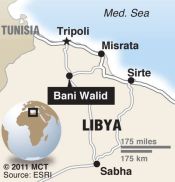
Libya: Bani Walid residents say military in control of surrounding districts as tens of thousands flee
The Libya Herald reports: Displaced refugees from Bani Walid have said that the military now controls the populated districts surrounding the town and are making frequent raids into the centre, using both light and heavy weapons.
The assertion comes amidst an ongoing exodus of civilians fleeing the fighting, with tens of thousands now believed to have left the hill-town.
Relief workers from the International Committee of the Red Cross estimated yesterday that as many as 5,000 families, or some 25,000 people, had fled Bani Walid into the Urban area alone, with the total figure believed to be much higher.

The Bani Walid Crisis Management Centre has claimed that almost 10,000 families have fled in total. It is estimated that Bani Walid and its environs are home to around 80,000 people.
Refugees are fleeing the town in every direction, with thousands known to have headed to Tarhouna with more passing on to other towns including Tripoli.
Few if any native residents are taking the main roads out of the Bani Walid, preferring instead to take the hazardous desert tracks in attempt to evade security forces who have a list of some 1,000 names wanted for arrest.
Egypt’s constitution: Islamists prepare for a long political battle
Nathan Brown writes: Those who follow the Egyptian constitutional process have every reason to be confused and concerned. Leaks, partial drafts, and conflicting accounts make the content of the document hard to follow. But the constitutional stakes in Egypt seem to be very high, and the debate has become emotional and charged. Rhetoric is highly polarized, with non-Islamists claiming that Islamists have hijacked the process. The Islamists retort that their contemplated changes are small. Their critics, the Islamists say, cannot accept election results that indicate strong support for the Muslim Brotherhood and Salafi movements.
In a sense, both sides are right. Islamists are correct when they claim to be acting with restraint. The document they are producing will make only limited and subtle textual changes in religion-state relations compared to the 1971 constitution. On the issues on which there has been most controversy, such as explicit mentions of the Islamic sharia, changes will be particularly light. But their critics are also correct. Islamists are dominating the process and are likely to see a constitution that reflects their interests.
This is not so much because of the tools that they are crafting and more because of who will be using those tools if Egypt’s future elections look anything like its most recent ones. The 2012 constitution will be operating in a very different political context, so that even the step of adopting past language is likely to produce very different results. In this way, Egypt’s new constitution will not so much resolve all controversies as it will set up a period of prolonged trench warfare within, among, and over a series of institutions. And Islamist forces are likely to move forward gradually rather than by suddenly capturing the state. This struggle will likely take place over many years, and the outcome will determine what the vague language of the constitution actually means in the lives of ordinary Egyptians. [Continue reading…]
Solitary in Iran nearly broke me. Then I went inside America’s prisons.
Shane Bauer writes: It’s been seven months since I’ve been inside a prison cell. Now I’m back, sort of. The experience is eerily like my dreams, where I am a prisoner in another man’s cell. Like the cell I go back to in my sleep, this one is built for solitary confinement. I’m taking intermittent, heaving breaths, like I can’t get enough air. This still happens to me from time to time, especially in tight spaces. At a little over 11 by 7 feet, this cell is smaller than any I’ve ever inhabited. You can’t pace in it.
Like in my dreams, I case the space for the means of staying sane. Is there a TV to watch, a book to read, a round object to toss? The pathetic artifacts of this inmate’s life remind me of objects that were once everything to me: a stack of books, a handmade chessboard, a few scattered pieces of artwork taped to the concrete, a family photo, large manila envelopes full of letters. I know that these things are his world.
“So when you’re in Iran and in solitary confinement,” asks my guide, Lieutenant Chris Acosta, “was it different?” His tone makes clear that he believes an Iranian prison to be a bad place.
He’s right about that. After being apprehended on the Iran-Iraq border, Sarah Shourd, Josh Fattal, and I were held in Evin Prison’s isolation ward for political prisoners. Sarah remained there for 13 months, Josh and I for 26 months. We were held incommunicado. We never knew when, or if, we would get out. We didn’t go to trial for two years. When we did we had no way to speak to a lawyer and no means of contesting the charges against us, which included espionage. The alleged evidence the court held was “confidential.”
What I want to tell Acosta is that no part of my experience — not the uncertainty of when I would be free again, not the tortured screams of other prisoners — was worse than the four months I spent in solitary confinement. What would he say if I told him I needed human contact so badly that I woke every morning hoping to be interrogated? Would he believe that I once yearned to be sat down in a padded, soundproof room, blindfolded, and questioned, just so I could talk to somebody?
I want to answer his question — of course my experience was different from those of the men at California’s Pelican Bay State Prison — but I’m not sure how to do it. How do you compare, when the difference between one person’s stability and another’s insanity is found in tiny details? Do I point out that I had a mattress, and they have thin pieces of foam; that the concrete open-air cell I exercised in was twice the size of the “dog run” at Pelican Bay, which is about 16 by 25 feet; that I got 15 minutes of phone calls in 26 months, and they get none; that I couldn’t write letters, but they can; that we could only talk to nearby prisoners in secret, but they can shout to each other without being punished; that unlike where I was imprisoned, whoever lives here has to shit at the front of his cell, in view of the guards?
“There was a window,” I say. [Continue reading…]
Former CIA officer pleads guilty in leak case
The New York Times reports: A former Central Intelligence Agency officer accused of leaking to journalists the identities of two former colleagues involved in the agency’s detention and interrogation program for high-level Qaeda suspects pleaded guilty on Tuesday to a single charge. The plea deal was a victory for the Obama administration’s crackdown on unauthorized disclosures of government secrets.
The former officer, John Kiriakou, 48, stood in a federal courtroom in the Eastern District of Virginia and told the judge that he had violated the Intelligence Identities Protection Act by disclosing the name of a former colleague to a reporter, who has been identified as Matthew Cole, formerly of ABC News. Under the terms of the plea deal, Mr. Kiriakou will be sentenced to two and a half years in prison.
But prosecutors agreed to drop several other charges, including accusations that he identified another colleague involved in interrogations to a different journalist, Scott Shane of The New York Times, and that he lied to a C.I.A. publication board reviewing his memoir.
Mr. Kiriakou worked for the C.I.A. from 1990 to 2004. He was a leader of the team that located and captured Abu Zubaydah, a suspected high-level member of Al Qaeda, in Pakistan in 2002. He came to public attention in late 2007 when he gave an interview to ABC News portraying the suffocation technique called waterboarding as torture, but calling it necessary. It later emerged that he significantly understated the C.I.A.’s use of the technique.
Mr. Kiriakou spoke calmly in court as he stood to face the judge, Leonie M. Brinkema. His lawyer, Robert Trout, stood beside him as the judge asked him a series of questions to make sure he understood the details and ramifications of his plea before she asked him how he would plead.
“Guilty,” he said, nodding slightly.
The former C.I.A. officer raised only one objection during the proceedings, questioning why a statement of facts to which he signed included admissions about some of the other charges that prosecutors had agreed to drop. The judge told him that such admissions were “window dressing” that would not change the outcome of the case, and he agreed to keep them in.
Judge Brinkema set a hearing to sentence Mr. Kiriakou formally on Jan. 25. But she indicated that she thought the 30-month term in the plea deal was appropriate, noting that it was the same term that I. Lewis Libby Jr., the former chief of staff to Vice President Dick Cheney, received for obstruction charges in connection with the investigation into the disclosure of the identity of Valerie Plame Wilson. President George W. Bush later commuted Mr. Libby’s prison term.
Does Romney know the location of the Strait of Hormuz?
Saeed Kamali Dehghan writes: Mitt Romney is not particularly new to gaffes but when it comes to one about the relationship between Syria and Iran, he has shown extraordinary courage in repeating it at least six times just in the past year.
During last night’s foreign policy debate, Romney said: “Syria is Iran’s only ally in the Arab world. It’s their route to the sea.”
In fact, Iran, a close ally of Bashar al-Assad’s regime, has direct access to international waters through its large coastline on the Gulf and is not even a neighbour to Syria in order to rely on it as a route to the sea.
Instead, Syria gives Iran a physical access to Lebanon and its Hezbollah militia which is strategically important for Tehran leaders because of the group’s geographical position in respect to Israel.
It is not the first time that governor Romney has referred to Syria as a country that provides Iran with a route to the sea.
In March, Romney made the exact gaffe at AIPAC conference.
Video: Aleppo struggles to survive amid violence
Egypt: When protest serves power
Issandr El Amrani writes: Last Friday, thousands of protesters affiliated with Egypt’s secularist parties took to the streets for what may have been the country’s first specifically anti-Muslim Brotherhood demonstration. Grievances concerned the performance of the current government, the “Brotherhoodization” of state institutions and a draft constitution produced by a Brotherhood-controlled constituent assembly that is peppered with Islamic references and conservative language on freedom of expression and women’s rights. Most of all, though, it was a protest against the way in which the previous Friday, Brotherhood activists had tried to foil a secularist demonstration against President Mohamed Morsi’s policies.
At the same time, by taking on the Brotherhood, this latest demonstration also officially consecrated the group as the new regime and the secularists as the new opposition.
The Brotherhood, which has just held internal elections for the Freedom and Justice party, its political arm, is still figuring out how to be in power. The F.J.P. is widely seen as remote-controlled by the Brotherhood’s Guidance Council, a politburo of about a dozen members, even though the party’s new leader is making noise about reinforcing the separation between the party and what is supposed to be a religious advocacy group. Elected officials, starting with Morsi, are scrambling to take control of the unwieldy helm of state and quickly realizing the difficulties ahead.
Even after more than eight decades in the opposition, the Brotherhood arguably still was not ready to govern. It just seemed more ready than anyone else.
The secularists — a broad term that includes socialists, liberals, conservatives and figures from the era of Hosni Mubarak — are united in only one thing: their hatred of the Brotherhood. Their ability to stage protests is, by the standards of post-Mubarak Egypt, limited. Only a few thousand people joined last Friday’s protests, when earlier demonstrations against Mubarak or the military council that ruled between Mubarak and Morsi typically attracted tens of thousands. And even when it comes out against the Islamists, the secular opposition bickers with itself. Radical secularists object to the presence of more conservative ones, for example: last week, a group of revolutionaries called April 6 jeered a delegation of supporters of Amr Moussa, a foreign minister under Mubarak. [Continue reading…]
Video: Osama Hamdan on Qatari emir’s Gaza visit
Modern American economic history in a few charts
Matt Stoller writes: The big economic strategy for the next term of whoever is Presidenti is essentially, “turn those machines back on”. It’s fracking to replace cheap oil and a new real estate bubble in housing. Essentially, the idea is to turn America into more and more of a resource extraction economy, or a petro-state. If American politics seems more and more oligarchical, that’s because the American political system is beginning to reflect the Middle Eastern oil states its economic investment implies it should. Here are a series of charts explaining what is going on.
First, this is data showing investment in various investment sectors.
American politics looks increasingly like a petro-state, and this chart shows why. In the 1990s, particularly the late 1990s, the Clinton economy showed parity between manufacturing of computers/electronic products and mining (mostly oil and gas extraction). The Bush economy, starting in 2003 when the invasion of Iraq went sour, saw enormous hockey stick like investment in fracking, tar sands, and other types of extractive mining. Technology investment showed a slight decline. Obama by and large has sustained these trends. [Continue reading…]
The war we aren’t debating
Michael Massing writes: It’s a social policy that, many experts agree, has failed miserably since it was introduced more than forty years ago, tearing apart families and communities across the United States, consuming tens of thousands of lives abroad, and squandering huge sums of money. Yet hardly any national politician is willing to challenge it, and it’s been completely ignored during the 2012 presidential campaign.
I’m speaking of the war on drugs. Since 1971, when Richard Nixon declared drug abuse “public enemy number one” and stated his intention of waging a “new, all-out offensive” against it, the government has spent an estimated trillion dollars on the war. Much of that money has gone to street-level drug arrests, undercover raids, intelligence taskforces, highway patrols, and—most costly of all—prison beds. Of the 2.3 million people in prison in the United States today, nearly half a million are there for drug offenses, many of them of the low-level, nonviolent variety. In 2010, 1.64 million people were arrested for drug violations—80 percent of them for possession.
In Latin America, the war on drugs has sown misery across a vast swath of territory stretching from the coca fields of Peru to Mexico’s border with the United States. Billions have been spent on crop eradication, commando units, military training, unmanned surveillance drones, and helicopters. The result has been endless bloodshed, widespread corruption, and political instability. In Mexico alone, an estimated 50,000 people have been killed in drug-related violence in the nearly six years since Mexican President Felipe Calderón (encouraged by Washington) declared war on his nation’s drug cartels. One result of the crackdown has been to push traffickers into Central America, where they now terrorize Guatemalans and Hondurans. All the while, drugs continue to flow unabated into the United States. In 1981, a pure gram of cocaine cost $669 (adjusted for inflation); today, it goes for $177.
As for consumption, cocaine use has decreased considerably since its peak in the mid-1980s, and methamphetamine use has also subsided after a destructive surge in the 2000s. But the abuse of prescription drugs, especially of opioid painkillers, has grown to what the Centers for Disease Control and Prevention calls “epidemic” levels, and the number of accidental overdose deaths from such substances has soared. This spurt underscores that the real source of our drug problem lies not in Mexico or Colombia but inside our own borders, and that arresting and locking up users is a singularly ineffective way of addressing it. [Continue reading…]
Most Israeli Jews support apartheid regime in Israel
Gideon Levy reports: Most of the Jewish public in Israel supports the establishment of an apartheid regime in Israel if it formally annexes the West Bank.
A majority also explicitly favors discrimination against the state’s Arab citizens, a survey shows.
The survey, conducted by Dialog on the eve of Rosh Hashanah, exposes anti-Arab, ultra-nationalist views espoused by a majority of Israeli Jews. The survey was commissioned by the New Israel Fund’s Yisraela Goldblum Fund and is based on a sample of 503 interviewees.
The questions were written by a group of academia-based peace and civil rights activists. Dialog is headed by Tel Aviv University Prof. Camil Fuchs.
The majority of the Jewish public, 59 percent, wants preference for Jews over Arabs in admission to jobs in government ministries. Almost half the Jews, 49 percent, want the state to treat Jewish citizens better than Arab ones; 42 percent don’t want to live in the same building with Arabs and 42 percent don’t want their children in the same class with Arab children. Continue reading
The death of the Israel-Palestine two-state solution brings fresh hope
Rachel Shabi writes: We could argue over who killed it, but what’s the point? It’s increasingly obvious that a continued insistence on zombie peace talks between Israelis and Palestinians is deluded, because the two-state principle framing them is dead. To précis: it’s now impossible to remove half a million Jewish settlers and infrastructure from the occupied West Bank and East Jerusalem; the international community is opposed to settlements on paper but does nothing in practice, and after 19 years of failed two-state talks, the fault plainly lies in the plan, not the leadership.
This view has grown more vocal on both sides, from unlikely quarters and for different reasons. In recent months, prominent Israeli commentators have declared the end of the two-state period, the latest to do so being the mainstream, veteran journalist Nahum Barnea, who in August wrote in the mass-circulation daily Yediot Aharonot that the Oslo two-state peace process is dead. His view – “Everybody knows how this will end. There will be a bi-national [state],” he clarified on Israeli TV – is shared by others once supportive of the Oslo framework but now calling time on it. “I do not give up on the two-state solution on ideological grounds,” wrote Haaretz columnist Carlo Strenger last month. “I give up on it because it will not happen.”
Alongside that, we’re starting to see the practical consequences of those Jewish settlers who, surprisingly, started talking about one-state approaches two years ago. Last week, a Palestinian village in an Israel-controlled area of the West Bank was given building permits – the first time that’s happened during a 45-year Israeli occupation – thanks to petitions from their Jewish settler neighbours. [Continue reading…]
From hope to fear: 2008 versus 2012
Richard Falk writes: In 2008, Barack Obama rekindled faith in the American electoral process for many, and revived the deeper promise of American democracy, bringing to the foreground of the national political experience a brilliant and compassionate African American candidate.
When Obama actually won the presidency, it was one of the most exciting political moments in my lifetime, and rather reassuring as a sequel to the dark years of George W Bush’s presidency.
Of course, many Americans didn’t share such positive feelings. An important embittered minority believed that the election of a liberal-minded black man was the lowest point ever reached in national politics, challenging this segment of society that now was deeply alienated from the prevailing political current to mobilise their forces so as to win back control of the country on behalf of white Christian Americans, and also a time to indulge such absurd scenarios as an imminent Muslim takeover of the society.
Such polarisation, gave rise to an Islamophobic surge that revived the mood of fear and paranoia that followed upon the 9/11 attacks and was reinforced by evangelical enthusiasm for Israel. In this regard, the Obama phenomenon was a mixed blessing as it contributed to a rising tide of rightest politics in the US that poses unprecedented dangers for the country and the world.
Nevertheless, as mentioned, Obama’s campaign and election was at the time a most welcome development, although not entirely free from doubts. From the outset, my hopes were tinged with concerns, although I did my best to suspend disbelief.
All along I found little evidence that Obama’s leadership would liberate the governing process from its threefold bondage to Wall Street, the Pentagon and Israel. Such a political will to mount such a challenge was never in evidence and never materialised. [Continue reading…]

Relief workers from the International Committee of the Red Cross estimated yesterday that as many as 5,000 families, or some 25,000 people, had fled Bani Walid into the Urban area alone, with the total figure believed to be much higher.