Author Archives: Attention to the Unseen

Scientists trace memories of things that never happened

The New York Times reports: The vagaries of human memory are notorious. A friend insists you were at your 15th class reunion when you know it was your 10th. You distinctly remember that another friend was at your wedding, until she reminds you that you didn’t invite her. Or, more seriously, an eyewitness misidentifies the perpetrator of a terrible crime.

Not only are false, or mistaken, memories common in normal life, but researchers have found it relatively easy to generate false memories of words and images in human subjects. But exactly what goes on in the brain when mistaken memories are formed has remained mysterious.

Now scientists at the Riken-M.I.T. Center for Neural Circuit Genetics at the Massachusetts Institute of Technology say they have created a false memory in a mouse, providing detailed clues to how such memories may form in human brains.

Steve Ramirez, Xu Liu and other scientists, led by Susumu Tonegawa, reported Thursday in the journal Science that they caused mice to remember being shocked in one location, when in reality the electric shock was delivered in a completely different location.

The finding, said Dr. Tonegawa, a Nobel laureate for his work in immunology, and founder of the Picower Institute for Learning and Memory, of which the center is a part, is yet another cautionary reminder of how unreliable memory can be in mice and humans. It adds to evidence he and others first presented last year in the journal Nature that the physical trace of a specific memory can be identified in a group of brain cells as it forms, and activated later by stimulating those same cells.

Although mice are not people, the basic mechanisms of memory formation in mammals are evolutionarily ancient, said Edvard I. Moser, a neuroscientist at the Norwegian University of Science and Technology, who studies spatial memory and navigation and was not part of Dr. Tonegawa’s team.

At this level of brain activity, he said, “the difference between a mouse and a human is quite small.” [Continue reading…]


Facebooktwittermail

The crystalline wall of shyness

Joe Moran writes: If I had to describe being shy, I’d say it was like coming late to a party when everyone else is about three glasses in. All human interaction, if it is to develop from small talk into meaningful conversation, draws on shared knowledge and tacit understandings. But if you’re shy, it feels like you just nipped out of the room when they handed out this information. W Compton Leith, a reclusive curator at the British Museum whose book Apologia Diffidentis (1908) is a pioneering anthropology of shy people, wrote that ‘they go through life like persons afflicted with a partial deafness; between them and the happier world there is as it were a crystalline wall which the pleasant low voices of confidence can never traverse’.

Shyness has no logic: it impinges randomly on certain areas of my life and not others. What for most people is the biggest social fear of all, public speaking, I find fairly easy. Lecturing is a performance that allows me simply to impersonate a ‘normal’, working human being. Q&As, however, are another matter: there the performance ends and I will be found out. That left-field question from the audience, followed by brain-freeze and a calamitous attempt at an answer that ties itself up in tortured syntax and dissolves into terrifying silence. Though this rarely happens to me in real life, it has occurred often enough to fuel my catastrophising imagination.

The historian Theodore Zeldin once wondered how different the history of the world might seem if you told it, not through the story of war, politics or economics, but through the development of emotions. ‘One way of tackling it might be to write the history of shyness,’ he mused. ‘Nations may be unable to avoid fighting each other because of the myths and paranoias that separate them: shyness is one of the counterparts to these barriers on an individual level.’ The history of shyness might well make a fascinating research project, but it would be hellishly difficult to write. Shyness is by its nature a subjective, nebulous state that leaves little concrete evidence behind, if only because people are often too uncomfortable with their shyness to speak or write about it. [Continue reading…]

Facebooktwittermail

Fewer calories, healthier gut, longer life

Genetic Engineering & Biotechnology News: Emerging research continues to show that the microbes inhabiting the gut play pivotal roles in health and disease throughout life. Two recent studies highlight how gut microbiota affect their hosts over the long term.

The first, published today in Nature Communications, charts changes to microbial composition based on life-long caloric restriction. In it, Shanghai Jiao Tong University’s Liping Zhao, Ph.D., and his colleagues show that mice that were calorie-restricted on both high-fat or low-fat diets throughout their lives showed gut microbiota phylotypes that correlated positively with lifespan, such as Lactobacillus, as compared with their non-calorie-restricted counterparts.

“These calorie restriction-induced changes in the gut microbiota are concomitant with signifcantly reduced serum levels of lipopolysaccharide-binding protein, suggesting that animals under calorie restriction can establish a structurally balanced architecture of gut microbiota that may exert a health benefit to the host via reduction of antigen load from the gut,” Dr. Zhao et al. write. [Continue reading…]

Facebooktwittermail

The most (and least) culturally diverse countries in the world

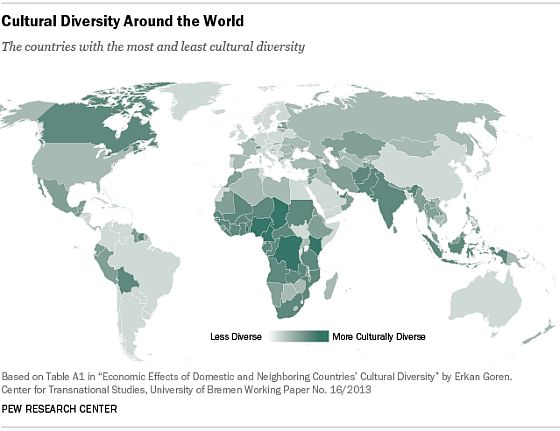
Pew Research Center: Looking for a real multicultural experience? Head to Chad in north-central Africa where 8.6 million residents belong to more than 100 ethnic groups or to Togo, home to 37 tribal groups that speak one of 39 languages and share little in the way of a common culture or history.

But if you find a kaleidoscope of cultures distracting, then consider a visit to Argentina, Haiti or the isolated Comoros islands off the southeast coast of Africa. They rank among the least culturally diverse countries in the world.

This multicultural map of the world is based on an analysis of data reported in a new study of cultural diversity and economic development by researcher Erkan Gören of the University of Oldenberg in Germany.

Facebooktwittermail

How do birds navigate?

The Economist: For decades scientists have known that birds’ ability to navigate with great accuracy over long distances, in some cases migrating from one side of the world to the other, relies on a magnetic sense that humans lack. Experiments with homing pigeons performed in the early 1970s found that attaching a magnet disrupted their ability to orientate themselves. Since then, research has intensified into the precise mechanism of birds’ magnetic sense. So how does it work?

Scientists have focused their attention in three areas: the beak, the inner ear and the eyes. Birds’ beaks contain tiny grains of magnetite, a form of iron oxide which is easily magnetised, and is known to be involved in magnetic sensing in bacteria. But when David Keays of the Institute of Molecular Pathology in Vienna examined the beaks of 200 pigeons, the results were surprising. He found that the magnetite grains were mostly located in macrophages, which are sort of biological garbage collectors that wander around the body, rather than in specialised sense cells. This strengthened the case that birds’ magnetic sense resides not in their beaks, but in their inner ears. Dr Keays and his colleagues changed tack, and earlier this year they reported that they had found tiny concentrations of iron in the neurons of a pigeon’s inner ear.

Case closed? Not quite. The latest research, published in June, suggests the beak does have a role to play after all. [Continue reading…]

Facebooktwittermail

The vexing question of how to sign off from an email

Ben Pobjie writes: The world of modern technology is filled with potential pitfalls to snare the unwary: how to keep sexting discreet; how to commit libel on Twitter without adverse consequence; how to stop playing the game Candy Crush.

But there are few elements of modernity as vexing as the question of how to sign off from an email. It’s an easy task if you want to look like a passive-aggressive tosser, but if you don’t, it’s one of the most fraught decisions you’ll make – and you have to make it over and over again, every day, knowing that if you slip up you might find yourself on the end of a workplace harassment complaint or scathing mockery from colleagues.

Like many people, I most often go for the safe option: the “cheers”. “Cheers, Ben” my emails tend to conclude. The trouble with “cheers” is, first of all, what does it actually mean? Am I literally cheering the person I’m writing to? Am I saying, “hooray!” at the end of my message? Or is it a toast – am I drinking to their health and electronically clinking e-glasses with them? Of course, it’s neither. “Cheers” doesn’t actually mean anything, and it’s also mind-bogglingly unoriginal: all that says to your correspondent is “I have neither the wit nor the inclination to come up with any meaningful way to end this”. [Continue reading…]

Facebooktwittermail

A village invents a language all its own

The New York Times reports: There are many dying languages in the world. But at least one has recently been born, created by children living in a remote village in northern Australia.

Carmel O’Shannessy, a linguist at the University of Michigan, has been studying the young people’s speech for more than a decade and has concluded that they speak neither a dialect nor the mixture of languages called a creole, but a new language with unique grammatical rules.

The language, called Warlpiri rampaku, or Light Warlpiri, is spoken only by people under 35 in Lajamanu, an isolated village of about 700 people in Australia’s Northern Territory. In all, about 350 people speak the language as their native tongue. Dr. O’Shannessy has published several studies of Light Warlpiri, the most recent in the June issue of Language.

“Many of the first speakers of this language are still alive,” said Mary Laughren, a research fellow in linguistics at the University of Queensland in Australia, who was not involved in the studies. One reason Dr. O’Shannessy’s research is so significant, she said, “is that she has been able to record and document a ‘new’ language in the very early period of its existence.” [Continue reading…]

Facebooktwittermail