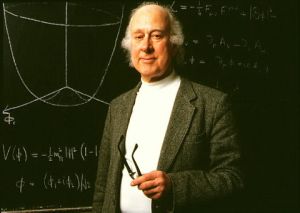
Jeff Forshaw, professor of particle physics at the University of Manchester, writes: There is utter joy in the world of particle physics – Cern’s announcement that a new particle has been discovered will have long-lasting consequences for our understanding of how the universe works and it paves the way for a swathe of exciting new results over the coming years.
All the evidence points to this new particle being the long-sought Higgs boson. Its discovery is testament not only to the brilliance of the experimental physicists and engineers from around the world who have built the Large Hadron Collider but also to the theoretical physicists who dreamed of its existence almost 50 years ago.
Fundamental science like this is thrilling, not least because of the way that years of hard work, experimentation and mathematical analysis have led us to a worldview of astonishing simplicity and beauty.
We have learned that the universe is made up of particles and that those particles dance around in a crazy quantum way. But the rules of the game are simple – they can be codified (almost) on the back of an envelope and they express the fact that, at its most elemental level, the universe is governed by symmetry. Symmetry and simplicity go hand in hand – half a snowflake is enough information to anticipate what the other half looks like – and so it is with those dancing particles. The discovery that nature is beautifully symmetric means we have very little choice in how the elementary particles do their dance – the rules simply “come for free”. Why the universe should be built in such an elegant fashion is not understood yet, but it leaves us with a sense of awe and wonder that we should be privileged to live in such a place. [Continue reading…]
Please consider supporting the MIDWAY film project:
The MIDWAY film will take the viewer on a stunning visual journey into the heart of an astonishingly symbolic environmental tragedy.
Near the heart of the Pacific Ocean, Midway Island is one of the most remote places on Earth, and the iconic site of a world-changing naval battle. Today Midway is inhabited by a million Laysan albatrosses — magnificent and beautiful seabirds who range over the entire Pacific from their home base on the island. Midway is a multi-layered kaleidoscope of natural wonder and human history, and it also serves as a powerful lens into a shocking environmental tragedy: tens of thousands of albatrosses lie dead on the ground, their bodies filled with plastic from the Pacific Garbage Patch.
Returning to the island over several years, our team has witnessed and filmed cycles of birth, life, and death of these birds as a multi-layered metaphor for our time. With internationally acclaimed artist Chris Jordan as our guide, our film will walk directly into the fire of horror and grief, facing the immensity of this tragedy—and our own complicity—head on. And in this process, we discover a unexpected doorway to a deeply felt experience of hope, beauty and reverence for the mystery and miracle of our world. Stepping far outside the stylistic templates of traditional environmental or documentary films, MIDWAY will take viewers on a lyrical guided tour into the depths of their own spirits, delivering a profound message of renewal and love that is already reaching an audience of millions of people around the globe.
Please join our story
Through this KICKSTARTER we hope to finance our two final trips to Midway to complete our filming, including the cost of a remote-controlled helicopter and pilot to film spectacular aerial shots of the island; and the cost of bringing a world-class editor onto our team to help us cut the film together.
We also are seeking additional funding to complete production of the film for release. This includes the cost of the musical score (original composition and studio recording); sound editing and mix-down fees; color correction and title editing; production of multiple versions of the film for release through television, internet, theaters, etc.; translation of the film into multiple languages for international release; creation of educational curriculum materials for teachers; creation of a state-of-the art website and mobile apps with user forums and additional resource materials; and other associated costs to reach a global audience with our message.
Every contribution helps, however small!
We are a team of devoted artists who believe that the mythical story of Midway has the power to break open the hearts and minds of viewers worldwide. Our job is simply to honor this story as it has revealed itself to us, and deliver it to a global audience with the best quality filming, editing, production, and distribution that we can achieve. The process has been transformational to everyone on our team, and we look forward to sharing our results with you in 2013. Thank you for your contribution.
~with big smiles from chris jordan and the Midway team.
Themis Bowcock writes: Early this morning, the physicists sat, with the media poised, waiting for two technical seminars from Cern to be delivered. There was only one question we all really wanted answered – would there be enough evidence to prove the Higgs particle had been discovered?
In London, John Womersley told us: “I can confirm that a particle has been discovered that is consistent with the Higgs boson theory.” In Cern, a spokesman said: “This is a preliminary result, but we think it’s very strong and very solid.” So there we have it. But what does the discovery of the Higgs actually mean to us? The answers lie in what the Higgs particle is and precisely what its role is in how the universe works.
About 50 years ago, physicists were faced with a conundrum in their theories of quantum mechanics, which describes nature at its most fundamental level. A successful theory called quantum electro-dynamics had been developed, which explained how particles of light and matter interacted. It was described as the “jewel of physics”, but while it correctly assumed that particles of light had no mass, it left a gap in our understanding of why otherwise similar particles were very heavy. For example we now know the particle of the force responsible for radioactivity is 100 times heavier than a hydrogen atom, but at the time we didn’t understand why. Two British scientists, Tom Kibble and Peter Higgs, decided to tackle this problem. They discovered that it is theoretically possible to make a particle without mass behave as if it did.
The Higgs theory suggested that nature, as it cooled after the big bang, froze into a unique configuration. The Higgs mechanism predicted that new particles came into existence as part of this freezing – “children” of the freeze. We now believe these Higgs particles are responsible for giving fundamental particles their mass and can leave them heavy or completely without mass; it’s as if the stickier a particle is to the Higgs, the heavier it is.
One of the great aims of modern physics has been to generate these Higgs particles. To create the right conditions for their study, huge accelerators such as the Tevatron in Illinois and the Large Hadron Collider in Geneva were built involving thousands of physicists and tens of thousands of engineers over decades, with funding from around the globe.
The Higgs particle is the first truly new particle that mankind has conceived – and now discovered – for millennia. Philosophers and scientists have reduced the world first to atoms, then fundamental particles, and then even the very quanta of the forces such as light.
The Higgs particle is not simply about the matter of which we are composed, nor about how it communicates (like light reaching our eyes from a distant galaxy), nor is it another layer of an infinite onion of smaller and smaller particles. It is the first part of the mechanism that tells us why the universe is the way it is today, why the stars burn the way they do and why light and matter are the way they are. Who among us can begin to imagine where this will lead in a century, let alone a millennium? [Continue reading…]
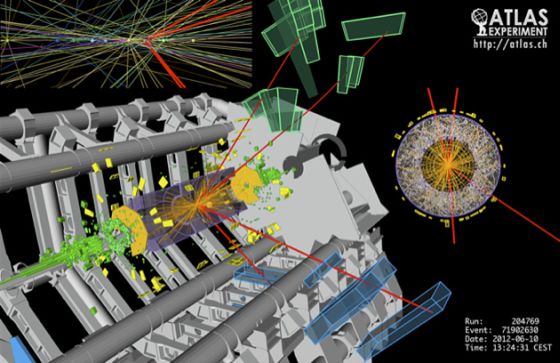
'The search is more advanced today than we imagined possible,' said ATLAS spokesperson Fabiola Gianotti. 'We observe in our data clear signs of a new particle, at the level of 5 sigma, in the mass region around 126 GeV. The outstanding performance of the LHC and ATLAS and the huge efforts of many people have brought us to this exciting stage. A little more time is needed to finalize these results, and more data and more study will be needed to determine the new particle’s properties.'
Wired Science reports: Prepare the fireworks: The discovery of the Higgs boson is finally here. Early in the morning on July 4, physicists with the Large Hadron Collider at CERN announced they have found a new particle that behaves similarly to what is expected from the Higgs.
“As a layman, I would now say, I think we have it,” said CERN director-general Rolf-Dieter Heuer. “It’s a historic milestone today. I think we can all be proud, all be happy.” Both CMS and ATLAS, the two main LHC Higgs-hunting experiments, are reporting a boson that has Higgs-like properties at a mass of 125 gigaelectronvolts (GeV) with a 5-sigma significance, meaning they are 99.999 percent confident of its existence.
At the first mention of 5-sigma by physicist Joe Incandela, who presented results from one of the main Higgs-searching efforts at the LHC, the audience burst into applause. “It was really a magnificent moment to see the reaction from the community,” he said later in a question and answer session. “Emotionally it didn’t really hit me until today because we have had to be so focused, and so much work to do.”
Though CERN scientists are making sure to be cautious about over-interpreting their data, the results are impressive and historic, and today will likely go down as the day the Higgs discovery was announced.
“This boson is a very profound thing that we have found. This is not like other ordinary particles,” Incandela said. “We are reaching into the fabric of the universe like we’ve never done before. It’s a key to the structure of the universe.”
First hypothesized in the 1960s, the Higgs boson is the final piece of the Standard Model, the physics framework explaining the interactions of all known subatomic particles and forces. The Higgs has been the subject of an extensive two-decade search, first at the European Large Electron-Positron Collider, then the Tevatron at Fermilab in Illinois, and finally at the LHC. Finding the Higgs within the predicted energy range is a major vindication for the Standard Model.
“I never expected this to happen in my lifetime and shall be asking my family to put some champagne in the fridge,” physicist Peter Higgs, the particle’s namesake who first theorized the existence of the particle, said in a statement.Peter Higgs
The Higgs is certainly the most important discovery in the field for a generation. The last of the Standard Model’s 16 particles to be found was the top quark, discovered at Fermilab’s Tevatron in 1995, while many physicists would point to the detection of the W and Z boson in 1983 as the field’s most recent monumental finding. And considering that it is gives rise to the mass of all other particles, the Higgs may well be the most important new particle found for years to come.
Discovering the Higgs boson is not likely to radically change life for most people — it will not lead to better communications devices or fancy new electronics. But knowing its characteristics will bring physicists a better understanding of nature. The Higgs is important because it is the manifestation of the Higgs field, which is thought to permeate all of space and interact with all other subatomic particles. This interaction leads to the different mass for each elementary particle. Some particles, like protons, are slowed by this field, like a tennis ball going through molasses, and are relatively heavy while others, like electrons, shoot rapidly through like BB gun pellets, making them light.
Phys.org explains: A Higgs boson is an excitation – a fleeting, grainy representation – of the Higgs field, which extends throughout space and gives all other particles their mass.
At the instant of the big bang, everything was the same as everything else, a state of symmetry that lasted no time and was immediately broken. Particles of matter called fermions emerged from the sea of energy (mass and energy being interchangeable), including quarks and electrons that would much later form atoms. Along with them came force-carrying particles called bosons to rule how they all were related. All had different masses – sometimes wildly different masses.
Using the concepts of a Higgs field and Higgs boson, the Standard Model explains why quarks, protons, electrons, photons, and a wide-ranging zoo of other particles have the specific masses they do. Oddly, however, the Standard Model can’t predict the mass of the Higgs itself. That will only be learned from experiment.
The following animation explains the Higgs boson. (The very noisy intro in the CERN cafeteria only lasts about 40 seconds.)
More on the Large Hadron Collider, particle physics and the evolution of the universe from English particle physicist, Brian Cox.

On the tricentenary of Jean-Jacques Rousseau’s birth, Terry Eagleton writes: Much of what one might call the modern sensibility was this thinker’s creation. It is in Rousseau’s writing above all that history begins to turn from upper-class honour to middle-class humanitarianism. Pity, sympathy and compassion lie at the centre of his moral vision. Values associated with the feminine begin to infiltrate social existence as a whole, rather than being confined to the domestic sphere. Gentlemen begin to weep in public, while children are viewed as human beings in their own right rather than defective adults.
Above all, Rousseau is the explorer of that dark continent, the modern self. It is no surprise that he wrote one of the most magnificent autobiographies of all time, his Confessions. Personal experience starts to take on a significance it never had for Plato or Descartes. What matters now is less objective truth than truth-to-self – a passionate conviction that one’s identity is uniquely precious, and that expressing it as freely and richly as possible is a sacred duty. In this belief, Rousseau is a forerunner not only of the Romantics, but of the liberals, existentialists and spiritual individualists of modern times.
It is true that he seems to have held the view that no identity was more uniquely precious than his own. For all his cult of tenderness and affection, Rousseau was not the kind of man with whom one would share one’s picnic. He was the worst kind of hypochondriac – one who really is always ill – and that most dangerous of paranoiacs – one who really is persecuted. Even so, at the heart of an 18th-century Enlightenment devoted to reason and civilisation, this maverick intellectual spoke up for sentiment and nature. He was not, to be sure, as besotted by the notion of the noble savage as some have considered. But he was certainly a scourge of the idea of civilisation, which struck him for the most part as exploitative and corrupt.
In this, he was a notable precursor of Karl Marx. Private property, he wrote, brings war, poverty and class conflict in its wake. It converts “clever usurpation into inalienable right”. Most social order is a fraud perpetrated by the rich on the poor to protect their privileges. The law, he considered, generally backs the strong over the weak; justice is largely a weapon of violence and domination, while culture, science, the arts and religion are harnessed to the task of preserving the status quo. The institution of the state has “bound new fetters on the poor and given new powers to the rich”. For the benefit of a few ambitious men, he comments, “the human race has been subjected to labour, servitude and misery”. [Continue reading…]
Macquarie University: There is strong evidence to support the discovery of a new European language.
Macquarie University historical linguistics researcher, Associate Professor Ilija Casule, discovered that the language, known as Burushaski, which is spoken by about 90,000 people who reside in a remote area of North West Pakistan, is Indo-European in origin, not Indo-Iranian.
Professor Casule’s discovery, which has now been verified by a number of the world’s top linguists, has excited linguistics experts around the world. An entire issue of the eminent international linguistics journal The Journal of Indo-European Studies is devoted to a discussion of his findings later this month.
More than 50 eminent linguists have tried over many years to determine the genetic relationship of Burushaski. But it was Casule’s painstaking research, based on a comprehensive grammatical, phonological, lexical and semantic analysis, which established that the Burushaski language is in fact an Indo-European language most likely descended from one of the ancient Balkan languages. Professor Casule believes that language is most probably ancient Phrygian.
The Phrygians migrated from Macedonia to Anatolia (today part of Turkey) and were famous for their legendary kings who figure prominently in Greek mythology such as King Midas who turned whatever he touched into gold. They later migrated further east, reaching India. Indeed, according to ancient legends of the Burushashki people, they are descendants of Alexander the Great.
Tracing the historical path of a language is no easy task. Professor Casule said he became interested in the origins of Burushaski more than 20 years ago.
“People knew of its existence but its Indo-European affiliation was overlooked and it was not analysed correctly. It is considered a language isolate – not related to any other language in the world in much the same way that the Basque language is classified as a language isolate,” he said.
The remoteness of the area that was independent until the early 1970s when it became part of Pakistan, ensured Burushaski retained certain grammatical and lexical features that led Professor Casule to conclude it is a North-Western Indo-European language, specifically of the Paleobalkanic language group and that it corresponds most closely with Phrygian.
Dr Casule’s work is groundbreaking, not only because it has implications for all the Indo-European language groups, but also provides a new model for figuring out the origins of isolate languages – where they reside in the linguistic family tree and how they developed and blended with other languages to form a new language.
Areas of North West Pakistan where Burushaski is spoken, marked in green:


The New York Times reports: Stone Age artists were painting red disks, handprints, clublike symbols and geometric patterns on European cave walls long before previously thought, in some cases more than 40,000 years ago, scientists reported on Thursday, after completing more reliable dating tests that raised a possibility that Neanderthals were the artists.
A more likely situation, the researchers said, is that the art — 50 samples from 11 caves in northwestern Spain — was created by anatomically modern humans fairly soon after their arrival in Europe.
The findings seem to put an exclamation point to a run of recent discoveries: direct evidence from fossils that Homo sapiens populations were living in England 41,500 to 44,200 years ago and in Italy 43,000 to 45,000 years ago, and that they were making flutes in German caves about 42,000 years ago. Then there is the new genetic evidence of modern human-Neanderthal interbreeding, suggesting a closer relationship than had been generally thought.
The successful application of a newly refined uranium-thorium dating technique is also expected to send other scientists to other caves to see if they can reclaim prehistoric bragging rights.
In the new research, an international team led by Alistair W. G. Pike of the University of Bristol in England determined that the red disk in the cave known as El Castillo was part of the earliest known wall decorations, at a minimum of 40,800 years old. That makes it the earliest cave art found so far in Europe, perhaps 4,000 years older than the paintings at Grotte Chauvet in France. [Continue reading…]
NPR reports: Scientists Wednesday unveiled the first catalog of the bacteria, viruses and other microorganisms that populate every nook and cranny of the human body.
Researchers hope the advance marks an important step towards understanding how microbes help make humans human.
The human body contains about 100 trillion cells, but only maybe one in 10 of those cells is actually — human. The rest are from bacteria, viruses and other microorganisms.
“The human we see in the mirror is made up of more microbes than human,” said Lita Proctor of the National Institutes of Health, who’s leading the Human Microbiome Project.
“The definition of a human microbiome is all the microbial microbes that live in and on our bodies but also all the genes — all the metabolic capabilities they bring to supporting human health,” she said.
These microbes aren’t just along for the ride. They’re there for a reason. We have a symbiotic relationship with them — we give them a place to live, and they help keep us alive. [Continue reading…]
Vocal: Dhafer Youssef
Diane Ackerman writes: It was a spring morning in upstate New York, one so cold the ground squeaked loudly underfoot as sharp-finned ice crystals rubbed together. The trees looked like gloved hands, fingers frozen open. A crow veered overhead, then landed. As snow flurries began, it leapt into the air, wings aslant, catching the flakes to drink. Or maybe just for fun, since crows can be mighty playful.
Another life form curved into sight down the street: a girl laughing down at her gloveless fingers which were texting on some hand-held device.
This sight is so common that it no longer surprises me, though strolling in a large park one day I was startled by how many people were walking without looking up, or walking in a myopic daze while talking on their “cells,” as we say in shorthand, as if spoken words were paddling through the body from one saltwater lagoon to another.
As a species, we’ve somehow survived large and small ice ages, genetic bottlenecks, plagues, world wars and all manner of natural disasters, but I sometimes wonder if we’ll survive our own ingenuity. At first glance, it seems as if we may be living in sensory overload. The new technology, for all its boons, also bedevils us with alluring distractors, cyberbullies, thought-nabbers, calm-frayers, and a spiky wad of miscellaneous news. Some days it feels like we’re drowning in a twittering bog of information.
But, at exactly the same time, we’re living in sensory poverty, learning about the world without experiencing it up close, right here, right now, in all its messy, majestic, riotous detail. The further we distance ourselves from the spell of the present, explored by our senses, the harder it will be to understand and protect nature’s precarious balance, let alone the balance of our own human nature. [Continue reading…]
Decca Aitkenhead interviews Slavoj Žižek: At the risk of upsetting Žižek’s fanatical global following, I would say that a lot of his work is impenetrable. But he writes with exhilarating ambition and his central thesis offers a perspective even his critics would have to concede is thought-provoking. In essence, he argues that nothing is ever what it appears, and contradiction is encoded in almost everything. Most of what we think of as radical or subversive – or even simply ethical – doesn’t actually change anything.
“Like when you buy an organic apple, you’re doing it for ideological reasons, it makes you feel good: ‘I’m doing something for Mother Earth,’ and so on. But in what sense are we engaged? It’s a false engagement. Paradoxically, we do these things to avoid really doing things. It makes you feel good. You recycle, you send £5 a month to some Somali orphan, and you did your duty.” But really, we’ve been tricked into operating safety valves that allow the status quo to survive unchallenged? “Yes, exactly.” The obsession of western liberals with identity politics only distracts from class struggle, and while Žižek doesn’t defend any version of communism ever seen in practice, he remains what he calls a “complicated Marxist” with revolutionary ideals.
To his critics, as one memorably put it, he is the Borat of philosophy, churning out ever more outrageous statements for scandalous effect. “The problem with Hitler was that he was not violent enough,” for example, or “I am not human. I am a monster.” Some dismiss him as a silly controversialist; others fear him as an agitator for neo-Marxist totalitarianism. But since the financial crisis he has been elevated to the status of a global-recession celebrity, drawing crowds of adoring followers who revere him as an intellectual genius. His popularity is just the sort of paradox Žižek delights in because if it were down to him, he says, he would rather not talk to anyone.
You wouldn’t guess so from the energetic flurry of good manners with which he welcomes us, but he’s quick to clarify that his attentiveness is just camouflage for misanthropy. “For me, the idea of hell is the American type of parties. Or, when they ask me to give a talk, and they say something like, ‘After the talk there will just be a small reception’ – I know this is hell. This means all the frustrated idiots, who are not able to ask you a question at the end of the talk, come to you and, usually, they start: ‘Professor Žižek, I know you must be tired, but …’ Well, fuck you. If you know that I am tired, why are you asking me? I’m really more and more becoming Stalinist. Liberals always say about totalitarians that they like humanity, as such, but they have no empathy for concrete people, no? OK, that fits me perfectly. Humanity? Yes, it’s OK – some great talks, some great arts. Concrete people? No, 99% are boring idiots.” [Continue reading…]