



Bashnia Tatlina Tower Bawher:
Ari LeVaux writes: Chinese researchers have found small pieces of ribonucleic acid (RNA) in the blood and organs of humans who eat rice. The Nanjing University-based team showed that this genetic material will bind to proteins in human liver cells and influence the uptake of cholesterol from the blood.
The type of RNA in question is called microRNA, due to its small size. MicroRNAs have been studied extensively since their discovery ten years ago, and have been linked to human diseases including cancer, Alzheimer’s, and diabetes. The Chinese research provides the first example of ingested plant microRNA surviving digestion and influencing human cell function.
Should the research survive scientific scrutiny, it could prove a game changer in many fields. It would mean that we’re eating not just vitamins, protein, and fuel, but information as well.
That knowledge could deepen our understanding of cross-species communication, co-evolution, and predator-prey relationships. It could illuminate new mechanisms for some metabolic disorders and perhaps explain how some herbal medicines function. And it reveals a pathway by which genetically modified (GM) foods might influence human health.
Monsanto’s website states, “There is no need for, or value in testing the safety of GM foods in humans.” This viewpoint, while good for business, is built on an understanding of genetics circa 1950. It follows what’s called the “Central Dogma” (PDF) of genetics, which postulates a one-way chain of command between DNA and the cells DNA governs.
The Central Dogma resembles the process of ordering a pizza. The DNA knows what kind of pizza it wants, and orders it. The RNA is the order slip, which communicates the specifics of the pizza to the cook. The finished and delivered pizza is analogous to the protein that DNA codes for.
We’ve known for years that the Central Dogma, though basically correct, is overly simplistic. For example: Pieces of microRNA that don’t code for anything, pizza or otherwise, can travel among cells and influence their activities in many other ways. So while the DNA is ordering pizza, it’s also bombarding the pizzeria with unrelated RNA messages that can cancel a cheese delivery, pay the dishwasher nine million dollars, or email the secret sauce recipe to WikiLeaks.
Monsanto’s claim that human toxicology tests are unwarranted is based on the doctrine of “substantial equivalence.” This term is used around the world as the basis of regulations designed to facilitate the rapid commercialization of genetically engineered foods, by sparing them from extensive safety testing.
According to substantial equivalence, comparisons between GM and non-GM crops need only investigate the end products of DNA translation: the pizza, as it were. “There is no need to test the safety of DNA introduced into GM crops. DNA (and resulting RNA) is present in almost all foods,” Monsanto’s website reads. “DNA is non-toxic and the presence of DNA, in and of itself, presents no hazard.”
The Chinese RNA study threatens to blast a major hole in that claim. It means that DNA can code for microRNA, which can, in fact, be hazardous.
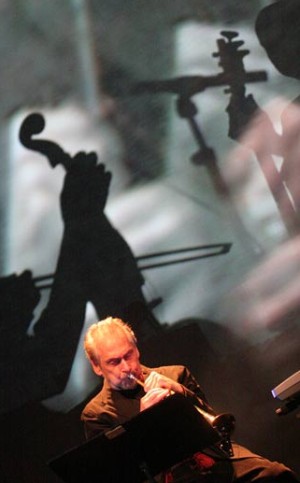 “Jon Hassell is more than a superb musician, and more even than a gifted composer. He is an inventor of new forms of music — of new ideas of what music could be, and how it might be made. His work is drawn from his whole being, and, by implication, from his whole cultural experience without fear or prejudice. It is an optimistic, global vision that suggests not only possible musics but possible futures.” — Brian Eno
The creator of “Fourth World” music described his ambition in this way: “My aim was to make a music that was vertically integrated in such a way that at any cross-sectional moment you were not able to pick a single element out as being from a particular country or genre of music.”
The following pieces, “Last Night the Moon Came”, and “Blue Period/Light on Water”, performed live in Lausanne, Switzerland, in 2009, come from his most recent album, “Last Night the Moon Came Dropping Its Clothes in the Street” (a line from Rumi).
On Public Radio International, Hassell describes the process, the allusions, and the musical theory that underpins his Fourth World music.
To learn more, visit Jon Hassell’s web site.

Farhad Manjoo writes: Today, Facebook is publishing a study that disproves some hoary conventional wisdom about the Web. According to this new research, the online echo chamber doesn’t exist.
This is of particular interest to me. In 2008, I wrote True Enough, a book that argued that digital technology is splitting society into discrete, ideologically like-minded tribes that read, watch, or listen only to news that confirms their own beliefs. I’m not the only one who’s worried about this. Eli Pariser, the former executive director of MoveOn.org, argued in his recent book The Filter Bubble that Web personalization algorithms like Facebook’s News Feed force us to consume a dangerously narrow range of news. The echo chamber was also central to Cass Sunstein’s thesis, in his book Republic.com, that the Web may be incompatible with democracy itself. If we’re all just echoing our friends’ ideas about the world, is society doomed to become ever more polarized and solipsistic?
It turns out we’re not doomed. The new Facebook study is one of the largest and most rigorous investigations into how people receive and react to news. It was led by Eytan Bakshy, who began the work in 2010 when he was finishing his Ph.D. in information studies at the University of Michigan. He is now a researcher on Facebook’s data team, which conducts academic-type studies into how users behave on the teeming network.
Bakshy’s study involves a simple experiment. Normally, when one of your friends shares a link on Facebook, the site uses an algorithm known as EdgeRank to determine whether or not the link is displayed in your feed. In Bakshy’s experiment, conducted over seven weeks in the late summer of 2010, a small fraction of such shared links were randomly censored—that is, if a friend shared a link that EdgeRank determined you should see, it was sometimes not displayed in your feed. Randomly blocking links allowed Bakshy to create two different populations on Facebook. In one group, someone would see a link posted by a friend and decide to either share or ignore it. People in the second group would not receive the link—but if they’d seen it somewhere else beyond Facebook, these people might decide to share that same link of their own accord.
By comparing the two groups, Bakshy could answer some important questions about how we navigate news online. Are people more likely to share information because their friends pass it along? And if we are more likely to share stories we see others post, what kinds of friends get us to reshare more often—close friends, or people we don’t interact with very often? Finally, the experiment allowed Bakshy to see how “novel information”—that is, information that you wouldn’t have shared if you hadn’t seen it on Facebook—travels through the network. This is important to our understanding of echo chambers. If an algorithm like EdgeRank favors information that you’d have seen anyway, it would make Facebook an echo chamber of your own beliefs. But if EdgeRank pushes novel information through the network, Facebook becomes a beneficial source of news rather than just a reflection of your own small world.
That’s exactly what Bakshy found. His paper is heavy on math and network theory, but here’s a short summary of his results. First, he found that the closer you are with a friend on Facebook—the more times you comment on one another’s posts, the more times you appear in photos together, etc.—the greater your likelihood of sharing that person’s links. At first blush, that sounds like a confirmation of the echo chamber: We’re more likely to echo our closest friends.
But here’s Bakshy’s most crucial finding: Although we’re more likely to share information from our close friends, we still share stuff from our weak ties—and the links from those weak ties are the most novel links on the network. Those links from our weak ties, that is, are most likely to point to information that you would not have shared if you hadn’t seen it on Facebook. The links from your close ties, meanwhile, more likely contain information you would have seen elsewhere if a friend hadn’t posted it. These weak ties “are indispensible” to your network, Bakshy says. “They have access to different websites that you’re not necessarily visiting.” [Continue reading…]
John Brockman, creator of Edge, presents 191 answers to the question: What is your favorite deep, elegant, or beautiful explanation?
Clay Shirky responds: Why do groups of people behave the same way? Why do they behave differently from other groups living nearby? Why are those behaviors so stable over time? Alas, the obvious answer—cultures are adaptations to their environments—doesn’t hold up. Multiple adjacent cultures along the Indus, the Euphrates, the Upper Rhine, have differed in language, dress, and custom, despite existing side-by-side in almost identical environments.
Something happens to keep one group of people behaving in a certain set of ways. In the early 1970s, both E.O. Wilson and Richard Dawkins noticed that the flow of ideas in a culture exhibited similar patterns to the flow of genes in a species—high flow within the group, but sharply reduced flow between groups. Dawkins’ response was to assume a hypothetical unit of culture called the meme, though he also made its problems clear—with genetic material, perfect replication is the norm, and mutations rare. With culture, it is the opposite—events are misremembered and then misdescribed, quotes are mangled, even jokes (pure meme) vary from telling to telling. The gene/meme comparison remained, for a generation, an evocative idea of not much analytic utility.
Dan Sperber has, to my eye, cracked this problem. In a slim, elegant volume of 15 years ago with the modest title Explaining Culture, he outlined a theory of culture as the residue of the epidemic spread of ideas. In this model, there is no meme, no unit of culture separate from the blooming, buzzing confusion of transactions. Instead, all cultural transmission can be reduced to one of two types: making a mental representation public, or internalizing a mental version of a public presentation. As Sperber puts it, “Culture is the precipitate of cognition and communication in a human population.”
Sperber’s two primitives—externalization of ideas, internalization of expressions—give us a way to think of culture not as a big container people inhabit, but rather as a network whose traces, drawn carefully, let us ask how the behaviors of individuals create larger, longer-lived patterns. Some public representations are consistently learned and then re-expressed and re-learned—Mother Goose rhymes, tartan patterns, and peer review have all survived for centuries. Others move from ubiquitous to marginal in a matter of years—pet rocks, the Pina Colada song. Still others thrive only within a subcultural domain—cosplay, Civil War re-enactment. (Indeed, a sub-culture is simply a network of people who traffic in particular representations, representations that are largely inert in the larger culture.)
With Sperber’s network-tracing model, culture is best analyzed as an overlapping set of transactions, rather than as a container or a thing or a force. Given this, we can ask detailed questions about which private ideas are made public where, and we can ask when and how often those public ideas take hold in individual minds.
Computerworld reports: IBM announced Thursday that after five years of work, its researchers have been able to reduce from about one million to 12 the number of atoms required to create a bit of data.
The breakthrough may someday allow data storage hardware manufacturers to produce products with capacities that are orders of magnitude greater than today’s hard disk and flash drives.
“Looking at this conservatively … instead of 1TB on a device you’d have 100TB to 150TB. Instead of being able to store all your songs on a drive, you’d be able to have all your videos on the device,” said Andreas Heinrich, IBM Research Staff Member and lead investigator on this project.
Today, storage devices use ferromagnetic materials where the spin of atoms are aligned or in the same direction.
The IBM researchers used an unconventional form of magnetism called antiferromagnetism, where atoms spin in opposite directions, allowing scientists to create an experimental atomic-scale magnet memory that is at least 100 times denser than today’s hard disk drives and solid-state memory chips.
PopSci reports: Each star in the Milky Way shines its light upon at least one companion planet, according to a new analysis that suddenly renders exoplanets commonplace, the rule rather than the exception. This means there are billions of worlds just in our corner of the cosmos. This is a major shift from just a few years ago, when many scientists thought planets were tricky to make, and therefore special things. Now we know they’re more common than stars themselves.
“Planets are like bunnies; you don’t just get one, you get a bunch,” said Seth Shostak, a senior astronomer at the SETI Institute who was not involved in this research. “So really, the number of planets in the Milky Way is probably like five or 10 times the number of stars. That’s something like a trillion planets.”
Of course there’s no way to know, at least not yet, how many of these worlds could be hospitable to forms of life as we know it. But the odds alone are tantalizing, Shostak said.
“It’s not unreasonable at this point to say there are literally billions of habitable worlds in our galaxy, probably as a lower limit,” he said. “Maybe they’re all sterile as an autoclave, but it doesn’t seem very likely, does it? That would make us very odd.”
Regular readers of War in Context might be perplexed about some of the items that have been popping up here lately — particularly those that appear under my generic and cryptic byline: Attention to the Unseen.
Here’s another one — but this isn’t just another seemingly “off-topic” post. It also illustrates one of the reasons I am picking out such items.
In Intelligent Life, Ian Leslie writes: One day in 1945, a man named Percy Spencer was touring one of the laboratories he managed at Raytheon in Waltham, Massachusetts, a supplier of radar technology to the Allied forces. He was standing by a magnetron, a vacuum tube which generates microwaves, to boost the sensitivity of radar, when he felt a strange sensation. Checking his pocket, he found his candy bar had melted. Surprised and intrigued, he sent for a bag of popcorn, and held it up to the magnetron. The popcorn popped. Within a year, Raytheon made a patent application for a microwave oven.
The history of scientific discovery is peppered with breakthroughs that came about by accident. The most momentous was Alexander Fleming’s discovery of penicillin in 1928, prompted when he noticed how a mould that floated into his Petri dish killed off the surrounding bacteria. Spencer and Fleming didn’t just get lucky. Spencer had the nous and the knowledge to turn his observation into innovation; only an expert on bacteria would have been ready to see the significance of Fleming’s stray spore. As Louis Pasteur wrote, “In the field of observation, chance favours only the prepared mind.”
The word that best describes this subtle blend of chance and agency is “serendipity”. It was coined by Horace Walpole, man of letters and aristocratic dilettante. Writing to a friend in 1754, Walpole explained an unexpected discovery he had just made by reference to a Persian fairy tale, “The Three Princes of Serendip”. The princes, he told his correspondent, were “always making discoveries, by accidents and sagacity, of things which they were not in quest of…now do you understand Serendipity?” These days, we tend to associate serendipity with luck, and we neglect the sagacity. But some conditions are more conducive to accidental discovery than others.
Today’s world wide web has developed to organise, and make sense of, the exponential increase in information made available to everyone by the digital revolution, and it is amazingly good at doing so. If you are searching for something, you can find it online, and quickly. But a side-effect of this awesome efficiency may be a shrinking, rather than an expansion, of our horizons, because we are less likely to come across things we are not in quest of.
To some extent, War in Context reflects this web-wide narrowing of attention in its focus on Middle East politics. But now, in my own attempt to buck this wider trend and also reflect the fact that my own interests are not limited to the enduring political reverberations of 9/11, I am using “attention to the unseen” as an amorphous theme where I will call attention to gleanings from the web covering topics as diverse as endangered cultures and neuroscience, or the social organization of bees and avant-garde accordion music.
Professor Renata Salecl explores the paralyzing anxiety and dissatisfaction surrounding limitless choice. Her unedited, unanimated talk can be viewed here.
Christopher Ryan challenges Steven Pinker’s dubious claim that we live in the most peaceful of times. Pinker bases his argument on a comparison of male deaths due to war using what he treats as modern tribal correlates of our hunter-gatherer ancestors.
The seven cultures listed on Pinker’s chart are the Jivaro, two branches of Yanomami, the Mae Enga, Dugum Dani, Murngin, Huli, and Gebusi.
Are these societies actually representative of our hunter-gatherer ancestors?
No.
Are they even hunter-gatherers at all?
Hell no.
Only the Murngin even approach being an immediate-return hunter-gatherer society like our prehistoric ancestors, and they had been living with missionaries, guns, and aluminum powerboats for decades by 1975, when the data Pinker cites were collected.
None of the other societies cited by Pinker are even arguably immediate-return hunter-gatherers like our ancestors. They cultivate yams, bananas, or sugarcane in village gardens while raising domesticated pigs, llamas, or chickens. This is crucial, because societies are far more likely to wage war when they have things worth fighting over (pigs, gardens, settled villages), but tend to be far less conflictive when living as nomadic hunter-gatherers, with little to plunder or defend. Any first-year anthropology student knows this. Presumably, so does Pinker.
Beyond the fact that these societies are not remotely representative of our nomadic hunter-gatherer ancestors, there are more problems with the data Pinker cites. Among the Yanomami, true levels of warfare are subject to passionate debate among anthropologists. The Murngin are not typical even of Australian native cultures, representing a bloody exception to the typical pattern of little to no intergroup conflict. Nor does Pinker get the Gebusi right. Bruce Knauft, the anthropologist whose research is cited on this chart, reports that warfare is “rare” among the Gebusi, writing, “Disputes over territory or resources are extremely infrequent and tend to be easily resolved.”
To make matters even worse, Pinker juxtaposes these bogus “hunter-gatherer” mortality rates with a tiny bar showing the relatively few “war-related deaths of males in twentieth-century United States and Europe.” This is a false comparison because the twentieth century gave birth to “total war” between nations, in which civilians were targeted (Dresden, Hiroshima, Nagasaki… ), so counting only male military deaths requires ignoring all the millions of civilians victimized by war.