Author Archives: Attention to the Unseen

The intricate circuitry revealed in new mapping of the neurons of touch

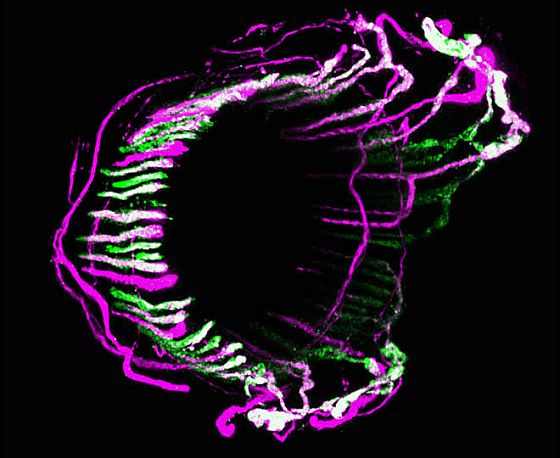
Guard hair palisade neural endings cell in a mouse.

Wired reports on a study [PDF] mapping tactile neurons, co-authored by Jeff Woodbury of the University of Wyoming: To untangle the wiring, Woodbury and other researchers led by neuroscientist David Ginty of Johns Hopkins University began with mouse nervous systems. They focused on a class of nerve endings called low-threshold mechanosensory receptors, or LTMRs, which are sensitive to the slightest of sensations: a mosquito’s footsteps, a hint of breeze.

The researchers identified genes active only in types of LTMRs at the base of ultra-sensitive hairs. Then, in mouse embryos, they tagged those genes with fluorescent proteins. The result: an engineered mouse strain illuminating the full, precise paths of LTMR cells.

Under a microscope, the researchers tracked three different types of LTMRs in never-before-seen detail, plus a fourth well-studied type. “This enabled us, for the first time, to nail down and tie specialized nerve endings to functions,” Woodbury said.

By following LTMRs all the way into ganglia and out the other side into the spinal cord, the researchers discovered a layering pattern that resembles the organization of neurons in the cerebral cortex — the outermost layer of the brain with major roles in consciousness, memory, attention and other roles.

With four of the two dozen different nerve ending types now traceable, the researchers are now working to tag the rest. Someday, perhaps, their technique could lead to complete neural maps of touch.

Facebooktwittermail

Neuroscience vs philosophy: Taking aim at free will

The leading science journal, Nature, reports: The experiment helped to change John-Dylan Haynes’s outlook on life. In 2007, Haynes, a neuroscientist at the Bernstein Center for Computational Neuroscience in Berlin, put people into a brain scanner in which a display screen flashed a succession of random letters. He told them to press a button with either their right or left index fingers whenever they felt the urge, and to remember the letter that was showing on the screen when they made the decision. The experiment used functional magnetic resonance imaging (fMRI) to reveal brain activity in real time as the volunteers chose to use their right or left hands. The results were quite a surprise.

“The first thought we had was ‘we have to check if this is real’,” says Haynes. “We came up with more sanity checks than I’ve ever seen in any other study before.”

The conscious decision to push the button was made about a second before the actual act, but the team discovered that a pattern of brain activity seemed to predict that decision by as many as seven seconds. Long before the subjects were even aware of making a choice, it seems, their brains had already decided.

As humans, we like to think that our decisions are under our conscious control — that we have free will. Philosophers have debated that concept for centuries, and now Haynes and other experimental neuroscientists are raising a new challenge. They argue that consciousness of a decision may be a mere biochemical afterthought, with no influence whatsoever on a person’s actions. According to this logic, they say, free will is an illusion. “We feel we choose, but we don’t,” says Patrick Haggard, a neuroscientist at University College London.

You may have thought you decided whether to have tea or coffee this morning, for example, but the decision may have been made long before you were aware of it. For Haynes, this is unsettling. “I’ll be very honest, I find it very difficult to deal with this,” he says. “How can I call a will ‘mine’ if I don’t even know when it occurred and what it has decided to do?”

Philosophers aren’t convinced that brain scans can demolish free will so easily. Some have questioned the neuroscientists’ results and interpretations, arguing that the researchers have not quite grasped the concept that they say they are debunking. Many more don’t engage with scientists at all. “Neuroscientists and philosophers talk past each other,” says Walter Glannon, a philosopher at the University of Calgary in Canada, who has interests in neuroscience, ethics and free will.

There are some signs that this is beginning to change. This month, a raft of projects will get under way as part of Big Questions in Free Will, a four-year, US$4.4-million programme funded by the John Templeton Foundation in West Conshohocken, Pennsylvania, which supports research bridging theology, philosophy and natural science. Some say that, with refined experiments, neuroscience could help researchers to identify the physical processes underlying conscious intention and to better understand the brain activity that precedes it. And if unconscious brain activity could be found to predict decisions perfectly, the work really could rattle the notion of free will. “It’s possible that what are now correlations could at some point become causal connections between brain mechanisms and behaviours,” says Glannon. “If that were the case, then it would threaten free will, on any definition by any philosopher.” [Continue reading…]

Facebooktwittermail

Anesthesia may leave patients conscious — and finally show consciousness in the brain

Vaughan Bell writes: During surgery, a patient awakes but is unable to move. She sees people dressed in green who talk in strange slowed-down voices. There seem to be tombstones nearby and she assumes she is at her own funeral. Slipping back into oblivion, she awakes later in her hospital bed, troubled by her frightening experiences.

These are genuine memories from a patient who regained awareness during an operation. Her experiences are clearly a distorted version of reality but crucially, none of the medical team was able to tell she was conscious.

This is because medical tests for consciousness are based on your behavior. Essentially, someone talks to you or prods you, and if you don’t respond, you’re assumed to be out cold. Consciousness, however, is not defined as a behavioral response but as a mental experience. If I were completely paralyzed, I could still be conscious and I could still experience the world, even if I was unable to communicate this to anyone else.

This is obviously a pressing medical problem. Doctors don’t want people to regain awareness during surgery because the experiences may be frightening and even traumatic. But on a purely scientific level, these fine-grained alterations in our awareness may help us understand the neural basis of consciousness. If we could understand how these drugs alter the brain and could see when people flicker into consciousness, we could perhaps understand what circuits are important for consciousness itself. Unfortunately, surgical anesthesia is not an ideal way of testing this because several drugs are often used at once and some can affect memory, meaning that the patient could become conscious during surgery but not remember it afterwards, making it difficult to do reliable retrospective comparisons between brain function and awareness.

An attempt to solve this problem was behind an attention-grabbing new study, led by Valdas Noreika from the University of Turku in Finland, that investigated the extent to which common surgical anesthetics can leave us behaviorally unresponsive but subjectively conscious. [Continue reading…]

Facebooktwittermail

Why you don’t really have free will

Professor Jerry A. Coyne, from the Department of Ecology and Evolution at The University of Chicago, writes: Perhaps you’ve chosen to read this essay after scanning other articles on this website. Or, if you’re in a hotel, maybe you’ve decided what to order for breakfast, or what clothes you’ll wear today.

You haven’t. You may feel like you’ve made choices, but in reality your decision to read this piece, and whether to have eggs or pancakes, was determined long before you were aware of it — perhaps even before you woke up today. And your “will” had no part in that decision. So it is with all of our other choices: not one of them results from a free and conscious decision on our part. There is no freedom of choice, no free will. And those New Year’s resolutions you made? You had no choice about making them, and you’ll have no choice about whether you keep them.

The debate about free will, long the purview of philosophers alone, has been given new life by scientists, especially neuroscientists studying how the brain works. And what they’re finding supports the idea that free will is a complete illusion.

The issue of whether we have of free will is not an arcane academic debate about philosophy, but a critical question whose answer affects us in many ways: how we assign moral responsibility, how we punish criminals, how we feel about our religion, and, most important, how we see ourselves — as autonomous or automatons. [Continue reading…]

Facebooktwittermail

Avian mathematicians and musicians

Discovery News reports: Pigeons may be ubiquitous, but they’re also brainy, according to a new study that found these birds are on par with primates when it comes to numerical competence.

The study, published in the latest issue of the journal Science, discovered that pigeons can discriminate against different amounts of number-like objects, order pairs, and learn abstract mathematical rules. Aside from humans, only rhesus monkeys have exhibited equivalent skills.

“It would be fair to say that, even among birds, pigeons are not thought to be the sharpest crayon in the box,” lead author Damian Scarf told Discovery News. “I think that this ability may be widespread among birds. There is already clear evidence that it is widespread among primates.”

The neural pathways that allow pigeons to do math might be connected to the ones that enable the cockatoos below to dance. Both skills hinge on the ability to conceptualize uniform units — the most abstract representations of space and time.

Facebooktwittermail

Honeybee democracy

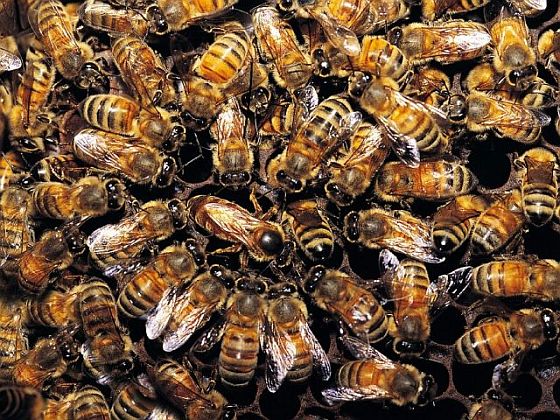
Joseph Castro reports: Honeybees choose new nest sites by essentially head-butting each other into a consensus, shows a new study.

When scout bees find a new potential home, they do a waggle dance to broadcast to other scout bees where the nest is and how suitable it is for the swarm. The nest with the most support in the end becomes the swarm’s new home.

But new research shows another layer of complexity to the decision-making process: The bees deliver “stop signals” via head butts to scouts favoring a different site. With enough head butts, a scout bee will stop its dance, decreasing the apparent support for that particular nest.

This process of excitation (waggle dances) and inhibition (head butts) in the bee swarm parallels how a complex brain makes decisions using neurons, the researchers say.

“Other studies have suggested that there could be a close relationship between collective decision-making in a swarm of bees and the brain,” said Iain Couzin, an evolutionary biologist at Princeton University, who was not involved in the study.”

“But this [study] takes it to a new level by showing that a fundamental process that’s very important in human decision-making is similarly important to honeybee decision-making.”

When honeybees outgrow their hive, several thousand workers leave the nest with their mother queen to establish a new colony. A few hundred of the oldest, most experienced bees, called scout bees, fly out to find that new nest.

“They then run a popularity contest with a dance party,” said Thomas Seeley, a biologist at Cornell University and lead author of the new study. When a scout bee finds a potential nest site, it advertizes the site with a waggle dance, which points other scouts to the nest’s location. The bees carefully adjust how long they dance based on the quality of the site.”

“We thought it was just a race to see which group of scout bees could attract a threshold number of bees,” Seeley told LiveScience. [Bees Form Better Democracy]

But in 2009, Seeley learned that there might be more to the story. He discovered that a bee could produce a stop-dancing signal by butting its head against a dancer and making a soft beep sound with a flight muscle. An accumulation of these head butts would eventually cause the bee to stop dancing. Seeley observed that the colony used these stop signals to reduce the number of bees recruited to forage from a perilous food source, but he wondered if the bees also used the head butts during nest hunting.

Thomas Seeley talks about Honeybee Democracy:

Facebooktwittermail

The Internet hasn’t changed our concept of truth as much as some theorists claim

Evgeny Morozov reviews Too Big to Know by David Weinberger: Weinberger argues that on the Internet facts are born “linked,” pointing to other facts and opinions. With time, other entities start linking to them, creating digital traces that can be used to scrutinize and even revise original facts.

On paper, facts look firm and reliable; online, they are always in flux. Furthermore, the Internet, unlike your local library, is infinite. Librarians choose which books to acquire; books that don’t make the cut become invisible. Not so with search engines. What they filter out doesn’t disappear — it stays in the background. New filters, Weinberger claims, don’t “filter out” but “filter forward.”

This triumph of the “networked” and the “hyperlinked” unsettles everything: facts (those who think that Barack Obama was born in Kenya also have facts), books (they are unable to contain “linked” and infinite knowledge) and even knowledge itself (it’s too obsessed with theories and consensus-seeking). Thus, “knowledge has become a network with the characteristics — for better and for worse — of the Net.”

This is an ambitious thesis. It’s also not original. “The Postmodern Condition: A Report on Knowledge,” a famous 1979 book by the French philosopher Jean-François Lyotard, makes a similar claim about computerization. “Along with the hegemony of computers comes a certain logic, and therefore a certain set of prescriptions determining which statements are accepted as ‘knowledge statements,’” wrote Lyotard. Weinberger doesn’t mention Lyotard by name but claims that “the Internet showed us that the postmodernists were right.”

Too bad, then, that his argument is ridden with familiar postmodernist fallacies, the chief of which is his lack of discipline in using loaded terms like “knowledge.” This term means different things in philosophy and information science; the truth of a proposition matters in the former but not necessarily in the latter. Likewise, sociologists of knowledge trace the social life of facts, often by studying how and why people come to regard certain claims as “knowledge.” The truth of such claims is often irrelevant.

For epistemologists, however, to say that “S knows that p” three conditions must be met. P must be true; S must believe that p; S must be justified in believing that p. One can’t “know” that “Barack Obama was born in Kenya” because it’s untrue. On the other hand, to “know” that “Barack Obama was born in Hawaii,” one needs to have justification. A copy of his birth certificate would do. The hyperlink nirvana has not rid us of the justification requirement. The Internet may have altered the context in which justification is obtained — one can now link to Obama’s birth certificate — but it hasn’t changed what counts as “knowledge.”

Facebooktwittermail

Happy New Year?

Tali Sharot, author of The Optimism Bias: Why we’re wired to look on the bright side (this book is not available in the U.S. yet), writes: We like to think of ourselves as rational creatures. We watch our backs, weigh the odds, pack an umbrella. But both neuroscience and social science suggest that we are more optimistic than realistic. On average, we expect things to turn out better than they wind up being. People hugely underestimate their chances of getting divorced, losing their job or being diagnosed with cancer; expect their children to be extraordinarily gifted; envision themselves achieving more than their peers; and overestimate their likely life span (sometimes by 20 years or more).

The belief that the future will be much better than the past and present is known as the optimism bias. It abides in every race, region and socioeconomic bracket. Schoolchildren playing when-I-grow-up are rampant optimists, but so are grown-ups: a 2005 study found that adults over 60 are just as likely to see the glass half full as young adults.

You might expect optimism to erode under the tide of news about violent conflicts, high unemployment, tornadoes and floods and all the threats and failures that shape human life. Collectively we can grow pessimistic – about the direction of our country or the ability of our leaders to improve education and reduce crime. But private optimism, about our personal future, remains incredibly resilient. A survey conducted in 2007 found that while 70% thought families in general were less successful than in their parents’ day, 76% of respondents were optimistic about the future of their own family.

Overly positive assumptions can lead to disastrous miscalculations – make us less likely to get health checkups, apply sunscreen or open a savings account, and more likely to bet the farm on a bad investment. But the bias also protects and inspires us: it keeps us moving forward rather than to the nearest high-rise ledge. Without optimism, our ancestors might never have ventured far from their tribes and we might all be cave dwellers, still huddled together and dreaming of light and heat.

To make progress, we need to be able to imagine alternative realities – better ones – and we need to believe that we can achieve them. Such faith helps motivate us to pursue our goals. Optimists in general work longer hours and tend to earn more. Economists at Duke University found that optimists even save more. And although they are not less likely to divorce, they are more likely to remarry – an act that is, as Samuel Johnson wrote, the triumph of hope over experience.

Even if that better future is often an illusion, optimism has clear benefits in the present. Hope keeps our minds at ease, lowers stress and improves physical health. Researchers studying heart-disease patients found that optimists were more likely than non-optimistic patients to take vitamins, eat low-fat diets and exercise, thereby reducing their overall coronary risk. A study of cancer patients revealed that pessimistic patients under 60 were more likely to die within eight months than non-pessimistic patients of the same initial health, status and age.

In fact, a growing body of scientific evidence points to the conclusion that optimism may be hardwired by evolution into the human brain. The science of optimism, once scorned as an intellectually suspect province of pep rallies and smiley faces, is opening a new window on the workings of human consciousness. What it shows could fuel a revolution in psychology, as the field comes to grips with accumulating evidence that our brains aren’t just stamped by the past. They are constantly being shaped by the future.
Hardwired for hope?

I would have liked to tell you that my work on optimism grew out of a keen interest in the positive side of human nature. The reality is that I stumbled onto the brain’s innate optimism by accident. After living through 9/11, in New York City, I had set out to investigate people’s memories of the terrorist attacks. I was intrigued by the fact that people felt their memories were as accurate as a videotape, while often they were filled with errors. A survey conducted around the country showed that 11 months after the attacks, individuals’ recollections of their experience that day were consistent with their initial accounts (given in September 2011) only 63% of the time. They were also poor at remembering details of the event, such as the names of the airline carriers. Where did these mistakes in memory come from?

Scientists who study memory proposed an intriguing answer: memories are susceptible to inaccuracies partly because the neural system responsible for remembering episodes from our past might not have evolved for memory alone. Rather, the core function of the memory system could in fact be to imagine the future – to enable us to prepare for what has yet to come. The system is not designed to perfectly replay past events, the researchers claimed. It is designed to flexibly construct future scenarios in our minds. As a result, memory also ends up being a reconstructive process, and occasionally, details are deleted and others inserted. [Continue reading…]

Facebooktwittermail

One world on Christmas Day

The best Christian slogan I know comes from the charity, Christian Aid: We believe in life before death.

Keep that in mind when gazing into the life-sustaining sky that from below looks so vast, yet from above is revealed to be wafer thin — all that stands between us and a lifeless void.

Sufjan Stevens — Michigan

Beissoul and Sophie — Lithuania

A murmuration of starlings — Ireland

Murmuration from Sophie Windsor Clive on Vimeo.

Facebooktwittermail