



“Leading sectors, including the government, are in a mood of paranoia and irrationality which is harming [Israel] very seriously.”
Chris McGreal, in a series of reports triggered by the publication of Sasha Polakow-Suransky’s new book, The Unspoken Alliance, writes:
For years after its birth, Israel was publicly critical of apartheid and sought to build alliances with the newly independent African states through the 1960s.
But after the 1973 Yom Kippur war, African governments increasingly came to look on the Jewish state as another colonialist power. The government in Jerusalem cast around for new allies and found one in Pretoria. For a start, South Africa was already providing the yellowcake essential for building a nuclear weapon.
By 1976, the relationship had changed so profoundly that South Africa’s prime minister, John Vorster, could not only make a visit to Jerusalem but accompany Israel’s two most important leaders, Yitzhak Rabin and Shimon Peres, to the city’s Holocaust memorial to mourn the six million Jews murdered by the Nazis.
Neither Israeli appears to have been disturbed by the fact that Vorster had been an open supporter of Hitler, a member of South Africa’s fascist and violently antisemitic Ossewabrandwag and that he was interned during the war as a Nazi sympathiser.
Rabin hailed Vorster as a force for freedom and at a banquet toasted “the ideals shared by Israel and South Africa: the hopes for justice and peaceful coexistence”.
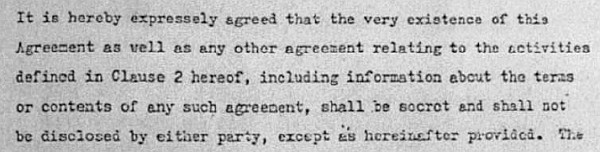
Secret agreement signed by South Africa's minister of defence PW Botha and Israel's minister of defence Shimon Peres in 1975.
Secret South African documents reveal that Israel offered to sell nuclear warheads to the apartheid regime, providing the first official documentary evidence of the state’s possession of nuclear weapons.
The “top secret” minutes of meetings between senior officials from the two countries in 1975 show that South Africa’s defence minister, PW Botha, asked for the warheads and Shimon Peres, then Israel’s defence minister and now its president, responded by offering them “in three sizes”. The two men also signed a broad-ranging agreement governing military ties between the two countries that included a clause declaring that “the very existence of this agreement” was to remain secret.
The documents, uncovered by an American academic, Sasha Polakow-Suransky, in research for a book on the close relationship between the two countries, provide evidence that Israel has nuclear weapons despite its policy of “ambiguity” in neither confirming nor denying their existence.
The Israeli authorities tried to stop South Africa’s post-apartheid government declassifying the documents at Polakow-Suransky’s request and the revelations will be an embarrassment, particularly as this week’s nuclear non-proliferation talks in New York focus on the Middle East.
They will also undermine Israel’s attempts to suggest that, if it has nuclear weapons, it is a “responsible” power that would not misuse them, whereas countries such as Iran cannot be trusted.
South African documents show that the apartheid-era military wanted the missiles as a deterrent and for potential strikes against neighbouring states.
The documents show both sides met on 31 March 1975. Polakow-Suransky writes in his book published in the US this week, The Unspoken Alliance: Israel’s secret alliance with apartheid South Africa. At the talks Israeli officials “formally offered to sell South Africa some of the nuclear-capable Jericho missiles in its arsenal”.
Among those attending the meeting was the South African military chief of staff, Lieutenant General RF Armstrong. He immediately drew up a memo in which he laid out the benefits of South Africa obtaining the Jericho missiles but only if they were fitted with nuclear weapons.

In a speech delivered at West Point on Saturday, President Obama previewed his new security doctrine. This was a key passage:
Now even as we fight the wars in front of us, we also have to see the horizon beyond these wars — because unlike a terrorist whose goal is to destroy, our future will be defined by what we build. We have to see that horizon, and to get there we must pursue a strategy of national renewal and global leadership. We have to build the sources of America’s strength and influence, and shape a world that’s more peaceful and more prosperous.
Time and again, Americans have risen to meet and to shape moments of change. This is one of those moments — an era of economic transformation and individual empowerment; of ancient hatreds and new dangers; of emerging powers and new global challenges. And we’re going to need all of you to help meet these challenges. You’ve answered the call. You, and all who wear America’s uniform, remain the cornerstone of our national defense, the anchor of global security. And through a period when too many of our institutions have acted irresponsibly, the American military has set a standard of service and sacrifice that is as great as any in this nation’s history.
Now the rest of us — the rest of us must do our part. And to do so, we must first recognize that our strength and influence abroad begins with steps we take at home. We must educate our children to compete in an age where knowledge is capital, and the marketplace is global. We must develop clean energy that can power new industry and unbound us from foreign oil and preserve our planet. We have to pursue science and research that unlocks wonders as unforeseen to us today as the microchip and the surface of the moon were a century ago.
Simply put, American innovation must be the foundation of American power — because at no time in human history has a nation of diminished economic vitality maintained its military and political primacy.
The sub-text here seems to be a neo-Clintonism: when it comes to national security, it’s the economy stupid!
David Ignatius, who often acts as an unofficial spokesman for the administration, pursues the same theme:
One of the strongest voices arguing for fiscal responsibility as a national security issue has been Defense Secretary Bob Gates. He gave a landmark speech in Kansas on May 8, invoking President Dwight Eisenhower’s warnings about the dangers of an imbalanced military-industrial state.
“Eisenhower was wary of seeing his beloved republic turn into a muscle-bound, garrison state — militarily strong, but economically stagnant and strategically insolvent,” Gates said. He warned that America was in a “parlous fiscal condition” and that the “gusher” of military spending that followed Sept. 11, 2001, must be capped. “We can’t have a strong military if we have a weak economy,” Gates told reporters who covered the Kansas speech.
On Thursday the defense secretary reiterated his pitch that Congress must stop shoveling money at the military, telling Pentagon reporters: “The defense budget process should no longer be characterized by ‘business as usual’ within this building — or outside of it.”
Adm. Mike Mullen, chairman of the Joint Chiefs of Staff, has also argued for a rethinking of the strategic mind-set that encouraged two expeditionary wars in the past decade at immense cost. “U.S. foreign policy is still too dominated by the military,” he said in a March 3 speech. He cautioned that the military should use its power “in a precise and principled manner,” rather than always insisting on overwhelming force.
Let’s return to the class exercise of the military and civilian logisticians who were asked to prepare a national security strategy. They focused on America’s domestic challenges, which included “unsustainable budget,” “finite foreign energy” and “failing education,” and proposed this rubric: “Credibility abroad begins with credibility at home.” In a multipolar world, they said, the “U.S. cannot be the sole guarantor of international security.”
What’s interesting about this focus on domestic economic security is that it probably would be endorsed by Republicans and Democrats, Tea Party conservatives and antiwar liberals. In a country that doesn’t agree on much, it could be a unifying theme.
At the pro-Israeli Washington Institute for Near East Policy, David Schenker writes:
On Monday, Lebanese prime minister Saad Hariri will visit Washington for a meeting with President Obama. In announcing the meeting, White House press secretary Robert Gibbs called it “a symbol of the close and historic relationship between Lebanon and the United States.” Indeed, between 2005 and 2009, bilateral ties were never closer or more consequential, with the Cedar Revolution ending nearly three decades of Syrian suzerainty in the country. Over the past year, however, Hariri has had to govern in coalition with Hizballah. The Iranian-Syrian backed Shiite militia will be the elephant in the Oval Office during Monday’s meeting.
Prior to becoming prime minister, Hariri was a frequent visitor to the Bush White House as head of Lebanon’s ruling March 14 coalition. This will be his first visit as premier, his first meeting with Obama, and his first trip to the White House since last year’s seeming reversal of the Cedar Revolution. Although Syria no longer has troops stationed across the border, President Bashar al-Asad’s allies in Lebanon have retrenched in recent months and once again wield preponderant political influence. Meanwhile, the March 14 coalition has been dramatically weakened by attrition and defections at home and abroad that have led the movement to moderate its pro-Western stance and embrace — at least rhetorically — Hizballah’s “resistance” doctrine.
Phil Sands, at The National, adds:
Syria and Lebanon have agreed they will present a united front of opposition to Israel and support for Hizbollah, when the Lebanese prime minister, Saad Hariri, travels to Washington next week.
Syria’s president, Bashar Assad, held talks with the Lebanese leader in Damascus on Tuesday. In contrast to Mr Hariri’s first prime ministerial visit to Syria in December, when he was joined by a large government delegation, this time only senior aides accompanied the two.
Bussaina Shaaban, a Syrian presidential adviser, said the meeting was designed to “co-ordinate policy” ahead of Mr Hariri’s trip to the United States, expected to take place on Monday.
There’s little question that like all other Lebanese politicians, Saad Hariri depends for his survival on a good measure of expediency and pragmatism, but even so, are we really to believe that he is tightening his bonds with the people who killed his father? Or is it time to acknowledge that whoever was benefited by the assassination of Rafic Hariri, it wasn’t Syria.
As Bill Van Auken wrote in 2005:
If one asks the question, “Who benefits?” the answer is clear. The destabilization of Lebanon, the mobilization of the US-backed opposition to the pro-Syrian government in Beirut, and the vilification of Damascus all serve to advance US and Israeli strategic plans long in the making.
It is not just a question of motive, however. Israel has a long history of utilizing assassination as an instrument of state policy. The Israeli regime has not infrequently carried out acts of terror and blamed them on its enemies.
And that was written before the assassinations of the Hezbollah commander Imad Mughniyah in Damascus in 2008 and of the Hamas commander Mahmoud al-Mabhouh in Dubai in January this year, both of which killings were attributed to Mossad.
In a presentation of Turkey’s “zero-problems” foreign policy, Turkey’s foreign minister, Ahmet Davutoglu, lays out five operational principles guide Turkey’s foreign policy-making process:
The first principle is the balance between security and democracy. The legitimacy of any political regime comes from its ability to provide security and freedom together to its citizens; this security should not be at the expense of freedoms and human rights in the country. Since 2002, Turkey has attempted to promote civil liberties without undermining security. This is an ambitious yet worthy aim — particularly in the post-Sept. 11 environment, under the threat of terrorism, in which the general tendency has been to restrict liberties for the sake of security.
Turkey has made great strides in protecting civil liberties despite serious domestic political challenges to such freedoms over the past seven years. This required vigorously carrying out the struggle against terrorism without narrowing the sphere of civil liberties — a challenge Turkey successfully overcame. In the process, we’ve found that Turkish soft power has only increased as our democracy has matured.
Second, the principle of zero problems towards neighbors has been successfully implemented for the past seven years. Turkey’s relations with its neighbors now follow a more cooperative track. There is a developing economic interdependence between Turkey and its neighboring countries. In 2009, for example, we achieved considerable diplomatic progress with Armenia, which nevertheless remains the most problematic relationship in Turkey’s neighborhood policy.
Turkey’s considerable achievements in its regional relationships have led policymakers to take this principle a step further and aim for maximum cooperation with our neighbors. Since the second half of 2009, Turkey established high-level strategic council meetings with Iraq, Syria, Greece and Russia. These are joint cabinet meetings where bilateral political, economic, and security issues are discussed in detail. There are also preparations to establish similar mechanisms with Bulgaria, Azerbaijan and Ukraine as well as other neighboring countries. Turkey abolished visa requirements with, among others, Syria, Tajikistan, Albania, Lebanon, Jordan, Libya and Russia. Turkey’s trade with its neighbors and nearby regions has substantially increased in recent years.
The third operative principle is proactive and pre-emptive peace diplomacy, which aims to take measures before crises emerge and escalate to a critical level. Turkey’s regional policy is based on security for all, high-level political dialogue, economic integration and interdependence, and multicultural coexistence. Consider Turkey’s mediation between Israel and Syria, a role that was not assigned to Turkey by any outside actor. Other examples of pre-emptive diplomacy include Turkey’s efforts to achieve Sunni-Shiite reconciliation in Iraq, reconciliation efforts in Lebanon and Palestine, the Serbia-Bosnia reconciliation in the Balkans, dialogue between Afghanistan and Pakistan, and the reconstruction of Darfur and Somalia.
The fourth principle is adherence to a multi-dimensional foreign policy. Turkey’s relations with other global actors aim to be complementary, not in competition. Such a policy views Turkey’s strategic relationship with the United States through the two countries’ bilateral strategic ties and through NATO. It considers its EU membership process, its good neighborhood policy with Russia, and its synchronization policy in Eurasia as integral parts of a consistent policy that serves to complement each other. This means that good relations with Russia are not an alternative to relations with the EU. Nor is the model partnership with the United States a rival partnership against Russia.
The fifth principle in this framework is rhythmic diplomacy, which aspires to provide Turkey with a more active role in international relations. This principle implies active involvement in all international organizations and on all issues of global and international importance. Turkey became a non-permanent member of the U.N. Security Council and is chairing three critical commissions concerning Afghanistan, North Korea, and the fight against terror. Turkey undertook the chairmanship-in-office of the South-East European Cooperation Process, a forum for dialogue among Balkan states and their immediate neighbors, for 2009 and 2010. Turkey is also a member of G-20, maintains observer status in the African Union, has a strategic dialogue mechanism with the Gulf Cooperation Council, and actively participates in the Arab League. Turkey has also launched new diplomatic initiatives by opening 15 new embassies in Africa and two in Latin America, and is a signatory to the Kyoto Protocol. These developments show a new perspective of Turkey, one that is based on vision, soft power, a universal language, and implementation of consistent foreign policies in different parts of the world.
Let us imagine the dream-country of most Israelis – without criticism, neither from within nor from without. It speaks in one voice and is eternally united, with devotion and cohesion; all-Jewish, that goes without saying. It stands unanimously behind its government, every government, and also, of course, behind its army, the Shin Bet security service and the Mossad espionage agency – Israel’s heroes.
There is not even a single “snitch,” no human rights organizations or peace movements, no nonprofit associations and no critical reports that are published here, or, heaven forbid, abroad. Its press never criticizes, never exposes, never investigates, publishing nothing but praise and admiration for the government and the state. It recites official statements and quotes from government and security briefings.
Every war that this dream-country wages is met immediately by nothing but cheers of approval. Any atrocity it commits in the occupied territories automatically earns across-the-board support – the most moral, the most just, the most security-oriented, in harmony. All residents must swear their allegiance, all those who wish to visit, too. Those who are faithful to Israel are welcome. All the rest must take the first plane (or truck ) out. In short, the country of one’s dreams.
But now let’s answer truthfully. Is that really the country we wound want to live in? Moreover, would the world that is always-against-us appreciate and like Israel better if that was how we looked and spoke, uniform and devoid of all self-criticism?
The benchmark upon which all psychological health and pathology can be assessed is the relationship between self and other. The breakdown of this relationship at its extreme results in psychosis: a condition in which an unbridgeable chasm has opened between the individual and the world he inhabits.
Is this where Israel is heading? A nation so deranged that the only source of comfort it finds is in a conversation that it mutters to itself? A nation that lashes out at anyone who ventures to close? A nation whose existence rests on a foundation of fear?
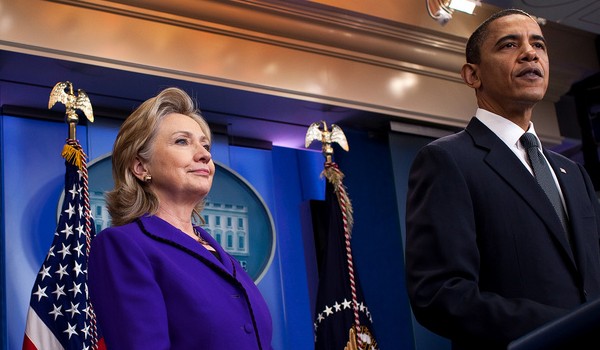
This week the Obama administration made what may come to be seen as a blunder of historic proportions. At a moment when tactical agility was a must, it stayed on course because it lacked the diplomatic finesse to show or perhaps even recognize the difference between being resolute and being inflexible.
The sanctions juggernaut plowed into the Iran diplomatic initiative masterminded by Brazil and Turkey and on the basis that these are “lesser” powers, Washington imagined its own agenda must be unstoppable. Or at least the administration felt compelled to bow in obedience to a fear that shackles every Democratic leader: the fear that flexibility will be seen as a sign of weakness.
Common sense and prudence made it clear that the smart way of responding to the new opening from Iran would have been with a cautious opening in return. Instead, Iran, Turkey and Brazil got the door slammed in their face. The calculation in Washington, no doubt, was that Iran, in its usual tempestuous style would swiftly reject the swap deal in the face of the continued threat of sanctions, and the diplomatic upstarts, Lula and Erdogan, would defer to the old world order.
Instead, it seems that Iran remains intent on seizing the initiative, will stick to the deal it signed and thereby demonstrate to the world that in the long-running nuclear dispute it is the United States that is now the intransigent party.
Turkey’s prime minister is seeking international support for a deal under which Iran would ship much of its low-enriched uranium to Turkey.
Recep Tayyip Erdogan’s office said Saturday he had written to the leaders of 26 countries saying the deal would resolve the nuclear standoff with Iran by way of diplomacy and negotiation. The countries included all permanent and non-permanent members of the UN Security Council.
Iran will submit an official letter to the IAEA on Monday morning conveying its acceptance of the uranium enrichment deal brokered by Turkey and Iran, state-run news agency IRNA reported on Friday, citing a statement by the country’s National Security Council.
“Following the joint declaration by Iran, Turkey and Brazil, permanent representative of the Islamic Republic of Iran at the IAEA officially announced its readiness to submit our country’s letter to the IAEA Chief per paragraph six of the Teheran Declaration,” the statement reportedly read.
Also on Friday, IRNA quoted a top Iranian cleric as saying that the deal was a “powerful response” that “put the ball in the West’s court.” He reportedly stated that far from being a ploy meant to facilitate enrichment for military use, the deal should be seen as a confidence-building measure.
Meanwhile in Turkey, UN Secretary-General Ban Ki-moon expressed hope that the deal reached last week would “open the door to a negotiated settlement” between Iran and Western nations, according to a Reuters report.
Ban reportedly called the enrichment agreement “an important initiative in resolving international tensions over Iran’s nuclear program by peaceful means.” He went on to praise Turkey’s role and cooperation with Brazil in negotiating the deal, stressing that the International Atomic Energy Agency (IAEA) would have to make its own assessment concerning the issue at hand.
At this point, it looks like Hillary Clinton has driven the United States into a diplomatic ditch.
The American mindset now as always fixes its attention on power and while the US remains the pre-eminent global power it assumes that it must have its way. But this fixation on power blinds Washington to a more important issue — one that provides the foundation for effective diplomacy, namely, trust.
The Turkish commentator, Mustafa Akyol, says:
This issue of trust, I believe, is the key to not just the Iranian nuclear crisis, but also other conflicts in the region, including the Arab-Israeli one. On all these issues, America has all the eye-catching instruments that give her full confidence: The world’s most powerful military, the largest diplomatic corps, and the most sophisticated brain power with plentitude of universities, institutes and think-tanks.
Yet, I am sorry to say, she terribly lacks the trust of the peoples of the Middle East. So, it would be only wise for her to rely more on the regional actors that do have that trust – such as the new Turkey of the 21st century.
Rami G Khouri adds:
The agreement on Iran’s nuclear fuel announced on Monday after mediation by the Turkish and Brazilian governments should be good news for those who seek to use the rule of law to prevent nuclear weapons proliferation. From both the American and Iranian perspectives the political dimension of the current dynamics is more important than the technical one. The accord should remind us that the style and tone in diplomatic processes is as important as substance.
Iran and its international negotiating partners have not reached agreement on Iran’s nuclear programs in the past half-decade, to a large extent because American- and Israeli-led concerns have been translated into an aggressive, accusatory, sanctions-and-threats-based style of diplomacy that Iran in turn has responded to with defiance.
Iran’s crime, in the eyes of its main critics in Washington and Tel Aviv (they are the two that matter most, as other Western powers play only supporting roles), is not primarily that it enriches uranium, but that it defies American-Israeli orders to stop doing so. (The Iranian response, rather reasonable in my view, is that it suspended uranium enrichment half a decade ago and did not receive the promises it expected from the United States and its allies on continuing with its plans for the peaceful use of nuclear technology. So why suspend enrichment again?)
The Iranians are saying, in effect, that this issue is about two things for them, one technical and one political: The technical issue is about the rule of law on nuclear nonproliferation and the right of all countries to use nuclear technology peacefully. The political issue is about treating Iran with respect, and negotiating with it on the basis of two critical phenomena: First, addressing issues of importance to Iran as well as those that matter for the American-Israeli-led states; and, second, actually negotiating with Iran rather than condescendingly and consistently threatening it, accusing it of all sorts of unproven aims, and assuming its guilt before it is given a fair hearing.
The age in which the non-Western world could be expected to show deference to the dictates of the dominant global powers is over. Western leaders must either humbly adapt to a world that has changed or suffer the humiliations that arrogance now invite.

No one knows fascism better than Israelis. They are schooled, drilled in the history, the mechanics, the horrendous potential of fascist regimes. Israelis know fascism when they see it. In others.
They might well have expected when fascism began taking root here, it would arise at a time of a national leadership of galvanizing charisma and sweeping, powerfully orchestrated modes of action.
But that would have been much too obvious to deny. And it would take denial, inertia, selective memory, a sense that things – bad as they are – can go on like this indefinitely, for fascism to be able gain its foothold in a country founded in its very blood trail.
In fact, it has taken the most dysfunctional, the most rudderless government Israel has ever known, to make moderates uncomfortably aware of the countless but largely cosmetized ways in which the right in Israel and its supporters abroad have come to plant and nurture the seeds of fascism.
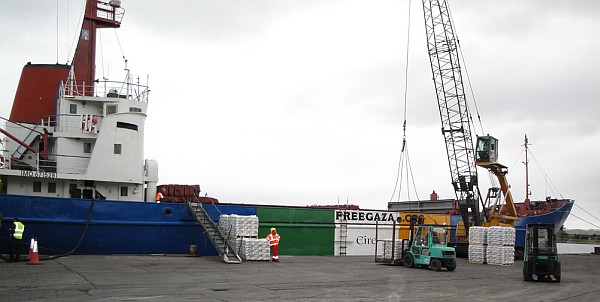
At Electronic Intifada, Ewa Jasiewicz writes:
Later this month, ships from all over the world will converge in the Mediterranean and set sail for the occupied and besieged Gaza Strip. This international coalition is called the Freedom Flotilla.
The Free Gaza Movement has sailed eight missions to Gaza in the past three years, five of them successful. The last three were violently stopped by the Israeli Navy; the boat Dignity was rammed three times and the Spirit of Humanity turned back in January 2009, then seized and all aboard arrested.
This time the Freedom Flotilla is upping the ante and instead of one- and two-vessel challenges, will be breaking Israel’s siege with an eight-boat front.
In the past, the Israel Navy could pick us off as individual boats. Now, including Free Gaza’s four ships, 700 passengers and some 5,000 tons of reconstruction materials and medical equipment. This includes Free Gaza’s MV Rachel Corrie, which was purchased through generous donations from Malaysia’s Perdana Global Peace Foundation.
The Israeli government has responded to the “sea intifada” coming its way with saber rattling and accusations of serving Hamas. Israel has proscribed the Turkish human rights and relief group Insani Vardim Vakafi (IHH). IHH is responsible for sending a cargo ship and passenger ship in the Freedom Flotilla. Israel has accused it and Free Gaza of “supporting terrorism.” Half the Israeli navy is set to challenge the mission, with Israeli Defense Minister Ehud Barak at the helm commanding the operation in person. The air force is on standby and “diplomatic pressure” is being applied behind the scenes. The message is clear from Israel: “We will stop you and we will use force to stop you.”
At no point does the Freedom Flotilla enter Israeli territorial waters. The journey starts in local European or Turkish waters, courses through international waters and ends in Gaza’s territorial waters. No checkpoints interrupt us. No walls daunt our sight. We’ve proven that it’s possible to sail a clear line with no borders, as we want the world to be, until we get to Gaza.

This could mark a significant tipping point in the BDS movement — not just the support from big name artists such as Elvis Costello, but the fact that others who might not voice support are simply deciding that it is not in their commercial interests to perform in Israel.
Costello’s action [cancelling his planned concerts in Israel] is the first open endorsement of the boycott movement by an A-list artist in protest of Israel’s policies in the occupied West Bank and of its siege of Gaza. In a detailed statement, the performer argued that he could not perform in Israel because by doing so, “it may be assumed that one has no mind for the suffering of the innocent.
“One lives in hope that music is more than mere noise, filling up idle time, whether intending to elate or lament,” Costello wrote in his statement.
He suggested that his decision had been complex and difficult. “I must believe that the audience for the coming concerts would have contained many people who question the policies of their government on settlement and deplore conditions that visit intimidation, humiliation or much worse on Palestinian civilians in the name of national security,” he wrote. “I am also keenly aware of the sensitivity of these themes in the wake of so many despicable acts of violence perpetrated in the name of liberation.
“I offer my sincere apologies for any disappointment to the advance ticket holders as well as to the organizers.”
In reaction, a music industry insider confirmed that the winds could be shifting. The music executive, who spoke on condition of anonymity in light of his ongoing business ties with artists, said that in recent months he had approached more than 15 performing artists with proposals to give concerts in Israel. None had agreed. The contracts offered high levels of compensation. He called them “extreme, big numbers that could match any other gig.”
Yonatan Touval, one of the Israelis behind the Geneva Initiative, clearly articulates the degree and ways in which Israel has suffered as a result of its special relationship with the United States. His hope is that Obama might correct the imbalance in the relationship and make it one based on genuine mutual interests, yet the quirk in Touval’s analysis is his claim that Israel is a victim in a relationship thrust upon the Jewish state — that America has indulged Israel “to the point of abuse.”
“Take the money,” insisted Uncle Sam. Little Israel was powerless to refuse. And now look what this over-indulgent uncle has done to its helpless nephew.
I guess this can be seen as a version of the “friends don’t let friends…” sentiment. Even so, the fact that Israelis still feel they can push their Little Israel image seems itself to be an expression of the way Israel has been over-indulged.
In “Pox Americana,” Touval writes:
Put simply, the relationship has damaged Israel by turning it into an adolescent state that doesn’t take responsibility for its own actions. And why should it take responsibility, when America’s uncritical embrace allows it to behave with the certainty that no action would ever be too costly – America would always save it from military, economic or diplomatic ruin.
To the extent, moreover, that this certainty has weakened Israel’s resolve to settle its conflict with its neighbors, the country has been further damaged by the loss of faith that the conflict could ever end. Hence the powerlessness to stop the occupation. This has had a terribly corrosive effect on Israeli life – from the high level of stress in everyday living, to the distorted allocation of national resources (Israel’s 2010 state budget allocates $14.4 billion for defense, a figure equal to 6.7 percent of the country’s GDP – the highest of any developed nation ), to the psychological adjustments that Israelis must make in the face of the deepening erosion of democratic values and growing doubts about the future prospects of the country as such.
Israelis have become accustomed to living under such anomalous conditions because, in many respects, the cushion of the special relations with the United States allows them to. But being habituated is a mixed blessing – which is also to say, a mixed curse.
Indeed, rather than habituation, Israel needs rehabilitation. And to those on the other side of the ocean who would disclaim responsibility, by placing the onus on Israel alone, we Israelis can only respond: “Where have you been all this time? It is you, America, that has turned us into what we are.”
Back in the days when Barack Obama scored political points for setting the right tone and hitting the right notes, this was one of his best lines, it’s significance underlined by the fact that it came in his inauguration speech.
… the world has changed, and we must change with it.
From America the hyperpower to America the adaptive power. From a president who liked to wield a chainsaw to a president who loved basketball — the blundering giant was going to give way to deft leadership, agile and attuned to the moment.
As cynical as I might sound, I still think Obama gets this. I think he understands what the possibility looks like, yet he also seems convinced that seemingly inviolable political realities dictate that he sticks to a script that could have been written for George Bush. Indeed, had it been possible for there to have been a third Bush term, the trajectory set from 2006 onward appeared to have been heading in the direction we have now landed.
So maybe it’s time Obama asked himself this question: does he want to be remembered as a continuation of the past or as a man who actually helped American embrace the future?
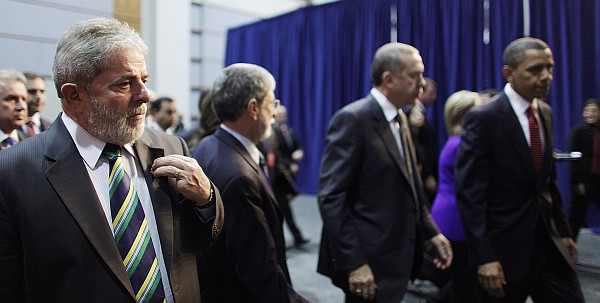
Luiz Inácio Lula da Silva and Recep Tayyip Erdoğan are men who represent the kind of future Obama really should believe in, yet having made himself a slavish tool of Washington’s institutional power, he operates with the calculations and lack of authenticity that have become synonymous with modern Western political leadership. Paradoxically, the art of securing political power now dictates that the power thereby acquired will be insufficient to bring about any significant change.
In spite of this, officials in Washington still harbor the conceit that they hold and are able to move all the major levers of global power — Washington still sees itself as the engine room of global change. No wonder the up-swell of indignation when two “lesser powers” have the audacity to become agents of change in an arena where this administration has thus far been manifestly impotent.
As Flynt and Hillary Mann Leverett note:
For months, Administration officials–and most U.S.-based Iran analysts–have asserted that the Islamic Republic is too internally conflicted to have a coherent international strategy or make important decisions. Senior Brazilian, Chinese, and Turkish officials who have invested significant amounts of time in substantive discussions with Iranian counterparts argued to Washington for months that a nuclear deal was possible. But Secretary Clinton and others in the Obama Administration thought they knew better–and said so publicly.
In fact, Iran has worked purposefully–dare we say strategically–to cultivate relations with important rising powers, like Brazil and Turkey, as well as China. And, this week, Tehran showed that it can take major decisions. Can the same things be said of the Obama Administration?
President Obama, who came to office professing a new U.S. approach to international engagement, allowed himself to be upstaged by new powers because he has been unwilling to match his rhetoric with truly innovative diplomacy that takes real notice of other countries’ interests.
The world was eager to forgive American arrogance when it appeared it could be more narrowly circumscribed as George Bush’s arrogance, but the heavy-handed approach now being applied by the current administration suggests that as the world changes, America is incapable of changing with it.
Simon Tisdall observes that the emerging realignment of global power does not simply involve America’s diminishing power but also a shift away from the American way of wielding power.
Brazil and Turkey, two leading members of a new premier league of emerging global powers, have a quite different approach. They stress persuasion and compromise. In the case of Iran, instead of ultimatums, deadlines and sanctions, they prefer dialogue. It helps that neither country feels threatened by Tehran.
Lula da Silva, Brazil’s popular president, typifies this outlook. He gave Clinton fair warning earlier this year that it was “not prudent to push Iran against a wall”. More broadly, Lula has championed the cause of emerging countries, challenged the rich world’s assumptions at the Copenhagen climate summit, and bearded the US over Cuba and Hugo Chávez.
Lula speaks for a world that was formed in the west’s image but is increasingly rejecting its tutelage and its ideas. China and India are the foremost members of this pack. But their leaders’ overriding priority is to build up their countries’ economic strengths. For most part, Beijing avoids open fights with the Americans and their west-European allies. The time will come when that will change – but not yet.
Reacting angrily to Clinton’s implied suggestion that somehow they had been suckered into the uranium deal by the crafty Iranians, Maria Luiza Ribeiro Viotti, Brazil’s ambassador to the UN, said Brazil would not co-operate with US-initiated security council discussions on a new resolution. Without unanimity in the council, new sanctions are even less likely to be honoured or effectively implemented than is already the case now.
Brazil’s foreign minister, Celso Amorim, also warned Washington to think again. “We have a chance to achieve a peaceful, negotiated solution [with Iran]. Those who turn down that possibility, or who think that sanctions or other measures would get us closer, they’ll have to take responsibility for that.” Such robust language is an eloquent expression of the changing power dynamic between the old superpower and its new rivals.
Recep Tayyip Erdogan, Turkey’s prime minister and, like Lula, the leader of an emerging regional power, has a more direct interest in what happens in Iran. The two countries have a common border and a common belief that the Middle East has seen too much interference by foreign powers. Ankara does not want a nuclear-armed Iran any more than it wants a nuclear-armed Israel. In fact, it seeks to empty the region of all weapons of mass destruction.
But Erdogan is increasingly resistant to the US way of doing things, whether it is turning a blind eye to Israel’s Gaza depredations, lecturing Turkey on Armenian history, or maintaining double standards on nuclear weapons. Like most Turks, Erdogan opposed the invasion of Iraq. He has led a rapprochement with Syria, another American bete noire. And he suggested this week that Washington was behaving arrogantly in dismissing the Iran deal.
“This is the time to discuss whether we believe in the supremacy of law or the law of the supremes and superiors,” he said. “While they [the US] still have nuclear weapons, where do they get the credibility to ask other countries not to have them?” Yet despite his obvious anger, Erdogan still answered Clinton’s criticism that the timeline for the uranium swap was “amorphous”. Iran was expected to fulfil its part of the deal within one month, otherwise it would “be on its own”, he said.
Ahmet Davutoglu, Turkey’s foreign minister, made clear Ankara’s opposition to further sanctions – and that he was not worried about upsetting the Americans. “We don’t want any new sanctions in our region because it affects our economy, it affects our energy policies, it affects our relations in our neighbourhood,” he said. Without Turkish co-operation, any new measures will struggle to have an impact.
That may prove to be the case anyway. Overlooked in the furore is the consideration that, thanks to stiff Chinese and Russian opposition, the proposed new sanctions, even if agreed as drafted, are fairly weak. This is nothing like the “crippling” package promised by Clinton, is largely voluntary or non-binding in nature, and will have no effect on Iran’s oil and gas sales – its main source of income.
Supplementary, tougher measures are expected from the EU at a later date while individual countries, such as the US and Britain, may take additional, unilateral steps. So what the US would like to portray as the international community’s united front against Iran is likely to boil down, in reality, to a narrowly-based coalition of the willing involving Washington and a handful of west-European states.
This week’s symbolically significant attempt by Brazil and Turkey to do things differently, and the divisions the subsequent row exposed, suggests this already rickety traditional international security architecture, maintained and policed by a few self-appointed countries, cannot hold much longer. Power is shifting away from the west. You can almost feel it go.
Will sanctions against Iran work?
There seems to be a near-universal consensus that sanctions won’t persuade Iran’s leaders to abandon the Islamic republic’s uranium enrichment program — but maybe that’s besides the point. Maybe by now what would be the most cynical interpretation of the Obama administration’s objectives can also be treated as the most credible view.
In this instance, what does that mean? It means that the drive to impose sanctions on Iran has less to do with Iran than it has to do with calming the fears of the Democratic Party’s wealthiest Zionist donors ahead of this fall’s midterm elections.
Unnerved by the repeated warnings that Israel faces an existential threat, these donors won’t sign their checks until they’ve heard a sufficiently soothing answer to the question: “What are you doing about Iran?”
“We’ll do whatever it takes.” “We’re pushing for tougher sanctions than the Bush administration did.” “We’re absolutely dedicated to preventing Iran acquiring a nuclear weapons capability.”
But meanwhile in Israel it turns out that preparations are being made for the unthinkable — living with a nuclear Iran.
Haaretz reporters, Amos Harel and Avi Issacharoff, just attended a simulation held at the prestigious Herzliya Interdisciplinary Center where the assumption was that the US will not give a green light for Israel to attack Iran and that sanctions will not derail Iran’s nuclear program.
The IDC simulation centered on a confrontation between Israel and Hezbollah with a hypothetically nuclear Iran in the background. Similar to other simulations taken place in the West in the last two years, the premise is that an Iranian nuclear umbrella would give more freedom to organizations such as Hezbollah and Hamas, encouraging them to provoke Israel. The Herzliya panelists reached the conclusion that Hezbollah’s possession of a “dirty” or radioactive bomb would bring about the kind of American determination that would lead to an international military task force, which would in turn disarm Hezbollah. We’ll believe it when we see it.
Indeed. If consideration of the prospect of a nuclear Iran reflects the rise of realism among Israeli strategic thinkers, the idea that the US would disarm Hezbollah suggests that realism is still struggling to gain a firm foothold.
As noteworthy as anything else that the simulation revealed was the fact that — at least in the thinking of these Israelis — in the context of the Jewish state’s fears about regional threats, the Palestinians don’t even come into consideration.
Disarming the Israeli-Palestinian landmine, a central Obama administration claim has it, would aid in cooling the region, and maybe even in curbing Iran’s nuclear ambitions. But, at least as simulation participants found out, the Palestinians have turned into a negligible entity. The most significant maneuvers were led by the United States, Israel, and the European Union, with some aid offered by the more moderate Arab states. Hamas and the Palestinian Authority were virtually out of the game.

The fate of Israel will be decided in New York — at least that’s what quite a few people in New York seem to think.
From this vantage point, the American Jewish community is the umbilical chord that keeps baby Zionism alive. And for Peter Beinart, this life-support system appears in jeopardy of raising a monster.
Among American Jews today, there are a great many Zionists, especially in the Orthodox world, people deeply devoted to the State of Israel. And there are a great many liberals, especially in the secular Jewish world, people deeply devoted to human rights for all people, Palestinians included. But the two groups are increasingly distinct. Particularly in the younger generations, fewer and fewer American Jewish liberals are Zionists; fewer and fewer American Jewish Zionists are liberal. One reason is that the leading institutions of American Jewry have refused to foster—indeed, have actively opposed—a Zionism that challenges Israel’s behavior in the West Bank and Gaza Strip and toward its own Arab citizens. For several decades, the Jewish establishment has asked American Jews to check their liberalism at Zionism’s door, and now, to their horror, they are finding that many young Jews have checked their Zionism instead.
Morally, American Zionism is in a downward spiral. If the leaders of groups like AIPAC and the Conference of Presidents of Major American Jewish Organizations do not change course, they will wake up one day to find a younger, Orthodox-dominated, Zionist leadership whose naked hostility to Arabs and Palestinians scares even them, and a mass of secular American Jews who range from apathetic to appalled. Saving liberal Zionism in the United States—so that American Jews can help save liberal Zionism in Israel—is the great American Jewish challenge of our age.
Like many missions of salvation, there is a large measure of grandiosity in Beinart’s perspective.
As Jerry Haber points out at The Magnes Zionist:
The truth is that Israel never really needed the American Jewish community, as long as it could have the US government. One of the great successes of Israeli Zionism was to convince American Jews that Israel was an American style democracy, instead of a Eastern European ethnocracy with some of the trappings of a liberal democracy. It was founded by Russians, and for the most part, Russians and their descendants have run it. And now with the Russian aliyah, it will be even more Russian. True, Bibi has always thrown in a few Americans, Oren, Gold, etc., as this generation’s Abba Ebans. But there is nothing in common between the ethnic democracy of Israel and the liberal democracy of America. Beinart doesn’t get this; he thinks that the shift rightward is a shift away from Israeli style democracy.
Ross Douthat points out that the trend Beinart is observing has as much to do with the evaporation of the Jewishness of liberal American Jews as it has with Israel’s rightward tilt.
One reason, and perhaps the major reason, that young liberal Jews are less attached to Israel is that Israel has become less liberal. But they also may be less attached to the Jewish homeland because they themselves are simply less Jewish.
In an email exchange, Jeffrey Goldberg asks Beinart whether he considers himself a Zionist (a strange question given that Beinart’s essay clearly presents itself as a passionate defense of liberal Zionism) and Beinart responds:
My grandmother was born in Alexandria, Egypt, then moved as a girl to Elizabethville (now Lubumbashi) Congo, now she lives in a third dying Jewish community (albeit the most beautiful in the world) in Cape Town, South Africa. So I really believe that Jews–if not perhaps American Jews—need a Jewish state to go to in time of need. Whenever I waxed too patriotic about America, my grandmother used to say, “the Jews are like rats,” we leave the sinking ship. So yes, I’m a Zionist. I’m close enough to people who still have their bags packed.
And when the sinking ship turns out to be Israel? What then?
For Beinart and his fellow liberal Zionists the one idea that is so unpalatable that it doesn’t even get discussed is that Israel’s rightward shift, far from being an aberration, is, on the contrary, the logical expression of the contradiction inherent in the idea that a state can both support a form of ethnic supremacy and at the same time practice genuine democracy.
Israel’s challenge now as from the day of its creation is whether it wants to be a Jewish state or a democracy. For 62 years it has been perfectly evident that it cannot be both.
As if to demonstrate that Washington refuses to be upstaged by lesser powers, Hillary Clinton blazed away in the campaign to impose not-quite crippling sanctions on Iran, after winning Russia and China’s agreement today on a draft resolution that will go to the Security Council.
The Wall Street Journal reports:
Washington called the proposed sanctions the toughest to date, but U.S. officials acknowledged they had to be softened in key areas to gain Russian and Chinese agreement.
And even as China joined in, Beijing also praised the last-minute deal Iran made with Brazil and Turkey to try to pre-empt the sanctions, calling the two efforts “dual tracks” and leaving some uncertainty over where China would ultimately side.
The agreement on a draft U.N. resolution was reached within the last several days. Senior administration officials said the timing of the announcement was intended as a direct response to the Turkish-Brazilian pact, in which Tehran renewed an offer to swap much of its nuclear fuel outside its borders for enrichment.
“This announcement is as convincing an answer to the efforts undertaken in Tehran over the last few days as any we could provide,” Secretary of State Hillary Clinton said on Tuesday.
Russian ambassador Vitaly Churkin told reporters that Russia would have preferred to wait a day or two after the Brazil-Iranian deal, but the U.S. wanted to put it on the table right away.
Western officials feared that the deal reached in Tehran could throw up new hurdles to the already-delayed sanctions regime.
Mrs. Clinton said Tuesday that while the U.S. believed Turkey and Brazil’s moves were “sincere efforts,” the U.S. and its fellow permanent members of the U.N. Security council were “proceeding to rally the international community on behalf of a strong sanctions resolution.”
There was no immediate, public reaction from Iranian officials late Tuesday to the announcement of a sanctions deal.
The Turkish and Brazilian efforts still could throw a wrench into the U.S. plans. Maria Luiza Ribeiro Viotti, Brazil’s ambassador to the U.N., told reporters outside the Security Council after seeing the draft that Brazil wasn’t ready to engage in negotiations over the text because of the “new situation” presented by the fuel-swap deal.
“It is the first time that the Iranians, at such a high level, have put in writing the swap, which creates a new confidence building,” she said. The fuel-swap deal is not “meant to address all the issues,” she added, “but it is a very important first step and we should seize this opportunity.”
Washington’s reaction to the Brazilian-Turkish deal has created some apprehension in the international community. The Obama administration has worked diligently to overcome the credibility gap America developed with the international community under President George W. Bush. One element of this effort was to utilize diplomacy as a premier tool of US foreign policy.
Punitive measures such as war or sanctions would no longer be the instruments of first resort. But the reaction to the Brazilian-Turkish deal may undo some of the progress the Obama administration has achieved with the international community. Washington’s lack of appreciation for the breakthrough may fuel suspicions of whether sanctions are pursued to achieve success in diplomacy, or whether diplomacy was pursued to pave the way for sanctions – and beyond.
In a world long dominated by Western powers, the global order has been one shaped by coercion. Although the twentieth century saw the end of formal colonialism — the most overt coercive system — the perpetuation of economic colonialism has meant that the United States and its allies still expect to have the final word on most issues of global importance.
It seems natural then as a new global order emerges, Western domination will not get replaced by another form of domination — the Western coercive paradigm itself will be rejected. This indeed, is the new approach to diplomacy that is being pioneered by Brazil and Turkey.
If Barack Obama really embodied a new way of thinking, we’d have reason to hope that he’d be nimble enough to adapt to the momentous period of change that is now unfolding, yet so far all the indications are that whatever his personal abilities might be, he remains firmly tethered to an arthritic diplomatic and political establishment.
The nuclear swap deal just struck by Brazil, Turkey and Iran could be grasped as an unexpected but welcome opportunity. Instead, Washington’s guarded response barely conceals the fact that it sees it own power as being usurped.
In the Financial Times, Jonathan Wheatley notes that the deal may vindicate Brazilian diplomacy and prove the skeptics wrong.
The idea that Iran would abandon its alleged nuclear weapons programme in favour of a peaceful nuclear energy programme in response to amicable talks rather than under the threat of UN-backed sanctions seemed unrealistic, even naïve. But it may well have paid off. Even a US official conceded today that the latest news was “potentially a good development.”
If so, Celso Amorim, Brazil’s foreign minister, can be forgiven some self-satisfaction. “We are holding conversations in a respectful manner and with conviction . . . Our language is not that of pressure. Our language is that of persuasion, friendship and cooperation,” he told reporters in Tehran on Monday.
Al Jazeera notes:
The recent visit by Luiz Inacio Lula da Silva, Brazil’s president, to Iran is part of a broad multilateral foreign policy that he believes is commensurate with his nation’s ever-growing importance in a changing world axis.
Brazil under Lula’s eight year reign has promoted trade between Israel and Latin America, while supporting talks with Hamas and Palestinian statehood. It has balked at US urges for sanctions on Iran over their nuclear programme, which Washington believes has nefarious intentions, while on Sunday it brokered an agreement in which Tehran exchanges low-enriched uranium for nuclear fuel.
Diplomatic ties have been created with more than 40 nations, including North Korea, and Brasilia maintains good relations across divides, for instance with foes Venezuela and Colombia.
Like India, Brazil is advocating for a permanent seat at the UN Security Council and wants reform of the International Monetary Fund (IMF) to better represent developing nations.
For as Lula said in an interview with Al Jazeera this week, international geopolitics is shifting and global governance needs to change with it.
The impact of the agreement on Israel — where coercion is generally regarded as the only effective tool of persuasion — was summed up by Yossi Melman:
The agreement on the transfer of Iran’s enriched uranium, achieved via Turkish-Brazilian mediation, is an important victory for Iranian diplomacy and a debacle for Israeli policy. The deal reduces the chances, which were slim to begin with, of new sanctions being imposed on Iran, and makes a military strike against Iran even less feasible.
Turkey is the deal’s big winner. Trade between Iran and Turkey already stands at $10 billion annually, so if sanctions were imposed on Tehran, Turkey would suffer a massive blow to its economy – and Prime Minister Recep Tayyip Erdogan’s party would suffer a major political setback. Alternatively, should Turkey decide not to uphold the sanctions, it might find itself in a crisis with the United States and Europe. Hence the tremendous effort Turkey made to achieve the deal, despite American warnings that Iran might be using Turkey in order to buy time.
Why did Iran choose to see Turkey as an “honest broker” and make the deal with it instead of with the permanent Security Council members? The two countries’ good relations are not free of suspicion, but both Iran and Turkey have adopted a policy of expanding their influence in the Middle East, influence of the sort that relies on cooperation rather than competition.
The closer ties between Turkey and Syria, Iran’s ally; the similar attitude that Turkey and Iran have toward Hamas; their shared interests in Iraq; and a similar view of radical Islamic terrorism all combined with Turkey’s disappointment over European views of its candidacy to join the European Union to create a confluence of interests that, for the time being, trumps their disagreements. Moreover, from an ideological standpoint, Iran prefers Turkey to the U.S.: Any concession to Washington or its Security Council partners would be perceived as a surrender.
The Wall Street Journal adds:
China welcomed Iran’s new nuclear fuel-swap agreement, saying the deal supports Beijing’s long-held position that the international dispute over Iran’s nuclear ambitions can be resolved through diplomacy rather than sanctions or force.
“We hope this will help promote a peaceful settlement of the Iranian nuclear issue through dialogue and negotiation,” foreign ministry spokesman Ma Zhaoxu said Tuesday at a regular press briefing. “We believe dialogue and negotiation is the best approach to settle the Iranian nuclear issue.”
Under the deal arranged by Brazil and Turkey, Iran will ship out some of its uranium to Turkey, have it enriched and then shipped back to Iran for use in a medical research reactor. Western powers want to keep Iran from enriching uranium on its own soil, because it fears that fuel will end up being used for nuclear weapons, which Tehran denies. The latest deal is a weakened version of one that was negotiated last October but fell through after Iran’s government didn’t approve it.
For China, a deal brokered by Brazil and Turkey is in line with its broader vision of a more multipolar world order not dominated by Washington.
Julian Borger thinks that Iran might have overplayed its hand.
The initial western response to the new Turkish-Brazilian-Iranian uranium swap deal was akin to a chess player realising loss is inevitable. There was an awkward silence and quietly spreading panic as western capitals looked a few moves ahead and could not think of a way of escaping the trap they had fallen into. The deal would have to be accepted, even though it did little to slow down Iran’s nuclear drive, and the push for sanctions in New York would deflate.
And then, the Iranian foreign ministry decided to speak. The spokesman, Ramin Mehmanparast, declared: “Of course, enrichment of uranium to 20% will continue inside Iran.”
The announcement was stunning. Iran’s justification for beginning 20% enrichment in February, was that it needed the material to make medical isotopes for the Tehran research reactor, although it was unclear how the Iranians were going to fabricate the necessary rods. Under this new deal, the rods will be provided free of charge. What then would be the civilian use of Iran’s home-enriched uranium?
For those already convinced Iran is working its way to breakout nuclear weapons capacity, the point of enriching to 20% is clear. In engineering terms it is a lot more than half way to 90% weapons-grade material, and an important test of the reliability of Iran’s centrifuges in reaching that goal.
Within minutes, the western capitals, tongue-tied over their response for the first few hours, began to rally.
But if Washington hoped that there might at least be unity in the expression of Western reservations about the deal, that hope was swiftly undermined as the French President Nicholas Sarkozy said he sees this development as a “positive step.”
