Author Archives: Paul Woodward

Floundering in Afghanistan

Last fall, President Obama faced criticism in the early months of his presidency during his exhaustive strategic review of the war in Afghanistan. The review had become so drawn out that his detractors claimed it presented an image of indecisiveness. Obama’s defenders responded by saying this was a process of careful and thorough deliberation from a commander in chief who, unlike his predecessor, had the interest and ability to think things through. If Bush was the decider, Obama was the studious deliberator.

The conclusion of those deliberations was less than impressive. Obama took the only idea that for Bush had acquired some brand value, on the assumption it could sell the war in Afghanistan just as it had helped rejuvenate the saleability of the war in Iraq. Obama followed what has become an American presidential tradition, which is to say, when you don’t know where you’re heading, move forward. Escalate the war — but give escalation a palatable name with the Viagra of American war-making: a surge.

This time around, with no counterpart to Iraq’s Sons of the Awakening offering a helping hand, the Pentagon’s latest efforts to prove the war is not being lost have been so unconvincing that the best face the US can now present is to say, “nobody is winning.”

Tom Engelhardt writes:

To all appearances, when it comes to the administration’s two South Asian wars, one open, one more hidden, Obama and his top officials are flailing around. They are evidently trying whatever comes to mind in much the manner of the oil company BP as it repeatedly fails to cap a demolished oil well 5,000 feet under the waves in the Gulf of Mexico. In a sense, when it comes to Washington’s ability to control the situation, Pakistan and Afghanistan might as well be 5,000 feet underwater. Like BP, Obama’s officials, military and civilian, seem to be operating in the dark, using unmanned robotic vehicles. And as in the Gulf, after each new failure, the destruction only spreads.

For all the policy reviews and shuttling officials, the surging troops, extra private contractors, and new bases, Obama’s wars are worsening. Lacking is any coherent regional policy or semblance of real strategy — counterinsurgency being only a method of fighting and a set of tactics for doing so. In place of strategic coherence there is just one knee-jerk response: escalation. As unexpected events grip the Obama administration by the throat, its officials increasingly act as if further escalation were their only choice, their fated choice.

This response is eerily familiar. It permeated Washington’s mentality in the Vietnam War years. In fact, one of the strangest aspects of that war was the way America’s leaders — including President Lyndon Johnson — felt increasingly helpless and hopeless even as they committed themselves to further steps up the ladder of escalation.

The hallmark of a floundering wartime leader is the extent to which whatever he says begins to ring hollow. Jeremy Scahill picked up on one such declaration last week.

During his White House press conference Wednesday with Afghan President Hamid Karzai, President Obama addressed the issue of civilian deaths caused by US operations in Afghanistan. “I take no pleasure in hearing a report that a civilian has been killed,” said Obama. “That’s not why I ran for president, that’s not why I’m Commander in Chief.”

“Let me be very clear about what I told President Karazi: When there is a civilian casualty, that is not just a political problem for me. I am ultimately accountable, just as Gen. McChrystal is accountable, for somebody who is not on the battlefield who got killed,” said Obama.

That statement is quite remarkable for a number of reasons, not the least of which is that it is not true. How are President Obama or Gen. McChrystal accountable? Afghans have little, if any, recourse for civilian deaths. They cannot press their case in international courts because the US doesn’t recognize an International Criminal Court with jurisdiction over US forces, Afghan courts have not and will not be given jurisdiction and Attorney General Eric Holder has made clear that the Justice Department will not permit cases against US military officials brought by foreign victims to proceed in US courts. So, what does it mean to be accountable for civilian deaths? Public apology? Press conferences? A handful of courts martial?

Meanwhile, David Ignatius remains convinced that the administration has some kind of strategic process in operation, but with his eyes set on the endgame, he suggests:

As the White House prepares its reconciliation strategy, it should ponder the Pashtun culture that spawned the Taliban insurgency. The United States has often lacked this sense of cultural nuance, which is why we have made so many mistakes in places such as Iraq and Afghanistan.

One thing that should be obvious by now is that you don’t make much progress with Pashtun leaders by slapping them around in public. This is a culture that prizes dignity and detests humiliation. Attempts to shame people into capitulation usually backfire.

And in which culture is dignity not prized and humiliation tolerated?

Ignatius is correct in suggesting that Washington needs to understand Pashtun culture — though that recommendation might have been more timely if delivered with some force nine years ago. But America’s problem consists equally in a lack of cultural self-awareness.

In a culture so deeply molded by what I will call the advertising gestalt, America’s most crippling deficit is a pervasive lack of interest in distinguishing between appearance and reality. Military campaigns have been turned into marketing campaigns viewed with the uncritical attention that attends most commercial communication.

We’ve got a government in a box, ready to roll in,” General Stanley McChrystal said on the eve of the Marja offensive. Billed as a “clear and hold” operation, the combat phase was declared a success at the end of February.

As has so often proved to be the case, the American declaration of victory turned out to be premature, McChrystal’s government in a box never got delivered and most of the clearing now taking place is by families clearing out of the battlefield.

Carlotta Gall, reporting from Lashkar Gah, says:

Marja residents arriving here last week, many looking bleak and shell-shocked, said civilians had been trapped by the fighting, running a gantlet of mines laid by insurgents and firefights around government and coalition positions. The pervasive Taliban presence forbids them from having any contact with or taking assistance from the government or coalition forces.

“People are leaving; you see 10 to 20 families each day on the road who are leaving Marja due to insecurity,” said a farmer, Abdul Rahman, 52, who was traveling on his own. “It is now hard to live there in this situation.”

One farmer who was loading his family and belongings onto a tractor-trailer on the edge of Lashkar Gah last week said he had abandoned his whole livelihood in Sistan, Marja, as soon as the harvest, a poor one this year, was done.

“Every day they were fighting and shelling,” said the farmer, Abdul Malook Aka, 55. “We do not feel secure in the village and we decided to leave. Security is getting worse day by day.”

“We thought security would be improving,” he said.

Those who remain in Marja voiced similar complaints in dozens of interviews and repeated visits to Marja over the last month.

“I am sure if I stay in Marja I will be killed one day either by Taliban or the Americans,” said Mir Hamza, 40, a farmer from Loye Charah.

Victory over the Taliban in Marja was supposed to be a prelude to forcing the insurgency out of its largest stronghold, Kandahar. But in light of the indecisive outcome of the earlier operation, US officials are back-pedaling hard in an effort to diminish expectations about what the much larger operation is meant to accomplish. And as they do so, the Taliban have mounted an assassination campaign which guarantees that this time around neither McChrystal nor anyone else will be making any idle promises about early success.

The Los Angeles Times reports:

In recent weeks, Western military officials in Afghanistan have stopped referring to the Kandahar campaign as an offensive.

“What we plan on is mainly an Afghan, politically led process … where you have slowly incremental changes of security, which enables governance and development,” said Army Col. Wayne Shanks, the chief public affairs officer for NATO’s International Security Assistance Force. “So this is not going to be anything that is immediate or quick.”

Such talk leaves many Kandaharis baffled. Rangina Hamidi, who runs a handicraft business that employs Afghan village women in Kandahar province, said it was difficult for local people to understand why the North Atlantic Treaty Organization began talking publicly months ago about Kandahar being the next big target for Western forces.

“Most of the women I work with are illiterate and hardly ever leave their homes — they are not involved in public life,” Hamidi said. “But even these women are saying, ‘If you are going to do an offensive, why are you going to announce it in advance?'”

As U.S. officials seek to emphasize the campaign’s political goals rather than its military ones, insurgent assassins are systematically targeting precisely the kind of people on whom Western planners are relying to help woo the populace to the side of the Afghan government: tribal elders, municipal employees, security officials, aid workers and others.


Facebooktwittermail

After denied entry to West Bank, Chomsky likens Israel to ‘Stalinist regime’

Haaretz reports:

The Interior Ministry refused to let linguist Noam Chomsky into Israel and the West Bank on Sunday. Chomsky, who aligns himself with the radical left, had been scheduled to lecture at Bir Zeit University near Ramallah, and visit Bil’in and Hebron, as well as meet with Palestinian Prime Minister Salam Fayyad and various Palestinian activists.

In a telephone conversation last night from Amman, Chomsky told Haaretz that he concluded from the questions of the Israeli official that the fact that he came to lecture at a Palestinian and not an Israeli university led to the decision to deny him entry.

“I find it hard to think of a similar case, in which entry to a person is denied because he is not lecturing in Tel Aviv. Perhaps only in Stalinist regimes,” Chomsky told Haaretz.

Sabine Haddad, a spokesperson for the Interior Ministry, confirmed to Haaretz that the officials at the border were from the ministry.

“Because he entered the Palestinian Authority territory only, his entry is the responsibility of the Office of the Coordinator of Government Activities in the Territories at the Defense Ministry. There was a misunderstanding on our side, and the matter was not brought to the attention of the COGAT.”

Haddad told Haaretz that “the minute the COGAT says that they do not object, Chomsky’s entry would have been permitted.”

Chomsky, a Jewish professor of linguistics and philosophy at the Massachusetts Institute of Technology, had spent several months at Kibbutz Hazore’a during the 1950s and had considered a longer stay in Israel. He had been invited by the Department of Philosophy at Bir Zeit.

He planned to spend four days in the West Bank and give two lectures.

On Sunday, at about 1:30 P.M. he came to the Israeli side of the border with Jordan. After three hours of questioning, during which the border officer repeatedly called the Interior Ministry for instructions, Chomsky’s passport was stamped with “Denied Entry.”

With Chomsky, 81, were his daughter Aviva, and a couple of old friends of his and his late wife.

Entry was also denied to his daughter.

Their friends, one of whom is a Palestinian who grew up in Beirut, were allowed in, but they opted to return with Chomsky to Amman.

Chomsky told Haaretz that it was clear that his arrival had been known to the authorities, because the minute he entered the passport control room the official told him that he was honored to see him and that he had read his works.

The professor concluded that the officer was a student, and said he looked embarrassed at the task at hand, especially when he began reading from text the questions that had been dictated to him, and which were also told to him later by telephone.

Chomsky told Haaretz about the questions.

“The official asked me why I was lecturing only at Bir Zeit and not an Israeli university,” Chomsky recalled. “I told him that I have lectured a great deal in Israel. The official read the following statement: ‘Israel does not like what you say.'”

Chomsky replied: “Find one government in the world which does.”

“The young man asked me whether I had ever been denied entry into other countries. I told him that once, to Czechoslovakia, after the Soviet invasion in 1968,” he said, adding that he had gone to visit ousted Czechoslovak leader Alexander Dubcek, whose reforms the Soviets crushed.

In Ynet, Boaz Okon expresses his fear that Israel is moving in the direction of becoming a fascist state.

[I]n Israel our government has already started to threaten the freedom, or at least the freedom of those perceived as “others.” We are no longer interested in what “others” have to say, let alone in their right to live here normally. We want them to get out of here. We persecute “others” based on generalizations, suspicions, bias, or just because they annoy us.

The police detain protestors in east Jerusalem’s Sheikh Jarrah neighborhood on false pretenses. The custody court expels a pregnant foreign worker so she won’t give birth to a foreign child in Israel. The family court prevents babies in India from being brought into Israel based on unfounded excuses, which may serve as a veneer for the disapproval of the sexual orientation of their father.

Meanwhile, our courts issue gag orders routinely and without much thought, possibly in order to cover the shame. We even expelled clowns who wished to arrive at a festival in Ramallah because we are scared.

What we have here is a worrisome common denominator. When freedom disappears, it comes first and foremost at the expense of the weak, marginal groups, or minorities. Yet this does not end there. Now it’s also being directed towards globally recognized intellectuals.

For that reason, it would not be exaggerated to say that the decision to silence Professor Noam Chomsky is an attempt to put an end to freedom in the State of Israel. I am not referring to the foolishness inherent in providing ammunition for those who argue that Israel is fascist, but rather, to the fear that we may indeed be in the process of becoming that way.

Facebooktwittermail

Lula and Erdogan demonstrate their diplomatic clout

If President Obama had accomplished what Brazil and Turkey are about to pull off — a deal through which Iran will exchange its stockpile of enriched uranium in return for fuel rods for a medical research reactor — then the US media would be hailing this as a diplomatic breakthrough. Instead, this is being described as a possible obstacle to sanctions. The New York Times reports:

Brazilian and Turkish government officials said Sunday that their leaders had brokered a tentative compromise with Iran in the international standoff over Iran’s nuclear program, a development that could undermine efforts in the United Nations to impose new sanctions on the Iranians.

A spokesman for the Turkish Foreign Ministry said that after 17 hours of talks in Tehran, ministers from Brazil, Iran and Turkey had reached an agreement on the “principles” to revive a stalled nuclear fuel-swap deal backed by the United Nations.

The spokesman, speaking on condition of anonymity, said the deal would be presented to the leaders of the countries for “final touches,” with a statement on the agreement expected as early as Monday. The exact terms, notably the amount of nuclear fuel to be swapped, were not revealed.

The Turkish prime minister, Recep Tayyip Erdogan, canceled an official visit to Azerbaijan late Sunday and instead joined officials in Tehran in what was seen as a sign of progress in the talks.

Laura Rozen adds:

[A] Washington Iran expert said the fact that the alleged nuclear deal was connected to Lula’s meeting with the Iranian Supreme Leader, as opposed to with the Iranian president, may be significant.

That signals that Khamenei “is endorsing the deal,” the National Iranian American Council’s Trita Parsi said, adding it may reduce the bouts of Iranian domestic political infighting that have plagued earlier rounds of negotiations that failed to hold up. “That means this is no longer Ahmadinejad’s nuclear deal, this is Khamenei’s nuclear deal.”

The Financial Times said:

Iran’s supreme leader on Sunday praised Luiz Inácio Lula da Silva for defying US calls to close ranks against the Islamic regime as the Brazilian leader arrived in Tehran seeking to mediate in the crisis over Iran’s nuclear ambitions.

“Brazil in recent years [under Mr Lula] has differed from previous years,” Ayatollah Ali Khamenei told his visitor. He called on “independent” countries to assert their roles in global affairsnd help to change the UN so it does not favour powerful states.

Facebooktwittermail

Biological warfare in Afghanistan?

Agence France Presse reports:

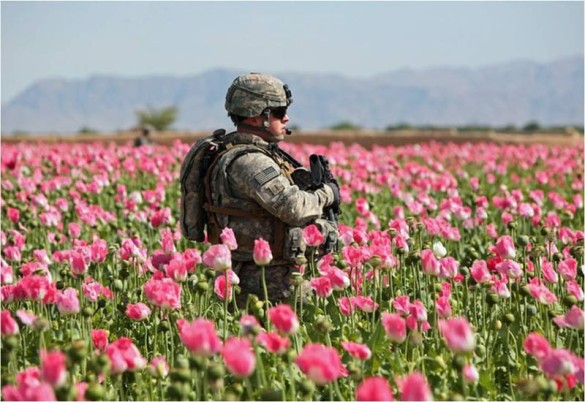
A mystery disease infecting opium poppies in Afghanistan could cut this year’s illicit crop in some areas by up to 70 percent, an official said Sunday.

The disease has led authorities to expect a “significant” reduction in opium production this year, with the UN Office on Drugs and Crime (UNODC) saying this week that the output could fall by up to 25 percent.

Daud Daud, Afghanistan’s deputy interior minister for counter-narcotics, said that “in some areas up to 70 percent of the crops have been destroyed” by the disease.

“We’ll have a significant reduction” in the opium production “this year,” Daud said, refusing to give further details, saying that an overall survey of this year’s output was still under way.

Afghanistan produces more than 90 percent of the world’s opium, the raw material for making heroin, mainly in the provinces of Helmand and Kandahar in the south and Farah in southwest.

“Interestingly there is a natural disease that is infecting opium in five provinces,” said Daud.

He could not confirm what disease had infected the crops but blamed it on an insect infestation. He said the disease was being investigated in government laboratories.

Antonio Maria Costa, the head of UNODC, has said the disease was a fungus, while some farmers have reportedly blamed the US and Britain for spraying their crops with a chemical in an effort to eradicate opium.

It’s hardly surprising that locals suspect they might be victims of some kind of foreign intrigue as they watch their lucrative crop wither but in this instance one doesn’t have to believe in conspiracy theories to have some doubts.

In October 2000, BBC television reported that a former biological warfare factory was being used in a British-funded project aimed at stemming heroin production.

Scientists in the plant in Uzbekistan are trying to perfect the Pleospora fungus that kills the opium poppy – source of the world’s illegal heroin supply.

But the research work may already be running out of control. Mike Greaves, the British scientist who is the secret project’s expert consultant, admits in a rare interview that he cannot be certain the fungus is 100% safe.

Despite this Greaves, a micro-biologist from Bristol, is convinced the fungus is a ‘sensational’ answer to the world’s heroin problem. He says: “I love the project, it’s one of the most exciting projects that I’ve been involved in.”

Professor Paul Rogers, a leading British plant pathologist warns: “The fungus sounds like a silver bullet but it could easily become a poisoned chalice. Once you develop a technology to spread plant diseases intentionally you are developing a technology which could easily be misused by bad people against legitimate food crops.”

Facebooktwittermail

U.S. is still using private spy ring, despite doubts

The New York Times reports on a secret network of private spies who have produced hundreds of reports from deep inside Afghanistan and Pakistan, despite concerns among some in the military about the legality of the operation.

Since the Sept. 11, 2001, attacks, the Pentagon has used broad interpretations of its authorities to expand military intelligence operations, including sending Special Operations troops on clandestine missions far from declared war zones. These missions have raised concerns in Washington that the Pentagon is running de facto covert actions without proper White House authority and with little oversight from the elaborate system of Congressional committees and internal controls intended to prevent abuses in intelligence gathering.

The officials say the contractors’ reports are delivered via an encrypted e-mail service to a “fusion cell,” located at the military base at Kabul International Airport. There, they are fed into classified military computer networks, then used for future military operations or intelligence reports.

To skirt military restrictions on intelligence gathering, information the contractors gather in eastern Afghanistan and Pakistan’s tribal areas is specifically labeled “atmospheric collection”: information about the workings of militant groups in Afghanistan and Pakistan or about Afghan tribal structures. The boundaries separating “atmospherics” from what spies gather is murky. It is generally considered illegal for the military to run organized operations aimed at penetrating enemy organizations with covert agents.

But defense officials with knowledge of the program said that contractors themselves regarded the contract as permission to spy. Several weeks ago, one of the contractors reported on Taliban militants massing near American military bases east of Kandahar. Not long afterward, Apache gunships arrived at the scene to disperse and kill the militants.

The web of private businesses working under the Lockheed contract include Strategic Influence Alternatives, American International Security Corporation and International Media Ventures, a communications company based in St. Petersburg, Fla., with Czech ownership.

One of the companies employs a network of Americans, Afghans and Pakistanis run by Duane Clarridge, a C.I.A. veteran who became famous for his role in the Iran-Contra scandal.

Facebooktwittermail

Remembering the Nakba


Shabbah TV: Palestine/Israel history since 1878 — 13 min 33 sec

Nabil Shaath writes:

Today Israel celebrated 62 years since its formation on 15 May 1948. For Palestinians, today marks the 62nd year since the Nakba – our national and personal catastrophe, involving the loss of our ancestral homeland and the dispersal of three-quarters of our people into exile.

To date, the Palestinian people await Israeli recognition of its responsibility in the catastrophe and agreement to resolve the conflict based on international law, including UN resolutions.

I experienced exile first-hand. On 13 May 1948 one day before Israel’s declaration of independence, my hometown of Jaffa was captured by Zionist forces. Seventy thousand Palestinian inhabitants of the city were forced to leave, most of them by sea to Gaza, Egypt, and Lebanon. We Jaffans were literally driven out to the sea. I was 10. We were never allowed to return.

The same reality befell more than 726,000 indigenous Christian and Muslim Palestinians who fled their homes or were expelled from Mandate Palestine in and around 1948; while hundreds of Palestinians were killed as they were driven out, or in their attempt to come back home. Several Israeli historians such as Benny Morris and Ilan Pappe described the catastrophe vividly and accurately.

In the wake of the expulsion, more than 418 Palestinian villages were razed to the ground. Nearly all Palestinian property, including that belonging to Palestinians who managed to stay within the areas that came under Israeli control, was confiscated by the nascent State of Israel for the exclusive benefit of Jews. In 1952, when Israel’s parliament passed its nationality law, Palestinian refugees were denied the option of citizenship in the new state. Additional measures were taken to bar our return to our country and our homes. The expulsion of Palestinians and the subsequent measures to render the displacement permanent were taken in contravention of international law.

These events, which left the majority of Palestinians stateless and dispossessed, were compounded by the Israeli military occupation of the West Bank and Gaza Strip in 1967. Hundreds of thousands of Palestinians once again fled their homes, and Israel expanded its control over the remaining 22% of our historic homeland. Today, the stranglehold over the Gaza Strip, the ongoing settlement and closure activities in the West Bank, including East Jerusalem, is leading to more Palestinian fragmentation and displacement. Indeed, the Nakba continues.

BADIL Resource Center for Palestinian Residency and Refugee Rights issued the following statement today:

At their core, the circumstances surrounding the Palestinian struggle today do not differ from those circumstances that led to the 1948 Nakba and the colonization of Palestine. Today, on the sixty-second anniversary of the Nakba, the nature of the western-backed Zionist-Israeli colonial enterprise appears all the clearer. The indigenous Palestinian people have been denied their most fundamental and inalienable rights of self-determination, including their rights to return to the land from which they were displaced, and continue to suffer from Israel’s grave violations of basic human rights and freedoms. As Israel cruelly blockades the Palestinians of the Gaza Strip and denies 7.1 million displaced Palestinians around the globe their rights to return, restitution and compensation, the international community provides a protective shield forged through diplomatic, economic, cultural and security cooperation which perpetuate Israel’s impunity.

In a time when Israel’s true face as a regime of colonization, apartheid and military occupation has been exposed for the world to see, governments and their organizations, have chosen to look the other way. The protective shield preventing effective redress and accountability for Israel’s crimes is no more provided by western states alone, as international organizations have joined the chorus that calls for a “balanced position” and have allowed Israel’s membership and integration into global and regional, civil and official organizations. Israel thus enjoys not only the unlimited support of the United States, but also enjoys preferential status with the European Union under the 1995 Barcelona Declaration and the E.U.-Israel Association Agreement, which have entrenched European relations with Israel in political, military, financial, economic, social and cultural terms, and even in the field of humanitarian aid.

Only recently, on 10 May, no OECD member state felt obliged by international law or found the moral strength to block Israel’s accession to that club of the world’s powerful economies. Israel’s protective shield is no longer composed merely of U.S. veto powers in the Security Council of the United Nations. It has spread to other UN fora, such as the General Assembly and the Human Rights Council where global powers exert coercive pressure on member states, and even to domestic judicial systems and international courts, in order to enable Israel to escape accountability for its grave violations of international law.

It has become painfully clear that Israel and the so-called Quartet view Palestinian demands for the implementation of international law as an obstacle to the peace process, at best, and as a form of unacceptable radical extremism, at worst. This explains why the U.S. has resumed pressure on the Palestinian and Arab representatives to return to the negotiating table despite Israel’s refusal to cease construction and expansion of its settlements in the occupied Palestinian West Bank, and irrespective of the personal commitment given in this regard by President Obama. Thus, so-called proximity talks and indirect negotiations are being relaunched while Israel’s prime minister reassures his coalition government that there will be no limitation on settlement construction and expansion, the forced displacement of Palestinians from Jerusalem and the expansion of the network of apartheid roads and the Wall in the occupied West Bank.

Meanwhile, Israel continues to draft and adopt more racist legislation, including law proposals to outlaw Nakba commemoration, the 2009 Israel Lands Authority Law and a 2010 amendment of the Land Acquisition Law, which allow privatization and confiscation of more land of Palestinian refugees and citizens, as well as new military orders, such as Order No. 1650 arbitrarily defining a large portion of the Palestinian population of the occupied West Bank and foreigners as “infiltrators” subject to arrest and deportation.

In light of the above and the division and weakness which has characterized the performance of the Palestinian leadership, BADIL re-iterates the call of the National Committee for the Commemoration of the Nakba issued this 15 May:

for the Palestinian leadership to:

• Adopt a coherent strategy towards a just and permanent solution for Palestinian refugees and IDPs, based on their right to return and in accordance with international law, universal principles of justice and UN resolutions 194 (1948) and 237 (1967);
• Halt all negotiations, whether direct or indirect, until Israel completely halts settlement expansion, population transfer (“Judaization”), and construction of the Wall and other infrastructure of colonization and apartheid, such as roads and the light train connecting Jewish settlements to West Jerusalem;
• Ensure national reconciliation and unity as a matter of urgency, and rebuild the PLO as a legitimate and credible platform representing the entire Palestinian people and its political organizations;
• Support and activate popular resistance in all forms permitted under international law.
• Establish a consultative mechanism with professional civil society organizations to support the efforts of the PLO in international fora.

To the public in Palestine and abroad to:

Build and expand the civil society-led movement for boycott, divestment and sanctions (BDS) against Israel until it complies with international law and exert stronger pressure on states to implement sanctions and adopt decisions and resolutions which support the global BDS Campaign;

Redouble efforts for investigation of Israeli war crimes and crimes against humanity and prosecution and punishment of those responsible, as well as efforts to prevent Israel’s accession and integration into international and regional organizations.

Facebooktwittermail

Israel’s red line: real democracy

Jonathan Cook writes:

The recent arrest of two respected public figures from Israel’s Palestinian Arab minority in night-time raids on their homes by the Shin Bet secret police – brought to light this week when a gag order was partially lifted – has sent shock waves through the community.

The arrests are not the first of their kind. The Shin Bet has been hounding and imprisoning politicians and intellectuals from the country’s Palestinian minority, a fifth of the population, since the birth of the Jewish state more than six decades ago. Currently, two MPs from Arab political parties, as well as the leader of the popular Islamic Movement, are facing trials.

But the detention of Amir Makhoul and Omar Sayid is seen differently — as the gathering storm clouds in a political climate already fiercely hostile to its Palestinian citizens.

Mohammed Zeidan, the head of the Human Rights Association in Nazareth, said: “We are used to our political leaders being persecuted but now the Shin Bet is turning its sights on the leaders of Palestinian civil society in Israel, and that’s a dangerous development.”

Mr Makhoul and Mr Sayid are not accused of the usual public order offenses, nor have they simply violated chauvinistic legislation that criminalizes Palestinian citizens’ visits to neighboring Arab states. Both are facing the much more serious charge of espionage, on behalf of Lebanon’s Hezbollah.

Mr Makhoul, who appears to be the chief object of the Shin Bet’s interest, is the head of Ittijah, an umbrella organization coordinating the activities of Palestinian human rights groups in Israel. More specifically, he has become the leading voice inside Israel backing the growing international campaign for boycott, sanctions, and divestment against Israel.

On Wednesday, the courts approved an extension of Mr Makhoul’s remand. He was not allowed to be present and was denied the right to a lawyer until at least next Monday, 12 days since his arrest. He is reportedly being interrogated around the clock.

Facebooktwittermail

The attacks on Goldstone

In Haaretz, Hagai El-Ad writes:

What will they come up with next? The campaign to discredit Judge Richard Goldstone, his fact-finding commission and the report that now bears his name seems to reach new heights every week. The latest installment in this high-drama farce has been the revelations about Goldstone’s record during apartheid-era South Africa, and the implication that his report can therefore be disregarded. The mind reels at the intensity of attempts by Israeli officials and others to do everything to dodge the real questions of accountability, policy and justice that have been lingering inconveniently since Operation Cast Lead. But inconvenient questions do tend to linger, and the attempts to deploy an ever-thicker smokescreen usually only draw more attention to what may be hidden behind it.

And yet, the recent attacks on Goldstone have been helpful in re-introducing into public discourse what is perhaps the most important question of all: moral responsibility. How must individuals behave when faced with injustice? What do we expect from our judges, public servants and elected officials? And what do we expect from ourselves? The focus on Goldstone’s past, far from enabling us to escape the lingering questions of Cast Lead – and other questions that must trouble anyone seeking justice – actually serves to throw them into sharp relief.

So here are some complementary questions about justice and those involved in its disservice. And mind you, these questions were not drawn from a far-away past, but from the here-and-now. It is the present that will determine our future – and to what extent justice will be a part of it.

Consider this: What is the reader’s moral judgment of a law that allows some people to reclaim past ownership rights but denies the same rights to others? This is the question today in Sheikh Jarrah.

How just do we deem the conduct of legal advisers who approve the evacuation of longtime indigenous residents from the center of a thriving city, enforcing almost complete separation between the hundreds who have moved in and the thousands who were displaced? This is the question today in Hebron.

What do we think of military commanders who collectively punish more than a million human beings, systematically answering their nutritional needs with provisions that keep them just above a state-secret “red line”? This is the question today in Gaza.

Facebooktwittermail

Obama wants US taxpayers to pay for an Israeli defense ‘scam’

Israel’s newly developed “Iron Dome” missile defense shield will supposedly provide vital protection from rocket attacks from Gaza or Lebanon.

The system’s manufacturer, Rafael Advanced Defense Systems, says:

The Iron dome is a cost effective system that can handle multiple threats simultaneously and efficiently [and] has been selected by the Israeli Defense Ministry as the best system offering the most comprehensive defense solution against a wide range of threats in a relatively short development cycle and at low cost.

Israel receives $3 billion annually in military aid from US taxpayers, so you’d imagine that the Israeli government would allocate some of that generous aid to pay for Iron Dome. No, instead President Obama just agreed that we should chip in an extra $205 million because Iron Dome “addresses an immediately existing threat to each Israeli citizen,” a senior administration official said.

But while Israel isn’t willing to cover the cost of deploying this system, it is already looking at opportunities to sell it to NATO.

As for the “low cost” the manufacturers tout, perhaps what they mean is that it will be a low cost for Israelis so long as its paid for by Americans. Whether the system would have any real value — that’s a completely different question.

Some of the harshest criticism of the system comes from inside Israel where Tel Aviv University professor and noted military analyst Reuven Pedatzur charged that despite the well-known ineffectiveness of Iron Dome and other missile defense systems, “for the aeronautics and defense industries, it’s a matter of money; and for politicians, supporting such projects allows them to tell the public that they’re doing something, they’re trying to find answers to the threats we face.”

“The Iron Dome is all a scam,” he said. “The flight-time of a Kassam rocket to Sderot is 14 seconds, while the time the Iron Dome needs to identify a target and fire is something like 15 seconds. This means it can’t defend against anything fired from fewer than five kilometers; but it probably couldn’t defend against anything fired from 15 km., either.”

Added Pedatzur: “Considering the fact that each Iron Dome missile costs about $100,000 and each Kassam $5, all the Palestinians would need to do is build and launch a ton of rockets and hit our pocketbook.

The David’s Sling is even worse, he said. “Each one of its missiles costs $1 million, and Hizbullah has well over 40,000 rockets. This issue has no logic to it whatsoever.”

Facebooktwittermail

Obama’s torture loophole

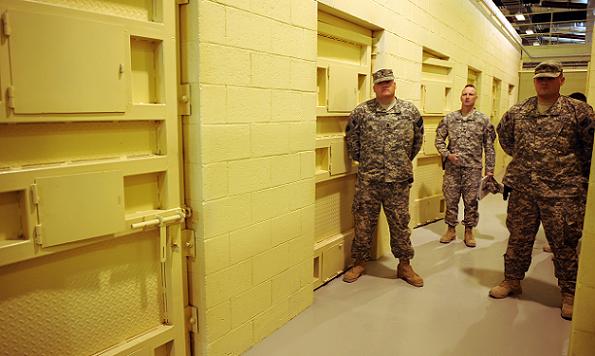
What’s the difference between a US-military-run detention facility and an intelligence gathering facility? For one thing, Red Cross officials are being prevented from seeing how prisoners are treated when held at Bagram’s intelligence gathering facility. Is that so that they can be tortured in secret?

Two days after taking office, Barack Obama signed an executive order banning torture. The era of secret detention facilities and CIA-administered waterboarding were over. Or so we thought.

Earlier this week, the BBC reported:

The US airbase at Bagram in Afghanistan contains a facility for detainees that is distinct from its main prison, the Red Cross has confirmed to the BBC.

Nine former prisoners have told the BBC that they were held in a separate building, and subjected to abuse.

The US military says the main prison, now called the Detention Facility in Parwan, is the only detention facility on the base.

However, it has said it will look into the abuse allegations made to the BBC.

The International Committee of the Red Cross (ICRC) said that since August 2009 US authorities have been notifying it of names of detained people in a separate structure at Bagram.

“The ICRC is being notified by the US authorities of detained people within 14 days of their arrest,” a Red Cross spokesman said.

“This has been routine practice since August 2009 and is a development welcomed by the ICRC.”

The spokesman was responding to a question from the BBC about the existence of the facility, referred to by many former prisoners as the Tor Jail, which translates as “black jail”.

Prisoners say they have been kept in isolation in cold cells and subjected to sleep deprivation, but it turns out the CIA’s hands are clean — this time it’s the Defense Intelligence Agency at work. And as for the fact that the Red Cross has been barred from entering this facility, that’s because it isn’t being called a detention facility.

Marc Ambinder reports:

Defense officials said that the White House is kept appraised of the methods used by interrogators at the site. The reason why the Red Cross hasn’t been invited to tour it, officials said, was because the U.S. does not believe it to be a detention facility, classifying it instead as an intelligence gathering facility.

A Defense official said that the agency’s inspector general had launched an internal investigation into reports in the Washington Post that several teenagers were beaten by the interrogators, but [Pentagon spokesman, Bryan] Whitman disputes this.

When the Obama Administration took over, it forbade the DIA from keeping prisoners in the facility longer than 30 days, although it is not clear how that dictum is enforced. It is also not clear how much Congress knows about the DIA’s interrogation procedures, which have largely escaped public scrutiny.

Facebooktwittermail

Israel’s unlawful destruction of property during Operation Cast Lead

In a press release, Human Rights Watch said today:

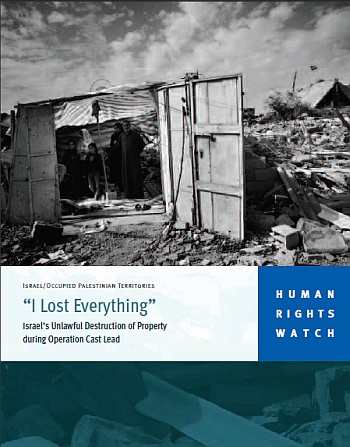
Israel should investigate the unlawful destruction of civilian property during the 2009 Gaza hostilities and lift the blockade that hinders residents from rebuilding their homes, Human Rights Watch said in a new report released today.

The 116-page report, “‘I Lost Everything’: Israel’s Unlawful Destruction of Property in the Gaza Conflict” documents 12 separate cases during Operation Cast Lead in which Israeli forces extensively destroyed civilian property, including homes, factories, farms, and greenhouses, in areas under their control, without any lawful military purpose. Human Rights Watch’s investigations, which relied upon physical evidence, satellite imagery, and multiple witness accounts at each site, found no indication of nearby fighting when the destruction occurred.

Israel has claimed that its forces destroyed civilian property only when Palestinian armed groups were fighting from it, or were using it to store weapons, hide tunnels, or advance other military purposes. Israel also claims that many Gazan homes were destroyed by Hamas booby-traps. The evidence in the incidents that Human Rights Watch investigated does not support such claims.

“Almost 16 months after the war, Israel has not held accountable troops who unlawfully destroyed swaths of civilian property in areas under their control,” said Sarah Leah Whitson, Middle East director at Human Rights Watch. “Israel’s blockade continues to keep Gazans from rebuilding their homes, meaning that Israel is still punishing Gaza’s civilians long after the fighting is over.”

Human Rights Watch found evidence in the 12 cases indicating that Israeli forces carried out the destruction for either punitive or other unlawful reasons, violating the prohibition under international humanitarian law – the laws of war – against deliberately destroying civilian property except when necessary for lawful military reasons. In seven of the cases, satellite imagery corroborated eyewitness accounts that Israeli forces destroyed many structures after establishing control over an area and shortly before Israel announced a ceasefire and withdrew its forces from Gaza on January 18, 2009.

Israel’s comprehensive blockade of the Gaza Strip, a form of collective punishment against civilians imposed in response to Hamas’s takeover of Gaza in June 2007, has prevented significant reconstruction, including in areas where Human Rights Watch has documented destruction. Israel has allowed imports of cement for several repair projects, but United Nations Secretary-General Ban Ki-moon noted in late March that these were “a drop in a bucket” compared to housing needs.

Israeli officials insist that the blockade – which had already degraded humanitarian conditions in Gaza before Operation Cast Lead – will remain in place until Hamas releases Staff Sergeant Gilad Shalit, the Israeli soldier captured in 2006, rejects violence, and fulfills other political conditions. Hamas’s prolonged incommunicado detention of Shalit violates the prohibition of cruel and inhuman treatment and may amount to torture.

Many goods are being smuggled into Gaza through tunnels beneath the southern border with Egypt, and many damaged buildings have been repaired at least partially with bricks made from smuggled cement and recycled concrete rubble. However, these improvised building materials are reportedly of poor quality and cannot be used for large reconstruction projects. In the areas of Gaza where Human Rights Watch found that Israeli forces had destroyed homes in areas under their control, there has been virtually no reconstruction of destroyed buildings, indicating that the inadequate supply of reconstruction materials still leaves these materials prohibitively expensive for most of Gaza’s residents, more than three-quarters of whom are impoverished.

Egypt shares responsibility for the collective punishment of Gaza’s civilian population due to its own closure of Gaza’s southern border. Except in limited circumstances, Egypt refuses to allow the passage of goods or people through the border crossing it controls at Rafah.

The laws of war prohibit attacks on civilian objects, including residential homes and civilian factories, unless they become a legitimate military objective, meaning that they are providing enemy forces a definite military advantage in the circumstances prevailing at the time. The report examines incidents of destruction that suggest violation of the laws-of-war prohibition of wanton destruction – the term used to describe extensive destruction of civilian property not lawfully justified by military necessity. Such destruction would be a grave breach of the Fourth Geneva Conventions of 1949, which is applicable in Gaza. Individuals responsible for committing or ordering such destruction should be prosecuted for war crimes.

Human Rights Watch did not include in its report cases in which the destruction was not extensive, or the evidence suggested any possibility that Israel’s destruction of the property in question could have been militarily justified or based on mistaken information.

Human Rights Watch documented the complete destruction of 189 buildings, including 11 factories, 8 warehouses and 170 residential buildings – roughly 5 percent of the total property destroyed in Gaza – leaving at least 971 people homeless. In the cases investigated in the neighborhoods of Izbt Abd Rabbo, Zeitoun, and Khoza’a, Israeli forces had destroyed virtually every home, factory, and orchard within certain areas, indicating an apparent plan of systematic destruction in these locations. The destroyed industrial establishments include juice and biscuit plants, a flour mill, and seven concrete factories. Human Rights Watch did not determine whether these incidents represent a broader pattern, but Israel should thoroughly investigate these cases – including the lawfulness of any relevant policy decisions – and appropriately punish persons found to have acted unlawfully.

“The evidence shows that, in these cases, Israeli forces gratuitously destroyed people’s homes and livelihoods,” said Whitson. “If the Israeli government doesn’t investigate and punish those responsible, it would be effectively endorsing the suffering that these civilians have endured.”

Israel Defense Forces (IDF) lawyers told Human Rights Watch that the IDF is probing many of the cases of property destruction documented in this report. However, these are not criminal investigations by military police, but so-called operational debriefings that do not involve contacting Palestinian witnesses. Of the 150 investigations opened to date into Operation Cast Lead, 36 are criminal investigations and the rest are operational debriefings. Two of these criminal cases include allegations of damage to individual buildings.

The only reported penalty imposed for unlawful property destruction during Operation Cast Lead was an unspecified disciplinary measure taken immediately by the commander in the field against one soldier for an incident involving “uprooting vegetation” in Gaza. The IDF has provided no further details regarding the incident or the disciplinary measure. Overall, to date Israel has criminally sentenced only one soldier and has disciplined four other soldiers and commanders for violations during the Gaza operation.

Notably, Israel has not conducted thorough and impartial investigations into whether policy decisions taken by senior political and military decision-makers, including pre-operation decisions, led to violations of the laws of war, such as the unlawful destruction of civilian infrastructure.

Israel has published the results of a military probe into one case documented in this report, which found an attack on a flour mill to be lawful. The probe’s conclusions, however, are contradicted by available video and other evidence. (In late March 2010, Israel announced that it had approved cement imports to repair the flour mill.) The IDF has not provided explanations for the other 11 incidents that Human Rights Watch documented and previously raised with the IDF.

Hamas authorities are not known to have taken any meaningful steps to investigate or hold accountable members of Hamas or other Palestinian armed groups responsible for serious laws-of-war violations either before, during, or since Operation Case Lead, primarily rocket attacks at populated areas in Israel. However, under the laws of war, unlawfulness by one party to a conflict does not justify unlawful acts by another.

Under the laws of war, not all destruction of civilian property is unlawful. At times, Hamas and other Palestinian armed groups used civilian structures to engage Israeli forces and to store arms; they also booby-trapped civilian structures and dug tunnels underneath them.

In addition, Human Rights Watch criticized Hamas and other Palestinian groups for firing rockets from populated areas. In such cases, property damage caused by Israeli counter-strikes against armed groups may have been lawful “collateral damage.” Palestinian armed groups also may have been responsible for damage to civilian property in cases in which IDF attacks triggered secondary explosions of weapons or explosives stored by armed groups, which damaged nearby structures. The destruction of civilian property during immediate fighting or in order to permit the movement of Israeli forces because adjoining roads were mined and impassable may be lawful as well, depending on the circumstances.

Human Rights Watch’s investigations considered these possibilities and focused on 12 cases where the evidence indicates that there was no lawful justification for the destruction of civilian property. In these incidents, the IDF was not engaging Palestinian forces at the time they destroyed the property – in all cases fighting in the area had stopped – and in most cases the property destruction occurred after Israeli forces had eliminated or dispersed Palestinian fighters in the area and consolidated their control, such as by occupying houses, stationing tanks in streets or on nearby hills, and undertaking continuous surveillance from manned and unmanned aircraft.

The mere possibility of future military use by armed groups of some civilian structures in these areas – such as to set booby-traps, store weapons, or build tunnels – cannot under the laws of war justify the wide-scale and at times systematic destruction of whole neighborhoods, as well as of factories and greenhouses that provided food and other items intended for the civilian population.

Public statements by some Israeli political leaders suggest a willingness to destroy civilian infrastructure in Gaza to deter rocket attacks by armed groups against Israel. Human Rights Watch documented numerous cases in which Palestinian armed groups in Gaza launched rocket attacks against Israeli population centers during and before Operation Cast Lead in violation of the laws of war. During the fighting, approximately 800,000 Israelis were within range of hundreds of rocket attacks, which killed three Israeli civilians and seriously injured several dozen others. Individuals who willfully conducted or ordered deliberate or indiscriminate rocket attacks on civilians are responsible for war crimes. However, as noted, laws of war violations by one party to a conflict do not justify violations by another party.

Israel controls the Gaza Strip’s land, air, and sea access with the exception of a 15-kilometer border with Egypt. Since the end of the conflict, Israel has approved limited shipments of food, fuel, and material into Gaza, but these fall far short of the humanitarian needs of the population. It has allowed construction materials designated for specific projects, but continues to deny entry to cement, iron bars, and other basic construction materials. While there are valid Israeli security concerns that Hamas could use cement to build or strengthen military bunkers and tunnels, humanitarian aid organizations report that Israel has refused to consider a mechanism to ensure the independent monitoring of the end-use of construction materials. Israel should urgently seek to create such a mechanism.

“The United States, the European Union, and other states should urgently call upon Israel and Egypt to open Gaza’s borders to reconstruction materials and other supplies essential for the civilian population,” Whitson said.

Facebooktwittermail

Russia’s Middle East moves

While Israel, Iraq and Afghanistan are like lead weights that limit the flexibility of the United States in the Middle East, other powers are now taking advantage of Washington’s inability to function as an agent of change.

After Russian President Dmitry Medvedev visited Turkey this week, commentator Semih Idiz wrote:

[I]f U.S. President Barack Obama’s visit to Turkey was the highlight of 2009, Medvedev’s visit to Turkey is the highlight of 2010. In fact, one can even go further and suggest that the latter visit has produced much more in terms of concrete results than the former.

There is no doubt, for example, that Washington is looking on with a certain chagrin as Turkey awards a $20 billion nuclear power plant contract to Russia and signs documents that propose a $100 billion volume of trade as well as billions of dollars worth of investments, all suggesting a rapidly growing strategic partnership.

Meanwhile, Al Jazeera reports that Russia has rejected criticism from Israel after Medvedev met the leader of Hamas in Damascus.

Israel’s foreign ministry said it was “deeply disappointed” that Medvedev had met Khaled Meshaal, the group’s exiled leader, during a visit to Syria this week.

“Hamas is not an artificial structure,” Andrei Nesterenko, the Russian foreign ministry spokesman, said in a statement on Thursday.

“It is a movement that draws on the trust and sympathy of a large number of Palestinians. We have regular contacts with this movement.

“It is known that all other participants of the Middle East quartet are also in some sort of contact with Hamas leadership, although for some unknown reason they are shy to publicly admit it,” Nesterenko said.

Joshua Landis says:

Russia will fish in the troubled waters of the Middle East. American isolation can only redound to its advantage. The Arabs and Iran will look to Russia for arms. Russia can also be gratified by the deterioration of Turkey’s relations with both Israel and the United Stats. It will continue to look for ways to frustrate U.S. efforts to add teeth to its sanctions regime against Iran.

So long as America’s No. 1 foreign-policy goal in the region is to hurt Iran and help Israel, Russia will be drawn back into the region and a new Cold War will take shape. Washington’s failure to realign relations with Iran and Syria dooms it to repeat its past. But this time Israel will be more of a millstone around its neck as it thumbs it’s nose at international law and human rights.

Facebooktwittermail

The end of an era?

A few hours before Gordon Brown resigned as Britain’s prime minister, Alastair Campbell, Tony Blair’s former communications director said: “I think the reason why I’ve got involved in the election campaign is because I really think it would be terrible for Britain if David Cameron was prime minister and there was a Tory government, but if that is what happens we’ll just have to accept that. I hope that can be prevented.”

Anyone who lived in Britain through the Thatcher era has good reason to view the return of a Tory government as potentially terrible, but there is one prospect that would be even worse: the continued influence of people like Alastair Campbell.

The final effort of the master of spin to thwart the return to power of the Conservatives was to conjure the prospect of a “progressive alliance” — even when the numbers didn’t quite add up — but as soon as it became clear that that wasn’t going to happen, Campbell rushed to announce the imminent publication of his tell-all diaries. His loss of political influence does no doubt open up fertile new commercial opportunities.

But as for the arrival of a much-dreaded Tory government, the fact that it will instead be a “Liberal Democrat-Conservative coalition” — it was the new Conservative prime minister David Cameron who put his partners first — should not, as Jonathan Freedland points out, be seen as a construction of mere political expedience.

Since taking over in 2005, the Tory leader has tried to recast his party as one with which liberal Britons could feel comfortable – modern, tolerant, environmentally aware. That has been an uphill struggle, as the failure to “seal the deal” in last week’s election confirms. Yet at a stroke, Cameron has rammed his point home. How, runs the logic, could anyone dispute the liberal credentials of the new prime minister now? His government is packed full of Liberals. Cameron had always tried to rebrand himself as a liberal Conservative. Today he could speak of his “liberal Conservative government” – and the phrase was no longer empty.

Indeed, Britain’s first coalition government since the Second World War opens up a possibility that should be watched with keen attention by observers who might otherwise have no particular interest in British politics. The era where image-makers such as Campbell turned policymaking into an utterly unprincipled message-shaping process, may finally be drawing to a close as the communications apparatus of a single party will no longer hold sway. David Cameron will not have the luxury of merely needing to sell his message to a friendly media but will have to persuade Liberal-Democrat partners much less willing to swallow the Conservative spin.

The political mechanics of consensus and compromise will be hard enough to manage without the additional strain of attempting to balance the competing demands of two communications teams. For that reason, there is a chance that the spin doctors will be sidelined or their influence at least diminished if they further complicate an already complex process.

Beyond Britain’s slavish allegiance to Washington during the Blair years, nothing represented the Labour government’s abandonment of principle more clearly over the last decade than the relentless erosion of civil liberties in the name of security. There is now the prospect that this trend will be reversed.

Yesterday, Andy Worthington wrote:

Those of us who are concerned about the erosion of civil liberties under the Labour government, and the assault on human rights as part of the “War on Terror,” will be watching the government closely. On ID cards, both parties pledged to scrap Labour’s much-criticized scheme, and wasted no time in announcing today that the scheme would indeed be scrapped. To follow, apparently, are plans to scrap the next generation of biometric passports, to review the libel laws in England and Wales “to protect freedom of speech,” and to regulate the use of CCTV cameras, in particular as used by local authorities. As Channel 4 News’ Home correspondent Andy Davies explained today, “There will almost certainly be a reduction in the capacity for the DNA database to store samples taken from people arrested but not convicted. The national child database in England (‘Contactpoint’) is likely to be abandoned.”

As Andy Davies also explained, civil liberties is “one area where the coalition parties have a struck a similar tone in recent years … In their manifestos, the Lib Dems complain[ed] that the UK has become a ‘surveillance state,’ the Tories bemoan[ed] a ‘database state.’ Both have made significant pledges to roll back what they describe as intrusive, authoritarian executive powers introduced under Labour.”

How this seemingly happy cooperation will translate to questions of terrorism and human rights remains to be seen. Andy Davies noted that “the controversial control order regime could be one of the first Labour counter-terror initiatives to disappear under the new National Security Council.” He added that “the Tories call the orders ‘inherently objectionable’ and want a review” and “the Lib Dems have said they’ll cancel the whole project.”

And if anyone is in any doubt about just how badly eroded civil liberties in Britain have become, watch David Hoffman, a photojournalist who lives in east London, describe how he got handcuffed by police officers who forced their way into his own home on election day after he displayed a mildly offensive political poster in his living room window.

Facebooktwittermail

Is Obama moving to escalate the war in Pakistan?

The United States is at war in Pakistan. It will be up to historians to decide when this war began.

“Drone Strikes Pound West Pakistan” says the headline above a brief report in the New York Times. After the CIA fired 18 missiles resulting in at least 14 deaths on Tuesday, the operation was described merely as “a continuation of the air campaign to degrade the capabilities of Al Qaeda, the Pakistani Taliban and the Afghan Taliban fighters now working together in North Waziristan” (my emphasis).

“Continuation” is another name for escalation when developments that should prompt alarm have already been inoculated with the name “necessity.”

A course of action that if it initiated by George Bush might have been seen as an expression of his intemperate nature, when pursued by no-drama Obama is instead billed as a judicious expansion in the use of force.

But the danger of escalation — now as always — is that the seemingly carefully calibrated expansion of a war has unintended and far-reaching consequences. Only after it’s too late do we learn that the calibration rested on nothing more than wishful thinking.

The logic behind the apparent necessity of expanding the war into Pakistan has been evident ever since the war in Afghanistan began. For Bush, the dangers implicit in crossing the Durand Line seemed to provoke fear, but his successor seems intent on showing he lacks such trepidation. North Waziristan is where Obama gets to prove that he has the steel that Bush lacked — or so the script says.

In this context the Times Square attempted bombing has acquired particular significance. If the lack of a credible endgame in Afghanistan would make it even more difficult to justify expanding the war, then a scare in New York could be useful in prompting a renewed sense of urgency.

In Pakistan’s Dawn newspaper today, Rafia Zakaria writes:

Security experts in Washington have since begun to call Shahzad’s bombing attempt a “game changer” in the war against terror and have been signalling the possibility of an incursion of US forces into Pakistani territory. Several factors point to the fact that such an option is indeed being considered by the Obama administration and Pentagon officials. First, conservative lawmakers on Capitol Hill have long been sounding alarm bells asking for a wider presence in Pakistan to accomplish the goals of the war on terror. Recent hearings held on Capitol Hill have focused on groups such as Jaish-i-Muhammad and Lashkar-i-Taiba that do not operate in the areas currently being targeted by aerial drone attacks.

In a hearing held in March, several US congressmen noted that the Lashkar “had put the world on notice that they intend to escalate the carnage and take it worldwide”. Other analysts have repeatedly pointed to the necessity of expanding drone strikes into Quetta to target the Quetta shura which supposedly runs the Taliban operations. While Shahzad’s connections are not currently traced to groups other than the Taliban, the fact that he spent time in Pakistan bolsters the position of those who insist that a wider military presence in Pakistan is crucial to eliminating the threat to the American homeland.

Second, the problems faced by the highly publicised US/Nato initiatives in Marja and Kandahar in Afghanistan have created a political demand for a more decisive endgame in the region. In the footsteps of the Marja offensive in early April, The New York Times reported that many of the gains made in the area by the US Marines’ costly offensive had largely been reversed and many Taliban had moved back into the area. The Kandahar offensive due to start soon has also been the subject of lowered expectations, with experts saying that the easy absorption of Taliban fighters into the local population and the lack of visible centres of Taliban control make it difficult to win a decisive victory in the area.

The reason why the failure of both offensives — one yet to begin — is relevant to the Pakistan equation is simple: with the beginning of a US withdrawal already announced for 2011, there is immense political pressure on the Obama administration to produce some semblance of victory. The expansion of the Afghanistan war into Pakistani territory would not only be a culmination of the Obama campaign’s slogans of Pakistan being the real problem, it would also provide a visible endgame to the vexing and increasingly intractable issue of whether the war in Afghanistan has really eliminated global terrorism.

If Obama is now a victim of his own campaign logic — the repetition of half-baked slogans must surely be as harmful to those who utter them as it is to those who hear them — this logic is nevertheless looking less persuasive outside the administration.

Noah Shachtman notes that the skepticism once only voiced by counter-insurgency wonks like David Kilcullen and Andrew Exum has now percolated right into the mainstream media.

“If you go into Pakistan and talk to college kids, which is what we did, these drone attacks are feeding this narrative: this is what we [Americans] are aiming to do. We’re aiming to kill Muslims,” Leslie Stahl said today on MSNBC’s Morning Joe.

“Let’s say China was launching drone attacks on Idaho, we would be pretty angry too. We are launching attacking against a people were not at war with, officially,” Joe Scarborough responded. “I would rather us go after the terrorists — individual terrorists — drag ‘em out, interrogate ‘em, get information — instead of dropping bombs that kill four year-old little girls. That dismember grandmoms that happen to be in the family compound. That seems immoral.”

The decision to dramatically escalate the drone war was done behind closed doors, with no public debate about whether the strikes were the best way to smash the jihadist networks based in Pakistan’s tribal wildlands. Perhaps now, we’ll have that discussion.

Visit msnbc.com for breaking news, world news, and news about the economy

Facebooktwittermail

Israel’s dark past arming apartheid South Africa

A new attack on Judge Richard Goldstone is the latest effort in a campaign to direct attention away from his allegations that Israel committed war crimes in Gaza. In this instance though, questions about Goldstone’s record as a judge in apartheid South Africa are overshadowed by the Jewish state’s own role in helping support the racist policies of one of the cruelest regimes of the 20th century.

Israel’s dark past as a secret ally of the cruel apartheid regime in South Africa is revealed in an article by Sasha Polakow-Suransky (the author of a new book on the same subject).

The Israel-South Africa alliance began in earnest in April 1975 when then-Defense Minister Shimon Peres signed a secret security pact with his South African counterpart, P.W. Botha. Within months, the two countries were doing a brisk trade, closing arms deals totaling almost $200 million; Peres even offered to sell Pretoria nuclear-capable Jericho missiles. By 1979, South Africa had become the Israeli defense industry’s single largest customer, accounting for 35 percent of military exports and dwarfing other clients such as Argentina, Chile, Singapore, and Zaire.

High-level exchanges of military personnel soon followed. South Africans joined the Israeli chief of staff in March 1979 for the top-secret test of a new missile system. During Israel’s 1982 invasion of Lebanon, the Israeli army took South African Defense Force chief Constand Viljoen and his colleagues to the front lines, and Viljoen routinely flew visiting Israeli military advisors and embassy attachés to the battlefield in Angola where his troops were battling Angolan and Cuban forces.

There was nuclear cooperation, too: South Africa provided Israel with yellowcake uranium while dozens of Israelis came to South Africa in 1984 with code names and cover stories to work on Pretoria’s nuclear missile program at South Africa’s secret Overberg testing range. By this time, South Africa’s alternative sources for arms had largely dried up because the United States and European countries had begun abiding by the U.N. arms embargo; Israel unapologetically continued to violate it.

As for Goldstone’s record as “a hanging judge”, this is what he told the Jewish Chronicle:

“During the nine years I was a trial judge from 1980 to 1989, I sentenced two people to death for murder without extenuating circumstances.

“They were murders committed gratuitously during armed robberies. In the absence of extenuating circumstances the imposition of the death sentence was mandatory. My two assessors and I could find no extenuating circumstances in those two cases.

“While I was a judge in the Supreme Court of Appeal from 1990 to 1994, all executions were put on hold. However, automatic appeals still continued to come before the Supreme Court of appeal. We sat in panels of three and again, in the absence of extenuating circumstances, some of those appeals failed.”

He added: “It was a difficult moral decision taking an appointment during the Apartheid era. With regard to my role in those years I would refer you to the joint public statement issues in January by former Chief Justice Arthur Chaskalson, the first Chief Justice appointed by President Mandela, and George Bizos, Nelson Mandela’s lawyer and close friend for over 50 years.

In their statement, Chaskalson and Bizos wrote:

Not every judge appointed during the apartheid era was a supporter of apartheid. There were a number among them, including Goldstone, who accepted appointment to the Bench in the 1970s and 1980s in the belief that they could keep principles of the law alive. They included Michael Corbett, Simon Kuper, Gerald Friedman, HC Nicholas, George Colman, Solly Miller, John Milne, Andrew Wilson, John Didcott, Laurie Ackermann, Johann Kriegler and others.

There is a considerable body of evidence that they discharged their functions with courage and integrity. This is recognised in the report of the Truth and Reconciliation Commission, which observed that “there were always a few lawyers (including judges, teachers and students) who were prepared to break with the norm”. Commenting on such judges, it says “they exercised their discretion in favour of justice and liberty wherever proper and possible . . . and [the judges, lawyers, teachers and students referred to] were influential enough to be part of the reason why the ideal of a constitutional democracy as the favoured form of government for a future South Africa continued to burn brightly throughout the darkness of the apartheid era”.

Goldstone was one of those judges. For instance, his decision in the case of S v Govender in 1986 that no ejectment order should be made against persons disqualified by the Group Areas Act from occupying premises reserved for the white group, without enquiring into whether alternative accommodation for such persons was available, was a blow to the apartheid regime and contributed substantially to that legislation becoming unenforceable in parts of the country.

As a judge of the Constitutional Court he concurred in the finding that the first draft of the Constitution of the Republic of South Africa passed by the newly elected Constituent Assembly did not comply in certain respects with the 34 constitutional principles agreed to by the negotiating parties at Codesa.

He was the founding chairperson of the National Institute for Crime Prevention and the Reintegration of Offenders (Nicro), which looks after prisoners who have been released; he exercised his power as a judge (not often used by other judges) to visit prisoners in jail; he insisted on seeing political prisoners indefinitely detained to hear their complaints; and he intervened so as to allow doctors to see them and where possible to make representations that their release be considered.

After the release of Nelson Mandela he played an important role in persuading his colleagues on the Bench to accept the inevitable changes that were likely to take place in the political and judicial structures.

Former president FW de Klerk, with the concurrence of the then-president of the African National Congress, Nelson Mandela, appointed Goldstone as the chairperson of the commission to investigate what became known as hit-squads or third-force organisations within the army and the police.

His reports exposed high-ranking officers, who were obliged by De Klerk to resign, and other ­members of the security forces, and he made findings that police had unlawfully shot at unarmed protesters and recommended that they be charged with murder.

Threats to his life were made, and his name was on the hit list produced in court as part of the state case against the killers of Chris Hani in 1993.

Meanwhile, yesterday was a good day for Israel as it was invited to join the mostly white, Eurocentric, rich nations’ club, the Organization for Economic Cooperation and Development.

Nothing better expresses the apartheid mentality at the heart of Zionism than Israel’s preference to belong to international organizations that are defined by exclusion rather than inclusion.

As Aluf Benn writes today in Haaretz:

Israel has always sought to become a member of international organizations where the Western bloc of nations enjoys a clear advantage. In the vast majority of UN institutions, for example, Israel is isolated and does not belong to any geographic group. So it can’t elect or be elected. But there are no Arab countries in the OECD and the only Muslim member is Turkey, which yesterday voted in support of the unanimous acceptance of Israel into the group.

Joining the OECD bolsters the approach of Netanyahu and Defense Minister Ehud Barak, who consider Israel “a villa in the jungle” – a small island of Western values and development in an Arab and Muslim sea. Now we’re in the club and the Palestinians, Egyptians and even the Saudis aren’t. They’re not even on the waiting list. In the OECD they can’t bother Israel with decisions condemning the occupation.

Facebooktwittermail

America’s latest nemesis

Among the many problems the Obama administration inherited from the Bush administration, none may be more troublesome than the fact that the man once granted the status most dangerous man in the world still remains the most elusive man in the world.

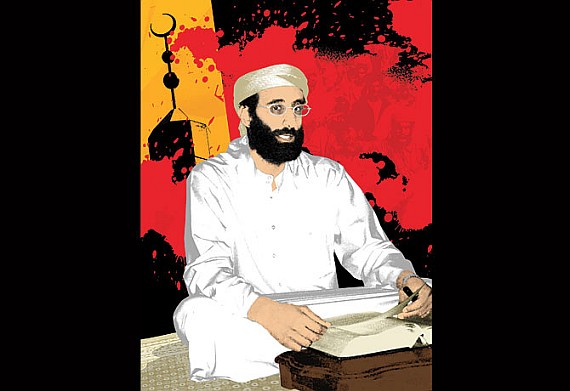
But if Osama bin Laden can’t be tracked down, maybe the alternative is to elevate an easier target to the same status in the hope of being able to claim an equal victory. It appears that the American-born and now fugitive imam, Anwar al-Awlaki, is being groomed for such a role.

This is how the New York Times is feeding the narrative:

One day in August 2001, Mr. Awlaki knocked at the door of Mr. Higgie, his neighbor [in San Diego], to say goodbye. He had moved the previous year to Virginia, becoming imam at the far bigger Dar al-Hijrah mosque, and he had returned to pick up a few things he had left behind.

As Mr. Higgie tells it, he told the imam to stop by if he was ever in the area — and got a strange response. “He said, ‘I don’t think you’ll be seeing me. I won’t be coming back to San Diego again. Later on you’ll find out why,’” Mr. Higgie said.

The next month, when Al Qaeda attacked New York and Washington, Mr. Higgie remembered the exchange and was shaken, convinced that his friendly neighbor had some advance warning of the Sept. 11 attacks.

In fact, the F.B.I. had first taken an interest in Mr. Awlaki in 1999, concerned about brushes with militants that to this day remain difficult to interpret. In 1998 and 1999, he was a vice president of a small Islamic charity that an F.B.I. agent later testified was “a front organization to funnel money to terrorists.” He had been visited by Ziyad Khaleel, a Qaeda operative who purchased a battery for Osama bin Laden’s satellite phone, as well as by an associate of Omar Abdel Rahman, the so-called Blind Sheik, who was serving a life sentence for plotting to blow up New York landmarks.

Still more disturbing was Mr. Awlaki’s links to two future Sept. 11 hijackers, Khalid al-Midhar and Nawaq Alhazmi. They prayed at his San Diego mosque and were seen in long conferences with the cleric. Mr. Alhazmi would follow the imam to his new mosque in Virginia, and 9/11 investigators would call Mr. Awlaki Mr. Alhazmi’s “spiritual adviser.”

The F.B.I., whose agents interviewed Mr. Awlaki four times in the days after the Sept. 11 attacks, concluded that his contacts with the hijackers and other radicals were random, the inevitable consequence of living in the small world of Islam in America. But records of the 9/11 commission at the National Archives make clear that not all investigators agreed.

One detective, whose name has been redacted, told the commission he believed Mr. Awlaki “was at the center of the 9/11 story.” An F.B.I. agent, also unidentified, said that “if anyone had knowledge of the plot, it would have been” the cleric, since “someone had to be in the U.S. and keep the hijackers spiritually focused.”

The 9/11 commission staff members themselves had sharp arguments about him. “Do I think he played a role in helping the hijackers here, knowing they were up to something?” said one staff member, who would speak only on condition of anonymity. “Yes. Do I think he was sent here for that purpose? I have no evidence for it.”

Let’s assume that the suspicions about Awlaki are well-founded. And let’s set aside questions about the legality or morality of Obama’s policy of targeted killing. The question this administration should soberly consider, now that Awlaki has been designated a target for assassination, is whether this influential imam poses a greater threat dead or alive?

Are we really to believe that while Awlaki remains a fugitive in Yemen and is dodging drone attacks, he is also handling an operational role in planning new attacks on the US? After all, one of George Bush’s favorite expressions, “on the run,” did actually have some practical and realistic implications.

And are we really to believe that once granted the status of martyr, Awlaki’s widely disseminated lectures and his iconic status would exert less and not more influence among those most likely to become radicalized in their hostility towards the United States?

In other words, right or wrong, is killing Anwar al-Awlaki really a smart idea?

Facebooktwittermail

The terrorism recruiting myth

After almost a decade of a US-led global war on terrorism, America’s approach to the issue has barely advanced from being a deadly game of Whack-a-Mole.

On CBS, Scott Pelley asked Secretary of State, Hillary Clinton: “I wonder if there’s anything about U.S. foreign policy that needs to change in your estimation to put more pressure on these terrorist groups where they live, like in Pakistan?”

“Well, we are doing that. And we’re increasing it. We’re expecting more from it. This is a global threat. We have probably the best police work in the world. But we are also the biggest target. And therefore, we just have to be better than everybody else,” Clinton replied.

Earlier in the interview she said: “We’ve made it very clear [to the Pakistani government] that, if, heaven forbid, that an attack like this [in Times Square], if we can trace back to Pakistan, were to have been successful, there would be very severe consequences.”

The US will start bombing Pakistan? Special Forces will start conducting operations in North Waziristan? Clinton would not specify what form these severe consequences might take.

In response to the Times Square incident, Richard Clarke, former counter-terrorism coordinator for the Bush administration writes:

The reason such attacks are hard to stop is rooted in the identity of the attackers. They often seem to be successful or well-educated members of society, uninvolved in any form of radicalism. But then, the drip-drip of terrorist propaganda — either on the Internet or circulated through friends — has its effect. They quietly make contact with radical groups overseas, perhaps even traveling abroad for training and indoctrination. They throw away the life they have made in the West and agree to stage an attack. Faisal Shahzad, the alleged Times Square terrorist, fits that profile, as have others in the United States and Europe.

For U.S. intelligence and law enforcement authorities, these newly minted terrorists are the hardest to stop. They may not be part of any known cell; there is no reason for their phones or e-mail accounts to come under surveillance. When they buy rifles, handguns, tanks of propane gas or fertilizer, they are doing nothing out of the ordinary in American society.

If they succeed in inflicting harm on us with terrorist acts designed to rivet media and public attention, our political debate may once again be as wrongheaded as it will be predictable. Some elected officials will claim that their party would have done a much better job protecting the country. Critics of America’s Middle East policy — or our energy policy, or our foreign policy writ large — will also fault whatever administration is in power.

Likewise, in a 60 Minutes report that aired last night, the prism through which the issue is filtered is one in which individuals are turned into the tools of a deadly ideology. Vulnerable young men are in jeopardy of being recruited by merciless ideologues and terrorist planners.

But as Scott Atran points out, the idea that Shahzad and those like him have to be recruited, does not fit the evidence.

Shahzad was also apparently inspired by the online rhetoric of Anwar al-Awlaki, a former preacher at a Northern Virginia mosque who gained international notoriety for blessing the suicide mission of the failed Christmas airplane bomber, Umar Farouk Abdulmutallib, and for Facebook communications with Major Nadal Hasan, an American-born Muslim psychiatrist who killed thirteen fellow soldiers at Fort Hood in November 2009. Although many are ready to leap to the conclusion that Awlaki helped to “brainwash” and “indoctrinate” these jihadi wannabes, it is much more likely that they sought out the popular Internet preacher because they already self-radicalized to the point of wanting reassurance and further guidance. “The movement is from the bottom up,” notes forensic psychiatrist and former CIA case officer Marc Sageman, “just like you saw Major Hasan send twenty-one e-mails to al-Awlaki, who sends him back two, you have people seeking these guys and asking them for advice.”

The CBS report, stuck on the track that recruitment is a central issue, homes in on the role of the internet. The would-be terrorist is someone whose deadly intent is sure to be triggered by something he sees online.

Phillip Mudd, who until a few months ago was the senior intelligence advisor to the FBI and its director says:

They’re seeing images, for example, of children and women in places like Palestine and Iraq, they’re seeing sermons of people who explain in simple, compelling, and some cases magnetic terms why it’s important that they join the jihad. They’re seeing images, and messages that confirm a path that they’re already thinking of taking.

CBS helpfully provides such an image, but predictably neglects to add any commentary.

What are we seeing? An Israeli soldier terrorizing a Palestinian mother and her two girls.

And there we have it: exactly the kind of image the foments terrorism.

Viewed through the American counter-terrorism lens, the problem lies with the propagation of the image and the violent reaction such an image can provoke. Why? Because any serious consideration of the foreign policy issues that the image signals is still off-limits.

But here’s what everyone in the Middle East sees: An Israeli Jew brandishing an American-made weapon, serving America’s closest ally in the Middle East, is threatening a Muslim family. This is the narrative that no amount of spin or cleverly fought battles in a war of ideas, can undo.

Yet here is the foreign policy dilemma for Washington: How can the United States adopt a posture in the Middle East that acknowledges the role America has played in fueling terrorism, without appearing to capitulate to terrorist demands?

The answer is to trust in the universally recognized truth: actions speak louder than words.

What Obama does in Pakistan matters more than what he said in Cairo.

In April 2003, the Bush administration made a step in the right direction when it withdrew American troops from Saudi Arabia. The moved turned out to be of little consequence since it was triggered by utterly false expectations about the war in Iraq. Yet there was an implicit recognition: the presence of American soldiers in close proximity to Islam’s holiest sites sends an ugly message to the Muslim world.

Seven years later, as the Obama administration puts increased pressure on the Pakistani government to launch a major offensive in North Waziristan — an operation that would yet again result in the displacement of tens of thousands of civilians — and as the CIA continues to expand a drone war that has resulted in hundreds of civilian deaths, what kind of signal is this sending to those who might now contemplate following in the footsteps of Faisal Shahzad?

Facebooktwittermail

To See If I Am Smiling

In the documentary, To See If I Am Smiling (released in 2007), six young Israeli women recount their experiences of military service in the occupied Palestinian territories.

The title comes from a story told by Meytal, a medic and medical officer. Having described how cleaning the corpses of Palestinians after they had been brutalized by Israeli soldiers had become a routine part of her job, she goes on to recount a particular moment that still haunts her: when she posed for a photograph next to a corpse.

I’m not sure when it was, but at some point I became very ashamed of that picture. And I didn’t tell anyone about it, that it existed. I forgot about it a little. But I would like to see it. To see if I look different. I want to see if I’m still smiling.

The photograph is not shown in the documentary, but in the mind’s eye of most Americans it probably evokes memories of Abu Ghraib.
Such images are iconic because they capture the moment in which a soldier discovers that he or she has become the very thing they fear. The dehumanized other is a vortex from which there is no escape.

If a nation can have such a thing as a soul, To See If I Am Smiling, reveals how profoundly Israel’s soul has been scarred by 43 years of occupation. A fully militarized society has shackled itself to a conviction — we have no choice — whereby each individual can then bury their own awareness of complicity and moral responsibility under a collective weight of irresistible necessity.

But even among Israelis who are comfortably indifferent to the plight of Palestinians, one has to wonder: how do they account for what they have done to their own sons and daughters?

As a nation struggles to avoid looking at itself, no wonder the fury and passion with which it attacks those who hold up a mirror.

Watch this 60-minute documentary.

Tamar Yarom, the film’s director, gave the following interview in 2008 at the ZagrebDox international documentary film festival:

(H/t to Marsha Cohen.)

Facebooktwittermail