There is a vital development — a new ruling from the British High Court — in a story about which I’ve written many times before: the extraordinary joint British/U.S. effort to cover up the brutal torture which Binyam Mohamed suffered at the hands of the CIA while in Pakistan and while he was “rendered” by the U.S. to various countries. While Mohamed, a British resident, was in American custody, the CIA told British intelligence agents exactly what was done to him, and those British agents recorded what they were told in various memos. Last year, the British High Court ruled that Mohamed — who was then at Guantanamo — had the right to obtain those documents from the British intelligence service in order to prove that statements he made to the CIA were the by-product of coercion.
The High Court’s original ruling in Mohamed’s favor contained seven paragraphs which described the torture to which Mohamed was subjected. It has been previously reported that those paragraphs contain descriptions of abuse so brutal that not even our own American media could dispute that it constitutes “torture”: [continued…]
Over those months, I came to a simple realization. After seven years of reporting in the region, I did not fully understand how extreme many of the Taliban had become. Before the kidnapping, I viewed the organization as a form of “Al Qaeda lite,” a religiously motivated movement primarily focused on controlling Afghanistan.
Living side by side with the Haqqanis’ followers, I learned that the goal of the hard-line Taliban was far more ambitious. Contact with foreign militants in the tribal areas appeared to have deeply affected many young Taliban fighters. They wanted to create a fundamentalist Islamic emirate with Al Qaeda that spanned the Muslim world.
I had written about the ties between Pakistan’s intelligence services and the Taliban while covering the region for The New York Times. I knew Pakistan turned a blind eye to many of their activities. But I was astonished by what I encountered firsthand: a Taliban mini-state that flourished openly and with impunity.
The Taliban government that had supposedly been eliminated by the 2001 invasion of Afghanistan was alive and thriving.
All along the main roads in North and South Waziristan, Pakistani government outposts had been abandoned, replaced by Taliban checkpoints where young militants detained anyone lacking a Kalashnikov rifle and the right Taliban password. We heard explosions echo across North Waziristan as my guards and other Taliban fighters learned how to make roadside bombs that killed American and NATO troops.
And I found the tribal areas — widely perceived as impoverished and isolated — to have superior roads, electricity and infrastructure compared with what exists in much of Afghanistan. [continued…]
Pakistan’s generals have called the offensive the “mother of all battles” for the survival of a country under siege.
There were reports of Taliban compounds coming under aerial bombardment from Pakistan gunships as troops moved out in three columns from Razmak to the north, Jandola to the east and Shakai in the west, and advanced on notorious Taliban target towns like Makeen and Ladha.
The significance of Pakistan’s army having Makeen in its sights will not have been lost on Pakistan’s president, Asif Zardari: the late Taliban leader, Baitullah Mehsud, was in Makeen when he was allegedly recorded on a telephone intercept claiming responsibility for the assassination of Mr Zardari’s wife, Benazir Bhutto, the former Pakistan prime minister. [continued…]
The attacks in advance of the army’s ground offensive in South Waziristan were widespread, taking place in three of the country’s four provinces and involving not just Taliban tribesmen from the Pashtun ethnic group, but extremist Punjabi factions who were until recently trained by the Interservices Intelligence (ISI) to fight India in Kashmir.
Several of the militants killed had direct connections to the army or the ISI. ‘Dr Usman’, the leader of the group that attacked the army headquarters in Rawalpindi last weekend and held 42 hostages for 22 hours inside the compound, was a member of the army’s medical corps.
That attack and three subsequent co-ordinated strikes in Lahore on Thursday on police training compounds and an intelligence office also appeared to be inside jobs, as the terrorists knew the lay out and security arrangements of all the complexes. The intelligence building and one police compound had been attacked by militants in 2008 and 2009 and since then their security arrangements had been improved, but still the attackers knew how to bypass security.
While the army is unwilling to admit what many Pakistanis now believe – that there is penetration by extremist sympathisers within its ranks – the government also refuses to admit that the largest province of Punjab has become the major new recruiting ground for militants. [continued…]
The Netanyahu government’s campaign to obstruct both the Goldstone inquiry and the report that it produced has been waged in the name of protecting Israel’s right of self-defense.
But Israel’s defenses are actually far weaker than the Goldstone critics care to admit: Israel is so vulnerable that it cannot withstand critical scrutiny or self-examination.
Gone are the days when an Israeli defense minister could be found by Israelis to “bear personal responsibility” for the massacre of hundreds of Palestinian civilians, as the Kahan Commission found Ariel Sharon after investigating his role in the Sabra and Shatila Massacre.
Now, Israel cannot even take the risk of conducting an independent investigation into alleged war crimes, let alone deal with the unpredictable outcome of such an investigation.
Instead, the defense of Israel now requires that all those who remain loyal to its interests and concerned about its preservation, maintain solidarity in a single mission: do everything possible to silence the Jewish state’s critics.
The underlying assumption seems to be that Israel will remain eternally an object of enmity; that the best it can hope for is that its enemies remain weak.
This is not merely the condition of a national identity; it percolates through to the outlook of individuals — an outlook that is inevitably misanthropic. It is to assume an existential orientation which regards the bulk of humanity as a harbor of ill-will.
For Israelis and many of their supporters, this situation ought to provoke a profound inquiry into the nature of antisemitism.
From where in the world does this ancient bigotry now draw most of its life?
In a pandemic of anti-Israel hostility?
Or might it find its most vital form of traction much closer to home, inside those very minds that perceive the rest of the world as other?
Are the Goldstone critics trying to defend Israel, or are they trying to sustain the image of an embattled state too fragile to survive the corrosive impact of investigation?
Mahmoud Ahmadinejad’s thesis is that Israel, like the Soviet Union, is destined to self-destruction. Michael Oren, Israel’s ambassador to the United States, seems susceptible to a similar fear.
The breakdown of public morality, in my view, poses the greatest single existential threat to Israel. It is this threat that undermines Israel’s ability to cope with other threats; that saps the willingness of Israelis to fight, to govern themselves, and even to continue living within a sovereign Jewish state. It emboldens Israel’s enemies and sullies Israel’s international reputation. The fact that Israel is a world leader in drug and human trafficking, in money laundering, and in illicit weapons sales is not only unconscionable for a Jewish state, it also substantively reduces that state’s ability to survive.
Oren’s view has apparently subsequently shifted and he now seems to regard the results of the UN investigation as posing a greater threat to Israel than any other: “The Goldstone Report goes further than Ahmadinejad and the Holocaust deniers by stripping the Jews not only of the ability and the need but of the right to defend themselves.”
The ambassador might pause to consider this: A breakdown in public morality and an unwillingness to investigate alleged war crimes may in fact be intimately connected.
The endorsement of the Goldstone Report by the UN Human Rights Council (UNHRC) does not necessarily mean that it will be reviewed by the Security Council, US State Department spokesman Ian Kelly said Friday.
Earlier, the UNHRC voted to refer the report to the Security Council, possibly setting up international prosecution of Israelis and Palestinians accused of war crimes.
The report accused both Israel and the Palestinian terror group Hamas of committing war crimes in Gaza in their December-January conflict.
Kelly told reporters in Washington that the resolution had “an unbalanced focus and we’re concerned that it will exacerbate polarization and divisiveness.” [continued…]
Israel’s increasingly troubled relations with its main ally in the Muslim world took a turn yesterday when it formally protested to Turkey over the “incitement” generated by a television series featuring fictional scenes of barbaric acts by Israeli soldiers.
The airing of the series, on Turkish
state television, coincides with tensions triggered by a decision last week by Ankara to exclude Israel – which it has severely criticised over last winter’s war in Gaza – from a planned Nato air exercise.
The acting Turkish ambassador, Ceylan Ozen, was summoned yesterday to the Israeli foreign ministry in protest at the drama series Ayrilik which shows soldiers brutalising Palestinians. In one abbreviated sequence shown on YouTube, a soldier is seen gratuitously shooting a girl at close range, killing her. In another, Palestinians are apparently about to be executed by a firing squad. [continued…]
On one level, it is indeed an ordinary place. People curse the traffic, follow their stocks, Blackberry, go to the beach and pay their mortgages. Stroll around in the prosperous North Tel Aviv suburbs and you find yourself California dreaming.
On another, it’s not. More than 60 years after the creation of the modern state, Israel has no established borders, no constitution, no peace. Born from exceptional horror, the Holocaust, it has found normality elusive. [continued…]
Human rights activists monitoring the West Bank report that despite commitments Israel made to President Barack Obama’s administration last month, widespread building activity commenced three weeks ago in at least 12 settlements.
The work consists of ground preparation, pouring concrete and drilling construction foundations.
This work is not part of the projects that Israel and the United States had reached an understanding on. Prime Minister Benjamin Netanyahu and Defense Minister Ehud Barak had agreed with the administration to complete some 2,500 housing units that were already in various stages of construction at the time. The dozen sites do not appear on the list of 492 new housing units that the defense ministry issued after Barak approved their construction. Work on these units began after the list was released. [continued…]
The Zionist Organization of America is praising the Obama administration for “taking a principled stance” against the Goldstone Report.
The ZOA points to the remarks made at the UN Human Rights Council by U.S. Assistant Secretary of State for Democracy, Human Rights and Labor Michael Posner, in which he said that “we believe that the document is deeply flawed and disagree sharply with its methodology and many of its recommendations, including their extraordinarily broad scope.” [continued…]
… he post-Oslo culture has espoused a class of contractors. These are businessmen who are either high-ranking officials in the PA and the Fatah Party, or both, or closely affiliated with them. Much of the billions of dollars of international aid that poured into Palestine following the signing of Oslo found its way into private bank accounts. Wealth generated more wealth and “export and import” companies sprung up like poison ivy amidst the poor dwelling of refugees throughout the occupied territories. The class of businessmen, still posing as revolutionaries, encroached over every aspect of Palestinian society, used it, controlled it, and eventually suffocated it. It espoused untold corruption and, naturally, found an ally in Israel, whose reign in the occupied territories never ceased.
The PA became submissive not out of fear of Israeli wrath per se, but out of fear that such wrath would disrupt business — the flow of aid and thus contracts. And since corruption is not confined by geographical borders, PA officials abroad took Palestinian shame to international levels. Millions marched in the US, Europe, Asia, South America and the rest of the world, chanting for Gaza and its victims, while some PA ambassadors failed to even turn out to participate. When some of these diplomats made it to public forums, it was for the very purpose of brazenly attacking fellow Palestinians in Hamas, not to garner international solidarity with their own people.
Readily blaming “American pressure” to explain Abbas’s decision at the UNHRC no longer suffices. Even the call on the 74-year-old Palestinian leader to quit is equally hollow. Abbas represents a culture, and that culture is self-seeking, self-serving and utterly corrupt. If Abbas exits (and considering his age, he soon will), Mohamed Dahlan could be the next leader, or even Habbash, who called on Gaza to rebel against Hamas as Israel was blowing up Palestinian homes and schools left and right.
Palestinians that are now calling for change following the UN episode must consider the Oslo culture in its entirety, its “revolutionary” millionaires, its elites and contractors. A practical alternative to those corrupted must be quickly devised. The Israeli annexation wall is encroaching on Palestinian towns and villages in the West Bank, and a new war might be awaiting besieged Gaza. Time is running out, and our collective shame is nearly complete. [continued…]
The government of President Hamid Karzai is preparing for the likelihood that he will have to face an election runoff with his main challenger, Afghanistan’s ambassador here said Thursday, acknowledging an outcome that Western diplomats had been pushing for but that could complicate the debate over whether to send more American troops.
The comments by the ambassador in Washington, Said Tayeb Jawad, were the first in which Mr. Karzai’s government conceded that a runoff was likely, after weeks of investigation into stark cases of election fraud.
In an interview on Wednesday and in a follow-up telephone conversation on Thursday, Mr. Jawad said that although he had no direct contact with the commission auditing the vote, the Karzai government was preparing for the commission to announce Saturday that a runoff was necessary. [continued…]
The Pentagon pays an average of $400 to put a gallon of fuel into a combat vehicle or aircraft in Afghanistan.
The statistic is likely to play into the escalating debate in Congress over the cost of a war that entered its ninth year last week.
Pentagon officials have told the House Appropriations Defense Subcommittee a gallon of fuel costs the military about $400 by the time it arrives in the remote locations in Afghanistan where U.S. troops operate. [continued…]
U.S. spy agencies are considering whether to rewrite a controversial 2007 intelligence report that asserted Tehran halted its efforts to build nuclear weapons in 2003, current and former U.S. intelligence officials say.
The intelligence agencies’ rethink comes as pressure is mounting on Capitol Hill, and among U.S. allies, for the Obama administration to redo the 2007 assessment, after a string of recent revelations about Tehran’s nuclear program.
German, French and British intelligence agencies have all disputed the conclusions of the 2007 National Intelligence Estimate, or NIE, in recent months, according to European officials briefed on the exchanges. [continued…]
Chinese Premier Wen Jiabao said Thursday that his nation was committed to deepening its ties with Iran, a declaration that underscores the difficulty the United States will face in seeking broad economic sanctions against Tehran in an effort to rein in its nuclear program.
“The Sino-Iranian relationship has witnessed rapid development, as the two countries’ leaders have had frequent exchanges, and cooperation in trade and energy has widened and deepened,” Wen said at a meeting in Beijing with visiting Iranian Vice President Mohammad Reza Rahimi, according to the official New China News Agency.
The U.S. and its allies are counting on China and Russia, veto-wielding members of the U.N. Security Council, for support in pressuring Iran to abandon activities the West fears could lead to the development of nuclear weapons. [continued…]
It is as hard as ever to know how much credence to give the report in today’s Kommersant newspaper that the Obama administration has done a backroom deal with Moscow in which it has agreed to self-censor on Russian human rights violations.
As The Guardian’s Moscow correspondent, Luke Harding, points out, Hillary Clinton took time out of her Moscow trip this afternoon to meet human rights activists, which knocks a bit of a hole in the story.
But the Obama White House has indisputably put the Bush democracy agenda on the back burner, if not taken it off the stove altogether. In his speech to the UN general assembly last month, the president spelled out the four pillars of his foreign policy which were non-proliferation, the pursuit of peace, combating climate change and the rebuilding of the global economy.
This is a long way from Bush’s second inaugural speech, which made America’s new manifest destiny the promotion of democracy across the world. In Obama’s UN address, human rights made an appearance principally as the right to life under the peace and security heading.
As for the rest, Obama’s message was: “America will live its values, and we will lead by example”. For example, by closing Guantanamo. [continued…]
The historic reconciliation agreement signed Saturday between Turkey and Armenia constitutes further testament to the positive changes undergone by Turkey in recent year. A government with an Islamic orientation was able to impressively promote two highly sensitive issues for Turkish public opinion: Recognizing the cultural rights of the Kurdish minority and normalizing ties with Armenia.
The strong sense of Turkish nationalism previously prevented any compromise with the Kurds, for fear this will open the door for boosting their national demands and in turn for a renewed territorial disintegration by Turkey.
Tayyip Erdogan’s administration realized that it is precisely openness towards the Kurdish minority that will prompt a greater sense of belonging among them and weaken their aspiration to join other Kurdish areas, mostly in Iraq.
Erdogan faced a similar choice vis-à-vis Armenia: Perpetuating the frozen status-quo in the ties with Turkey’s neighbor would have boosted the global Armenian campaign for recognition of the massacre committed by the Turks as an organized and methodical genocide. Turkey would have been faced with all the possible implications of such recognition, especially if it would have also been backed by the US Congress.
Erdogan decided to preempt this blow, and while taking advantage of the weak Armenian economy (which suffered gravely as result of the closure of its borders with Turkey and Azerbaijan) managed to secure (with Swiss mediation) a reconciliation agreement that is difficult for both for the Turks and for the Armenians – yet postpones to an unknown future date the question of addressing the Armenian holocaust and entrusts future research on its scope in the hands of historians. [continued…]
Editor’s Comment — The writer notes “the fact that precisely at a time when Turkey reaches out to its past enemies, the Turkish administration is adopting an increasingly hostile policy vis-à-vis its former great ally – Israel” and he cites this as a justification for Turkey’s entry into the European Union being blocked.
It’s interesting that an Israeli should be advising the EU who it should or should not be willing to consider as a future member. Of course Israelis who are concerned about keeping Turkey out of the EU merely need to do their bit in helping foment anti-Muslim bigotry across Europe to ensure that the Turks won’t get a fair hearing.
While Eldad Beck clearly admires Erdogan’s diplomatic successes, he falls back on an old cliche in assuming that the Turkish leader is merely taking advantage of popular hostility towards Israel in order to advance his political goals. The assumption, as always, is that such hostility would either not exist or be of minor proportions were it not being fomented. Israel remains the perpetual victim of a bad press.
The real lesson that Israelis should be drawing from observing Turkey is to note how stark the difference is between a diplomatically and democratically empowered nation as it pursues a policy of regional engagement, versus the inevitable isolation that Israel now faces as a diplomatically crippled nation.
It turns out that having just one friend isn’t enough.
… we have to recognize the fact that should the trend of isolation continue, we shall have to pay a heavy price – first and foremost on the economic front.
More than ever before, Israel’s growth and employment situation hinge on exporting goods to the global market. In case of isolation, we will find it difficult to engage in international trade, attract foreign investments, and acquire the credit we need.
The isolation will also undermine us strategically, as it would encourage Hezbollah, Hamas, Syria and Iran to provoke us. This is based on the assumption that the Israeli government will shy away from ordering the IDF to operate against them in full force, for fear of another Goldstone Report and possibly even UN Security Council sanctions.
Moreover, the isolation also serves to increase Israel’s depends on the American Administration to a dangerous degree; this dependence is too heavy as it is. [continued…]
Israel has come under pressure from its allies to investigate UN allegations of possible war crimes by its army during its Gaza offensive last winter.
Britain’s UN envoy urged Israel to hold “full, credible and impartial” investigations, echoing similar calls from his US and French counterparts. [continued…]
Israeli and Palestinian leaders should launch investigations of alleged war crimes in Gaza to help rebuild trust and support peace, the U.N. High Commissioner for Human Rights said on Thursday.
At the opening of a U.N. Human Rights Council meeting on the issue, Navi Pillay said that all sides of the Middle East conflict were continuing to violate international law and voiced concern that transgressors are being left unpunished.
“A culture of impunity continues to prevail in the occupied territories and in Israel,” she told the 47-member body, calling for “impartial, independent, prompt and effective investigations into reported violations of human rights and humanitarian law.” [continued…]
Mia Farrow said Thursday she was outraged by conditions for children in the Gaza Strip after a blockade that has stretched for more than two years and a large-scale Israeli offensive against Hamas last winter.
The 64-year-old American actress also criticized Gaza militants’ rocket attacks on southern Israel, saying stopping them could lead to more international aid for the impoverished coastal strip. [continued…]
For a man who is sometimes seen as the Palestinian politician that the Israelis and the Americans like best, Prime Minister Salaam Fayyad was in a strikingly robust mood during a two-hour press conference in Ramallah yesterday. While too polite to criticise the Obama administration, he nevertheless had a clear message in the wake of the failure by the US to persuade the Israeli government of Benjamin Netanyahu to grant a freeze on Jewish settlement construction in the West Bank as a precursor to serious negotiations.
He suggested that the Palestinian leadership no longer had much interest in a “process for the sake of a process” and he questioned what Mr Netanyahu’s “equivocal” endorsement of a Palestinian state really meant.
Mr Fayyad had been much struck by a report from the Jerusalem Centre for Public Affairs, arguing that the 60 per cent of the West Bank controlled by Israel and designated as Area C under the Oslo accords, including the Jordan Valley, should not be handed over in any peace deal. If the Israeli establishment was envisaging a “Mickey Mouse state” along these lines, he said, then “it looks like it would not come close to what we have in mind.” [continued…]
Interior Minister and Shas Party chairman Eli Yishai plans “to muster all of Shas’ political power on the issue of the foreign workers,” he told Haaretz on Tuesday.
During a conversation with Prime Minister Benjamin Netanyahu on Monday, Yishai warned that if the cabinet rejects his demand that children of foreign workers not be given residency or citizenship in Israel, he will abdicate responsibility for the Immigration Authority, which is currently in his ministry’s purview, to the Prime Minister’s Office, and foment a coalition crisis to boot. [continued…]
When Turkish officials land in bitterly divided countries like Lebanon or Afghanistan or Pakistan, every faction is eager to talk to them. No country’s diplomats are as welcome in both Tehran and Jerusalem, Moscow and Tblisi, Damascus and Cairo. As a Muslim country intimately familiar with the region around it, Turkey can go places, engage partners, and make deals that the United States cannot.
This new Turkish role holds tantalizing potential. Before Turkey can play it fully, though, it must put its own house in order. That is one reason its leaders were so eager to resolve their country’s dispute with Armenia.
Turkey has one remaining international problem to resolve: Cyprus. Then it must solidify its democracy at home. That means lifting restrictions on free speech and fully respecting minority rights not just those of Kurds, whose culture has been brutalized by decades of repression, but also those of Christians, non-mainstream Muslims, and unbelievers.
Under other circumstances, Egypt, Pakistan, or Iran might have emerged to lead the Islamic world. Their societies, however, are weak, fragmented, and decomposing. Indonesia is a more promising candidate, but it has no historic tradition of leadership and is far from the center of Muslim crises. That leaves Turkey. It is trying to seize this role. Making peace with Armenia was an important step. More are likely to come soon. [continued…]
In contentious, high-stakes negotiations, deals are possible when both sides have a chance to declare victory, and that point may have been reached.
“If the Iranian endgame is to keep enrichment, and if the United States’ endgame is to make sure there are no nuclear weapons in Iran, then it can be a win-win,” said Trita Parsi, author of a book on Iran and president of the National Iranian American Council, an independent advocacy group in Washington. “Those who have been criticizing the administration for compromising or giving Iran a concession, they are wrong. It is not a concession to adjust to an unchanging reality.”
For Iran, this is not exactly about compromising — which it has shown little appetite for — as much as cooperating. For the West, it is not about winning concessions but about developing verifiable assurances that Iran is not producing weapons.
“I think the Iranians are simply in no mood to accept any serious limits on the expansion of their program,” said Flynt Leverett, director of the Iran Project at the New America Foundation. “From their point of view, they already suspended enrichment for almost two years, from 2003 to 2005, and from their perspective, they got nothing for that and they’re not going to do that again.”
But Mr. Leverett said Iran sees “that by expanding, they’ve gotten the attention of the international community and they have cards to play.”
And that may have been Iran’s primary goal from the start.
There are many analysts inside and outside Iran who say that Tehran’s objective has been to master — or at least appear to master — the process of preparing nuclear fuel, fashioning a warhead and providing the means to deliver that warhead, but not actually to build a weapon. [continued…]
Israel is making preparations to carry out military attacks in Iran after December, a French magazine reported overnight Wednesday.
According to the report in Le Canard Enchainé quoted by Israel Radio, Jerusalem has already ordered high-quality combat rations from a French food manufacturer for soldiers serving in elite units and has also asked reservists of these units staying abroad to return to Israel.
The magazine further reported that in a recent visit to France, IDF Chief of General Staff Lt.-Gen. Gabi Ashkenazi told his French counterpart Jean-Louis Georgelin that Israel was not planning to bomb Iran, but might send elite troops to conduct activities on the ground there. [continued…]
Editor’s Comment — So, the bombing plans have now been shelved. Instead, Israel is going to send in commandos?
I kind of doubt it. The first problem is getting them in. I suppose the Kurds might oblige. But is Israel willing to risk seeing any of its soldiers taken prisoner and put on trial or used as human shields?
In his initial assessment of the country, sent to President Obama early last month, McChrystal described an Afghanistan on the brink of collapse and an America at the edge of defeat. To reverse the course of the war, McChrystal presented President Obama with what could be the most momentous foreign-policy decision of his presidency: escalate or fail. McChrystal has reportedly asked for 40,000 additional American troops — there are 65,000 already here — and an accelerated effort to train Afghan troops and police and build an Afghan state. If President Obama can’t bring himself to step up the fight, McChrystal suggested, then he might as well give up.
“Inadequate resources,” McChrystal wrote, “will likely result in failure.”
The magnitude of the choice presented by McChrystal, and now facing President Obama, is difficult to overstate. For what McChrystal is proposing is not a temporary, Iraq-style surge — a rapid influx of American troops followed by a withdrawal. McChrystal’s plan is a blueprint for an extensive American commitment to build a modern state in Afghanistan, where one has never existed, and to bring order to a place famous for the empires it has exhausted. Even under the best of circumstances, this effort would most likely last many more years, cost hundreds of billions of dollars and entail the deaths of many more American women and men.
Joe Biden had a question. During a long Sunday meeting with President Obama and top national-security advisers on Sept. 13, the VP interjected, “Can I just clarify a factual point? How much will we spend this year on Afghanistan?” Someone provided the figure: $65 billion. “And how much will we spend on Pakistan?” Another figure was supplied: $2.25 billion. “Well, by my calculations that’s a 30-to-1 ratio in favor of Afghanistan. So I have a question. Al Qaeda is almost all in Pakistan, and Pakistan has nuclear weapons. And yet for every dollar we’re spending in Pakistan, we’re spending $30 in Afghanistan. Does that make strategic sense?” The White House Situation Room fell silent. But the questions had their desired effect: those gathered began putting more thought into Pakistan as the key theater in the region. [continued…]
It’s been known for a while that Biden has been on the other side of McChrystal’s desire for a big escalation of our forces there — the New York Times reported last month that he has “deep reservations” about it. So if the president does decide to escalate, Biden, for the good of the country, should escalate his willingness to act on those reservations.
What he must not do is follow the same weak and worn-out pattern of “opposition” we’ve become all-too-accustomed to, first with Vietnam and then with Iraq. You know the drill: after the dust settles, and the country begins to look back and not-so-charitably wonder, “what were they thinking?” the mea-culpa-laden books start to come out. On page after regret-filled page, we suddenly hear how forceful this or that official was behind closed doors, arguing against the war, taking a principled stand, expressing “strong concern” and, yes, “deep reservations” to the president, and then going home each night distraught at the unnecessary loss of life.
Well, how about making the mea culpa unnecessary? Instead of saving it for the book, how about future author Biden unfetter his conscience in real time — when it can actually do some good? If Biden truly believes that what we’re doing in Afghanistan is not in the best interests of our national security — and what issue is more important than that? — it’s simply not enough to claim retroactive righteousness in his memoirs. [continued…]
Obama’s delusion By David Bromwich, London Review of Books, October 22, 2009
Long before he became president, there were signs in Barack Obama of a tendency to promise things easily and compromise often. He broke a campaign vow to filibuster a bill that immunised telecom outfits against prosecution for the assistance they gave to domestic spying. He kept his promise from October 2007 until July 2008, then voted for the compromise that spared the telecoms. As president, he has continued to support their amnesty. It was always clear that Obama, a moderate by temperament, would move to the middle once elected. But there was something odd about the quickness with which his website mounted a slogan to the effect that his administration would look to the future and not the past. We all do. Then again, we don’t: the past is part of the present. Reduced to a practice, the slogan meant that Obama would rather not bring to light many illegal actions of the Bush administration. The value of conciliation outweighed the imperative of truth. He stood for ‘the things that unite not divide us’. An unpleasant righting of wrongs could be portrayed as retribution, and Obama would not allow such a misunderstanding to get in the way of his ecumenical goals. [continued…]
Russia is weighing changes to its military doctrine that would allow for a “preventive” nuclear strike against its enemies — even those armed only with conventional weapons. The news comes just as American diplomats are trying to get Russia to cut down its nuclear stockpile, and put the squeeze on Iran’s suspect nuclear program.
In an interview published today in Izvestia, Nikolai Patrushev, the secretary of the Kremlin’s security council, said the new doctrine offers “different options to allow the use of nuclear weapons, depending on a certain situation and intentions of a would-be enemy. In critical national security situations, one should also not exclude a preventive nuclear strike against the aggressor.” [continued…]
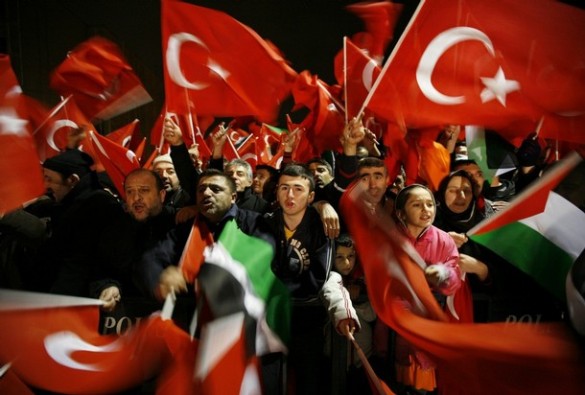
Ten months after Turkey first protested Israel’s military operation in and around Palestinian Gaza Strip, crisis between Ankara and the Israelis appears to be going from bad to worse.
It became clear on Sunday that Turkey had banned Israel from participating in a NATO-led, international air-force drill over its territory, which led to the entire exercise being postponed.
A day later, Turkish Prime Minister Recep Tayyip Erdogan launched a blistering verbal attack on Israel and its actions in Gaza last winter.
“While in some countries children are provided with comfort, peace, the most advanced education and health opportunities, other children are faced with poverty, destitution, helplessness, war, conflict, weapons of mass destruction and phosphorus bombs,” he told the Turkish Religious Council, cited by media reports in Turkey and Israel. [continued…]
After boosting their political relationship under the high-level strategic cooperation mechanism, Turkey and Syria are now taking steps to intensify defensive ties as well, a development that comes after Ankara’s decision to delay an international military exercise that would have included Israel.
In Gaziantep, Syrian Defense Minister Ali Habib announced Ankara and Damascus agreed to expand the scope of military drills that were conducted last spring. “Syria and Turkey held maneuvers in the spring and will hold more exercises to develop our actions on the border,” Habib said, according to local press but not confirmed by Turkish officials.
Turkey’s Defense Minister Vecdi Gönül said contact groups would be established between Turkey and Syria later this month to improve defense ties. He did not elaborate further but it has been learned that the contact groups will work on the fight against terrorism, military exercises and logistics. [continued…]
he Öncüpınar border gate on the Turkish side of the Turkish-Syrian border on Tuesday served as the venue for a symbolic gesture reflecting remarkable progress in bilateral relations between the two countries with the signing of a historic deal by the foreign ministers of the two countries, which came to the brink of war more than a decade ago.
Foreign Minister Ahmet Davutoğlu and his Syrian counterpart, Walid al-Moallem, officially signed an agreement on Tuesday in Gaziantep to end visa requirements between the two countries, a goal announced in mid-September by the two ministers during a visit to İstanbul by Syrian President Bashar al-Assad. While announcing the end to visa requirements, Davutoğlu and al-Moallem made an accord last month to end visa requirements and signed a bilateral cooperation agreement under which top ministers from the two countries will meet each year.
The accord, titled the “High-Level Strategic Cooperation Council Agreement,” is similar to a strategic mechanism recently established between Turkey and Iraq. [continued…]
The conceit of every autocratic leader is that power fits comfortably upon his shoulders. Even if he has not been chosen directly by his people, his right to rule reflects a natural order.
The World Economic Forum at Davos, with all its trappings of civility and reflective sophistication, embodies the same conceit. This is the forum of world governance that repeatedly unwittingly exposes the chasm dividing the world from its leaders.
Yesterday’s session, “Gaza: the case for Middle East peace,” was a pivotal moment in political discourse between the West and the rest of the world. The self-righteous hubris of an enraged Israeli president collided with the outrage of those who refused to ignore his bloodied hands.
To fully understand what happened, watch the one-hour eight-minute discussion. (For readers who want to fast forward to the part where Shimon Peres starts venting his rage, drag the play marker across to 45 minutes 50 seconds.)
Right now, the press has much less interest in exposing Peres’ lies than it has in the headline-grabbing moment — the point at which Turkish prime minister Recep Tayyip Erdogan left the stage in reaction to the insulting behavior of the Washington Post‘s David Ignatius. [continued…]
This website or its third-party tools use cookies, which are necessary to its functioning. By closing this banner, you agree to the use of cookies.




 o the innocent refuse to be questioned?