Author Archives: Paul Woodward

Jordanian frustration with U.S., Israel mounting

Jordanian frustration with U.S., Israel mounting

While I was in Jordan, King Abdullah gave a lengthy interview to Haaretz about the Israeli-Palestinian situation in which he warned that “We’re sliding back into the darkness.” My conversations with more than two dozen Jordanian officials, political activists, journalists and analysts suggest that on this, at least, the King reflects a widespread Jordanian consensus. Jordanians are growing increasingly frustrated with the Obama team’s approach, alarmed at Netanyahu’s unpunished intransigence, and downright frantic about the trend in Jerusalem. If we don’t start seeing progress soon, with stronger American leadership, then the “tinderbox” could explode.

It wasn’t always like this. When I was last in Jordan about six months ago, I found a great deal of optimism over the appointment of George Mitchell and the high profile Obama gave to the Israeli-Palestinian problem. But now those hopes seem to have largely evaporated. The launch of Israeli-Palestinian talks which they had expected by June continue to drift in limbo, while Obama’s failure to deliver on the settlement freeze has — just as so many predicted — eroded his credibility. How could the Americans have allowed Netanyahu to not only defy U.S. demands on settlements but to not even pay any significant price? Again and again, from all sectors of Jordanian political society, I heard the same refrain: Obama’s heart is in the right place and we want him to succeed, but he’s just not getting it done. [continued…]

‘Israel abuses detention without trial’

Twenty-eight Palestinians have been held in administrative detention for two to four years, and one has been held for four-and-a-half years, according to a report due to be released early Wednesday morning by two human rights organizations, B’Tselem and Hamoked.

The report, entitled “Without Trial,” found that more than 1,000 Palestinians had been held simultaneously in administrative detention during the second intifada.

At the end of September of this year, Israel was holding 335 administrative detainees, including three women and a minor. Thirty-seven percent of the detainees had been in jail for one to two years. [continued…]

Palestinian support wanes for American-trained forces

Commanders of the U.S.-trained Palestinian security forces who have been locking up criminals and battling Hamas militants here for nearly two years have maintained morale in the ranks with a single promise: They will one day be the anchor of security for an independent Palestinian state.

The lack of progress toward that goal is starting to sap Palestinian public support for the forces and erode morale among troops, even as they win praise and fresh funding from Washington for their accomplishments. [continued…]

After the bombing, drug addiction strikes Gaza

Mental health professionals say there has been a rise in the drug’s usage in Gaza since the war. The Hamas authorities have tried to crack down on it, but the drug’s severe withdrawal symptoms means it is a seriously hard habit to break. Hasan Shaban Zeyada, a senior psychologist at the Gaza Community Mental Health Programme (GCMHP) is convinced that many of the psychological problems underlying the addiction are “the consequence of living in this situation: the siege, internal division and the war”.

Abu Ahmed used to have a good job as a driver. But like an estimated 100,000 other Gazans he lost it when Israel imposed its blockade after Hamas seized control of the strip from Fatah in June 2007. “Before the war the situation was so hard. There was no work, plus I had to take care of 11 people, including my wife. All people could do was sit around in the street and drink tea or coffee.” [continued…]


Facebooktwittermail

In Kabul, little hope that a runoff will be fair

In Kabul, little hope that a runoff will be fair

As experts pore over ballots to determine whether the fraud in this country’s presidential election was so big that a runoff vote was required, many Afghans interviewed here on Tuesday shared the same view: Why bother?

In shops, offices and bakeries around the capital, many Afghans said holding a second round of voting to designate a winner simply did not make sense.

It was not that they did not want a final result. Or that they thought the Aug. 20 election had been fraud-free. But years of disappointment in their government has hardened into cynicism, and many said a second round would only lead to another flawed result.

“It’s a waste of time and money,” said Muhammad Hashem Haideri, a 52-year-old movie theater manager. “It would be useless.” [continued…]

Not good enough

If President Obama can find a way to balance the precise number of troops that will stabilize Afghanistan and Pakistan, without tipping America into a Vietnam there, then he indeed deserves a Nobel Prize — for physics.

I have no problem with the president taking his time to figure this out. He and we are going to have to live with this decision for a long time. For my money, though, I wish there was less talk today about how many more troops to send and more focus on what kind of Afghan government we have as our partner.

Because when you are mounting a counterinsurgency campaign, the local government is the critical bridge between your troops and your goals. If that government is rotten, your whole enterprise is doomed. [continued…]

Facebooktwittermail

Saudis seek payments for any drop in oil revenues

Saudis seek payments for any drop in oil revenues

Saudi Arabia is trying to enlist other oil-producing countries to support a provocative idea: if wealthy countries reduce their oil consumption to combat global warming, they should pay compensation to oil producers.

The oil-rich kingdom has pushed this position for years in earlier climate-treaty negotiations. While it has not succeeded, its efforts have sometimes delayed or disrupted discussions. The kingdom is once again gearing up to take a hard line on the issue at international negotiations scheduled for Copenhagen in December.

The chief Saudi negotiator, Mohammad al-Sabban, described the position as a “make or break” provision for the Saudis, as nations stake out their stance before the global climate summit scheduled for the end of the year. [continued…]

Facebooktwittermail

Russia resists U.S. position on sanctions for Iran

Russia resists U.S. position on sanctions for Iran

Denting President Obama’s hopes for a powerful ally in his campaign to press Iran on its nuclear program, Russia’s foreign minister said Tuesday that threatening Tehran now with harsh new sanctions would be “counterproductive.”

The minister, Sergey V. Lavrov, said after meeting with Secretary of State Hillary Rodham Clinton here that diplomacy should be given a chance to work, particularly after a meeting in Geneva this month in which the Iranian government said it would allow United Nations inspectors to visit its clandestine nuclear enrichment site near the holy city of Qum.

“At the current stage, all forces should be thrown at supporting the negotiating process,” he said. “Threats, sanctions and threats of pressure in the current situation, we are convinced, would be counterproductive.” [continued…]

Iran investigating prominent opposition cleric

Iranian authorities launched a provocative attack on the opposition movement Tuesday by announcing a special investigation of prominent cleric Mehdi Karroubi over his accusations that security forces raped and tortured protesters after the disputed June reelection of President Mahmoud Ahmadinejad.

The move against Karroubi, a revered figure from Iran’s 1979 Islamic Revolution, is an attack on the heart of the opposition. It’s an indication that the government is increasing pressure on top dissenters, even clerics, and it follows death sentences handed to at least two anti-government protesters.

The investigation will test the resolve of the opposition and has the potential to unleash another round of street demonstrations, which recently have been largely thwarted by the Revolutionary Guard and the Basiji militia. At a rally in September, protesters shouted: “If Karroubi is arrested, there will be insurrections across Iran.” [continued…]

Facebooktwittermail

U.S. sees Saudi program as an option for detainees

U.S. sees Saudi program as an option for detainees

Four years after Khalid al-Jehani’s release from the U.S. prison camp at Guantanamo Bay, Cuba, the 34-year-old Saudi lives a peaceful life in this sprawling coastal city. He has a car, a job and a well-furnished apartment — courtesy of the Saudi government.

The rehabilitation of militants such as Jehani has convinced the Obama administration that Saudi Arabia is the ideal place to send dozens of Yemenis being held at Guantanamo. For months, U.S. officials have applied pressure on Riyadh. But Saudi officials say their success with former detainees such as Jehani lies in members of his family and tribe, who keep constant watch over him, and cannot be duplicated with those whose social networks and roots lie outside Saudi Arabia.

“If I try to do something bad, my family will tell the government about me,” said Jehani, who joined a radical Islamist movement in the Philippines and trained al-Qaeda fighters in Afghanistan. “How can you trust that will happen with a family living in Yemen?” [continued…]

Facebooktwittermail

More US troops deployed overseas under Obama than Bush

More US troops deployed overseas under Obama than Bush

President Obama announced in March that he would be sending 21,000 additional troops to Afghanistan. But in an unannounced move, the White House has also authorized — and the Pentagon is deploying — at least 13,000 troops beyond that number, according to defense officials.

The additional troops are primarily support forces, including engineers, medical personnel, intelligence experts and military police. Their deployment has received little mention by officials at the Pentagon and the White House, who have spoken more publicly about the combat troops who have been sent to Afghanistan.

The deployment of the support troops to Afghanistan brings the total increase approved by Obama to 34,000. The buildup has raised the number of U.S. troops deployed to the war zones of Iraq and Afghanistan above the peak during the Iraq “surge” that President George W. Bush ordered, officials said. [continued…]

Rushed training ‘risks turning Afghan troops into cannon fodder’

Recruits to the Afghan Army are being rushed into combat with a barely acceptable level of training, according to senior British officers closely involved in the programme.

With US and Nato leaders pressing for a rapid expansion of the army to relieve pressure on their own forces and facilitate their eventual departure, the recruits are becoming “cannon fodder”, another coalition official said.

Courses are being shortened, class sizes are swelling and there is a serious shortage of Afghan instructors and Western mentors. [continued…]

Resignation of Afghan election official raises anxiety level

The disarray surrounding Afghanistan’s presidential election deepened Monday when an Afghan member of the vote-reviewing commission quit, citing “foreign interference.”

The resignation of Mustafa Barakzai from the Electoral Complaints Commission was not expected to affect the panel’s work of sifting through allegations of massive vote-rigging in the Aug. 20 balloting, officials said. But it added an acrimonious new element to a vote that has already become an exercise in recrimination — and has left Afghanistan in political limbo at a time when crucial decisions about the course of the conflict are being made in Washington. [continued…]

Facebooktwittermail

Obama floats like a butterfly – and stings like one as well

Obama floats like a butterfly – and stings like one as well

Just five years ago, Barack Obama was still a local politician in Illinois, preparing for a run for the US Senate. His office wall in Chicago at the time was decorated with the famous picture of Muhammad Ali standing over Sonny Liston, after knocking him out in a heavyweight title fight. Ali famously boasted that he could “float like a butterfly and sting like a bee.” But now that Mr Obama is president, he seems to float like a butterfly – and sting like one as well.

The notion that Mr Obama is a weak leader is now spreading in ways that are dangerous to his presidency. The fact that he won the Nobel Peace Prize last Friday will not change this impression. Peace is all very well. But Mr Obama now needs to pick a fight in public – and win it with a clean knock-out.

In truth, the Norwegians did the US president no favours by giving him the peace prize after less than a year in office. The award will only embellish a portrait of the president that has been painted in ever more vivid colours by his political enemies. The right argues that Mr Obama is a man who has been wildly applauded and promoted for not doing terribly much. Now the Nobel committee seems to be making their point for them. [continued…]

Whiner-in-Chief

The Obama administration really needs to get over itself.

First, the president and his aides go to war with Fox News because the network maintains a generally anti-Obama slant.

Then, an anonymous administration aide attacks bloggers for failing to maintain a sufficiently pro-Obama slant.

These are not disconnected developments.

An administration that won the White House with an almost always on-message campaign and generally friendly coverage from old and new media is now frustrated by its inability to control the debate and get the coverage it wants. [continued…]

Facebooktwittermail

U.S. to Egypt: Fatah-Hamas deal undermines Israel-PA talks

U.S. to Egypt: Fatah-Hamas deal undermines Israel-PA talks

The United States sent a message to Egypt stating it does not support the proposed reconciliation agreement between Fatah and Hamas as it would undermine negotiations with Israel, Haaretz has learned.

George Mitchell, the U.S. envoy to the Middle East, met on Saturday night in Cairo with the chief of Egyptian intelligence, Gen. Omar Suleiman, and told him the United States would not support an agreement not aligned with the principles of the Quartet.

According to the agreement, which was supposed to have been signed by Thursday, Abbas was to issue a presidential decree no later than October 25, scheduling both parliamentary and presidential elections for June 28. Eighty percent of the delegates to the Palestinian parliament were to be elected by party basis, and 20 percent by constituency.

A special committee with delegates from all factions was supposed to have assumed control of the Gaza Strip, reporting to Abbas. The Strip was also to see a new security force, staffed with members of all Palestinian factions.

Sources told Haaretz that Mitchell made clear to the Egyptians on Saturday the United States expects any Palestinian government to follow the conditions of the Quartet, which include recognition of the State of Israel, acknowledging earlier agreements and renouncing terrorism.

Mitchell also said certain aspects of current agreement were poorly timed as they would undermine relaunching negotiations between Israel and the Palestinians. [continued…]

Palestinian memo says hopes in Obama ‘evaporated’

An internal document circulated among members of Palestinian President Mahmoud Abbas’ political party says all hopes placed in the Obama administration “have evaporated” because of alleged White House backtracking on key issues to the Palestinians.

The Fatah Party memorandum, obtained Tuesday by The Associated Press, accuses the United States of backing off from its demands that Israel freeze settlement construction and failing to set a clear agenda for new Mideast peace talks.

It wasn’t immediately clear whether the Oct. 12 document reflected Abbas’ views or was intended to be leaked as Fatah’s attempt to pressure President Barack Obama to bear down harder on Israel.

The document said the Palestinians have lost hope in Obama and accused the American leader of caving in to pressure from pro-Israel lobbyists in Washington.

“All hopes placed in the new U.S. administration and President Obama have evaporated,” said the document issued by Fatah’s Office of Mobilization and Organization. The department is headed Fatah’s No. 2, Mohammed Ghneim. [continued…]

Turkey’s attitude toward Israel is changing

Turkey did not hide its deep opposition to Israel’s policies in the territories in general and to Operation Lead Cast in particular. Erdogan’s outburst against President Shimon Peres last January at the Davos gathering did not stem from Islamist or pro-Iranian objectives.

Erdogan’s support for a UN deliberation of the Goldstone Report and his declaration that “those responsible for war crimes must be identified and held accountable,” is not based on any wish to please Iran or Syria. Turkey has a steady and clear policy on this issue and it is not a proxy for any country.

Public opinion exists in Turkey too and it is influential, and when the prime minister sees thousands of Turks protesting against Israel’s policy in Jerusalem, he cannot remain indifferent. At the same time, Turkey continues and will continue to have normal ties with Israel because such a relationship is part of Turkey’s strategy, but today it finds itself in a different international status, of the sort that allows it to also take swipes at Israel. [continued…]

Facebooktwittermail

Russian FM: Threats of Iran sanctions won’t work

Russian FM: Threats of Iran sanctions won’t work

Russia pushed back Tuesday at U.S. efforts to threaten tough new sanctions if Iran fails to prove its nuclear program is peaceful, a setback to the Obama administration’s desire to present a united front with Moscow.

After meeting with U.S. Secretary of State Hillary Rodham Clinton, Russian Foreign Minister Sergey Lavrov said Moscow believed that such threats would not persuade Iran to comply and that negotiations should continue to be pursued.

“At the current stage, all forces should be thrown at supporting the negotiating process,” he told reporters at a joint news conference with Clinton. “Threats, sanctions and threats of pressure in the current situation, we are convinced, would be counterproductive.” [continued…]

Iranian journalists flee, fearing retribution for covering protests

For two months Ehsan Maleki traveled around Iran with a backpack containing his cameras, a few pieces of clothing and his laptop computer, taking pictures of the reformist candidate Mir Hussein Moussavi during the presidential campaign. He did not know that his backpack and his cameras would soon become his only possessions, or that he would be forced to crawl out of the country hiding in a herd of sheep.

Mr. Maleki, 29, is one of dozens of reporters, photographers and bloggers who have either fled Iran or are trying to flee in the aftermath of the disputed June presidential election. Reporters Without Borders, a Paris-based organization that promotes press freedom and monitors the safety of journalists, said the number of journalists leaving Iran was the largest since the years after the 1979 Islamic Revolution.

The wave of departures reflects the journalists’ anxiety over the retribution many of them have faced for reporting on the government’s violent suppression of the post-election protests. As bloody clashes unfolded in the streets of Tehran, the government went to great lengths to restrict the flow of information to the outside world. Foreign journalists were banned, and local reporters and photographers were warned to stay at home. [continued…]

Facebooktwittermail

Hadron Collider physicist Adlene Hicheur charged with terrorism

Hadron Collider physicist Adlene Hicheur charged with terrorism

A French physicist with the European atomic research centre near Geneva was charged with terrorism offences by a Paris judge last night after investigators said that he offered to work with the North African branch of al-Qaeda.

Adlène Hicheur, 32, who is of Algerian origin, was arrested last week with his younger brother after intelligence agents intercepted his alleged internet contacts with al-Qaeda in the Islamic Maghreb.

The physicist, who works at the giant atomic collider at CERN (European Organisation for Nuclear Research), which straddles Swiss and French territory, told the Islamic group that he was interested in committing an attack but had not begun any material preparation, according to police sources. He had acknowledged contacting the militant organisation, they said. [continued…]

Facebooktwittermail

The myth of “America”

The myth of “America”

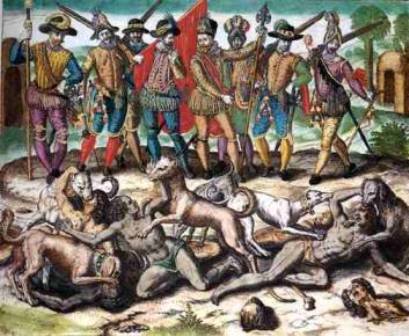
Catholic priest Bartolome de las Casas, in the multi-volume “History of the Indies” published in 1875, wrote, “… Slaves were the primary source of income for the Admiral (Columbus) with that income he intended to repay the money the Kings were spending in support of Spaniards on the Island. They provide profit and income to the Kings. (The Spaniards were driven by) insatiable greed … killing, terrorizing, afflicting, and torturing the native peoples … with the strangest and most varied new methods of cruelty.”

This systematic violence was aimed at preventing “Indians from daring to think of themselves as human beings. (The Spaniards) thought nothing of knifing Indians by tens and twenties and of cutting slices off them to test the sharpness of their blades…. My eyes have seen these acts so foreign to human nature, and now I tremble as I write.”
Father Fray Antonio de Montesino, a Dominican preacher, in December 1511 said this in a sermon that implicated Christopher Columbus and the colonists in the genocide of the native peoples:

“Tell me by what right of justice do you hold these Indians in such a cruel and horrible servitude? On what authority have you waged such detestable wars against these people who dealt quietly and peacefully on their own lands? Wars in which you have destroyed such an infinite number of them by homicides and slaughters never heard of before …”

In 1892, the National Council of Churches, the largest ecumenical body in the United States, is known to have exhorted Christians to refrain from celebrating the Columbus quincentennial, saying, “What represented newness of freedom, hope, and opportunity for some was the occasion for oppression, degradation and genocide for others.”

Yet America continues to celebrate “Columbus Day.” [continued…]

Facebooktwittermail

The world’s first terrorists

The world’s first terrorists

Imagine it. A network of violent radicals is picking off the world’s leaders one by one. They have killed the American president, the Russian head of state, the French president, the Austrian head of state, and the Spanish prime minister.
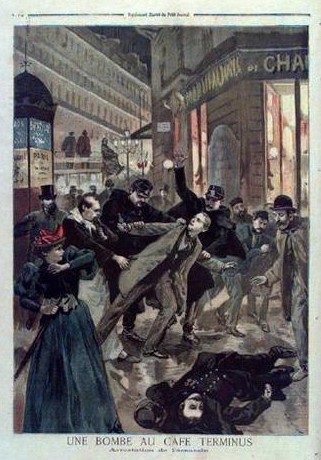
Bomb attacks are ripping through the world’s richest cities: explosions devastate Wall Street, the London Underground, a theatre in Barcelona, cafés in Paris, parades in Moscow. The police profile of a typical bomber warns: “He walks to his death with courage and no regrets.” There is panic, and governments launch programs of torture and deportation targeted at immigrant communities. Yet still the radicals wash defiantly across the world, killing as they go. They say they have “only one aim, one science: destruction.”

It sounds like a feverish novel about al-Qa’ida, set 30 years from now. But it has already happened. It is a story from our past. In the late 19th and early 20th century, anarchist bombers did all this. They were prepared to die for their beliefs. They lived in the same places as today’s Islamists — such as Whitechapel, in east London — and they struck the same targets, like lower Manhattan on a clear September morning.

In a new documentary — The Enemy Within, by Joe Bullman — young Islamists read the words of yesterday’s Jewish anarchists, from their writings and trial transcripts. While the societies they dream of building after the bombs are very different, their rage, their alienation, and their tactics are almost identical. The words fit so easily into their mouths that the Islamists say it is “creepy.” [continued…]

Facebooktwittermail

Israeli Nobel prize winner: Release all terrorists

Israeli Nobel prize winner: Release all terrorists

Professor Ada Yontah, who became the first Israeli woman to win a Nobel Prize this week, shared her political views in an interview with Army Radio on Saturday.

Referring to the Shalit affair, Yonath said that regardless of the deal “Anyone who is imprisoned in Israel who is not just a criminal but what we refer to as a terrorist, with or without blood on his hands – these definitions too are unclear to me – should not be imprisoned here.”

“We need to think of ways to ensure that people would not be motivated to kill and get killed,” Professor Yonath said. She stressed that responsibility for solving the problem should not lie solely with Israel, but noted that Israel “should do its best” to solve it.

Asked whether Israel should solve its political problems by releasing all terrorists, Yonath replied: “It’s not just a political issue, these are people who usually have no hope for the future, no reason to want to live, and therefore they don’t care if others don’t live…It doesn’t happen to those who have options for life…we can change that.” [continued…]

Facebooktwittermail

Afghanistan – the proxy war

Afghanistan – the proxy war

Obama ran for the presidency promising change. The doves sense correctly that Obama’s decision on Afghanistan may well determine how much – if any – substantive change is in the offing.

If the president assents to McChrystal’s request, he will void his promise of change at least so far as national security policy is concerned. The Afghanistan war will continue until the end of his first term and probably beyond. It will consume hundreds of billions of dollars. It will result in hundreds or perhaps thousands more American combat deaths – costs that the hawks are loath to acknowledge.

As the fighting drags on from one year to the next, the engagement of US forces in armed nation-building projects in distant lands will become the new normalcy. Americans of all ages will come to accept war as a perpetual condition, as young Americans already do. That “keeping Americans safe’’ obliges the United States to seek, maintain, and exploit unambiguous military supremacy will become utterly uncontroversial.

If the Afghan war then becomes the consuming issue of Obama’s presidency – as Iraq became for his predecessor, as Vietnam did for Lyndon Johnson, and as Korea did for Harry Truman – the inevitable effect will be to compromise the prospects of reform more broadly.

At home and abroad, the president who advertised himself as an agent of change will instead have inadvertently erected barriers to change. [continued…]

Civilian goals largely unmet in Afghanistan

Even as President Obama leads an intense debate over whether to send more troops to Afghanistan, administration officials say the United States is falling far short of his goals to fight the country’s endemic corruption, create a functioning government and legal system and train a police force currently riddled with incompetence.

Interviews with senior administration and military officials and recent reports assessing Afghanistan’s progress show that nearly seven months after Mr. Obama announced a stepped-up civilian effort to bolster his deployment of 17,000 additional American troops, many civil institutions are deteriorating as much as the country’s security.

Afghanistan is now so dangerous, administration officials said, that many aid workers cannot travel outside the capital, Kabul, to advise farmers on crops, a key part of Mr. Obama’s announcement in March that he was deploying hundreds of additional civilians to work in the country. The judiciary is so weak that Afghans increasingly turn to a shadow Taliban court system because, a senior military official said, “a lot of the rural people see the Taliban justice as at least something.” [continued…]

How to rig an election

No one will ever know how Afghans voted in their country’s presidential elections on Aug. 20, 2009. Seven weeks after the polling, the U.N.-backed Electoral Complaints Commission (ECC) is still trying to separate fraudulent tallies from ballots. In some provinces, many more votes were counted than were cast. E.U. election monitors characterize 1.5 million votes as suspect, which would include up to one-third of the votes cast for incumbent President Hamid Karzai. Once fraud occurs on the scale of what took place in Afghanistan, it is impossible to untangle.

Afghanistan’s fraudulent elections complicate President Obama’s job as he weighs a recommendation from General Stanley McChrystal, his top commander there, to send as many as 40,000 additional troops to support a beefed-up counterinsurgency strategy. But for that strategy to work, the U.S. needs a credible Afghan partner, which Afghanistan’s elections now seem unlikely to produce. [continued…]

U.N. official acknowledges ‘widespread fraud’ in Afghan election

A top United Nations official acknowledged publicly for the first time on Sunday that the country’s presidential election had been marred by “widespread fraud,” but said he has worked to ensure that the irregularities get documented.

Flanked by the ambassadors to the United States, Britain, France and Germany at a news conference, Kai Eide, the top United Nations official here, affirmed that the Aug. 20 election was tainted but insisted that he had pursued all claims of fraud that he was able to verify

“There was widespread fraud, but any specific figure would be pure speculation,” he said.

His remarks were intended to rebuff allegations by his former deputy that he was covering up fraud to benefit President Hamid Karzai. The deputy, the American diplomat Peter Galbraith, was fired this month after making his accusation public. [continued…]

Pakistani police had warned army about a raid

The mastermind of the militant assault on Saturday that shook the heart of the Pakistani military was behind two other major attacks in the last two years, and the police had specifically warned the military in July that such an audacious raid was being planned, police and intelligence officials said Sunday.

The revelation of prior warning was sure to intensify scrutiny of Pakistan’s ability to fight militants, after nine men wearing army uniforms breached the military headquarters complex in Rawalpindi and held dozens hostage for 20 hours until a commando raid ended the siege. In all, 16 people were killed, including eight of the attackers, the military said.

The surviving militant, who was captured early Sunday morning, was identified as Muhammad Aqeel, who officials said was a former soldier and the planner of this attack and others. Mr. Aqeel, who is also known as Dr. Usman because he had once worked with the Army Medical Corps before dropping out about four years ago, is believed to be a member of Lashkar-e-Jhangvi, a militant group affiliated with Al Qaeda and the Pakistani Taliban. [continued…]

Facebooktwittermail

Diplomacy in the lead on Iran nuclear issue — for now

Diplomacy in the lead on Iran nuclear issue — for now

Agreement to open Iran’s hidden nuclear complex to inspection has reduced talk of military action and put diplomacy back on track — at least for a while. But even as the U.S. tries to build international pressure, emerging details suggest it might already be too late for an armed strike.

Everything about Iran’s newly disclosed site near the holy city of Qom complicates the task for the two most likely attackers, the U.S. and Israel. Iranian officials say that’s precisely why they built the facility on an elite military base, fortified with steel and concrete, and buried under a mountain.

Less than a week after President Obama revealed that the U.S. knew about the site, Iran agreed to open it to inspectors from the International Atomic Energy Agency. In a subsequent visit to Tehran, IAEA Director-General Mohamed ElBaradei said inspectors would visit Oct. 25. [continued…]

Facebooktwittermail

Bombings outside Iraq reconciliation meeting kill 23

Bombings outside Iraq reconciliation meeting kill 23

A series of apparently coordinated bombings aimed at a meeting for national reconciliation killed 23 people and wounded 65 others in western Iraq on Sunday, but they did not injure the officials who were at the gathering, the authorities said.

The bombings, which occurred in Ramadi, the capital of Anbar Province, were the latest in a string of deadly attacks in the province during the past few months that have focused on tribal leaders and members of Iraqi security forces and Awakening Councils.

The province had been among the more peaceful in Iraq during the past two years after many tribal leaders dropped allegiances to Al Qaeda in Mesopotamia, an extremist Sunni Arab group, and joined Awakening Councils that linked with the American military and the Iraqi government. [continued…]

Facebooktwittermail

Muslims in U.S. feel unfairly implicated in the war on terror

Muslims in U.S. feel unfairly implicated in the war on terror

As the FBI pursues one alleged terrorist plot after another, Muslim Americans are grappling with a widespread sense that the government thinks they all could be terrorists.

In dozens of interviews across the country, McClatchy has found that the government’s search for the enemy within is threatening to divide and destroy America’s Muslim communities.

“It’s not a guilty complex; it’s the stigma of being a Muslim and constantly having to defend religion,” said Edina Lekovic, the communications director for the Muslim Public Affairs Council. “It causes people to give up and say, ‘Why should I bother? No one likes me. Why should I keep trying?’ ”

Americans of all faiths support the government’s efforts to keep them safe, but the war on terrorism looks different to those who find themselves under constant scrutiny because of their religion, ethnicity or both. [continued…]

Facebooktwittermail

Former US diplomat holds secret stake in Kurdish oil field

Former US diplomat holds secret stake in Kurdish oil field

It is widely known that the former US diplomat Peter Galbraith has been one of the most prominent figures in shaping the state structure of Iraq in the period after 2003, especially with his vocal advocacy of various forms of radical decentralisation and/or partition solutions for Iraq’s political problems that are reflected in his books and numerous articles in the New York Review of Books, especially in the period from 2004 to 2008. Until now, though, it has generally been assumed that Galbraith’s fervent pro-partition propaganda was rooted in an ideological belief in national self-determination and a principled view of radical federalism as the best option for Iraq’s Kurds. Many have highlighted Galbraith’s experience as a former US diplomat (especially in the Balkans in the 1990s) as key elements of his academic and policy-making credentials.

Today, however, it has emerged that the realities were probably rather different. For some time, Norway’s most respected financial newspaper, Dagens Næringsliv (DN), has been focusing on the operations of DNO, a small Norwegian private oil company in Kurdistan, especially reporting on unclear aspects concerning share ownership and its contractual partnerships related to the Tawke field in the Dahuk governorate. One particular goal has been to establish the identity of a hitherto unknown “third party” which participated with DNO in the initial production sharing agreement (PSA) for Tawke between 2004 and 2008, but was squeezed out when this deal was converted to a new contract in early 2008, prompting a huge financial claim of around 500 million US dollars against DNO which has yet to be settled. Today, DN claims to present proof that one of the two major “mystery stake-holders” involved in the claim was none other than Peter Galbraith, who allegedly held a five-percent share in the PSA for Tawke from June 2004 until 2008 through his Delaware-based company Porcupine. Galbraith’s partner was the Yemenite multi-millionaire Shahir Abd al-Haqq, whose identity was revealed by the same newspaper earlier this month. DN has published documents from Porcupine showing Galbraith’s personal signature, and today’s reports are complete with paparazzi photographs of Galbraith literally running away from reporters as they confront him in Bergen, where he is currently staying with his Norwegian wife. He refused to give any comment citing potential legal complications. [continued…]
(H/t to Helena Cobban.)

Facebooktwittermail