Author Archives: Paul Woodward

NEWS & VIEWS ROUNDUP: May 4

Pakistan nuclear projects raise US fears

Pakistan is continuing to expand its nuclear bomb-making facilities despite growing international concern that advancing Islamist extremists could overrun one or more of its atomic weapons plants or seize sufficient radioactive material to make a dirty bomb, US nuclear experts and former officials say.

David Albright, previously a senior weapons inspector for the UN’s International Atomic Energy Agency in Iraq, said commercial satellite photos showed two plutonium-producing reactors were nearing completion at Khushab, about 160 miles south-west of the capital, Islamabad.

“In the current climate, with Pakistan’s leadership under duress from daily acts of violence by insurgent Taliban forces and organised political opposition, the security of any nuclear material produced in these reactors is in question,” Albright said in a report issued by the independent Institute for Science and International Security in Washington. [continued…]

Pakistan strife raises U.S. doubts on nuclear arms

The Obama administration inherited from President Bush a multiyear, $100 million secret American program to help Pakistan build stronger physical protections around some of those facilities, and to train Pakistanis in nuclear security.

But much of that effort has now petered out, and American officials have never been permitted to see how much of the money was spent, the facilities where the weapons are kept or even a tally of how many Pakistan has produced. The facility Pakistan was supposed to build to conduct its own training exercises is running years behind schedule.

Administration officials would not say if the subject would be raised during Mr. Zardari’s first meeting with Mr. Obama. But even if Mr. Obama raises the subject, it is not clear how fruitful the conversation might be. [continued…]

Spain okays Gaza war crimes probe against Israelis

Spanish National Court judge Fernando Andreu announced Monday that he will pursue his investigation into a 2002 Israeli bombing in the Gaza Strip, despite contrary advice by prosecutors at the court.

Andreu said the 2002 bombing in densely populated Gaza City might constitute a crime against humanity. That attack, using a one-ton bomb dropped from an Israeli F-16, targeted and killed alleged Hamas member Salah Shehadeh along with 14 other people. [continued…]

Gaza costs Israel its reputation for press freedom

Israeli restrictions on journalists during its Gaza offensive have seen the state downgraded in a survey of press freedom, removing the Middle East’s lone example of a “free” media environment.

A study made public by Freedom House on Friday saw Israel move from the “free” category to “partly free” after officials curtailed reporters and sought to influence coverage of the three-week invasion of the Gaza Strip, which ended on Jan 18.

The global report describes the region as having “the world’s lowest level of press freedom” with only Israel, Kuwait, Lebanon and Egypt ranking as “partly free” and all other countries as “not free”. [continued…]

If Israel acquiesces on Iran, world will follow suit

Israel’s strategy against Iran’s nuclear program has failed. If there were any clandestine elements that could have bought some time, their effectiveness is waning. At the obvious, external level – the level of politics – the world was urged to rally behind the effort to block Iran from acquiring military nuclear capabilities using distinctly un-Israeli arguments, concerning the dangers of expanding the nuclear “club” to the breaking point; of escalating competition for control over the Persian Gulf; and of bringing Europe within the range of nuclear armed missiles. However, in its pretentiousness, this is a typical Israeli approach: to educate the “other” about what is good and important for him, so he will realize what he must do, which also happens to be what Israel wants. A great idea if only there were buyers.

Other countries, who seem to be terribly selfish, insist on deciding for themselves what constitutes a threat to them and how much they are willing to invest in dealing with it. An Iran with nukes troubles them a great deal, but not to the point of going to war to prevent Tehran from having them. [continued…]

ADL poll: 66 percent of Israeli Jews back attack on Iran

A large majority of Israeli Jews support military action aimed at destroying Iran’s nuclear facilities, according to a survey sponsored by the Anti-Defamation League.

According to the poll, co-sponsored by the Begin-Sadat Center for Strategic Studies at Bar-Ilan University, a large majority of those who support a move by the army said they would maintain their support even if the Obama administration opposed it. [continued…]

Facebooktwittermail

NEWS & VIEWS ROUNDUP: May 3

Kabul’s new elite live high on West’s largesse

Vast sums of money are being lavished by Western aid agencies on their own officials in Afghanistan at a time when extreme poverty is driving young Afghans to fight for the Taliban. The going rate paid by the Taliban for an attack on a police checkpoint in the west of the country is $4, but foreign consultants in Kabul, who are paid out of overseas aids budgets, can command salaries of $250,000 to $500,000 a year.

The high expenditure on paying, protecting and accommodating Western aid officials in palatial style helps to explain why Afghanistan ranks 174th out of 178th on a UN ranking of countries’ wealth. This is despite a vigorous international aid effort with the US alone spending $31bn since 2002 up to the end of last year.

The high degree of wastage of aid money in Afghanistan has long been an open secret. In 2006, Jean Mazurelle, the then country director of the World Bank, calculated that between 35 per cent and 40 per cent of aid was “badly spent”. “The wastage of aid is sky-high,” he said. “There is real looting going on, mainly by private enterprises. It is a scandal.” [continued…]

In Baghdad, dread grows with death toll

The crowds at the restaurants are thinning out. Parents have started to escort their children to school again. And cellphones are ringing more often than usual, with family members checking in just to ask, “Are you OK?” or “Is everyone safe?”

After a string of high-profile bombings and other attacks that killed 355 Iraqi civilians and security personnel and 18 U.S. troops last month nationwide, a pall has descended upon Baghdad, a lowering storm cloud swirling with echoes of the darkest days of Iraq’s civil war.

Above all, there is a sense of dread, rooted in the terrifying possibility that the calm that had brought the capital back to life over the last 18 months might have been just a lull.

“I feel a shadow of danger on the horizon, that the old days are coming back again,” Nidal Shahar, 36, said as she watched her children play in a nearly empty park along the Tigris River that would normally be crowded with families in the early evening hours. “It’s like we’re seeing the early phases again of the sectarian war.” [continued…]

Iraq bloodshed rises as US allies defect

Iraq is threatened by a new wave of sectarian violence as members of the “Sons of Iraq” – the Sunni Awakening militias that were paid by the US to fight Al-Qaeda – begin to rejoin the insurgency.

If the spike in violence continues, it could affect President Barack Obama’s pledge to withdraw all combat troops from Iraqi cities by the end of June. All US troops are due to leave the country by 2012.

A leading member of the Political Council of Iraqi Resistance, which represents six Sunni militant groups, said: “The resistance has now returned to the field and is intensifying its attacks against the enemy. The number of coalition forces killed is on the rise.” [continued…]

The AIPAC case in Washington, Iraq, and beyond

Do we really want the U.S. to have a “special relationship to Israel” — with all the benefits and allowances this brings to adepts of channeling like Rosen and Weissman, and the sub rosa understanding that the American people have consented to the arrangement? In that case, every friend of Israel is a friend of the U.S., and there is no such thing as spying for Israel. An Israeli agent caught passing state secrets becomes an American agent by definition.

How close is Israel to the United States — in politics, national interest, practice of equality, and other relevant traits? How close do the people of either country wish us to be? AIPAC is based, of course, on an ideology of total identification. It would be absurd to claim that someone could spy on America for California or New York. Someone who seems to be doing that must be trying “to lubricate the wheels of decision-making” between the federal and state governments that are “close but sometimes quarrelsome friends.” The New York Times supposes the idea of information passed from the U.S. to Israel without both sides wanting it passed it is likewise simply absurd. The true doctrine is, they know we know they know. With the exception of the agents at the FBI, and maybe a few U.S. attorneys, everybody understands. But do we?

The suppressed alternative is that we treat Israel as an ally with whom we sympathize, but with whom on occasion we have differences which we are not afraid to show. Can Israel become again, what it once preferred to be, an ally of the United States in the same sense in which France or Australia is an ally? Or will it press, like AIPAC, for total identification of interest and cause? Our friends are your friends, our enemies are your enemies, our weapons are your weapons. And our self-destruction? It is time to slow down and look hard. [continued…]

Hamas: U.S. diplomacy’s final frontier

Israel’s new government is a headache the Obama Administration doesn’t need. Compared with Tzipi Livni, the woman he narrowly beat out, and even Ehud Olmert, the man he succeeds, incoming Prime Minister Benjamin Netanyahuis cool toward a Palestinian state. And although it includes the moderate Labor Party, Netanyahu’s ruling coalition teems with right-wing figures like Foreign Minister Avigdor Lieberman, whose call for a loyalty oath directed at Israel’s Arab citizens dismays even Israel’s staunchest friends.

But if Israel’s new government is making the Obama team anxious, it’s nothing compared with the government that could be coming together next door in the Palestinian territories — where President Mahmoud Abbas and his Fatah party may join hands with the Islamist militants of Hamas. That’s a problem, since the U.S. won’t have anything to do with Hamas or any government in which it takes part. A few months ago, when Hamas was at odds with Abbas and at war with Israel, that was an easy position to take. But now it’s becoming harder. And sooner or later, the U.S. may have to come to the same painful realization it has arrived at in Iraq and Afghanistan: the only thing worse than talking to terrorists is not talking to them. [continued…]

Lifting the Bush-era veil of secrecy

The Obama administration’s decision to release more Bush-era memoranda, which sought to rationalize torture, shows that President Obama is following through on his promise to ban torture and to provide transparency to our government. The Bush-Cheney administration not only broke the law, it shattered the public trust and undermined America’s reputation around the world.

After withdrawing the so-called Bybee “torture memo,” the Bush-Cheney administration secretly reinstated the torture policy. While repeatedly claiming that the United States did not torture, the Bush-Cheney administration secretly authorized techniques that included waterboarding – up to 183 times in one case. This was not an “abstract legal theory,” or “hypothetical,” as Alberto Gonzales dismissively described in testimony before the Senate Judiciary Committee. These were specific techniques, authorized by high-ranking US government officials and used on real people. We have prosecuted people for these kinds of acts against Americans, and condemned other nations for sanctioning these methods.

The techniques are wrong and their supposed legal rationale is just as bad. The idea that the Department of Justice’s Office of Legal Counsel would be used to contort our laws on subjects as serious as torture is appalling. The rationalization of these memos showed a willingness to ignore legal requirements as long as there is no clear mechanism of enforcement. These memoranda seem calculated to provide legal cover – a legal free pass – for these unlawful policies. The Justice Department was apparently being used to immunize government officials to conduct torture by defining it down and building in legal loopholes. [continued…]

Facebooktwittermail

NEWS & VIEWS ROUNDUP & EDITOR’S COMMENT: May 2

Case against pro-Israel lobbyists likely to be dropped

The Justice Department asked a judge Friday to drop espionage-related charges against two pro-Israel lobbyists, a move expected to end a politically sensitive case that focused on whether U.S. secrets had been leaked.

Prosecutors said recent court decisions would have made the case hard to win and forced disclosure of large amounts of classified information. But defense lawyers and some legal experts said the government was wrong in the first place for trying to criminalize the kind of information horse-trading that long has occurred in Washington.

The intrigue surrounding the case against the two former lobbyists for the American Israel Public Affairs Committee already was chock-full of references to top-secret intelligence matters and Middle East politics. But it intensified in recent weeks with reports that Rep. Jane Harman (D-Venice), a staunch supporter of AIPAC, had been caught on federal wiretaps in 2005 offering to aid the two lobbyists in exchange for help in obtaining a coveted House committee chairmanship.

The dismissal, which is all but certain to be approved by a federal judge, probably will end the five-year legal battle between the government and the two lobbyists, Steven J. Rosen and Keith Weissman….

Rosen and Weissman may sue the government to recover legal costs, which are estimated at more than $10 million.

Many current and former federal law enforcement officials said the prosecution’s case was strong and that there was proof the two lobbyists knew their actions were wrong.

“The judge had made so many adverse rulings that this was inevitable, but it grates on me,” one former senior Justice Department official said of the decision to drop the case. [continued…]

Editor’s Comment — Rosen is also suing AIPAC for $21 million. Since I imagine neither he nor the pro-Israel lobby actually have any interest in slugging this out in court, Rosen is presumably out to see how much he can squeeze out of his former employer in an out-of-court settlement.

Meanwhile, Jeff Stein notes that blogging speculation around rivalry between Jane Harman and Porter Goss has smothered the “question of what Israeli agents were up to in Washington.”

Just imagine if a headline had read: “FBI wiretap catches Saudi intelligence agent cutting secret deal with member of Congress.” It would have been followed by relentless media coverage, grave official statements, calls for a full investigation and endless commentary.

Instead, after learning that Harman was talking to an Israeli spy, the response is: but didn’t you know that she and Porter Goss were bitter rivals. Say what?!

U.N. finds 60,000 Palestinians risk eviction in East Jerusalem

Since he was a boy in the 1940s, Mazen Abu Diab has seen houses pop up steadily in the Bustan neighborhood of East Jerusalem, slowly filling a strip of land just outside the walled Old City with what are now about 88 homes.

Some were built with the proper permits. Others were not, particularly after Israel annexed the Arab neighborhood in the wake of the 1967 Arab-Israeli war. But while Abu Diab, 63, acknowledges that some of the houses are unauthorized, he argues that the Israeli response — the threatened demolition of dozens of buildings — is an unfair slap at his community.

“I don’t know what the Israeli government teaches a child by demolishing their home,” he said.

On Friday, a United Nations report showed how deep and festering the dispute over housing has become. It estimates that as many as a quarter of the Palestinian homes in East Jerusalem have been built without permits, putting as many as 60,000 people at risk of eviction if Israel strictly enforces its rules on construction. [continued…]

America’s necessary dark night of the soul

So it has finally come, our strange, anesthetized and vaguely dreaded day of national reckoning.

Almost eight years ago, a terrorist attack destroyed two towers in America’s greatest city and killed almost 3,000 people. A year and a half later, still half-dazed by that trauma, America sleepwalked into the weirdest war in our history, a pointless, ruinous conflict fomented by ignorant ideologues, launched on false premises, justified by bogus evidence — and supported by the majority of the American people, both political parties and most of the media. Under cover of that war, President George W. Bush and his top officials created a separate prison system not governed by U.S. laws, ordered the torture of detainees, sent others off to be tortured abroad, illegally wiretapped Americans, and in general ignored and flouted the U.S. Constitution and the rule of law.

In full knowledge of all of that, the American people narrowly reelected George W. Bush president. Two years ago they turned decisively against Bush’s party and his war, throwing Republicans out of Congress en masse. And five months ago, staring into an economic abyss, they elected Barack Obama. Obama’s opposition to the Iraq war from the beginning is almost certainly why he was able to defeat his formidable rival Hillary Clinton. [continued…]

‘Abu Ghraib US prison guards were scapegoats for Bush’ lawyers claim

Prison guards jailed for abusing inmates at the Abu Ghraib jail in Iraq are planning to appeal against their convictions on the ground that recently released CIA torture memos prove that they were scapegoats for the Bush Administration.

The photographs of prisoner abuse at the Baghdad jail in 2004 sparked worldwide outrage but the previous administration, from President Bush down, blamed the incident on a few low-ranking “bad apples” who were acting on their own.

The decision by President Obama to release the memos showed that the harsh interrogation tactics were approved and authorised at the highest levels of the White House. [continued…]

U.S. may revive Guantánamo military courts

The Obama administration is moving toward reviving the military commission system for prosecuting Guantánamo detainees, which was a target of critics during the Bush administration, including Mr. Obama himself.

Officials said the first public moves could come as soon as next week, perhaps in filings to military judges at the United States naval base at Guantánamo Bay, Cuba, outlining an administration plan to amend the Bush administration’s system to provide more legal protections for terrorism suspects.

Continuing the military commissions in any form would probably prompt sharp criticism from human rights groups as well as some of Mr. Obama’s political allies because the troubled system became an emblem of the effort to use Guantánamo to avoid the American legal system. [continued…]

Videotape complicates U.S. deal with Emirates

A gruesome videotape showing a member of the Abu Dhabi ruling family torturing an Afghan grain merchant has begun casting a lurid new light on allegations of human rights abuses in a city-state better known for skyscrapers and global finance.

The 45-minute videotape shows Sheik Issa bin Zayed al-Nahyan, assisted by uniformed police officers, torturing the merchant with whips, cattle prods and a wooden plank with a protruding nail, and finally driving over him with an S.U.V.

The videotape — first shown last week by ABC News — has provoked outrage from members of Congress, who said it could add fuel to lawmakers’ reservations about a pending civilian nuclear agreement between the United States and the United Arab Emirates, the seven-member federation on the Persian Gulf to which Abu Dhabi belongs. [continued…]

In Pakistan, U.S. courts leader of opposition

As American confidence in the Pakistani government wanes, the Obama administration is reaching out more directly than before to Nawaz Sharif, the chief rival of Asif Ali Zardari, the Pakistani president, administration officials said Friday.

American officials have long held Mr. Sharif at arm’s length because of his close ties to Islamists in Pakistan, but some Obama administration officials now say those ties could be useful in helping Mr. Zardari’s government to confront the stiffening challenge by Taliban insurgents.

The move reflects the heightened concern in the Obama administration about the survivability of the Zardari government. Gen. David H. Petraeus, the head of the United States Central Command, has said in private meetings in Washington that Pakistan’s government is increasingly vulnerable, according to administration officials. [continued…]

Expert groups largely back Obama’s nuclear s tance

Two bipartisan panels of nuclear weapons experts are endorsing much of President Obama’s ambitious arms-control effort in advance of next week’s nonproliferation talks here between Russian Foreign Minister Sergey Lavrov and Secretary of State Hillary Rodham Clinton.

A congressionally mandated commission will recommend next week that the United States resume the lead in international efforts to prevent further proliferation of nuclear weapons. The U.S. government should declare that it will rely less on such weapons and seek to reduce U.S. and Russian nuclear stockpiles through extension of the Strategic Arms Limitation Treaty (START), according to the Congressional Commission on the Strategic Posture of the United States. But, the commission said, it also should maintain “an appropriately effective nuclear deterrent force.”

The commission split over Senate ratification of the Comprehensive Test Ban Treaty, a move Obama has said he will seek. The group, chaired by William J. Perry, who was President Bill Clinton’s defense secretary, and vice-chaired by James R. Schlesinger, who held that post in the Nixon and Ford administrations, agreed that the Senate should take a close look at the “benefits, costs and risks” of the test ban treaty, which was defeated in 1999 when Republicans controlled Congress. [continued…]

Ex-spy sits down with Islamists and the West

Talking to Islamists is the new order of the day in Washington and London. The Obama administration wants a dialogue with Iran, and the British Foreign Office has decided to reopen diplomatic contacts with Hezbollah, the Shiite militant group based here.

But for several years, small groups of Western diplomats have made quiet trips to Beirut for confidential sessions with members of Hamas, Hezbollah and other Islamist groups they did not want to be seen talking to. In hotel conference rooms, they would warily shake hands, then spend hours listening and hashing out accusations of terrorism on one side and imperial arrogance on the other.

The organizer of these back-door encounters is Alastair Crooke, a quiet, sandy-haired man of 59 who spent three decades working for MI6, the British secret intelligence service. He now runs an organization here called Conflicts Forum, with an unusual board of advisers that includes former spies, diplomats and peace activists. [continued…]

Facebooktwittermail

Thinking about torture

Where this buck stops

The trouble with this desire for retribution isn’t that it goes too far. The trouble is that it doesn’t go far enough. There is another group — a large one — that stood by doing nothing while Americans grabbed people off the streets of foreign countries, took them to other foreign countries (because we don’t allow this sort of thing in the United States!) and tortured them until they said whatever our government wanted to hear. If you’re going to punish people for condoning torture, you’d better include the American citizenry itself.

Sixty-two million of us voted to reelect George W. Bush in 2004. That was more people than had ever voted for a presidential candidate up until then. (In 2008, Obama got 69 million.) Unlike 2000, Bush’s 2004 victory was solid and unambiguous.

Bush was so unpopular by the time he left office that it’s hard to believe he was reelected four years earlier. That gave him and his associates four more years to violate America’s dearest principles. But plenty of torture had gone on by the end of his first term. If you’re looking to punish the ultimate decision makers, you can’t stop at the Justice Department or even the White House. You’ve got to go all the way to the top. You have to ask the famous Howard Baker question about the voters themselves: What did we know, and when did we know it? [continued…]

Editor’s Comment — People don’t think much. It’s sad but true. So to point to the complicity of the American public in supporting the use of torture says as much about what people fail to reflect on as it says about what they believe. It also leaves out the instrumental role that journalists played in making torture acceptable by declining to insist on calling it torture.

In the name of impartiality, reporters generally sided with the Bush administration by using phrases such as “harsh interrogation techniques” without placing the terms in quotation marks. Even now, the New York Times in its reporting prefers the pseudo-neutral term “interrogation” as though it still awaits a directive from the ministry of information (the most effective agency in the executive branch that without a budget or any staff is able to persuade American journalists to police themselves).

When the press has been so shy about using the word “torture,” how are ordinary Americans supposed to reflect on the implications of a state-sanctioned torture program?

If we want to think about torture, we first need to think about human rights.

A few Americans might claim that “human rights” is a concept concocted by liberals and bodies like the UN, but I think the majority would accept the basic proposition that human rights deserve protection. Moreover, most would agree that human rights, if they are fitly named, must be utterly non-discriminatory. I’ve never heard anyone argue that such and such a person or such and such an action provided grounds that would justify someone’s human rights being taken away. Prisoners lose their liberty but they retain their human rights.

The most widely accepted enunciation of human rights is the Universal Declaration of Human Rights adopted by the United Nations in 1948. In laying out prohibitions in conduct, the only act that ranks higher than the prohibition of torture in the articles of the declaration is the prohibition of slavery.

Article Five says:

No one shall be subjected to torture or to cruel, inhuman or degrading treatment or punishment.

“No one” is unequivocal. It’s not, “no one, unless they’re suspected of being a terrorist,” or “no one, unless they’re regarded as an enemy of the state.”

The most fundamental rights exist for the protection of everyone and they can only perform that function if they protect anyone, irrespective of that individual’s history or predispositions.

So far, we have not really had a national conversation about torture. The Bush administration’s torture program was largely hidden — with the press corps’ complicity — behind a shield of terms whose function was to legitimize what had been done. The methods used were portrayed as debatable in character yet judicious in their application and effective in their outcome. Most Americans did not so much condone torture as much as swallow a claim that whatever was being done was done with the best of intentions and for the good of the country.

Even now, when we learn that torture is particularly favored by evangelical church-goers, I’m less inclined to assume that evangelical Christianity has a particular appeal for sadists, than that Americans whose religion and nationalistic fervor are deeply entwined, have a faith-based approach to national security. Their support for torture is an expression of their trust in George Bush — the man willing to do “what needed to be done.”

Ignorance absolves no one of moral responsibility, but the voices that America most needs to hear right now are those made vivid by nightmares — the enduring horror of the tortured and the torturers. Only when such publicly spoken and televised testimony shapes this debate will America begin the process of self-examination that is now needed.

Abu Zubaydah’s suffering

No one can pass unscathed through an ordeal like this. Abu Zubaydah paid with his mind.

Partly as a result of injuries he suffered while he was fighting the communists in Afghanistan, partly as a result of how those injuries were exacerbated by the CIA and partly as a result of his extended isolation, Abu Zubaydah’s mental grasp is slipping away.

Today, he suffers blinding headaches and has permanent brain damage. He has an excruciating sensitivity to sounds, hearing what others do not. The slightest noise drives him nearly insane. In the last two years alone, he has experienced about 200 seizures. [continued…]

Survey: Support for terror suspect torture differs among the faithful

The more often Americans go to church, the more likely they are to support the torture of suspected terrorists, according to a new survey.

More than half of people who attend services at least once a week — 54 percent — said the use of torture against suspected terrorists is “often” or “sometimes” justified. Only 42 percent of people who “seldom or never” go to services agreed, according to the analysis released Wednesday by the Pew Forum on Religion & Public Life.

White evangelical Protestants were the religious group most likely to say torture is often or sometimes justified — more than six in 10 supported it. People unaffiliated with any religious organization were least likely to back it. Only four in 10 of them did. [continued…]

Facebooktwittermail

EDITORIAL: Churchill’s “we don’t torture” — except they did

Churchill’s “we don’t torture” — except they did

During last night’s news conference, President Obama took a less than subtle jab at his predecessor by citing Winston Churchill’s statement: “We don’t torture.” Whether the exact words that we’re so familiar with coming from George Bush’s mouth were ever also uttered by his English hero, I don’t know, but even if they were, it’s unfortunate that Obama would cite Churchill’s as quite such a principled stance. The British war record actually reveals a dark side even more chilling than the one Dick Cheney inspired.

In 2005, The Guardian reported on then newly-revealed records of Britain’s brutal treatment of Nazi prisoners — treatment that led to Britain being accused of operating concentration camps after World War Two had ended. Citing the British example is useful, but not for the purpose of showing that those who espouse high principles necessarily have the integrity to match their words with their actions.

And herein lies the fatal flaw of the conceit: we’re better than that. We don’t torture because we’re Americans.

In truth there is no failing from which Americans are immune. On the contrary, as Americans we’re just like anyone else — just like the British and so many others who under the pressure of a perceived necessity think that torture can be justified even while its use must remain a closely guarded secret.

In other words, if we argue that we must not torture, it should be because we recognize that Americans are just as capable as anyone else of tumbling down a moral spiral in which conscience and individual responsibility make themselves subordinate to a collective imperative.

The reason we should not torture terrorists isn’t because we operate on a higher moral plane than them, but because we know that we too are capable of descending into barbarity and moral depravity. We should not torture because we want to protect ourselves from our own demons.

Consider then the chilling British record:

The interrogation camp that turned prisoners into living skeletons

Despite the six years of bitter fighting which lay behind him, James Morgan-Jones, a major in the Royal Artillery, could not have been more specific about the spectacle in front of him. “It was,” he reported, “one of the most disgusting sights of my life.”

Curled up on a bed in a hospital in Rotenburg, near Bremen, was a cadaverous shadow of a human being. “The man literally had no flesh on him, his state of emaciation was incredible,” wrote Morgan-Jones. This man had weighed a little over six stones (38kg) on admission five weeks earlier, and “was still a figure which may well have been one of the Belsen inmates”. At the base of his spine “was a huge festering sore”, and he was clearly terrified of returning to the prison where he had been brought so close to death. “If ever a man showed fear – he did,” Morgan-Jones declared.

Adolf Galla, 36, a dental technician, was not alone. A few beds away lay Robert Buttlar, 27, a journalist, who had been admitted after swallowing a spoon handle in a suicide attempt at the same prison. He too was emaciated and four of his toes had been lost to frostbite.

The previous month, January 1947, two other inmates, Walter Bergmann, 20, and Franz Osterreicher, 38, had died of malnutrition within hours of arriving at the hospital. Over the previous 13 months, Major Morgan-Jones learned, 45 inmates of this prison, including several women, had been dumped at Rotenburg. Each was severely starved, frostbitten, and caked in dirt. Some had been beaten or whipped.

The same week that Major Morgan-Jones was submitting his report, a British doctor called Jordan was raising similar concerns at an internment camp 130 miles away. Dr Jordan complained to his superiors that eight men who had been transferred from the same prison “were all suffering gross malnutrition … one in my opinion dying”.

They included Gerhard Menzel, 23, a 6ft German former soldier who weighed seven stones, and was described as a living skeleton. Another, admitted as Morice Marcellini, a 27-year-old Frenchman, later transpired to be Alexander Kalkowski, a captain in the Soviet secret police, the NKVD. He weighed a little over eight stones, and complained that he had been severely beaten and forced to spend eight hours a day in a cold bath.

Prisoners complained thumbscrews and “shin screws” were employed at the prison and Dr Jordan’s report highlighted the small, round scars that he had seen on the legs of two men, “which were said to be the result of the use of some instrument to facilitate questioning”. One of these men was Hans Habermann, a 43-year-old disabled German Jew who had survived three years in Buchenwald concentration camp.

All of these men had been held at Bad Nenndorf, a small, once-elegant spa resort near Hanover. Here, an organisation called the Combined Services Detailed Interrogation Centre (CSDIC) ran a secret prison following the British occupation of north-west Germany in 1945.

CSDIC, a division of the War Office, operated interrogation centres around the world, including one known as the London Cage, located in one of London’s most exclusive neighbourhoods. Official documents discovered last month at the National Archives at Kew, south-west London, show that the London Cage was a secret torture centre where German prisoners who had been concealed from the Red Cross were beaten, deprived of sleep, and threatened with execution or with unnecessary surgery.

As horrific as conditions were at the London Cage, Bad Nenndorf was far worse. Last week, Foreign Office files which have remained closed for almost 60 years were opened after a request by the Guardian under the Freedom of Information Act. These papers, and others declassified earlier, lay bare the appalling suffering of many of the 372 men and 44 women who passed through the centre during the 22 months it operated before its closure in July 1947.

They detail the investigation carried out by a Scotland Yard detective, Inspector Tom Hayward, following the complaints of Major Morgan-Jones and Dr Jordan. Despite the precise and formal prose of the detective’s report to the military government, anger and revulsion leap from every page as he turns his spotlight on a place where prisoners were systematically beaten and exposed to extreme cold, where some were starved to death and, allegedly, tortured with instruments that his fellow countrymen had recovered from a Gestapo prison in Hamburg. Even today, the Foreign Office is refusing to release photographs taken of some of the “living skeletons” on their release.

Initially, most of the detainees were Nazi party members or former members of the SS, rounded up in an attempt to thwart any Nazi insurgency. A significant number, however, were industrialists, tobacco importers, oil company bosses or forestry owners who had flourished under Hitler.

By late 1946, the papers show, an increasing number were suspected Soviet agents. Some were NKVD officers – Russians, Czechs and Hungarians – but many were simply German leftists. Others were Germans living in the Russian zone who had crossed the line, offered to spy on the Russians, and were tortured to establish whether they were genuine defectors.

One of the men who was starved to death, Walter Bergmann, had offered to spy for the British, and fell under suspicion because he spoke Russian. Hayward reported: “There seems little doubt that Bergmann, against whom no charge of any crime has ever been made, but on the contrary, who appears to be a man who has given every assistance, and that of considerable value, has lost his life through malnutrition and lack of medical care”.

The other man who starved to death, Franz Osterreicher, had been arrested with forged papers while attempting to enter the British zone in search of his gay lover. Hayward said that “in his struggle for existence or to get extra scraps of food he stood a very poor chance” at Bad Nenndorf.

Many of Bad Nenndorf’s inmates were there for no reason at all. One, a former diplomat, remained locked up because he had “learned too much about our interrogation methods”. Another arrived after a clerical error, and was incarcerated for eight months. As Inspector Hayward reported: “There are a number against whom no offence has been alleged, and the only authority for their detention would appear to be that they are citizens of a country still nominally at war with us.”

Today, the older people of Bad Nenndorf talk about August 1 1945, the day the British arrived, with undisguised bitterness. A convoy of trucks pulled into the village, and the Tommies took over from an easygoing US infantry division. Within hours, the British had ordered everybody in the centre of the village to pack their belongings and leave. Bad Nenndorf was heaving with refugees from the bomb-ravaged ruins of Hanover, 18 miles to the east: hundreds of people were given 90 minutes to pack some food and valuables, and get out.

“We thought everyone would be allowed back in a few days,” recalls Walter Münstermann, now a retired newspaperman, but then a 14-year-old. “Then the soldiers started putting barbed wire fences around the centre of the village, and slowly we began to realise that this was going to be no ordinary camp.”

Walter and his neighbours realised that the centre of their village was being transformed into a prison camp when they heard that the British were converting a large, 40-year-old bath-house, ripping out the baths and installing heavy steel doors to turn each cubicle into a cell. They saw the first batch of prisoners arrive in the back of a truck. Later groups arrived at the village railway station in cattle trucks.

Ingrid Groth, then a seven-year-old, said locals claimed that if you crept up to the barbed wire at night, you could hear the prisoners’ screams. Mr Münstermann, who passed the main gate on his way to school each day, insists that the opposite was true: that it was a sinister place precisely because “you never, ever saw anyone, and you never heard a sound”. Among the people of Lower Saxony, Bad Nenndorf became known as das verbotene dorf – the forbidden village.

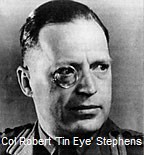
The commanding officer was Robin “Tin Eye” Stephens, 45, a monocled colonel of the Peshawar Division of the Indian Army who had been seconded to MI5 in 1939, and who had commanded Camp 020, a detention centre in Surrey where German spies had been interrogated during the war.

An authoritarian and a xenophobe with a legendary temper, Stephens boasted that interrogators who could “break” a man were born, and not made. Of the 20 interrogators ordered to break the inmates of Bad Nenndorf, 12 were British, a combination of officers from the three services and civilian linguists. The remaining eight included a Pole and a Dutchman, but were mostly German Jewish refugees who had enlisted on the outbreak of war, and who, Inspector Hayward suggested, “might not be expected to be wholly impartial”.

Most of the warders were soldiers barely out of their teens. Some had endured more than a year of combat, at the end of which they had liberated Belsen. Some represented the more unruly elements of the British Army of the Rhine, sent to Bad Nenndorf after receiving suspended sentences for assault or desertion. Often, Hayward said, they were the sort of individuals “likely to resort to violence on helpless men”.

The inmates were starved, woken during the night, and forced to walk up and down their cells from early morning until late at night. When moving about the prison they were expected to run, while soldiers kicked them. One warder, a soldier of the Welsh Regiment, told Hayward: “If a British soldier feels inclined to treat a prisoner decently he has every opportunity to do so; and he also has the opportunity to ill-treat a prisoner if he so desires”.

The Foreign Office briefed Clement Attlee, the prime minister, that “the guards had apparently been instructed to carry out physical assaults on certain prisoners with the object of reducing them to a state of physical collapse and of making them more amenable to interrogation”.

Former prisoners told Hayward that they had been whipped as well as beaten. This, the detective said, seemed unbelievable, until “our inquiries of warders and guards produced most unexpected corroboration”. Threats to execute prisoners, or to arrest, torture and murder their wives and children were considered “perfectly proper”, on the grounds that such threats were never carried out.

Moreover, any prisoner thought to be uncooperative during interrogation was taken to a punishment cell where they would be stripped and repeatedly doused in water. This punishment could continue for weeks, even in sub-zero temperatures.

Naked prisoners were handcuffed back-to-back and forced to stand before open windows in midwinter. Frostbite became common. One victim of the cold cell punishment was Buttlar, who swallowed the spoon handle to escape. An anti-Nazi, he had spent two years as a prisoner of the Gestapo. “I never in all those two years had undergone such treatments,” he said.

Kalkowski, the NKVD officer, claimed that toenails were ripped out and that he had been hung from his wrists during interrogation, with weights tied to his legs. British NCOs, he alleged, would beat him with rubber truncheons “while the interrogating officers went for lunch”. Hayward concluded, however, that “there was not a shred of evidence to support these allegations”.

Whatever was happening during the interrogations must have been widely known among many of the camp’s officers and men. In common with every CSDIC prison, each cell was bugged, so that the prisoners’ private utterances could be matched against their “confessions”.

Inspector Hayward’s investigation led to the courts martial of Stephens, Captain John Smith, Bad Nenndorf’s medical officer, and an interrogator, Lieutenant Richard Langham. The hearings were largely held behind closed doors. A number of sergeants – men who had carried out the beatings – were told they would be pardoned if they gave evidence against their officers. [continued…]

Facebooktwittermail

NEWS & VIEWS ROUNDUP: April 30

Six years after Saddam Hussein, Nouri al-Maliki tightens his grip on Iraq

Baghdad has always produced more than its fair share of surreal conversations, but few can match the one I had with three Iraqi intelligence officers in the garden of a newly opened restaurant a few weeks ago. The three were former members of Saddam’s notorious Mukhabarat. Now “reformed”, they worked for the newly established Iraqi National Intelligence Service (INSI), a highly independent security service which some in the Iraqi government accuse of being too close to the US.

After a few pleasantries, which included frisking my shirt for wire-tapping devices, we sat around a plastic table while the most senior officer told me that his men were actively monitoring intelligence and military activities inside the government of Nouri al-Maliki. The two other officers looked in opposite directions as their colleague spoke.

“We have our own eyes and follow what they are doing there,” the senior officer said. “Maliki is running a dictatorship – everything is run by his office and advisers, he is surrounded by his party and clan members. They form a tight knot that is running Iraq now. He is not building a country, he is building a state for his own party and his own people.”

As a waiter in a white shirt and black trousers approached, the senior officer fell silent and his colleague ordered tea. Only when the waiter moved away, the senior officer continued: “We compile reports on their activities, generals’ and military units’ movements, and their corruption, the positions they are taking in the government and the contracts they are obtaining. But we don’t know what to do with these reports because we don’t trust the government.”

The charges voiced by the INSI officers are heard, in hushed tones, more and more around Baghdad these days. Critics say Maliki is concentrating power in his office (the office of the prime minister) and his advisers are running “a government inside a government”, bypassing ministers and parliament. In his role as commander in chief, he appoints generals as heads of military units without the approval of parliament. The officers, critics say, are all loyal to him. He has created at least one intelligence service, dominated by his clan and party members, and taken two military units – the anti-terrorism unit and the Baghdad brigade – under his direct command. At the same time he has inflated the size of the ministry of national security that is run by one of his allies. [continued…]

Is Obama wrong on Iraq? Baghdad violence worst in year

April was the bloodiest month for violence in Baghdad in more than a year, another sign that Iraq’s security gains are beginning to reverse.

President Barack Obama acknowledged Wednesday night that violence has risen in recent weeks, but he said the levels of violence were still below last year’s.

Calling recent bombings “a legitimate cause for concern,” Obama said “civilian deaths . . . remain very low compared to what was going on last year.”

But statistics kept by McClatchy show that in Baghdad alone, more than 200 people have been killed in attacks so far this month, compared with 99 last month and 46 in February, according to a McClatchy count. [continued…]

Busting the torture myths

In the space of a week, the torture debate in America has been suddenly transformed. The Bush administration left office resting its case on the claim it did not torture. The gruesome photographs from Abu Ghraib, it had said, were the product of “a few bad apples” and not of government policy. But the release of a series of grim documents has laid waste to this defense. The Senate Armed Services Committee’s report—adopted with the support of leading Republican Senators John McCain, John Warner, and Lindsey Graham—has demonstrated step-by-step how abuses on the ground in Iraq and Afghanistan had their genesis in policy choices made at the pinnacle of the Bush administration. A set of four Justice Department Office of Legal Counsel memoranda from the Bush era has provided a stomach-turning legal justification of the application of specific torture techniques, including waterboarding.

As public and congressional calls for the appointment of a prosecutor and the creation of a truth commission have proliferated, President Barack Obama stepped in quickly to try to turn down the heat. A commission would not be helpful, he argues, and he has made plain his aversion to any form of criminal-law accountability. Republicans, meanwhile, bristle with anger as they attempt to defend against the flood of new information. But, in the end, Obama’s assumption that the torture debate has run its course and that the country can now “move on,” as conservative pundit Peggy Noonan urged, may rest in some serious naïveté: Karl Rove and Dick Cheney have different ideas. They’re convinced that Bush-era torture policy is a promising political product for a party down on its luck. Its success on the political stage is just one more 9/11-style attack away. [continued…]

U.S. plans new talks with Syria

The Obama administration is dispatching two high-level envoys to Syria in coming weeks for a second round of talks focused on securing the Iraqi border and supporting the Arab-Israeli peace process, said officials briefed on the trip.

The diplomats’ visit is the latest sign of a reconciliation between Washington and Syrian President Bashar Assad’s government, which is partly driven by the U.S. desire to weaken Syria’s strategic alliance with Iran.

Syrian officials said this week they hope the diplomatic thaw could lead to an easing of trade sanctions enacted by the Bush administration. The sanctions were aimed at curbing Damascus’s support for militant groups operating in Lebanon and the Palestinian territories. [continued…]

Suspects in Hariri’s death released

A judge on Wednesday ordered the release of four high-ranking Lebanese security officers, all being held here in connection with the 2005 killing of former Prime Minister Rafik Hariri. The decision was seen here as a blow to the political movement led by Mr. Hariri’s son, and it underscored the legal pitfalls of a divisive international trial.

The judge, Daniel Fransen of a special international tribunal, said there was not enough evidence to indict the four men, who have been detained without charge since September 2005 and are widely believed to have had some knowledge of the killing or involvement in it. They were the only suspects in the custody of the tribunal, which is based in The Hague and was formed under United Nations auspices after Mr. Hariri’s death in a powerful car bombing on Feb. 14, 2005. [continued…]

Peres: Bombing Iran may not be the ‘best solution’

President Shimon Peres said Wednesday that attacking Iran would only postpone its ability to build an atom bomb.

“I’m not sure that bombing the nuclear facilities is the best solution. You know, the moment there are centrifuges, you can destroy the centrifuges. You cannot destroy the know-how to create centrifuges. You can postpone,” he told Channel 10.

Asked whether Israel could accept a nuclear Iran, the president said: “Attacking the nuclear sites is not the only option. The West has other options. First of all we can tell the Iranians ‘If you launch a nuclear attack, it doesn’t matter against whom, it will elicit a nuclear response.’ Secondly, we can monitor their missiles. It is easier to monitor launching devices. If, like they say, they are not interested in developing nuclear weapons, why do they need launchers?”

Peres also said the new Israeli government of hard-line Prime Minister Benjamin Netanyahu should work for a peace agreement with the Palestinians. [continued…]

Israel to EU: Criticism of Netanyahu government unacceptable

A Foreign Ministry official has been warning European countries that unless they curtail criticism of Benjamin Netanyahu’s government, Israel will block the European Union from participating in the diplomatic process with the Palestinians.

The main target of the offensive is EU External Affairs Commissioner Benita Ferrero-Waldner, who recently called for a freeze in upgrading ties with Israel over its peace process policies.

Several days ago, the deputy director for Europe at the Foreign Ministry, Rafi Barak, began calling European ambassadors in Israel regarding the attitude toward the new government. The first conversations were with France’s Jean-Michel Casa, Britain’s Tom Phillips and the Charge d’Affaires of the German embassy. [continued…]

The binationalism vogue

Several factors have combined to rouse greater interest in the binational option. First, there is a growing realization that the chances of establishing an independent, viable Palestinian state no longer exist, aside from an entity along the lines of a Bantustan. Second, the status quo that has emerged, though it appears chaotic, is in practice quite stable and could be characterized as de facto binational. Third, the diplomatic positions of Benjamin Netanyahu’s government inevitably lead to a diplomatic deadlock and a deepening of the policy of annexation.

Under these circumstances, it appears that the continued preoccupation with establishing a Palestinian state is not just hopeless, but also injurious, since the delusions that it fosters enable the continuation of the status quo.

Nothing serves the interests of Netanyahu and Avigdor Lieberman better than the demand that they recognize the principle of “two states.” What happens if they agree to it? They do not intend to offer the Palestinians any proposals more generous than those Mahmoud Abbas already turned down in talks with Ehud Olmert. And in the meantime, they would have a free hand to expand settlements. Even the impassioned pleas for the Obama administration to finally enforce the “road map” lead to the same smokescreen of imagined progress toward a dead end. [continued…]

Torture tape delays U.S.-UAE nuclear deal, say U.S. officials

A videotape of a heinous torture session is delaying the ratification of a civil nuclear deal between the United Arab Emirates and the United States, senior U.S. officials familiar with the case said.
In the tape, an Afghan grain dealer is seen being tortured by a member of the royal family of Abu Dhabi, one of the UAE’s seven emirates.

The senior U.S. officials said the administration has held off on the ratification process because it believes sensitivities over the story can hurt its passage. The tape emerged in a federal civil lawsuit filed in Houston, Texas, by Bassam Nabulsi, a U.S. citizen, against Sheikh Issa bin Zayed al Nahyan. Former business partners, the men had a falling out, in part over the tape. In a statement to CNN, the sheikh’s U.S. attorney said Nabulsi is using the videotape to influence the court over a business dispute. [continued…]

Bretton Woods III?

A few years back, before this crisis erupted, several economists were concerned about the sustainability of the large global imbalances fueled by the so-called Bretton Woods II system. These economists recognized, in the tendency of export-led economies to manage their exchange-rate systems, the origin of large trade and current account surpluses that, via large foreign reserve accumulation, were financing the mirror image of those surpluses, namely the large U.S. trade and current account deficits.

These surpluses, primarily in several export-led Asian economies and also in oil-producing countries, ballooned to extensive proportions in 2007 and 2008. The purchases of U.S. government bonds by these investors helped keep long-term interest rates low and led many investors to seek high-yielding investments, especially in some emerging markets.

Although we are not (yet) witnessing a U.S. dollar crisis, the Bretton Woods II system is still at the center of the debates on the origins of this crisis. Understanding the nature of this crisis is fundamental in order to understand what reforms need to be undertaken for this not to happen again–and to understand what the global economy will look like after this crisis. [continued…]

How to prevent a pandemic

The swine flu outbreak seems to have emerged without warning. Within a few days of being noticed, the flu had already spread to the point where containment was not possible. Yet the virus behind it had to have existed for some time before it was discovered. Couldn’t we have detected it and acted sooner, before it spread so widely? The answer is likely yes — if we had been paying closer attention to the human-animal interactions that enable new viruses to emerge.

While much remains unknown about how pandemics are born, we are familiar with the kinds of microbes — like SARS (severe acute respiratory syndrome), influenza and H.I.V. — that present a risk of widespread disease. We know that they usually emerge from animals and most often in specific locations around the world, places like the Congo Basin and Southeast Asia.

By monitoring people who are exposed to animals in such viral hotspots, we can capture viruses at the very moment they enter human populations, and thus develop the ability to predict and perhaps even prevent pandemics. [continued…]

Facebooktwittermail

NEWS & VIEWS ROUNDUP: April 29

Farewell, the American Century

In a recent column, the Washington Post‘s Richard Cohen wrote, “What Henry Luce called ‘the American Century’ is over.” Cohen is right. All that remains is to drive a stake through the heart of Luce’s pernicious creation, lest it come back to life. This promises to take some doing.

When the Time-Life publisher coined his famous phrase, his intent was to prod his fellow citizens into action. Appearing in the February 7, 1941 issue of Life, his essay, “The American Century,” hit the newsstands at a moment when the world was in the throes of a vast crisis. A war in Europe had gone disastrously awry. A second almost equally dangerous conflict was unfolding in the Far East. Aggressors were on the march.

With the fate of democracy hanging in the balance, Americans diddled. Luce urged them to get off the dime. More than that, he summoned them to “accept wholeheartedly our duty and our opportunity as the most powerful and vital nation in the world… to exert upon the world the full impact of our influence, for such purposes as we see fit and by such means as we see fit.” [continued…]

Truth commission to proceed despite Obama’s wishes

Senate Judiciary Chairman Patrick Leahy (D-VT) plans to proceed with a special commission to investigate alleged Bush administration abuses of power, despite lacking President Barack Obama’s support, according to a report Tuesday.

Sen. Leahy called for a “Truth Commission” in February to probe Bush administration policies on torture, interrogation and surveillance and to — as he puts it — “get to the bottom of what went wrong.” Such an idea would be modeled around truth commissions established in South Africa and Chile, which offered immunity to officials who committed abuses in exchange for the truth. [continued…]

Conyers, Nadler request special prosecutor on torture

Congressmen John Conyers and Jerrold Nadler have written a letter to the Attorney General requesting the appointment of a special prosecutor on torture.

“While I applaud the Obama administration for releasing these torture memos in the spirit of openness and transparency, the memos’ alarming content requires further action,” opined Nadler, who chairs the House Judiceary Committee on the Constitution, Civil Rights and Civil Liberties. “These memos, without a shadow of a doubt, authorized torture and gave explicit instruction on how to carry it out, all the while carefully attempting to maintain a legal fig leaf. [continued…]

Official defends signing interrogation memos

Judge Jay S. Bybee broke his silence on Tuesday and defended the conclusions of legal memorandums he had signed as a Bush administration lawyer that allowed use of several coercive interrogation practices on suspected terrorists.

Judge Bybee, who issued the memorandums as the head of the Office of Legal Counsel and was later nominated to the federal appeals court by President George W. Bush, said in a statement in response to questions from The New York Times that he continued to believe that the memorandums represented “a good-faith analysis of the law” that properly defined the thin line between harsh treatment and torture.

As the head of the Office of Legal Counsel at the Justice Department, Mr. Bybee signed two memorandums in August 2002 that discussed the legal limits on American interrogators seeking to apply pressure on captured operatives of Al Qaeda. [continued…]

Hannity waterboard offer: Olbermann increases the pressure

The debate over torture is getting personal for two of cable TV’s prime-time hosts. After Fox News Channel’s Sean Hannity made a seemingly impromptu offer last week to undergo waterboarding as a benefit for charity, MSNBC’s Keith Olbermann leapt at it. He offered $1,000 to the families of U.S. troops for every second Hannity withstood the technique.

Olbermann repeated the offer on Monday’s show and said in an interview Tuesday that he’s heard no response. He said he’ll continue to pursue it.

“I don’t think he has the courage to even respond to this _ let alone do it,” Olbermann said. [continued…]

The bourgeois revolution

For years, political theorists have argued that developing a healthy middle class is the key to any country’s democratization. To paraphrase the late political scientist Samuel Huntington: Economic growth and industrialization usually lead to the creation of a middle class. As its members become wealthier and more educated, the middle class turns increasingly vocal, demanding more rights to protect its economic gains.

But over the past decade, the antidemocratic behavior of the middle class in many countries has threatened to undermine this conventional wisdom. Although many developing countries have created trappings of democracy, such as regular elections, they often failed to build strong institutions, including independent courts, impartial election monitoring, and a truly free press and civil society.

The middle class’s newfound disdain for democracy is counterintuitive. After all, as political and economic freedoms increase, its members often prosper because they are allowed more freedom to do business. But, paradoxically, as democracy gets stronger and the middle class grows richer, it can realize it has more to lose than gain from a real enfranchisement of society. [continued…]

Palestinian rivals to try once more for an accord

The rival Palestinian groups Fatah and Hamas ended a fourth round of reconciliation talks here on Tuesday without success, but agreed to convene one more time to try to reach an accord.

Egypt, which has been mediating the talks, set May 15 as the new deadline for reaching an agreement, according to Moussa Abu Marzouk, a senior Hamas leader based in Damascus who participated in the meetings.

“We cannot just talk for the sake of talking,” said Mr. Abu Marzouk, the deputy political chief of Hamas, in an interview here. “To continue without results is a disaster on the national level.” [continued…]

Israel-Palestine is already a de facto single state

Critics of the one-state solution to the Israel-Palestine conflict see it, at best, as utopian and unachievable, and at worst, as the dismantling of Israel, the denial of the right of Jewish self-determination and the ultimate expression of the new antisemitism.

The idea certainly doesn’t find favour among the Palestinian and Israeli populations, as the One Voice survey results showed. The two-state solution, despite the failure of years of peace negotiations to bring it about, still seems to be the preferred option of significant majorities on both sides.

Nevertheless, there are increasing doubts that it will ever come about, even though it is the choice of the international community, and more voices are now calling for a “one-state” solution as the only way of protecting the human rights of the Palestinian population in Gaza and the West Bank. And as such voices are heard more often, so too are the critics’ predictions that it would spell national suicide were the single state to be adopted. [continued…]

Hezbollah looks for election win that could shake up Lebanon

With quiet campaigning and moderate talk, Hezbollah is building its strength for Lebanon’s June 7 parliament elections — and the militant Shiite Muslim group and its allies stand a good chance of winning.

That could mean a stunning shake-up for one of the Middle East’s most volatile countries, replacing a pro-U.S. government with a coalition dominated from behind the scenes by Hezbollah, the political movement and guerrilla group widely seen as the proxy of Iran and Syria in Lebanon. [continued…]

Iraqi premier says leader in insurgency is in custody

Prime Minister Nuri Kamal al-Maliki said Tuesday that Iraqi forces had recently arrested a leader of the Sunni insurgency who had been in league with members of Saddam Hussein’s ousted Baath Party.

Iraqi officials say the insurgent, Abu Omar al-Baghdadi, is the leader of the Islamic State of Iraq, an umbrella group that includes Al Qaeda in Mesopotamia, the homegrown group that American intelligence officials say is led by foreigners.

The government has not provided proof of his capture since announcing the arrest on Thursday, beyond showing a photograph of a man with a trimmed beard wearing a black T-shirt. In 2007, Iraqi officials announced twice that Mr. Baghdadi had been captured and killed. A spokesman for the United States military, which has suggested that he might not exist, said Tuesday that the military could still not confirm his arrest. [continued…]

Living with the Taliban

At my daughter’s annual school parents’ day in Lahore, the tension was palpable. An innocuous annual event had transformed into a maximum security operation. Parents filed in their hundreds past security guards, metal detectors and bag searches to see their children perform songs. One more year like the last one and next year there will be no parents’ day. Another month or two like the previous ones and there might be no school left open. Pakistanis may be scared of a future comprising daily doses of floggings, beheadings, daisy-cutters and drones; but if your children cannot go to school, the future has ceased to be.

Pakistan is facing an existential crisis at multiple levels. The Taliban have already taken over large parts of the North-West Frontier province (NWFP). They have imposed their authority in Swat and adjoining areas through summary executions – including beheadings – of state officials and political opponents, and intimidation of the population. Girls’ schools have been shut down, women are not allowed to leave their homes unless escorted by male family members, polio immunisation programmes have been halted, and nongovernmental organisations have been expelled. Music and film have been banned, and stores trading in them have been destroyed. All men have been required to grow beards. Bombs go off all over the country. [continued…]

Facebooktwittermail

Torture only used in moderation

Despite reports, Khalid Sheikh Mohammed was not waterboarded 183 times

The New York Times reported last week that Khalid Sheikh Mohammed, the alleged mastermind of the Sept. 11 terror attacks, was waterboarded 183 times in one month by CIA interrogators. The “183 times” was widely circulated by news outlets throughout the world.

It was shocking. And it was highly misleading. The number is a vast inflation, according to information from a U.S. official and the testimony of the terrorists themselves.

A U.S. official with knowledge of the interrogation program told FOX News that the much-cited figure represents the number of times water was poured onto Mohammed’s face — not the number of times the CIA applied the simulated-drowning technique on the terror suspect. According to a 2007 Red Cross report, he was subjected a total of “five sessions of ill-treatment.” [continued…]

Editor’s Comment — So there we were — we torture scaremongers — hyperventilating that Khalid Sheikh Mohammed had been waterboarded an excessive 183 times and it turns out he was only brought close to drowning 183 times during a mere five sessions of waterboarding. It turns out that the CIA torturers studied the rules very carefully and realized that water poured for less than 10 seconds didn’t “count.” It did of course count as far as diligent torture bookkeeping is concerned — hence the carefully recorded 183 fleeting glimpses of death. Thanks goes to Fox News for helping set the record straight.

Since Sean Hannity recently agreed to submit himself to waterboarding “for charity” (is he going to raise money for Amnesty International’s fight against torture?), perhaps when he gets waterboarded he’ll be man enough to take a dozen 9-second pours — the ones that don’t really count. And once he’s graduated from this kiddy torture he’ll be ready to show us he can handle the real thing — Jay Bybee-approved waterboarding, that is.

Facebooktwittermail

Easing some of the obstacles to Palestinian unity

Obama move alarms Israel supporters

The Obama administration, already on treacherous political ground because of its outreach to traditional adversaries such as Iran and Cuba, has opened the door a crack to engagement with the militant group Hamas.

The Palestinian group is designated by the U.S. government as a terrorist organization and under law may not receive federal aid.

But the administration has asked Congress for minor changes in U.S. law that would permit aid to continue flowing to Palestinians in the event Hamas-backed officials become part of a unified Palestinian government. [continued…]

Editor’s Comment — The Israel lobby will want to portray this as a step down the slippery slope towards the legitimization of Hamas. What it really means is that the Obama administration is setting aside the Bush administration’s policy of fomenting division among Palestinians.

For the former administration, under Elliot Abrams’ direction, Palestinian “unity” was only of value if it involved the exclusion of Hamas. What the Obama administration appears to recognize is that Palestinian unity based on reconciliation between Fatah and Hamas is a practical necessity if any semblance of a peace process can be revived.

Israel: PA recognition of Jewish state ‘crucial’ for reconciliation

The Foreign Ministry said Monday that Palestinian recognition of Israel as a Jewish state was ‘crucial’ for reconciliation between the two sides after Palestinian President Mahmoud Abbas dismissed Israeli calls to do so.

“Recognition of Israel as the sovereign state of the Jewish people is an essential and necessary step in the historic reconciliation process between Israel and the Palestinians,” the ministry said in a statement.

“The sooner the Palestinians internalize this basic and essential fact, peace between the two peoples will progress and come to fruition.” [continued…]

Editor’s Comment — Here’s one of the central paradoxes of the Israeli-Palestinian conflict. Supposedly, Israelis attach a great deal of importance to what Palestinians think — do the Palestinians recognize our right to exist? Do they accept that Israel is a Jewish state?

At the same time, the Israelis think its acceptable to kill Palestinians, hold them under siege, restrict their movements and curtail their political rights.

It’s an absurd contradiction. The only rational way of interpreting these demands for recognition is to see them as facets of a more fundamental demand: We reserve the right to exert absolute control over the terms of our co-existence.

The Israelis lay down the demands and the Palestinians either meet or fail to meet those demands. The right of return, the end of the occupation, the dismantling of settlements — all of these Palestinian demands have effectively been made inert by “formaldehyde”: the Israeli decision, five years ago, that the political process would indefinitely be placed on hold.

Barak tells Haaretz: No existential threat to Israel

[In an interview with Haaretz that appears in full on Friday, Israel’s defense minister, Ehud Barak] struck a blustery yet pragmatic tone [on Iran’s nuclear program]. “There is no one who will dare try to destroy Israel. We are not in a position of being able to tell the Americans whether to talk to the Iranians. I told American leaders: First learn from the professionals about what is going on in Iran, what they are doing behind the smoke screen, acquaint yourselves with the intelligence material, and from this you will understand they are working determinedly to deceive, confuse and blur things, and that under the headline of ‘nuclear power for peaceful purposes,’ they are trying to achieve military nuclear capability.

“I told them negotiations should be short and have a deadline, accompanied by ‘soft’ sanctions such as limitations on money transfers, while preparing the ground for harsh sanctions that involve authorizing action afterward. This has to be done in deep cooperation with the Russians and the Chinese, and we say we are not removing any option from the table. We have a tendency to hope for a heroic operation that will end everything, as with the bombing of the Iraqi reactor in 1981. Is that realistic?

“There is no comparison,” he said. “In the Iraqi case there was one target that existed and was working, and a surgical strike eliminated it. We thought we were delaying the project for three to four years, whereas in practice it was delayed forever. Here we are up against something far more complex, sophisticated and extensive.”

“The Iranians don’t play backgammon, they play chess, and in fact they invented the game. They are proceeding with far greater sophistication and are far more methodical. The Iranian nation is a collection of people held together by an identity that includes the perception of being an empire from the dawn of history. Part of their nuclear pretensions have nothing to do with Israel, but with their place in the world and the Orient.” [continued…]

Facebooktwittermail

NEWS & VIEWS ROUNDUP & EDITOR’S COMMENTS: April 27

Iran’s President ‘would support two-state solution’ for Israel

Asked if he would support an agreement between the Palestinians and Tehran’s arch enemy, he said: “Whatever decision they take is fine with us. We are not going to determine anything. Whatever decision they take, we will support that.

“We think that is the right of the Palestinian people, however we fully expect other states to do so as well.”

Given his frequently stated hostility to Israel’s existence – calling more than once for its “annihilation” – and his habit of capriciously offering threat and promises of friendship within the space of a few days, Mr Ahmadinejad’s words will not treated by Western diplomats as a permanent shift in policy. [continued…]

Editor’s Comment — It’s often said that Iranian politics is a subject so complex that it often baffles the leading experts. Even so, there is one utterly predictable and dependable rule when it comes to the interpretation of statements from Mahmoud Ahmadinejad: If he says something extreme and inflammatory then his words should be taken literally and treated with the utmost seriousness. If he says something reasonable and conciliatory then he obviously doesn’t mean what he’s saying and his words can be dismissed.

There you have it: Iran-watching made simple!

Israel’s secret plan for West Bank expansion

Israel has taken a step towards expanding the largest settlement in the West Bank, a move Palestinians warn will leave their future state unviable and further isolate its future capital, East Jerusalem

The Israeli Peace Now group, which monitors settlement growth, said it had obtained plans drawn up by experts that the interior ministry had commissioned which call for expanding the sprawling Maale Adumim settlement near Jerusalem southward by 1200 hectares, placing what is now the separate smaller settlement of Kedar within Maale Adumim’s boundaries.

The expansion is on a highly sensitive piece of real estate that both sides see as holding the key to whether the Palestinians will have a viable state with their own corridor between the north and south parts of the West Bank. [continued…]

Clinton’s Mideast pirouette

The sparring between the United States and Israel has begun, and that’s a good thing. Israel’s interests are not served by an uncritical American administration. The Jewish state emerged less secure and less loved from Washington’s post-9/11 Israel-can-do-no-wrong policy.

The criticism of the center-right government of Prime Minister Benjamin Netanyahu has come from an unlikely source: Secretary of State Hillary Clinton. She’s transitioned with aplomb from the calculation of her interests that she made as a senator from New York to a cool assessment of U.S. interests. These do not always coincide with Israel’s. [continued…]

Lieberman: Israel will not attack Iran – even if sanctions fail

Israel will not attack Iran even if the international sanctions against Tehran fail to convince President Mahmoud Ahmadinejad to give up his country’s nuclear program, Foreign Minister Avigdor Lieberman told the Austrian daily Kleine Zeitung. In an interview published this weekend, Lieberman was asked whether Israel planned to strike Iran as a last resort.

“We are not talking about a military attack. Israel cannot resolve militarily the entire world’s problem. I propose that the United States, as the largest power in the world, take responsibility for resolving the Iranian question,” Lieberman told the paper. [continued…]

Editor’s Comment — According to Jeffrey Goldberg, in an interview late in March, “Benjamin Netanyahu laid down a challenge for Barack Obama. The American president, he said, must stop Iran from acquiring nuclear weapons—and quickly—or an imperiled Israel may be forced to attack Iran’s nuclear facilities itself.” Subsequently, President Shimon Peres has said that Israel will not go it alone in a military confrontation with Iran. And now Lieberman echoes Peres.

What are we to make of this? Is it Israeli tactical ambiguity whose purpose is to keep its enemies (and allies) guessing? Or is possible that Netanyahu simply dug himself into a rhetorical hole. Once you’ve presented yourself as a Churchillian figure ready to stand up to Hitler II, it’s hard to reposition yourself without appearing to swing in the direction of Chamberlain. The only alternative is to let the president and foreign minister say what the prime minister knows but daren’t utter.

‘Obama’s rabbi’: Support for Israel doesn’t mean blanket approval

After Rabbi David Saperstein was appointed by U.S. President Barack Obama to a White House volunteer advisory council of religious and secular leaders and scholars, some called him “Obama’s rabbi.”

Saperstein, however, is more cautious with definitions. Named America’s top rabbi by Newsweek, Rabbi David Saperstein is quick to supply a disclaimer: “They have my mother on the committee.”

Saperstein has served for more than 30 years as a leader of the Union for Reform Judaism’s Religious Action Center and is the leader of the Washington D.C.-based lobbying arm of the North American Reform movement.

This week, he sat down to speak with Haaretz on Israel, the peace process, Iran, gay marriage and spirituality.

While he stressed the importance of the connection between U.S. Jews and Israel, the rabbi said he didn’t feel support for the country necessarily meant blanket approval of its actions.

“If I see my brother or sister doing something that I believe is truly harmful to them – I’m going to say something even if they are adults that make their own decisions,” he said. [continued…]

My country, caving to the Taliban

The day after Pakistan’s government signed a peace deal with the Taliban allowing them to implement their own version of sharia in the Swat Valley, there was a traffic jam at a square in downtown Mingora, the main town in the region. The square, Green Chowk, has acquired the nickname Khooni Chowk, or Bloody Square, because the Taliban used to string up their victims there. “Look at this.” A shopkeeper pointed to the hubbub. “This is what people wanted, to get out and do business. Take the security forces away, take the Taliban away, and we can get on with our lives.” He, like many Pakistanis, believed that the deal with the Taliban was the only way to stop bullet-riddled bodies from turning up at Khooni Chowk.

Mingora is not a backwater, not part of the Wild West that foreign journalists invoke whenever they talk about the Taliban. It’s bursting with aspiration; it has law schools, a medical college, a nurses’ training institute. There is even a heritage museum. Yet when peace arrived on Feb. 16, all the women vanished. They were not in the streets or in the offices, not even in the bazaar, which sells nothing but fabric, bags, shoes and fashion accessories.

The music market vanished, too. All 400 shops. The owner of one had converted it into a kebab joint. “This is sharia,” he spat at his grill, which hissed with more smoke than fire. Across from his stand, a barber had hung the obligatory “No un-Islamic haircuts, no shaves” sign and was taking an early morning nap, his face covered with a newspaper.

This, I was told, was the price of peace. [continued…]

Taliban advance: is Pakistan nearing collapse?

The move by Taliban-backed militants into the Buner district of northwestern Pakistan, closer than ever to Pakistan’s capital of Islamabad, have prompted concerns both within the country and abroad that the nuclear-armed nation of 165 million is on the verge of inexorable collapse. [continued…]

Taliban seize vital Pakistan area closer to the capital

Pushing deeper into Pakistan, Taliban militants have established effective control of a strategically important district just 70 miles from the capital, Islamabad, officials and residents said Wednesday.

The fall of the district, Buner, did not mean that the Taliban could imminently threaten Islamabad. But it was another indication of the gathering strength of the insurgency and it raised new alarm about the ability of the government to fend off an unrelenting Taliban advance toward the heart of Pakistan.

Buner, home to about one million people, is a gateway to a major Pakistani city, Mardan, the second largest in North-West Frontier Province, after Peshawar. [continued…]

U.S. questions Pakistan’s will to stop Taliban

As the Taliban tightened their hold over newly won territory, Pakistani politicians and American officials on Thursday sharply questioned the government’s willingness to deal with the insurgents and the Pakistani military’s decision to remain on the sidelines.

Some 400 to 500 insurgents consolidated control of their new prize, a strategic district called Buner, just 70 miles from the capital, Islamabad, setting up checkpoints and negotiating a truce similar to the one that allowed the Taliban to impose Islamic law in the neighboring Swat Valley. [continued…]

Obama’s sins of omission

The history of American liberalism is one of promoting substantively modest if superficially radical reforms in order to refurbish and sustain the status quo. From Franklin Roosevelt’s New Deal to Bill Clinton’s New Covenant, liberals have specialized in jettisoning the redundant to preserve what they see as essential. In this sense, modern liberalism’s great achievement has been to deflect or neutralize calls for more fundamental change – a judgment that applies to President Obama, especially on national security.

Granted, Obama has acted with dispatch to repudiate several of George W. Bush’s most egregious blunders and for this he deserves credit. In abrogating torture, ordering the Guantanamo prison camp closed, and setting a deadline for withdrawing troops from Iraq, Obama is turning the page on a dark chapter in American statecraft. After the hectoring and posturing that figured so prominently in his predecessor’s style, the president’s preference for dialogue rather than preaching is refreshing.

But however much Obama may differ from Bush on particulars, he appears intent on sustaining the essentials on which the Bush policies were grounded. Put simply, Obama’s pragmatism poses no threat to the reigning national security consensus. Consistent with the tradition of American liberalism, he appears intent on salvaging that consensus.

For decades now, that consensus has centered on what we might call the Sacred Trinity of global power projection, global military presence, and global activism – the concrete expression of what politicians commonly refer to as “American global leadership.” The United States configures its armed forces not for defense but for overseas “contingencies.” To facilitate the deployment of these forces it maintains a vast network of foreign bases, complemented by various access and overflight agreements. Capabilities and bases mesh with and foster a penchant for meddling in the affairs of others, sometimes revealed to the public, but often concealed. [continued…]

The big sleep

On March 28, clashes erupted in Baghdad’s Fadhil district after Iraqi troops arrested the leader of the local Awakening Council, Adil al Mashhadani, one of many former Sunni insurgents who had allied with American forces in the fight against al Qaeda-inspired Salafi militants in Iraq. Mashhadani’s men staged a two-day uprising, which was put down by Iraqis with considerable help from American troops fighting against their former allies.

In Baghdad Mashhadani was a notorious figure, one of many Awakenings men suspected of serious crimes before he went on the American payroll and of continuing them afterwards. I had heard complaints about him since 2007 from Shiites, and especially from supporters of Muqtada al Sadr, who were outraged that a man they accused of the indiscriminate slaughter of Shiite civilians had been empowered by the Americans. An American intelligence officer in Washington told me that the US had possessed incriminating information on Mashhadani for several years – but that he had been one of the first insurgents to see which way the wind was blowing and sign on with the Americans.

Mashhadani’s men and their allies complained that the Americans had betrayed them, and threatened to renew their insurgency unless their leader was released; the clashes in Fadhil provoked new speculation that the failure to integrate the Awakenings into the Iraqi security forces would lead to renewed sectarian strife, if not a return to full-scale civil war. But the brief uprising was quickly put down, and Mashhadani’s arrest demonstrated quite clearly that the civil war is over: there is no organised force in Iraq today capable of challenging, or attempting to overthrow, the government of Prime Minister Nouri al Maliki. [continued…]

How the horrors of war nearly destroyed me

War’s most dreadful secret, banal and terrible at the same time, is not that men kill – that much is obvious – or even that many men enjoy their killing. That, too, has been well documented. It is more insidious than that. There exists a widespread envy of those who kill, and especially those who kill and kill again. There is a bitter resentment among men when others claim their kills, or their kills are denied. That deems some men “luckier” to have the opportunity to kill more than others.

Soldiers bitching. Another outpost, infested with rats that crawl across useless ceiling ducts that are connected to nothing in a former police station half-ruined by a bomb. The talk is about the young Texan lieutenant who has just left to lead a Small Kill Team on an overnight ambush, palefaced and tired. Top of his class at school, the soldiers say with pride. From what they say it is evident he likes killing and is motivated by opportunities to kill. His men like and respect him, admire his bravery, but sitting on their cots they resent him grabbing all the opportunities to rack up his kills. An activity so full of paradoxes, its meanings are hard to mine and even more difficult to understand. Killing, as Joanna Bourke explains in her study of combat, An Intimate History of Killing, for very many men is an exciting and pleasurable activity as well as a taboo. Being exciting, it is hidden on return to a civilian life that regards permissive killing, even in the high heat of conflict, as something “to be done”, an experience to be endured. But it is different in proximity to the battlefield – among your “buddies” – where all ordinary rules are deliberately suspended. There it becomes obvious that the business of killing is easily assimilated into the story-worlds that define men’s lives. It is integrated into all the other stories that I hear when the men are sitting in their hooches, or round their Saturday night barbecue pits with their cigars, drinking non-alcoholic beer or Gatorade with a shot of illicit spirits occasionally mixed in, after smoking a discreet bowl of hash. Then they talk about sex and cars and films; holidays and children. And sometimes combat and killing. [continued…]

A pirate in the dock, and the US in murky waters

There’s nothing new about the United States making tragically misguided judgement calls in Somalia: think of the ill-fated attempt to arrest the Mogadishu warlord Mohammed Farah Aidid in 1993 that turned into the Blackhawk Down bloodbath and prompted a US withdrawal.

Then there was the decision to back an Ethiopian proxy invasion in late 2006 to topple the Islamic Courts Union that had taken control of Mogadishu. That the ICU had restored a modicum of stability and security to a city long plagued by fighting among rival warlords and had managed to tamp down on offshore piracy was less important than one faction of the movement giving shelter to a handful of wanted al Qa’eda men. And of course, once the Islamists were scattered, piracy became a multimillion dollar industry that plagued global shipping.

Which brings us to what may be the latest misguided judgement call: the arraignment in a Manhattan court of Abduwali Abdulkhadir Muse, a Somali teenager captured in the course of a US military operation to free a hostage captured from the US-flagged freighter Maersk Alabama. Most Somalis captured by western navies in the course of anti-piracy operations are handed over for trial in Kenya; even if Muse is guilty as charged, staging his trial in New York is likely to turn him into a hero or martyr in his own community. Somalis tend to take a dim view of the United States to begin with, and many of the pirates that raid shipping off its shores are not viewed by their own communities as criminals. [continued…]

Facebooktwittermail

NEWS & VIEWS ROUNDUP: April 26

Torture? It probably killed more Americans than 9/11

The use of torture by the US has proved so counter-productive that it may have led to the death of as many US soldiers as civilians killed in 9/11, says the leader of a crack US interrogation team in Iraq.

“The reason why foreign fighters joined al-Qa’ida in Iraq was overwhelmingly because of abuses at Guantanamo and Abu Ghraib and not Islamic ideology,” says Major Matthew Alexander, who personally conducted 300 interrogations of prisoners in Iraq. It was the team led by Major Alexander [a named assumed for security reasons] that obtained the information that led to the US military being able to locate Abu Musab al-Zarqawi, the head of al-Qa’ida in Iraq. Zarqawi was then killed by bombs dropped by two US aircraft on the farm where he was hiding outside Baghdad on 7 June 2006. Major Alexander said that he learnt where Zarqawi was during a six-hour interrogation of a prisoner with whom he established relations of trust.

Major Alexander’s attitude to torture by the US is a combination of moral outrage and professional contempt. “It plays into the hands of al-Qa’ida in Iraq because it shows us up as hypocrites when we talk about human rights,” he says. An eloquent and highly intelligent man with experience as a criminal investigator within the US military, he says that torture is ineffective, as well as counter-productive. “People will only tell you the minimum to make the pain stop,” he says. “They might tell you the location of a house used by insurgents but not that it is booby-trapped.” [continued…]

Iraq resists pleas by U.S. to placate Hussein’s party

On April 18, American and British officials from a secretive unit called the Force Strategic Engagement Cell flew to Jordan to try to persuade one of Saddam Hussein’s top generals — the commander of the final defense of Baghdad in 2003 — to return home to resume efforts to make peace with the new Iraq.

But the Iraqi commander, Lt. Gen. Raad Majid al-Hamdani, rebuffed them.

After a year of halting talks mediated by the Americans, he said, he concluded that Iraq’s leader, Prime Minister Nuri Kamal al-Maliki, simply was not interested in reconciliation.

The American appeal — described by General Hamdani and not previously reported — illustrates what could become one of the biggest obstacles to stability in Iraq. Mr. Maliki’s pledges to reconcile with some of the most ardent opponents of his government have given way to what some say is a hardening sectarianism that threatens to stoke already simmering political tensions and rising anger over a recent spate of bombings aimed at Shiites. [continued…]

Storm of violence in Iraq strains its security forces

A deadly outburst of violence appears to be overwhelming Iraq’s police and military forces as American troops hand over greater control of cities across the country to them. On Friday, twin suicide bombings killed at least 60 people outside Baghdad’s most revered Shiite shrine, pushing the death toll in one 24-hour period to nearly 150.

Like many recent attacks, the bombings appeared intended to inflame sectarian tensions, to weaken Iraq’s security forces and to discredit its government.

The bombings on Friday ominously echoed attacks like the one at a Shiite shrine in Samarra in February 2006 that unleashed a wave of sectarian bloodshed and pushed the country toward civil war. [continued…]

Follow the evidence

What have we done as a country over the past eight years? What wrong acts were performed in our name on the pretext of national security? How far have those actions harmed our fame in the world, and how deeply have our institutions been corrupted by a system of concealment devised to perpetuate those actions and to shelter them from inspection? Among those who broke laws by ordering criminal acts, who are those that remain even now in government, and to what extent can they be relied on not to break the laws again? Do Americans understand the Constitution better today than we did in 2002? We: not just secret agents and government officials, but the civilian lawyers in that time of panic who urged such nostrums as “torture warrants” (as Alan Dershowitz did) and representatives who said such things as “I’m OK with it not being pretty” (as Jane Harman said of extreme interrogations). We are at a moment of national inquest. It was not in the president’s power to launch and contain it in a single stroke.

In an essay well known to the American founders, “That Politics may be Reduced to a Science,” David Hume wrote that “A constitution is only so far good, as it provides a remedy against maladministration.” Mere knowledge that crimes were committed is not in itself a remedy. It is necessary that the people responsible for acts of maladministration be rooted out and exposed to public opprobrium. If they committed crimes, they ought to be punished just as other citizens are, without any benefit owing to their official status. Praise of the good is meaningless where blame of the bad is prohibited. So long as servile lawyers and compliant executioners, who work in the dark, continue to be sheltered in the dark, every whistle-blower is at risk by his very loyalty to a public good that trusts the light of day. [continued…]

CIA reportedly declined to closely evaluate harsh interrogations

The CIA used an arsenal of severe interrogation techniques on imprisoned Al Qaeda suspects for nearly seven years without seeking a rigorous assessment of whether the methods were effective or necessary, according to current and former U.S. officials familiar with the matter. [continued…]

My tortured decision

For seven years I have remained silent about the false claims magnifying the effectiveness of the so-called enhanced interrogation techniques like waterboarding. I have spoken only in closed government hearings, as these matters were classified. But the release last week of four Justice Department memos on interrogations allows me to shed light on the story, and on some of the lessons to be learned.

One of the most striking parts of the memos is the false premises on which they are based. The first, dated August 2002, grants authorization to use harsh interrogation techniques on a high-ranking terrorist, Abu Zubaydah, on the grounds that previous methods hadn’t been working. The next three memos cite the successes of those methods as a justification for their continued use.

It is inaccurate, however, to say that Abu Zubaydah had been uncooperative. Along with another F.B.I. agent, and with several C.I.A. officers present, I questioned him from March to June 2002, before the harsh techniques were introduced later in August. Under traditional interrogation methods, he provided us with important actionable intelligence. [continued…]

U.S. soldier killed herself — after refusing to take part in torture

With each new revelation on U.S. torture in Iraq, Afghanistan and Gitmo (and who, knows, probably elsewhere), I am reminded of the chilling story of Alyssa Peterson, who I have written about numerous times in the past three years but now with especially sad relevance. Appalled when ordered to take part in interrogations that, no doubt, involved what we would call torture, she refused, then killed herself a few days later, in September 2003. [continued…]

Part II: soldier who killed herself — after refusing to take part in torture

CIA official: no proof harsh techniques stopped terror attacks on America

The CIA inspector general in 2004 found that there was no conclusive proof that waterboarding or other harsh interrogation techniques helped the Bush administration thwart any “specific imminent attacks,” according to recently declassified Justice Department memos.

aa – That undercuts assertions by former vice president Dick Cheney and other former Bush administration officials that the use of harsh interrogation tactics including waterboarding, which is widely considered torture, was justified because it headed off terrorist attacks. [continued…]

The torture timeline

In the past 10 days, the revelation of once classified memos and Senate reports has greatly elucidated how torture happened. This timeline shows the key relevant legal and military events. [continued…]

Facebooktwittermail

EDITORIAL: Who did Rep. Harman talk to?

Who did Rep. Harman talk to?

In 1963, the American Zionist Council (AZC) — regarded as the parent organization of American Israel Public Affairs Committee (AIPAC) — was under intense pressure from the Justice Department of the Kennedy administration to register under the Foreign Agents Registration Act due to the fact that it received funding from the Zionist Agency of Israel, a branch of the Israeli government. AZC resisted, making a plea to Justice officials that if it complied this “would eventually destroy the Zionist movement.” No doubt the memory still haunts AIPAC.

The upcoming trial of former AIPAC officials, Steven J. Rosen and Keith Weissman, accused of passing classified documents to Israeli officials, has escalated fears that a thorough examination of the organization’s operations might raise unwelcome questions about the nature of the pro-Israel lobby’s ties.

For that reason, as the Rep. Jane Harman story unfolds, one of the key unanswered questions is the identity of the Israeli agent that the California representative was taped talking to. If a request to intercede with the Justice Department on behalf of Rosen and Weissman, seeking lesser charges than the ones they still face, came from an AIPAC official, that would be one thing. If that official also happened to be an intelligence agent for the Israeli government, then the case has much farther reaching implications.

Interestingly (as David Corn pointed out), when interviewed on NPR this week, Harman initially claimed to have little recollection of the conversation that was wiretapped. “I can’t recall with any specificity a conversation I may have had four years ago.” But later in the interview, she was quite specific in recalling, “The person I was talking to was an American citizen.”

“I didn’t talk to some foreigner,” Harman said. But what about an Israeli agent who also happened to be an American citizen?

If the Israeli government, in contravention with a long-standing agreement not to do so, is in fact conducting intelligence operations inside the United States, it’s hard to imagine that it would not recruit American-Israelis for this purpose. Indeed, staff inside AIPAC with their excellent access to Capital Hill and the highest levels of recent administrations, would seem to be in an ideal position for gathering political intelligence.

Since 1985, after Jonathan Pollard, a US citizen, was convicted of spying on the US for Israel, Israel agreed that it would not conduct intelligence operations inside the United States. Whether it kept to that agreement is clearly open to question. Indeed, that this remains a live issue is apparent from the fact that in 2004 Israel secretly acknowledged to American officials that Pollard was not an isolated case.

In The Forward, in the wake of the Harman accusations, Nathan Guttman writes :

for close observers of the national security establishment, the real news was the extent of its suspicions of American Jewish supporters of Israel — up to and including its willingness to wiretap a member of Congress.

“It’s rooted deep in the system,” an official with an American Jewish organization said, “and it comes from the bottom up.”

The leaked transcripts hint, among other things, at the security establishment’s continued search for an Israeli mole that some reportedly believe remained uncaught after Jonathan Pollard, an American Jewish civilian naval intelligence analyst, was discovered engaged in massive espionage for Israel in 1985. More generally, the wiretap reflects the security establishment’s continuing concern about leaks of classified information to pro-Israel activists and Israeli agents who have shown themselves adept at obtaining nonpublic information from the government.

“We know that we are closely watched, that people might be listening to our phone calls. This is our working premise,” said a former senior Israeli official who was based in Washington in recent years. The official, who spoke on condition of anonymity due to the sensitivity of the issue, said he believed that suspicion toward Israel was prevalent in the military and intelligence establishments but was not common at the political and diplomatic levels.

The disclosure of the Harman wiretaps comes at a time when the government’s most elaborate attempt to crack down on alleged wrongdoings by pro-Israel activists is at a crossroads. The prosecution of two former AIPAC lobbyists, which began more than four years ago and is scheduled to go to trial June 2, is under review and, according to press reports, might be dropped altogether. The conversations involving Harman focused on attempts to put an end to the legal proceedings against the two former AIPAC staffers, Steve Rosen and Keith Weissman.

Although no formal explanation was provided from the National Security Agency for eavesdropping on the Harman conversation, it is widely believed that the wiretap was part of the investigation into the AIPAC case.

According to court records, wiretaps and surveillance in the Rosen-Weissman case began as early as 1999. From the indictment, which is now being reviewed by the attorney general’s office, it is clear that attempts to stop the flow of information to pro-Israel activists led to a wide- ranging counterintelligence operation in which Israeli diplomats and pro-Israel lobbyists were being followed and their conversations monitored. These conversations involved senior government officials who had been in touch with the subjects of the investigation. The U.S. District Court in the Eastern District of Virginia reviewed transcripts of these wiretaps in lengthy pretrial proceedings, and parts of them are expected to be presented if the case reaches trial.

Stephen Green, a Vermont-based writer who has chronicled the counterintelligence spats between the United States and Israel since the late 1970s, said the mistrust toward Israel stems from agents working on the cases and not from an overall anti-Israel ideology. “This has nothing to do with politics or with Israeli foreign policy. These are people who deal with these issues on a daily basis and become very, very upset,” Green said.

If the Justice Department does indeed drop the case against Rosen and Weissman, the person who arguably has the deepest personal interest in this is Larry Franklin, the former Defense Department official who was sentenced to serve 12 and a half years in prison for passing classified information to the AIPAC staffers without authorization.

Although he was sentenced in January 2006, Franklin has yet to be imprisoned. At the time of his conviction, he agreed to assist prosecutors and, according to David Frum, currently works as “a parking lot attendant in West Virginia.” Even so, he has been able to retain the services of one of Washington DC’s highest profile attorneys and no doubt if AIPAC dodges this bullet, Franklin will be wondering why or if he still deserves to go behind bars.

As for Representative Harman, since all sections of the media and fellow members of Congress have happily convinced themselves that this is a story about egregious government overreach and the need for diligent intelligence oversight, the chances that we’ll ever learn the identity of the American-Israeli agent she spoke to now appear slim. Unless of course there’s another useful leak…

Facebooktwittermail

Thank G-d for the IDF!

Gaza probe shows IDF among world’s most moral armies

The Israel Defense Forces announced on Wednesday that an internal investigation has determined that no civilians were purposefully harmed by IDF troops during Operation Cast Lead in the Gaza Strip.

Following the release of the investigation results, Defense Minister Ehud Barak said that the army’s willingness to probe itself “once again proves that the IDF is one of the most moral armies in the world.

“The IDF is not afraid to investigate itself and in that, proves that its operations are ethical,” said Barak. The defense minister added that he has “complete faith in the IDF, from the chief of staff to the last of the combat soldiers.” [continued…]

Editor’s Comment — Oh my! And to think that cynics like me could have judged the IDF so harshly. What better time could there be to watch again this rousing anthem and wonderful tribute to the most moral army in the world: Don’t mess with the IDF.

Lieberman: U.S. will accept any Israeli policy decision

The Obama Administration will put forth new peace initiatives only if Israel wants it to, said Foreign Minister Avigdor Lieberman in his first comprehensive interview on foreign policy since taking office.

“Believe me, America accepts all our decisions,” Lieberman told the Russian daily Moskovskiy Komosolets.

Lieberman granted his first major interview to Alexander Rosensaft, the Israel correspondent of one of the oldest Russian dailies, not to an Israeli newspaper. The role of Israel is to “bring the U.S. and Russia closer,” he declared. [continued…]

Senior Hamas official: Rockets damage Palestinian interests

A senior Hamas official said yesterday that firing rockets at Israel ultimately does a disservice to Palestinian interests.

Ismail al-Ashkar is a member of the security committee in the Palestinian Legislative Council and a leading candidate for the interior minister position. “The firing of rockets at Israel is against the Palestinian interest. It benefits certain individuals and groups, but not the Palestinians themselves,” he said yesterday.

Since January 18, the Hamas armed wing, the Iz al-Din al-Qassam Brigades, has not taken credit for a single Qassam rocket. Sources in the Gaza Strip said just two weeks ago that Hamas detained Islamic Jihad operatives for trying to launch rockets.

Yesterday Hamas representatives met delegates from Islamic Jihad and smaller militant groups in order to ensure the cease-fire with Israel remains in force for now. [continued…]

Clare Short criticised over parliament invitation to Hamas leader

Israel accused former Labour Cabinet minister Clare Short of undermining the Middle East peace process today after she invited the political leader of Hamas to address a meeting in Parliament.

Khaled Mashaal is due to address MPs and peers tonight by video link from Damascus at the event organised by Ms Short, now a independent MP, and Liberal Democrat peer Lord Alderdice.

They say that dialogue with Hamas – which is regarded as a terrorist organisation by the UK, the US and the EU – is crucial if a solution is to be found to the Palestinian crisis. [continued…]

Most Palestinians and Israelis willing to accept two-state solution, poll finds

A majority of both Palestinians and Israelis are willing to accept a two-state solution, according to a poll from the international grassroots movement One Voice.

Based on public opinion research methods used in Northern Ireland, 500 interviews were completed in Israel and 600 in the West Bank and Gaza immediately following the Gaza war and the Israeli elections.

Each side was asked which problems they thought were “very significant” and what the solutions might be.

The results indicate that 74% of Palestinians and 78% of Israelis are willing to accept a two-state solution on an option range from “tolerable” to “essential”, while 59% of Palestinians and 66% of Israelis find a single bi-national state “unacceptable”. [continued…]

Israel puts Iran issue ahead of Palestinians

The new Israeli government will not move ahead on the core issues of peace talks with the Palestinians until it sees progress in U.S. efforts to stop Iran’s suspected pursuit of a nuclear weapon and limit Tehran’s rising influence in the region, according to top government officials familiar with Prime Minister Binyamin Netanyahu’s developing policy on the issue.

“It’s a crucial condition if we want to move forward,” said Deputy Foreign Minister Daniel Ayalon, a member of the Israeli parliament and former ambassador to the United States. “If we want to have a real political process with the Palestinians, then you can’t have the Iranians undermining and sabotaging.”

The emerging Israeli position, a significant change from that of previous governments, presents a challenge for President Obama, who has made quick progress on Palestinian statehood a key foreign policy goal. Obama is also trying to begin engagement with Iran as part of a broad effort to slow its nuclear program and curtail its growing strength in the Middle East. [continued…]

Barack Obama begins push for Middle East peace

Barack Obama is to invite Israeli, ­Palestinian and Egyptian leaders to the White House within the next two months in a fresh push for Middle East peace.

Obama, speaking at the White House yesterday, said there was a need to try to rise above the cynicism about prospects for peace. The decision appeared to mark the end of a debate within the Obama administration between those who argued in favour of devoting time and energy to trying to resolve the conflict and those who argued it was a blind alley.

Meeting King Abdullah of Jordan at the White House yesterday, Obama said he hoped “gestures of good faith” would be made “on all sides” in the coming months. He did not say what these ­gestures, intended as confidence-building ­measures, would amount to. [continued…]

Word games

Lord have mercy: Prime Minister Benjamin Netanyahu has relinquished for the moment his demand that the Palestinians recognize Israel as “a Jewish state” as a condition for negotiations. He has deigned to postpone the demand until future stages. Listen up, world: Perhaps, just perhaps, Netanyahu will also see fit to utter the forbidden phrase “two states for two peoples.”

The slogan of yesterday’s illegitimate radical left will be heard publicly in Washington from the mouth of Israel’s most right-wing prime minister ever, and everyone will sing the praises of the historic turnaround. The diplomatic process will again take wing and the expectations will soar. Peace is just around the corner.

Once again the diplomatic arena has become a playground of words. This will be said and that will be declared and the other will be proclaimed. This is a guarantee of another foregone failure.

Whether or not Netanyahu says two states, nothing will change. The Americans will rejoice, the Europeans will be thrilled, the Israeli right will wax wrathful, commentators will again write with pathos about how the dream of the greater land of Israel has been shelved – and the occupation will flourish. [continued…]

Facebooktwittermail

NEWS & EDITOR’S COMMENTS: Using torture to force “confessions”

Report: Abusive tactics were used to find Iraq-al Qaida link

The Bush administration put relentless pressure on interrogators to use harsh methods on detainees in part to find evidence of cooperation between al Qaida and the late Iraqi dictator Saddam Hussein’s regime, according to a former senior U.S. intelligence official and a former Army psychiatrist.

Such information would’ve provided a foundation for one of former President George W. Bush’s main arguments for invading Iraq in 2003. No evidence has ever been found of operational ties between Osama bin Laden’s terrorist network and Saddam’s regime.

The use of abusive interrogation — widely considered torture — as part of Bush’s quest for a rationale to invade Iraq came to light as the Senate issued a major report tracing the origin of the abuses and President Barack Obama opened the door to prosecuting former U.S. officials for approving them. [continued…]

Editor’s CommentInterrogation is used for extracting information. Torture is used to force confessions.

It’s not about getting the victim to tell you something you don’t yet know; it’s about getting the victim to say what you want to hear.

The New York Times refers to Dr James E. Mitchell as a mastermind of the torture program. In a telling quote that sounds like an account straight from the Spanish Inquisition — who’s purpose was to force confessions — we learn:

    “Jim believed that people of this ilk would confess for only one reason: sheer terror,” said one CIA official who had discussed the matter with Dr. Mitchell.

There you have it: this was about forcing confessions.

Waterboarding someone dozens of times in order to gain new information makes no sense. Repeated application in order to force a confession makes perfect sense.

In adopting harsh tactics, no inquiry into their past use

The program began with Central Intelligence Agency leaders in the grip of an alluring idea: They could get tough in terrorist interrogations without risking legal trouble by adopting a set of methods used on Americans during military training. How could that be torture?

In a series of high-level meetings in 2002, without a single dissent from cabinet members or lawmakers, the United States for the first time officially embraced the brutal methods of interrogation it had always condemned.

This extraordinary consensus was possible, an examination by The New York Times shows, largely because no one involved — not the top two C.I.A. officials who were pushing the program, not the senior aides to President George W. Bush, not the leaders of the Senate and House Intelligence Committees — investigated the gruesome origins of the techniques they were approving with little debate. [continued…]

Editor’s Comment — To hear this story the way the New York Times tells it, then-CIA director George Tenet and his sidekick John McLaughlin added up to a stellar torture sales team. The leaders of the Bush administration passively swallowed the pitch. Good faith was flowing from every direction. It’s yet another ripping yarn in the never ending tale of American innocence. How dreadful that so many eager patriots could have unwittingly become party to the very un-American practice of torture. It’s a great narrative, but somehow it doesn’t quite ring true.

The part that’s missing here is the context — not the context of the United States in a condition of high alert, but the context of an administration that months before had declared its willingness to take the gloves off and operate in the dark side.

The core premise at work here — one that flowed directly from Cheney and Bush — was that the effectiveness of counterterrorism necessarily corresponds with freedom from constraints. From that assumption it naturally follows that the closer one can operate to the boundaries imposed by law, the more effective will be the operation. The perspective on legality is that it is an operational constraint.

Which brings us to the article’s opening words: “The program began…” It began with the assumption that a SERE based interrogation program could not be called torture. Really? Or did it begin with an assignment: find a way to use the most brutal techniques you can devise without any of us running foul of the law.

The idea that brutality and effectiveness might not perfectly coincide never entered the vice president’s mind.

Banned techniques yielded ‘high value information,’ memo says

President Obama’s national intelligence director told colleagues in a private memo last week that the harsh interrogation techniques banned by the White House did produce significant information that helped the nation in its struggle with terrorists.

“High value information came from interrogations in which those methods were used and provided a deeper understanding of the al Qa’ida organization that was attacking this country,” Adm. Dennis C. Blair, the intelligence director, wrote in a memo to his staff last Thursday. [continued…]

Editor’s Comment — Some precision is called for here. Information comes from the suspect, not the technique. To say that the interrogation technique had an instrumental and indispensable role in soliciting the information depends on knowing that the information could not have been gained in any other way and that the information was reliable. As Blair acknowledged: “The information gained from these techniques was valuable in some instances, but there is no way of knowing whether the same information could have been obtained through other means.”

But as I said yesterday, the fundamental problem with the argument of expediency is that this provides a justification for torture. If you think that whatever works is justifiable and you think torture works then you have to condone torture. If you can’t condone torture then pointing to “success” stories is simply a way of deflecting attention away from the central issue: the use of torture.

Report gives new detail on approval of brutal techniques

A newly declassified Congressional report released Tuesday outlined the most detailed evidence yet that the military’s use of harsh interrogation methods on terrorism suspects was approved at high levels of the Bush administration.

The report focused solely on interrogations carried out by the military, not those conducted by the Central Intelligence Agency at its secret prisons overseas. It rejected claims by former Defense Secretary Donald H. Rumsfeld and others that Pentagon policies played no role in harsh treatment of prisoners at Abu Ghraib prison in Iraq or other military facilities.

The 232-page report, the product of an 18-month inquiry, was approved on Nov. 20 by the Senate Armed Services Committee, but has since been under Pentagon review for declassification. Some of the findings were made public in a Dec. 12 article in The New York Times; a spokesman for Mr. Rumsfeld dismissed the report at the time as “unfounded allegations against those who have served our nation.” [continued…]

Facebooktwittermail

Cheney’s bogus pragmatism on torture

Pressure grows to investigate interrogations

Pressure mounted on President Obama on Monday for more thorough investigation into harsh interrogations of terrorism suspects under the Bush administration, even as he tried to reassure the Central Intelligence Agency that it would not be blamed for following legal advice.

Mr. Obama said it was time to admit “mistakes” and “move forward.” But there were signs that he might not be able to avoid a protracted inquiry into the use of interrogation techniques that the president’s top aides and many critics say crossed the line into torture. [continued…]

Cheney wants CIA files for memoir

Researching his memoirs, former Vice President Dick Cheney is pushing the CIA to declassify files that he claims would vindicate the CIA’s use of coercive interrogation techniques that President Barack Obama has banned.

The request, which the CIA has not yet answered, sets up a showdown between the past and current administrations. Cheney can be expected to argue that the Obama administration’s publication of other files last week is a precedent for release of the reports he wants. Cheney contends that the information he seeks does not pose a threat to anyone, nor to intelligence sources and methods. [continued…]

The CIA’s questioning worked

In releasing highly classified documents on the CIA interrogation program last week, President Obama declared that the techniques used to question captured terrorists “did not make us safer.” This is patently false. The proof is in the memos Obama made public — in sections that have gone virtually unreported in the media.

Consider the Justice Department memo of May 30, 2005. It notes that “the CIA believes ‘the intelligence acquired from these interrogations has been a key reason why al Qaeda has failed to launch a spectacular attack in the West since 11 September 2001.’ . . . In particular, the CIA believes that it would have been unable to obtain critical information from numerous detainees, including [Khalid Sheik Mohammed] and Abu Zubaydah, without these enhanced techniques.” The memo continues: “Before the CIA used enhanced techniques . . . KSM resisted giving any answers to questions about future attacks, simply noting, ‘Soon you will find out.’ ” Once the techniques were applied, “interrogations have led to specific, actionable intelligence, as well as a general increase in the amount of intelligence regarding al Qaeda and its affiliates.” [continued…]

Editor’s Comment — Cheney’s interests — as always — are preeminently political, rather than legal or moral. He understands that the argument that the vast majority of Americans will buy without a second thought is that when it comes to counterterrorism, whatever can be demonstrated as having “worked” is demonstrably justifiable. If waterboarding yielded vital intelligence, it was warranted. Lives were saved. Cheney et al did the right thing.

The problem with this line of reasoning is that it provides an ironclad justification for torture. If the protection of American lives is a supreme good, it follows that success in extracting vital intelligence by torturing a terrorist suspect and thereby saving lives, would provide the necessary moral justification for torture — at least for those who subscribe to this ends-justifies-the-means line of reasoning.

Yet — and here’s the problem — the Bush administration cleaved assiduously to the line: “we do not torture.” Why? Simply because it was illegal? Laws can be changed. If the administration was unwilling to change the law then this either means the pragmatic argument didn’t hold — because torture is wrong even when if it saves lives — or, and this would be utterly contrived, the proponents of not-quite-torture believed that their “legal” torture techniques were more effective than illegal torture.

The question Cheney needs to answer is this: If torturing terrorist suspects can save American lives, do you support the use and thus the legalization of torture?

If his answer is “no,” then the documentary evidence of how CIA interrogations “made us safer” is irrelevant to the current debate. If his answer is “yes,” then this begs a further question: Why have you spent all these years arguing that the US does not torture, rather than arguing that the US needs the legal freedom to do whatever it takes — including using torture — to protect its citizens?

Of course, even if Cheney was to face such questions he would decline the debate since he knows perfectly well that torture is indefensible — unless it can be dressed up as something else. “We didn’t torture. We defended America.”

Facebooktwittermail

EDITORIAL: AIPAC on trial

AIPAC on trial

As the Harman-AIPAC story unfolds all I can do at this point is make a few observations whose significance (or irrelevance) will become apparent in the future.

The questions that everyone predictably grab hold of in a situation like this are: Why is the story coming out now? Who’s interests are served by the timing?

In this case a supposedly telling coincidence is the fact that the story comes out in the middle of the waterboarding controversy and, lo and behold, it turns out Harman was the only Congressional leader who had objected to the interrogation program.

Well, Jeff Stein is quite emphatic in asserting that the story came out at this particular time for prosaic rather than political reasons. When asked why it came out now he said: “No special reason. The story was not ‘planted’ on me to influence any other events – in particular the looming AIPAC trial or things related to the NSA’s warrantless wiretapping program. I’ve known about it for some time but just not been able to pull it together until now for various reasons.” He also said, “The fact is, there is no ‘timing’ to any ‘leak.’ No sources ‘came forward,’ so to speak. I learned about this quite a while ago and was just recently able to turn my full attention to it.” Stein has a reputation as a methodical, diligent journalist and I’ll take his word for it on the timing.

Meanwhile, as everyone scrambles to try and figure out what’s going on here there are vying narratives that seem to have more to do with the observers preoccupations than they do with the story.

This is a story about AIPAC. It’s not about waterboarding or warrantless wiretaps.

There are those who, even if they don’t like AIPAC, nevertheless seem to think the AIPAC investigation rests on shaky legal ground and doubt that it will ever make it to trial. But that level of skepticism is hard to square that view with what are already established facts.

Larry Franklin is sitting in jail, serving a 13-year term. Two Israelis involved in the case hold or are about to enter key positions in the new Israeli government. Naor Gilon, who was alleged to receive classified information both from Franklin and then-AIPAC officials, Steve Rosen and Keith Weissman, has just been appointed as Foreign Minister Avigdor Lieberman’s chief of staff. Another Israeli official also involved in the case, former Mosad director, Uzi Arad, is expected to become Prime Minister Netanyahu’s national security adviser.

Unless this trial is avoided (might there be a plea bargain in the works?), this isn’t going to just be about the arcane Espionage Act. It’s going to be about how AIPAC works. Potentially, it’s going to be about whether AIPAC is genuinely an independent lobbying organization, or whether its operations have become so deeply entwined with those of Likud/Kadima-led Israeli governments that AIPAC should be legally treated as an agent of a foreign government.

Sources: wiretap recorded Rep. Harman promising to intervene for AIPAC

Lieberman taps Franklin case diplomat for top slot

The Harman-AIPAC story: a timeline

Lawmaker is said to have agreed to aid lobbyists

Jeff Stein takes the Harman story to MSNBC

Who listened to Harman? NSA or FBI?

More on that “suspected Israeli agent”

Are the Harman leaks fueled by her dissent on waterboarding?

Exclusive: Feds probe a top Democrat’s relationship with AIPAC

Facebooktwittermail

EDITORIAL: Power, humiliation and torture

Power, humiliation and torture

In the wake of 9/11, no phrase more succinctly projected the upwelling of popular jingoism across the United States than the words “Power of Pride.”

America needed to reassert its potency after experiencing the insult and humiliation of witnessing its power simultaneously centralized and instantaneously crushed when two drab towers acquired their national and international iconic significance in the very same moment that they collapsed.

As American power symbolically turned to a cloud of dust, its leaders scurried around in a desperate effort to salvage their authority and reclaim their dominance.

It now appears that central to that process was a calculated effort through which senior members of the Bush administration would restore their own pride and purge their own humiliation by torturing those who had collaborated in the attacks.

The fact that the CIA’s torture program was claimed to merely use “harsh interrogation” techniques was not simply a way of asserting that the legal threshold of torture had not been crossed. By using the term “interrogation” the issue of sadistic retribution was effectively screened out of consideration.

Even those who were critical of the approach the administration had adopted were inclined to confine those criticisms to questions such as whether these coercive methods would have any chance of yielding valuable intelligence. Alternatively they might press a patriotic argument by suggesting that torture was un-American.

The assumption inside the administration was that if its harsh methods could be presented as having been effective in preventing subsequent acts of terrorism, then pragmatic Americans would have less concern about the moral qualms of the administration’s critics — individuals who could be dismissed as civil liberties fanatics.

The moral question of whether the state can be allowed to use torture as a method of extra-judicial punishment and retribution rarely if ever entered the debate. But the evidence now suggests that it should.

We now learn that Khalid Sheikh Mohammed was waterboarded 183 times in March 2003 and Abu Zubaydah was waterboarded 83 times in August 2002.

The New York Times has reported:

Abu Zubaydah had provided much valuable information under less severe treatment, and the harsher handling produced no breakthroughs, according to one former intelligence official with direct knowledge of the case….

…the use of repeated waterboarding against Abu Zubaydah was ordered “at the direction of CIA headquarters,” and officials were dispatched from headquarters “to watch the last waterboard session.”

The memo, written in 2005 and signed by Steven G. Bradbury, who worked in the Office of Legal Counsel, concluded that the waterboarding was justified even if the prisoner turned out not to know as much as officials had thought.

And he did not, according to the former intelligence officer involved in the Abu Zubaydah case. “He pleaded for his life,” the official said. “But he gave up no new information. He had no more information to give.”

A line of command and a set of orders is one way of attempting to explain how it could come about that a man would be waterboarded day after day. Yet the significance of what was taking place at that time was implicit rather than explicit. What mattered most was what was left unstated.

Within a relatively short period, Zubaydah would have learned that as agonizing as waterboarding might be, it was something he could survive. In about the same amount of time, his torturers would have learned that there was no more information they could extract.

And yet the torture continued, day in, day out, multiple times a day.

Cheney knew. Bush knew. Rumsfeld knew.

Each day might yield no new intelligence but for those who had been most deeply humiliated by 9/11, unremitting waterboarding provided its own rewards.

To be able to say, “carry on” — with no reasonable justification — was to silently know: I have the power to exact retribution.

Facebooktwittermail

NEWS & VIEWS ROUNDUP & EDITOR’S COMMENT: April 18

Divisions arose on rough tactics for Qaeda figure

The first use of waterboarding and other rough treatment against a prisoner from Al Qaeda was ordered by senior Central Intelligence Agency officials despite the belief of interrogators that the prisoner had already told them all he knew, according to former intelligence officials and a footnote in a newly released legal memorandum.

The escalation to especially brutal interrogation tactics against the prisoner, Abu Zubaydah, including confining him in boxes and slamming him against the wall, was ordered by officials at C.I.A. headquarters based on a highly inflated assessment of his importance, interviews and a review of newly released documents show.

Abu Zubaydah had provided much valuable information under less severe treatment, and the harsher handling produced no breakthroughs, according to one former intelligence official with direct knowledge of the case. Instead, watching his torment caused great distress to his captors, the official said.

Even for those who believed that brutal treatment could produce results, the official said, “seeing these depths of human misery and degradation has a traumatic effect.” [continued…]

Expedience and the torture amnesty

President Obama’s statement on releasing the Bush-era torture memos is a curious and depressing document, but it bears the marks of having been revised with care by the president himself. He takes the occasion to assure the country that a dark age has passed. At the same time he assures the agents of that darkness that they will be exempt from prosecution. The statement betrays an odd mixture of frankness and caution; the appearance of resolution, with a good deal of actual equivocation; a wish to channel the conspicuous truth to one’s own cause without revealing a disadvantageous quantity of truth. [continued…]

Editor’s Comment — Opinion writers can debate questions about whether President Obama deserves praise for releasing the torture memos and whether he is exercising good or bad political judgment in his appeal that we now “move forward” and not waste “time and energy laying blame for the past.” As Manfred Nowak, the UN’s top torture investigator points out however, Obama has far less leeway here than he is attempting to exercise.

As president of the United States, Obama took an oath to uphold the constitution. The constitution requires that the United States complies with international treaties to which it is bound. This includes the United Nations Convention Against Torture which the US ratified in 1994. This convention requires that torturers be prosecuted. It specifically states: “An order from a superior officer or a public authority may not be invoked as a justification of torture.”

CIA memos could bring more disclosures

Even as President Obama urges the country to turn the page, his decision to reveal exhaustive details about interrogation methods used by the Central Intelligence Agency could lead to a flood of new disclosures about secret Bush administration operations against Al Qaeda, current and former government officials said Friday.

At the same time, the new revelations are fueling calls by lawmakers for an extensive inquiry into controversial Bush administration programs, and Mr. Obama now faces a challenge making good on his promise to protect from legal jeopardy those intelligence operatives who acted within Justice Department interrogation guidelines.

Some members of Congress and human rights lawyers are likely to press for new disclosures about the period of several months in 2002 when C.I.A. interrogators began interrogating Abu Zubaydah, a Qaeda operative captured in March of that year, before the Justice Department had officially endorsed the interrogation program. [continued…]

Plan for Palestinian state is ‘dead end,’ Israel tells U.S.

In a direct challenge to President Barack Obama’s commitment to rejuvenate moribund Mideast peace talks, Israel on Thursday dismissed American-led efforts to establish a Palestinian state and laid out new conditions for renewed negotiations.

Leaders of Israel’s hawkish new government told former Maine Sen. George Mitchell, the special U.S. envoy, that they aren’t going to rush into peace talks with their Palestinian neighbors.

Israeli Prime Minister Benjamin Netanyahu said that he’d require Palestinians to accept Israel as a Jewish state in any future negotiations — a demand that Palestinians have up to now rejected — Israeli government officials said. [continued…]

The reawakened specter of Iraqi civil war

April has already been a cruel month in Iraq. A spate of bombings aimed at Shi‘i civilians in Baghdad has raised fears that the grim sectarian logic that led the capital to civil war in 2005-2007 will reassert itself. On April 6, a string of six car bombs killed at least 37 people; the next day, shortly after President Barack Obama landed in Baghdad, another car bomb killed eight; and on the morrow, still another bomb blew up close to the historic Shi‘i shrine in Kadhimiyya just northwest of the capital’s central districts, taking an additional seven civilian lives. Worryingly for Iraqis, the bombings occurred following gun battles between the security forces of Prime Minister Nouri al-Maliki’s Shi‘i-led government and Sunni Arab militiamen, fueling rumors that the disgruntled militiamen have spearheaded the violent campaign. [continued…]

U.S. experts: Pakistan on course to become Islamist state

A growing number of U.S. intelligence, defense and diplomatic officials have concluded that there’s little hope of preventing nuclear-armed Pakistan from disintegrating into fiefdoms controlled by Islamist warlords and terrorists, posing a greater threat to the U.S. than Afghanistan’s terrorist haven did before 9/11.

“It’s a disaster in the making on the scale of the Iranian revolution,” said a U.S. intelligence official with long experience in Pakistan who requested anonymity because he wasn’t authorized to speak publicly.

Pakistan’s fragmentation into warlord-run fiefdoms that host al Qaida and other terrorist groups would have grave implications for the security of its nuclear arsenal; for the U.S.-led effort to pacify Afghanistan; and for the security of India, the nearby oil-rich Persian Gulf and Central Asia, the U.S. and its allies.

“Pakistan has 173 million people and 100 nuclear weapons, an army which is bigger than the American army, and the headquarters of al Qaida sitting in two-thirds of the country which the government does not control,” said David Kilcullen, a retired Australian army officer, a former State Department adviser and a counterinsurgency consultant to the Obama administration. [continued…]

Facebooktwittermail