Author Archives: Paul Woodward

EDITORIAL: The scars of torture

The scars of torture

How much credit does President Obama deserve for releasing the torture memos?

Glenn Greenwald argues:

Other than mildly placating growing anger over his betrayals of his civil liberties commitments (which, by the way, is proof of the need to criticize Obama when he does the wrong thing), there wasn’t much political gain for Obama in releasing these documents. And he certainly knew that, by doing so, he would be subjected to an onslaught of accusations that he was helping Al Qaeda and endangering American National Security. And that’s exactly what happened, as in this cliché-filled tripe from Hayden and Michael Mukasey in today’s Wall St. Journal, and this from an anonymous, cowardly “top Bush official” smearing Obama while being allowed to hide behind the Jay Bybee of journalism, Politico‘s Mike Allen.

But Obama knowingly infuriated the CIA, including many of his own top intelligence advisers; purposely subjected himself to widespread attacks from the Right that he was giving Al Qaeda our “playbook”; and he released to the world documents that conclusively prove how that the U.S. Government, at the highest levels, purported to legalize torture and committed blatant war crimes. There’s just no denying that those actions are praiseworthy. I understand the argument that Obama only did what the law requires. That is absolutely true. We’re so trained to meekly accept that our Government has the right to do whatever it wants in secret — we accept that it’s best that most things be kept from us — that we forget that a core premise of our government is transparency; that the law permits secrecy only in the narrowest of cases; and that it’s certainly not legal to suppress evidence of government criminality on the grounds that it is classified.

Still, as a matter of political reality, Obama had to incur significant wrath from powerful factions by releasing these memos, and he did that. That’s an extremely unusual act for a politician, especially a President, and it deserves praise.

Really? I honestly don’t see it and I think that drawing a distinction between the act of releasing the memos and the act of throwing out a lifeline to those who might face prosecution is a way of decoupling what were actually interlocking actions.

The Obama administration had already stalled on releasing the memos. Had they continued to do so they would have put themselves in the position of appearing to be complicit in covering up a criminal conspiracy.

Central to that conspiracy was an effort to use evidence derived from observing the effects of the US military’s Survival, Evasion, Resistance and Escape (SERE) training.

In assessing the potential risk involved in the use of torture techniques such as waterboarding, the Department of Justice’s Office of Legal Council rested heavily on the proposition that if no lasting harm had been done to SERE trainees then neither would terrorist suspects be at risk.

In his memo to John Rizzo, Acting General Council of the CIA, Assistant Attorney General Jay Bybee wrote:

…the information derived from SERE training bears upon the impact of the use of the individual techniques and upon their use as a course of conduct. You have found that the use of these methods together or separately, including the use of the waterboard, has not resulted in any negative long-term mental health consequences. The continued use of these methods without mental health consequences to the trainees indicates that it is highly improbable that such consequences would result here. Because you conducted the due diligence to determine that these procedures, either alone or in combination, do not produce prolonged mental harm, we believe that you do not meet the specific intent requirement necessary to violate Section 2340A [the statute prohibiting the use of torture].

But the gaping hole in that argument was acknowledged by Steven Bradbury, a member of Bybee’s own staff, three years later:

Although we refer to the SERE experience below, we note at the outset an important limitation on reliance on that experience. Individuals undergoing SERE training are obviously in a very different situation from detainees undergoing interrogation; SERE trainees know it is part of a training program, not a real-life interrogation regime, they presumably know it will last only a short time, and they presumably have assurances that they will not be significantly harmed by the training.

What was obvious to Bradbury in 2005 somehow eluded Bybee’s grasp in 2002. Maybe it was because Bybee had spent too much time in the company of the likes of Dick Cheney, David Addington and Donald Rumsfeld.

It was Rumsfeld who had famously asserted that as someone who worked standing up, he couldn’t see the harm in forcing someone else to remain standing for many hours — as though it was neither here nor there whether the person standing was also naked, chained in position and being held in secret in a foreign country.

The point — and this is really the core issue in the whole torture debate — is that there is and always has been only one pressure point against which force is applied in the practice of torture, that being, the human mind. Its aim is to break the mind without breaking the body. Its successful practice requires that whatever scars are left behind are not clearly visible.

If its up to Obama, America will now “move forward” and the scars of torture will remain invisible.

The CIA however is bracing itself for examination.

The Washington Post reports:

For the first time, officials said yesterday that they would provide legal representation at no cost to CIA employees subjected to international tribunals or inquiries from Congress. They also said they would indemnify agency workers against any financial judgments.

The announcement appeared to be designed to soothe concerns expressed by top intelligence officials, who argued in recent weeks that the graphic detail in the memos could bring unwanted attention to interrogators and deter others from joining government service.

CIA Director Leon E. Panetta told employees that the interrogation practices won approval from the highest levels of the Bush administration and that they had nothing to fear if they followed the legal guidance from the Justice Department.

“You need to be fully confident that as you defend the nation, I will defend you,” Panetta said.

John Demjanjuk, the former Nazi death camp guard who is awaiting deportation from the United States before being sent to Germany to face trial for his part in the Holocaust, is being defended by lawyers who argue that putting the 89-year-old on trial would cause him pain amounting to torture.

If he does end up on trial, his defense may well suggest that we no longer live in a world where the Nuremberg defense is untenable.

As Barack Obama and Leon Panetta seem to be saying, “I was just following orders,” has now become an honorable American justification for torture.

Facebooktwittermail

NEWS & VIEWS ROUNDUP & EDITOR’S COMMENT: April 16

The battle against piracy begins in Mogadishu

We call them “pirates”, because that is how they most easily translate into Western culture, but the Somali marauders currently terrorising Indian Ocean shipping might better be termed ocean-going shiftas, heirs to a long and uniquely African tradition of banditry.

The term shifta may be unfamiliar, yet it is a key to understanding what is happening off the coast of Somalia, and how it might possibly be resolved. Shifta, derived from the Somali word shúfto, can be translated as bandit or rebel, outlaw or revolutionary, depending on which end of the gun you are on.

In the roiling chaos that is Somalia, the killers and criminals are variously pirates, warlords, kidnappers, fanatics or Islamic insurgents. Most are young, angry men with no prospects, no education and a great deal of heavy weaponry. But all are historically descended from the shiftas who have plundered the Horn of Africa for decades. [continued…]

Editor’s Comment — When the Daily Show turns on some triumphalist, hot-blooded American nationalism (not withstanding some token irony) it makes me wonder how differently a Democratic president would have handled 9/11 from the way George Bush did.

The event of three teenage Somali pirates being shot has been treated as though President Obama has successfully traversed a national security rite of passage. Three scalps held aloft, he can now be hailed by his followers as a blood-anointed chieftain. The ghosts of Mogadishu has been exorcised.

Less attention has given to the fact that the lifeboat containing the pirates and their hostage was tethered no more than 80 feet behind the USS Bainbridge, presenting a bobbing but not very distant target. Or, that we really have no way of knowing whether the critical moment came dramatically with Capt Phillips’ life in immediate danger or whether it came clinically when three pirates simultaneously found themselves in the snipers’ cross hairs.

As for the administration’s broader response to what has been dubbed “the scourge of piracy”, Hillary Clinton’s statement sounds horribly like a piece of vacuous off-the-shelf diplomacy.

What we will do is first send an envoy to attend the international Somali peacekeeping and development meeting scheduled in Brussels. The solution to Somali piracy includes improved Somali capacity to police their own territory. Our envoy will work with other partners to help the Somalis assist us in cracking down on pirate bases and in decreasing incentives for young Somali men to engage in piracy.

Second, I’m calling for immediate meetings with our partners in the International Contact Group on Piracy to develop an expanded multinational response. The response that came to our original request through the Contact Group for nations to contribute naval vessels has turned out to be very successful. But now we need better coordination. This is a huge expanse of ocean, four times the size of Texas, so we have to be able to work together to avoid the pirates. We also need to secure the release of ships currently being held and their crews, and explore tracking and freezing pirate assets.

Third, I’ve tasked a diplomatic team to engage with Somali Government officials from the Transitional Federal Government as well as regional leaders in Puntland. We will press these leaders to take action against pirates operating from bases within their territories.

And fourth, because it is clear that defending against piracy must be the joint responsibility of governments and the shipping industry, I have directed our team to work with shippers and the insurance industry to address gaps in their self-defense measures. So we will be working on these actions as well as continuing to develop a long-term strategy to restore maritime security to the Horn of Africa.

The elephant in the room here is that Somalia effectively has no government. Where there is no rule of law, there are in a practical sense no law breakers. Pressing leaders of a powerless government to “take action against pirates” is really a rather transparent way sidestepping the core political issue: the need to help in the establishment of an effective Somali government whose legitimacy is accepted by the majority of the population.

Netanyahu’s false promises

Tony Blair, who now serves as the Middle East Quartet’s envoy, has told Time magazine he has concluded that the return to power of the newly elected Israeli prime minister, Binyamin Netanyahu – universally seen as a near-fatal setback to prospects for a two-state solution – may be a blessing.

Blair informs us that he had a serious chat with Netanyahu in which it became clear that far from putting Palestinian statehood beyond reach, Netanyahu intends to become the father of the Palestinian nation. Like his friend George W Bush, Blair apparently looked into his interlocutor’s soul and concluded that this man aspires to nothing less than “to build the [Palestinian] state from the bottom up”.

Of course, there is the annoying matter that Netanyahu refuses to affirm his support for a two-state solution; indeed, Netanyahu considers a Palestinian state a plague to be avoided. However, Blair would like all of us to understand that “circumstances must be right” for Netanyahu before he can let the world in on his secret passion for Palestinian nation-building. [continued…]

IDF planning largest-ever drill to prepare Israel for war

The Home Front Command is preparing to hold the largest exercise ever in Israeli history, scheduled to take place in about two months, in hopes of priming the populace and raising awareness of the possibility of war breaking out.

Should there be a war, Israel would have insufficient emergency and rescue response units, according to a senior Home Front Command officer.

Speaking with Haaretz, Col. Hilik Sofer, who is in charge of the Department for Population at the Home Front Command, said that “in wartime there will be insufficient Magen David Adom, rescue and chemical and biological warfare units. Even if we call up the reserves of the Home Front Command, we will have to rely on the population itself.”

“We need to train for a reality in which during war missiles can fall on any part of the country without warning,” he said.

The Home Front Command is hoping to convince the population that in a future war the entire country can become a front without warning. [continued…]

Aid rots outside Gaza

Hundreds of thousands of tonnes of aid intended for the Gaza Strip is piling up in cities across Egypt’s North Sinai region, despite recent calls from the United Nations to ease aid flow restrictions to the embattled territory in the wake of Operation Cast Lead.

Food, medicine, blankets, infant food and other supplies for Gaza’s 1.5 million people, coming from governments and non-governmental agencies around the world, are being stored in warehouses, parking lots, stadiums and on airport runways across Egypt’s North Sinai governorate.

Egypt shares a 14-kilometre border with Gaza that has been closed more or less permanently since the Islamist movement Hamas took control of the territory in June 2007.

Flour, pasta, sugar, coffee, chocolate, tomato sauce, lentils, date bars, juice, chickpeas, blankets, hospital beds, catheter tubes and other humanitarian- based items are all sitting in at least eight storage points in and around Al- Arish, a city in North Sinai approximately 50 kilometres from Gaza’s border.

Three months after the end of the war, much of the aid has either rotted or been irreparably damaged as a result of both rain and sunshine, and Egypt’s refusal to open the Rafah crossing. [continued…]

Iran treating Obama declarations as policy

It appears Mahmoud Ahmadinejad has begun treating the declarations of U.S. President Barack Obama as policy, and this is a substantive response to the new American strategy, coordinated with the supreme leader, Ayatollah Ali Khamenei. Contrary to previous Iranian declarations, Ahmadinejad is dropping the precondition to dialogue that the United States first change its policy.

The new American strategy assumes that Iran will continue developing nuclear technology and enriching uranium, and says the Bush policies toward Iran have failed. As such, Washington has decided to do away with Bush’s preconditions, which refused dialogue with Iran as long as Tehran enriched uranium. It appears Obama is willing to allow Iran to continue enriching a limited amount of uranium under strict supervision by the International Atomic Energy Agency.

The lifting of this precondition was perceived by Tehran as American recognition of its nuclear program and its right to pursue nuclear technology. Iran also assumes that the threat of further sanctions is now on hold, at least during the dialogue. Iran may be encouraged that the dialogue is not limited in time, and that the U.S. president’s rhetoric does not include ultimatums or threats. Moreover, Washington has decided that there is no point in waiting until the Iranian elections are over, both because Ahmadinejad has a very good chance of being reelected, and because the Iranian people fully support the country’s nuclear program. [continued…]

Gates warns against Israeli strike on Iran’s nuclear facilities

Amid increasing suggestions that Israel might attack Iran’s nuclear facilities, Defense Secretary Robert M. Gates warned this week that such a strike would have dangerous consequences, and asserted that Tehran’s acquisition of a bomb can be prevented only if “Iranians themselves decide it’s too costly.”

Using his strongest language on the subject to date, Gates told a group of Marine Corps students that a strike would probably delay Tehran’s nuclear program from one to three years. A strike, however, would unify Iran, “cement their determination to have a nuclear program, and also build into the whole country an undying hatred of whoever hits them,” he said.

Israeli officials fear that the Islamic Republic may gain the know-how to build a bomb as early as this year. Several of them have warned that Israel could strike first to eliminate what it considers an existential threat. [continued…]

Iran ‘to propose nuclear package’

President Mahmoud Ahmadinejad says Iran has prepared proposals aimed at resolving his country’s nuclear dispute with the West.

Speaking in southern Iran, Mr Ahmadinejad said that the package would ensure “peace and justice” for the world.

It would be offered to the West soon, he said, but gave no further details. [continued…]

Pakistan dodges a bullet

A month ago, Pakistan came close to a political breakdown that could have triggered a military coup. How that crisis developed — and how it was ultimately defused — illuminates the larger story of a country whose frontier region President Obama recently described as “the most dangerous place in the world.”

A detailed account of the March political confrontation emerged last week during a visit to Islamabad by Ambassador Richard Holbrooke and Adm. Mike Mullen. As described by U.S. and Pakistani officials, it’s a story of political brinkmanship and, ultimately, of a settlement brokered by the Obama administration.

At stake was the survival of Pakistani democracy. Allies of President Asif Ali Zardari attempted to cripple his political rival, former prime minister Nawaz Sharif. The opposition leader took to the streets in response, joining a “long march” to Islamabad to demand the reinstatement of Pakistan’s deposed chief justice, Iftikhar Chaudhry. The march threatened a violent street battle that could have forced Gen. Ashfaq Kiyani, the army chief of staff, to intervene. [continued…]

Facebooktwittermail

Is Obama being blackmailed by the CIA?

Obama tilts to CIA on memos

The Obama administration is leaning toward keeping secret some graphic details of tactics allowed in Central Intelligence Agency interrogations, despite a push by some top officials to make the information public, according to people familiar with the discussions.

These people cautioned that President Barack Obama is still reviewing internal arguments over the release of Justice Department memorandums related to CIA interrogations, and how much information will be made public is in flux.

Among the details in the still-classified memos is approval for a technique in which a prisoner’s head could be struck against a wall as long as the head was being held and the force of the blow was controlled by the interrogator, according to people familiar with the memos. Another approved tactic was waterboarding, or simulated drowning. [continued…]

Editor’s Comment — No wonder there’s so much trepidation around releasing these memos. One can only imagine what kind of phrasing is involved in defining the “appropriate” amount of force with which someone’s head can be bashed against a wall.

Was it something specific like this: With less force than would be required to fracture the skull or spill blood? Or was it something more legalistic but vague, like this: With less force than could reasonably be expected to result in permanent brain damage?

The key issue here, the CIA would have us believe, is that revealing details on the torture techniques it has used would “undermine the agency’s credibility with foreign intelligence services.”

What this means, as far as I can tell from reading reports on the Binyam Mohamed case is this: When the CIA enlisted the support of MI5 (and other intelligence services) in the rendition and torture of suspected terrorists, the agreement was that information about the intelligence process would remain under the control of all participants. Another way of putting it would be to say that the co-conspirators agreed to cover each other’s backs so that they could collectively enjoy legal impunity.

Now that that impunity is in jeopardy, the lawbreakers are upping the ante by implying that exposing torture practices poses a national security threat. Ostensibly the threat comes from providing al Qaeda a propaganda coup, but the underlying threat is that the CIA will no longer get cooperation from foreign agencies and that intelligence gathering will therefore suffer. And what this boils down to is the crudest possible threat: if the administration doesn’t protect the agency, the agency won’t protect the administration. This is, in a word: blackmail.

At the White House, joking about a torture investigation?

I was asked to go on Hardball on Tuesday night to discuss the news that Spanish prosecutors are likely to recommend a full investigation be conducted to determine if six former Bush administration officials—including ex-Attorney General Alberto Gonzales—ought to be indicted for having sanctioned torture at Guantanamo. So I thought I’d ask White House press secretary Robert Gibbs about the matter.

This could become a true headache for the White House—a high-profile case in which Spanish prosecutors bring charges against Gonzales; Douglas Feith, former undersecretary of defense; David Addington, former counsel to Vice President Dick Cheney; William Haynes, a former Pentagon lawyer; and John Yoo and Jay Bybee, two former Justice Department officials. Several steps must occur before any prosecution proceeds. If the prosecutors determine a full criminal investigation is warranted–as is expected–it will be up to a Spanish judge to open a full-fledged inquiry that could produce indictments. He could decide not to accept the recommendation. And, of course, it’s possible that an investigation could end without indictments. The Spanish hook for the case is a simple one: Five Guantanamo detainees were either Spanish citizens or residents. And, by the way, Spanish courts claim jurisdiction that extends to other nations when it comes to torture and war crimes. [continued…]

Facebooktwittermail

Israeli war talk

Israel threatens military strike on Iran

President Shimon Peres has threatened that Israel will take military action against Iran if talks proposed by the US president Barack Obama fail to halt Iran’s nuclear programme. In an interview on the Israeli Kol Hai radio station on Sunday, Mr Peres warned that if the talks don’t soften the approach of the Iranian president, “we’ll strike him”.

Mr Peres ruled out the possibility of Israel engaging in a unilateral attack, and said: “We certainly cannot go it alone, without the US, and we definitely can’t go against the US. This would be unnecessary.”

The Israeli president’s statement comes just a few days after the US Vice President Joe Biden issued a high-level warning to Israel’s new government that it would be “ill advised” to launch a military strike against Iran.

Mr Peres also suggested that the arrest last week of 49 alleged agents of Hizbollah by Egyptian authorities was a blow to the Iranian president’s ambitions. [continued…]

Editor’s CommentIsrael threatens to attack Iran has become a dog-bites-man story. What’s significant here is that Peres went out of his way to say that Israel will not go it alone. An attack either gets US backing or it’s not going to happen.

The subtext here is that the Israelis are becoming genuinely afraid of a US-Israeli rift. And the driving force behind this rift is one that the Israel lobby is powerless to rein in: Avigdor Lieberman.

The diplomatic sleight of hand that the Israelis love to play is to gloss over disagreements and brush away criticisms by suggesting that the differences only exist in the eye of the beholder — that Israel and the US are of one heart, indivisible. But no one makes this posture more difficult than Lieberman, a man who is now too powerful to dismiss as a somewhat harmless embarrassment.

As Douglas Bloomfield wrote in the Jerusalem Post on Sunday, Lieberman “could do what the Arabs and their supporters could only dream of – drive a wedge between Americans and Israel.”

Netanyahu and threat of bombing Iran — the bluff that never stops giving?

Israel does not have the military capability to successfully eliminate Iran’s nuclear program. Even the most successful bombing campaign would only set back the known program for a few years — without affecting any potential clandestine program. This is not classified information. Military experts are well aware of Israel’s capabilities — and its limits.

Yet, the threat of military action, or rather the bluff, serves a purpose: Threats of military action militarizes the atmosphere. It creates an environment that renders diplomacy less likely to succeed — it may even prevent diplomacy from being pursued in the first place.

In the Iranian case, Netanyahu’s tough talk undermines the Obama administration’s prospects for diplomacy in the following ways.

Getting to the negotiating table has proven an arduous task for the US and Iran. Both sides are currently testing each other’s intentions, asking themselves if the other side is serious about diplomacy or if the perceived desire for talks is merely a tactical maneuver to either buy time or build greater international support for more confrontational policies down the road. From Tehran’s perspective, uncertainty about Washington’s intentions during the Bush administration was partly fueled by the insistence of the military option remaining on the table. Tehran seemed to fear entering negotiations that could have been designed to fail, since that could strengthen the case for military action against Iran. [continued…]

U.S. may drop key condition for talks with Iran

The Obama administration and its European allies are preparing proposals that would shift strategy toward Iran by dropping a longstanding American insistence that Tehran rapidly shut down nuclear facilities during the early phases of negotiations over its atomic program, according to officials involved in the discussions.

The proposals, exchanged in confidential strategy sessions with European allies, would press Tehran to open up its nuclear program gradually to wide-ranging inspection. But the proposals would also allow Iran to continue enriching uranium for some period during the talks. That would be a sharp break from the approach taken by the Bush administration, which had demanded that Iran halt its enrichment activities, at least briefly to initiate negotiations.

The proposals under consideration would go somewhat beyond President Obama’s promise, during the presidential campaign, to open negotiations with Iran “without preconditions.” Officials involved in the discussion said they were being fashioned to draw Iran into nuclear talks that it had so far shunned.

A review of Iran policy that Mr. Obama ordered after taking office is still under way, and aides say it is not clear how long he would be willing to allow Iran to continue its fuel production, and at what pace. But European officials said there was general agreement that Iran would not accept the kind of immediate shutdown of its facilities that the Bush administration had demanded. [continued…]

Iran says it controls entire nuclear fuel cycle

Iran now controls the entire cycle for producing nuclear fuel with the opening of a new facility to produce uranium fuel pellets, the Iranian president said Saturday.

Mahmoud Ahmadinejad made the speech two days after the inauguration of the facility which produces uranium oxide pellets for a planned 40-megawatt heavy-water nuclear reactor near the town of Arak, central Iran.

Production of nuclear fuel pellets is the final step in the long, complicated chain of nuclear fuel cycle. The U.S. and its allies have expressed concern over Iran’s developing nuclear program for fear it masks a nuclear weapons program — a charge Iran denies. [continued…]

Differences with US on Mideast ‘semantic’: Israel

Differences between Israel and the United States over the Middle East conflict are fundamentally semantic and will be harmonised within a few weeks, an Israeli minister said on Saturday.

“There are differences of approach toward the problems in the Middle East between our government and the administration of (US President Barack) Obama, but they point more to wording and semantics than to reality,” Transport Minister Israel Katz told public radio.

Israel’s hawkish new Prime Minister Benjamin Netanyahu “has already had meetings with American leaders, and our policies will converge,” he added. [continued…]

Israel lobbies Russia on Iranian arms sales

Israel has lobbied Russia to pull away from selling a strategic air-defense system to Iran but has received only vague assurances, Israeli defense sources said on Monday.

Last week Israel agreed to supply surveillance drones worth $50 million to Russia. The Israeli Haaretz newspaper said this followed a pledge by Moscow not to sell Iran the S-300, which could protect Iranian nuclear facilities against air strikes.

An Israeli defense official said he had no knowledge of such an undertaking by Russia in its talks with Israel on the matter. Moscow has given mixed messages on the prospects of Iran buying S-300s, a deal one Russian newspaper valued at $800 million. [continued…]

U.S. troops take part in Israel X-Band radar test

U.S. troops took part in a missile defense exercise in Israel last week that for the first time incorporated a U.S.-owned radar system deployed to the country in October.

About 100 Europe-based troops continue to operate the X-Band radar, which is intended to give Israel early warning in the event of a missile launch from Iran.

While it’s not a permanent assignment for U.S. troops, as long as the radar is in use, U.S. personnel will be there to operate it, U.S. European Command said. [continued…]

Facebooktwittermail

An Israeli attack on Iran

Realpolitik for Iran

Here’s one normalization scenario:

Iran ceases military support for Hamas and Hezbollah; adopts a “Malaysian” approach to Israel (nonrecognition and noninterference); agrees to work for stability in Iraq and Afghanistan; accepts intrusive International Atomic Energy Agency verification of a limited nuclear program for peaceful ends only; promises to fight Qaeda terrorism; commits to improving its human rights record.

The United States commits itself to the Islamic Republic’s security and endorses its pivotal regional role; accepts Iran’s right to operate a limited enrichment facility with several hundred centrifuges for research purposes; agrees to Iran’s acquiring a new nuclear power reactor from the French; promises to back Iran’s entry into the World Trade Organization; returns seized Iranian assets; lifts all sanctions; and notes past Iranian statements that it will endorse a two-state solution acceptable to the Palestinians.

Any such deal is a game changer, transformative as Nixon to China (another repressive state with a poor human rights record). It can be derailed any time by an attack from Israel, which has made clear it won’t accept virtual nuclear power status for Iran, despite its own nonvirtual nuclear warheads.

“Israel would be utterly crazy to attack Iran,” ElBaradei said. “I worry about it. If you bomb, you will turn the region into a ball of fire and put Iran on a crash course for nuclear weapons with the support of the whole Muslim world.”

To avoid that nightmare Obama will have to get tougher with Israel than any U.S. president in recent years. It’s time. [continued…]

Don’t flash the yellow light

It should go without saying that an Israeli attack on Iran would have disastrous consequences. No matter what Washington might claim, or how vociferously officials there denounce it, such an attack would be widely understood throughout the Muslim world as a joint U.S.-Israeli operation.

It would, as a start, serve as a powerful recruiting tool for extremist Islamist groups. In addition, an outraged Iran might indeed send commandos into Iraq, aid armed Iraqi groups determined to attack U.S. and government forces, shoot missiles into the Saudi or Kuwaiti oilfields, and attempt to block the Straits of Hormuz though which a significant percentage of global oil passes. Washington would certainly have to write off desperately needed cooperation in the war against the Taliban and al-Qaeda in Afghanistan and Pakistan. Any attack would only strengthen the reign of the mullahs in Iran and reinforce the country’s determination to acquire a nuclear deterrent force that would prevent future attacks. And keep in mind, Iran’s nuclear program has overwhelming public support, even from those opposed to the current regime.

Given the Netanyahu government’s visible determination to attack, an ambiguous signal from Washington, something far less than a green light, could be misread in Tel Aviv. Anything short of a categorical, even vociferous U.S. refusal to countenance an Israeli attack might have horrific consequences. So here’s a message to Obama from an observer in Israel: Don’t flash the yellow light — not even once. [continued…]

Peres makes rare hint at possible strike on Iran

President Shimon Peres had some unusually aggressive words for Iran Sunday, seemingly threatening military action if US President Barack Obama’s overtures to the Islamic republic fail to bear fruit.

In an interview with Kol Hai Radio, Peres also said that the arrest before the weekend of a Hizbullah terror cell in Egypt was a blow to Iranian President Mahmoud Ahmadinejad’s power.

“Ahmadinejad recruits forces against us, but there are also forces against him,” Peres said. “What happened in Egypt created a fierce opposition and we must unify all his opponents – the Sunnis and the Europeans, as well as those afraid of nuclear weapons and terror.”

Peres went on to say that he hoped Obama’s call for dialogue with Ahmadinejad would be heeded, but warned that if such talks don’t soften the Iranian president’s approach “we’ll strike him.” [continued…]

Why Israel will bomb Iran

From the standpoint of international relations theory, the scariest thing about recent Israeli rhetoric is that an attack on Iran lines up quite well with Israel’s rational interests as a superpower client.

While Israeli bluster is clearly calculated to push America to take a more aggressive stance toward Iran, that doesn’t mean the Israelis won’t actually attack if President Obama decides on a policy of engagement that leaves the Iranians with a viable nuclear option. In fact, the more you consider the rationality of an Israeli attack on Iran in the context of Israel’s relationship with its superpower patron, the more likely an attack appears. [continued…]

Editor’s Comment — Whatever you want to say about David Samuels’ argument, he certainly deserves credit for creative reasoning. That said, the idea that Israel bombing Iran could be a precursor to a grand bargain that delivers a Palestinian state is, I would say, a mighty stretch.

What interests me more about his piece is that it represents the common thread that unites all those who present a military solution to “the Iranian threat” as desirable, inevitable and necessary. That is, it presents an attack on Iran as an action that will have an upside (success being measured by how far Iran’s nuclear program is set back) but no significant downside. Warnings such as ElBaradei’s that an attack would “turn the region into a ball of fire” are dismissed. Israel’s missile defense systems are assumed to provide the Jewish state with adequate protection from a retaliatory attack. Hamas and Hezbollah have already been “taught a lesson,” while the international community is expected to be outwardly critical yet quietly grateful. Israel will have successfully demonstrated its regional dominance while Iran and its allies will sullenly resign themselves to accepting the status quo.

The risk assessment being made by attack-Iran proponents places all the risk in Iran’s acquisition of nuclear weapons and essentially none in the effects of an attack — an extraordinary replay of the arrogance that led to the war in Iraq.

There is however one major difference. The war in Iraq began during a period of global economic buoyancy. An attack on Iran, if it comes, is going to take place during a dire economic crisis. To blithely assume that Iran would not exploit its economic leverage in such a situation is beyond reckless. It suggests that those whose imaginations are shackled by their obsession with the fate of the Jewish state seem to think that Israel can prosper even while the world goes to ruin.

Facebooktwittermail

NEWS & VIEWS ROUNDUP & EDITOR’S COMMENTS: April 11

Obama team mulls aims of Somali extremists

Senior Obama administration officials are debating how to address a potential terrorist threat to U.S. interests from a Somali extremist group, with some in the military advocating strikes against its training camps. But many officials maintain that uncertainty about the intentions of the al-Shabab organization dictates a more patient, nonmilitary approach.

Al-Shabab, whose fighters have battled Ethiopian occupiers and the tenuous Somali government, poses a dilemma for the administration, according to several senior national security officials who outlined the debate only on the condition of anonymity.

The organization’s rapid expansion, ties between its leaders and al-Qaeda, and the presence of Americans and Europeans in its camps have raised the question of whether a preemptive strike is warranted. Yet the group’s objectives have thus far been domestic, and officials say that U.S. intelligence has no evidence it is planning attacks outside Somalia. [continued…]

Editor’s Comment — One of the great soundbites of the Obama election campaign was: “I want to end the mindset that got us into war.”

So far, the Obama administration has paid more attention to linguistic adjustments (“war on terror” is out) without any clear evidence that it is willing to address the deeper issues of political transformation.

Somalia provides the perfect test case of whether the war on terror has truly ended or whether it is simply going to be repackaged.

The threat posed by al Shabab is a direct result of policies shaped by the war-on-terror mindset.

Al Shabab’s precursor, the Islamic Courts Union, brought the first period of peace and order experienced in Somalia for over a decade but this experiment in Islamist rule was cut short by the Bush administration because of it’s name: “Islamist.”

The mindset that all Islamists are cut from the same cloth made it inconceivable that any form of Islamist rule could be deemed tolerable. Moreover, the fact that the neocons deemed Somalia as having been the arena in which American weakness had emboldened al Qaeda in the nineties, meant that American toughness — even if primarily through Ethiopian proxies — would have to put on display.

The direct result of this misconceived policy is that Somalia is now largely under the control of the much more extreme al Shabab splinter group and during the political turmoil resulting from the US-backed Ethiopian invasion, Somali piracy has become the strongest sector in the economy.

As the Obama administration develops it regional policy towards the Horn of Africa, the first thing it needs to acknowledge is that military solutions rarely solve political problems. The second is that the Bush administration made a serious mistake in undermining the Islamic Courts Union. Supporting a movement that enjoys broad indigenous support is more important than determining whether the political complexion of that movement is appealing in the eyes of Americans. Moreover, the American tradition of choosing its allies on the basis of who they oppose rather than whether they have grassroots support has invariably been a miserable failure.

Requiem for the war on terror

This is the way the Global War on Terror (also known, in Bush-era jargon, as GWOT) ends, not with a bang, not with parades and speeches, but with an obscure memo, a few news reports, vague denials, and a seemingly off-handed comment (or was it a carefully calculated declaration?) from Secretary of State Hillary Clinton: “The administration has stopped using the phrase [“war on terror”] and I think that speaks for itself. Obviously.”

This is often the way presidents and their administrations operate when it comes to national security and foreign policy — not with bold, clear statements but through leaks, trial balloons, small gestures, and innuendo.

In this case, though, are we seeing the cleverly orchestrated plan of a shrewd administration, every move plotted with astonishing cunning? Or are the operators actually a bunch of newbies bumbling along from day to day, as a literal reading of press reports on the end of GWOT might suggest? Unless some historian finds a “smoking gun” document in the archives years from now, we may never know for sure. [continued…]

Obama to appeal detainee ruling

The Obama administration said Friday that it would appeal a district court ruling that granted some military prisoners in Afghanistan the right to file lawsuits seeking their release. The decision signaled that the administration was not backing down in its effort to maintain the power to imprison terrorism suspects for extended periods without judicial oversight. [continued…]

Editor’s Comment — One has to ask: where’s the push coming from to maintain extrajudicial power? Most likely, the CIA. CIA murder suspects like Mark Swanner seem no closer to facing charges. Swanner’s role in the homicide of an Abu Ghraib prisoner was supposedly being investigated by the Justice Department. But as Jeff Stein points out:

It’s not likely Swanner, who was not an undercover employee, was ever really under investigation by the Bush administration’s Justice Department, which constantly found loopholes for CIA interrogators to escape Geneva Convention and congressional strictures on torture.

Nor were CIA officers in charge of interrogations at Baghram Air Base in Afghanistan, where another prisoner died of hypothermia, ever held to account. CIA inspectors found that headquarters officials had carefully coached them on what to say in their official report. But the matter, including the names of the CIA’s Baghram base chief and his deputy, remains classified, and no one was punished, much less prosecuted.

Swanner’s name, too, might have remained secret, were it not for Mayer’s story. But it quickly slipped beneath the waves, not to surface again. Nor has the Justice Department announced it has decided not to pursue charges against him.

Swanner’s case has just been left to die quietly, without notice, a former CIA official involved in the matter observed, on condition of anonymity because it remains classified.

CIA to close secret prisons for terror suspects

The Central Intelligence Agency announced on Thursday that it will no longer use contractors to conduct interrogations, and that it is decommissioning the secret overseas sites where for years it held high-level Al Qaeda prisoners.

In a statement to the agency’s work force, the director, Leon E. Panetta, said that the secret detention facilities were no longer in operation, but he suggested that security and maintenance have been continued at the sites at taxpayers’ expense.

“I have directed our agency personnel to take charge of the decommissioning process, and have further directed that the contracts for site security be promptly terminated,” Mr. Panetta said. “It is estimated that our taking over site security will result in savings of up to $4 million.”

The C.I.A. has never revealed the location of its overseas facilities, but intelligence officials, aviation records and news reports have placed them in Afghanistan, Thailand, Poland, Romania and Jordan, among other countries. Agency officials have said that fewer than 100 prisoners were held in them over several years. [continued…]

Netanyahu returns

We’ve learned that the Netanyahu character remains the same as it was during his previous three-year episode in power, in the late 1990s: He is, in principle, a hardliner. That said, the principle he holds most strongly is that he should be prime minister. And the public advocate of unbending diplomatic stances is, in fact, a weak negotiator who hands out contradictory concessions to whomever he meets. Barack Obama, take note: Netanyahu speaks loudly and carries a small stick.

To build a coalition, Netanyahu cut deals with five parties besides his own Likud Party. Left out was the centrist Kadima, led by former Foreign Minister Tzipi Livni, which actually won more seats in the Knesset than the Likud did in February’s election. Livni’s most public conditions for joining the government were that Netanyahu commit himself to a two-state solution and that he continue the negotiations with the Palestinians begun at the 2007 Annapolis conference. Reportedly, she also demanded a rotation agreement, under which she would serve as premier for part of the four-and-a-half-year term. (The precedent was the 1984-1988 agreement between the Likud’s Yitzhak Shamir and Labor’s Shimon Peres, after an electoral stalemate between the two parties.) Netanyahu was neither willing to share power with Livni in the Israeli government nor to divide the land now under Israeli rule into two states. [continued…]

The gathering storm

Six years to the day since the statue of Saddam Hussein was toppled in Baghdad, the war that has dominated American politics for half a decade and upturned an entire regional order is being not-so-gently forced from centre stage. Iraq specialists at the National Security Council in Washington have hung signs on their office doors declaring that theirs is now “the good war”; the Obama administration is eager to declare victory in Iraq and shift its attention to the long-neglected conflict in Afghanistan.

It is difficult to predict what will occur as the Americans reduce their troop numbers, but few Iraqis feel optimistic, despite the recent reduction in violence: whatever comes next, it is unlikely that Iraq will recover quickly from six years of chaos and bloodshed.

Iraq’s economy remains in tatters. The central government has bought a provisional peace by placing hundreds of thousands of military-age men on its payroll. But the drop in oil prices has forced the state to slash its budget at a time when it is almost the only source of employment.

The oil sector, still Iraq’s most significant industry, is plagued by a rotting infrastructure. Pipelines in Basra are being kept together by “duct tape and spit”, according to one concerned American official. “They can burst at any minute.” Most Iraqis today might say much the same about their country. They are grateful for the temporary respite from extreme violence, but certain it will not take much to reignite the flames. [continued…]

General Ray Odierno: we may miss Iraq deadline to halt al-Qaeda terror

The activities of al-Qaeda in two of Iraq’s most troubled cities could keep US combat troops engaged beyond the June 30 deadline for their withdrawal, the top US commander in the country has warned.

US troop numbers in Mosul and Baqubah, in the north of the country, could rise rather than fall over the next year if necessary, General Ray Odierno told The Times in his first interview with a British newspaper since taking over from General David Petraeus in September.

He said that a joint assessment would be conducted with the Iraqi authorities in the coming weeks before a decision is made. [continued…]

Facebooktwittermail

NEWS & VIEWS ROUNDUP & EDITOR’S COMMENTS: April 9

Israel cries wolf

“Iran is the center of terrorism, fundamentalism and subversion and is in my view more dangerous than Nazism, because Hitler did not possess a nuclear bomb, whereas the Iranians are trying to perfect a nuclear option.”

Benjamin Netanyahu 2009? Try again. These words were in fact uttered by another Israeli prime minister (and now Israeli president), Shimon Peres, in 1996. Four years earlier, in 1992, he’d predicted that Iran would have a nuclear bomb by 1999.

You can’t accuse the Israelis of not crying wolf. Ehud Barak, now defense minister, said in 1996 that Iran would be producing nuclear weapons by 2004.

Now here comes Netanyahu, in an interview with his faithful stenographer Jeffrey Goldberg of The Atlantic, spinning the latest iteration of Israel’s attempt to frame Iran as some Nazi-like incarnation of evil… [continued…]

Editor’s Comment — In the interest of precision it’s worth pointing out that Netanyahu doesn’t merely liken Iran’s leaders to the Nazis — he says the Iranians are more dangerous. What happened in Germany was horrific but what the Iranians might do is even worse.

In the likes-to-be-called “progressive” Huffington Post, Mort Zuckerman offers some more scare-mongering on steroids:

    Fundamentally, a nuclear Iran represents a unique threat. The fear of mutually assured destruction has long restrained other nuclear powers. There is a real risk that Iran is not rational, that driven by its mad hatreds it will act in ways that are irrational, even self-destructive. Anti-Americanism is a cornerstone of the ideology of this Islamic State. The virulence of Iran’s hostility is impervious to reason. “Death to America!” has provoked the Iranian street for over a quarter of a century and is the venom upon which an entire generation of Iranians has been raised.

Thank goodness the cool rational voices of Zuckerman and Netanyahu are speaking out to alert us to the diabolical threat. And let’s add another dispassionate voice: The Manhattan district attorney, Robert M. Morgenthau, announced on Tuesday that his office is making every effort to prosecute “perhaps the largest supplier of weapons of mass destruction to the Iranian government.”

Everyone’s been warning about the risk of Iran producing its own nuclear weapons and now we learn from the Manhattan DA that Iran has WMD suppliers — several of them — perhaps. This is terribly alarming — perhaps.

U.S. to join Iran talks over nuclear program

The Obama administration said Wednesday that the United States would start participating regularly with other major powers in negotiations with Iran over its nuclear program.

The decision was a further step toward the direct engagement with Iran that President Obama has promised. It followed an invitation to Iran to join in a new round of talks, which would include Britain, France, Germany, Russia and China. And it coincided with an unusual expression of conciliation toward the United States by President Mahmoud Ahmadinejad of Iran.

Mr. Ahmadinejad said Wednesday in a speech that his government would welcome talks with the Obama administration, provided that the shift in American policy was “honest.” [continued…]

Biden warns Israel off any attack on Iran

Vice President Joe Biden issued a high-level admonishment to Israel’s new government Tuesday that it would be “ill advised” to launch a military strike against Iran.

Biden said in a CNN interview that he does not believe newly installed Israeli Prime Minister Benjamin Netanyahu would take such a step. Even so, his comment underscored a gap between the conservative new Israeli government and the Obama White House on a series of questions, including the Israeli-Palestinian peace process and Iran. [continued…]

U.S. reiterates 2-state solution after Lieberman remarks

Foreign Minister Avigdor Lieberman said on Tuesday that Western-backed peace efforts with the Palestinians had reached a “dead end” and that Israel intended to present new ideas for diplomacy, prompting a response from the State Department re-emphasizing the American goal of establishing two states.

“There is definitely a regression here and we must understand and admit that we are at a dead end,” Lieberman told members of Yisrael Beiteinu during a party meeting. “We definitely intend to present new ideas.”

The Yisrael Beiteinu chairman also said that he planned to remain foreign minister for at least “four and a half years,” and vowed that his faction would stay a central component of the current government coalition until the next round of elections.

The State Department did not react directly to Lieberman’s statements, preferring instead to reiterate Washington’s commitment to a two-state solution. [continued…]

With ‘Annapolis,’ a warning to Israel

By forcefully rebutting Mr. Lieberman’s repudiation of Annapolis, and in such a public fashion, Mr. Obama is issuing a warning to Mr. Netanyahu that the United States will push for a two-state solution, and will expect him to publicly articulate his own support for such an initiative, many experts said.

“At a minimum, Bibi will need to disown these statements and come out explicitly in support of the two-state solution before his meeting with President Obama,” said Ghaith Al-Omari, a former Palestinian negotiator who now works with the American Task Force on Palestine. “If not,” Mr. Al-Omari said, “the issue will become the focus of the meeting.” [continued…]

Lieberman’s paradoxical strength

In the absence of a peace process – a situation that did not start with Lieberman’s appointment – the Palestinian position is likely to improve, much to the dismay of Lieberman and Benjamin Netanyahu. When Israel becomes entrenched in the world’s eyes as an obstacle to the peace process, thanks to Lieberman’s shoot-from-the-hip statements, what will prevent Europe from easing the pressure on Hamas, funneling cash to Gaza without Israel’s approval, requesting that Egypt open the Rafah crossing, freezing the upgrade in Israel’s relations with the European Union (as the EU has hinted) and opening consulates in the West Bank? All this would be to signal that the Europeans recognize the principle of two states for two peoples.

What will happen if Washington does not automatically veto every resolution condemning Israel in the Security Council? Or worse, what if Washington decides to join the condemnation? After all, it will have a good excuse: Lieberman. Paradoxically, Lieberman is likely to become a part of Obama’s new doctrine of global arrangements: the Israeli-Palestinian conflict will not end, but Israeli obduracy will enhance, not diminish, the United States’ standing in the Middle East. While Lieberman can continue to bang on his tom-toms every time somebody mentions the phrase “diplomatic process,” he will not be able to direct forces much larger than him or Israel. He will be the perfect excuse for these forces to act. This is his strength, nothing more. [continued…]

Editor’s Comment — Whatever you might think of Lieberman, it’s hard not to find his bluntness refreshing. A peace process that’s reached a “dead end” is hard to rejuvenate. It really does provide an opportunity to open up debate instead of expending energy on giving CPR to a corpse.

Unfortunately, given that the Obama administration has lately discovered some virtue in the so-called Annapolis “process”, I’m skeptical about how soon we’ll be hearing US officials openly referring to “Israeli obduracy”. Instead, I predict, in the coming months we’re going to hear officials, face cast down, chin withdrawn, saying that such-and-such a statement or development is “unhelpful”. And when it gets really, really bad the Israeli government might even be admonished for being, “frankly, unhelpful”.

The wild card here is whether there will emerge a significant split between the US and Europe. In that event, there may well be European-made fait accomplis to which Washington (with hidden relief) stoically acquiesce.

Obama team readying for confrontation with Netanyahu

In an unprecedented move, the Obama administration is readying for a possible confrontation with Prime Minister Benjamin Netanyahu by briefing Democratic congressmen on the peace process and the positions of the new government in Israel regarding a two-state solution.

The Obama administration is expecting a clash with Netanyahu over his refusal to support the establishment of a Palestinian state alongside Israel.

In recent weeks, American officials have briefed senior Democratic congressmen and prepared the ground for the possibility of disagreements with Israel over the peace process, according to information recently received. The administration’s efforts are focused on President Barack Obama’s Democratic Party, which now holds a majority in both the Senate and the House of Representatives. [continued…]

Obama saying Israel still bound to two-state solution

Dialogue between Jerusalem and Washington over the past week has been done via speech-making. Foreign Minister Avigdor Lieberman swept aside the Annapolis process, and U.S. President Barack Obama swept it right back. Prime Minister Benjamin Netanyahu rejected the two-state solution and Obama “clarified” that the United States not only “strongly” supports it, but he himself intends to advance it.

What’s going on here? Clearly the Netanyahu government and the Obama administration have not yet developed discrete communication channels to let them coordinate their policy and avoid statements that would embarrass the other party. The response from Netanyahu’s bureau after Obama’s speech was mainly intended to play for time “to formulate a policy.” [continued…]

Grappling with the ‘Problem of Lieberman’

… therein lies the Problem of Lieberman. It is tempting to characterise him as a radical populist, but his rhetoric clearly mirrors what many Israelis feel, namely that the Palestinian minority in Israel should be treated as a fifth column and that Israel should prioritise its Jewishness over democratic values.

To Palestinian citizens of Israel, the minority has always been viewed and treated that way and Mr Lieberman is only reaping the benefit of spelling out what are already both official and common attitudes. From 1948 to 1966, Palestinians in Israel lived under military rule that allowed them little freedom of movement and no recourse to civil law. Large swathes of land were confiscated to make room for new Jewish immigrants. The situation has improved since then, but Palestinians still complain of discrimination in budget allocations and in the health and education sectors, and the minority is the poorest and least educated sector in Israeli society.

“Lieberman only gives voice to what is already a very racist mentality [in Israel] against Palestinian citizens,” said Johnny Mansur, a Haifa historian. “This mentality exists because Israel has never resolved the question of whether it is possible to define itself as a Jewish state and at the same time offer full rights to non-Jewish citizens.” [continued…]

Rattling the cage: The threat from within

Lieberman talks a lot about “the threat from within” being more dangerous than the threat from without – that the Arabs inside our borders can destroy this country easier than the Arabs outside. He’s right about the threat from within, but it isn’t from Israeli Arabs, it’s from Lieberman himself and what he represents and the power he’s gained. He’s now taken over the Foreign Ministry. He’s gotten the stamp of approval from the leading parties of the right, center and center-left – the Israeli consensus. He’s being laundered and sanitized by virtually the entire American Jewish establishment.

And he’s not through by a long shot. At this point, he seems to have an even brighter future ahead.

Lieberman is more dangerous than Ahmadinejad because we have the military power to deter Iran’s threat to destroy us physically. I don’t know if we have the power to deter Lieberman from destroying us morally – from turning us into the image of what we claim to hate. [continued…]

Losing the ‘war on terror’

By lumping together the disparate forces, movements, armies, ideas and grievances of the greater Muslim world, from Morocco to Malaysia; by placing them in a single category (“enemy”), assigning them a single identity (“terrorist”); and by countering them with a single strategy (war), the Bush administration seemed to be making a blatant statement that the war on terror was, in fact, “a war against Islam.”

That is certainly how the conflict has been viewed by a majority in four major Muslim countries — Egypt, Morocco, Pakistan and Indonesia — in a worldpublicopinion.org poll in 2007. Nearly two-thirds of respondents said they believe that the purpose of the war on terror is to “spread Christianity in the region” of the Middle East.

Indeed, if the war on terror was meant to be an ideological battle against groups such as Al Qaeda for the hearts and minds of Muslims, the consensus around the globe seems to be that the battle has been lost. [continued…]

“I am under a lot of pressure to not diagnose PTSD”

“Sgt. X” is built like the Bradley Fighting Vehicle he rode in while in Iraq. He’s as bulky, brawny and seemingly impervious as a tank.

In an interview in the high-rise offices of his Denver attorneys, however, symptoms of the damaged brain inside that tough exterior begin to appear. Sgt. X’s eyes go suddenly blank, shifting to refocus oddly on a wall. He pauses mid-sentence, struggling for simple words. His hands occasionally tremble and spasm.

For more than a year he’s been seeking treatment at Fort Carson for a brain injury and post-traumatic stress disorder, the signature injuries of the Iraq war. Sgt. X is also suffering through the Army’s confusing disability payment system, handled by something called a medical evaluation board. The process of negotiating the system has been made harder by his war-damaged memory. Sgt. X’s wife has to go with him to doctor’s appointments so he’ll remember what the doctor tells him. [continued…]

For America, the problem is Pakistan

We will need to remind ourselves often in the next few years that the situation in Afghanistan and Pakistan is not the Obama administration’s fault. It inherited from George W. Bush a crisis so deep and so horribly complex that dealing with it would tax the powers of St Peter, let alone a US government with many other things on its mind and on its grossly overstrained budget. Improving the situation is the best that we can hope for. Finding a “solution” to the Afghan war and its repercussions in Pakistan is not even a possibility.

On Afghanistan itself, the administration’s new strategy, set out last week, strikes most of the right notes. In particular, it is correct to emphasise the critical importance of building up the Afghan National Army, without which nothing can be achieved in Afghanistan in the long term; and on the need for the US to work towards an exit strategy rather than engage in empty rhetoric about “staying the course”. Talk of creating a modern, western-style democracy in Afghanistan has been drastically scaled back.

The administration has also done something that should have been obvious from the very beginning and reached out to Afghanistan’s northern and western neighbours. When the US eventually leaves Afghanistan, regional powers – perhaps grouped in the Shanghai Co-operation Council – will have to try to manage Afghanistan’s ongoing conflict. [continued…]

Do U.S. drones kill Pakistani extremists or recruit them?

Even as the Obama administration launches new drone attacks into Pakistan’s remote tribal areas, concerns are growing among U.S. intelligence and military officials that the strikes are bolstering the Islamic insurgency by prompting Islamist radicals to disperse into the country’s heartland.

Al Qaida, Taliban and other militants who’ve been relocating to Pakistan’s overcrowded and impoverished cities may be harder to find and stop from staging terrorist attacks, the officials said.

Moreover, they said, the strikes by the missile-firing drones are a recruiting boon for extremists because of the unintended civilian casualties that have prompted widespread anger against the U.S. [continued…]

US bounty scheme struggles in Pakistan

In Afghanistan and Pakistan’s tribal territories, where the Taleban and al-Qaeda are resurgent, the US does benefit from a loose network of informants.

But anyone caught betraying a fellow Muslim risks finding their family dishonoured for generations.

Mike Scheuer believes this explains why after all these years Osama Bin Laden is still a free man.

“It’s very unlikely that any Muslim is going to turn him in to the Americans for money,” says the former CIA officer, making reference to al-Qaeda’s attacks on the US in 2001.

“He’s been in Afghanistan since 9/11. It’s the third poorest place on the planet. We have $200m of reward money outstanding, including $50m for Osama and no-one has come forward to take a cent.

“I think we need in the West to grow up a little bit, everything doesn’t pivot on money.”

“In the Islamic world, at least when it comes to Osama Bin Laden, it pivots off of religion,” Mike Scheuer says. [continued…]

Facebooktwittermail

NEWS & VIEWS & EDITOR’S COMMENTS: April 7

Report outlines medical workers’ role in torture

Medical personnel were deeply involved in the abusive interrogation of terrorist suspects held overseas by the Central Intelligence Agency, including torture, and their participation was a “gross breach of medical ethics,” a long-secret report by the International Committee of the Red Cross concluded.

Based on statements by 14 prisoners who belonged to Al Qaeda and were moved to Guantánamo Bay, Cuba, in late 2006, Red Cross investigators concluded that medical professionals working for the C.I.A. monitored prisoners undergoing waterboarding, apparently to make sure they did not drown. Medical workers were also present when guards confined prisoners in small boxes, shackled their arms to the ceiling, kept them in frigid cells and slammed them repeatedly into walls, the report said.

Facilitating such practices, which the Red Cross described as torture, was a violation of medical ethics even if the medical workers’ intentions had been to prevent death or permanent injury, the report said. But it found that the medical professionals’ role was primarily to support the interrogators, not to protect the prisoners, and that the professionals had “condoned and participated in ill treatment.” [continued…]

The Red Cross torture report: what it means

When it comes to torture, it is not what we did but what we are doing. It is not what happened but what is happening and what will happen. In our politics, torture is not about whether or not our polity can “let the past be past”—whether or not we can “get beyond it and look forward.” Torture, for Dick Cheney and for President Bush and a significant portion of the American people, is more than a repugnant series of “procedures” applied to a few hundred prisoners in American custody during the last half-dozen or so years—procedures that are described with chilling and patient particularity in this authoritative report by the International Committee of the Red Cross.[2] Torture is more than the specific techniques—the forced nudity, sleep deprivation, long-term standing, and suffocation by water,” among others—that were applied to those fourteen “high-value detainees” and likely many more at the “black site” prisons secretly maintained by the CIA on three continents.

Torture, as the former vice-president’s words suggest, is a critical issue in the present of our politics—and not only because of ongoing investigations by Senate committees, or because of calls for an independent inquiry by congressional leaders, or for a “truth commission” by a leading Senate Democrat, or because of demands for a criminal investigation by the ACLU and other human rights organizations, and now undertaken in Spain, the United Kingdom, and Poland.[3] For many in the United States, torture still stands as a marker of political commitment—of a willingness to “do anything to protect the American people,” a manly readiness to know when to abstain from “coddling terrorists” and do what needs to be done. Torture’s powerful symbolic role, like many ugly, shameful facts, is left unacknowledged and undiscussed. But that doesn’t make it any less real. On the contrary.

Torture is at the heart of the deadly politics of national security. The former vice-president, as able and ruthless a politician as the country has yet produced, appears convinced of this. [continued…]

Editor’s Comment — Is Cheney convinced? I’m really not so sure. As a healthy young man, Dick Cheney made it a priority to avoid being sent to Vietnam. As an enfeebled former vice-president, Cheney’s priority these days is avoiding being sent to prison. His fear might not be great because at least so far he has been able to hide behind fairly strong institutional protection. But the emotive bedrock of his defense — and that of his co-conspirators — is that their actions were the expression of their concern for national security. I don’t buy it.

Cheney could always have made an argument in defense of the use of torture. He never has for the simple reason that he knows that the thin legal ice he’s already been walking on would at that point shatter. He has shied away from the T-word strictly for legal — not ethical — reasons. Cheney’s passion to defend America only goes so far — it does not mount to the level of personal risk.

The ticking-bomb scenario that so captured the limited imaginations of Cheney and his cohorts always had an obvious flaw. It’s easy enough to argue that an extreme situation might call for an extreme response but that extreme response could always include an individual’s willingness to ignore the law.

Here’s the way it goes:

    FBI: Mr Vice President. We have the suspect. He knows where the dirty bomb is hidden and he’s already told us it’s going to explode in an hour but he won’t say any more. What can we do to force him to talk?
    Cheney (national hero): Do whatever it takes and if we all end up in court I’m willing to pay that price to defend my country.
    Cheney (the real one): Speak to my lawyer.

What Cheney actually did was to construct a quasi-legal culture within which individuals would not feel personally responsible and legally and ethically accountable for their own actions. By so doing, he populated a counter-terrorism institutional structure with Cheney-clones whose primary concern was to be able to hide themselves behind some mangled construction of the law.

The issue here is not national security; it’s how to save your ass.

Obama rejects the clash of civilizations

In 1993 with the era of the Cold War having ended and amid vociferous debate about how the future world order might take shape, the American political scientist Samuel P Huntington asserted: “The clash of civilizations will dominate global politics. The fault lines between civilizations will be the battle lines of the future.”

For the neoconservatives who steered US foreign policy after 9/11, Mr Huntington’s views were regarded as prophetic. While the Bush administration insisted that its war on terrorism should not be seen as a war against Islam, for proponents of a the clash-of-civilizations view of history that distinction was often seen as nothing more than a matter of political correctness. As recently as last month, the former US Secretary of State Condoleezza Rice conceded, “we were never able to make clear that it was not a war against Islam”.

Without mentioning Mr Huntington or the expression “clash of civilizations”, Barack Obama went to Turkey, “a place where civilizations meet, and different peoples come together” and declared on Monday: “This is not where East and West divide – this is where they come together.” [continued…]

Editor’s Comment — Obama’s speech was well-crafted as an exercise in redefining US relations with the Islamic world and in underlining the strategic importance of US-Turkish relations and in emphasizing the valuable role Turkey can play in Europe.

That said, there is still a serious gap between presidential rhetoric and administration actions. Emblematic of that gap in this instance (as I point out in the piece above) is that while a certified hate-monger like Geert Wilders is free to tour the United States promoting Islamophobia, Obama administration lawyers are in court defending a Bush administration ruling that the highly respected European Islamic scholar, Tariq Ramadan, be denied entry into this country.

Mitchell: Arab peace initiative will be part of Obama policy

The Arab peace initiative will be part of the Obama administration’s policy toward the Middle East, the United States special envoy to the region said.

The 2002 initiative offers to normalize relations between the entire Arab region and Israel, in exchange for a complete Israeli withdrawal from occupied territories including East Jerusalem, the establishment of a Palestinian State and a “just settlement” for Palestinian refugees.

The envoy, George Mitchell, said the U.S. intends to “incorporate” the initiative into its Middle East policy. He made the statement at a meeting with Israeli, Arab American and European senior diplomats and officials in Washington a few weeks ago. [continued…]

Peres: ‘Devious’ Iran imitates Israel by hiding nuke ambitions

President Shimon Peres on Monday said a “sophisticated and devious” Iranian regime has managed to hide the Islamic Republic’s nuclear ambitions from the world.

Speaking to a group of visiting U.S. members of Congress, Peres also said the United States must enlist Europe in its efforts to thwart those ambitions.

“The U.S. has a real partner in the European leadership and it must enlist it in the struggle against the Iranian nuclear [program],” the president said. [continued…]

Editor’s Comment — “Nuclear ambiguity” — what a devious concept! Maybe it’s time for Israel to reframe its nuclear policy and start saying that for the sake of “nuclear modesty” it can’t divulge the size of its arsenal.

Israel not taking orders from Obama

Israel does not take orders from [Barack] Obama,” Environmental Protection Minister Gilad Erdan (Likud) said on Monday, responding to an earlier statement by the US president in which he reaffirmed his administration’s commitment to all previous understandings between Israel and the Palestinians, including the process launched at Annapolis, Maryland, in 2007.

Erdan, who is also the liaison between the cabinet and the Knesset, praised Foreign Minister Avigdor Lieberman (Israel Beiteinu), who only last week said Israel was not bound by the Annapolis talks because it had never been approved by the cabinet or the Knesset. [continued…]

Editor’s Comment — You tell ’em Gilad! It’s an Israeli prime minister’s right to dictate how the US votes in the UN Security Council but what kind of American president would be so arrogant as to insist that Israel abide by its own agreements? Really!

Most in poll back outreach to Muslims

Most Americans think President Obama’s pledge to “seek a new way forward” with the Muslim world is an important goal, even as nearly half hold negative views about Islam and a sizable number say that even mainstream adherents to the religion encourage violence against non-Muslims, according to a new Washington Post-ABC News poll.

There is still a broad lack of familiarity with the world’s second-largest religion — 55 percent of those polled said they are without a basic understanding of the teachings and beliefs of Islam, and most said they do not know anyone who is Muslim. While awareness has increased in recent years, underlying views have not improved.

About half, 48 percent, said they have an unfavorable view of Islam, the highest in polls since late 2001. Nearly three in 10, or 29 percent, said they see mainstream Islam as advocating violence against non-Muslims; although more, 58 percent, said it is a peaceful religion. [continued…]

Editor’s Comment — I’d never be able to work as an opinion pollster. I just wouldn’t be able to resist responding to some of the answers I got by saying, “Are you serious?” “Do you really mean that?” “You’re just kidding. Now give me an honest answer.”

For instance, one of the numbers in this poll intrigues me. The question: Do you feel you do or do not have a good basic understanding of the teachings and beliefs of Islam, the Muslim religion?

45% of those polled answered that they do have a good basic understanding of Islam. This may correspond with the 47% who say they personally know a Muslim. The latter figure seems surprisingly high to me, considering that only one per cent of Americans are Muslims, but who knows? As for the nearly half of Americans who understand Islam, is it the case that they understand Islam, or that they believe they understand Islam, or that they believe that it’s the socially appropriate thing to be able to claim that one understands Islam in order to avoid looking ignorant?

Perhaps a follow up question would have been in order. Can you name the Five Pillars of Islam? No? Do you want to change the answer you gave to the previous question?

Facebooktwittermail

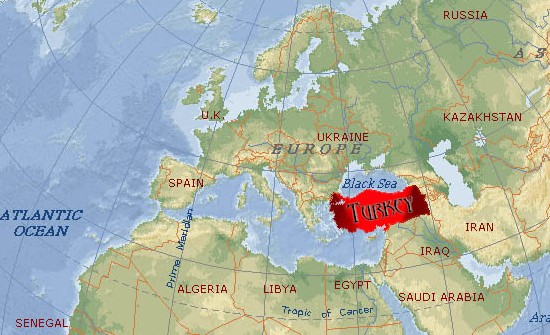
Turkey’s pivotal place

“Turkey’s greatness lies in your ability to be at the center of things. This is not where East and West divide — this is where they come together.” Barack Obama addressing the Turkish parliament, April 6, 2009.

Turkey wants U.S. ‘balance’

Prime Minister Recep Tayyip Erdogan of Turkey is a man of brisk, borderline brusque, manner and he does not mince his words: “Hamas must be represented at the negotiating table. Only then can you get a solution.”

We were seated in his suite at London’s Dorchester Hotel, where a Turkish flag had been hurriedly brought in as official backdrop. Referring to Mahmoud Abbas, the beleaguered Fatah leader and president of the Palestinian Authority, Erdogan said, “You will get nowhere by talking only to Abbas. This is what I tell our Western friends.”

In an interview on the eve of President Barack Obama’s visit to Turkey, his first to a Muslim country since taking office, Erdogan pressed for what he called “a new balance” in the U.S. approach to the Middle East. “Definitely U.S. policy has to change,” he said, if there is to be “a fair, just and all-encompassing solution.” [continued…]

Editor’s Comment — Obama was well-advised in making Turkey one of his first foreign destinations. As a country that most Americans associate with a bird, its significance is not widely appreciated. But just look at a map. If any country can claim to be located at the strategic center of the world it is Turkey. No other country has as pivotal a position between multiple continents. It is no accident that Istanbul (or as it was, Constantinople) has been the capital of four successive empires. If the Turks now want to reclaim some of their former geopolitical power, the basis of that claim does not have to be imperial nostalgia. Turkey matters because this is where continents and cultures all converge.

Obama in Istanbul: Test for the West

“If we can show that a big Muslim nation can modernize itself with the help of friends,” former German Foreign Minister Joschka Fischer has argued on behalf of Turkey’s admission to the European Union, “it demonstrates that a strong civil society, equal rights for men and women, the rule of law, an independent judiciary, a modern administration and modern economy are not in contradiction to Islam. This would be the most powerful message against the jihadists and terrorists.”

That is certainly President Barack Obama’s hope when he attends the UN “Alliance for Civilizations” gathering in Istanbul this week after a pointed visit in Ankara to the grave of Ataturk, modern Turkey’s secular saint and founder. The meeting is of particular importance because Mohamed Khatami, the reformist former president of Iran is a key member of the group, as is Federico Mayor, the former secretary general of UNESCO who, long before 9/11, extolled the tolerant virtues of “La Convivencia” — the peaceful coexistence of Muslims, Jews and Christians in Andalusian Spain from 711-1492.

Whether Obama’s hope is justified is indeed the great test for the West in relations with the Muslim world. [continued…]

A Mideast play’s uncertain script

The Obama administration is preparing a broad stage for Middle East diplomacy stretching from the Palestinians to Syria to Iran. It’s a supremely ambitious agenda, and before the curtain goes up, Obama should explore his options and risks carefully.

By seeking to engage all the major actors in the Middle East at once, Obama is pursuing a general settlement of tensions in a dangerously unstable region. That’s intriguing and also worrying for countries in the Middle East. It makes Saudis and Israelis — not to mention Iranians and Syrians — nervous.

If you’re looking for a historical analogy for this scale of diplomacy, think of the Congress of Vienna of 1815. That gathering produced a new security architecture for a Europe that had been violently destabilized by revolutionary France — in something like the way the Middle East has been upset by the 1979 Iranian revolution. [continued…]

Facebooktwittermail

Nuclear disarmament: a dream or an imperative?

Obama outlines disarmament plan

Under a hazy spring sky, before a swelling Czech crowd, U.S. President Barack Obama called for an international effort to lock down nuclear weapons materials within four years, one of a host of steps he said would move the globe to nuclear disarmament.

Speaking just hours after North Korea launched a controversial multistage rocket, the U.S. president took to the stage in Castle Square here, testifying “clearly and with conviction” to an audience of at least 20,000 of “America’s commitment to seek the peace and security of a world without nuclear weapons.”

“We have to insist, ‘Yes, we can,'” he said, reprising a battle theme recognizable to a crowd a continent away from his campaign victory. [continued…]

Many obstacles to Obama nuclear dream

President Obama’s hopes for a world free of nuclear weapons may just be a dream.

Despite his rousing rhetoric in Prague that “we can do it”, huge obstacles are in the way and even he gave himself two escape clauses.

The first was that he did not necessarily expect this to happen in his lifetime. He is 47 years old, so, given that the life expectancy in the US is about 78, that means another thirty years or more in which the goal might not be realised. [continued…]

Editor’s Comment — A goal is just a dream unless there’s a deadline. When JFK announced his plan to send a man to the moon, he didn’t add the caveat, “but it might not happen in my lifetime.”

In a single breath, Obama inflated hopes and then let them drift away. To turn a dream into a reality will require a clearly defined strategy, a set of intermediary goals and deadlines, and genuine political commitment. If Obama becomes really serious, this could actually be the easy route for him to make history.

Gone are the days when nuclear disarmament could be dismissed as a lofty goal only entertained by dreamers. The CND marchers from the 50’s led by the likes of Bertrand Russell have been replaced an unlikely band of elder-statesman realists. Henry Kissinger, George Shultz, William Perry, and Sam Nunn made appeals for disarmament in 2007 and 2008 that drew a favorable response by pointing out that the risks in failing to disarm are now far greater than the challenge of taking on this goal.

But how can disarmament be easy? Of course it won’t be — but everything is relative. Placed alongside objectives such as tackling climate change, ending poverty or eradicating terrorism, nuclear disarmament is a much less complex undertaking. Whether Obama is ready to lead the way may come down to whether he has the courage to take on a bold political strategy that ties together nuclear disarmament with Middle East policy.

The effort to press Iran to abandon its uranium enrichment program would acquire a moral legitimacy that has so far been lacking if this particular objective was an integral part of a wider campaign for disarmament. At the same time, if Iran is to be persuaded then pressure must simultaneously be placed on Israel to both sign the non-proliferation treaty and commit to its own disarmament.

Benjamin Netanyahu says that stopping Iran becoming a nuclear power is a global imperative. Fair enough — but what is Israel willing to give up to make that happen?

If Obama wants to take a small but highly symbolic step in the right direction, he could tell the Israeli prime minister during his first trip to Washington, that the United States will no longer afford Israel the privelage of colluding in Israel’s policy of “nuclear ambiguity”. Robert Gates already chipped a crack in the foundations of that policy during his confirmation hearings. Now it’s time to drop the pretense altogether.

Challenging Iran’s nuclear aspirations requires acknowledging Israel’s nuclear realities.

US may cede to Iran’s nuclear ambition

US officials are considering whether to accept Iran’s pursuit of uranium enrichment, which has been outlawed by the United Nations and remains at the heart of fears that Iran is seeking nuclear weapons capability.

As part of a policy review commissioned by President Barack Obama, diplomats are discussing whether the US will eventually have to accept Iran’s insistence on carrying out the process, which can produce both nuclear fuel and weapons- grade material.

“There’s a fundamental impasse between the western demand for no enrichment and the Iranian dem­and to continue enrichment,” says Mark Fitzpat­rick, a former state depart­- ­­ment expert now at the International Institute for Strategic Studies. “There’s no obvious compromise bet­ween those two positions.” [continued…]

Facebooktwittermail

Criticizing Israel

Statement by incoming Foreign Minister Avigdor Lieberman at the ministerial inauguration ceremony

The Israeli government never approved Annapolis, neither the Cabinet nor the Knesset, so anyone who wants to amuse himself can continue to do so. I have seen all the proposals made so generously by Ehud Olmert, but I have not seen any results.

So we will therefore act exactly according to the Road Map, including the Tenet document and the Zinni document. I will never agree to our waiving all the clauses – I believe there are 48 of them – and going directly to the last clause, negotiations on a permanent settlement. No. These concessions do not achieve anything. We will adhere to it to the letter, exactly as written. Clauses one, two, three, four – dismantling terrorist organizations, establishing an effective government, making a profound constitutional change in the Palestinian Authority. We will proceed exactly according to the clauses. [continued…]

Editor’s Comment — Lieberman needs to study the agreement that he just promised Israel will assiduously abide by. Phase One concludes:
— Government of Israel immediately dismantles settlement outposts erected since March 2001.

— Consistent with the Mitchell Report, GOI freezes all settlement activity (including natural growth of settlements).

Prominent gentiles must get over their hangups and start criticizing Israel

This post is not aimed at Jews. Note the headline. Many non-Jews have not come into this space–Criticizing Israel– because of fears of being called anti-Semites and written off. Years ago my friend Rob Buchanan said to me, Phil you have to speak out on this ’cause they’ll just smear non-Jews as anti-Semites. And I accepted that responsibility.

But the point of this post is that the passivity of likeminded gentiles has now become a problem. We need more prominent gentiles to step forward. [continued…]

Editor’s Comment — I can’t claim to be a prominent gentile but I’m certainly one who has never been terribly worried about being accused of being an anti-Semite. (Everyone has to be able to read their own moral compass and so long as you are confident in doing that, it doesn’t really matter what kinds of slurs get flung in your direction.)

But the challenge now is not one of recruiting gentiles; it is one of transcending tribalism.

Pro-Israel Jews have two weapons that they predictably unleash. They demean and belittle fellow Jews by calling them “self-hating” whereas they vilify non-Jews by implying that they harbor the murderous intent of anti-Semites.

This is a divide-and-rule tactic and maybe the best way of responding to it is by forging solidarity and recognizing that those who draw attention to the ethnicity of Israel’s critics are merely trying to deflect attention from the criticism to the critic.

New town may be death blow to hopes for Israel peace

The sign in big, red Hebrew letters reads “Welcome to Mevasseret Adumim, the Harbinger of the Hills”. A three-lane road with roundabouts leads up the hill to a police station and street lamps line the flyover that links the new town to neighbouring Ma’aleh Adumim, one of the largest Jewish settlements in Israel.

There are no houses, cars or people in Mevasseret Adumim: it is a town laid out, waiting to be built. That is because international pressure has so far prevented construction from going ahead. The area is the last piece of open land linking Arab East Jerusalem to the West Bank and critics said that to develop it would bury the very notion of a two-state solution to the Middle East crisis.

According to reports in the Israeli media, the area has been earmarked for development under a secret accord between Binyamin Netanyahu, the new, conservative Israeli Prime Minister, and his ultra-nationalist Foreign Minister, Avigdor Lieberman. [continued…]

Netanyahu, America and the cow in the house

To understand how Israel’s new Netanyahu government will handle relations with its neighbours, and a US administration with which it is clearly at odds, it is worth recounting an old Hasidic Jewish folktale

A man’s wife nags him relentlessly that their home is too small. A poor man, he can afford nothing larger, so he asks the advice of his rabbi. “Bring your chickens into the house,” the rabbi advises, which the man duly goes home and does. Naturally his wife’s anger escalates, which he reports back to the rabbi the following day. “Now bring in your goat,” the sage advises – a course of action with predictable consequences, but when the man returns the rabbi orders him to bring a cow into the house the next night. The man returns red-eyed and frantic after a sleepless night. “Rabbi, what can I do, my wife is threatening to leave.” To which the rabbi replies: “Now, take out the cow.”

The basic principle is simple: when you have a problem you can’t solve, create a bigger one. Plainly, Benjamin Netanyahu has a problem he can’t solve: Israel is highly dependent on US support, but America now has an administration determined to move quickly to end the conflict that has raged since Israel’s creation in 1948 by creating a viable, independent Palestinian state. And Mr Netanyahu has repeatedly insisted that he cannot accept such an outcome because he deems sovereign independence for the Palestinians to be an intolerable threat to Israel’s security. [continued…]

Facebooktwittermail

NEWS & VIEWS ROUNDUP & EDITOR’S COMMENT: April 5

The poor must be included in a global economy

In an age characterised by the death of trust we find comfort in being able to blame everyone. It is entirely reasonable that thousands will protest, hopefully peacefully, against bankers who stuck their noses in the trough, regulators who turned away and governments who kept smiling as the tax take grew. The truth is they could just as easily protest against themselves for blindly succumbing to this leveraged society. We must now clear up the mess. Amid all the experts who failed to call this disaster, only one got it right. It was Bob Dylan, who said: “Money doesn’t talk. It swears.”

The system was always skewed and its rewards asymmetric. We built a global economy that excluded half of the globe. We marginalised the productive capacity of the 3bn people who live on less than $2 a day. By excluding them, we deprived them of the income they need to buy our stuff and consigned them to ill-health, lack of education and conflict. Instability is inherent in asymmetry. It will topple over. The first task of the Group of 20 nations must be to bring the peripheral economies and their people into the centre. [continued…]

Editor’s Comment — In the midst of an economic crisis, the spirit “charity begins at home” always prevails. But in America on top of that there is a near universal assumption that the United States leads the world when it comes to foreign aid. That might be true as a raw number, but when it comes to aid as a proportion of GDP the US lags way behind the leading nations.

A key element of the crisis is a deficit of ethics

Financial crises are triggered when — partially due to the decline of correct ethical conduct — those working in the economic sector lose trust in its modes of operating and in its financial systems. Nevertheless, finance, commerce and production systems are contingent human creations which, if they become objects of blind faith, bear within themselves the roots of their own downfall. The only true and solid foundation is faith in the human person. For this reason all the measures proposed to rein in this crisis must seek, ultimately, to offer security to families and stability to workers and, through appropriate regulations and controls, to restore ethics to the financial world. [continued…]

Administration seeks an out on bailout rules for firms

The Obama administration is engineering its new bailout initiatives in a way that it believes will allow firms benefiting from the programs to avoid restrictions imposed by Congress, including limits on lavish executive pay, according to government officials.

Administration officials have concluded that this approach is vital for persuading firms to participate in programs funded by the $700 billion financial rescue package.

The administration believes it can sidestep the rules because, in many cases, it has decided not to provide federal aid directly to financial companies, the sources said. Instead, the government has set up special entities that act as middlemen, channeling the bailout funds to the firms and, via this two-step process, stripping away the requirement that the restrictions be imposed, according to officials. [continued…]

‘Holy hell’ over torture memos

A fierce internal battle within the White House over the disclosure of internal Justice Department interrogation memos is shaping up as a major test of the Obama administration’s commitment to opening up government files about Bush-era counterterrorism policy.

As reported by Newsweek, the White House last month had accepted a recommendation from Attorney General Eric Holder to declassify and publicly release three 2005 memos that graphically describe harsh interrogation techniques approved for the CIA to use against Al Qaeda suspects. But after the story, U.S. intelligence officials, led by senior national-security aide John Brennan, mounted an intense campaign to get the decision reversed, according to a senior administration official familiar with the debate. “Holy hell has broken loose over this,” said the official, who asked not to be identified because of political sensitivities.

Brennan is a former senior CIA official who was once considered by Obama for agency director but withdrew his name late last year after public criticism that he was too close to past officials involved in Bush administration decisions. Brennan, who now oversees intelligence issues at the National Security Council, argued that release of the memos could embarrass foreign intelligence services who cooperated with the CIA, either by participating in overseas “extraordinary renditions” of high-level detainees or housing them in overseas “black site” prisons. [continued…]

Federal judge to Obama DOJ: You’re wrong, Bagram Prisoners do have rights

Barack Obama’s Department of Justice made headlines in late February when it adopted the Bush administration’s notoriously unconstitutional stance on prisoners at Bagram Air Base, claiming that such “detainees” have no right to challenge their detention. As the Independent UK reported at the time, “less than a month after signing an executive order to close the Guantanamo Bay prison camp, President Barack Obama has quietly agreed to keep denying the right to trial to hundreds more terror suspects held at a makeshift camp in Afghanistan that human rights lawyers have dubbed ‘Obama’s Guantanamo.'”

Four prisoners at Bagram, however, have been challenging this position in court since before Obama took office — and today, three of them won a major victory.

In a momentous, 53-page decision by Judge John D. Bates of the U.S. District Court for the District of Columbia, a U.S. court concluded “for the first time,” according to the International Justice Network, “that detainees held indefinitely without charge in U.S. custody in Afghanistan are entitled to challenge their detentions in U.S. courts.” [continued…]

U.S. attacks ‘Sons of Iraq,’ its former allies

Less than a week after helping disarm and disband a Sunni paramilitary group that had once been on its payroll, the U.S. military has now directly clashed with some of its former allies.

Multi-National Division – Baghdad announced today that a U.S. aircraft targeted “Sons of Iraq” members who were spotted planting a roadside bomb last night north of Taji. According to a coalition news release, one man was killed in the strike; two others were found wounded in a nearby house. At least one of the men was identified has having served in the “Sons of Iraq.” That’s the largely Sunni tribal group, bankrolled by the U.S. to keep order in their neighborhoods — and to stop fighting American forces. Many of the “Sons” were former insurgents, and insurgent allies. If they flip back to being enemies of the government, the Iraq enterprise could be in deep, deep trouble. [continued…]

Outcry in Pakistan after video of a 17-year-old girl’s flogging by the Taliban is shown on TV

The Pakistani government has ordered an inquiry into the flogging of a 17-year-old woman by Taliban militants in the troubled Swat valley, after public outrage triggered by shocking video footage of the punishment.

The images, played yesterday on private television channels, show a burka-clad woman being pinned to the ground by two men while a third whips her backside 34 times. The woman is seen screaming and begging for mercy as a crowd of largely silent men look on. She is accused of having had an illegal sexual relationship, according to local law. Her brother is among those restraining her.

President Asif Ali Zardari led a wave of public condemnation, and ordered the arrest of the perpetrators. Prime minister Yousaf Raza Gilani termed it “shocking” and called for an immediate inquiry. At the supreme court, the newly reinstated chief justice, Iftikhar Chaudhry, summoned officials to a hearing scheduled for Monday to investigate the incident. [continued…]

Britain says U.S. doesn’t object to efforts to engage Hezbollah

The Obama administration is “comfortable” with the British government’s attempts to engage Hezbollah, the Iranian-backed group that the U.S. labels a terrorist organization, a senior British diplomat asserts.

Bill Rammell, Britain’s minister of state for foreign and Commonwealth affairs, said in a brief interview late last week in Damascus that despite protests to the contrary, the new U.S. administration does not object to the fledgling contacts with the political wing of the Lebanon-based Shiite Muslim group, which also has a heavily armed militia.

Britain likens the attempt to engage Hezbollah, launched quietly this year, to its outreach to political leaders of the Irish Republican Army — a move that helped quell the Northern Ireland conflict. [continued…]

Facebooktwittermail

EDITORIAL: Intelligence, information, truth and power

Intelligence, information, truth and power

When the Israel lobby launched its frantic campaign to obstruct the appointment of Chas Freeman as chairman of the National Intelligence Council (NIC), it was as though a notorious anti-Zionist was just about to torpedo US-Israeli relations. The idea that Ambassador Freeman could have played an important role in improving America’s national security and its position in the world apparently didn’t enter the minds of those who saw him as a threat.

Now that the furor has died down, Freeman has given an interview with Jim Lobe from the Inter Press Service and he outlines the approach that he had hoped to bring to the handling of intelligence and its role in government. What Freeman touches upon actually reaches far beyond the issue of intelligence and points to fundamental questions about how information is viewed and how its use shapes our lives.

This is how the issues were laid out in the interview:

Jim Lobe: Because much of the talk around Washington after your appointment – before, during and after your withdrawal – has so narrowly focused on a few issues, there was never much public debate about what you hoped to accomplish in the job of NIC chairman.

Chas Freeman: I was, frankly, approaching this with a fairly well thought out but still hypothetical focus on process with some additional questions of substance that I wanted to explore. I say hypothetical, because you never know until you encounter bureaucratic or other realities whether your notion of what needs to be done is in fact realistic or feasible.

But my sense was there have been several problems with the intelligence community and its output in recent years. Obviously, there’s been a problem of quality, illustrated along with the other problem – credibility – very nicely in the run-up to the Iraq War and the credulity with which the intelligence community responded to assertions by exile and special interest groups and others, and its willingness to slice and dice its conclusions to suit the political taste of its principal consumers.

Jim Lobe: What sorts of procedural changes were you thinking about implementing?

Chas Freeman: In general, I would’ve tried very hard to encourage members of the intelligence community to use classified information as a form of corroboration for information that is not classified, or is not terribly sensitive even if it is classified. In other words, I would urge analysts to write down rather than write up terms of levels of classification.

The theory here is that, whereas many people in the (NIC) have tended to see the value of intelligence as directly proportional to its level of classification, this, in fact, misunderstands the nature of intelligence. Intelligence is simply information that is relevant to statecraft or decision-making. If it’s on the front page of the Financial Times or Inter Press or has been stolen out of the Kremlin safe, the key question is what is its reliability and how much can you rely upon it in understanding the situation you confront and in forming policies to deal with that situation.

I must say much of the criticism of my appointment focused on the apparently horrifying possibility that I might actually produce intelligence that might not conform to political convenience or correctness but reached some other conclusion – intelligence that wouldn’t fit the preconceptions or policy preferences of its consumers. And that would be unacceptable.

The tendency to tie the value of intelligence to its level of classification is the product of a philosophical view of information that has profound implications.

The crucial issue is whether information is viewed as a repository of truth or power.

Is information valued because it illuminates understanding or because it can serve as a means to an end?

Information as a repository of power needs to be guarded and channeled in the most effective way. Its value becomes diluted through loss of ownership.

Information as a repository of truth acquires value if it can be tied to other information through a process of exchange. Its value is enhanced through the relinquishment of ownership.

Democracy rises or falls on its ability to sustain the free flow of information. As a practical necessity that flow needs to be managed yet if this is treated as an exercise in the control of power, democratic governance itself will be undermined.

Those who saw Freeman as a threat were looking through the prism of information-as-power. They thought he would be a gatekeeper who held back information that would serve their agenda while promoting the flow of information whose dissemination would act against their interests. What they failed to see was that Freeman never shared their presuppositions about the nature of information.

Facebooktwittermail

Israel’s threats

Israel expected to hold back on Iran

Robert Gates, US defence secretary, has said Israel is unlikely to attack Iran this year to prevent Tehran from developing a nuclear weapon.

In an interview with the Financial Times, Mr Gates said there was still enough time to persuade Iran to abandon what is widely perceived to be a nuclear weapons programme.

Mr Gates said he does not expect Israel – which believes the US estimate for when Iran could develop a nuclear weapon is too sanguine – to take military action this year.

“I guess I would say I would be surprised…if they did act this year,” said Mr Gates. [continued…]

Israel’s awful new government

Israeli leaders and their advocates have already promoted a full-court blitz demanding that the United States “stop” Iran, or Israel will be forced to do so on its own. In part, this is bluster, as few analysts believe Israel is able to attack Iran on its own, and no one believes that Iran wouldn’t retaliate, which would force the United States into the middle of the conflict. However, this emphasis on Iran serves another useful purpose for Netanyahu and Lieberman: Not only does it remove Palestinian independence and potential Israeli peace treaties with the Arab world from U.S. focus, but it sets the agenda for the U.S.-Israeli talks that are to take place this May.

So far, the Obama administration has kept its cards close to the vest — there’s little sign of how it will engage Israel’s new administration on such fundamental differences in policy. But one thing is certain. The longer the United States waits, the harder it will be for the Israeli government to back down from its positions. And it is clear, looking at the challenges facing the United States throughout the Middle East, that placing Israel’s occupation of the West Bank on the back burner is only going to add fuel to the many brush fires the United States is already fighting in the region. Dealing with a hostile and recalcitrant enemy in Afghanistan and Pakistan is hard enough, but the Obama administration may find that dealing with a hostile and recalcitrant ally brings its own set of challenges. [continued…]

Will Netanyahu attack Iran?

European governments are practicing evacuating their citizens from Iran in case a “third party” strikes the nuclear installations. Israel’s veiled threats “that no option should be lifted from the table,” which were meant to push the international community to intensify pressure and sanctions on Iran to prevent war, have had the opposite effect. The international community has become convinced that Israel will act on its own, so it does not need to do a thing. [continued…]

Editor’s Comment — Irrespective of whether Israel is ultimately a free agent, for Robert Gates to refer to Israeli intentions as though they are something about which Americans can only guess, does not seem to be in American interests. It burnishes Israel’s image of unpredictability and it implies that the US lacks the power to rein in its ally at a critical juncture.

It’s one thing for the Obama administration to want to show that Israeli interests and US interests don’t always coincide, but to suggest that the US has no leash strong enough to hold back the mad dog will merely have the effect of creating the appearance of complicity. If the US truly sees Israel as a maverick state that in the international arena is a law unto itself, then it’s time to question the basis of the US-Israeli alliance.

Facebooktwittermail

EDITORIAL: Who poses a greater threat to Israel? Mahmoud Ahmadinejad or Benjamin Netanyahu?

Who poses a greater threat to Israel? Mahmoud Ahmadinejad or Benjamin Netanyahu?

“In an interview conducted shortly before he was sworn in today as prime minister of Israel, Benjamin Netanyahu laid down a challenge for Barack Obama. The American president, he said, must stop Iran from acquiring nuclear weapons — and quickly — or an imperiled Israel may be forced to attack Iran’s nuclear facilities itself,” writes Jeffrey Goldberg.

In Haaretz, Aluf Benn presents a somber assessment of the likelihood that Israel will start a war with Iran:

“I promise that if I am elected, Iran will not acquire nuclear arms, and this implies everything necessary to carry this out,” Benjamin Netanyahu said before the elections. In other speeches Netanyahu described Iran’s nuclear program as “an existential threat for Israel,” and warned that it risked a second Holocaust. Does his return as prime minister necessarily bring Israel nearer to war with Iran?

In political circles the view is that yes, Netanyahu as prime minister brings Israel closer to war with Iran. Politicians in touch with Netanyahu say he has already made up his mind to destroy Iran’s nuclear installations.

In The National, I reviewed a recent assessment of the feasibility of an Israeli attack and some of its consequences:

In a recent study conducted by the Center for Strategic and International Studies in Washington, Abdullah Toukan predicted that an air assault by Israel on Iran’s nuclear facilities would involve 20 per cent of the high-end combat aircraft and all of the tankers from the Israeli air force.

“We can conclude that a military strike by the Israeli air force against Iranian nuclear facilities is possible, however, it would be complex and high risk in the operational level and would lack any assurances of a high mission success rate.”

The study also noted that Iran may have secretly acquired Russian air defence systems in which case an Israeli strike force would face a significantly elevated risk.

“The attrition rates of the Israeli air strike will be high, could go up to 20 to 30 per cent. For a strike mission of some 90 aircraft, the attrition could then be between 20 to 30 aircraft. A loss Israel would hardly accept in paying.”

The study also considered the possibility that Israel might choose instead to use conventionally-armed ballistic missiles to attack Iran.

Whatever the method of attack, the effects of radioactive fallout emitted by the Bushehr nuclear reactor, if it was destroyed, would be severe. “Most definitely Bahrain, Qatar and the UAE will be heavily affected by the radionuclides.

“Any strike on the Bushehr nuclear reactor will cause the immediate death of thousands of people living in or adjacent to the site, and thousands of subsequent cancer deaths or even up to hundreds of thousands depending on the population density along the contamination plume.”

Significantly, Goldberg writes:

Few in Netanyahu’s inner circle believe that Iran has any short-term plans to drop a nuclear weapon on Tel Aviv, should it find a means to deliver it. The first-stage Iranian goal, in the understanding of Netanyahu and his advisers, is to frighten Israel’s most talented citizens into leaving their country. “The idea is to keep attacking the Israelis on a daily basis, to weaken the willingness of the Jewish people to hold on to their homeland,” Moshe Ya’alon said. “The idea is to make a place that is supposed to be a safe haven for Jews unattractive for them. They are waging a war of attrition.”

What seems strikingly obvious is that the choices made by the Israeli government may well have the same effect and lead Jews in increasing numbers to conclude that Zionism has failed.

An attack on Iran when described as potentially successful — from Israel’s point of view — is likely to merely push back Iran’s nuclear program by a few years.

But what about the psychological impact of failure?

Where would Israel stand strategically in the event that it suffered significant losses while only doing limited damage to Iran’s nuclear facilities?

What would the mood be in Tel Aviv as its residents awaited a reprisal through a means and at a time of Iran’s choosing?

Israel’s nuclear reactor at Dimona is within range of missiles fired from Iran or Lebanon. Bennett Ramberg writing in Arms Control Today says:

… a successful strike on an operating Dimona reactor that breached containment and generated an explosion and fire involving the core would present effects similar to a substantial radiological weapon or dirty bomb. Although consequences would represent only a small fraction of the Chernobyl release, for Israel, a country the size of New Jersey with a population of some six million, the relative economic dislocation, population relocation, and immediate and lingering psychological trauma could be significant.

Whether or not Dimona ends up being attacked, Israel is doomed if it clings on to the idea that military invulnerability and security are the same.

Facebooktwittermail

EDITORIAL: Super top-secret scoop by an American magazine whose name can be revealed

Super top-secret scoop by an American magazine whose name can be revealed

If Deep Throat had been as paranoid as the Israelis maybe Richard Nixon would have managed to serve out his second term. Maybe the name “Watergate” would have never become infamous.

The Sudan raid story has been dribbling out over the last few days, a rumor here, a rumor there.

Apparently the Israelis got tired of the story getting so tangled.

Enough is enough, they said. We will have to provide a definitive account to an authoritative outlet.

I can now reveal that Israel’s most trusted messenger (at least at this moment) is Time magazine.

Humbled and honored that highly-placed Israeli security sources would provide Time with “exclusive details,” the magazine apparently went one step further than promising the standard anonymity to sources whose names can’t be revealed for the standard reasons. In this case the Israelis apparently needed to be so guarded that not only could they not reveal their own names, but (sources might have told me) they insisted that the journalists they were speaking to would also have to wrap themselves in the same cloak of anonymity.

Unnamed sources talk to unnamed journalists. There’s no risk that “TIME STAFF” will ever get a subpoena!

On the other hand, there’s not much chance we can expect tenacious investigative reporting from journalists who don’t get a byline.

How long would Bob Woodward and Carl Bernstein have toiled for if they had to work under the selfless byline of “Washington Post Staff Writers”?

As for the Big Story, did it contain any major revelations?

The official motive for the attack — and I’ll take this as official even though it doesn’t come in quotes but it does come as the second sentence, immediately after we’ve been told that we’re getting the straight dope from “two highly-placed Israeli security sources” — (drumroll):

The attack was a warning to Iran and other adversaries, showing Israel’s intelligence capability and its willingness to mount operations far beyond its borders in order to defend itself from gathering threats.

So there you have it. Iran now knows that any time it sends a small convoy of trucks through an isolated desert in north-east Africa, the trucks, drivers and cargo might get wiped out by a long-range stealth attack by Israeli fighter bombers.

Does this have implications for the security of Iran’s nuclear facilities?

Israel can knock out a convoy in Sudan, so, who knows what else it could do?

Knock out another convoy?

As for the question I raised yesterday, what did the Americans know and when did they know it?

Here’s the partial answer: “The Americans were notified that Israel was going to conduct an air operation in Sudan, but they were not involved.” And that’s a direct quote from… “a source.” Would that source be one of the highly-placed Israeli security sources? Maybe. Maybe not.

If the Americans got the heads-up from the Israelis that an operation was just about to take place in Sudan, did the Israelis know that the Americans had just or were just about to talk to the Sudanese?

It’s clearly in Israel’s interests to put out the message that Israel and the US see eye to eye at all times, but maybe someone at Time needs to track down an anonymous American source who’s willing to tell an anonymous reporter the American side of the story. Is that too much to ask?

Facebooktwittermail

NEWS & VIEWS ROUNDUP & EDITOR’S COMMENTS: March 31

Israel’s covert war on Iran faces disapproving White House

Facing mounting U.S. opposition behind the scenes, Israel still plans to continue a covert operation to delay Iran’s nuclear program by assassinating key Iranian scientists, U.S. officials said.

The Israeli program which has been in place for almost a decade, involves not only targeted killings of key Iranian assets but also disrupting and sabotaging Iran’s nuclear technology purchasing network abroad, these sources said.

Reva Bhalla, a senior analyst for Stratfor, a U.S. private intelligence company, commented publicly that key Iranian nuclear scientists were the targets of the strategy.

“With cooperation from the United States, Israeli covert operations have focused both on eliminating key [Iranian] assets involved in the nuclear program and the sabotaging of the Iranian nuclear supply chain,” he said.

But U.S. opposition to the program has intensified as U.S. President Barack Obama makes overtures aimed at thawing 30 years of tension between the two countries. [continued…]

Editor’s Comment — At least one reader doubts the credibility of this story. All I can say is that this isn’t the first time it’s been reported. The February Telegraph report appears to have been based on some of the same sources.

Big sigh of relief in the White House: Israel’s Netanyahu says he can work with Obama

In the weeks since he was chosen to form Israel’s next government, Benjamin Netanyahu has labored to dispel the perception that he’s on a collision course with the country’s most powerful ally.

Never mind his history of spats with Washington, or that he refuses to embrace the goal of an independent Palestinian state, a cornerstone of American policy reaffirmed by President Obama last week.

And never mind that religious parties in his coalition call for expanding the Jewish settlements in the West Bank that Obama has criticized. Or that his foreign minister lives in one.

Netanyahu, expected to be sworn in as prime minister today, speaks with utter confidence that none of this record matters. He claims that Obama, with whom he has met twice, is “open to new ideas” — including his ideas — on how to address the region’s conflicts. [continued…]

Editor’s Comment — No doubt Obama’s been sweating it out for the last few weeks wondering whether Netanyahu really likes him and wondering whether Israel’s next prime minister will be gracious enough to accept an invitation to the White House.

Thank goodness! The suspense is over. All that anguish can be set aside. It’s time to roll out the red carpet.

Israel’s moment of decision

Israel’s formation of a national unity government, a common strategy by parliamentary governments in times of war or national emergencies, is a move to gird the Jewish state for an impending crisis involving Iran’s nuclear program.

Though it could have formed a free-standing right-leaning coalition, Likud last week concluded an agreement with Israel’s Labor Party for a national unity government, with Benjamin Netanyahu as prime minister. After February’s elections, it had seemed the differences between Likud, the leading right-leaning party, and Labor, the leading left-leaning party, were too great to permit unity.

Later it looked as if Labor would split and just half of its members join with Likud. But Israel’s dire security situation, particularly over Iran’s nuclear program, drove Mr. Netanyahu and Labor’s Ehud Barak, who still disagree on the peace process, to overlook their differences. Iran is at the top of the agenda for the incoming Israeli administration, with the peace process lower down. [continued…]

Editor’s Comment — Likudnik Meyrav Wurmser makes a fairly persuasive argument — except for one detail. If Ehud Barak joined Netanyahu’s government for the sake of Israel and because the threat from Iran trumps all other political considerations, why wasn’t Tzipi Livni moved by the same argument? After all, a Likud-Kadima coalition would have diminished Avigdor Lieberman’s strength and given Netanyahu an easier working majority and more international appeal. Does Wurmser view Livni as less of a patriotic Israeli than Barak or does this have more to do burnishing the “national unity” image of Israel’s new government?

National unity’s the thing — forget about ultra-nationalist fanatics.

Israeli military investigates itself and discovers that it’s squeaky clean

The Israeli military’s top lawyer on Monday closed an investigation into alleged misconduct by soldiers who took part in Israel’s recent three-week assault on the Gaza Strip, concluding that accusations made by graduates of a military preparatory school were “based on hearsay.”

In a statement, the Israel Defense Forces said that Brig. Gen. Avichai Mendelblit, the IDF’s advocate general, found no evidence to support the most serious accusations, including alleged instances in which civilians were shot without cause.

Israeli human rights groups including B’Tselem and Yesh Din said they still want a broad, independent investigation of the Gaza operation because they don’t trust the Israeli military to police itself. [continued…]

What it means to talk with Hamas

March 2009 may come to be seen as a critical month in the ending of the international community’s isolation of Hamas. Finally engaging Hamas would spell the end of hypocritical Western policy and bring the peace process in line with the realities of the Middle East.

First, a group of high-level US foreign policy officials, past and present, went public with their recommendation that the Obama administration talk to Hamas. Coincidentally, European politicians who visited Hamas officials in Syria about the same time echoed that view.

Typically, meetings between European lawmakers and Hamas leaders are conducted discretely, if not entirely in secret. Now, the trips have begun to be publicized: In March there were trips by a cross-party group of British and Irish members of parliaments, as well as their counterparts from Greece and Italy. [continued…]

Hezbollah says not to carry out operation outside Lebanon

Lebanese Shiite armed group Hezbollah has vowed Monday that it will deter possible Israeli aggressions but will not carry out any military operation outside the country, local Elnashra website reported.

“We will not carry out any operation outside our Lebanese territories, but we will not accept after today that the enemy (Israel) stages any assault against our land,” head of Hezbollah’s members of parliament bloc Mouhamad Raad said at a funeral. [continued…]

Bush’s torture rationale debunked

Abu Zubaida was the alpha and omega of the Bush administration’s argument for torture.

That’s why Sunday’s front-page Washington Post story by Peter Finn and Joby Warrick is such a blow to the last remaining torture apologists.

Finn and Warrick reported that “not a single significant plot was foiled” as a result of Zubaida’s brutal treatment — and that, quite to the contrary, his false confessions “triggered a series of alerts and sent hundreds of CIA and FBI investigators scurrying in pursuit of phantoms.”

Zubaida was the first detainee to be tortured at the direct instruction of the White House. Then he was President George W. Bush’s Exhibit A in defense of the “enhanced interrogation” procedures that constituted torture. And he continues to be held up as a justification for torture by its most ardent defenders.

But as author Ron Suskind reported almost three years ago — and as The Post now confirms — almost all the key assertions the Bush administration made about Zubaida were wrong.

Zubaida wasn’t a major al Qaeda figure. He wasn’t holding back critical information. His torture didn’t produce valuable intelligence — and it certainly didn’t save lives.

All the calculations the Bush White House claims to have made in its decision to abandon long-held moral and legal strictures against abusive interrogation turn out to have been profoundly flawed, not just on a moral basis but on a coldly practical one as well. [continued…]

Facebooktwittermail

NEWS & VIEWS ROUNDUP & EDITOR’S COMMENTS: March 30

Report: U.S. warned Sudan before attack on Gaza convoy

The U.S. warned the Sudanese government that weapons were being smuggled into the Gaza Strip through its territory ahead of a recent attack on a Gaza-bound arms convoy, which foreign media has attributed to the Israel Air Force, the pan-Arab daily Al-Sharq al-Awsat reported Monday.

On Friday, the American network ABC reported that the IAF had targeted a convoy of trucks in Sudan carrying Iranian weapons to Gaza in January. According to the report, 39 people riding in 17 trucks were killed, and civilians in the area sustained injuries. The network later reported that the IAF had carried out three such strikes since the beginning of the year.

According to the report in Al-Sharq al-Awsat, which quotes reliable sources, a senior American official transferred a message to a Sudanese government official and asked him to make sure that the message makes its way to Sudan’s leaders in Khartoum so that immediate steps can be taken to put a stop to the smuggling of weapons. The sources said that the Sudanese security establishment declared that the issue would be investigated, shortly before the first attack.

In light of the fact that the attacks occurred in such close proximity to the American warning, Sudanese officials initially assumed that it was the U.S. that was behind the bombings. However, when the U.S. denied involvement, the accusations were pointed at Israel, which has yet to confirm or deny the reports. [continued…]

Editor’s Comment — When Condoleezza Rice and Tzipi Livni signed a Memorandum of Understanding on January 16 whose aim was to combat weapons smuggling into Gaza, State Department spokesman Sean McCormack said the agreement had been reached in consultation with the incoming administration. The implication was that the Bush administration and the Obama administration were on exactly the same page on this issue.

So now we learn that US officials warned the Sudanese just before the Israelis reportedly sent in drones to destroy an alleged weapons convoy. What’s going on here?

This could be a good cop/bad cop routine. Or it could have been a way of attempting to disassociate the US from the operation, or it could mean that the US didn’t know what the Israelis were about to do.

Since it’s hard to imagine that the Israelis would want to give the Sudanese or anyone else advance warning of a risky long-range operation of this nature, my guess is that the US was outside the loop. Intelligence was being shared by the US but the Israelis gave no prior notice on how they were going to use it — at least that’s my best guess in interpreting the latest wrinkle in a many-wrinkled story.

Assad: Israel not a true peace partner

Syrian President Bashar Assad spoke Monday at the opening of the Arab League summit in Doha, Qatar, and said that peace between Arab nations and Israel could not be reached without willingness on the part of the Jewish state.

“Israel killed the initiative, not the Doha summit,” he said, referring to a 2002 Arab initiative that offered Israel normal ties in return for its withdrawal from Arab land seized in 1967.

Arab countries “have no real partner in the peace process. The arrival of a Rightist government makes no difference, because in Israel, the Right, the Left and the Center… all reflect a reality which is that Israeli society is not ready for peace,” said Assad. [continued…]

Editor’s Comment — Assad is really stating the obvious yet American discourse on the conflict continues to treat Israel as though it is the bride of peace that got jilted at the altar.

Israel can learn from ‘The Troubles’

Upon the arrival of Sinn Fein President and Northern Irish Republican leader Gerry Adams into the Middle East, Israeli officials will give him the cold shoulder – “We expect all dignitaries who come here to make it clear that they will not dignify Hamas with a meeting,” said Foreign Ministry spokesman Yigal Palmor.

On Adams’s previous 2006 trip, he met with Hamas officials, and during his stay he advocated dialogue between the group and Israel, even without the precondition of Hamas’s recognition of the Jewish state. Israel should not set as a prerequisite for official engagement a refusal to see Hamas officials.

As a foreign observer, and one bringing with him a breadth of knowledge from a lifetime of dealing with the complexities of Northern Ireland’s ethnic and religious conflict, Adams has every right, and indeed he should meet with Hamas; likewise, official Israel should not shun him for so doing. [continued…]

Turkey’s fallout with Israel deals blow to settlers

A legal battle being waged by Palestinian families to stop the takeover of their neighbourhood in East Jerusalem by Jewish settlers has received a major fillip from the recent souring of relations between Israel and Turkey.

After the Israeli army’s assault on the Gaza Strip in January, lawyers for the families were given access to Ottoman land registry archives in Ankara for the first time, providing what they say is proof that title deeds produced by the settlers are forged.

On Monday, Palestinian lawyers presented the Ottoman documents to an Israeli court, which is expected to assess their validity over the next few weeks. The lawyers hope that proceedings to evict about 500 residents from Sheikh Jarrah will be halted.

The families’ unprecedented access to the Turkish archives may mark a watershed, paving the way for successful appeals by other Palestinians in East Jerusalem and the West Bank caught in legal disputes with settlers and the Israeli government over land ownership. [continued…]

The truth about Abu Zubaydah

This article was submitted to the CIA prior to publication. Passages redacted by the CIA are marked […].

Zayn al-Abidin Muhammad Husayn, more commonly known as Abu Zubaydah, is my client. After being extensively tortured by the CIA and imprisoned in various black sites around the world, Zayn may finally be approaching his day in court. I and my co-counsel welcome that day. But what if we are successful and establish that Zayn is not an enemy combatant? Would any country agree to take our client? The Bush administration’s misrepresentations about Zayn make that virtually impossible unless I am allowed to tell his side of the story. This article is the first step in that reclamation process.

For many years, Abu Zubaydah’s name has been synonymous with the war on terror because of repeated false statements made by the Bush administration, the majority of which were known to be false when uttered. On 17 April 2002, […] President Bush publicly announced that Zayn had been captured: “We recently apprehended one of al-Qaida’s top leaders, a man named Abu Zubaydah. He was spending a lot of time as one of the top operating officials of al-Qaida, plotting and planning murder.”

Zayn’s capture and imprisonment were touted as a great achievement in the fight against terrorism and al-Qaida. There was just one minor problem: the man described by President Bush and others within his administration as a “top operative”, the “number three person” in al-Qaida, and al-Qaida’s “chief of operations” was never even a member of al-Qaida, much less an individual who was among its “inner circle”. The Bush administration had made another mistake. [continued…]

Obama will face a defiant world on foreign visit

President Obama is facing challenges to American power on multiple fronts as he prepares for his first trip overseas since taking office, with the nation’s economic woes emboldening allies and adversaries alike.

Despite his immense popularity around the world, Mr. Obama will confront resentment over American-style capitalism and resistance to his economic prescriptions when he lands in London on Tuesday for the Group of 20 summit meeting of industrial and emerging market nations plus the European Union.

The president will not even try to overcome NATO’s unwillingness to provide more troops in Afghanistan when he goes on later in the week to meet with the military alliance.

He seems unlikely to return home with any more to show for his attempts to open a dialogue with Iran’s leaders, who have, so far, responded with tough words, albeit not tough enough to persuade Russia to support the United States in tougher sanctions against Tehran. And he will be tested in face-to-face meetings by the leaders of China and Russia, who have been pondering the degree to which the power of the United States to dominate global affairs may be ebbing. [continued…]

Sons of Iraq movement suffers another blow

A moderate Sunni paramilitary leader allied with the Americans was detained by Iraqi forces, his deputies said Sunday, in an illustration of how the Shiite-led government has humbled a nationwide movement that emerged two years ago to help end the Iraqi insurgency.

Iraqi authorities also continued their drive against supporters of another paramilitary leader, arresting at least seven of his backers and taking away their weapons. Those fighters were loyal to Adel Mashadani, the fiery leader of the Sons of Iraq group in Baghdad’s Fadhil neighborhood, who was detained Saturday.

The arrest of Raad Ali, who helped the Americans stabilize the west Baghdad neighborhood of Ghazaliya, came to light Sunday, five days after the Iraqi army picked him up in a midnight raid, his aides said. [continued…]

US opens route to Afghanistan through Russia’s backyard

The road passes a shimmering green mountain pasture, then dips steeply to a new US-built bridge. Across the languid Panj river is Afghanistan and the dusty northern town of Kunduz. On this side is Tajikistan, Afghanistan’s impoverished Central Asian neighbour.

It is here, at what used to be the far boundary of the Soviet empire, that the US and Nato are planning a new operation. Soon, Nato trucks loaded with non-military supplies will start rolling into Afghanistan along this northern route, avoiding Pakistan’s perilous tribal areas and the ambush-prone Khyber Pass.

This northern corridor is essential if Barack Obama’s Afghan-Pakistan strategy is to work. With convoys supplying US and Nato forces regularly attacked by the Taliban on the Pakistan route, the US is again courting the former Soviet republics of Tajikistan, Uzbekistan, Kyrgyzstan, Kazakhstan and Turkmenistan. [continued…]

Facebooktwittermail