A large majority of President Obama’s supporters favor increasing US pressure on Israel, according to a new poll released today that shows a deep partisan divide on the issue and an increased willingness on the part of Democrats to support actions that have long been considered taboo in mainstream American politics.
According to the Zogby International survey, 71 percent of Obama backers believe that the United States should “get tough with Israel” to stop the expansion of settlements, compared to just 26 percent of those who supported Republican presidential candidate John McCain. Also, 80 percent of likely Obama voters were in total agreement with the phrase, “It’s time for the United States to get tough with Israel,” while just 16 percent of McCain supporters agreed.
The poll, commissioned by the Doha Debates, a Qatar-based foundation, also found that half of all Obama supporters believe US support for Israel weakens US security, while 67 percent of Obama voters supported talks with the Palestinian militant group Hamas, a percentage similar to the proportion of Israelis who support such talks. [continued…]
Editor’s Comment — These polls have several implications but the one that the media will give least attention to (while it also gives little attention to the poll itself) is that there is a huge gap between mainstream opinion and opinion in the so-called mainstream media when it comes to Israel.
Those who leaf through the secret files of any intelligence service know what grave mistakes bad intelligence can lead to. But they also know that sometimes even excellent intelligence doesn’t change a thing.
The Israeli intelligence community is now learning this lesson the hard way. It has penetrated enemies like Syria, Iran, Lebanon, Hezbollah and Hamas. Yet despite former Prime Minister Ehud Olmert’s willingness to authorize highly dangerous operations based on this intelligence, and despite the unquestionable success of the operations themselves, the overall security picture remains as grim as ever. [continued…]
Iran and Israel By Roger Cohen, New York Times, May 18, 2009
A story is doing the rounds in Washington about an Arab ambassador whose view of Barack Obama’s overtures to Iran is: “We don’t mind you seeking engagement, but please, no marriage!”
It’s sometimes hard to know if the Arabs or Israelis are more alarmed — or alarmist — about Iran’s nuclear program and regional ambitions.
A comment a few months back from an Iranian official to the effect that the small desert kingdom of Bahrain was historically a province of Iran sent fears of exportable Shia revolution into overdrive in Sunni Arab capitals. Iran apologized, but the damage was done. [continued…]
Members of Congress have been told in confidential briefings that Pakistan is rapidly adding to its nuclear arsenal even while racked by insurgency, raising questions on Capitol Hill about whether billions of dollars in proposed military aid might be diverted to Pakistan’s nuclear program.
Adm. Mike Mullen, the chairman of the Joint Chiefs of Staff, confirmed the assessment of the expanded arsenal in a one-word answer to a question on Thursday in the midst of lengthy Senate testimony. Sitting beside Defense Secretary Robert M. Gates, he was asked whether he had seen evidence of an increase in the size of the Pakistani nuclear arsenal.
“Yes,” he said quickly, adding nothing, clearly cognizant of Pakistan’s sensitivity to any discussion about the country’s nuclear strategy or security.
Inside the Obama administration, some officials say, Pakistan’s drive to spend heavily on new nuclear arms has been a source of growing concern, because the country is producing more nuclear material at a time when Washington is increasingly focused on trying to assure the security of an arsenal of 80 to 100 weapons so that they will never fall into the hands of Islamic insurgents. [continued…]
Editor’s Comment — As Benjamin Netanyahu shared his apocalyptic fears with President Obama today, I can’t help wondering whether Obama at any point attempted to contrast the relative threat from Pakistan’s real nuclear weapons versus that posed by Iran’s imaginary weapons.
To get to President Asif Ali Zardari’s presidential palace in the heart of Islamabad for dinner is like running an obstacle course. Pakistan’s once sleepy capital, full of restaurant-going bureaucrats and diplomats, is now littered with concrete barriers, blast walls, checkpoints, armed police, and soldiers; as a result of recent suicide bombings the city now resembles Baghdad or Kabul. At the first checkpoint, two miles from the palace, they have my name and my car’s license number. There are seven more checkpoints to negotiate along the way.
Apart from traveling to the airport by helicopter to take trips abroad, the President stays inside the palace; he fears threats to his life by the Pakistani Taliban and al-Qaeda, who in December 2007 killed his wife, the charismatic Benazir Bhutto, then perhaps the country’s only genuine national leader. Zardari’s isolation has only added to his growing unpopularity, his indecisiveness, and the public feeling that he is out of touch. Even as most Pakistanis have concluded that the Taliban now pose the greatest threat to the Pakistani state since its cre- ation, the president, the prime minister, and the army chief have, until recently, been in a state of denial of reality.
“We are not a failed state yet but we may become one in ten years if we don’t receive international support to combat the Taliban threat,” Zardari indignantly says, pointing out that in contrast to the more than $11 billion former president Pervez Musharraf received from the US in the years after the September 11 attacks, his own administration has received only between “$10 and $15 million,” despite all the new American promises of aid. He objects to the charge that his government has no plan to counter the Taliban-led insurgency that since the middle of April has spread to within sixty miles of the capital. “We have many plans including dealing with the 18,000 madrasas”—i.e., the Muslim religious schools—”that are brainwashing our youth, but we have no money to arm the police or fund development, give jobs or revive the economy. What are we supposed to do?” Zardari’s complaints are true, but he does acknowledge that additional foreign money would have to be linked to a plan of action, which does not exist. [continued…]
Lieutenant Joshua Rodriguez, a U.S. platoon commander guarding the Afghan-Pakistan frontier, reckons he is lucky to be alive.
Two weeks after he set up an outpost with 20 Afghan soldiers and seven Americans overlooking a key Taliban smuggling route, some 80 insurgents attacked them hard at daybreak.
“We were very close, very close,” he said, days after the fight, holding his fingers a fraction of an inch apart.
As the Taliban threatened to overrun the base, his sniper put down his long-range rifle and grabbed a shotgun. Then he dropped the shotgun and picked up hand grenades. The enemy had come within throwing distance of the outpost’s razor wire.
“They were trying to get in from everywhere. It was a miracle,” Rodriguez said.
Yet although they managed to fend off the fighters and prevent the outpost from being overrun that day, they abandoned it a few days later, leaving the cross-border smuggling route through the vast Suna Valley unguarded. [continued…]
Taliban fighters seeking money, rest and refuge from U.S. missile strikes are turning up in increasing numbers in Pakistan’s largest city and economic hub, Karachi, according to militants, police officials and an intelligence memo.
The Taliban presence in this southern port city, hundreds of miles away from the Islamist organization’s strongholds in the northwest, shows how quickly its influence is spreading throughout the nuclear-armed nation.
Karachi is especially important because it is the main entryway for supplies headed to U.S. and NATO forces in Afghanistan, as well as the most critical city to Pakistani commerce. Few think the Taliban could actually take over this diverse metropolis of more than 12 million, but there is fear that it could destabilize it through violence and rock the already shaky national economy. [continued…]
No doubt every diligent reporter still needs a notebook and a telephone, but to read David E Sanger’s report, “Biblical Quotes Said to Adorn Pentagon Reports,” you have to wonder whether the New York Times‘s chief Washington correspondent actually knows how to use the internet.
I know, he did manage to find his way to Robert Draper’s article on GQ, but after that Sanger seemed to think that his time would be better spent listening to a goofball like Lawrence Di Rita than to spend just a few minutes drilling the web to find out more about “a general who worked on the Joint Staff.”
Even though Draper gave prominence to “Major General Glen Shaffer, a director for intelligence serving both the Joint Chiefs of Staff and the secretary of defense,” who crafted the evangelical war reports on which Draper’s article focuses, Sanger didn’t seem to think it was worth mentioning the general by name. It was sufficient to cite Di Rita who “said that he had no recollection of the biblical briefs, but that he doubted the famously acerbic and sometimes cranky secretary would have tolerated them for long, much less shared them with Mr. Bush.”
Given that Maj Gen Shaffer retired on August 1 2003, his handiwork clearly wouldn’t have been gracing the secretary of defense’s desk for very long however well or poorly it was received.
Much more relevant to Sanger’s report would have been a little biographical information about the nameless general. For instance, the fact that he serves on the board of directors of an evangelical Christian school in Texas and is on the board of trustees of an evangelical program supplier that sells seminars to churches around the world “and in chapels of all branches of the U.S. military.”
At the same time, Shaffer is maintaining the time-honored tradition of cashing in on his Pentagon connections by working as executive vice president of Kforce Government Solutions (KGS) which “provides innovative solutions to federal government.”
While Shaffer might not have been inclined to discuss with a New York Times reporter how his evangelical orientation affected his work in the Pentagon, it’s reasonable to assume that the general’s public service experience provides the foundation for his private sector day-to-day work. On that basis, Shaffer could have been pressed a bit — but only if Sanger had managed to track down. The KGS contact page would have been an obvious place to start. Clearly, Sanger didn’t even get that far.
On the morning of Thursday, April 10, 2003, Donald Rumsfeld’s Pentagon prepared a top-secret briefing for George W. Bush. This document, known as the Worldwide Intelligence Update, was a daily digest of critical military intelligence so classified that it circulated among only a handful of Pentagon leaders and the president; Rumsfeld himself often delivered it, by hand, to the White House. The briefing’s cover sheet generally featured triumphant, color images from the previous days’ war efforts: On this particular morning, it showed the statue of Saddam Hussein being pulled down in Firdos Square, a grateful Iraqi child kissing an American soldier, and jubilant crowds thronging the streets of newly liberated Baghdad. And above these images, and just below the headline secretary of defense, was a quote that may have raised some eyebrows. It came from the Bible, from the book of Psalms: “Behold, the eye of the Lord is on those who fear Him…To deliver their soul from death.”
This mixing of Crusades-like messaging with war imagery, which until now has not been revealed, had become routine. On March 31, a U.S. tank roared through the desert beneath a quote from Ephesians: “Therefore put on the full armor of God, so that when the day of evil comes, you may be able to stand your ground, and after you have done everything, to stand.” On April 7, Saddam Hussein struck a dictatorial pose, under this passage from the First Epistle of Peter: “It is God’s will that by doing good you should silence the ignorant talk of foolish men.” [continued…]
The history books will record that the so-called Sunni Awakening—when many of Iraq’s Sunni tribes, in return for money and other considerations, began cutting deals with American forces and turned away from their nationalist insurgency—got under way in late 2006. The Sunni tribes, concentrated in Anbar province, had long been the backbone of the insurgency. In the Iraq of Saddam Hussein, Sunni Arabs had exercised a domination far out of proportion to their numbers (some 20 percent of the population), and after the American-led invasion, suddenly excluded from power and influence, they exacted a bloody revenge. After the Awakening, the Sunnis helped obliterate al-Qaeda’s networks in most of Sunni Iraq, a development that many believe did more to dampen the violence than the subsequent “surge” in American troop numbers. Having reached a peak in 2006 and early 2007, the casualty rates for combatants and civilians quickly plummeted.
What the history books should also record, revealed here for the first time, is that the Sunni insurgents had offered to come to terms with the Americans 30 months earlier, in the summer of 2004, during secret talks with senior U.S. officials and military commanders. The Sunnis were gathered by an Iraqi named Talal al-Gaaod, a Sunni sheikh and wealthy businessman based in the Jordanian capital, Amman. The American officials included Jerry H. Jones, then a special assistant to Secretary of Defense Donald Rumsfeld and later serving as an expert on transitional government to Rumsfeld’s successor, Robert Gates; the late ambassador Evan Galbraith, Rumsfeld’s special envoy to Europe; Colonel Mike Walker, the head of civil affairs for the Marine Corps in Iraq; and James Clad, then a counselor to the Overseas Private Investment Corporation (which was seeking to foster economic development in Iraq) and later the Pentagon’s deputy assistant secretary for South and Southeast Asia. These men were desperate to pursue the Sunni contacts, and took serious risks with their own careers in order to do so. They were supported by officers close to the top of the U.S. military, including Lieutenant General James T. Conway, then the Marine Corps commander in Iraq and today the commandant of the Corps. For a variety of reasons, some of them petty, some of them ideological, and some of them still obscure, these men were blocked by superiors in the State Department, the Pentagon, and the White House. [continued…]
Troops from the US Marines Corps’ Special Operations Command, or MarSOC, were responsible for calling in air strikes in Bala Boluk, in Farah, last week – believed to have killed more than 140 men, women and children – as well as two other incidents in 2007 and 2008. News of MarSOC’s involvement in the three incidents comes just days after a Special Forces expert, Lieutenant-General Stanley McChrystal, was named to take over as the top commander of US and Nato troops in Afghanistan. His surprise appointment has prompted speculation that commando counterinsurgency missions will increase in the battle to beat the Taliban.
MarSOC was created three years ago on the express orders of Donald Rumsfeld, US defence secretary at the time, despite opposition from within the Marine Corps and the wider Special Forces community. An article in the Marine Corps Times described the MarSOC troops as “cowboys” who brought shame on the corps.
The first controversial incident involving the unit happened just three weeks into its first deployment to Afghanistan on 4 March 2007. Speeding away from a suicide bomb attack close to the Pakistan border, around 120 men from Fox Company opened fire on civilians near Jalalabad, in Nangahar province. The Marines said they were shot at after the explosion; eyewitnesses said the Americans fired indiscriminately at pedestrians and civilian cars, killing at least 19 people. [continued…]
FBI interrogator, Ali Soufan: The interrogator uses a combination of interpersonal, cognitive and emotional strategies to extract the information needed. If done correctly, this approach works quickly and effectively, because it outsmarts the detainee using a method that he is not trained nor able to resist. The Army Field Manual is not about being soft. It’s about outwitting, outsmarting and manipulating the detainee.
The approach is in sharp contrast of the enhanced interrogation method that instead tries to subjugate the detainee into submission through humiliation and cruelty. A major problem is it—it is ineffective. Al-Qaeda are trained to resist torture, as we see from the recently released DOJ memos on interrogation. The contractors had to keep requesting authorization to use harsher and harsher methods.
In the case of Abu Zubaydah, that continued for several months, right ’til waterboarding was introduced. And waterboarding itself had to be used eighty-three times, an indication that Abu Zubaydah had already called his interrogators’ bluff. In contrast, when we interrogated him using intelligent interrogation methods, within the first hour we gained important actionable intelligence. [continued…]
To paraphrase Al Pacino in “Godfather III,” just when we thought we were out, the Bush mob keeps pulling us back in. And will keep doing so. No matter how hard President Obama tries to turn the page on the previous administration, he can’t. Until there is true transparency and true accountability, revelations of that unresolved eight-year nightmare will keep raining down drip by drip, disrupting the new administration’s high ambitions.
That’s why the president’s flip-flop on the release of detainee abuse photos — whatever his motivation — is a fool’s errand. The pictures will eventually emerge anyway, either because of leaks (if they haven’t started already) or because the federal appeals court decision upholding their release remains in force. And here’s a bet: These images will not prove the most shocking evidence of Bush administration sins still to come.
There are many dots yet to be connected, and not just on torture. This Sunday, GQ magazine is posting on its Web site an article adding new details to the ample dossier on how Donald Rumsfeld’s corrupt and incompetent Defense Department cost American lives and compromised national security. The piece is not the work of a partisan but the Texan journalist Robert Draper, author of “Dead Certain,” the 2007 Bush biography that had the blessing (and cooperation) of the former president and his top brass. It draws on interviews with more than a dozen high-level Bush loyalists. [continued…]
The unthinkable is happening in Sadr City as the U.S. military begins to shut down its outposts to meet a June 30 deadline to withdraw from Iraqi cities.
Separation anxiety is growing among residents, local leaders and American soldiers in the sprawling, impoverished Shiite district that was once the most dangerous battlefield in Baghdad for U.S. troops.
“When the Americans leave, everything will be looted because no one will be watching,” an Iraqi army lieutenant newly deployed there said. “There will be a civil war — without a doubt,” predicted an Iraqi interpreter. Council members have asked about political asylum in the United States. [continued…]
[Chas] Freeman, in a telephone interview last week, said he still believed that Mr. Obama would go where his predecessors did not on Israel. Mr. Obama’s appointment of Gen. James L. Jones as his national security adviser — a man who has worked with Palestinians and Israelis to try to open up movement for Palestinians on the ground and who has sometimes irritated Israeli military officials — could foreshadow friction between the Obama administration and the Israeli government, several Middle East experts said.
The same is true for the appointment of George J. Mitchell as Mr. Obama’s special envoy to the region; Mr. Mitchell, who helped negotiate peace in Northern Ireland, has already hinted privately that the administration may have to look for ways to include Hamas, in some fashion, in a unity Palestinian government.
Mr. Obama’s meeting with Mr. Netanyahu, while crucial, may only preview the beginning of the path the president will take, Mr. Freeman said.
“You can’t really tell anything by what happened to me and the fact that he didn’t step forward to take on the skunks,” he said, referring to his own appointment controversy and Mr. Obama’s silence amid critics’ attacks. “The first nine months, Nixon was absolutely horrible on China. In retrospect, it was clear that he had every intention to charge ahead, but he was picking his moment. He didn’t want to have the fight before he had to have the fight.”
“I sense that Obama is picking his moment,” Mr. Freeman said. [continued…]
Andrew C. McCarthy, a former federal prosecutor who has handled terrorism cases, said the only prudent course in the current case is to withhold the images. “If you’re in a war that’s been authorized by Congress, it should be an imperative to win the war,” he said. “If you have photos that could harm the war effort, you should delay release of the photos.”
But Jameel Jaffer, a lawyer with the civil liberties union, said history favored disclosure, citing the 2004 photographs from Abu Ghraib and the 1991 video of police beating Rodney King in Los Angeles.
But the touchstone remains the Pentagon papers case. It not only framed the issues, but also created a real-world experiment in consequences.
The government had argued, in general terms, that publication of the papers would cost American soldiers their lives. The papers were published. What happened?
David Rudenstine, the dean of the Cardozo Law School and author of “The Day the Presses Stopped,” a history of the case, said he investigated the aftermath with an open mind.
“I couldn’t find any evidence whatsoever from any responsible government official,” he said, “that there was any harm.” [continued…]
On PBS’s Washington Week last night, in a roundtable discussion on the Pelosi-CIA joust, there was a clear consensus among the assembled reporters: anyone who dares pick a fight with the CIA does so at their own peril and is almost certain to lose.
As is always the case, the only thing the press is interested in here is the fight — who, if anyone, is telling the truth is apparently of no consequence. It also appears that journalists — just as much as the White House and Congress — are afraid of challenging the agency. No one’s at risk of ending up with a bullet in the back of their head, but that isn’t because the CIA is benign — it just means it can exploit much subtler but equally effective methods for accomplishing its aims.
Consider for a moment that we supposedly live in a democracy. How can it be that the head of state, the executive and legislative branches of government and the erstwhile Fourth Estate should all be afraid of a single government agency?
Why is it that an agency that enjoys the medieval privilege of operating with a “black budget” in the ostensible interests of national security, nevertheless always seems able to lift the umbrella of secrecy as and when it serves its own interests?
After Nancy Pelosi accused the CIA of lying about briefing Congressional leaders on waterboarding, CIA Director Leon Panetta’s response was to publicly issue a statement to CIA employees. This was a multi-layered message.
Top layer: The agency didn’t lie. He said: “…our contemporaneous records from September 2002 indicate that CIA officers briefed truthfully on the interrogation of Abu Zubaydah, describing ‘the enhanced techniques that had been employed.’ ” (This isn’t a particularly solid statement. “Contemporaneous records” — so might there be other records that tell a different story? “CIA officers briefed truthfully” — briefed who truthfully? “Describing ‘the enhanced techniques that had been employed'” — why didn’t he put it in black and white: Nancy Pelosi was told by CIA officers that Abu Zubaydah was waterboarded?)
Next layer: I’m defending you guys (and want to be seen defending you — hence, he didn’t just send out the memo but also put it on the CIA web site). He said: “We are an Agency of high integrity, professionalism, and dedication. Our task is to tell it like it is — even if that’s not what people always want to hear. Keep it up. Our national security depends on it.”
Next layer: But I do have to cover my own ass: “Let me be clear: It is not our policy or practice to mislead Congress.”
Why should the employees of the CIA need reminding that they shouldn’t mislead — which is to say, lie to or deceive — Congress? Oh yes, because it’s already public knowledge that in 2005, even after having been requested by Rep. Jane Harman not to do so, they destroyed video tapes of the torture of Abu Zubaydah and Abd al-Rahim al-Nashiri — tapes that would almost certainly have been used as evidence if anyone is ever prosecuted for torture.
For the last seven years, the CIA has been playing what probably ranks as the most masterful political game in its history. When 9/11 should have posed an existential threat to the agency, instead it was able to distance itself from the Bush administration to such a degree that it ended up being perceived as the victim of a neocon vendetta. Former agents became honorary members of the anti-Bush movement with Valerie Plame as their poster child.
Even now, as the agency fends off demands for investigations into its use of torture, a defense narrative has already being wheeled into service. We were just honest government employers doing what we were asked to do. The real offenders were in Cheney’s office.
I have no problem with the idea that it is the decision-makers and architects of the torture program who should be held responsible. But that doesn’t mean that torturers and murderers get off the hook. Indeed, an agency that goes to such lengths to protect its own doesn’t just need reform; it needs breaking up.
The time will come for the US to unfurl a grand diplomatic initiative. Not now. The most urgent task is to prepare the way for that day by countering the skepticism that has greeted and torpedoed every recent American idea, good or bad—from Secretary of State William Roger’s 1969 plan to the road map. The time is for a clean break, in words, style, and approach.
For many in the US, the notion of such radical change often is reduced to the question of whether or not to talk to Hamas. That is a diversion. The challenge is whether Obama can speak to those for whom Hamas speaks. They are the people who have lost faith in America, its motivations, and every proposal it promotes.
The broader point is this: a window exists, short and subject to abrupt closure, during which President Obama can radically upset Palestinian, Arab, and Muslim preconceptions and make it possible for his future plan, whatever and whenever it might be, to get a fair hearing—for American professions of seriousness to be taken seriously. It won’t be done by repackaging the peace process of years past. It won’t be done by seeking to strengthen those leaders viewed by their own people as at best weak, incompetent, and feckless, at worst irresponsible, careless, and reckless. It won’t be done by perpetuating the bogus and unhelpful distinction between extremists and moderates, by isolating the former, reaching out to the latter, and ending up disconnected from the region’s most relevant actors.
It won’t be done by trying to perform better what was performed before. President Bush’s legacy was, in this sense, doubly harmful: he did the wrong things poorly, which now risks creating the false expectation that, somehow, they can be done well. [continued…]
The U.S. president who did most for Israel was not Harry Truman, who recognized the Jewish state almost immediately after it was founded. Nor was it John Kennedy, Lyndon Johnson or Richard Nixon. Or Gerald Ford, or Ronald Reagan, or the two George Bushes, or Bill Clinton, though all of these provided America’s ally with economic assistance, supplied it with arms and stood at its side at critical moments, from the 1967 Six-Day War to the 2006 war against Hezbollah in Lebanon.
The president who did most for Israel was Jimmy Carter — the same Carter who has sometimes been described as an Israel-hater. In numerous appearances around the world, he has never shrunk from criticizing Israel for its faults, real and imaginary; the dislike is mutual. [continued…]
Israel has acceded to American demands by pledging to coordinate its moves on Iran with Washington and not surprise the United States with military action.
During a trip to Jerusalem earlier this week, CIA chief Leon Panetta informed Prime Minister Benjamin Netanyahu that U.S. President Barack Obama demanded that Israel not launch a surprise attack on Iran. The message expressed concern that Israel would cause an escalation in the region and undermine Obama’s efforts to improve relations with Tehran. [continued…]
Foreign Minister Avigdor Lieberman’s party wants to ban Israeli Arabs from marking the anniversary of what they term “the Catastrophe” or Nakba, when in 1948 some 700,000 Arabs lost their homes in the war that led to the establishment of the state of Israel.
The ultranationalist Yisrael Beitenu party said it would propose legislation next week for a ban on the practice and a jail term of up to three years for violators.
“The draft law is intended to strengthen unity in the state of Israel and to ban marking Independence Day as a day of mourning,” said party spokesman Tal Nahum. [continued…]
Some 58% of Israel’s Jewish public backs the “two states for two peoples” solution to the Israeli-Palestinian conflict, a Smith Institute poll commissioned by Ynet revealed. [continued…]
It requires a spectacular leap of faith in a kind of superheroic American exceptionalism to imagine that the invasion of Afghanistan that occurred in November 2001 will end any differently from any previous invasion of that country. And it takes an elaborate exercise in self-delusion to avoid recognizing that the Taliban crisis in Pakistan is an effect of the war in Afghanistan, rather than a cause — and that Pakistan’s turmoil is unlikely to end before the U.S. winds down its campaign next door. [continued…]
President Asif Ali Zardari, less than a year into his reign, has managed to engage Pakistan’s armed forces, the seventh largest army in the world, in a guerrilla war with the newly formed Tehreek-e-Taliban Pakistan, our very own Taliban, in the North West Frontier Province. Rumors of Talibanization air daily on Pakistani television, radio and print media: The barbarians are at the gate, we are told, and warned that if there was a time to rally around the nation’s oleaginous president, a man known locally as “President Ghadari” or traitor in Urdu, this is it. However, the time for scaremongering has past — it is precisely President Zardari’s politically expedient use of national hysteria that has seen American drones welcomed over Pakistan’s airspace and has birthed a war that this government cannot win.
In the aftermath and fallout of 9/11, Pakistan saw its elite — the power brokers of the country’s politics and economy — turn against their traditional allies, the United States for the first time. As U.S. forces occupied first Afghanistan and then Iraq, Pakistan’s elite took an unexpected turn; they welcomed resistance to American foreign policy and supported, as they had never quite done before, Islamic parties that took control of local government and provincial cabinet positions in the North West Frontier Province. [continued…]
Army footage shows laser-guided missiles slamming into mountain buildings that explode into a fountain of fragments. Warplanes blast away at Taliban targets in the Swat valley and ground troops push towards the main town, Mingora. When Pakistani forces kill the Taliban, few complain – this is a popular war, for now.
“We are progressing well,” a spokesman, Major General Athar Abbas, said.
Sometimes, though, they hit the wrong target. Jan Nawab, a slightly-built man with a scraggly beard, stood outside the house where he has taken refuge, and sobbed softly under the weight of the calamity that had befallen him. [continued…]
Shaista Behran lay on a hospital bed with a battered leg and a burdened psyche after watching several members of her family diebefore her eyes.
The 8-year-old and her family fled the village of Wodkhi in Pakistan’s war-torn Swat Valley last week, making it as far as the area’s biggest town, Mingora, when a mortar shell exploded nearby.
“I saw my brother, two sisters and my mother die in front of me,” she said, her words halting and barely audible, as a fly settled on her matted black hair. “Then everything went dark and I woke up here in the hospital.” [continued…]
If you wonder what has happened to al-Qaida, follow the trail of Arab and Muslim public opinion, and you’ll get a clear picture of its massive crisis of authority and legitimacy.
The balance of forces in the world of Islam has shifted dramatically against al-Qaida’s global jihad and its local manifestations.
Now, more and more Muslims view al-Qaida through a prism that focuses on the monstrosity of killing of non-combatants in general, not just Muslim civilians. Recent opinion surveys and my own field-research confirm that an overwhelming majority of Muslims are more than just unsympathetic to the ideology of Osama bin Laden and his followers; they place the blame squarely at his feet for the harm he has caused to the image of Islam and the damage his movement has wrought within Muslim societies. [continued…]
In the storied and steady history of faith-based opposition to nuclear weapons, however, mainstream U.S. Evangelicals have been notably absent. Such has been our (yes, I’m one) absence that Michael Sean Winters, blogging on the website of the Catholic magazine America, wrote last week of the new Two Futures Project, “Nothing in recent memory is stranger than the emerging alliance between a group of activist evangelicals and former Cold War statesmen in support of an effort to eliminate nuclear weapons.”
As the founder and director of said alliance, I’m delighted to discover that we’re so superlative.
Last week we launched the Two Futures Project, a Christian movement led by a new generation of U.S. Evangelicals–with the blessing of our older forebears–for the complete, multilateral abolition of nuclear weapons. We have no illusions that the process will be quick or easy, and thus, are preparing for the work of a generation–to ensure nonpartisan continuity of purpose in U.S. political leadership for a nuclear-weapon-free world. Our goal is rooted in “the power of the ought,” as Max Kampelman and George Shultz call it, securing unshakable support for a post-atomic age, with the intention that its attainment would become the north star, or organizing principle, for U.S. nuclear policy. [continued…]
My investigations have revealed to me — vividly and clearly — that once the Abu Ghraib photographs were made public in the Spring of 2004, the CIA, its contractors, and everyone else involved in administering “the Cheney methods of interrogation”, simply shut down. Nada. Nothing. No torture or harsh techniques were employed by any U.S. interrogator. Period. People were too frightened by what might happen to them if they continued.
What I am saying is that no torture or harsh interrogation techniques were employed by any U.S. interrogator for the entire second term of Cheney-Bush, 2005-2009. So, if we are to believe the protestations of Dick Cheney, that Obama’s having shut down the “Cheney interrogation methods” will endanger the nation, what are we to say to Dick Cheney for having endangered the nation for the last four years of his vice presidency?
Likewise, what I have learned is that as the administration authorized harsh interrogation in April and May of 2002–well before the Justice Department had rendered any legal opinion–its principal priority for intelligence was not aimed at pre-empting another terrorist attack on the U.S. but discovering a smoking gun linking Iraq and al-Qa’ida.
So furious was this effort that on one particular detainee, even when the interrogation team had reported to Cheney’s office that their detainee “was compliant” (meaning the team recommended no more torture), the VP’s office ordered them to continue the enhanced methods. The detainee had not revealed any al-Qa’ida-Baghdad contacts yet. This ceased only after Ibn al-Shaykh al-Libi, under waterboarding in Egypt, “revealed” such contacts. Of course later we learned that al-Libi revealed these contacts only to get the torture to stop.
There in fact were no such contacts. (Incidentally, al-Libi just “committed suicide” in Libya. Interestingly, several U.S. lawyers working with tortured detainees were attempting to get the Libyan government to allow them to interview al-Libi….) [continued…]
Editor’s Comment — Conspiracy is notoriously difficult to prove, but can we go at least this far: Dick Cheney, the CIA and Libya all had a mutual interest in Ibn al-Shaykh al-Libi’s death. Might a mutual interest have gone as far as a mutual understanding? Might the former vice president have ever so discreetly let it be known that Libi’s sudden demise could send out a useful message to anyone else with a loose tongue?
News of the death, in a Libyan jail, of Ibn al-Shaikh al-Libi, a US terror suspect who was the subject of an extraordinary rendition, then tortured in Egypt and Jordan as well as CIA prisons in Afghanistan and Poland has, understandably, raised questions about whether he committed suicide – as the Libyan authorities claimed – or whether he was murdered. Just two weeks ago, representatives of Human Rights Watch saw him in Tripoli’s Abu Salim prison, and although he refused to speak to them, they reported that he “looked well.”
Al-Libi’s death should also raise uncomfortable questions for former US vice-president Dick Cheney, who is still turning up with alarming regularity on US television, peddling his claims that the use of torture saved America from further terrorist attacks. The focus on al-Libi should be a stark reminder that, when he was rendered to Egypt in early 2002, the CIA’s proxy torturers extracted a false confession from him – that al-Qaida operatives had received training from Saddam Hussein in the use of chemical and biological weapons – which was used not to protect the US from attack, but to justify the invasion of Iraq. The claim featured prominently in secretary of state Colin Powell’s presentation to the UN, just a month before the invasion began.
However, beyond the story of al-Libi’s mysterious death and of Dick Cheney’s role in torturing him to launch an illegal war – as documented by Moazzam Begg earlier this week – another disturbing aspect of America’s cosy relationship with Colonel Gaddafi, in the war on terror emerged in Human Rights Watch’s press release about al-Libi’s death. The organisation noted that its researchers had interviewed four other prisoners also rendered to Libya by the CIA, who reported that they had been tortured – by or on behalf of US forces – in Afghanistan, Pakistan and Thailand. [continued…]
In testimony that could bolster Speaker Nancy Pelosi’s claim that the CIA misled her during briefings on detainee interrogations, former Senator Bob Graham insisted on Thursday that he too was kept in the dark about the use of waterboarding, and called the agency’s records on these briefings “suspect.”
In an interview with the Huffington Post, the former Senate Intelligence Committee Chairman said that approximately a month ago, the CIA provided him with false information about how many times and when he was briefed on enhanced interrogations. [continued…]
Editor’s Comment — The CIA is immensely concerned about its image. It doesn’t want to appear to be a den of rogues. It wants to be seen as a bastion of upright patriots, but please, let’s get real.
What’s the appeal of joining an intelligence agency? Does the CIA find its recruits among those who believe in transparency in government; in full accountability and strict compliance with the law? Or is it looking for those drawn by the adventure of crossing boundaries, taking risks and avoiding getting caught? To be blunt, does intelligence work not actually appeal to a certain kind of grandiose criminality?
“Within the first hour of interrogation,” Soufan said, “we gained actionable intelligence.” Soufan could not say what that information was because it remains classified. Zubaydah had been injured during his capture, and Soufan’s team arranged for medical care and continued talking to the prisoner. Within the next few days, Soufan made one of the most significant intelligence breakthroughs of the so-called war on terror. He learned from Zubaydah that Khalid Sheikh Mohammed was the mastermind behind the attacks on 9/11.
Then, however, a CIA interrogation team from Washington led by a contractor arrived at the secret location. Zubaydah was stripped naked and the contractor began a series of coercive, abusive interrogations, based on Cold War-era communist techniques designed to elicit false confessions. During the Korean War, for example, Chinese interrogators employed the measures to get captured American pilots to make false confessions. “The new techniques did not produce results, as Abu Zubaydah shut down and stopped talking,” Soufan explained. “After a few days of getting no information, and after repeated inquiries from D.C. asking why all of a sudden no information was being transmitted … we again were given control of the interrogation.”
As Soufan and his team resumed their interrogation, Zubaydah revealed information about Jose Padilla, the alleged “dirty bomber.”
But after that, the CIA and the contractor again took over, using what Soufan called an “untested theory” that the Cold War techniques might work for getting good information. “Again, however, the technique wasn’t working,” Soufan recalled.
Soufan’s team was brought back yet again. “We found it harder to reengage him this time, because of how the techniques had affected him,” Soufan noted. “But eventually, we succeeded.”
A third time the CIA and the contractor team took over, using increasingly brutal methods. Soufan reported what he called “borderline torture” to his superiors in Washington. In protest of the abuse, former FBI Director Robert Mueller pulled Soufan out of the location. [continued…]
Editor’s Comment — As Dick Cheney pursues his campaign to avoid criminal prosecution, it’s natural that he would want to frame the issue of so-called “enhanced interrogations” in terms of necessity and national security. At the same time, for Cheney and Bush the use of torture fits very comfortably into their general approach to politics. These are men who have neither an aptitude in the art of persuasion nor skill in outwitting their opponents. The way you win is through dominance and when necessary, crushing your opponent. The idea that interrogation might involve building a rapport with a terrorist suspect is something that would simply seem objectionable.
At the end of April 2003, not long after the fall of Baghdad, U.S. forces captured an Iraqi who Bush White House officials suspected might provide information of a relationship between al Qaeda and Saddam Hussein’s regime. Muhammed Khudayr al-Dulaymi was the head of the M-14 section of Mukhabarat, one of Saddam’s secret police organizations. His responsibilities included chemical weapons and contacts with terrorist groups.
“To those who wanted or suspected a relationship, he would have been a guy who would know, so [White House officials] had particular interest,” Charles Duelfer, head of the Iraqi Survey Group and the man in charge of interrogations of Iraqi officials, told me. So much so that the officials, according to Duelfer, inquired how the interrogation was proceeding.
In his new book, Hide and Seek: The Search for Truth in Iraq, and in an interview with The Daily Beast, Duelfer says he heard from “some in Washington at very senior levels (not in the CIA),” who thought Khudayr’s interrogation had been “too gentle” and suggested another route, one that they believed has proven effective elsewhere. “They asked if enhanced measures, such as waterboarding, should be used,” Duelfer writes. “The executive authorities addressing those measures made clear that such techniques could legally be applied only to terrorism cases, and our debriefings were not as yet terrorism-related. The debriefings were just debriefings, even for this creature.” [continued…]
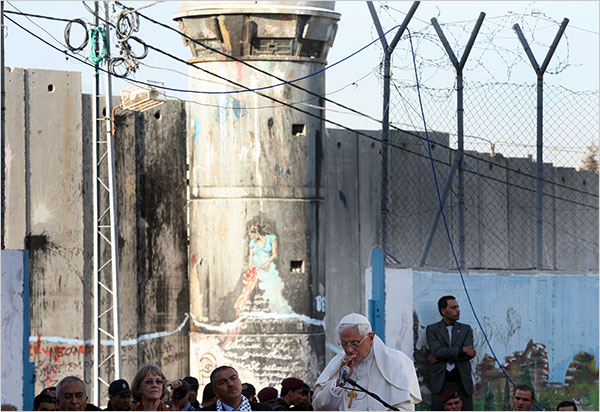
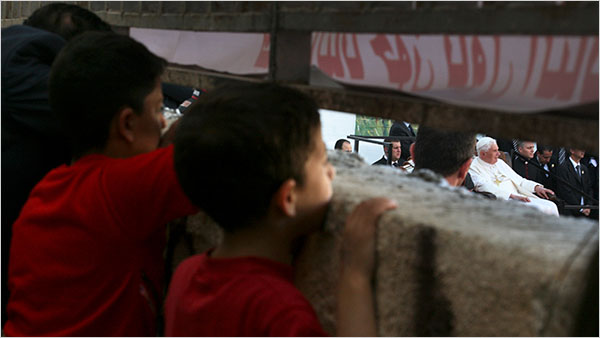
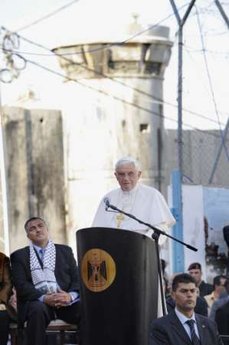
The New York Times ran an article with the headline: “In Bethlehem, Pope laments Israeli wall“. The perfect place to use the image above — the one their own photographer had provided. Right?
Wrong. Instead, they went with a poetic Getty image: little children peaking over a little wall. How enchanting!
Editor’s Comment — The Israeli PR campaign designed to cash in on the Pope’s visit cut no corners. Haaretz reported:
About 300 journalists from around the world are covering the pope’s visit to the region. By way of comparison, when U.S. president George W. Bush came to Israel, only 100 reporters were with him.
The Jerusalem municipality, the Foreign Ministry and the Tourism Ministry will have a press center at city hall to assist foreign and local journalists during the four-day visit. It will be Israel’s largest and best-appointed such center.
In addition, the balcony of the municipality building will be converted for use as a live broadcast site, overlooking the Jerusalem skyline. The building will also serve as the departure point for journalists and camera crews.
The press center will offer hundreds of Internet access stations, a few quiet areas for face-to-face interviews, and live TV signals and radio feed of press pool coverage. There will be a second, smaller press center at Nazareth’s Golden Crown Hotel, near the Mount of the Precipice.
The Tourism Ministry will distribute information to journalists aimed at boosting Israel’s image as well as incoming tourism. Among other things, it will stress that Israel provides full freedom of worship and full access to holy sites, develops and maintains these sites, and supports mutual understanding, and that Jerusalem offers a combination of ancient holy sites with a modern urban infrastructure. It will also emphasize the increasingly close relationship between Israel and the Vatican.
The ministry will also explain that pilgrims can take advantage of other attractions in Israel, such as spa treatments at the Dead Sea and nature walking trails.
The ministry intends to use documentary material from the pope’s visit in future tourism campaigns targeting countries with large Catholic populations.
So many wonderful photo opportunities that will help drive “pilgrim tourism” — a source of revenue that will have pumped $22.5 million into the Israeli economy this week alone.
But then comes the image that will* should overshadow all others: the Pope in a fully operational open-air prison camp. No need to get lost in a debate about whose memories he is giving sufficient attention to — the visible reality of incarceration is inescapable.
The Pope’s vaguely Reaganesque moment when he said that walls “can be taken down” not only evoked the fall of the Berlin Wall, but intentionally or not, called attention to the differences between the two barriers. East Berliners were deprived of all sorts of liberties, yet even they enjoyed far greater freedom than Palestinians. The emancipation of those oppressed by authoritarian communist rule was a popular cause among freedom-loving Americans. The emancipation of Palestinians from Israeli oppression… oh, that’s something we’re not even interested in thinking about.
*Having scoured the web in search of decent images of the Pope with the Wall behind him, I have to conclude that either press photographers were prevented from getting good shots or they colluded in self-censorship.
Pope Benedict XVI criticized Israel’s construction of a security barrier through the West Bank and urged a loosening of restrictions on the Gaza Strip on Wednesday, a day of speeches and symbolic appearances that amounted to a running critique of Israeli policies toward the Palestinians.
From a morning address alongside Palestinian Authority President Mahmoud Abbas to a late-afternoon visit to a refugee camp, the pontiff used a full day in the occupied West Bank to highlight some of the main issues on the Palestinian agenda.
His comments were pointed. And although he referred to Israeli security concerns, the focus was on how Palestinians are affected by Israeli measures such as the tall concrete fence that, Benedict said, “intrudes into your territories, separating neighbors and dividing families.” [continued…]
President Barack Obama has sent a message to Prime Minister Benjamin Netanyahu demanding that Israel not surprise the U.S. with an Israeli military operation against Iran. The message was conveyed by a senior American official who met in Israel with Netanyahu, ministers and other senior officials. Earlier, Netanyahu’s envoy visited Washington and met with National Security Adviser James Jones and with Secretary of State Hillary Clinton, and discussed the dialogue Obama has initiated with Tehran.
The message from the American envoy to the prime minister reveals U.S. concern that Israel could lose patience and act against Iran. It is important to the Americans that they not be caught off guard and find themselves facing facts on the ground at the last minute.
Obama did not wait for his White House meeting with Netanyahu, scheduled for next Monday, to deliver his message, but rather sent it ahead of time with his envoy. [continued…]
When Philip Zelikow, the former counselor to Secretary of State Condoleezza Rice, testifies before a Senate Judiciary subcommittee Wednesday about controversial legal opinions issued by the Bush-era Justice Department, he’ll be wading into a political maelstrom. Former Bush administration and CIA officials have accused Congressional Democrats of hypocrisy for calling for investigations of the interrogations policies, saying that some, including now House Speaker Nancy Pelosi, were briefed on the techniques employed and approved them.
Zelikow, who revealed last month on ForeignPolicy.com that the Bush White House tried to destroy all copies of a 2006 memo he wrote opposing the policies, has generally sought to avoid the political spectacle, but describes the program as a collective failure. He is calling for an independent commission to investigate what happened.
“I think the record will show as CIA wants it to be known that quite a number of people from both parties were aware of this program, and endorsed it over a period of years,” Zelikow told The Cable on the eve of his still-embargoed testimony (.pdf) Tuesday. “Goodness knows, this was a problem for the people inside” like himself “who objected to the program. We were constantly told, ‘We briefed XYZ and they had no problem with that.'”
But Zelikow said he is not trying to point fingers. “My point of view on this is fairly straightforward,” he said. “This is now a historical problem. Our country quit doing this some time ago. I think that a lot of people agree with me in judging that this program was a mistake – a pretty big mistake. It was a collective failure. A lot of people in both parties of this country convinced themselves for years that we needed a program like this to protect America. [continued…]
The Obama administration is weighing plans to detain some terror suspects on U.S. soil — indefinitely and without trial — as part of a plan to retool military commission trials that were conducted for prisoners held in Guantanamo Bay, Cuba.
The proposal being floated with members of Congress is another indication of President Barack Obama’s struggles to establish his counter-terrorism policies, balancing security concerns against attempts to alter Bush-administration practices he has harshly criticized. [continued…]
Editor’s Comment — Indefinite detention is unconstitutional. Obama took an oath to uphold — not tinker with — the US Constitution. If there isn’t sufficient evidence to prosecute detainees, they should be released. In a free society, people cannot be confined indefinitely purely on the basis that they are deemed to pose a risk.
Congressional Democrats are voicing growing unease over the Obama administration’s national security policies, including the seemingly open-ended commitment in Afghanistan and the nettlesome question of what to do with prisoners held at Guantánamo Bay, Cuba.
House leaders have yanked from an emergency military spending bill the $80 million that President Obama requested to close the detention center, saying he had not provided a plan for the more than 200 detainees there. The White House has said the center will close by Jan. 22, 2010.
It is virtually certain that the Democratic majorities, with solid Republican support, will approve $96.7 billion in spending for the wars in Iraq and Afghanistan and for other military operations.
But with votes in the House on Thursday and in the Senate next week, the discomfort among Democrats points to a harder road ahead for Mr. Obama and the prospect of far more serious rancor if conditions worsen overseas. [continued…]
As vice president, Richard B. Cheney famously spent much of the past eight years in undisclosed locations and offering private advice to President George W. Bush. But past was not prologue.
Today Cheney is the most visible — and controversial — critic of President Obama’s national security policies and, to the alarm of many people in the Republican Party, the most forceful and uncompromising defender of the Bush administration’s record. His running argument with the new administration has spawned a noisy side debate all its own: By leading the criticism, is Cheney doing more harm than good to the causes he has taken up and to the political well-being of his party?
His defenders believe he has sparked a discussion of vital importance to the safety of the country, and they hold up Obama’s reversal of a decision to release photos of detainee abuse as a sign that Cheney is having an effect. But there is a potential political price that his party may pay in having one of the highest officials in an administration repudiated in the last election continue to argue his case long after the voters have rendered their decision. [continued…]
As classes begin at the Jamia Naeemia madrassa, an Islamic college in Lahore, the courtyard echoes to the sound of 125 students reciting the Koran. Mostly from poor families in Punjab and North West Frontier Province, the youngsters are prime targets for the Taleban and other militant groups preaching the fundamentalist forms of Islam in Pakistan.
Here, however, they are learning a different doctrine that is music to the ears of Pakistani, US and British officials. “The Taleban is a stigma on Islam,” says Sarfraz Ahmed Naeemi, a Sunni cleric who heads the madrassa. “That is why we will support our Government and our army and their right to destroy the Taleban. We will save Pakistan,” he told The Times.
Until recently it was unusual to hear a cleric denounce the Taleban in the country that helped to create the movement and has long resisted Western pressure to engage it militarily. [continued…]
At the entrance to the Hazrat Usman camp just south of the Swat Valley, a welcoming committee greets those fleeing violence between the government and militants with a cool glass of water, a meal and a place to sleep with fans and a pharmacy.
Though camp organizers don’t voice any overt sympathy for the Taliban, their view is clear: The entire crisis is a creation of the government and the army.
Two miles up the road sits the much larger government-run Jalala camp. It is hot, mosquito-ridden and busy turning newcomers away. Water, food and medicine are in short supply, tempers flare and many people are forced to sleep in the open — a particular indignity for women in this Islamic society.
If counterinsurgency is about hearts and minds, the rapid, efficient way some Islamic groups have aided the needy amid the recent army offensive against the Taliban — and the lumbering state response — suggests the hard-liners could win the battle that counts. [continued…]
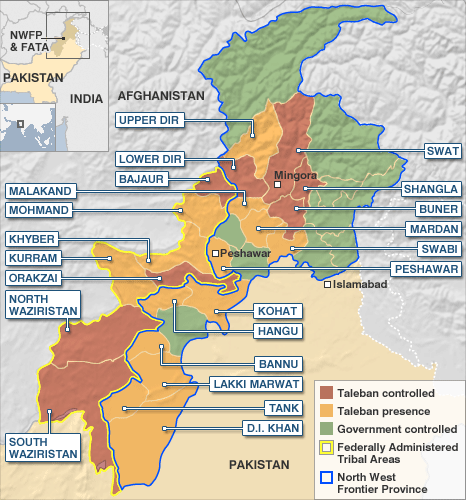
Research by the BBC Urdu’s service into the growing strength of Taleban militants in north western Pakistan shows that only 38% of the area remains under full government control.
Russia raised the prospect of war in the Arctic yesterday as nations struggle for control of the world’s dwindling energy reserves.
The country’s new national security strategy identified the intensifying battle for ownership of vast untapped oil and gas fields around its borders as a source of potential military conflict within a decade.
“The presence and potential escalation of armed conflicts near Russia’s national borders, pending border agreements between Russia and several neighbouring nations, are the major threats to Russia’s interests and border security,” stated the document, which analysed security threats up to 2020. [continued…]
A month after making public once-classified Justice Department memos detailing the Bush administration’s coercive methods of interrogation, President Obama yesterday chose secrecy over disclosure, saying he would seek to block the court-ordered release of photographs depicting the abuse of detainees held by U.S. authorities abroad.
Obama agreed less than three weeks ago not to oppose the photos’ release but changed his mind after viewing some of the images and hearing warnings from his generals in Iraq and Afghanistan that such a move would endanger U.S. troops deployed there.
“The publication of these photos would not add any additional benefit to our understanding of what was carried out in the past by a small number of individuals,” Obama said yesterday. “In fact, the most direct consequence of releasing them, I believe, would be to further inflame anti-American opinion and to put our troops in danger.” [continued…]
Editor’s Comment — The ACLU’s executive director, Anthony D. Romero, responded:
“The Obama administration’s adoption of the stonewalling tactics and opaque policies of the Bush administration flies in the face of the president’s stated desire to restore the rule of law, to revive our moral standing in the world and to lead a transparent government. This decision is particularly disturbing given the Justice Department’s failure to initiate a criminal investigation of torture crimes under the Bush administration.
“It is true that these photos would be disturbing; the day we are no longer disturbed by such repugnant acts would be a sad one. In America, every fact and document gets known – whether now or years from now. And when these photos do see the light of day, the outrage will focus not only on the commission of torture by the Bush administration but on the Obama administration’s complicity in covering them up. Any outrage related to these photos should be due not to their release but to the very crimes depicted in them. Only by looking squarely in the mirror, acknowledging the crimes of the past and achieving accountability can we move forward and ensure that these atrocities are not repeated.
“If the Obama administration continues down this path, it will betray not only its promises to the American people, but its commitment to this nation’s most fundamental principles. President Obama has said we should turn the page, but we cannot do that until we fully learn how this nation veered down the path of criminality and immorality, who allowed that to happen and whose lives were mutilated as a result. Releasing these photos – as painful as it might be – is a critical step toward that accounting. The American people deserve no less.”
If torture is an absolute wrong, whatever the circumstances, the question of its effectiveness is irrelevant. To hold the debate on those terms threatens to dilute the moral principle.
This leaves the question of why torture should be condemned absolutely, whereas other acts of war, such as bombing, which cause more damage to human life, might be acceptable as inevitable consequences of national defense.
Bombing can, of course, be a war crime if it is used as an act of terror against unarmed people. But military operations that kill or injure civilians often do not automatically qualify as crimes, as long as deliberately inflicting pain or humiliation on a helpless individual — even if he or she is an enemy — is not the aim. In the case of torture, that is the aim, which is why it is different from other acts of war.
A prominent US right-wing commentator recently opined that any attempt to hold the torturers, and their masters in the Bush administration, accountable, would make a mockery “of the efforts of the tough and brave Americans who guard us while we sleep.”
Aside from the fact that torturing people is not the same as combat and requires little bravery, this gets it exactly wrong. After years of torturing people in one of South America’s most savage “dirty wars,” Brazil’s generals decided to stop it because its institutionalized use was undermining the armed forces’ discipline and morale. It was making a mockery of men who should be tough and brave, but instead had become thugs. [continued…]
While the Obama administration has adopted large numbers of policies that directly contradict Cheney’s positions, it would be a mistake to overlook Cheney’s continued influence on the executive branch through the precedents set by the Bush administration. Among the former vice-president’s most important legacies is increased government secrecy. Obama’s Department of Justice continues to rely on an alleged “state secrets” privilege. It has thus tried to block lawsuits by victims who alleged they were kidnapped and tortured by U.S. intelligence even though they were innocent of wrongdoing, on the grounds that such trials would reveal state secrets. The same state secrets doctrine was used by Obama’s DOJ in an attempt to block investigations of Bush-Cheney warrantless wiretaps. Likewise, the DOJ has attempted to block lawsuits seeking the release of Bush-era e-mails and to prevent prisoners held at Bagram air base in Afghanistan from appearing before a judge to challenge their imprisonment. [continued…]
Here is a statement you will not hear today from Jerusalem: “I wish to declare that the government of Israel will not ask any nation, be it near or far, mighty or small, to recognize our right to exist.”
But it is a statement that was made in June 1977 by then-prime minister Menachem Begin. A sentimental nationalist of the highest order, Begin was nevertheless able to identify the only kind of recognition that Israel should require: “I re-emphasize that we do not expect anyone to request, on our behalf, that our right to exist in the land of our fathers, be recognized. It is a different recognition which is required between us and our neighbors: recognition of sovereignty and of the mutual need for a life of peace and understanding.”
A generation later, successive Israeli leaders have ignored Begin’s instruction and demanded, first, that the Palestinians recognize Israel’s right to exist (which the P.L.O. did, in 1993) and, more recently, that they recognize Israel as a Jewish state. [continued…]
Editor’s Comment — Yonatan Touval’s conclusion that for Israel to seek Palestinian recognition of Israel as a Jewish state risks letting the other define who you are, seems a somewhat implausible risk. After all, he’s already acknowledged that the demand is one which the Palestinians will not accept. And really that’s the point. This is not a recognition that Israelis in their wisdom would see they do not need; it is a demand whose very purpose is that it be refused.
Obama’s new budget plan includes a little-noted sea change in U.S. nuclear policy, and a step towards his vision of a denuclearized world. It provides no funding for the Reliable Replacement Warhead program, created to design a new generation of long-lasting nuclear weapons that don’t need to be tested. (The military is worried that a nuclear test moratorium in effect since 1992 might endanger the reliability of an aging US arsenal.) But this spring Obama issued a bold call for a world free of nuclear weapons, and part of that vision entails leading by example. That means halting programs that expand the American nuclear stockpile. For the past two budget years the Democratic Congress has refused to fund the Bush-era program. But Obama’s budget kills the National Nuclear Security Administration program once and for all.
“My colleagues just stared at that line,” says Joe Cirincione, a longtime nonproliferation expert and president of the Ploughshares Fund. “They had never seen anything like that.” Killing the program, he said, was “the first programmatic impact of the new [zero nukes] policy. People have said they want to see more than words, this is the very first action.” [continued…]
Chain reaction By Joseph Cirincione, Foreign Policy, May, 2009
Most of my nonproliferation colleagues think that having the United States help build a nuclear power reactor for the United Arab Emirates (UAE) is a great idea. I think it is a big mistake.
The U.S.-UAE civilian nuclear cooperation agreement was signed in the closing days of the George W. Bush administration and praised by advocates as a “model” for future agreements with Algeria, Libya, Saudi Arabia, and other states. President Barack Obama will have to decide in the next few weeks whether to send the deal to Congress for final approval. Wary of a repeat of the Dubai Ports World fiasco, the emirates have launched a $1.6 million lobbying campaign to bring U.S. lawmakers on board. They’ve enlisted many of my friends in the effort.
One former colleague, now a consultant for the UAE, sends me regular updates filled with good news about this multibillion-dollar deal. Her latest e-mail quotes an op-ed by Elliott Abrams, deputy national security advisor during the Bush administration, promising that the deal “will show the way forward in responsible, transparent uses of nuclear energy — at the very moment when the world must confront Iran’s defiance.” I remember Abrams’s assurances about the invasion of Iraq and cringe.
Maybe I’m wrong. It may well be that the leaders of a country the size of Maine that holds 4.8 million people and 98 billion barrels of oil (the fifth-largest reserves in the world and projected to last another 100 years) are truly interested in diversifying energy production. But 10, 20, or 30 years from now will they, or the governments that replace them, still honor their promises not to engage in any nuclear-weapon-related activities, including producing reactor fuel? Or, after they have developed nuclear technologies, trained nuclear scientists and engineers, and plugged into global nuclear markets, will they go one step further and build uranium enrichment and plutonium reprocessing plants that could be used to make fuel — or bombs? [continued…]
As Barack Obama heads into his second hundred days in office, let’s head for the big picture ourselves, the ultimate global plot line, the tumultuous rush towards a new, polycentric world order. In its first hundred days, the Obama presidency introduced us to a brand new acronym, OCO for Overseas Contingency Operations, formerly known as GWOT (as in Global War on Terror). Use either name, or anything else you want, and what you’re really talking about is what’s happening on the immense energy battlefield that extends from Iran to the Pacific Ocean. It’s there that the Liquid War for the control of Eurasia takes place.
Yep, it all comes down to black gold and “blue gold” (natural gas), hydrocarbon wealth beyond compare, and so it’s time to trek back to that ever-flowing wonderland — Pipelineistan. It’s time to dust off the acronyms, especially the SCO or Shanghai Cooperative Organization, the Asian response to NATO, and learn a few new ones like IPI and TAPI. Above all, it’s time to check out the most recent moves on the giant chessboard of Eurasia, where Washington wants to be a crucial, if not dominant, player.
We’ve already seen Pipelineistan wars in Kosovo and Georgia, and we’ve followed Washington’s favorite pipeline, the BTC, which was supposed to tilt the flow of energy westward, sending oil coursing past both Iran and Russia. Things didn’t quite turn out that way, but we’ve got to move on, the New Great Game never stops. Now, it’s time to grasp just what the Asian Energy Security Grid is all about, visit a surreal natural gas republic, and understand why that Grid is so deeply implicated in the Af-Pak war. [continued…]
Defense Secretary Robert Gates announced this afternoon that he has “asked for the resignation” of Gen. David McKiernan, commander of NATO forces in Afghanistan, and that he plans to replace him with Gen. Stanley McChrystal.
This is a very big deal.
McKiernan’s ouster signals a dramatic shift in U.S. strategy for the war in Afghanistan. And it means that the war is now, unequivocally, “Obama’s war.” The president has decided to set a new course, not merely to muddle through the next six months or so.
First, let’s clarify a few things. When a Cabinet officer asks for a subordinate’s resignation, it means that he’s firing the guy. This doesn’t happen very often in the U.S. military. McKiernan had another year to go as commander. (When Gen. George Casey’s strategy clearly wasn’t working in Iraq, President George W. Bush let him serve out his term, then promoted him to Army chief of staff.) Gates also made it clear he wasn’t acting on a personal whim. He said that he took the step after consulting with Gen. David Petraeus, commander of U.S. Central Command; Adm. Mike Mullen, chairman of the Joint Chiefs of Staff; and President Barack Obama. According to one senior official, Gates went over to Afghanistan last week for the sole purpose of giving McKiernan the news face-to-face. [continued…]
Gaza laid bare By Jason Larkin and Jack Shenker, Guernica, May, 2009
Israel’s air assault on Gaza began with attacks on the Strip’s main police stations, including one in Rafah’s densely populated Junaina neighborhood which left twenty-five officers dead. Over the course of the war, approximately two hundred and fifty civilian policemen would be killed and every major police office damaged or destroyed, according to figures provided by the Ministry of the Interior.
When it became clear that policemen were being targeted, officers were ordered to don plain clothes uniforms and continue their patrols carrying sticks rather than guns to avoid detection. Trestle-table desks were set up amidst the rubble of bombed police stations to maintain the administrative network of law enforcement in the Strip, and the thirteen thousand-strong police force continued to function. “We would not allow the Israeli aggression to bring chaos to our streets,” says Ihab Al-Ghusain, a spokesperson for the Ministry. “We simply made the best of what we had.”
The Geneva Convention stipulates that to be considered a legitimate military target, objects must contribute to military action. “Police were not combatants and could not represent legitimate targets unless actively engaged in hostilities,” claims Sarah Leah Witson, the Executive Director of Human Rights Watch.
There was no significant increase in theft or looting during the war, although several calls were made to an emergency police hotline reporting incidents of over-pricing by merchants. “We have a bad history of safety in Gaza,” says Mr. Al-Ghusain, “and as a result people here have suffered. In times of crisis, people need the reassurance of a working police force more than ever; we could have everything else, but without security we have nothing. That’s why it was so important to keep going.” [continued…] (Hat-tip to Mondoweiss.)
A period of high-level diplomacy on the Middle East opens in New York on Monday, promising further insights into an emerging strategy from Barack Obama’s administration that is already raising concerns among Israel’s supporters.
On Monday, King Abdullah of Jordan said the US was promoting a “57-state solution” in which the entire Muslim world would recognise Israel. But he also warned that the new US administration had little time, before fresh violence erupted, to promote a two-state solution to the conflict between Israel and the Palestinians. [continued…]
President Obama’s critical meeting with Binyamin Netanyahu next week has become the acid test for the Administration’s commitment to peace in the Middle East, King Abdullah of Jordan said yesterday.
The monarch does not conceal his feelings about the Israeli leader. He described their last encounter – 10 years ago when he had just come to the throne – as the “least pleasant” of his reign. But he, and President Mubarak of Egypt, are expected to meet the Israeli leader before his trip to Washington, where the future course of the region could be decided.
The King said that he was prepared to believe what Israelis have told him — that a right-wing Government in Israel is better able to deliver peace than the Left.
“All eyes will be looking to Washington,” he said. “If there are no clear signals and no clear directives to all of us, there will be a feeling that this is just another American Government that is going to let us all down.”
If Israel procrastinated on a two-state solution, or if there was no clear American vision on what should happen this year, the “tremendous credibility” that Mr Obama had built up in the Arab world would evaporate overnight. [continued…]
First of all, I want to apologize to all the good women who are engaged in the world’s oldest profession.
I recently described Shimon Peres as a political prostitute. One of my female readers has protested vigorously. Prostitutes, she pointed out, earn their money honestly. They deliver what they promise.
Israel’s president, on the other hand, only tells the truth by accident. He is a political impostor and a political sham. To him, too, apply Winston Churchill’s words about a former prime minister: “The right honorable gentleman sometimes stumbles upon the truth, but he always hurries on as if nothing has happened.” Or the words of former minister Amnon Rubinstein about Ariel Sharon: “He blushes when he tells the truth.” [continued…]
For all the talk of “smart power,” President Obama is pressing down the same path of failure in Pakistan marked out by George Bush. The realities suggest need for drastic revision of US strategic thinking.
Military force will not win the day in either Afghanistan or Pakistan; crises have only grown worse under the US military footprint.
The Taleban represent zealous and largely ignorant mountain Islamists. They are also all ethnic Pashtuns. Most Pashtuns see the Taleban — like them or not — as the primary vehicle for restoration of Pashtun power in Afghanistan, lost in 2001. Pashtuns are also among the most fiercely nationalist, tribalized and xenophobic peoples of the world, united only against the foreign invader. In the end, the Taleban are probably more Pashtun than they are Islamist.
It is a fantasy to think of ever sealing the Pakistan-Afghanistan border. The “Durand Line” is an arbitrary imperial line drawn through Pashtun tribes on both sides of the border. And there are twice as many Pashtuns in Pakistan as there are in Afghanistan. The struggle of 13 million Afghan Pashtuns has already enflamed Pakistan’s 28 million Pashtuns.
To American eyes the struggle raging in Pakistan with the Taliban is about religious fanaticism. But in Pakistan it is about an explosive fusion of Islamist zeal and simmering ethnic tensions that have been exacerbated by U.S. pressures for military action against the Taliban and its al-Qaeda allies. Understanding the ethnic dimension of the conflict is the key to a successful strategy for separating the Taliban from al-Qaeda and stabilizing multiethnic Pakistan politically.
The Pakistani army is composed mostly of Punjabis. The Taliban is entirely Pashtun. For centuries, Pashtuns living in the mountainous borderlands of Pakistan and Afghanistan have fought to keep out invading Punjabi plainsmen. So sending Punjabi soldiers into Pashtun territory to fight jihadists pushes the country ever closer to an ethnically defined civil war, strengthening Pashtun sentiment for an independent “Pashtunistan” that would embrace 41 million people in big chunks of Pakistan and Afghanistan.
This is one of the main reasons the army initially favored a peace deal with a Taliban offshoot in the Swat Valley and has resisted U.S. pressure to go all out against jihadist advances into neighboring districts. While army leaders fear the long-term dangers of a Taliban link-up with Islamist forces in the heartland of Pakistan, they are more worried about what they see as the looming danger of Pashtun separatism. [continued…]
As they waited in rows of empty white tents, refugees from fighting in the Swat Valley said Sunday that they had been repeating a Koranic verse from the sayings of the prophet Muhammad.
“He who recites this will receive my blessing and protection,” one woman read from a pamphlet in Arabic. “If he is hungry, he will find plentiful food. . . . If he has fear of a cruel ruler or enemy . . . the fear will be gone.”
The army has launched an offensive in Swat against armed Taliban extremists, and for now at least, there is enough food, water and shelter for the estimated 200,000 refugees who since Thursday have poured into four camps set up by the United Nations and the government of this northwest Pakistani city.
But there is a pervasive sense of loss and worry among the families that keep arriving in overcrowded farm trucks and rented vans. In interviews in two camps Saturday and Sunday, some refugees said their homes had been destroyed in the fighting. Others said they had to abandon their goats and cows. And some, in their rush to escape, even had to leave their children behind.
“When the shelling started, my wife and I ran out to gather the children. It was like a hell outside, and we just started running,” recounted Taj Mahmad, 35, a vegetable-cart puller. “I realized that my son and my smallest daughter were missing. She is only 3. But my wife cried and said the rest of us would be killed if we stayed, so we kept going. I have no idea what happened to them.” [continued…]
Three years ago in Jerusalem, I met a very bright couple in their late 40s, who had emigrated from Russia a decade earlier. When we began to speak of the Palestinians, the husband said: “In my Russian village in 1920, there was trouble with guerrillas. Budenny’s Cossacks came. They burnt the village from which the guerrillas came. The guerrillas returned twice more. The Cossacks burned two more villages. Then there was no more trouble with guerrillas.” This was the culture from which these two highly-educated Israelis came. They asserted that the Budenny method was the only proper one by which to address Hamas, Hizbollah and Fatah. The policies of recent Israeli governments suggest that their view is widely shared.
Between the late 1970s and 1990s, I was one of those foreigners who progressively fell out of love with Israel. I became persuaded that the arrogance of its faith in its own military power had induced its people to go far beyond a belief in defending their own society, to support a polity committed to perpetuating a great historic injustice against the Palestinians. Whatever government is in power in Jerusalem, there is a belief that peace with the Muslim world is unattainable; and thus that Israel must resign itself to a future dependent on its military capability rather than on negotiation. Associated with this is a belief that Jewish colonisation of the West Bank is a price the Palestinians must expect to pay for their refusal to make peace.
The most extraordinary, indeed nihilistic aspect of Israeli military policy towards the Palestinians is that it has sought to punish terrorism by deliberately wrecking the economic base of Palestinian society. On its own terms, this has succeeded. Today the only thriving industries in Palestinian territory are human reproduction, terrorism, and the propagation of grievances. The conditions in Gaza are, to us, almost unimaginable. Few have work. Most live in breezeblock barracks. From one year to the next they see nothing that is beautiful except the sea and sky. Hatred for their oppressors has become the only functioning engine of their society. People who have nothing have nothing to lose. [continued…]
The Israeli government and a coalition of settler organizations have been secretly cooperating to encircle Jerusalem’s Old City with a network of national parks, trails, cable cars, escalators, tunnels and other sites, a report released yesterday claimed.
The detailed secret plan, presented to former Israeli prime minister Ehud Olmert in September, has a stated purpose of creating “a sequence of parks surrounding the Old City” so as to “strengthen Jerusalem as the capital of the state of Israel.”
The confidential program, put together by the Jerusalem Development Authority (JDA) and sponsored by the Israeli Prime Minister’s Office and the mayor of Jerusalem, was revealed yesterday in a report by Ir Amim, a non-profit organization which promotes “an equitable and stable Jerusalem with an agreed political future.”
“The program is sponsored secretly by the Office of the Prime Minister and the Mayor of Jerusalem, not only without public discussion, but without the existence of the project even publicly known,” Ir Amim said in a statement. “The exposure of the program grants for the first time a comprehensive view of how the government and settlers, working as one body, are creating a ‘biblical’ territorial reign.” [continued…]
Waiting in line to drive through an army checkpoint on the leafy Shami Road of Lahore garrison, my driver hesitatingly utters: ‘Sir, can I ask you a question?’ ‘Yes sure,’ I tell him. ‘This is all a game isn’t it…. Ultimately they want to take away our nuclear weapons … don’t they sir?’
With military operations under way in Dir, Buner and Swat and the question coming from a retired infantry soldier who is now employed as my driver I assume the ‘they’ means the Taliban, the troublemakers, the Islamists, the militants, the rebels or some such. Still, to be sure I ask: who wants to take them away? ‘Why, the Americans, the Jews, the Indians of course. After all they are the ones funding the Taliban!’ he exclaims. I stare out of the windscreen and let my mind wander … to Islamabad, Constitution Avenue, to the information ministry. Do the folks there know how ordinary Pakistanis are thinking? [continued…]
In the Washington of the US president George W Bush, “the other war” was shorthand for Afghanistan; today, however, Iraq has inherited the Cinderella title. That shift is not simply a product of the hysteria fuelled over the past two weeks of the Obama administration predicting an apocalyptic collapse of Pakistan and scaring Americans with the spectre of a nuclear-armed Taliban. No, the US President Barack Obama has always made it clear that he believed Iraq had been “the wrong war” and, taking office at a moment when he hoped Iraq was on course to an acceptable outcome, he immediately recast the battle against the Taliban and al Qa’eda in the “Afghanistan-Pakistan” theatre as America’s strategic priority.
Obama plans to increase the US troop commitment in Afghanistan to some 64,000 soldiers by the summer and he hopes to find those reinforcements by bringing home more of the 134,000 troops currently in Iraq. The new military budget sent to Congress by the US Secretary of Defence, Robert Gates, for the first time seeks more money ($65 billion) for Afghanistan than it seeks for Iraq ($61 billion). “Af-Pak” as it is known, like the Israeli-Palestinian conflict, is the responsibility of a special envoy reporting directly to the president; the Iraq dossier is in the hands of a routine ambassador and a military commander reporting to Centcom chief Gen David Petraeus, whose top priority is the Af-Pak theatre. [continued…]
Sunni parliamentarian Salim al-Jubouri took Muqtada al-Sadr’s recent appearance in Turkey as a good sign. Sadr surfaced in Ankara ostensibly to discuss the situation in Iraq with top Turkish leaders, including President President Abdullah Gul and Prime Minister Recep Tayyip Erdogan. Turkey is a predominantly Sunni country, many observers noted, and maybe the militant Shi’ite warlord was making a show of nascent sectarian reconciliation. “The attitude is good,” says al-Jubouri, a member of the Sunni political bloc known in Arabic as Tawafiq. “But so far it’s all talk, we need to see actions.”
All talk indeed. Sadr’s visit to Turkey a week ago, his first public appearance in nearly two years, has renewed talk in Baghdad about what his plans might be in the months and years ahead. “I think Sadr picked Turkey to show himself in order to prove that he’s against sectarianism… and to try and kill the rumor that he is an Iranian toy,” says Tahseen al-Shekhli, a spokesman for the Iraqi government, which gained the upper hand over Sadr’s Mahdi Army forces in heavy fighting last year. Sadr’s followers, for their part, are notably reticent on the subject. Several figures prominent in Sadr’s political ranks refused to discuss the topic when contacted by TIME. That has left some in Iraq revisiting an old question that no one so far seems to be able to answer well: Where is Sadr living, and what is he planning next? [continued…]
As President Obama prepared last month to release secret memos on the CIA’s use of severe interrogation methods, the White House fielded a flurry of last-minute appeals.
One came from former CIA Director Michael V. Hayden, who expressed disbelief that the administration was prepared to expose methods it might later decide it needed.
“Are you telling me that under all conditions of threat, you will never interfere with the sleep cycle of a detainee?” Hayden asked a top White House official, according to sources familiar with the exchange.
From the beginning, sleep deprivation had been one of the most important elements in the CIA’s interrogation program, used to help break dozens of suspected terrorists, far more than the most violent approaches. And it is among the methods the agency fought hardest to keep. [continued…]
Psychologists versed in the military’s Survival, Evasion, Resistance and Escape “SERE” program, which was meant to train American soldiers how to cope with torture if captured by the enemy, warned officials as early as 2002 that reverse-engineering SERE techniques for use on detainees could be ineffective and dangerous, a Senate Armed Services Committee report [3] revealed last week. What has been little noticed is that the same psychologists helped develop the very interrogation policies and practices they warned against.
The new information re-opens a number of questions that have tugged at the conscience of a whole profession since the Sept. 11 attacks. Is it possible for psychologists to uphold the ethical tenets of their profession while working within a system of interrogation that violates those tenets? Does it matter if they raised objections to the system of interrogation but cooperated with it anyway?
The moral dilemma is encapsulated in the experiences of a psychiatrist and psychologist who worked at the U.S. military prison at Guantánamo Bay, Cuba. According to the Senate report, in an Oct. 2, 2002, memo they prepared a list of harsh interrogation techniques that ended up influencing interrogation policy not only at Guantánamo, but also in Afghanistan and Iraq. In the same memo, they warned that these methods were likely to result in inaccurate tips and could harm detainees. Those warnings disappeared as the memo moved up the chain of command. [continued…]
The Obama administration is preparing to revive the system of military commissions established at Guantanamo Bay, Cuba, under new rules that would offer terrorism suspects greater legal protections, government officials said.
The rules would block the use of evidence obtained from coercive interrogations, tighten the admissibility of hearsay testimony and allow detainees greater freedom to choose their attorneys, said the officials, who spoke on the condition of anonymity because they were not authorized to speak publicly.
The military commissions have allowed the trial of terrorism suspects in a setting that favors the government and protects classified information, but they were sharply criticized during the administration of President George W. Bush. “By any measure, our system of trying detainees has been an enormous failure,” then-candidate Barack Obama said in June 2008. [continued…]
A stockpile of documents about hundreds of Guantanamo Bay detainees, some written by the prisoners themselves, could be destroyed under a little-known provision of a federal court order the Bush administration obtained in 2004.
For four years, records in the prisoners’ habeas corpus lawsuits challenging the legality of their detentions have been piling up in a secure federal facility in the Crystal City neighborhood of Arlington, Va. Because much of the information is classified, the 750 or so attorneys representing the prisoners are required to do and store all their work on-site.
The provision is part of a broad order [1] (PDF) issued at the very outset of the habeas cases — at the last official count in January, 220 cases remained — that set rules for how sensitive documents and attorney access should be handled. It calls for the government to destroy all classified records given to, prepared by or kept by prisoners’ lawyers — including originals and copies of writings, photographs, videotapes, computer files and voice recordings — when the cases end. [continued…]
The reported detention of a member of the United Arab Emirates royal family, Sheikh Issa bin Zayed al Nahyan, in connection with the videotaped torture of an Afghan grain dealer is a significant development, but much more needs to be done to restore faith in the country’s police and justice system, Human Rights Watch said today.
UAE officials told American diplomats that the sheikh was put under “house arrest” this week and prevented from leaving the country as the Ministry of Justice conducts a criminal investigation of the incidents on the videotape, ABC News reported today. The government has not released any information about the detention.
“The videotape of this episode shocked the world,” said Sarah Leah Whitson, Middle East director at Human Rights Watch. “The report of the arrest was reassuring, but now the government needs to make the details public. Secretive prosecutions will not deter further abuses and torture.” [continued…]
Pakistan’s offensive against the Taliban has forced a million people to flee their homes, the United Nations said.
Air strikes rocked Mingora, the main town in the Swat Valley, on Friday as the armed forces pressed ahead with the latest assault designed to clear the area of Taliban insurgents who have claimed swathes of the country in recent months.
The latest assessment from the UN High Commission for refugees laid bare the scale of the fighting. The UN said that 200,000 civilians have already fled the Swat Valley and two neighbouring districts, while another 300,000 are either on the move or preparing to leave. Earlier offensives against the Taliban in other regions of the rugged North West Frontier Province near the Afghan border displaced another 500,000 people, bringing the total number displaced by the offensives to a million. [continued…]
Most displaced people say they have left their homes not because of the Taleban’s excesses, but because of shelling by the army.
“The Taleban captured our area and started patrolling the streets, they snatched vehicles from NGO staff, government officials and private individuals, and they threatened local people,” says Nasir Ali, a high school student.
“But it wasn’t as bad as the shelling by the army – that was what actually forced us to leave our homes.”…
I interviewed a large number of refugees in Swabi, but I did not meet a single person who actually saw the army and the Taleban as members of opposing camps.
Instead, I heard, they were “two sides of the same coin”.
“The Pakistani army has hurt us badly – but while they have killed civilians, I swear I haven’t seen a single shell directed at the Taleban,” says Shahdad Khan, a refugee sheltering at a camp in Swabi’s Shave Ada area.
Others question the Pakistani military’s stated commitment to “eliminating” the Taleban.
“No way,” Siraj tells me.
“The army brought the Taleban to our area! It’s politics. The Taleban and the army are brothers.” [continued…]
On May 4, 1999, Husain Haqqani was yanked off a Pakistani street and bundled into a car, a blanket thrown over his head. He managed to keep his cellphone hidden in his pocket, and surreptitiously dialed a friend’s number to let her know he was in trouble.
That may have saved his skin, said Mr. Haqqani, now Pakistan’s ambassador to the United States. The news of his detention made it harder for his captors, Pakistani intelligence agents, to hurt him, Mr. Haqqani said, though he was roughed up and kept in jail for two months until a court ordered his release.
As the Obama administration struggles with another darkening crisis in Pakistan, Mr. Haqqani has become an influential figure in Washington — a silver-tongued interpreter in public of his country’s bewildering politics, but also a relentless, unyielding defender of Pakistan’s image and reputation….
Since moving to the United States, Mr. Haqqani has developed an affinity for American culture. He taught international relations at Boston University from 2004 to 2008, and he roots for the Red Sox. The American experience has only added to suspicions about him back in Pakistan.
“They see him more as a U.S. envoy than a Pakistani envoy,” said Mowahid Hussain Shah, a Pakistani lawyer. “They see him as someone who is competent and bright, but slick.”
Mr. Haqqani readily admits shifting his allegiances over the years. But he denies being an opportunist, saying he underwent a personal journey from being an Islamic activist in his youth to a conservative supporter of Mr. Sharif to an acolyte of the populism of the Bhutto clan. [continued…]
Afghan President Hamid Karzai on Friday called on the United States to halt air strikes in his country, following attacks this week that Afghan officials said killed 147 people.
“We demand an end to these operations … an end to air strikes,” Karzai said in Washington in an interview with CNN.
Farah Province deputy governor Yunus Rasooli told Reuters on Friday that residents of two villages hit this week by U.S. warplanes had produced lists with the names of 147 people killed in the attacks. [continued…]
The cost of fighting the war in Afghanistan will overtake that of the Iraq conflict for the first time in 2010, Pentagon budget documents showed Thursday.
On top of the basic defense budget of 533.7 billion dollars, the White House is requesting a further 130 billion dollars for overseas missions, including 65 billion for Afghanistan and 61 billion for Iraq.
“This request is where you’re going to first see the swing of not only dollars or resources, but combat capability, from the Iraqi theater into the Afghan theater,” Navy Vice Admiral Steve Stanley, director of force structure for the US Joint Chiefs of Staff, told reporters. [continued…]
Israel has always believed in “creating facts on the ground,” whose existence may later come as an unpleasant surprise to others. Iran now seems to have learned from this Israeli precedent, to Israel’s disadvantage.
In diplomatic circles, in Europe as well as the Arab states, there has been discussion of the possibility of Iran’s being designated a “civil nuclear power,” exercising its right, under the Nonproliferation Treaty (which it has signed), to develop power for civilian uses.
This is what Iran has persistently claimed to be all it wants. The proposal goes on to say that whatever military work Iran has done is already faits accomplis—“created facts,” that are useless to contest. [continued…]
Pakistan declared war on its homegrown Islamic extremists Thursday in a dramatic move that could trigger a wider conflagration.
Prime Minister Yousuf Raza Gilani, in a late-night televised address to the nation, said Pakistan would launch a full-scale offensive against Pakistani Taliban guerrillas who’ve seized control of the vast Swat valley, which is about 100 miles north of the capital.
Pakistan will no longer “bow our heads before the terrorists,” Gilani said in an 11 p.m. address as he called on citizens to rally behind the armed forces. He said that the government had tried peaceful negotiation with Taliban entrenched in the Swat valley, but the strategy hadn’t worked.
Pakistan had “reached a stage where the government believes that decisive steps have to be taken,” he said, and the army’s job now was to “eliminate the militants and the terrorists.”
Thousands of civilians have fled from Swat and neighboring districts in the fighting between the army and militants in the past week, but hundreds of thousands are unable to move and could be caught in the crossfire. Gilani appealed to the international community for humanitarian aid. [continued…]
Socio-economic disparities run rampant, and corruption, classism and an entrenched feudal system all but ensure that the poor – more than 30 percent of Pakistan’s 170 million citizens, according to the World Bank – remain poor and marginalized.
Nine percent of Pakistanis lack access to clean water, according to the UN, and 38 percent of Pakistani children are underweight. Bonded labor continues unhindered in the most densely populated provinces of Punjab and Sindh.
Given the little that Pakistani governments, both civilian and military, have provided by way of land reform, education, health care and equitable justice over the past few decades, it’s not entirely surprising that an alternative – any alternative – holds appeal for Pakistan’s lower classes and peasantry. The Taliban in Swat have forced wealthy landowners out, and, in an ersatz land reform, passed the abandoned plots to the tenants who manned them. [continued…]
The conservative view held by many Islamist parties, populist politicians, retired army brass and hyper-nationalistic television anchors is that the Taliban are a reflection of the people’s desire for an Islamic system of governance, with quick justice, order and compliance with God’s will as the hallmarks of public life. Proponents of this view maintain that the excesses of the Taliban are greatly exaggerated, and that the real threat to Pakistan is from the US, which has destabilized the whole region with its Afghan war and its drone attacks on Pakistan. According to this view, the real aim of the US is to undermine Pakistan’s sovereignty and deprive it of its cherished nuclear weapons. To date, the conservatives have been more vocal, and gained more traction with the Pakistani public – drowning out the concerns about the Taliban by pointing fingers at George Bush, the US and India.
On the other side are people derided as “Liberals” and “Western apologists” by the conservatives. These liberals, many of them western educated, secular and belonging to the professional urban classes, have been reminding whoever will listen that while Pakistan is a Muslim majority country, it was created as a constitutional republic with the ideals of an independent judiciary, a parliamentary system of government, and representative democracy. Liberals argue that letting parts of the country become theocratic enclaves run by armed gangs of religious extremists undermines the ideals on which Pakistan was built, threatens its territorial integrity and is a recipe for disaster. Liberals insist that the Taliban, and their policy of “Islamicization at gun point” is the real threat to Pakistan, not India or the United States.
Which narrative ultimately prevails is crucial to Pakistan’s future because it determines whether the people of Pakistan see the fight against the Taliban and extremism as their own fight, or whether they will continue to see it as a US manufactured Global War on Terror into which Pakistan has been sucked. If Pakistanis see the fight in Swat as their own, then there will be public support for a continuing military offensive, there will be more latitude given to the bumbling civilian government of Asif Zardari, and there may even be some tolerance for the drone attacks which normally cause deep resentment among Pakistanis. But if the dominant narrative in Pakistan continues to be that Pakistanis are victims of global conspiracies, that the Taliban threat is exaggerated, and that Pakistan should have no part in fighting “America’s war”, then the military will most likely be forced to sign a truce with the Taleban, the civilian government will probably collapse under the weight of its unpopularity, and Talibanization will continue unchecked, one district at a time. [continued…]
Israel is under siege. More precisely, Binyamin Netanyahu’s government faces excruciating pressure on all sides as showdown talks loom with Barack Obama in Washington on 18 May. Circling the wagons will not work this time. Israel’s prime minister needs a breakout plan – and the outlines of his coming counter-offensive are taking shape.
The intensifying push to finally resolve the Arab-Israeli conflict, and not just the Palestinian issue, stems partly from the dangerously unfinished business of January’s shocking Gaza carnage. More broadly, it is driven by the hopes of a new administration in Washington and the spectre of a nuclear-armed Iran.
Now Netanyahu is receiving much the same free advice from all directions. Drop your opposition to a two-state solution with Palestine and you will unlock a wider Middle East peace, said Angela Merkel, Germany’s chancellor, this week, backed by EU policy chief Javier Solana. Accept you must relinquish the Golan Heights and anything is possible, said in-from-the-cold Bashar Assad, Syria’s president, backed by Egypt and the Saudis. [continued…]
It is unclear whether the U.S. assistant secretary of state’s call to Israel to sign on to the nuclear Non-Proliferation Treaty indicates a change in Washington’s policy toward Israel’s nuclear program, or even if the move was anticipated by the White House.
It is clear, however, that where there’s smoke, there’s fire. The U.S. has been protecting Israel for years, creating a diplomatic umbrella and pushing away any attempt, in any international debate, to discuss the nuclear weapons the entire world believes Israel possesses. [continued…]
A new national poll indicates that most Americans don’t want to see an investigation of Bush administration officials who authorized harsh interrogation techniques on suspected terrorists, even though most people think such procedures were forms of torture.
Six in ten people questioned in a CNN/Opinion Research Corporation survey released Wednesday believe that some of the procedures, such as water boarding, were a form of torture, with 36 percent disagreeing.
But half the public approves of the Bush administration’s decision to use of those techniques during the questioning of suspected terrorists, with 50 percent in approval and 46 percent opposed. [continued…]
Editor’s Comment — We live in a hit-and-run-move-on-forward-looking-don’t-look-back-pick-yourself-up-no-regrets culture. Investigate torture? Heck no! That’s the past and the past is the stuff we leave behind. We live in the future — haven’t got there yet, but it’s sure to be good. Mustn’t let anything spoil that American dream.
Since August 2002, nearly 100 detainees have died while in the hands of U.S. officials in the global “war on terror.” According to the U.S. military’s own classifications, 34 of these cases are suspected or confirmed homicides; Human Rights First has identified another 11 in which the facts suggest death as a result of physical abuse or harsh conditions of detention. In close to half the deaths Human Rights First surveyed, the cause of death remains officially undetermined or unannounced. Overall, eight people in U.S. custody were tortured to death. [continued…]
Perhaps the most macabre case occurred in Iraq, which was documented in a Human Rights First report in 2006.
“Nagem Sadoon Hatab… a 52-year-old Iraqi, was killed while in U.S. custody at a holding camp close to Nasiriyah,” the group wrote. “Although a U.S. Army medical examiner found that Hatab had died of strangulation, the evidence that would have been required to secure accountability for his death – Hatab’s body – was rendered unusable in court. Hatab’s internal organs were left exposed on an airport tarmac for hours; in the blistering Baghdad heat, the organs were destroyed; the throat bone that would have supported the Army medical examiner’s findings of strangulation was never found.” [continued…]
In internal Justice Department inquiry has concluded that Bush administration lawyers committed serious lapses of judgment in writing secret memorandums authorizing brutal interrogations but that they should not be prosecuted, according to government officials briefed on its findings.
The report by the Office of Professional Responsibility, an internal ethics unit within the Justice Department, is also likely to ask state bar associations to consider possible disciplinary action, which could include reprimands or even disbarment, for some of the lawyers involved in writing the legal opinions, the officials said.
The conclusions of the 220-page draft report are not final and have not yet been approved by Attorney General Eric H. Holder Jr. The officials said that it is possible that the final report might be subject to further revision but that they did not expect major alterations in its main findings or recommendations. [continued…]
When he first got word of Israel’s sneak attack on the Iraqi atomic reactor in 1981, U.S. President Ronald Reagan privately shrugged it off, telling his national security adviser: “Boys will be boys!”
Would Barack Obama be so sanguine if today’s Israelis made good on years of threats and bombed Iran’s nuclear facilities, yanking the United States into an unprecedented Middle East eruption that could dash his goal of easing regional tensions through revived and redoubled U.S. outreach?
For that matter, would Israeli Prime Minister Benjamin Netanyahu readily take on Iran alone, given his country’s limited firepower and the risk of stirring up a backlash against the Jewish state among war-weary, budget-strapped Americans?
Obama is no Reagan. And many experts believe the two allies are now so enmeshed in strategic ties — with dialogue at the highest level of government and military — that complete Israeli autonomy on a major issue like Iran is notional only. [continued…]
When Shimon Peres met with U.S. President Barack Obama at the White House Tuesday, the White House had to walk a fine line: Honor the president of a close U.S. ally, but don’t make overmuch of the visit of a figurehead who has publicly supported the Middle East peace process and was granted a meeting at the White House before Israel’s prime minister, Benjamin Netanyahu, who has opposed it. (Netanyahu is being invited to the White House later this month, along with the presidents of Egypt and the Palestinian Authority).
So, while the White House made no secret of the Peres-Obama meeting, there was no press conference featuring the two leaders in the Oval Office; just a chance to catch photos and a few comments from Peres as he departed the White House meeting and a one-paragraph readout of their visit on WhiteHouse.gov. [continued…]
The most important thing is what Hamas is doing and the policies it is adopting today. The world must deal with what Hamas is practicing today. Hamas has accepted the national reconciliation document. It has accepted a Palestinian state on the 1967 borders including East Jerusalem, dismantling settlements, and the right of return based on a long term truce. Hamas has represented a clear political program through a unity government. This is Hamas’s program regardless of the historic documents. Hamas has offered a vision. Therefore, it’s not logical for the international community to get stuck on sentences written 20 years ago. It’s not logical for the international community to judge Hamas based on these sentences and stay silent when Israel destroys and kills our people. [continued…]
Editor’s Comment — When Hamas offers Israel a ten-year truce, the general response seems to be: what kind of an offer is that? Ten years to arm and plot is no peace. But just consider the history of Israel. In sixty years, ten years without war is more than any Israeli leader has been capable of or willing to offer. Ten years without war would provide a better foundation for long-term peace than Israel has ever known.
A misdirected US air strike has killed as many as 120 Afghans, including dozens of women and children. The attack is the deadliest such bombing involving civilian casualties so far in the eight years since the US-led invasion of Afghanistan.
Families in two villages in Farah province in western Afghanistan were digging for bodies in the ruins of their mudbrick houses yesterday. “There were women and children who were killed,” said Jessica Barry, a Red Cross spokeswoman. “It seemed they were trying to shelter in houses when they were hit.” Survivors said the number of dead would almost certainly to rise as the search for bodies continued.
The killing of so many Afghan civilians by US aircraft is likely to infuriate Afghans and lead to an increase in support for the Taliban in the bombed area. President Hamid Karzai, who was meeting President Barack Obama in Washington yesterday, sent a joint US-Afghan delegation to investigate the incident. The US Secretary of State Hillary Clinton, standing next to Mr Karzai, voiced her “deep regret”. [continued…]
Hajji Karim and his extended family of 70 were camped in a dirt-floor stable 10 miles outside Islamabad, the Pakistani capital. It was as far as they could get from the Swat Valley, where thousands of people are fleeing from the ravages of the Taliban and the imminent prospect of war with government forces.
When Taliban fighters first entered Karim’s village last month, he recounted, they said they had come to bring peace and Islamic law, or sharia, to Swat. But the next day, two of the fighters dragged a policeman out of his truck and tried to slit his throat. Horrified, a crowd rushed over, shouting and trying to shield the officer. The fighters let him go, but the incident confirmed the villagers’ worst suspicions.
“We all said to each other, what sort of people have come here? And what kind of sharia is this? Cutting off people’s heads has nothing to do with Islam,” recounted Karim, 55, a bus driver. “The people were filled with great rage, and great fear.”
Authorities in North-West Frontier Province said that with the conflict intensifying, they expect half a million people to flee the once-bucolic Swat region near the Afghan border, much of which is now occupied by heavily armed militants. Officials announced Tuesday that they plan to open six refugee camps in the safer nearby districts of Swabi and Mardan, but until then, many who leave home to escape the violence are facing the arduous task of finding their own shelter. [continued…]
In a highly unusual reversal, the Defense Department’s inspector general’s office has withdrawn a report it issued in January exonerating a Pentagon public relations program that made extensive use of retired officers who worked as military analysts for television and radio networks.
Donald M. Horstman, the Pentagon’s deputy inspector general for policy and oversight, said in a memorandum released on Tuesday that the report was so riddled with flaws and inaccuracies that none of its conclusions could be relied upon. In addition to repudiating its own report, the inspector general’s office took the additional step of removing the report from its Web site.
The inspector general’s office began investigating the public relations program last year, in response to articles in The New York Times that exposed an extensive and largely hidden Pentagon campaign to transform network military analysts into “surrogates” and “message force multipliers” for the Bush administration. The articles also showed how military analysts with ties to defense contractors sometimes used their special access to seek advantage in the competition for contracts related to Iraq and Afghanistan. [continued…]
At the web site of the neoconservative magazine, Commentary, Michael B Oren (who is in line to become Israel’s next ambassador to the United States) moves away from the standard position on existential threats to Israel. Seeing an array of existential threats, Oren says that among those, that posed by a nuclear-armed Iran would itself constitute “not one but several existential threats.” Even so, he does not see the risk of Israel being wiped off the map as preeminent among the dangers Israel faces.
This is where Oren locates the greatest threat to Israel’s survival:
Recent years have witnessed the indictment of major Israeli leaders on charges of embezzlement, taking bribes, money laundering, sexual harassment, and even rape. Young Israelis shun politics, which are widely perceived as cutthroat; the Knesset, according to annual surveys, commands the lowest level of respect of any state institution. Charges of corruption have spread to areas of Israeli society, such as the army, once considered inviolate.
The breakdown of public morality, in my view, poses the greatest single existential threat to Israel. It is this threat that undermines Israel’s ability to cope with other threats; that saps the willingness of Israelis to fight, to govern themselves, and even to continue living within a sovereign Jewish state. It emboldens Israel’s enemies and sullies Israel’s international reputation. The fact that Israel is a world leader in drug and human trafficking, in money laundering, and in illicit weapons sales is not only unconscionable for a Jewish state, it also substantively reduces that state’s ability to survive.
When it comes to Oren’s remedy, he sounds less than convincing:
…corruption must be rooted out through a revival of Zionist and Jewish values. These should be inculcated, first, in the schools, then through the media and popular culture. The most pressing need is for leadership.
Perhaps there’s another route — one that’s presumably compatible with Jewish values yet can make no claim to being specifically Judaic: the promotion of public integrity.
Corruption is the most glaring expression of a conflict between words and actions. The gap that separates what Israel’s leaders say from what they do is what renders their utterances worthless. But although such leaders are viewed with cynicism by those who have witnessed how deeply ingrained this lack of integrity has become, that cynicism can easily be washed away if promises are fulfilled through actions.
While Israel’s pathological political culture has been shaped by many powerful internal forces there has also been for many decades an external enabler: the United States.
Having previously given Israel’s leaders a free pass, the US could, if it chose, help break the cycle of corruption.
From an unexpected quarter an opportunity is now emerging through which Israel could reclaim some international faith in the value of its word.
Israel’s US-enabled policy of “nuclear ambiguity” has frayed beyond repair. A policy which was never anything more than a bargain of deceit does nothing more than give Israel an excuse for excluding itself from an international debate within which its unacknowledged nuclear arsenal is a central factor.
Now, the Obama administration’s top arms control negotiator, Assistant Secretary of State Rose Gottemoeller, has effectively declared that the era of nuclear ambiguity is over and that Israel’s nuclear arsenal cannot forever remain outside the regime of the nuclear non-proliferation treaty.
“Universal adherence to the NPT itself, including by India, Israel, Pakistan and North Korea … remains a fundamental objective of the United States,” Gottemoeller said at the UN on Tuesday.
Former prime minister Ariel Sharon’s chief strategist, Dov Weisglass, said Gottemoeller’s comments were very alarming.
“If these statements indicate a change in American policy on this issue, I believe this may be the most worrisome development for Israel’s security in many years,” he told Army Radio.
Ms. Gottemoeller endorsed the concept of a nuclear-free Middle East in a 2005 paper that she co-authored, “Universal Compliance: A Strategy for Nuclear Security.”
“Instead of defensively trying to ignore Israels nuclear status, the United States and Israel should proactively call for regional dialogue to specify the conditions necessary to achieve a zone free of nuclear, chemical, and biological weapons,” she wrote.
The paper recommends that Israel take steps to disarm in exchange for its neighbors getting rid of chemical and biological weapons programs as well as Iran forgoing uranium enrichment.
If soon-to-be ambassador Oren is serious about reversing Israel’s problem with corruption, maybe he needs to put into practice the art of political leadership and press Prime Minister Netanyahu to take a bold political initiative by bringing Israel out of the nuclear closet.
Is this likely to happen? Hardly. Why? Because Israel does not perceive Iran so much as an existential threat as much as a strategic threat to its regional military dominance.
Entering the NPT and eventually disarming would not threaten Israel’s existence but would destroy its privileged status as a rogue nation able to resist international pressure.
If Obama really wants to sharpen his challenge to Netanyahu when they meet later this month, perhaps who can present him with this choice: keep your nuclear arsenal and learn how to live with a nuclear Iran, or, sign up for the creation of a non-nuclear Middle East. Nukes or no nukes. Which do you want?
A site that focuses so heavily on so much grim news from around the world needs once in a while to offer some inspiration. Here’s some from Mark Johnson, the creator of Playing for Change, whose goal is to unite people around the world through music — music performed by diverse and widely scattered musicians who listen to each other from afar and play together, their latest offering being a delightful Indian folk song: Chanda Mama…
Pakistan’s diverse and dysfunctional leadership inhibits U.S. policymaking. The visit to Washington this week by the increasingly isolated President Zardari might only confirm the problem. The enigmatic military leader Gen. Ashfaq Kayani seems unwilling to work closely with Zardari. Kayani is not accompanying his president to the United States. The traditional template of Pakistan’s military and bureaucratic elite providing stability regardless of the country’s shifting political leadership appears no longer valid.
The United States is planning more aid for the Pakistan military, particularly for forces capable of operating against the Taliban rather than confronting India. Economic aid for social and educational spending is also planned, but at a projected $1.5 billion a year, it is likely to have little impact in a country of 176 million people. Measures to secure Pakistan’s nuclear weapons and manufacturing facilities also need to be considered. The destruction or seizure of this arsenal by U.S. special forces is increasingly being perceived as a necessary part of Washington’s planning rather than a fanciful option. [continued…]
Editor’s Comment — Whatever planning the Pentagon has already engaged in with a view to securing Pakistan’s nuclear arsenal (a difficult task considering there’s no evidence that anyone outside Pakistan knows all the locations), it’s reasonable to assume that plenty of planning has already been done on the Pakistani side — both official military planning and likely some clandestine planning on the part of factions who would want to thwart US plans at all possible costs. For that reason, there is a definite risk that a US operation could be the catalyst for triggering the very eventuality it is designed to prevent: the transfer of nuclear materials to jihadist groups.
One only needs to consider A.Q. Khan’s stature as a national hero in Pakistan to get a sense of the devastating impact on the Pakistani military’s domestic standing in the event that the country’s nuclear arsenal was impounded by foreign forces. Rather than face that humiliation, it’s easy to see how patriotic fervor could motivate the transfer of a few “bargaining chips” to groups or individuals seen as a bulwark against foreign interference.
In a way, however, you really have to know only one fact to understand what is happening: and that, to judge by my meetings with hundreds of Pakistanis from all walks of life over the past nine months, is that the vast majority of people believe that the 9/11 attacks were not an act of terrorism by al-Qaeda, but a plot by the Bush Administration or Israel to provide an excuse to invade Afghanistan and dominate the Muslim world.
It goes without saying that this belief is a piece of malignant cretinism, based on a farrago of invented “evidence” and hopelessly warped reasoning, but that is not the point. The point is that most of the Pakistani population genuinely believe it, even here in Sindh where I have been travelling for the past week; and the people who believe it include the communities from which the army’s soldiers, NCOs and junior officers are drawn. Understand this, and much else falls into place.
After all, if British soldiers strongly believed that the war in Afghanistan was the product of a monstrous American lie, involving the deliberate slaughter of thousands of America’s own citizens, would they be willing for one moment to risk their lives fighting the Taleban?
All the same, it is important not to exaggerate the extent of Taleban power. Whatever Hillary Clinton, the US Scretary of State, may say, there is no possibility at present of the Taleban seizing Islamabad and bringing down the state. In Punjab, the province with a majority of the country’s population, there have been a number of serious terrorist attacks and a growth of Taleban influence, but as yet, nothing like the insurgency occurring among the Pashtun tribes. In the interior of Sindh, support for the Taleban is virtually non-existent. [continued…]
President Obama is pouring more than 20,000 new troops into Afghanistan this year for a fighting season that the United States military has called a make-or-break test of the allied campaign in Afghanistan.
But if Taliban strategists have their way, those forces will face a stiff challenge, not least because of one distinct Taliban advantage: the border between Afghanistan and Pakistan barely exists for the Taliban, who are counting on the fact that American forces cannot reach them in their sanctuaries in Pakistan.
One Pakistani logistics tactician for the Taliban, a 28-year-old from the country’s tribal areas, in interviews with The New York Times, described a Taliban strategy that relied on free movement over the border and in and around Pakistan, ready recruitment of Pakistani men and sustained cooperation of sympathetic Afghan villagers. [continued…]
The Pakistani army’s assault against Islamic militants in Buner, in northwest Pakistan, is flattening villages, killing civilians and sending thousands of farmers and villagers fleeing from their homes, residents escaping the fighting said Monday.
“We didn’t see any Taliban; they are up in the mountains, yet the army flattens our villages,” Zaroon Mohammad, 45, told McClatchy as he walked with about a dozen scrawny cattle and the male members of his family in the relative safety of Chinglai village in southern Buner. “Our house has been badly damaged. These cows are now our total possessions.”
Mohammad’s and other residents’ accounts of the fighting contradict those from the Pakistani military and suggest that the government of President Asif Ali Zardari is rapidly losing the support of those it had set out to protect. [continued…]
Pakistan is on the brink of chaos, and Congress is in a critical position: U.S. lawmakers can hasten that fateful process, halt it or even help turn things around. The speed and conditions with which Congress provides emergency aid to Islamabad will affect the Pakistani government and army’s ability and will to resist the Taliban onslaught. It will also affect America’s image in Pakistan and the region. Pakistanis are looking for evidence of the long-term U.S. commitment about which President Obama has spoken.
Since Obama announced his strategic review of U.S. policy on Afghanistan and Pakistan, worsening conditions here have nudged Afghanistan from the top of his foreign policy agenda. Pakistanis are beset by a galloping Taliban insurgency in the north that is based not just among Pashtuns, as in Afghanistan, but that has extensive links to al-Qaeda and jihadist groups in Punjab, Sindh and Baluchistan. [continued…]
The U.S. military today denied the allegation made in this Al Jazeera piece that evangelical chaplains are urging U.S. toops in Afghanistan to protelytize for Christianity:
The reporting here does seem a little dodgy. The piece implies that this line from a U.S chaplain’s sermon is a violation of U.S. policy:
“The special forces guys – they hunt men basically. We do the same things as Christians, we hunt people for Jesus. We do, we hunt them down.”
But it’s not at all clear that this refers to converting Afghans and this seems like a line that one could hear in any evangelical sermon in the United States. None of the officers “caught on camera” in the segment ever actually instruct troops to proselytize, in fact the only discussion of the practice is about how it’s against military rules. [continued…]
Editor’s Comment — This would be a radically different story if Al Jazeera had been interviewing Afghan villagers who’d had these Pasto bibles thrust into their hands, but all we know at this point is that they landed in the hands of evangelical American soldiers. A more interesting story would be the one here untold: the one about the moronic American evangelists who make it their business not only to translate bibles for people who don’t want them, but to even go so far as impose such texts as the first written word for pre-literate peoples — the profoundest cultural insult that anyone ever dreamed of.
The leader of the militant Palestinian group Hamas said Monday that its fighters had stopped firing rockets at Israel for now. He also reached out in a limited way to the Obama administration and others in the West, saying the movement was seeking a state only in the areas Israel won in 1967.
“I promise the American administration and the international community that we will be part of the solution, period,” the leader, Khaled Meshal, said during a five-hour interview with The New York Times spread over two days in his home office here in the Syrian capital.
Speaking in Arabic in a house heavily guarded by Syrian and Palestinian security agents, Mr. Meshal, 53, gave off an air of serene self-confidence, having been re-elected a fourth time to a four-year term as the leader of the Hamas political bureau, the top position in the movement. His conciliation went only so far, however. He repeated that he would not recognize Israel, saying to fellow Arab leaders, “There is only one enemy in the region, and that is Israel.” [continued…]
Editor’s Comment — Just about every state across the Middle East does not recognize Israel. Why should Hamas be expected to do something that neither Saudi Arabia or even Iraq is thus far willing to do?
Israel’s foreign minister, whose anti-Arab statements have frayed diplomatic nerves, committed himself on Monday to Mideast peace, but did not endorse the idea of a Palestinian state as sought by the United States and the European Union.
As he kicked off a European tour in Rome, hardline politician Avigdor Lieberman skirted around the issue of a Palestinian state, putting him on a possible collision course with U.S. and EU efforts for a solution to the region’s conflict.
“This government’s goal is not produce slogans or make pompous declarations, but to reach concrete results,” he said when asked if he would ever endorse a Palestinian state. [continued…]
In his own version of the evasion game that has become tradition for Israeli leaders when pressed by the U.S. and others to conclude a two-state peace agreement, Bibi Netanyahu has insisted that before he’ll talk to Mahmoud Abbas, the PLO Chairman would first have to recognize Israel as a “Jewish State” and “the national home of the Jewish people”.
Excuse me?
My own understanding of Judaism makes the very term “Jewish State” an oxymoron — a nation state cannot almost by definition be based on the universal ethical imperatives at the heart of Judaism; and as I’ve long argued, Israel is hardly an exemplar of Jewish values. And anyone who tells me that my “national home” is not Brooklyn or Cape Town or wherever I choose to make it, as I’ve also long argued, is an anti-Semite. [continued…]
On November 14, 2003, at Abu Ghraib prison, on the outskirts of Baghdad, six hooded Iraqi prisoners accused by their American jailers of trying to start a riot were brought to the Military Intelligence cellblock and handed over to Corporal Charles A. Graner, Jr., the military-police officer in charge of the night shift. Graner noted in the M.P. logbook that he had instructions from a lieutenant colonel to strip the newcomers, and to subject them to a routine of rough calisthenics designed to disorient, exhaust, terrify, and humiliate them, and to cause them pain. This was standard practice on the M.I. block, and Graner set to work. When one of the prisoners resisted, Graner later told Army investigators, “I bashed him against the wall.” Running hooded prisoners into walls was also standard practice at Abu Ghraib, but this prisoner fell to the floor, and blood ran out from under his hood, and a medic was summoned. In the logbook, Graner wrote that the prisoner required eight stitches on his chin. He helped sew the stitches himself, and he had one of his soldiers photograph the bloodstained scene.
Graner clearly felt that he had nothing to hide. When his company commander, Captain Christopher Brinson, and one of Brinson’s deputies, Master Sergeant Brian Lipinski, stopped by, Graner said, he made the other prisoners crawl to their cells while Brinson and Lipinski watched. Graner also said that, in addition to medics and his superior officers, lawyers from the Judge Advocate General’s Corps frequently visited the cellblock and saw the abuse that went on there. Graner interpreted their presence to be “implied consent that this was all O.K.,” he said. In fact, two days later, Brinson, who in civilian life is a top aide to Representative Mike Rogers, Republican of Alabama, a member of the House Armed Services Committee, issued a Developmental Counselling Form to Graner. Such a form is normally used for reprimands, but what Brinson wrote sounded more like a commendation: “CPL Graner, you are doing a fine job. . . . You have received many accolades. . . . Continue to perform at this level and it will help us succeed at our overall mission.”
That story comes to mind as Americans are seized by belated outrage over the Bush Administration’s policy of practicing torture against prisoners in the war on terror. It was exactly five years ago that some of the photographs that Charles Graner and his comrades took at Abu Ghraib were aired on CBS’s “Sixty Minutes” and published in this magazine. At that time, the Administration claimed that Graner was the mastermind of the abuse represented in the photographs, and that they showed nothing more than the depravity of a group of rogue soldiers who had fallen under his sway. Yet it became almost immediately apparent—and has been confirmed repeatedly in the years since, most recently with President Obama’s decision to release four Bush Administration memorandums seeking to establish a legal justification for the use of torture—that the Abu Ghraib photographs showed not individuals run amok but American policy in action. [continued…]
The United States has the world’s largest economy (so far), and the world’s most powerful conventional military forces. It spends about as much on national security than the rest of the world combined, and nearly nine times more than the No. 2 power (China). It has several thousand operational nuclear weapons, each substantially more powerful than the bombs that destroyed Hiroshima and Nagasaki in 1945. America is further protected from conventional military attack by two enormous oceanic moats, there no great powers in the Western hemisphere, and it hasn’t been invaded since the War of 1812. (A few southerners may want to challenge that last statement, but I’m not going to get into that).
9/11 reminded us American security is not absolute, of course, and the strategic advantages I just outlined are no defense against climate change, pandemic disease, or financial collapse. But surely the United States is about as secure as any great power in modern history. Yet Americans continue to fret about national security, continue to spend far more on national security than any other country does, and continue to believe that our way of life will be imperiled if we do not confront an array of much weaker foes on virtually every continent.
One reason Americans exaggerate security fears is the existence of an extensive cottage industry of professional threatmongers, who deploy a well-honed array of arguments to convince us that we are in fact in grave danger. (The United States is hardly the only country that does this, of course, but the phenomenon is more evident here because its overall strategic position is so favorable). Debunking these claims is easier once you know the basics, so I hereby offer as a public service:
The Threatmonger’s Handbook:
(Or, How to Scare Your Fellow Citizens for Fun and Profit.) [continued…]
After years of being the eminence grise of Turkey’s foreign policy, Ahmet Davutoglu has finally stepped into the limelight.
Mr Davutoglu, who became foreign minister in a cabinet reshuffle announced last weekend by the prime minister, Recep Tayyip Erdogan, wasted no time in mapping out his agenda: to make sure that Turkey’s voice is heard from Europe to the Middle East and beyond.
“Turkey has a vision,” Mr Davutoglu said at a handover ceremony that marked the end of the tenure of his predecessor, Ali Babacan, who was made vice-premier in charge of overseeing Turkey’s economic policy. [continued…]
This website or its third-party tools use cookies, which are necessary to its functioning. By closing this banner, you agree to the use of cookies.




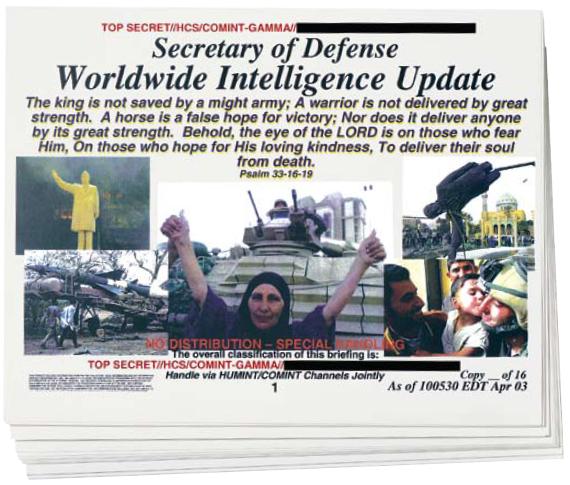


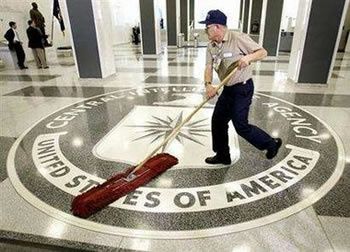 veryone’s afraid of the CIA.
 y investigations have revealed to me — vividly and clearly — that once the Abu Ghraib photographs were made public in the Spring of 2004, the CIA, its contractors, and everyone else involved in administering “the Cheney methods of interrogation”, simply shut down. Nada. Nothing. No torture or harsh techniques were employed by any U.S. interrogator. Period. People were too frightened by what might happen to them if they continued.