But the headline says: “As the West Celebrates a Cleric’s Death, the Mideast Shrugs.”
The New York Times, forever the trumpet of institutional power, apparently sees no need to draw a distinction between the White House and the West — even though most people in the West, like those in the Middle East, wouldn’t, until a few days ago, have been able name Anwar al-Awlaki, identify his photo or say anything about him.
Until about two years ago, few in Yemen or the Arab world had heard of Anwar al-Awlaki, the American-born propagandist for Islamic radicalism whose death President Obama celebrated as a major blow against Al Qaeda.
“A dime-a-dozen cleric” was one response, by Gregory Johnsen, a Princeton professor who studies Yemen. Another: “I don’t think your average Middle Easterner knows who Anwar al-Awlaki is,” said Emad Shahin, a scholar of political Islam at Notre Dame University.
While Western officials and commentators saw the end of Mr. Awlaki as another serious loss for Al Qaeda, a very different reception in the Middle East was the latest reminder of the disconnect between American aims and Arab perceptions. In a region transfixed by the drama of its revolts, Mr. Awlaki’s voice has had almost no resonance.
“I don’t think this will really get people’s interest, I can’t imagine why it would,” said Shadi Hamid, director of research at the Brookings Doha Center. “It seems totally irrelevant to how Arabs view the world right now. They don’t care about Awlaki.”
It is a remarkable feature in the Arab world these days how little Al Qaeda actually comes up in conversations. Even before the eruption of revolts and revolutions, a group that bore some responsibility for two wars and deepening American involvement from North Africa to Iraq was losing its significance. When Osama bin Laden died, his killing seemed more an epitaph for another era. As is often remarked, the events of Sept. 11 seem a historical note to much of an Arab population where three in five are younger than 30.
In that atmosphere, many saw Mr. Awlaki’s death as an essentially American story: here was a man that American attention helped create, and its Hellfire missiles killed, in a campaign born out of American fears of homegrown militancy. What distinguished Mr. Awlaki was not his ideas or influence but his American upbringing, passport and perfectly idiomatic English.
“When the Obama administration and the U.S. media started focusing on him, that is when Al Qaeda in the Arabian Peninsula pushed him to the fore,” Mr. Johnsen said, referring to the group’s Yemeni branch. “They were taking advantage of the free publicity, if you will. And any stature he has now in the Arab world is because of that.”
Another analyst, Michael Wahid Hanna, a fellow at the Century Foundation, echoed the idea that Mr. Awlaki’s fluency in English generated more interest about him. “The U.S. focus on Awlaki was a function of his language abilities and their understanding of his role as a recruiter and propagandist. If recent events can be said to further marginalize violent rejectionists such as Bin Laden and Ayman al-Zawahri, then there is very little room for a virtual unknown such as Awlaki to command any serious attention.”
Mr. Hanna said that was even more the case with the Arab world having plunged into what he described as “this transformational juncture.”
After Barack Obama began his presidency by deciding to close Guantanamo and ban torture, Anthony D. Romero, Executive Director of the ACLU said:
These executive orders represent a giant step forward. Putting an end to Guantanamo, torture and secret prisons is a civil liberties trifecta, and President Obama should be highly commended for this bold and decisive action so early in his administration on an issue so critical to restoring an America we can be proud of again.
What later became apparent was that Obama had less interest in civil liberties than he has in resolving the legal complications of dealing with terrorist suspects.
Should suspected terrorists be tried in civilian or military courts?
Should they be detained inside or outside the United States?
What kind of legal protections do they deserve when being interrogated?
What constitute legal interrogation methods?
For Obama, all of these questions have a simple answer: whenever possible, terrorist suspects should be killed rather than taken into detention.
He will never articulate his policy in such brutal and simple terms, but by this point the policy of the US government should be clear.
What has become apparent over the last two and a half years is that George Bush and Dick Cheney would have faced little or no criticism if there had been just one subtle difference in their approach to governance: had they been Democrats they could have avoided the political messiness of using torture and instead been global vigilante purists and said America will kill its enemies whenever and wherever we find them.
So, as Dick Cheney now applauds Obama, he does so with an apparent sense of envy and resentment.
But note also, Cheney is still promoting an old-school approach when he says: “I think you’ve got to go through the process internally, making certain it’s reviewed by the appropriate people in the Justice Department — that they take a good careful look at it — but I think they [the Obama administration] did all that in this case.”
Well, from what we know at this point, that careful review process was either not applied to Samir Khan, or, if it was applied, concluded he could not be targeted — but he got assassinated in any case.
The fact that President Obama decided to target the US citizen Anwar Awlaki for extra-judicial execution, is a subject of considerable controversy. What is arguably even more questionable is the killing of Awlaki’s American companion at the time of the Hellfire missile strike in Yemen yesterday: Samir Khan.
CNN says intelligence professionals “see Khan’s death as a ‘two-fer,’ with al-Awlaki being the primary target.”
If there is any kind of official explanation about what happened — not that we’re likely to hear one from a president who clearly values secrecy more than accountability — how might it go?
Khan’s presence alongside Awlaki was a happy coincidence? His shredded body was a welcome piece of collateral damage?
Or, Obama’s authorization was sought and Khan’s was a kind of two-for-the-price-of-one impulse killing.
What can reasonably be inferred is that careful consideration had already been given to whether Khan could be legitimately targeted and the conclusion was that he could not — hence, even though he had long been known to be in Yemen and been responsible for producing al Qaeda’s English-language Inspire magazine, he had not been added to Obama’s target list.
In response to the killing of Awlaki, ACLU Deputy Legal Director Jameel Jaffer said yesterday:
The targeted killing program violates both U.S. and international law. As we’ve seen today, this is a program under which American citizens far from any battlefield can be executed by their own government without judicial process, and on the basis of standards and evidence that are kept secret not just from the public but from the courts. The government’s authority to use lethal force against its own citizens should be limited to circumstances in which the threat to life is concrete, specific, and imminent. It is a mistake to invest the President — any President — with the unreviewable power to kill any American whom he deems to present a threat to the country.
The execution of Samir Khan would seem to indicate that Obama took a step even further: he claims the right to kill any American — even those whom he does not deem to present a threat to the country!
“This is a great day for America,” says a senior Obama administration official, but not such a great day for the people of Yemen.
Fayza Sulieman, a protest leader fighting for democracy in Yemen told The Guardian:
We always question the timing of these announcements from our government, [Yemen’s recently returned President] Saleh is on the backfoot and on the verge of stepping down and suddenly Anwar Awlaki is killed. We all know that Saleh’s ‘fight’ against Al-Qaida is the only thread of support keeping him in office. We pray that this news does not distract the world from our struggle against this tyrannical regime.
Mary Ellen O’Connell, vice chair of the prestigious American Society of International Law, as well as a professor at the University of Notre Dame, tells Danger Room why President Obama had no legal authority to order the assassination of Awlaki.
“The United States is not involved in any armed conflict in Yemen,” O’Connell tells Danger Room, “so to use military force to carry out these killings violates international law.”
O’Connell’s argument turns on the question of whether the U.S. is legally at war in Yemen. And for the administration, that’s a dicey proposition. The Obama administration relies on the vague Authorization to Use Military Force, passed in the days after 9/11, to justify its Shadow Wars against terrorists. Under its broad definition, the Authorization’s writ makes Planet Earth a battlefield, legally speaking.
But the Authorization authorizes war against “nations, organizations, or persons [the president] determines planned, authorized, committed, or aided the terrorist attacks that occurred on September 11, 2001.” It’s a stretch to apply that to al-Qaida’s Yemen affiliate, which didn’t exist on 9/11. But when House Republicans tried to re-up the Authorization to explicitly bless the new contours of the war against al-Qaida, the Obama administration balked, fearing the GOP was actually tying its hands on the separate question of terrorist detentions.
“It is only during the intense fighting of an armed conflict that international law permits the taking of human life on a basis other than the immediate need to save life,” O’Connell continues. “In armed conflict, a privileged belligerent may use lethal force on the basis of reasonable necessity. Outside armed conflict, the relevant standard is absolute necessity.”
So did al-Awlaki represent an “absolute” danger to the United States? President Obama, in acknowledging Awlaki’s death on Friday morning, didn’t present any evidence that he did.
As NPR reported, at a moment when few politicians are willing to question anything that is done in the name of national security, GOP presidential candidate Ron Paul had some tough words for Obama
“I don’t think that’s a good way to deal with our problems,” Paul told reporters. “Al-Awlaki was born here; he is an American citizen. He was never tried or charged for any crimes. No one knows if he killed anybody. We know he might have been associated with the underwear bomber. But if the American people accept this blindly and casually that we now have an accepted practice of the president assassinating people who he thinks are bad guys, I think it’s sad.
“I think what would people have said about Timothy McVeigh? We didn’t assassinate him, who we were pretty certain that he had done it. Went and put through the courts then executed him. To start assassinating American citizens without charges, we should think very seriously about this.”
And if Obama thinks his much trumpeted overseas successes are going to help him get re-elected, as MSNBC points out, the failing economy is really the only issue that preoccupies American voters.
No president since George H.W. Bush has had more foreign-policy successes happen under his watch than President Obama. The death of bin Laden. The dismantling of al Qaeda. The ouster of Khaddafy. And the end of combat operations in Iraq. Yet when you look at polls and Obama’s approval rating, he’s getting almost no credit from the American public, a la Bush 41.
When you ask the public about Obama and foreign policy, he gets good marks. But it’s not front of voters’ minds. In a bad economy, as Bush 41 learned, what happens overseas doesn’t matter.
An American citizen responsible for taking al-Qaida’s message viral has been killed in Yemen, according to the Yemeni government. As a target, the Obama administration considered him second only to Osama bin Laden. But don’t expect al-Qaida’s surging Yemeni cell to grow much weaker as a result.
Anwar al-Awlaki, a New Mexico-born extremist, was reportedly killed while traveling in southern Yemen, his base of operations for years. The Yemeni government made the announcement of Awlaki’s death on Friday, but left out the circumstances — notably, who killed Awlaki.
It would also mean that the Obama administration assassinated an American citizen without due process of law. Ever since evidence emerged in late 2009 that Awlaki communicated with both Fort Hood shooter Maj. Nidal Malik Hasan and would-be Christmas bomber Umar Farouk Abdulmutallab, the U.S. has launched numerous air strikes in the hope of killing him. A bevy of U.S. counterterrorism officials have testified that Awlaki plays an “operational” role in al-Qaida in the Arabian Peninsula. None have offered any evidence for that conclusion.
In 2008 Obama was able to inspire a grassroots campaign, mobilizing young people across America with the bland and non-committal slogan: “Change We Can Believe In.” Now we have an even less meaningful “Obama for America” in 2012. Maybe it should be: “Obama — the lean, mean, killing machine,” or “Obama: on target for 2012.”
There’s no way he can get re-elected on the strength of the economy, so maybe it will come down to this: being able to kill the right people at the right time.
David Axelrod is probably gathering reports right now on whether Obama’s latest assassination is really going to be a vote winner. There might not be the same expression of jubilation that accompanied Osama bin Laden’s killing, so maybe this will have to be decided by focus groups.
“This is a great day for America,” a senior administration official says. That’s what they think in the White House. And then there are those of us left to wonder whether by the end of his first term, we’ll end up sick and bemused, having concluded: Obama turned out to be worse than Bush.
It was first reported in January of last year that the Obama administration had compiled a hit list of American citizens whom the President had ordered assassinated without any due process, and one of those Americans was Anwar al-Awlaki. No effort was made to indict him for any crimes (despite a report last October that the Obama administration was “considering” indicting him). Despite substantial doubt among Yemen experts about whether he even has any operational role in Al Qaeda, no evidence (as opposed to unverified government accusations) was presented of his guilt. When Awlaki’s father sought a court order barring Obama from killing his son, the DOJ argued, among other things, that such decisions were “state secrets” and thus beyond the scrutiny of the courts. He was simply ordered killed by the President: his judge, jury and executioner. When Awlaki’s inclusion on President Obama’s hit list was confirmed, The New York Times noted that “it is extremely rare, if not unprecedented, for an American to be approved for targeted killing.”
After several unsuccessful efforts to assassinate its own citizen, the U.S. succeeded today (and it was the U.S.). It almost certainly was able to find and kill Awlaki with the help of its long-time close friend President Saleh, who took a little time off from murdering his own citizens to help the U.S. murder its. The U.S. thus transformed someone who was, at best, a marginal figure into a martyr, and again showed its true face to the world. The government and media search for The Next bin Laden has undoubtedly already commenced.
A financial trader who appeared on the BBC and said he dreamed of making money from another recession was not a hoaxer, the broadcaster has said.
Users of Twitter have cast doubt on Alessio Rastani’s credentials.
But the BBC said: “We’ve carried out detailed investigations and can’t find any evidence to suggest that the interview… was a hoax.”
On his website Mr Rastani says he is “an experienced stock market and forex trader and professional speaker”.
So there you have it: the BBC conducted a “detailed investigation” — by reading about how Rastani describes himself on his own website!
The Daily Mail provides some reporting with a little more depth (and when you have to turn to the Mail for “depth”, that really shows how bad the BBC has become!).
The ‘trader’ at the centre of a controversial interview, in which he claimed the City just ‘loves’ an economic disaster, has admitted that trading is just a ‘hobby’.
Far from being a City hotshot, Alessio Rastani has admitted to being an ‘attention seeker’ who lives in a £200,000 semi-detached house owned by his girlfriend.
And despite his brash demeanour, there is precious little evidence that the 34-year-old has ever been employed in a senior post for a bank or stockbroking firm.
Rumours that the self-styled ‘leading trader’ was a member of the ‘Yes Men’ hoaxers have been shown to be untrue – but if not a hoaxer, Mr Rastani certainly seems to be a chancer.
Rastani told the Daily Telegraph how he landed in front of the BBC’s cameras.
“They approached me,” he told The Telegraph. “I’m an attention seeker. That is the main reason I speak. That is the reason I agreed to go on the BBC. Trading is a like a hobby. It is not a business. I am a talker. I talk a lot. I love the whole idea of public speaking.”
So he’s more of a talker than a trader. A man who doesn’t own the house he lives in, but can sum up the financial crisis in just three minutes – a knack that escapes many financial commentators.
“I agreed to go on because I’m attention seeker,” he said on Tuesday. “But I meant every word I said.”
For those who missed the interview that went viral, here it is again. And for those of you who happened to first watch this here and know as little as I do about the financial markets, be advised: this isn’t the place to gather all the information you need if you’re trying to decide how to safeguard your investments!
The New York Times has a “public editor” — currently Arthur S. Brisbane — who is described as “the readers’ representative.” His job is to respond to complaints and comments from the public and to monitor the paper’s journalistic practices.
Readers’ representative? Is he selected by the paper’s readers? No. Is he employed by the paper? Yes. So, let’s be clear then: the public editor represents the newspaper — not its readers.
The existence of a public editor is an exercise in self-policing and like most other forms of self-policing, the function of the public editor is to create the appearance of institutional integrity in order to improve the newspaper’s image. In other words, the public editor is regarded as having commercial value as a component in the New York Times’ brand management.
Having said that, I have no doubt Brisbane is a decent guy but he’s as tough as the newspaper wants him to be — which isn’t much.
Of his predecessor, Byron Calame, Jack Shafer at Slate once wrote:
Calame possesses a mandate that would allow him to boil the journalistic ocean if he so desired, but he usually elects to merely warm a teapot for his readers and pour out thimblefuls of weak chamomile.
If the executives at the New York Times actually wanted a public editor intent on boiling the journalistic ocean, they wouldn’t appoint characters like Calame and Brisbane.
Which brings us to today’s column in which Jerusalem bureau chief, Ethan Bronner, gets a slap on the wrists for his own conflicts of interest. Bronner comes out badly not because he gets rough treatment from Brisbane but because he’s a serial offender who’s working on borrowed time.
What both Brisbane and Bronner supposedly don’t understand is that there is no real difference between an “actual” conflict of interest and the appearance of a conflict of interest — conflicts of interest are by their very nature all about appearance.
CONFLICT of interest, or the appearance of it, is poisonous in journalism. This is particularly so when it relates to reporting on Israel and the Palestinians, a subject that draws a steady stream of skepticism about New York Times coverage from readers and partisans on all sides.
The article by Max Blumenthal on Sept. 14 set off a chain of follow-up pieces by others and by Mr. Blumenthal himself, hammering away at the allegation that Ethan Bronner, the Times bureau chief, was compromised by his relationship with a public relations firm that arranged paid speaking engagements for him.
A close examination of the facts leads me to conclude that the case for an actual conflict of interest is slender. But the appearance of a conflict clearly exists, and that is a problem in and of itself. The Times’s “Ethical Journalism” (PDF) guidelines state that staff members “may not accept anything that could be construed as a payment for favorable coverage or as an inducement to alter or forgo unfavorable coverage.”
Mr. Bronner has now severed his ties to the public relations firm. “In my view, it is all about appearances,” he told me. “I am not denying they matter. There is nothing of an actual conflict.”
The matter revolves around Mr. Bronner’s engagement, beginning in 2009, with Lone Star Communications, a firm operated by Charley Levine, a prominent public relations executive in Israel. Mr. Levine added a speakers bureau to his firm that year, and Mr. Bronner signed on to be represented by him.
The core of Mr. Blumenthal’s critique was that Mr. Levine is a figure of the Israeli right, who counsels prominent Zionists and serves as a reservist in the Israeli Defense Forces Spokesperson’s Unit. Mr. Blumenthal, a writing fellow at the Nation Institute, said it was improper of Mr. Bronner to have a business relationship with Mr. Levine while covering stories that Lone Star promoted.
In The Columbia Journalism Review article, Mr. Blumenthal never explicitly accused Mr. Bronner of providing favorable coverage as a quid pro quo for receiving speaking engagements from Mr. Levine’s firm. He objected that Mr. Bronner “takes paid speaking engagements from a firm that also pitches him stories.” Elsewhere in the article, he wrote: “On the one hand, it might be hard to cover Israel without stumbling across Lone Star’s many clients. On the other, however, that might be a good reason not to have a business relationship with the firm.”
In an interview, Mr. Blumenthal said, “It is a question of appearances and his ability to be taken seriously because he says he is an objective reporter.”
Mr. Blumenthal’s article enumerated six cases in which Mr. Bronner had written about, or at least mentioned, Lone Star clients. Mr. Bronner walked me through those cases. Of the six, he said, only one involved an instance in which he had received a pitch from Lone Star and, on that basis, decided to write about it. The article concerned the Jewish National Fund and was about a fortified play area for children in the Israeli border town of Sderot.
In the rest of the cases except one, he said, he did not receive a pitch from Lone Star and was unaware that the story involved a Lone Star client. The exception involved Danny Danon, a conservative member of the Israeli Parliament. Mr. Bronner said he has covered Mr. Danon but the coverage decisions were influenced not by Lone Star but by the prominence of Mr. Danon, who is deputy speaker of Parliament and chairman of World Likud.
The Blumenthal piece creates the implication of a corrupt arrangement. In my view, the arrangement was ill-advised and created an appearance that could be construed by some as corrupt, but was not in actuality.
I consulted two journalism ethics experts on this, who reached the same conclusion. Stephen Ward, who heads the Center for Journalism Ethics at the University of Wisconsin, said: “Has there been an actual conflict of interest? I don’t find it in this case. What about the perception of a conflict? That is where I think some might see the relationship between him and the public relations firm and have some reason to doubt.”
Ed Wasserman, Knight professor of journalism ethics at Washington and Lee University, said Mr. Bronner’s decision to sever ties to Lone Star was the “appropriate” action.
For his part, Mr. Bronner is kicking himself over the episode. “I allowed myself to be in a situation where someone could come after me this way,” he said. “I feel pretty bad about it.”
He said Lone Star had booked only a half dozen speeches for him, out of 75 that he had given since he became bureau chief three and a half years ago. He speaks only to nonprofit organizations and, in Israel, typically receives fees of less than a thousand dollars, he added.
He did not tell his editors about his relationship with Lone Star, he told me, because he did not think joining a speakers bureau had to be disclosed. Indeed, the ethics guidelines do not specifically require it. But the guidelines do require Times staff members to provide an accounting to editors if they earn more than $5,000 of speaking fees in a year. Mr. Bronner acknowledged he was “delinquent” in failing to do this, saying he believed he was obligated to account only for any single speech for which he was paid more than $5,000, another requirement of the policy.
(Mr. Bronner faced criticism previously when his son joined the Israeli military, prompting The Times’s public editor then, Clark Hoyt, to recommend that Mr. Bronner be reassigned because of the appearance of a conflict. Bill Keller, the executive editor at the time, supported Mr. Bronner, and he remained in his post. Mr. Bronner’s son has since completed his service and returned to the United States.)
Mr. Bronner was pointed in arguing that the attack by Mr. Blumenthal, who writes critically of Israel’s dealings with the Palestinians, was ideologically motivated and designed to discredit Mr. Bronner.
Mr. Blumenthal’s piece may well have been influenced by an animus toward Mr. Bronner’s reportage for The Times. But the fact remains that the Lone Star engagement created a problem and stands as a reminder that The Times must be fastidiously independent, in reality and in appearance, or face attacks like this one.
Here’s the irony: if the New York Times was to have a public editor worthy of the name, he’d do nothing to insinuate that criticism of the kind delivered by Max Blumenthal was in some way unfair, but on contrary acknowledge the fact that the most rigorous criticism of the paper’s practice of journalism is most often going to come from those who take the deepest interest in the issues — not those who practice the mealy-mouthed art of balanced impartiality.
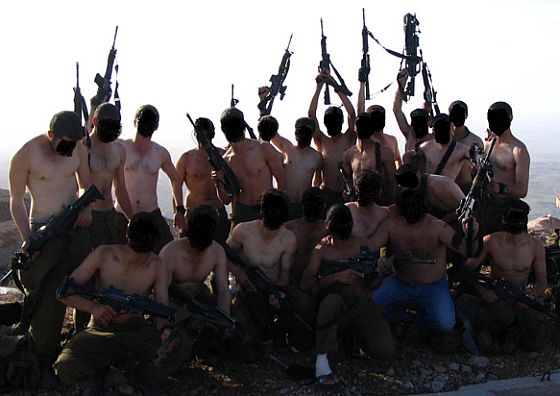
Armed French citizens in a West Bank settlement -- Photo: Jewish Defense League
While Israeli authorities are making it increasingly difficult for non-violent international activists to visit the West Bank, suspected Jewish terrorists — members of the Jewish Defense League (JDL) — coming from France in recent days apparently had no difficulty reaching the illegal settlements which they claim they want to defend.
The FBI has described the JDL as a “right-wing terrorist group“. One of its most infamous charter members was Baruch Goldstein who attack unarmed Palestinian Muslim worshipers at a mosque in Hebron in 1994, killing 29 and wounding 125 others. On its website, the JDL says “We do not consider his assault to qualify under the label of terrorism,” in reference to Goldstein’s Hebron attack — they also describe him as “a brilliant surgeon, a mild-mannered Yeshiva-educated man.”
Al Jazeera reports on an operation organized by the French chapter of the JDL.
Two weeks ago, an announcement appeared on a French website, calling for “militants with military experience” to participate in a solidarity trip to Israel between September 19 and 25. “The aim of this expedition is to lend a hand to our brothers facing aggression from the Palestinian occupiers, and to enhance the security of Jewish towns in Judea and Samaria,” it explained. The dates of the trip coincide with the Palestinian statehood bid at the United Nations.
As of yesterday, in response to this call, there were 55 French citizens, both men and women, with military experience, stationed inside the illegal Israeli settlements up and down the West Bank. Organised into five separate groups of 11, their mandate is to “defend the settlements against any attack from Palestinians”, and to “aid” in areas where they feel there is a lack of Israeli army personnel or police forces.
The website belongs to the French chapter of the Jewish Defence League (JDL), a far-right Jewish group founded by Rabbi Meir Kahane in the United States in 1968. The Federal Bureau of Investigation has refered to the JDL as a “violent extremist organisation”.
“In France, it is a movement made up of French citizens who defend the Jewish community when faced with aggression, and also defends Israel in a more general manner,” said Amnon Cohen, a spokesperson for the group. “In terms of ideology, we are Zionists, pro-Israeli, and we share similar ideologies to that of the Ichud Leumi [“National Union”] party in Israel.” The National Union advocates the settlement of Jewish people in the entirety of the occupied West Bank, which it calls by its biblical name of Judea and Samaria.
“People say we are extreme because we believe in Judea and Samaria, and that this belongs to the Israelis, the Jews, but I don’t consider this to be extreme,” he told Al Jazeera. [Continue reading…]
Comparing Benjamin Netanyahu’s address to the UN today with Nikita Khrushchev’s boorish conduct in 1960, The Guardian‘s Julian Borger tweeted: “He didn’t take his shoe off and thump the lectern but Bibi just delivered one of the more combative speeches in UN history.”
Netanyahu proceeded to insult the UN which he called “the theater of the absurd”, while he compared the Palestinians to the Nazis.
Here in the UN automatic majorities can decide anything. They can decide that the sun sets in the West — or rises in the West. I think the first has already been preordained. They can also decide — they have decided — that the Western Wall in Jerusalem, Judaism’s holiest place, is occupied Palestinian territory.
And yet, even here, in the General Assembly, the truth can sometimes break through.
In 1984, when I was appointed as Israel’s ambassador to the United Nations, I visited the great rabbi of Lubavitch. He said to me — and ladies and gentlemen, I don’t want any of you to be offended because from personal experience of serving here, I know there are many honorable men and women, capable and decent people serving their nations here — but here’s what the rabbi said to me. He said to me: “You’ll be serving in a house of many lies.” And then he said: “Remember, that even in the darkest place, the light of a single candle can be seen far and wide.”
Today I hope that the light of truth will shine, if only for a few minutes, in a hall that for too long has been a place of darkness for my country. So as Israel’s prime minister, I didn’t come here to win applause. I came here to speak the truth.
Maybe Netanyahu’s truth-telling will have helped tip some undecided votes in the Security Council in Palestine’s favor but the odds don’t look good.
[Palestinian president Abbas] privately retreated from his pledge to seek an immediate security council vote in part because he is no longer sure of winning the necessary majority, which would have given the Palestinians a moral victory even if the US used its veto. Palestinian sources say they believe Washington has bullied several security council members into withdrawing their support for the Palestinian move, including Portugal, by threatening to withhold support for its stricken economy, and Bosnia, over its opposition to Kosovo being admitted to the UN. Palestinian officials also believe Nigeria is no longer certain to vote in their favour. There are also questions about the position of Gabon and Colombia.
One senior Palestinian official described the Americans as “playing a really nasty game”.
“Israel and the US are one and the same: the US is Israel, and Israel is the US. Israel doesn’t want to give the Palestinians anything and Obama can’t do anything without Israel because Congress is pro-Israel.”
That’s how Marwan Jubeh, a shop owner in Ramallah, neatly sums up the situation.
If there was an honest element in President Obama’s speech at the UN General Assembly yesterday, it was implicit rather than directly spelled out: it was in effect a declaration of impotence.
And as Obama shifts into gear in his campaign for re-election, he will be grateful for the kosher seal of approval he just got from Israel’s political leaders which he can deploy as often as necessary over the next twelve months to signal that for both Democrats and Republicans, Israel and the US are one and indivisible — even when the president’s middle name is Hussein.
“I think it’s in our national interest, and Israel’s national interest, that we have a strong partnership and that the president is perceived as a friend and ally of Israel. While he does that, everybody should be happy.” So says Bob Turner who — even though he just rode to victory in New York’s 9th Congressional district through a campaign that presented Obama as no friend of Israel — now says that he does not see Israel as a wedge issue.
So now that Obama has once again burnished his credentials as a stalwart friend of Israel, he will be only too happy to set aside any expectation that the US, under his leadership, has a constructive role to play in ending the conflict.
Meanwhile, as Obama insists that the current Palestinian bid for statehood will make no difference, as Henry Siegman argues, it may actually completely change the power dynamics as the Palestinians begin to assert their right of self-determination.
The outpouring of commentary on the request that Palestinians intend to submit to the United Nations to affirm their right to statehood within the pre-1967 borders has fallen into two categories. The first supports the Israeli and American view that sees the Palestinian initiative as endangering the Oslo Accords and prospects for a two-state solution. As described by President Obama, it is a “distraction” from the serious business at hand. The second view supports the Palestinian right to apply for UN membership, or for non-member-state observer status, and rejects the notion that this would set back the peace process.
However, both approaches believe that UN action will not result in any practical changes on the ground and that Palestinians will have to return to the U.S.-orchestrated “peace process” to achieve a two-state solution. And both have in common a profound misreading of the significance of the Palestinian initiative, which is likely to be transformative, changing the rules of the game for Israeli-Palestinian peacemaking.
According to the prevailing rules, every aspect of the Palestinians’ existence depends on Israel. Whether Palestinians can travel from town to town within the areas to which they are restricted, open a new business venture, see their homes demolished by an Israeli bulldozer—indeed whether they will live or die—are Israeli decisions, often made by armed Israeli eighteen-year-olds just out of high school.
The Oslo Accords, requiring as they do that Israel withdraw its occupation in stages from the West Bank, were intended to change that reality. But Oslo was quickly undermined by Prime Minister Yitzhak Rabin, who declared—“unilaterally”—that the dates established in the accords for the withdrawals are not “holy” and can be ignored by Israel. Furthermore, as noted by Uri Savir, who headed Israel’s Foreign Ministry at the time, Rabin had no intention of returning the Jordan Valley or of sharing Jerusalem. (He might well have changed his views on these issues, as he did on some others, had he not been assassinated by a settler.)
Although the Oslo Accords did not mention a Palestinian state, statehood was the goal implicit in the agreement’s terms and the permanent-status issues slated for negotiations between the parties. But the peace process overseen by the United States was based on an unstated principle that fatally undermined the achievement of a Palestinian state: that any change in the Palestinians’ status as a people under Israel’s occupation depended entirely on Israel’s consent. This effectively excluded everyone other than the occupiers from a role in deciding the Palestinians’ fate. The UN, which was established to assure compliance with international law and to facilitate the self-determination of peoples living under colonial domination, was shunted aside. Above all, this principle excluded the Palestinian people themselves.
To be sure, President Obama recently proposed that negotiations begin at the 1967 lines, with territorial swaps. What he failed to say is that if the parties cannot reach agreement on the swaps, the lines will be drawn by the Security Council. Indeed, he said the opposite—that peace terms cannot be imposed on Israel. His proposal therefore changed nothing. Netanyahu can continue to make demands he knows no Palestinian leader can accept, and the occupation persists.
The real meaning of the Palestinians’ decision to defy the United States is that they will no longer accept their occupier’s role in their quest for statehood. They demand national self-determination as a right—indeed, as a “peremptory norm” that in international law takes precedence over all other considerations—and not as an act of charity by their occupiers.
The American insistence on aborting the Palestinians’ initiative and returning them to a peace process in which their fate remains dependent on Israel is shameful. It stains America’s honor. It will not succeed, for the Palestinian decision to defy the American demand is itself a declaration of independence; that genie cannot be returned to the bottle.
On the ground, little will be changed by a UN affirmation of Palestinian statehood. But nothing will be the same again in the Palestinians’ dealings with Israel and the United States. The notion that Israel will decide where negotiations begin and what parts of Palestine it will keep is history. It is sad that America, of all nations, has failed to understand this simple truth, even in the wake of the Arab Spring. Sadder still is Israel’s continuing blindness not only to the injustice but also to the impossibility of its colonial dream. That dream may now turn into a nightmare as the international community increasingly sees Israel as a rogue state and treats it accordingly.
In case anyone is in any doubt that President Obama’s comments on the Israeli-Palestinian conflict, delivered to the UN General Assembly this morning, were nothing more than a string of worthless peace-process platitudes, then listen to the rave review he got from Israeli foreign minister Avigdor Lieberman: “I congratulate President Obama, and I am ready to sign on this speech with both hands.” Prime Minister Netanyahu and opposition leader Tzipi Livni were similarly pleased.
As usual Israel and the United States are speaking with one voice: Israel’s.
One year ago, I stood at this podium and called for an independent Palestine. I believed then – and I believe now – that the Palestinian people deserve a state of their own. But what I also said is that genuine peace can only be realized between Israelis and Palestinians themselves. One year later, despite extensive efforts by America and others, the parties have not bridged their differences. Faced with this stalemate, I put forward a new basis for negotiations in May. That basis is clear, and well known to all of us here. Israelis must know that any agreement provides assurances for their security. Palestinians deserve to know the territorial basis of their state.
I know that many are frustrated by the lack of progress. So am I. But the question isn’t the goal we seek – the question is how to reach it. And I am convinced that there is no short cut to the end of a conflict that has endured for decades. Peace will not come through statements and resolutions at the UN – if it were that easy, it would have been accomplished by now. Ultimately, it is Israelis and Palestinians who must live side by side. Ultimately, it is Israelis and Palestinians – not us – who must reach agreement on the issues that divide them: on borders and security; on refugees and Jerusalem.
Peace depends upon compromise among peoples who must live together long after our speeches are over, and our votes have been counted. That is the lesson of Northern Ireland, where ancient antagonists bridged their differences. That is the lesson of Sudan, where a negotiated settlement led to an independent state. And that is the path to a Palestinian state.
We seek a future where Palestinians live in a sovereign state of their own, with no limit to what they can achieve. There is no question that the Palestinians have seen that vision delayed for too long. And it is precisely because we believe so strongly in the aspirations of the Palestinian people that America has invested so much time and effort in the building of a Palestinian state, and the negotiations that can achieve one.
America’s commitment to Israel’s security is unshakeable, and our friendship with Israel is deep and enduring. And so we believe that any lasting peace must acknowledge the very real security concerns that Israel faces every single day. Let’s be honest: Israel is surrounded by neighbors that have waged repeated wars against it. Israel’s citizens have been killed by rockets fired at their houses and suicide bombs on their buses. Israel’s children come of age knowing that throughout the region, other children are taught to hate them. Israel, a small country of less than eight million people, looks out at a world where leaders of much larger nations threaten to wipe it off of the map. The Jewish people carry the burden of centuries of exile, persecution, and the fresh memory of knowing that six million people were killed simply because of who they were.
These facts cannot be denied. The Jewish people have forged a successful state in their historic homeland. Israel deserves recognition. It deserves normal relations with its neighbors. And friends of the Palestinians do them no favors by ignoring this truth, just as friends of Israel must recognize the need to pursue a two state solution with a secure Israel next to an independent Palestine.
That truth – that each side has legitimate aspirations – is what makes peace so hard. And the deadlock will only be broken when each side learns to stand in each other’s shoes. That’s what we should be encouraging. This body – founded, as it was, out of the ashes of war and genocide; dedicated, as it is, to the dignity of every person – must recognize the reality that is lived by both the Palestinians and the Israelis. The measure of our actions must always be whether they advance the right of Israeli and Palestinian children to live in peace and security, with dignity and opportunity. We will only succeed in that effort if we can encourage the parties to sit down together, to listen to each other, and to understand each other’s hopes and fears. That is the project to which America is committed. And that is what the United Nations should be focused on in the weeks and months to come.
Less than an hour after Mr. Obama spoke, President Nicolas Sarkozy of France stood at the same podium in a sharp repudiation, calling for a General Assembly resolution that would upgrade the Palestinians to “observer status,” as a bridge towards statehood. “Let us cease our endless debates on the parameters,” Mr. Sarkozy said. “Let us begin negotiations and adopt a precise timetable.”
For Mr. Obama, the challenge in crafting the much-anticipated General Assembly address on Wednesday was how to address the incongruities of the administration’s position: the president who committed himself to making peace between the Israelis and the Palestinians a priority from Day One, who still has not been able to even get peace negotiations going after two and a half years; the president who opened the door to Palestinian state membership at the United Nations last year ending up threatening to veto that very membership; the president who was determined to get on the right side of Arab history ending up, in the views of many on the Arab street, on the wrong side of it on the Palestinian issue.
The US-Israeli message to Palestinians remains now what it has long been: the Palestinians deserve a state, but not just yet.
So if you’re looking for Palestine, all you need to do is find your way to the end of the peace process rainbow — it’s right there, alongside a pot of gold.
But if the White House is still willing to collude with its Israeli partners in refusing to set a deadline for the creation of a Palestinian state, France’s president issued Obama a stern warning:
“Each of us knows that Palestine cannot immediately obtain full and complete recognition of the status of United Nations member state,” he said. “But who could doubt that a veto at the Security Council risks engendering a cycle of violence in the Middle East?”
Those who still declare their belief that a two-state solution is the only viable solution to the conflict must move beyond their endless repetition of the parameters of such a solution and declare without equivocation when a Palestinian state must be created.
“House Republicans Discover a Growing Bond With Netanyahu” says the headline in the New York Times.
Discover? This isn’t exactly news. What the headline should say (and I know I’m fantasizing about an imaginary New York Times whose headlines don’t pull any punches) is: “House GOP trusts Netanyahu more than Obama.”
The report does acknowledge: “Unbending support for Israel has long been a bipartisan fact of American politics, but Mr. Netanyahu’s popularity in Congress now runs deeper than ever.” Or, as Pat Buchanan would put it, Capitol Hill is still Israeli occupied territory.
When the Obama administration wanted to be certain that Congress would not block $50 million in new aid to the Palestinian Authority last month, it turned to a singularly influential lobbyist: Israel’s prime minister, Benjamin Netanyahu.
At the request of the American Embassy and Secretary of State Hillary Rodham Clinton, Mr. Netanyahu urged dozens of members of Congress visiting Israel last month not to object to the aid, according to Congressional and diplomatic officials. Mr. Netanyahu’s intervention with Congress underscored an extraordinary intersection of American diplomacy and domestic politics, the result of an ever-tightening relationship between the Israeli government and the Republican Party that now controls the House.
On Tuesday, one of President Obama’s potential rivals in 2012, Gov. Rick Perry of Texas, delivered a speech in New York criticizing Mr. Obama’s stance toward Israel as “naïve, arrogant, misguided and dangerous.” Mr. Perry said that he would be a guest soon of Danny Danon, the hard-right deputy speaker of the Israeli Parliament.
The relationship between the Israeli government and the Republican Party has significantly complicated the administration’s diplomatic efforts to avert a confrontation at the United Nations this week over the Palestinian bid for full membership as a state, limiting President Obama’s ability to exert pressure on Mr. Netanyahu to make concessions that could restart negotiations with the Palestinians.
One of the members of Congress who attended the meeting with Mr. Netanyahu in August, Representative Michael G. Grimm of New York, a Republican, said that it was carefully explained to the delegation that the money would be used for training Palestinian police officers who work closely with the Israeli government.
Mr. Grimm said he felt more comfortable receiving the explanation from the prime minister than from Obama administration officials.
The FBI has publicly declared that its counterterrorism training seminars linking “mainstream” Muslims to terrorists was a “one time only” affair that began and ended in April 2011. But two months later, the Bureau employee who delivered those controversial briefings gave a similar lecture to a gathering of dozens of law enforcement officials at an FBI-sponsored public-private partnership in New York City.
And during that June presentation, the FBI’s William Gawthrop told his audience that the fight against al-Qaida is a “waste,” compared to the threat presented by the ideology of Islam itself.
“At the operational level, you have groups such as Hamas, Hezbollah, al-Qaida. Like teeth in a shark, it is irrelevant if you take one group out,” Gawthrop said during his lecture to the New York Metro Infragard at the World Financial Center in downtown Manhattan.
This June 8 lecture is controversial in a different way. In Gawthrop’s worldview, the struggle against al-Qaida is really just an afterthought in a broader war. The group that knocked down the World Trade Center and rammed a jet into the Pentagon is a mere distraction. These are the professional assessments of a representative from the nation’s top domestic counterterrorism agency — a man considered so expert in understanding militant strategy that the FBI had him training agents on the subject.
“We waste a lot of analytic effort talking about the type of weapon, the timing, the tactics. All of that is irrelevant … if you have an Islamic motivation for actions,” Gawthrop said. Even taking down hostile states like Iran is futile, since “there are still internal forces that will seek to exert Islamic rule again.”
The best strategy for undermining militants, Gawthrop suggested, is to go after Islam itself. To undermine the validity of key Islamic scriptures and key Muslim leaders.
“If you remember Star Wars, that ventilation shaft that goes down to into the depths of the Death Star, they shot a torpedo down there. That’s a critical vulnerability,” Gawthrop told his audience. Then he waved a laser pointer at his projected PowerPoint slide, calling attention to the words “Holy Texts” and “Clerics.”
“We should be looking at, should be aiming at, these,” Gawthrop said.
Outside counterterrorists disagree — strongly — with Gawthrop’s take. “This is mind-numbingly stupid and dangerous,” says Aki Peritz, a former intelligence analyst at the National Counterterrorism Center, now with the Third Way think-tank in Washington. “If we were to follow his idea to a logical extension, that means we have individuals in every single government agency, at top levels, from CIA to the Defense Department to members of Congress, that are part of this cabal to destroy Western civilization. If you truly believe that, then this is McCarthyism on steroids.”
Gawthrop’s views are fully in line with other members of the Islamophobia network for whom one of the central tenets of their thesis is the idea that Islam is not a religion; it is an ideology.
This idea that the West is engaged in a deadly ideological struggle with Islam appears in many ways to not simply be a recreation of Cold War thinking in which communism has been substituted by Islam. It actually looks like the product of Cold War brains incapable of seeing the world in any other way than one in which the United States/The West is locked in combat with an enemy it must destroy.
To those who became entrenched in this mindset through the 1970s and 80s (and earlier), the end of the Cold War, with the Soviet Union quietly breaking apart rather than being incinerated, must have come as something of a disappointment.
How then will these Cold Warriors-turned Islamophobic ideologues conceive of “victory” in their war against Islam?
The ease with which the communist world fell apart had a great deal to do with the fact that communism’s ideological guardians had already passed away and the remaining ranks of its true believers were pretty thin. Islam, on the other hand, is clearly much more vibrant, so what for those who present Islam as the threat, do they think its “defeat” might look like?
A few years ago, the security analyst Michael Vlahos provided some clues:
I have had many “Defense World” conversations that have ended with: “the time may come when we will have to kill millions of Muslims,” or, “history shows that to win over a people you have to kill at least 10 percent of them, like the Romans” (for comparison, we killed or contributed to the death of about five percent of Japan from 1944-46, while Russia has killed at least eight percent of the Chechen people). Or consider the implications of “Freeper” talk-backs to an article of mine in The American Conservative: “History shows that wars only end with a totally defeated enemy otherwise they go on … Either Islam or us will quit in total destruction.”
Total destruction?
Let’s be clear: they’re talking about another Holocaust.
Here are some numbers President Obama should think about: Americans currently view him less favorably than they do UN recognition of Palestine! Obama’s approval rating is 43% while 45% support Palestine.
In a poll conducted for the BBC, Americans (among 20,446 citizens from 19 countries) were asked the following question:
As you may know, the Palestinian Authority is planning to request that the UN General Assembly recognize the Palestinian Territories as a state and as a member of the UN. Do you think [RESPONDENT’S COUNTRY] should vote for or against this request?
The response from Americans was 45% in favor, 36% opposed, 2% abstain, 17% undecided.
Globally, the public is five to two in favor of UN recognition of Palestine.
Even though less than a majority of Americans polled support the move, that number along with the large number who are undecided, needs to be put into perspective.
US media coverage of the Israeli-Palestinian conflict is heavily skewed in favor of the Israelis. Israel’s political leaders and Israel’s American supporters have characterized the Palestinian initiative as an attempt to delegitimize the Jewish state. The Palestinians do not have a charismatic leader whose face can serve as an iconic, positive and internationally recognized image of Palestinian nationalism. And yet in spite of the prevailing pressure to oppose the move, more Americans than those who think otherwise, support Palestine’s admission to the UN.
Most likely, this has much less to do with an interest or understanding of the conflict than it is an expression of an idea that most Americans readily accept: people should be allowed to govern themselves.
In the United States, the term Islamist is often one small step away from al Qaeda. The idea that someone could be an Islamist and not an extremist seems barely conceivable. And the existence of pro-Western Islamists sounds about as probable as the discovery of unicorns.
Yet Jeffrey D. Feltman, the assistant secretary of state for Near Eastern affairs and the first high-level US official to visit Libya since the fall of Gaddafi, says:
“We aren’t concerned that one group is going to dominate the aftermath of what has been a common struggle by the Libyan people to open the door to a better future.”
He added: “I think it is something that everybody is watching; first of all, the Libyan people themselves are talking about this.”
But based on what he has heard from Libyans across the political spectrum, Mr. Feltman said, there is “a shared desire for a different type of Libya that is going to have to take into account a lot of political trends.”
One of the most commonly voiced fears about the Islamists is that they are well organized — as though their organizational skills give them an unfair advantage.
“There will be attempts by some parties to take over; it’s only natural,” said one prominent official with the Transitional National Council, who spoke anonymously so as not to alienate Islamists. “And definitely [the Islamist umbrella group] Etilaf is trying to increase its influence. And we’re hearing much more from the Islamists in the media because they are more organized and they are more articulate.”
Aref Nayed, coordinator of the Transitional National Council’s stabilization team and a prominent religious scholar, responds:
“My answer to anyone who complains about that: You must be as articulate as they are and as organized as they are,” he said. “And I think we’re starting to see that among various youth groups.”
The inclination of journalists and other Western observers to see in Libya the makings of a potentially violent power struggle seems to say more about their own preconceptions than it does about what’s actually happening.
Rory Stewart, who had been critical of NATO for, in his opinion, moving well beyond its mandate, nevertheless saw, during his recent visit, evidence that the power dynamics in the new Libya are refreshingly healthy.
Since Gaddafi’s state was not powerful, its fall may have comparatively little effect. Security in the streets was provided almost from the start by neighbourhood committees, many organised from mosques; their effectiveness and legitimacy was taken almost for granted and they did not seem (yet) to be abusing their power. The lack of foreigners allowed Libyans to feel that the revolution was theirs, not an international production. It also meant that our curious priorities and processes were not imposed on Libyan politics. The Islamists and the Gaddafi loyalists couldn’t portray the new government as a puppet, or market themselves as fighting for Libya and Islam against a foreign military occupation.
Even the improvisatory, passive nature of the opposition may have been constructive. It included many members of Gaddafi’s government who were working from the very beginning to make links with their former colleagues. When the politician Abdul Hafiz Ghoga arrived in Benghazi and criticised the council, they invited him in. They seemed to be able to incorporate Islamists with equal ease. Every time they described their strategy, they talked about compromise and negotiation. Sometimes people spoke like this in Afghanistan and Iraq too – explaining how easy it would be to cut deals with the Taliban or the Sunni insurgency – but the US-led coalition rarely let them try.
And then there was their attitude to the West. I expected the minister of health – a British-Libyan doctor who knew I was an MP – to present a shopping list of demands. But when I asked him about foreign support, he said that Libya had been ‘well-supported by Qatar and the UAE, by Turkey and Tunisia’. And there he stopped. When I asked about the UN agencies and NGOs, he said he had seen a bit of them in ‘stake-holder meetings’ held on Tuesdays in Benghazi, but the meetings had petered out. He implied that the processes for getting support from Western aid agencies were far too bureaucratic, that he would stick with Middle Eastern cash, confident that Libya would get what it needed. The mixture of self-importance and desperation that created the destructive, co-dependent marriage between foreigners and locals in Afghanistan seems to be entirely absent in Libya.
Abdul Basset Haroun al-Shahaidi, a top rebel commander, tells the Washington Post: “The Islamic groups want a democratic country, and they want to go to the mosque without being arrested. They’re looking for freedom like everyone else.”
What concerns many Libyans now, more than Western fears about Islamists, is the ability of remnants of the old regime to incorporate themselves into the new government.
“I’m not an Islamist, but I feel like I have more in common with the Islamists than I do with the secularists who are in the picture right now,” an NTC official tells a correspondent for Time. “Why? Because I think the Islamists have no connection with the old regime. They’re more nationalist. And they have no frozen assets, that’s for sure.”
“Which prosperous ally gets $3 billion a year in aid, and a veto power over America’s entire Mid-East foreign policy? Which ally refuses to cooperate with its military and political protector – even to the point of humiliating a duly elected American president? Which ally violates the Non-Proliferation treaty and manages to get its super-power protector to maintain total silence on this glaring fact? Which ally is threatening conventional warfare if its own nuclear monopoly in the region is in any way threatened?” asks Andrew Sullivan.
“Israel is the exception to every rule. And its intransigence is beginning to force the US toward a horrible choice between allying ourselves with the tectonic democratic forces in the region, or backing a fundamentalist-dominated state bent on expansion and war.”
Sullivan hasn’t turned into a fringe anti-Zionist blogger. He’s merely echoing views that are expressed much more freely in Washington than mainstream media reports generally reveal.
Robert Gates, having served as defense secretary for both presidents Bush and Obama, clearly wasn’t a political maverick when he ran the Pentagon, yet his assessment of Israel was no less blunt than Sullivan’s.
In a meeting of the National Security Council Principals Committee held not long before his retirement this summer, Gates coldly laid out the many steps the administration has taken to guarantee Israel’s security — access to top- quality weapons, assistance developing missile-defense systems, high-level intelligence sharing — and then stated bluntly that the U.S. has received nothing in return, particularly with regard to the peace process.
Senior administration officials told me that Gates argued to the president directly that Netanyahu is not only ungrateful, but also endangering his country by refusing to grapple with Israel’s growing isolation and with the demographic challenges it faces if it keeps control of the West Bank. According to these sources, Gates’s analysis met with no resistance from other members of the committee.
Gates has expressed his frustration with Netanyahu’s government before. Last year, when Vice President Joe Biden’s visit to Israel was marred by an announcement of plans to build new housing units for Jews in East Jerusalem, Gates told several people that if he had been Biden, he would have returned to Washington immediately and told the prime minister to call Obama when he was serious about negotiations.
Even so, having thoroughly alienated himself from the Obama administration, who does Netanyahu turn to in a desperate situation?
Former Director of the Mossad Efraim Halevy, speaking in New York on Monday night, described the predicament the Israeli prime minister found himself in on Friday as protesters in Cairo were storming the Israeli embassy and six Israelis remained trapped inside.
[Netanyahu] turned to one man, to the President of the United States, and he spoke to him. And the president of the United States, without having much time to consult with Congress, and with the media, and with the analysts and with all of the other people who have to be consulted on major and grave decisions. He took a decision to take up the telephone and get on the line with the powers that be in Egypt, and get them to order the release of these six people, and the detail of the Egyptian commando forces entered and saved them.
I think that this decision by President Obama was a unique decision in many ways. Because I don’t have to tell you, and this was just said time and time and over again this afternoon/this evening, that the United States is not in a position the way it was many years ago in the Middle East, it has its problems, it has its considerations, and rightly so. But I believe the leadership that the President of the United States showed on that night was a leadership of historic dimensions. It was he who took the ultimate decision that night which prevented what could have been a sad outcome—instead of six men coming home, the arrival in Israel of six body bags.
And I want to say to you very openly and very clearly that had there been six body bags, there would have been a much different Israel today than we have been used to seeing over recent years. This would not have been one more incident, one more operation, one event. And the man who brought this about was one man and that was President Barack Hussein Obama.
And I believe it is our duty as Israelis, as citizens of the free world, to say, not simply thank you President Obama, but also we respect you for the way and the manner in which you took this decision.
Note first the ominous way in which Halevy says that had these Israelis died this would not have been “one more incident” — unlike, say, the deaths of six Egyptian border guards shot by Israelis in late August, or the deaths of nine Turkish activists killed by Israeli commandos on board the Mavi Marmara just over a year ago.
But note also that Israel, while pursuing what a senior Israeli official describes as a “porcupine policy” to defend itself, when caught in this particular corner found its prickles of no use and instead was compelled to turn to its only reliable protector, the United States.
As Tzipi Livni, the head of the Kadima Party, told Goldberg: “For Israelis, when they wake up in the morning and ask themselves, what is the general situation today, the litmus test for them is the health of the relationship between Israel and the United States.”
And thus we see the contradiction which is Israel — forever pumping itself up, flexing its muscles and showing its neighbors that no one should risk messing with the mighty Zionist state, yet all the while knowing that without the protection of the United States, Israel’s survival would depend on a revolutionary transformation.
Absent American protection, Israel, for the first time, would have to seriously take on the challenge of getting along with its neighbors and not, as it has for the last two decades, simply use diplomacy as a facade behind which it can pursue its policies of territorial expansion.
Is the West’s spoiled child ready to grow up? And is the United States ready to see that its own patronage is what has allowed the Jewish state to trap itself in such a prolonged adolescence?
In recent years, the Department of Homeland Security has provided grants for hundreds of police departments across America to buy $300,000 Lenco BearCats in the name of counter-terrorism.
In the wake of the September 11 attacks in 2001, a strange consensus quickly emerged in Washington: this was just al Qaeda’s first homeland assault. There would be further attacks and most likely what was to come would be even worse — far worse.
With a sense of foreboding and determination we ventured into the third great era for America as world leader — what was briefly dubbed a New American Century.
First came the fight against global fascism which resulted in unqualified victory at the end of World War Two.
Then came the American-led Western alliance to halt the advance of communism.
Even if the collapse of the Soviet Union didn’t bring communism to an end, the end of the Cold War supposedly marked the dawn of a New Global Order in which America reigned supreme as the sole Super Power.
And if after the Cold War, a decade of globalization lacked the ideological clarity needed to satisfy conservative America’s sense of righteousness and moral purpose, or the military focus that would satisfy the Pentagon, all of that was to end with 9/11 as once again the United States assumed its role as world savior.
A president whose own sense of purpose had until then extended no further than his desire to continue a family tradition, was now fired up with a mission as he led the world in a struggle between good and evil.
Yet behind Bush’s apparent boldness was the confidence of a man making a very safe bet.
In response to the attacks the president and the political class across America made a simple calculation: if they were to overstate the threat posed by terrorism they could do so with virtually no political risk and potentially great political rewards. Indeed, the greater the exaggeration the less the risk.
At the same time an honest assessment of the threat posed by al Qaeda would be freighted with enormous risk.
That meant that a dishonest assessment of the threat posed by terrorism would also be a safe assessment.
If there were no further major attacks then this would be taken as the measure of a successful counter-terrorism policy; not a reflection of al Qaeda’s inherent weakness.
Bush immediately understood this and quickly declared war. This, the neocons rapturously declared, was Bush’s great “insight”: we’re at war.
Since we couldn’t be sure exactly where the enemy was located, then just to be safe, we assumed he was everywhere. So this wasn’t going to be just another war — it would be a global war.
America had defeated fascism and then communism and now it was going to take on a battle soon predicted to last for the rest of our lives: a long war against global terrorism.
With the smoke still rising from the ruins of the Twin Towers, no one had the guts to state the obvious: whatever threat al Qaeda might pose, it was surely minute compared to the Soviet nuclear arsenal during the Cold War or the nation-crushing military forces of Japan and Germany during World War Two.
If 9/11 had really been another Pearl Harbor, where was the amassed power that made it clear: this is just the beginning, there is much worse to come?
Asymmetric threats notwithstanding, could a few terrorist camps in eastern Afghanistan really constitute a credible threat to the preeminent military and economic power in the world?
Even if there was evidence that al Qaeda had diabolical ambitions, the evidence of its capabilities was much less impressive. When the long-predicted follow-up attacks emerged, they weren’t exactly attacks on America. Shoe bombers and underpants bombers could put hundreds of lives at risk but they didn’t really threaten a whole nation.
The cowards’ logic dictates, however, that no risk is too small and no security strategy too expensive. America could never become too safe.
The application of this logic not only opened the door to the creation of a massive new government bureaucracy, Homeland Security — along with its attendant terrorism industry — but it also made a war against Iraq look unavoidable.
An operational link between Saddam Hussein and al Qaeda did not need to be conclusively proved; it would be sufficient to merely generate fear about such a possibility. We didn’t need to know that he had weapons of mass destruction; we merely needed to fear that he might soon possess them.
Again and again we were impressed to believe that possible threats were more important than imminent danger. Fear became the signpost to necessity.
And the political class, whether inside or outside government, bought into this idea with virtually no dissent.
By the time this strategic outlook could be seen to have bankrupted this country, everyone who had been promoting it would have already reaped their own political and material rewards.
If challenged — don’t you think you’ve spent too much? — the glib answer was bound to come back: who can set a price on the value of American life?
Well, tell that to the unemployed. Tell that to Americans who have vastly less reason to worry about al Qaeda than they do about paying their mortgage.
A decade after 9/11 how many Americans should be in any doubt that $6 trillion is too much?
“There’s going to be a terrorist strike some day,” warns former Bush administration official Richard Clarke. “And when there is, if you’ve reduced the terrorism budget, the other party — whoever the other party is at the time — is going to say that you were responsible for the terrorist strike because you cut back the budget. And so it’s a very, very risky thing to do.”
But note, very clearly: that is a political risk — much less a security risk. It endangers politicians much more than the people they represent.
“You can look, if you’re objective,” acknowledges Clarke, “at all of this money and all of this effort and say: What would have happened if we hadn’t done that? And in almost every case, nothing would have happened.
“It’s true that there hasn’t been another attack. It’s not true that all of this expenditure and all of these people have stopped it.”
Immediately after 9/11 the most frequently cited threat to America supposedly came from al Qaeda sleeper cells — an invisible enemy within, poised to strike again. Such sleeper cells either never woke up, or more likely never existed.
Instead, a different threat emerged — not one made up of a few fanatical Muslims, but instead filled with thousands of seemingly loyal Americans. Men and women who thought that they could help protect this country and get rich in the process. Like traders in a stock market for emotions, they realized that fear would never get over-priced.
As this country faces a much graver economic threat than any threat from terrorism, political boldness and courage are called for, yet none can be found. America’s political, military and commercial elites have spent the last decade betting on fear, investing in fear and consumed by fear.
In a culture of unchallenged fear, we find thus ourselves ruled by cowards.
At some point, will it dawn on the Israelis that constructing walls is not the magic solution to all their security problems?
After Israel enraged many Egyptians by killing five border guards on August 18 (a sixth who was shot in the same incident died today), the Israeli government thought it would be prudent to install a 15-foot concrete barrier around its embassy in Cairo.
The construction of a wall outside the embassy was almost a provocation to people to come and bring it down. The symbolism of a wall was not lost on any one and merely angered people.
After protesters stormed the embassy on Friday night, Egyptian authorities only moved in to protect the Israeli staff after the Obama administration interceded on Israel’s behalf. Even then, it took two hours before U.S. Secretary of Defense Leon Panetta was able to speak to Supreme Military Council head Mohamed Hussein Tantawi.
“There’s no time to waste,” Panetta reportedly told Tantawi in the 1 A.M. call, warning of a tragic outcome that “would have very severe consequences.”
The U.S. source also said that Tantawi failed to answer incoming calls from U.S. officials throughout the evening, finally answering after more than two hours of attempts.
Nominally, Egypt is one of Israel’s only allies in the Middle East, but as Israelis are now acutely aware, there’s a big difference between an alliance with Hosni Mubarak and cordial relations with the Egyptian people.
Israel has now pulled out all its embassy staff and their families leaving behind just one diplomat, its deputy ambassador who has taken refuge at the US embassy.
The flight of the Israelis from Egypt comes just a few days before Turkish Prime Minister Recep Tayyep Erdogan is about to arrive in Cairo where he will address a meeting of Arab foreign ministers on Tuesday. Some reports say that he might travel from Cairo for a brief visit to Gaza.
This website or its third-party tools use cookies, which are necessary to its functioning. By closing this banner, you agree to the use of cookies.




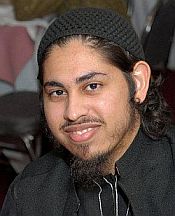 The fact that President Obama decided to target the US citizen Anwar Awlaki for extra-judicial execution, is a subject of considerable

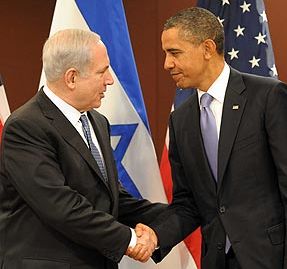 In case anyone is in any doubt that President Obama’s comments on the Israeli-Palestinian conflict, delivered to the UN General Assembly this morning, were nothing more than a string of worthless peace-process platitudes, then listen to the rave review he got from Israeli foreign minister
 The FBI has publicly declared that its counterterrorism training seminars linking “mainstream” Muslims to terrorists was a “one time only” affair that began and ended in April 2011. But two months later, the Bureau employee who delivered those controversial briefings gave a similar lecture to a gathering of dozens of law enforcement officials at an FBI-sponsored public-private partnership in New York City.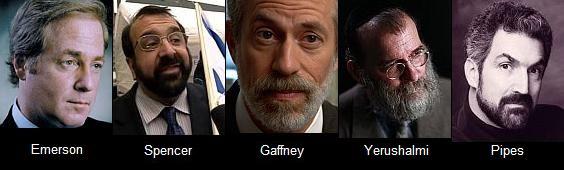

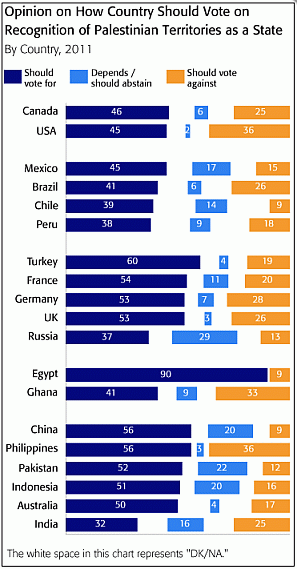 Here are some numbers President Obama should think about: Americans currently view him less favorably than they do UN recognition of Palestine!
