Category Archives: Analysis

Trump’s Syria policies could create a hotbed for ISIS to plan attacks

Mohamad Bazzi writes: Since Bashar al-Assad’s Syrian regime and its allies forced out the last rebels from eastern Aleppo and regained full control over Syria’s largest city, the six-year-old Syrian civil war has now entered a new phase. The next major battle will be to drive out the Islamic State group from the city of Raqqa, but that fight is far more dependent on the United States than Assad and his allies.

Donald Trump wants to stay out of Syria’s complicated war. But as soon as he’s inaugurated on Jan. 20, the new American president will face a crucial decision: Will he continue the Pentagon’s support and training for a coalition of Syrian rebel groups leading the offensive to oust ISIS from Raqqa, the capital of its self-proclaimed caliphate?

That campaign began Nov. 6 with a mobilization of some 30,000 rebels to encircle Raqqa and cut it off from all sides and deny ISIS the ability to resupply with weapons and fighters. The battle to push the Islamic State out of Raqqa could take months. If it falters under a fledging Trump administration, ISIS would continue to have a safe base from which it would unleash new terror attacks in Syria and Iraq, and inspire and possibly direct operations around the world.

After the fall of eastern Aleppo, there are signs of an emerging division of labor in Syria between the incoming Trump administration and that of Russian President Vladimir Putin. Russia would continue its intensive air strikes and logistical aid to help Assad recapture territory from rebels, while Washington would take the lead in the fight against ISIS. On Dec. 10, Defense Secretary Ashton Carter announced that the Pentagon would send 200 additional special forces to Syria — for a total of 500 US troops on the ground — to help train and advise Syrian opposition groups who are fighting ISIS, especially around Raqqa. [Continue reading…]

Facebooktwittermail

The most powerful men in the world

Masha Gessen writes: Russian President Vladimir Putin’s mode of public communication is the very opposite of Donald Trump’s: rather than tweet 140-character bursts, he stages elaborate, laboriously choreographed affairs that far outlast anyone’s attention span. He holds one press conference and one televised call-in show a year. Participants are pre-screened, question topics are pre-cleared, and many are pre-scripted. Each event usually lasts more than four hours. Each usually contains a memorable and informative passage that summarizes Putin’s current vision of himself in the world. There have been times when he positioned himself as the savior of a country on the brink of catastrophe, a conqueror, a victor. This year, in his press conference on December 23, he positioned himself as the most powerful man in the world.

Here is Putin’s scripted exchange with a state-media journalist (I am quoting both sides at length precisely because this is pre-written dialogue):

Journalist: Vladimir Vladimirovich, the world is undergoing a global transformation. We are witnessing nations expressing their will, voting against old political concepts, against the old elites. Britain voted to leave the EU, though we still don’t know how it’s going to play out. Many people are saying that Trump won because people were voting against the old elites, against faces that they are tired of seeing, among other reasons. Have you and your colleagues discussed these changes? What will the new global order be like? Remember, at the General Assembly, on the seventieth anniversary [of the United Nations], you said, “Can’t you see what you’ve done?” Where are we going? At this point we are still in the context of confrontation. The back-and-forth yesterday about whose military is stronger. During his last press conference your still-colleague Barack Obama said that 37 percent of Republicans like you and that Ronald Reagan is probably turning over in his grave.

Putin: What was that?

Journalist: 37 percent of Republican voters like you.

Putin: Really?

Journalist: Yes, and if Ronald Reagan knew, he’d be turning over in his grave. By the way, we as your voters are very pleased that you have such power, that you could even reach Ronald Reagan. Our Western colleagues often tell us that you can manipulate the world, pick presidents of your choosing, intervene in elections wherever you want. How does it feel to be the most powerful man in the world? Thank you.

Putin: I have addressed this issue on numerous occasions. But if you think that I need to do it one more time, fine, I will say it one more time. The current US government and the leadership of the Democratic Party are trying to blame all their failures on outside forces. I have some questions and a few ideas regarding this.

The Democratic Party lost not only the presidential election but also the election to the Senate, where Republicans have the majority, and to Congress, where Republicans have the majority. I wonder if that’s my accomplishment too. [Here Putin cracks a joke with a reference to a Soviet-era film about a hapless college student who gets in trouble and takes the blame for things he did as well as things he didn’t do.] None of this is true. All of it is testament to the fact that the current administration is facing systemic problems. I have talked about this before.

I think there is a gap between the elites and the broad masses, as we used to say in Soviet times, regarding what’s right and what’s wrong. The fact that a significant portion of, let’s say, Republican voters are supporting the Russian president is not something I take personal credit for. You want to know what I think? I think a large number of Americans share our ideas of what the world should be like, what we should be doing, where we face common dangers and problems. It’s good that there are people who share our understanding of traditional values, because it’s a good start for building relations between two countries as powerful as Russia and the United States, on this basis, the basis of mutual admiration of the people.

I wish they wouldn’t dredge up the names of their former leaders. I don’t know who would be turning over in his grave. I think Reagan would rejoice in the victory of his party and would be happy for the newly elected president, who had a fine understanding of societal mood and worked in that paradigm and went to the very end even though no one, except you and me, believed that he would win.

At this point Putin is interrupted by applause. After the break, he continues by chiding Democrats for being sore losers. Later in the press conference he dismisses the conclusions of the CIA that Russian intelligence services threw the American election through hacking, claiming (much as Donald Trump has done) that the hackers could have been anyone, including “someone lying on the couch or in bed.” But Putin is reveling in the idea that he is “the most powerful man in the world.” He is right: it doesn’t matter if Russian hacks were decisive in the election—what matters is that many people believe that they were. If Americans perceive Putin as the ultimate winner of the presidential race, then that is what he is. [Continue reading…]

Facebooktwittermail

NASA’s overlooked duty to look inward

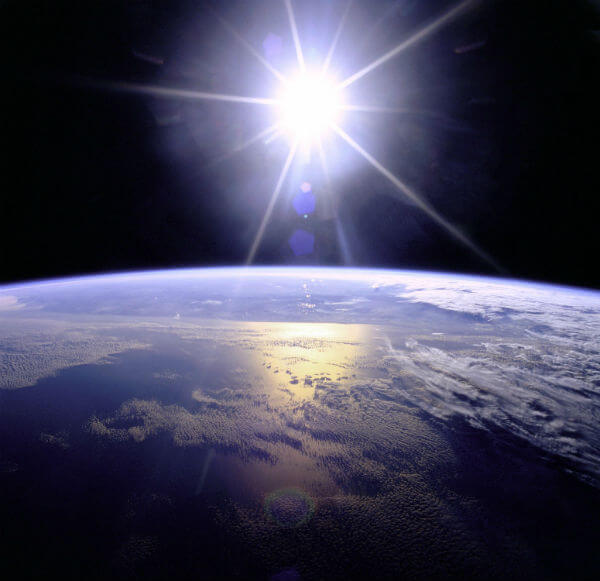
Elisa Gabbert writes: In 1942, not long after the attack on Pearl Harbor, the poet Archibald MacLeish wrote an essay called “The Image of Victory,” in which he asked what winning the Second World War, the “airman’s war,” would mean for posterity. MacLeish believed that pilots could do more than bring victory; by literally rising above the conflicts on the ground, they could also reshape our very understanding of the planet. “Never in all their history have men been able truly to conceive of the world as one: a single sphere, a globe, having the qualities of a globe, a round earth in which all the directions eventually meet, in which there is no center because every point, or none, is center — an equal earth which all men occupy as equals,” he wrote. The airplane, he felt, was both an engine of perspective and a symbol of unity.

MacLeish could not, perhaps, have imagined the sight of a truly whole Earth. But, twenty-six years after his essay appeared, the three-man crew of Apollo 8 reached the highest vantage point in history, becoming the first humans to witness Earth rising over the surface of the moon. The most iconic photograph of our planet, popularly known as “The Blue Marble,” was taken by their successors on Apollo 17, in 1972. In it, Earth appears in crisp focus, brightly lit, as in studio portraiture, against a black backdrop. The picture clicked with the cultural moment. As the neuroscientist Gregory Petsko observed, in 2011, in an essay on the consciousness-shifting power of images, it became a symbol of the budding environmentalist movement. “Our whole planet suddenly, in this image, seemed tiny, vulnerable, and incredibly lonely against the vast blackness of the cosmos,” Petsko wrote. “Regional conflict and petty differences could be dismissed as trivial compared with environmental dangers that threatened all of humanity.” Apollo 17 marked America’s last mission to the moon, and the last time that humans left Earth’s orbit.

It was always part of NASA’s mission to look inward, not just outward. The National Aeronautics and Space Act of 1958, which established the agency, claimed as its first objective “the expansion of human knowledge of phenomena in the atmosphere and space.” NASA’s early weather satellites were followed, in the seventies and eighties, by a slew of more advanced instruments, which supplied data on the ozone layer, crops and vegetation, and even insect infestations. They allowed scientists to recognize and measure the symptoms of climate change, and their decades’ worth of data helped the Intergovernmental Panel on Climate Change conclude, in 2007, that global warming is “very likely” anthropogenic. According to a report released last month by NASA’s inspector general, the agency’s Earth Science Division helps commercial, government, and military organizations around the world locate areas at risk for storm-related flooding, predict malaria outbreaks, develop wildfire models, assess air quality, identify remote volcanoes whose toxic emissions contribute to acid rain, and determine the precise length of a day. [Continue reading…]

Facebooktwittermail

Trump refuses to face reality about Russia

In an editorial, the Washington Post says: Although President Obama’s sanctions against Russia for interfering with the U.S. presidential election came late, his action on Thursday reflected a bipartisan consensus that penalties must be imposed for Moscow’s audacious hacking and meddling. But one prominent voice in the United States reacted differently. President-elect Donald Trump said “it’s time for our country to move on to bigger and better things.” Earlier in the week, he asserted that the “whole age of computer has made it where nobody knows exactly what is going on.”

No, Mr. Trump, it is not time to move on. U.S. intelligence agencies are in agreement about “what is going on”: a brazen and unprecedented attempt by a hostile power to covertly sway the outcome of a U.S. presidential election through the theft and release of material damaging to Democratic nominee Hillary Clinton. The president-elect’s dismissive response only deepens unanswered questions about his ties to Russia in the past and his plans for cooperation with Vladi­mir Putin.

For his part, Mr. Putin seems to be eagerly anticipating the Trump presidency. On Friday, he promised to withhold retaliatory sanctions, clearly hoping the new Trump administration will nullify Mr. Obama’s acts. Then Mr. Trump cheered on Twitter: “Great move on delay (by V. Putin) — I always knew he was very smart!”

For any American leader, an attempt to subvert U.S. democracy ought to be unforgivable — even if he is the intended beneficiary. Some years ago, then-Defense Secretary Leon Panetta warned of a “cyber-Pearl Harbor,” and the fear at the time was of a cyberattack collapsing electric grids or crashing financial markets. Now we have a real cyber-Pearl Harbor, though not one that was anticipated. Mr. Obama has pledged a thorough investigation and disclosure; the information released on Thursday does not go far enough. Congress should not shrink from establishing a select committee for a full-scale probe.

Mr. Obama also hinted at additional retaliation, possibly unannounced, and we believe it would be justified to deter future mischief. How about shedding a little sunshine on Mr. Putin’s hidden wealth and that of his coterie?

Mr. Trump has been frank about his desire to improve relations with Russia, but he seems blissfully untroubled by the reasons for the deterioration in relations, including Russia’s instigation of an armed uprising in Ukraine, its seizure of Crimea, its efforts to divide Europe and the crushing of democracy and human rights at home.

Why is Mr. Trump so dismissive of Russia’s dangerous behavior? Some say it is his lack of experience in foreign policy, or an oft-stated admiration for strongmen, or naivete about Russian intentions. But darker suspicions persist. Mr. Trump has steadfastly refused to be transparent about his multibillion-dollar business empire. Are there loans or deals with Russian businesses or the state that were concealed during the campaign? Are there hidden communications with Mr. Putin or his representatives? We would be thrilled to see all the doubts dispelled, but Mr. Trump’s odd behavior in the face of a clear threat from Russia, matched by Mr. Putin’s evident enthusiasm for the president-elect, cannot be easily explained.

Facebooktwittermail

How Russians pay to play in other countries

The New York Times reports: For a brief moment, it seemed that the powerful adviser’s head might roll at the Castle. After he lost his long legal battle over a hefty state fine, the Czech president warned him to pay up or lose his post.

Then a guardian angel materialized from Moscow.

Lukoil, the largest private Russian oil company in an industry dependent on Kremlin approval, stepped in to pay the nearly $1.4 million fine owed to a Czech court.

The aide, Martin Nejedly, stayed on as economic adviser to the Czech president, Milos Zeman, and vice chairman of his party. Perhaps more important, he retained his office right next to the president’s in the Castle, the official palace that looms over the capital, Prague.

But the payment last spring raised questions about Russian influence-buying in the Castle, where Mr. Zeman has staked out a position as one of the Kremlin’s most ardent sympathizers among European leaders.

“Unfortunately in the Czech Republic, some advisers to the president or the prime minister are willing to cooperate with the Russians,” said Karel Randak, who retired as head of the Czech foreign intelligence service in 2007. “I am not saying that they are Russian agents — but unfortunately for some people, the money is more important than the security of the Czech Republic.” [Continue reading…]

Facebooktwittermail

The world has finally called Israel’s bluff on its non-existent Palestinian peace process

Tony Karon writes: Israeli prime minister Benjamin Netanyahu has long based his settlement strategy on the assumption that the international community will ignore the plight of the Palestinians. But the United Nations proved him wrong on Dec. 23, passing Security Council resolution 2334, which reaffirms the longstanding UN ruling that all Israeli settlements built outside Israel’s pre-1967 borders violate international law.

Israel has reacted with predictable fury to the UN resolution, with Netanyahu engaging in theatrical attempts to humiliate the resolution’s supporters. Netanyahu has also jousted verbally with US secretary of state John Kerry over the Obama administration’s reasons for withholding its veto, presumably hoping to impress his domestic political audience with an almost comical display of assumed international authority.

But even though Israel has made it clear that the non-binding resolution won’t restrain its continued settlement construction on the ground, the tone of its response reflects a well-grounded anxiety over the potential consequences of renewed international engagement on the conflict.

Despite Netanyahu’s confidence that the incoming Trump administration will back Israel on its settlement enterprise, the fact that not a single Israeli ally voted against the resolution deals a staggering blow to the prime minister’s core belief that Israel can normalize its international standing while denying the rights of millions of Palestinians. Netanyahu frequently boasts of Israel’s diplomatic gains, claiming it has made common cause with Sunni Arab states against Iran. But these statements are based on the unspoken assumption that amid more dramatic developments elsewhere, the world will simply forget about the Palestinians’ plight. [Continue reading…]

Facebooktwittermail

U.S.-Venezuela relations will probably deteriorate under Trump. Ask ExxonMobil why

Timothy M. Gill writes: President-elect Donald Trump recently nominated ExxonMobil CEO Rex Tillerson to be secretary of state. That company and Venezuela have been hostile toward each other over the past decade — which means Tillerson’s nomination suggests that the United States and Venezuela have a tense relationship ahead.

Venezuela is in a stunning economic crisis, with triple-digit inflation, scarce food and medicine, and a weakening currency. The Venezuelan government blames all this on “economic war” waged by the United States and the Venezuelan opposition.

Over the past two decades, the United States and Venezuela have had a difficult relationship. Since the 1998 election of Hugo Chávez as president, Venezuela has criticized U.S. foreign policy, including the “war on terror”; promoted socialist and left-wing governments throughout Latin America; and sought to create a multipolar world by embracing anti-U.S. leaders in Belarus, Cuba, Iran and Russia. [Continue reading…]

Facebooktwittermail

Ceasefire in Syria: Turkish policy sets Syria on new path

Yezid Sayigh writes: If the ceasefire brokered by Russia and Turkey holds, it will be welcomed by most people in Syria – but the odds seem stacked against it.

Several previous ceasefires have collapsed, and new clashes have already broken out in several parts of the country amidst sharp differences in interpretation of the latest agreement by the Syrian opposition and the regime of Syrian President Bashar al-Assad.

But not all past ceasefire attempts have failed. And this time dramatic shifts in Turkish policy towards the Syrian conflict may alter everything.

Political investment by major external powers is clearly critical for any ceasefire deal to succeed.

The “cessation of hostilities” that was brokered by the US and Russia in February 2016 produced a major drop in levels of violence in all regime- and opposition-held areas for some two months.

Its eventual collapse was likely, but not inevitable.

Other, more localized ceasefires were mediated by Iran in the city of Homs in May 2014 and January 2015 and by Iran and Turkey in the large towns of Zabadani, Foah and Kefraya in September 2015.

These were flawed and highly coercive arrangements that had to be renegotiated repeatedly, but they allowed the evacuation of fighters and wounded and some supply of humanitarian assistance.

Russia and Turkey appear sufficiently invested politically to make the latest ceasefire work.

But in seeking to encompass all parts of Syria not under Islamic State control, they are hostage to the two parties that have the least stake in a general truce: the Assad regime and Jabhat Fateh al-Sham, formerly known as Jabhat al-Nusra until ending its formal affiliation to Al-Qaeda last July.

Their gradual military escalation and counter-escalation was the principal reason for the ultimate collapse of the February cessation of hostilities agreement.

Already, the Assad regime has claimed that the latest ceasefire does not include Jabhat Fateh al-Sham. But opposition spokesmen say the opposite: that only areas under IS control are excluded. [Continue reading…]

Facebooktwittermail

Trump and the climate: His hot air on warming is far from the greatest threat

By Andrew Revkin, ProPublica, December 29, 2016

President-elect Donald J. Trump has long pledged to undertake a profound policy shift on climate change from the low-carbon course President Obama made a cornerstone of his eight years in the White House.

“This very expensive GLOBAL WARMING bullshit has got to stop,” Trump tweeted a year ago.

In recent weeks, Trump doubled down, nominating champions of fossil fuels to several cabinet positions and peppering his transition team with longtime opponents of environmental regulations.

Both the rhetoric and the actions have provoked despair among many who fear a Trump presidency will tip the planet toward an overheated future, upending recent national and international efforts to stem emissions of heat-trapping carbon dioxide from burning coal, oil and natural gas.

But will a President Trump noticeably affect the globe’s climate in ways that, say, a President Hillary Clinton would not have?

In recent weeks, a variety of consultants tracking climate and energy policy have used models to help address that question. ProPublica asked Andrew P. Jones at Climate Interactive, a nonprofit hub for such analysis, to run one such comparison.

Continue reading

Facebooktwittermail

The right is emboldened but it’s not in the ascendancy

Gary Younge writes: When there’s a cloud this large and foreboding no lining, silver or otherwise, will suffice. This was a year in which vulgarity, divisiveness and exclusion won – a triumph for dystopian visions of race, nation and ethnicity. Those thought dangerous and marginal are now not only mainstream, they have power. Immigrants and minorities are fearful, bigots are emboldened, discourse is coarsened. Progressive alternatives, while available, have yet to find a coherent electoral voice. You can polish this turd of a year all you like – it won’t stop it stinking to high heaven.

But while the prospects for hope are scarce there is, none the less, one thing from which we might draw solace. The right is emboldened but it is not in the ascendancy. The problem is that the centre has collapsed, and liberalism is in retreat. There is nothing to celebrate in the latter but there is much to ponder in the former. It suggests that this moment is less the product of some unstoppable force than the desperate choice of last resort.

Americans did not turn their backs on a bright new future but on a candidate offering more of the same at a time when the gap between rich and poor and black and white is growing. Nor did most of them vote for Donald Trump. Not only did he get fewer votes than Hillary Clinton, but he got a lower proportion of the eligible vote than Mitt Romney in 2012, John McCain in 2008, John Kerry in 2004 and Al Gore in 2000 – all of whom lost.

Britain did back Brexit – no sugarcoating that. But voters didn’t reject the case for the EU because it was never really made. Nor was it a rejection of the case for immigration, because that was never made either. I don’t know whether remain would have prevailed if those cases had been made. Probably not. But since they weren’t made they could hardly have been defeated. Instead people were fed a diet of fear of the unknown from a political class that has failed them and gagged.

The right did not win the arguments: they won electoral contests because their principal opponents were too arrogant, complacent or contemptuous (and sometimes all three) to make an argument beyond “at least we’re not them”.

We are not set for an ideological assault like the early 80s, when Thatcherism provided a sharper understanding of the forces shaping our society than the left did. On both sides of the Atlantic, the right is deeply divided, intellectually incoherent and set to fail on its own terms. [Continue reading…]

Facebooktwittermail

If Donald Trump targets journalists, thank Obama

James Risen writes: If Donald J. Trump decides as president to throw a whistle-blower in jail for trying to talk to a reporter, or gets the F.B.I. to spy on a journalist, he will have one man to thank for bequeathing him such expansive power: Barack Obama.

Mr. Trump made his animus toward the news media clear during the presidential campaign, often expressing his disgust with coverage through Twitter or in diatribes at rallies. So if his campaign is any guide, Mr. Trump seems likely to enthusiastically embrace the aggressive crackdown on journalists and whistle-blowers that is an important yet little understood component of Mr. Obama’s presidential legacy.

Criticism of Mr. Obama’s stance on press freedom, government transparency and secrecy is hotly disputed by the White House, but many journalism groups say the record is clear. Over the past eight years, the administration has prosecuted nine cases involving whistle-blowers and leakers, compared with only three by all previous administrations combined. It has repeatedly used the Espionage Act, a relic of World War I-era red-baiting, not to prosecute spies but to go after government officials who talked to journalists.

Under Mr. Obama, the Justice Department and the F.B.I. have spied on reporters by monitoring their phone records, labeled one journalist an unindicted co-conspirator in a criminal case for simply doing reporting and issued subpoenas to other reporters to try to force them to reveal their sources and testify in criminal cases. [Continue reading…]

Facebooktwittermail

How a guy from a Montana trailer park overturned 150 years of biology

Ed Yong writes: In 1995, if you had told Toby Spribille that he’d eventually overthrow a scientific idea that’s been the stuff of textbooks for 150 years, he would have laughed at you. Back then, his life seemed constrained to a very different path. He was raised in a Montana trailer park, and home-schooled by what he now describes as a “fundamentalist cult.” At a young age, he fell in love with science, but had no way of feeding that love. He longed to break away from his roots and get a proper education.

At 19, he got a job at a local forestry service. Within a few years, he had earned enough to leave home. His meager savings and non-existent grades meant that no American university would take him, so Spribille looked to Europe.

Thanks to his family background, he could speak German, and he had heard that many universities there charged no tuition fees. His missing qualifications were still a problem, but one that the University of Gottingen decided to overlook. “They said that under exceptional circumstances, they could enroll a few people every year without transcripts,” says Spribille. “That was the bottleneck of my life.”

Throughout his undergraduate and postgraduate work, Spribille became an expert on the organisms that had grabbed his attention during his time in the Montana forests — lichens.

You’ve seen lichens before, but unlike Spribille, you may have ignored them. They grow on logs, cling to bark, smother stones. At first glance, they look messy and undeserving of attention. On closer inspection, they are astonishingly beautiful. They can look like flecks of peeling paint, or coralline branches, or dustings of powder, or lettuce-like fronds, or wriggling worms, or cups that a pixie might drink from. They’re also extremely tough. They grow in the most inhospitable parts of the planet, where no plant or animal can survive.

Lichens have an important place in biology. In the 1860s, scientists thought that they were plants. But in 1868, a Swiss botanist named Simon Schwendener revealed that they’re composite organisms, consisting of fungi that live in partnership with microscopic algae. This “dual hypothesis” was met with indignation: it went against the impetus to put living things in clear and discrete buckets. The backlash only collapsed when Schwendener and others, with good microscopes and careful hands, managed to tease the two partners apart.

Schwendener wrongly thought that the fungus had “enslaved” the alga, but others showed that the two cooperate. The alga uses sunlight to make nutrients for the fungus, while the fungus provides minerals, water, and shelter. This kind of mutually beneficial relationship was unheard of, and required a new word. Two Germans, Albert Frank and Anton de Bary, provided the perfect one — symbiosis, from the Greek for ‘together’ and ‘living’. [Continue reading…]

Facebooktwittermail

Why Russia-brokered Syrian ceasefire has chance of succeeding

Patrick Wintour writes: Labelled an international pariah only months ago by Boris Johnson, and warned he would be stuck in a Syrian quagmire by a patronising Barack Obama, Vladimir Putin ends 2016 if not as the undisputed victor, then at least as the man at the centre of decision making.

It is Moscow and not Washington that is calling the shots in the Middle East.

Reeling from its cold war defeat and the subsequent collapse of the Soviet empire, Moscow was unable to save Yugoslavia from what it termed western aggression.

But in the case of Syria, it can claim it has recovered its self-respect. In the process, it has built a brutal reputation for sticking by its friends, understanding the dynamics of the region better than America, and knowing how to use military power to forge diplomatic alliances.

The US, by contrast, ends 2016 out in the cold, holding a postmortem into the failure of its peace drive with Israel.

Many will rightly warn that experience in Syria shows ceasefires are fragile and do not lead to peace talks, let alone peace deals. But the unlikely Russian-Turkish peace drive has a propitious backdrop.

No single formula or manual exists for ending a civil war. But a sense of futility born of exhaustion, a decisive change in the military balance, a recasting of the key actors and a shift in the diplomatic alliances are all key ingredients, and in the case of the Syrian civil war all four factors exist.

After five years, hundreds of thousands of civilian deaths and the displacement of millions, the Syrian people have experienced the deepest depth of despair. Whatever democratic hopes led to the rebellion, those dreams seem further away than ever. [Continue reading…]

Charles Lister notes: “Although excluded from the negotiations, JFS/AQ [Jabhat Fateh al-Sham, formerly Jabhat al-Nusra] has said behind the scenes that it’ll abide by a ceasefire so long as it exists 100%.”

Facebooktwittermail

Trump could be Israel’s worst nightmare

Gregg Carlstrom writes: Netanyahu is a cautious politician. He prefers the status quo to dramatic steps. For all their personal animosity, Obama was actually a great help in this respect: Netanyahu invoked his name in Cabinet meetings like a father warning his unruly children about the boogeyman. He used the specter of an American response to deter the far-right impulses of his coalition partners. With Trump in office, he loses that ability.

In order to stay in power, Netanyahu will have to appease the growing chorus of voices on his right. Some of the extreme views in his Cabinet are no longer so extreme. For example, a November poll by the Israel Democracy Institute found that 44 percent of Israeli Jews support annexation of the full West Bank, with just 38 percent opposed. Perhaps more striking, a plurality does not believe the Palestinians living there should be granted equal rights. “That is, a small but significant minority of the Jewish public supports a situation that the international community regards as apartheid,” the pollsters noted.

Any move toward annexation would cause irreparable harm to Israel’s relationships with its closest allies. As Kerry said in his speech [on Wednesday], “if the choice is one state, Israel can either be Jewish or democratic, it cannot be both.”

In September, Netanyahu announced at the General Assembly that Israel had broadened its diplomatic relations, not just with traditional allies in the West, but with emerging powers and markets in Africa, Asia and Latin America. But many of these “new allies” were part of the 14 nations that voted unanimously for the resolution last week. Netanyahu speaks with Vladimir Putin more frequently than any Western leader, but Moscow voted in favor. He has spent years cultivating ties with tiny Senegal, which benefits from a major Israeli agricultural aid program. When it came time to vote at the Security Council, though, they supported the resolution.

And, at a news conference last year, Bennett said that Asian countries could become Israel’s closest friends, because they “lack a heritage of anti-Semitism” found in the West. But China and Japan backed the resolution, too. In fact, Asian diplomats in Tel Aviv tend to laugh when asked whether they would play a role as Israel’s protectors at the United Nations. “We’re not a very active player in this conflict, and I think that would continue to be the case,” one high-ranking Asian diplomat told me. “We want to maintain our distance and focus on other issues.”

Israel’s newest allies, in other words, are happy to increase trade, tourism and security cooperation — but when it comes to diplomacy, they won’t stick their necks out. And if the Netanyahu government provokes a stronger reaction from the U.N., they might even retreat.

Even more worrisome for Israel, however, is the growing alienation of American Jews, who find it more and more difficult to support a religious, right-wing government that they perceive as supporting Israeli racism and endless occupation. The tension between liberalism and Zionism, always lingering below the surface, has become more pronounced. And the Israeli government’s embrace of a president-elect (and his controversial political coterie) loathed by the vast majority of American Jews will only widen the chasm. [Continue reading…]

Facebooktwittermail

How Donald Trump served as a willing accomplice in the Russian email hacking operation

David Frum writes: The content of the Russian-hacked emails was actually remarkably unexplosive. Probably the biggest news was that Hillary Clinton had expressed herself in favor of a hemispheric common market in speeches to Wall Street executives. Otherwise, we learned from them that some people at the Democratic National Committee favored a lifelong Democrat for their party’s nomination over a socialist interloper who had joined the party for his own convenience. We learned that many Democrats, including Chelsea Clinton, disapproved of the ethical shortcomings of some of the people in Bill Clinton’s inner circle. We learned that Hillary Clinton acknowledged differences between her “public and private” positions on some issues. None of this even remotely corroborated Donald Trump’s wild characterizations of the Russian-hacked, Wikileaks-published material.

These Wikileaks emails confirm what those of us here today have known all along: Hillary Clinton is the vessel for a corrupt global establishment that is raiding our country and surrendering our sovereignty. This criminal government cartel doesn’t recognize borders, but believes in global governance, unlimited immigration, and rule by corporations.

Or:

The more emails WikiLeaks releases, the more lines between the Clinton Foundation, the secretary of state’s office and the Clintons’ personal finances—they all get blurred … I mean, at what point—at what point do we say it? Hillary Clinton is the most corrupt person ever to seek the office of the presidency.

Without Trump’s own willingness to make false claims and misuse Russian-provided information, the Wikileaks material would have deflated of its own boringness. The Russian-hacked material did damage because, and only because, Russia found a willing accomplice in the person of Donald J. Trump. [Continue reading…]

Facebooktwittermail

Open society needs defending

George Soros writes: Open societies are in crisis, and various forms of closed societies – from fascist dictatorships to mafia states – are on the rise. How could this happen? The only explanation I can find is that elected leaders failed to meet voters’ legitimate expectations and aspirations and that this failure led electorates to become disenchanted with the prevailing versions of democracy and capitalism. Quite simply, many people felt that the elites had stolen their democracy.

After the collapse of the Soviet Union, the US emerged as the sole remaining superpower, equally committed to the principles of democracy and free markets. The major development since then has been the globalization of financial markets, spearheaded by advocates who argued that globalization increases total wealth. After all, if the winners compensated the losers, they would still have something left over.

The argument was misleading, because it ignored the fact that the winners seldom, if ever, compensate the losers. But the potential winners spent enough money promoting the argument that it prevailed. It was a victory for believers in untrammeled free enterprise, or “market fundamentalists,” as I call them. Because financial capital is an indispensable ingredient of economic development, and few countries in the developing world could generate enough capital on their own, globalization spread like wildfire. Financial capital could move around freely and avoid taxation and regulation. [Continue reading…]

Facebooktwittermail

How the U.S. came to abstain on a UN resolution condemning Israeli settlements

The Washington Post reports: On Dec. 21, amid his morning workout, an afternoon round of golf and a family dinner with friends, President Obama interrupted his Hawaii vacation to consult by phone with his top national security team in Washington. Egypt had introduced a resolution at the U.N. Security Council condemning Israeli settlements as illegal, and a vote was scheduled for the next day.

The idea had been circulating at the council for months, but the abrupt timing was a surprise. Obama was open to abstaining, he said on the call, provided the measure was “balanced” in its censure of terrorism and Palestinian violence and there were no last-minute changes in the text.

Skeptics, including Vice President Biden, warned of fierce backlash in Congress and in Israel itself. But most agreed that the time had come to take a stand. The rapid increase of Israeli settlements in the West Bank and East Jerusalem, despite escalating U.S. criticism, could very well close the door to any hope of negotiating side-by-side Israeli and Palestinian states. Pending Israeli legislation would retroactively legalize settlements already constructed on Palestinian land.

The resolution’s sponsors, four countries in addition to Egypt, were determined to call a vote before Obama left office. A U.S. veto would not only imply approval of Israeli actions but also likely take Israel off the hook for at least the next four years during President-elect Donald Trump’s administration.

The United States, in discussions with New Zealand and indirectly with Egypt, insisted it would not even consider the matter unless the resolutions were more balanced to reflect criticism of Palestinian violence along with condemnation of Israeli settlements, according to U.S. officials.

The officials categorically denied Israeli allegations this week that the United States secretly pushed the resolutions. An Egyptian newspaper report alleging that Rice and Kerry met in early December with Palestinian negotiator Saeb Erekat and the head of Palestinian intelligence to plot the resolution was false, officials said. While Kerry and Rice met separately with Erekat during a visit here, they said, there was no intelligence official and no discussion of a resolution. [Continue reading…]

As far as these claims of orchestration go, the most likely collaboration going on has been between the offices of Prime Minister Netanyahu and Egyptian President Sisi. The Egyptians don’t want to get punished by Israel or the incoming Trump administration and thus duly conjured up or at least obligingly published a “leaked document.”

Facebooktwittermail