Category Archives: Analysis

How did Brazil go from rising BRIC to sinking ship?

By Steven M. Helfand, University of California, Riverside and Antônio Márcio Buainain, Universidade Estadual de Campinas

Most of the headlines in recent weeks have focused on Brazil’s troubling political crisis. But the country is also in the midst of a deep economic recession.

The economy has been shrinking since the second quarter of 2014. It contracted by 3.8 percent in 2015 and is expected to shrink by a similar amount this year. Earlier this month, the Organisation for Economic Co-operation and Development (OECD) said it sees the recession continuing into 2017.

Yet it was only in 2009 – in the middle of the global financial crisis – that the Economist magazine featured a story entitled “Brazil takes off,” with a photo of the Corcovado – the iconic statue of Christ that overlooks Rio de Janeiro – launching like a rocket. That article emphasized why Brazil deserved to be one of the “BRICs” – the rapidly growing economies including Russia, India and China that now account for nearly 25 percent of global GDP.

How could the outlook for Brazil have changed so rapidly? Is this sort of boom and bust unprecedented or a recurring theme in Brazil’s history?

In this article, we provide a historical perspective on the current economic crisis, relying on our own scholarship and years of analysis of the Brazilian economy.


Continue reading

Facebooktwittermail

Why the Western-backed assault on ISIS in Iraq and Syria is failing

Shiraz Maher writes: The first signs of a Western-backed attempt to recapture Raqqa, ­Islamic State’s de facto capital in Syria, came a fortnight ago when fighter jets dropped leaflets over the city telling residents to leave. “The time has come,” the warnings read, alongside an illustration of residents evacuating the city as incoming forces overran IS fighters.

Although up to half of Raqqa’s residents fled when IS first took control of the city in 2014, the militants have made it ­increasingly difficult for the people who stayed behind to leave. Following the US-led coalition’s warnings of an impending attack, however, the jihadis relaxed their restrictions on movement. Citizens were allowed to disperse into the nearby countryside. The idea was to spare them whatever onslaught was planned against Raqqa while keeping them within IS territory.

Ever since the latest offensive against IS began in Syria and Iraq in late May, it has become clear that the group will not concede territory easily around Raqqa – or elsewhere. It might lose small villages from time to time, but all of its major urban centres remain well fortified. Few observers expect them to fall any day soon. IS has too much invested in Raqqa, as well as Mosul in Iraq. Occupying the cities fuels the group’s prestige by projecting the impression of ­viable statehood and by allowing it to house fighters and military equipment. [Continue reading…]

Facebooktwittermail

Decades later, sickness among airmen after a hydrogen bomb accident

The New York Times reports: Alarms sounded on United States Air Force bases in Spain and officers began packing all the low-ranking troops they could grab onto buses for a secret mission. There were cooks, grocery clerks and even musicians from the Air Force band.

It was a late winter night in 1966 and a fully loaded B-52 bomber on a Cold War nuclear patrol had collided with a refueling jet high over the Spanish coast, freeing four hydrogen bombs that went tumbling toward a farming village called Palomares, a patchwork of small fields and tile-roofed white houses in an out-of-the-way corner of Spain’s rugged southern coast that had changed little since Roman times.

It was one of the biggest nuclear accidents in history, and the United States wanted it cleaned up quickly and quietly. But if the men getting onto buses were told anything about the Air Force’s plan for them to clean up spilled radioactive material, it was usually, “Don’t worry.”

“There was no talk about radiation or plutonium or anything else,” said Frank B. Thompson, a then 22-year-old trombone player who spent days searching contaminated fields without protective equipment or even a change of clothes. “They told us it was safe, and we were dumb enough, I guess, to believe them.”

Mr. Thompson, 72, now has cancer in his liver, a lung and a kidney. He pays $2,200 a month for treatment that would be free at a Veterans Affairs hospital if the Air Force recognized him as a victim of radiation. But for 50 years, the Air Force has maintained that there was no harmful radiation at the crash site. It says the danger of contamination was minimal and strict safety measures ensured that all of the 1,600 troops who cleaned it up were protected.

Interviews with dozens of men like Mr. Thompson and details from never before published declassified documents tell a different story. Radiation near the bombs was so high it sent the military’s monitoring equipment off the scales. Troops spent months shoveling toxic dust, wearing little more protection than cotton fatigues. And when tests taken during the cleanup suggested men had alarmingly high plutonium contamination, the Air Force threw out the results, calling them “clearly unrealistic.” [Continue reading…]

Facebooktwittermail

Brexit is being driven by English nationalism

Fintan O’Toole writes: The Brexit campaign is fuelled by a mythology of England proudly “standing alone”, as it did against the Spanish armada and Adolf Hitler. But when did England really stand alone? The answer, roughly speaking, is for 300 of the past 1,200 years. England has been a political entity for only two relatively short periods. The first was between the early 10th century, when the first English national kingdom was created by Athelstan, and 1016 when it was conquered by Cnut the Dane. The second was between 1453, when English kings effectively gave up their attempts to rule France, and 1603, when James VI and I united the thrones of England and Scotland.

Otherwise – and this includes all of the past 400 years – England has always been part of at least one larger entity: an Anglo-French kingdom, the United Kingdom in its various forms, a global empire, the European Union. The English are much less used to being left to their own devices than they think they are.

English nationalists can quite reasonably point out that many emerging nation states have even less experience of being a standalone, self-governing entity – my own country, Ireland, being an obvious example. The big difference is that other countries actually go through a process – often very long and difficult – of preparing themselves politically, culturally and emotionally for the scary business of being (to borrow a term from Irish nationalism) “ourselves alone”. In England, there is no process. A decisive step is about to be taken without acknowledging the path ahead. [Continue reading…]

Facebooktwittermail

Why has the far right made West Yorkshire a home?

The Guardian reports: In late January, a column of demonstrators marched in driving sleet through the West Yorkshire town of Dewsbury, chanting: “Britain First, fighting back.”

Although the group has amassed more than 1.4m Facebook likes, greater than any other UK political party, the number of actual boots on the ground for Britain First, a relative newcomer on the far-right scene, was not that impressive. Just 120 supporters assembled to march from the train station to the town hall, escorted by many police and jeered by many residents.

Yesterday Thomas Mair from the West Yorkshire town of Batley, a mile north of Dewsbury, appeared at Westminster magistrates court and was charged with the murder of MP Jo Cox.

There has been considerable speculation that the 52-year-old may have had links to far-right groups. Whatever the truth, there is no doubt that an extreme right-wing element has established a disturbing foothold in the post-industrial social landscape of West Yorkshire.

According to experts, at least seven far-right groups united by racist ideologies are active in the region, an area dominated by Leeds and Bradford. Activists pinpoint a hardcore cohort of 100 prominent individuals able to cite the broader backing of thousands of social-media supporters.

Among the far-right organisations in West Yorkshire are the virulently anti-Muslim English Defence League (EDL), which claims to have established “divisions” in Leeds, Huddersfield, Halifax and Dewsbury, along with the British Movement (BM), a small but ultra-violent group considered extreme even by the standards of the British far right.

Other organisations include National Action, a neo-Nazi nationalist youth movement that openly advocates violence and whose strategy document reportedly makes reference to Hitler.

The neo-Nazi National Front, which advocates repatriation for non-whites, has a presence. Anti-racism activists also point to the Britain Democratic Party, a modest organisation founded by a group of former BNP politicians including Andrew Brons, former MEP for Yorkshire and the Humber, who has hosted seminars on racial nationalism. The Yorkshire Infidels belong to a regional network of far-right nationalists whose marches have descended into violence. [Continue reading…]

Facebooktwittermail

Jo Cox, Brexit and the politics of hate

Daniel Trilling writes: The main threat of far-right attacks in recent years has come from men acting alone or in small groups. They may sympathize with fascist ideology, or they may have passed through the ranks of a far-right party at some point, but they are not acting on orders.

An attack like this, or a plot for one, is uncovered every few years — rare, but more common than many Britons would like to admit. In June 2015, a member of the neo-Nazi group National Action was convicted of the attempted murder of a South Asian man at a supermarket in Wales. In 2007, a former B.N.P. candidate was jailed for stockpiling explosives in anticipation of a coming “civil war” caused by immigration. In 1999, David Copeland, a neo-Nazi lone wolf, set off three nail bombs in London, targeting the black, gay and South Asian communities, killing three people and injuring more than 100.

These people may act independently, but their behavior and ideas are not shaped in a void. Far more people move through the periphery of far-right politics than formally join a party or organization. The details that have emerged about Mr. Mair’s life place him in this periphery: The Southern Poverty Law Center has reported that he was a longtime customer of Vanguard Books, the publishing arm of the National Alliance, an American neo-Nazi group. The police have reportedly found Nazi regalia and far-right literature at his house.

Social media has extended the far right’s reach. Sources tell me that Britain First has only a few hundred members. But its Facebook page has more than 1.4 million likes and churns out nationalist, Islamophobic and anti-immigration memes. “Saying UK borders are secure, open to 500 million people,” declares one meme, which displays a photo of the European Union’s flag, “is like saying my home is more secure with the doors and windows left open.” Another shows Muslims praying in the street in London and asks: “Is this what our war heroes died for?” Many of these are widely shared — and they often echo the coverage of immigration and ethnic minorities found in much of the British press.

This points to an uncomfortable truth: Far-right politics cannot be as easily cordoned off from the mainstream as people would like to believe. Fascists attach themselves to popular causes and drag the debate in their direction. Populists and parties of the center take note and then try to appeal to voters susceptible to the far right’s messages by taking xenophobic positions of their own. [Continue reading…]

Facebooktwittermail

Possible link to Jo Cox killing puts U.S. neo-Nazi group back into focus

The Guardian reports: Roaring up the gravel track on a Yamaha Grizzly ATV, Dave Pringle is wearing a long beard, ponytail, a camouflage hunting cap and shorts. His dark blue T-shirt says “Hillary for prison 2016”. His right arm has a tattoo with the words, “molon labe” – the ancient Greek battle cry, “Come and take them”.

Pringle, a gunsmith, is chief of staff at the National Alliance (NA), a fascist group that apparently sold books to Thomas Mair, the man charged with the murder of British MP Jo Cox. On Saturday, speaking to the Guardian over a padlocked gate at the organisation’s 364-acre “campus” in the Appalachian mountains, he denied all knowledge of Mair.

“If he bought the books from Amazon.com, could he be linked to [its founder] Jeff Bezos?” he demanded. “Lots of people buy books. I’ve been buying from New Vanguard [the NA’s propaganda arm] since 1989 and guess how many crimes I’ve committed? Zero.”

Pringle, 47, married with two teenage children, said of Cox’s death: “It’s a terrible thing. She was white, an Englishwoman with two children. What else can I say? Do I agree with her politics? Of course not. Do I think you guys need more Syrians in Britain? No.”

Once the most feared neo-Nazi group in the world, the NA is now something of a spent force. It never recovered from the death in 2002 of its founder, William Pierce, a leading white supremacist who advocated racial apartheid in America and was banned from the UK. His 1978 novel The Turner Diaries, about a survivalist who blows up the FBI and triggers a purge of Jewish and black people to create an Aryan fantasy world, inspired Oklahoma City bomber Timothy McVeigh and British “nail bomber” David Copeland. It was described by the FBI as “the bible of the racist right”. [Continue reading…]

Facebooktwittermail

The gay rights movement could take on the NRA — and actually win

Jennifer Carlson and David Pettinicchio write: It’s an all-too-familiar routine for Americans: mass shooting, dramatic calls for change, inaction. It happened when 20 schoolchildren were murdered at Sandy Hook Elementary School. When a dozen people were killed in an Aurora, Colo., movie theater. When almost three dozen were slaughtered at Virginia Tech.

But this time, things might be different. Not because of the record number of people killed in Orlando or because this heinous act was a terrorist attack, a hate crime and a mass shooting. It’s because the victims were part of a social movement with infrastructure and political know-how largely unmatched within the gun-control movement. It’s because the attack targeted gays — and their community is organized.

Today’s lesbian, gay, bisexual, transgender and queer coalition is made up of powerful groups able to mobilize at a moment’s notice, including the NOH8 Campaign, the Human Rights Campaign and PFLAG. This robust and multifaceted apparatus is one of the most effective political movements in recent American history. It has faced down obscene public indifference to gay lives (peaking with the AIDS epidemic), violence against LGBTQ people (who suffer more hate crimes than any other protected group), laws that criminalized gay sex (Bowers v. Hardwick was overturned only in 2003) and widespread intolerance. [Continue reading…]

Facebooktwittermail

Syria is Obama’s shame

Hisham Melhem writes: It was a moral rational Cri de Coeur for taking steps to end the carnage in Syria, but it was also grounded in equally clear and compelling strategic imperatives. For weeks, scores of State Department officers in Washington and in U.S. embassies in the Middle East have been circulating a draft of a sharply critical “dissent cable” of the Obama administration’s fickle policies towards the tragic war in Syria, and forcefully urging the United States to end its dithering and carry out military strikes if necessary to compel the Assad regime to end its systematic mass murder of Syrian civilians.

About two weeks ago the message titled Syria Policy was posted on the “Dissent Channel” signed by fifty one mostly middle ranking and junior officers who worked over the last five years on aspects of Syria policy, and who were exposed to the daily gut-wrenching accounts that came across their desks of the demoralizing and very depressing depredations, mostly from the Assad regime.

The Dissent Channel was set up during the Vietnam War as a vehicle for officers who had strong political and moral disagreements with official policies, to express their dissent to their senior officials without fear of retaliation.

Although the military recommendations in the dissent message are thoughtful and the signatories believe that “perhaps most critically, a more muscular military posture under U.S. leadership would underpin and propel a new and reinvigorated diplomatic initiative,” it is very unlikely that President Obama, who pursued half-heartedly and with stunning detachment several tentative, incomplete and contradictory approaches to Syria will fundamentally alter his current policy, which involves only criticizing the Assad policies but steering away from undermining him or his regime, and focus instead on containing the threat of ISIS. [Continue reading…]

Facebooktwittermail

Former Ambassador Robert Ford on the State Department mutiny on Syria

Robin Wright: What does the letter of dissent reflect?

Former Ambassador Robert Ford: Frustration at the State Department has come to a boil. People don’t write in the Dissent Channel every day. The cessation of hostilities in Syria has broken down completely. The bombings of hospitals in Aleppo and Idlib are a violation of every human norm — and that’s not including the barrel bombs and the chemical weapons. The effort to get a political deal is going nowhere. The Assad government has refused to make any serious concessions. It won’t let in food aid, in violation of U.N. resolutions. And the Americans are watching it all happen. So the Dissent Channel message is a reflection of frustration by the people who are responsible for conducting policy on the ground. I felt that way when I left—and that was after Geneva II, in January-February, 2014.

The existing policy is failing and will continue to fail. Why? I don’t sense, in the message, dissent from the strategic objective, which is a negotiated settlement of the Syrian civil war, but I sense a sharp disagreement with the tactics the Administration is or is not using. The dissent message says that, without greater pressure on the Assad government, it will be impossible to secure the compromises necessary to win a political agreement and end the war. The message says that the Administration needs to reconsider tactics to generate that pressure.

We all learned from Iraq that regime change is not the way to bring about positive political change. In the case of civil war, there needs to be negotiation between the opposition and the government. The question is how you increase the likelihood that it will succeed. And ever since Secretary Clinton and Sergei Lavrov concluded the communiqué, in June, 2012, Administration policy has failed to create the conditions necessary to succeed. [Continue reading…]

Facebooktwittermail

A war of brothers in Iraq: ‘I will kill him with my own hands’

The New York Times reports: In the days leading up to the storming of Falluja by Iraqi forces, Brig. Gen. Hadi Razaij, the leading Sunni police commander in the campaign, sat on a cot in an abandoned house near the front line. He described the resistance that lay ahead: a determined force of hundreds of jihadists that had months to prepare.

General Razaij’s presence on the battlefield shows that local Sunnis, and not just the Shiite forces that now dominate Iraqi politics, are fighting to liberate their own communities, and has helped tamp down fears that the battle for Falluja would heighten sectarian tensions.

He was dispassionate as he described the challenges, but for him the fight was personal, too. General Razaij’s brother stands accused of being a member of the Islamic State and is in a prison cell after being arrested at a checkpoint with a car full of explosives.

In northern Iraq, Nofal Hammadi, the governor-in-exile of Mosul, is working with the United States to plan for that city’s liberation from the Islamic State. He, too, has family in the fight: Mr. Hammadi’s brother is an Islamic State official, having appeared in a video pledging his allegiance to the terror group and disowning his brother.

Even as the central question of Iraq remains unanswered — whether the country’s Sunni minority and Shiite majority can ever peacefully coexist in a unified state — the experiences of General Razaij, Mr. Hammadi and others add a troubling corollary: It is not clear that Iraq’s divided Sunnis will ever be able to find peace among themselves after a conflict that in many ways is playing out as a war within families.

After all, when Iraqi Sunnis talk about fighting the Islamic State, it is not a discussion of some shadowy and unknowable force. It is about sons and brothers, nephews and neighbors. [Continue reading…]

Facebooktwittermail

Seeing beyond the Islamist extremism narrative in cases of Muslim attackers

Hannah Allam reports: Hours after Mohammad Abdulazeez fired 100 rounds into Chattanooga military offices, gunning down four Marines and a sailor before being killed by police, the emerging story was one of a “lone wolf” jihadist with possible ties to extremist groups abroad.

But Abdulazeez’s family made a decision that would quickly redirect the story of their son’s rampage last July in ways that didn’t happen after attacks in San Bernardino or, now, Orlando: They hired an attorney who turned the Chattanooga aftermath into a case study of what it takes to add nuance to a national tragedy involving a Muslim perpetrator.

The attorney, who asked that his name not be published because of the sensitivity of the case, first urged the parents to go public with a statement about their son’s history of depression, explaining that “the first thing you say is critical.” Convinced that Abdulazeez was no diehard jihadist, they also leaked the attacker’s suspected bipolar behavior, abuse of alcohol and painkillers, his struggle to stay employed, and how he faced bankruptcy and a drunken-driving charge.

The effect was immediate, with all major TV networks and newspapers pivoting from the terrorism angle to the shooter’s “troubled past.” The lesson, the attorney said, is that it’s hard – but not impossible – to make Americans see beyond Islamist extremism in cases of Muslim attackers.

“It would’ve been ‘ISIS lone wolf plans deliberate, premeditated attack on a military installation,’ ” the attorney said, imagining the headlines had the family not been up front about Abdulazeez’s struggles. “It would’ve been about the propaganda rather than the factors that converted that to action.”

That more nuanced public examination of Abdulazeez’s motivations remains the exception in a climate where fear of the Islamic State and other Muslim extremist groups seem to make the more simplistic jihadist storyline irresistible to news organizations and useful to politicians, according to interviews with attorneys, counter-terrorism analysts and representatives of civil liberties groups. Often, they said, that angle persists even with little or no evidence that the assailant was motivated by extremist ideology. [Continue reading…]

Facebooktwittermail

Troubled. Quiet. Macho. Angry. The volatile life of the Orlando shooter

The Washington Post reports: After a lifetime of angst and embarrassment, Omar Mateen was on the verge of realizing a longtime dream in the spring of 2007.

He was about to graduate from a Florida training academy that would put him on a path to being a police officer. He had left behind his youth as a pudgy, often-bullied kid to become a bulked-up bodybuilder. He was learning how to shoot a gun. Now it was all about to fall apart.

At a class barbecue, Mateen told a fellow cadet he was “allergic” to pork, and he got teased about it. Mateen blew up, recalled several cadets who were present, and said he couldn’t eat anything off the grill.

“I asked him if he was Muslim and he denied it,” Roy Wolf said. “I said, ‘It doesn’t matter to me if you are.’ . . . He got mad, really angry.”

A short while later — just a week after the Virginia Tech shooting that left 32 victims dead — Mateen asked a classmate whether he would report him if he brought a gun to campus, documents show. The next thing students knew, Mateen had been kicked out of the academy for a pattern of sleeping in class, plus the gun threat, which officials described in documents as “at best extremely disturbing.”

Mateen was never charged, and so the incident became one more anecdote in a life punctuated by many such moments, outbursts when his insecurities and inner conflict erupted into rage — a pattern culminating Sunday at a gay nightclub in Orlando in the worst shooting in U.S. history.

Mateen appeared conflicted about his religion and his sexuality, according to dozens of interviews with those who knew him. He married twice, each time to a woman he had met online, even though he also seemed drawn to gay life and culture. [Continue reading…]

Facebooktwittermail

Artificial intelligence: ‘We’re like children playing with a bomb’

The Observer reports: You’ll find the Future of Humanity Institute down a medieval backstreet in the centre of Oxford. It is beside St Ebbe’s church, which has stood on this site since 1005, and above a Pure Gym, which opened in April. The institute, a research faculty of Oxford University, was established a decade ago to ask the very biggest questions on our behalf. Notably: what exactly are the “existential risks” that threaten the future of our species; how do we measure them; and what can we do to prevent them? Or to put it another way: in a world of multiple fears, what precisely should we be most terrified of?

When I arrive to meet the director of the institute, Professor Nick Bostrom, a bed is being delivered to the second-floor office. Existential risk is a round-the-clock kind of operation; it sleeps fitfully, if at all.

Bostrom, a 43-year-old Swedish-born philosopher, has lately acquired something of the status of prophet of doom among those currently doing most to shape our civilisation: the tech billionaires of Silicon Valley. His reputation rests primarily on his book Superintelligence: Paths, Dangers, Strategies, which was a surprise New York Times bestseller last year and now arrives in paperback, trailing must-read recommendations from Bill Gates and Tesla’s Elon Musk. (In the best kind of literary review, Musk also gave Bostrom’s institute £1m to continue to pursue its inquiries.)

The book is a lively, speculative examination of the singular threat that Bostrom believes – after years of calculation and argument – to be the one most likely to wipe us out. This threat is not climate change, nor pandemic, nor nuclear winter; it is the possibly imminent creation of a general machine intelligence greater than our own. [Continue reading…]

Facebooktwittermail

Jo Cox murder suspect tells court his name is ‘death to traitors, freedom for Britain’; new indications of Britain First ties

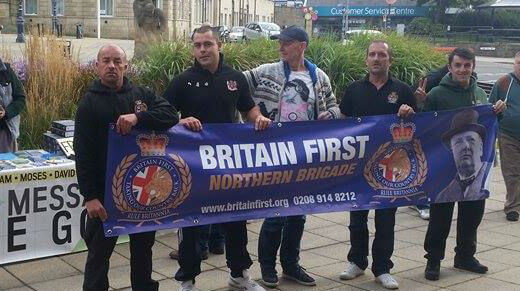
A photo of anti-Muslim protesters in Dewsbury which includes a man resembling Thomas Mair was posted on the Britain First Facebook page in October 2015. The man's identity has yet to be established.

A photo of anti-Muslim protesters in Dewsbury including a man resembling Thomas Mair was posted on the Britain First Facebook page in October 2015. The man’s identity has yet to be established.


The anti-Muslim, extreme right-wing, Britain First party, has disavowed any connection to Thomas Mair, the man who has been charged with murdering British MP Jo Cox.

When Mair appeared in Westminster magistrates court in London today, he answered the judge’s request to confirm his name by saying: “My name is death to traitors, freedom for Britain.”

The Guardian also reports:

The prosecution told the court that Mair told police he was “a political activist” as he was being arrested moments after the fatal attack. This assertion was repeated in a summary of crime released by the prosecution.

Mair also allegedly said “this is for Britain” and “keep Britain independent” as he stabbed and shot the MP for Batley and Spen, prosecutors said both in court and in their printed outline of the case.

Police searching Mair’s property found newspaper articles related to Cox, as well as far-right and white supremacist literature, they claimed.

Whatever assessment is made of Mair’s mental health, there seems to be no question that this was a politically motivated murder.

Witnesses to the murder reported that Mair shouted “Britain first” while attacking Cox.

The photograph above (which is circulating on social media) shows members of Britain First’s Northern Brigade in Dewsbury, West Yorkshire, just three miles away from Birstall where Cox was murdered. Whether the man in the baseball cap is indeed Mair remains unknown. But there is mounting evidence of Mair’s long-standing ties to right-wing extremism in the form of Nazi regalia found in his home along with literature on how to construct homemade guns and explosives.

Britain First recently organized an “activist training camp” in North Wales where its members “learned things including self-defence, martial arts, knife defence,” according to a report at WalesOnline.

In March, Britain First made clear its deadly hostility to EU supporters:

Deputy leader, Jayda Fransen, admonished their “pro-EU, Islamist-loving opponents” for “ruining our country”.

She added: “They think they can get away with ruining our country, turning us into a Third World country, giving away our homes, jobs and heritage, but they will face the wrath of the Britain First movement, make no mistake about it!

“We will not rest until every traitor is punished for their crimes against our country.

“And by punished, I mean good old fashioned British justice at the end of a rope!”

Facebooktwittermail

England and Wales are in the midst of a working-class revolt

John Harris writes: For the last five days I have been driving around England and Wales, filming scores of people as they talk about which way they’ll vote in the European Union referendum.

From ardent leavers in Merthyr Tydfil and undecided people on the English-Welsh borders to university students in Manchester who were 95% for remain, my Guardian colleague John Domokos and I have sampled just about every shade of opinion, and soaked up an atmosphere of often passionate political engagement. If a common journalistic pose is to roll one’s eyes and pronounce oneself impossibly bored with the whole thing, that is not where most people are at all.

Hardly anybody talks about the official campaigns, and the most a mention of the respective figureheads of each camp tends to elicit is a dismissive tut – but just about everyone agrees that this is a fantastically important moment, and a litmus test of the national mood.

What must David Cameron make of it all? This story is unfolding, let’s not forget, because of his ludicrous belief that a referendum might somehow definitively address the EU-related divisions in his own party and the public at large – as if a month or so of political knockabout under Queensberry rules could sort everything out, and the country could then go back to normal.

Fat chance, obviously: he now finds his Eurosceptic foes emboldened by a sense that many Conservative voters are on their side, while politicians of all parties – and Labour people in particular – are gripped by something that has been simmering away for the best part of a decade. To quote the opinion pollsters Populus: “Both socioeconomic groups C2 and DE disproportionately back the UK leaving the EU.” To be a little more dramatic about it, now that Scotland has been through its political reformation, England and Wales are in the midst of a working-class revolt. [Continue reading…]


Facebooktwittermail

From Great Britain to Little England

Neal Ascherson writes: In less than a week, the United Kingdom of Great Britain and Northern Ireland could be tearing up its European treaties and backing into Atlantic isolation.

The slogan “Take back control!” has been showing up everywhere in the last two weeks. It’s about sovereignty: the idea that unelected bureaucrats in Brussels, not the Westminster Parliament, make the laws of England. Above all, it means taking control of the country’s frontiers. This would break decisively with a sacred principle of the European Union: the free movement of people, which, for more than 20 years under the Schengen Agreement, has allowed Europeans to travel among member states without passport checks, and live and work in those countries with no visa requirements.

With fateful timing, the latest official figures for net migration to Britain, published at the end of May, showed the second-highest annual number on record, 333,000 in 2015; European Union nations accounted for more than half of that figure. This was far higher than government targets, and played directly into the Leave campaign’s refrain about “uncontrolled immigration.”

Is it a baseless panic? Many European countries tolerate far higher levels of immigration. Scotland, with a new community of some 55,000 Poles, actively encourages it. In England, support for Brexit and for the xenophobic U.K. Independence Party is often in inverse proportion to the scale of the problem: The fewer immigrants there are in a town, the louder the outcry against foreigners. In contrast, polling in inner London, where about four out of 10 inhabitants are now foreign-born, shows a clear preference for staying in Europe.

The English, normally skeptical about politics, have grown gullible. Both sides pelt the voters with forecasts of doom should the other side win. None are reliable, and the Leave figures have been especially deceitful. Remainers predict an economic armageddon of lost growth, a devalued pound and withered City of London. The Leavers’ Conservative leaders, assuming the mantle of a government in waiting, promise that “their” Britain could cover all the lost European subsidies and grants to farmers, poor regions, universities and schools. Evidence that they could find these additional billions is scant.

But there are deeper motives here than anxiety about the exchange rate or banks in London decamping to Frankfurt. Behind Brexit stalks the ghost of imperial exception, the feeling that Great Britain can never be just another nation to be outvoted by France or Slovakia. There’s still a providential feeling about Shakespeare’s “sceptred isle” as “this fortress built by Nature.” Or as an old Royal Marines veteran said to me, “God dug the bloody Channel for us, so why do we keep trying to fill it in?” [Continue reading…]

Facebooktwittermail