Carl Bildt, a former prime minister of Sweden, writes: With the old political landscape fading, we see the rise of parties in more or less fundamental opposition to the ideas and principles that have governed the West until now. The politics of ideology has faded, and the politics of identity has been gaining ground.
The rise of the nationalist right has been faster in Austria than in most other countries. It is obvious that it has been boosted significantly by legitimate revulsion against the old-fashioned system of Proporz. Change has been in high demand.
With faith in the future also waning in view of economic difficulties and rapidly changing societies, it has been easy for these forces to trumpet nationalist myths and gain adherents for their calls for closed borders and old values. The Muslim hordes are at the gates, they say; Brussels is just bureaucracy, trade is treason, and the United States is aggressive and alien. These have been the messages resonating in the valleys and on the plains of rural Austria.
While the politics in the past was about different ideas about a better future, this is about bringing protection against change and a future that many fear will be even more different. Previously you won elections by saying that tomorrow will be better than yesterday. These forces are promising to bring back a yesterday that they portray as better than the tomorrow they see coming.
Immigration is clearly one part of the story that Austria has had difficulties handling. But that voters in more diverse Vienna strongly rejected the siren songs of closed borders is a good sign in the darkness.
It was Karl Popper, born in Imperial Vienna, who not only conceived the ideas of open society but also warned of the “strain of civilization” that can occur when change is seen as too rapid, and the lure of a return to the tribe makes itself felt. [Continue reading…]
Category Archives: Analysis
Effort to expose Russia’s ‘troll army’ draws vicious retaliation
The New York Times reports: Seeking to shine some light into the dark world of Internet trolls, a journalist with Finland’s national broadcaster asked members of her audience to share their experience of encounters with Russia’s “troll army,” a raucous and often venomous force of online agitators.
The response was overwhelming, though not in the direction that the journalist, Jessikka Aro, had hoped.
As she expected, she received some feedback from people who had clashed with aggressively pro-Russian voices online. But she was taken aback, and shaken, by a vicious retaliatory campaign of harassment and insults against her and her work by those same pro-Russian voices.
“Everything in my life went to hell thanks to the trolls,” said Ms. Aro, a 35-year-old investigative reporter with the social media division of Finland’s state broadcaster, Yle Kioski.
Abusive online harassment is hardly limited to pro-Russian Internet trolls. Ukraine and other countries at odds with the Kremlin also have legions of aggressive avengers on social media.
But pro-Russian voices have become such a noisy and disruptive presence that both NATO and the European Union have set up special units to combat what they see as a growing threat not only to civil discourse but to the well-being of Europe’s democratic order and even to its security.
This “information war,” said Rastislav Kacer, a veteran diplomat who served as Slovakia’s ambassador to Washington and at NATO’s headquarters in Brussels, “is just part of a bigger struggle.” While not involving bloodshed, he added, it “is equally as dangerous as more conventional hostile action.” [Continue reading…]
Germany considers easing of Russia sanctions
Der Spiegel reports: With the Wednesday evening sun shining in his face, German Economics Minister Sigmar Gabriel is standing at the entrance to the HanseMesse convention center in the northern German city of Rostock. He’s surrounded by cardboard sandwich boards displaying the center’s motto: “Where the world comes together.” Today, the sentence is half true at best: The world isn’t coming together in Rostock, rather German and Russian business leaders are converging here. It is the second “Russia Day” and Gabriel is the keynote speaker.
The focus of the gathering is on business, but when Russia is involved, politics are never far away. Even Gabriel’s appearance sends a political message, as is his demonstratively friendly treatment of Russia’s industry minister — not to mention the first sentence he speaks into the microphone: “Isolation is not at all helpful.”
Later in his speech, Gabriel expands on that sentiment, saying isolation is not a tenable policy and that only continued dialogue is helpful. He says that Russia has recently shown that it can be a reliable partner and mentions the nuclear deal with Iran as an example. He says that Russia and the world are dependent on each other — and that the time has come for a step-by-step easing of sanctions.
Gabriel voiced a similar message prior to the most recent extension of the sanctions against Russia. Nothing came of it then, but things could be different this time.
As expected, G-7 leaders reiterated their hardline approach to Moscow in the Japan summit’s closing statement. Chancellor Angela Merkel complained last Thursday that there still isn’t a stable cease-fire in Ukraine and the law pertaining to local elections in eastern Ukraine, as called for by the Minsk Protocol, still hasn’t been passed. That, she said, is why “it is not to be expected” that the West will change its approach to Russia.
What Merkel didn’t say, though, is that behind the scenes, her government has long since developed concrete plans for a step-by-step easing of the sanctions against Russia and that the process could begin as early as this year. [Continue reading…]
America’s Middle East allies could win friends for ISIS
Hassan Hassan writes: The tortuous war against Isis is taking a treacherous turn. Two years after the militant Sunni group declared its brutal caliphate, the US and its allies in Iraq and Syria have begun a two-front offensive to dislodge the militant group from its strongholds in the Iraqi city of Fallujah and Raqqa in Syria. But, while the campaign has made progress, the composition of the forces leading the battles in the two Arab Sunni cities is intensifying sectarian and ethnic tensions in the bitterly divided nations and beyond. The danger is that the US-led action will, ultimately, help Isis gain legitimacy as a defender of Sunnis — even if it cedes territory.
Heightened fears in Syria, Iraq and the wider region about the offensive in Falluja and Raqqa bode ill for the long-term fight against the group. With western help channelled to militias beholden to the Shia regime in Iran and close to Tehran’s allies in Damascus, the fight is widely seen in the region as nakedly sectarian.
The US-backed offensive is the first of its kind since the American-led anti-Isis campaign began soon after the group swept into Iraq. America has long sought to avoid providing air support for Shia and Kurdish militias to fight in two Sunni areas at once: when Baghdad launched the battle to retake the city of Tikrit from Isis in March last year, Washington refrained from providing air strikes in support of the estimated 30,000 Shia fighters until the battle stalled three weeks later. [Continue reading…]
Should Israel negotiate with Hamas?
A skeptic bashing Skeptics
John Horgan, in a slightly edited version of a talk he gave recently at Northeast Conference on Science and Skepticism, writes: I hate preaching to the converted. If you were Buddhists, I’d bash Buddhism. But you’re skeptics, so I have to bash skepticism.
I’m a science journalist. I don’t celebrate science, I criticize it, because science needs critics more than cheerleaders. I point out gaps between scientific hype and reality. That keeps me busy, because, as you know, most peer-reviewed scientific claims are wrong.
So I’m a skeptic, but with a small S, not capital S. I don’t belong to skeptical societies. I don’t hang out with people who self-identify as capital-S Skeptics. Or Atheists. Or Rationalists.
When people like this get together, they become tribal. They pat each other on the back and tell each other how smart they are compared to those outside the tribe. But belonging to a tribe often makes you dumber.
Here’s an example involving two idols of Capital-S Skepticism: biologist Richard Dawkins and physicist Lawrence Krauss. Krauss recently wrote a book, A Universe from Nothing. He claims that physics is answering the old question, Why is there something rather than nothing?
Krauss’s book doesn’t come close to fulfilling the promise of its title, but Dawkins loved it. He writes in the book’s afterword: “If On the Origin of Species was biology’s deadliest blow to supernaturalism, we may come to see A Universe From Nothing as the equivalent from cosmology.”
Just to be clear: Dawkins is comparing Lawrence Krauss to Charles Darwin. Why would Dawkins say something so foolish? Because he hates religion so much that it impairs his scientific judgment. He succumbs to what you might call “The Science Delusion.” [Continue reading…]
Will Israel move from occupation to annexation?
Uri Savir writes: Israeli Prime Minister Benjamin Netanyahu’s surprising turn in appointing Avigdor Liberman, head of the right-wing Yisrael Beitenu party, as defense minister May 25 caught the international community off-guard. In the days before the appointment, intense deliberations took place about the upcoming Quartet report on obstacles in the way of a two-state solution and the Paris conference to relaunch a two-state process. The deliberations were based on the assumption that Netanyahu was on his way to enlarging his government with the moderate center-left Zionist Camp and Isaac Herzog as foreign minister in charge of peace negotiations.
A senior official at EU headquarters dealing with the Middle East peace process told Al-Monitor on condition of anonymity that there was a new, although brief, sense of optimism in European capitals that Netanyahu would, at the very least, engage in the beginning of a two-state solution process and restrain settlement expansion.
These intense international deliberations included exchanges over US Secretary of State John Kerry’s participation at the Paris conference, which has now been rescheduled for June 3. [Continue reading…]
As rich nations turn their backs on those in need

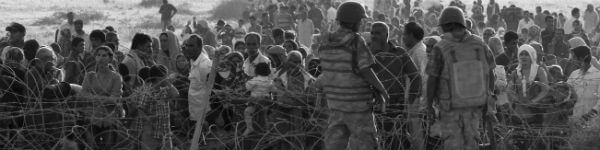
In an editorial, the New York Times says: The world is witnessing the largest exodus of refugees in generations, spawned by armed conflicts in the Middle East, North Africa and South Asia. But “witnessing” is perhaps the wrong word. Many world leaders, including those who run most of the richest countries, are choosing to look the other way. They are more interested in barricading their nations from the fallout of conflict than in investing in peacekeeping and stability.
This willful neglect was on display last week at the inaugural World Humanitarian Summit, convened to face the needs of the world’s most vulnerable people. Most heads of state from the richest nations — including the United States — didn’t bother to show up, drawing a rebuke from the United Nations secretary general, Ban Ki-moon.
“It’s disappointing that some world leaders could not be here, especially from the G-7 countries,” he said at a news conference on Tuesday. “We have reached a level of human suffering without parallel since the founding of the United Nations” 70 years ago. [Continue reading…]
Contrast Ki-moon’s words with the happy talk from Barack Obama two weeks ago when he gave the commencement address at Rutgers:
by almost every measure, America is better, and the world is better, than it was 50 years ago, or 30 years ago, or even eight years ago.
This assessment has I believe less to do with the dry statistical arguments made by the likes of Steven Pinker, than it has with the group-think inside the Obama administration.
The easiest way to counter criticism on Syria, with the refugee crisis, and elsewhere, is by insisting we did all that we could.
This self-administered anesthetic is designed to suppress remorse, guilt and a keen sense on personal responsibility.
Obama’s faith in inexorable progress derives from his refusal to “look backwards” — a conviction not unlike that of a hit-and-run driver who keeps his eyes firmly on the road ahead.
Likewise, the notion that the United States can extricate itself from its Middle East entanglements by simply walking away, is really no different from the attitude of a deadbeat father who thinks he can leave his past behind.
Our need to understand the past derives from our need to understand the present — it has nothing to do with (as Obama claims) a fear of the future.
The simplistic approach favored inside the White House reduces everything to a choice over which Obama had no control: the decision to invade Iraq.
Those who make that the beginning of history, have very often thereafter indulged in the conceit that by having personally opposed that misadventure, they can thereby shed any sense of collective responsibility for what followed — as though the neocons’ war never actually became America’s war.
What is ostensibly geographically circumscribed by a neat divide between domestic and foreign is really a separation between those things we claim as our own and those we don’t.
The convenient reflex to which most people are susceptible is simply to disown whatever becomes problematic.
We turn our backs on refugees because we prefer to believe that they are not our problem.
Trump’s rise part of global trend
The New York Times reports: Mr. Trump’s campaign has engendered impassioned debate about the nature of his appeal and warnings from critics on the left and the right about the potential rise of fascism in the United States. More strident opponents have likened Mr. Trump to Adolf Hitler and Benito Mussolini.
To supporters, such comparisons are deeply unfair smear tactics used to tar conservatives and scare voters. For a bipartisan establishment whose foundation has been shaken by Mr. Trump’s ascendance, these backers say, it is easier to delegitimize his support than to acknowledge widespread popular anger at the failure of both parties to confront the nation’s challenges.
But the discussion comes as questions are surfacing around the globe about a revival of fascism, generally defined as a governmental system that asserts complete power and emphasizes aggressive nationalism and often racism. In places like Russia and Turkey, leaders like Vladimir V. Putin and Recep Tayyip Erdogan employ strongman tactics. In Austria, a nationalist candidate came within three-tenths of a percentage point of becoming the first far-right head of state elected in Europe since World War II.
In Hungary, an authoritarian government has clamped down on the news media and erected razor wire fences to keep out migrants. There are worries that Poland may follow suit. Traditional parties in France, Germany, Greece and elsewhere have been challenged by nationalist movements amid an economic crisis and waves of migrants. In Israel, fascism analogies by a former prime minister and a top general have again inflamed the long-running debate about the occupation of Palestinian territories.
“The crash of 2008 showed how globalization creates losers as well as winners,” said Mark Leonard, the director of the European Council on Foreign Relations. “In many countries, middle-class wages are stagnant and politics has become a battle over a shrinking pie. Populists have replaced contests between left and right with a struggle between cosmopolitan elites and angry nativists.” [Continue reading…]
Iran-led push to retake Falluja from ISIS worries U.S.
The New York Times reports: American commandos are on the front lines in Syria in a new push toward the Islamic State’s de facto capital in Raqqa, but in Iraq it is an entirely different story: Iran, not the United States, has become the face of an operation to retake the jihadist stronghold of Falluja from the militant group.
On the outskirts of Falluja, tens of thousands of Iraqi soldiers, police officers and Shiite militiamen backed by Iran are preparing for an assault on the Sunni city, raising fears of a sectarian blood bath. Iran has placed advisers, including its top spymaster, Qassim Suleimani, on the ground to assist in the operation.
The battle over Falluja has evolved into yet another example of how United States and Iranian interests seemingly converge and clash at the same time in Iraq. Both want to defeat the Islamic State, also known as ISIS or ISIL. But the United States has long believed that Iran’s role, which relies on militias accused of sectarian abuses, can make matters worse by angering Sunnis and making them more sympathetic to the militants. [Continue reading…]
The graves of the Marines I lost
J. Kael Weston writes: Created after the Civil War, Memorial Day is an odd holiday, at once a solemn commemoration of those killed in war and a day of beach outings and backyard barbecues celebrating the start of summer. Rarely does it serve as a time to reflect on the policies that led to all those deaths.
While in Iraq and Afghanistan, I witnessed military officers and enlisted soldiers, at all ranks, being held accountable for their decisions. I have yet to see that happen with Washington policy makers who, far removed from the battlefields, benefit from our collective amnesia about past military and foreign policy failures.
The commander in chief and the senior military brass should leave the manicured grounds of Arlington and visit some of those places where most of America’s war dead are buried: farm towns, immigrant neighborhoods and working-class suburbs. At a time when fewer and fewer of us have any real ties to the military, how better to remind the nation that our troops are not just faceless volunteers, but people who live next door? [Continue reading…]
Behind Venezuela’s looming collapse
How would Trump ‘take the oil’?
Zack Beauchamp writes: In the past five years, Trump has consistently pushed one big foreign policy idea: America should steal other countries’ oil.
He first debuted this plan in an April 2011 television appearance, amid speculation that he might run for the GOP nomination. In the interview, Trump seemed to suggest the US should seize Iraqi oil fields and just operate them on its own.
“In the old days when you won a war, you won a war. You kept the country,” Trump said. “We go fight a war for 10 years, 12 years, lose thousands of people, spend $1.5 trillion, and then we hand the keys over to people that hate us on some council.” He has repeated this idea for years, saying during one 2013 Fox News appearance, “I’ve said it a thousand times.”
Trump sees this as just compensation for invading Iraq in the first place. “I say we should take it [Iraq’s oil] and pay ourselves back,” he said in one 2013 speech.
During the 2016 campaign, Trump has gotten more specific about how exactly he’d “take” Iraq’s oil. In a March interview with the Washington Post, he said he would “circle” the areas of Iraq that contain oil and defend them with American ground troops:
POST: How do you keep it without troops, how do you defend the oil?
TRUMP: You would… You would, well for that— for that, I would circle it. I would defend those areas.
POST: With U.S. troops?
TRUMP: Yeah, I would defend the areas with the oil.
After US troops seize the oil, Trump suggests, American companies would go in and rebuild the oil infrastructure damaged by bombing and then start pumping it on their own. “You’ll get Exxon to come in there … they’ll rebuild that sucker brand new. And I’ll take the oil,” Trump said in a December stump speech.
Trump loves this idea so much that he’d apply it to Libya as well, telling Bill O’Reilly in April that he’d even send in US ground troops (“as few as possible”) to fight off ISIS and secure the country’s oil deposits.
To be clear: Trump’s plan is to use American ground troops to forcibly seize the most valuable resource in two different sovereign countries. The word for that is colonialism.
Trump wants to wage war in the name of explicitly ransacking poorer countries for their natural resources — something that’s far more militarily aggressive than anything Clinton has suggested.
This doesn’t really track as “hawkishness” for most people, mostly because it’s so outlandish. A policy of naked colonialism has been completely unacceptable in American public discourse for decades, so it seems hard to take Trump’s proposals as seriously as, say, Clinton’s support for intervening more forcefully in Syria.
Yet this is what Trump has been consistently advocating for for years. His position hasn’t budged an inch, and he in fact appears to have doubled down on it during this campaign. This seems to be his sincere belief, inasmuch as we can tell when a politician is being sincere. [Continue reading…]
Ignoring the issue of whether this policy might be widely supported in the U.S. (I fear that large numbers of Americans, like Trump, may actually feel the U.S. is entitled to lay claim to Iraq’s oil), and ignoring the fact that Iraqis themselves would object to the theft of their resources, a problem that Trump seems to overlook is the reaction of the rest of the Gulf’s oil producing countries.
Rather than succeeding in taking the oil, what Trump would more likely accomplish is something that currently looks improbable: the formation of an alliance between Iran, Saudi Arabia and the other Gulf states, all of whom would feel threatened by Trump’s move. Not only would they feel threatened but they would also have the means to apply a stranglehold on the global oil supply by shutting down the Straits of Hormuz until Washington’s Pirate-in-Chief stepped back in line by respecting Iraq’s sovereignty.
What’s scarier than any of Trump’s outlandish proposals, is the fact that millions of Americans take him seriously.
The Morning They Came For Us by Janine di Giovanni – heroic dispatches from Syria
Robin Yassin-Kassab writes: Reading this book by the war correspondent Janine di Giovanni is at once necessary, difficult and elating. Her reporting from the Syrian revolution and war is clear-eyed and engaged in the best sense – engaged in the human realm rather than the abstractly political.
Giovanni’s account is deeply personal. She was once obsessed with Bosnian crimes; in the introduction, she says that Syria may similarly “engulf her”. She finds herself unable to trim her baby son’s nails for thinking of an Iraqi who’d had his ripped out. Later, accepting a cigarette pack from a student of human rights, she notes the old cigarette burns on his arms.
Her Syrian visits fell between March and December 2012. During the first, she describes an uneasy silence in central Damascus even as the suburbs burned. Class in this society is a more significant divider than religion, and the bi-national elite are in denial, spinning conspiracy theories and attending pool parties. In these “last days of a spoilt empire that was about to implode”, Giovanni delineates the two different kinds of regime “believer” – true devotees, and those simply scared of the alternatives. A few hundred frustrated UN monitors are confined to their hotel, and war is “descending with stunning velocity”.
The book continues by recounting the ramifications for Syrian civilians of Assad’s various scorched earth strategies. An estimated 200,000 people disappeared into the regime gulag. Most have experienced torture. “I struggle to remember a place where torture has been so widespread and systematic,” a Human Rights Watch official tells Giovanni, who sets about uncovering some of the individual stories, by means of interviews and recollections of beatings, burnings and cuttings, perpetrated to the torturer’s usual refrain: “You want freedom? Is this the freedom you want?” [Continue reading…]
Iran’s Rouhani may now control parliament, but do his economic reforms stand a chance?
By Nader Habibi, Brandeis University
Iranian President Hassan Rouhani and his policies are set to get a boost this week after voters elected a parliament that favors reform.
While Rouhani’s reformists didn’t win a majority of seats, it appears likely that the “moderate” independents also elected will side with his faction, giving the reformists an effective majority in the parliament for the first time since 2004.
So now that Rouhani may finally have the backing of parliament, will he be able to pursue the economic and social reforms he has promised since first taking office in 2013? And does this mean the nuclear deal that he helped champion will lead to an Iran that’s more open to foreign businesses and the West?
While a parliamentary majority helps – along with his general popularity – other power centers have enormous influence over economic policy, constraining Rouhani’s ability to implement reforms. These powerful institutions, such as the judiciary and the Revolutionary Guards, remain under the strong influence of Iran’s Supreme Leader Ayatollah Ali Khamenei, who also enjoys veto power over all executive and parliamentary decisions.
To reach these conclusions, I’ve drawn upon more than two decades of research on political and economic conditions in Iran.
Brazil: ‘Unhappy is the nation that needs heroes’
Bruno Cava writes: The fall of Dilma seems to demand an obvious reading on the part of the left. Again in the history of Latin America, a national-popular government is overthrown by the neocolonial elites. Again, the geopolitical attempt to build an alternative axis to the imperialism of Washington, this time through the BRICs, ends up crushed by a restoration of the conservatives. The history of coups d’etat again returns to the stage in the subcontinent, and an echo is heard of the coups of 1964 (Brazil), 1973 (Chile) and 1976 (Argentina), and the military uprising against Chavez in Venezuela (2002), or again the so-called “soft coups” against Zelaya in Honduras (2009) and Lugo in Paraguay (2012). This time the victims have been the largest mass party in the Americas, the biggest domino piece that now threatens the entire wave of progressive governments. There are more than enough signs to reinforce that interpretation. Taking to the streets in favour of the Partido de Trabalhadores (PT) are Lula, the MST (Movimiento de los Trabajadores Sin-Tierra, Landless Workers’ Movement) and a pantheon of leftist intellectuals, along with stars and red flags, exposing the immediate ramifications of the coup and denouncing it.
The end of the Workers Party’s 2003 to 2016 hold on federal government affects the current situation of those who feel themselves to be directly involved in the project. Regardless of what this “project” may mean, to admit its collapse is interpreted as the end of a worldview. As truncated and full of contradictions as it may be, when the curtain falls to end the petista play, the feeling that manifests is a mixture of melancholy and rage. So great was the hope placed in the PT that the present moment feels like the end of an era, and, shipwrecked with it, the left, progressivism, and every possible horizon of struggle. Future, present and past come together at a point where everything appears to gain depth and everything is put in doubt: not only who occupies the governmental seat will be decided, but also the social gains of the past two decades, the institutional legacy of the 1988 Constitution, and the memory of the struggles against dictatorship.
During the impeachment vote in Congress, parliamentarians repeatedly invoked sacred values and patriotic institutions in dramatic speeches. A deputy praised a torturer colonel of the 1964 regime, another proclaimed the end of the “lulopetista dictatorship” grounded in the Bolsa Familia (Family Allowance programme), described by another deputy as “creating paid vagrants”. Time constraints also impelled the opposing deputies to invoke the martyrs of the resistance, from Zumbi, the insurgent leader of the slaves, to Olga Benário, the communist deported from the Vargas dictatorship to the Third Reich and subsequently gassed. The dramatised scenes of the Brazilian parliamentary representation’s tableau vivant sounded like successive blows of theatre, jumping uncharacteristically from scene to scene.
It should provoke at least curiosity, in those less easily persuaded by histrionics and melodramatic effects, to qualify as a coup the procedure carried out under the country’s presidential constitution, foreseen precisely for the removal of an elected president, when the procedure itself is carried out to the letter and under the supervision of a supreme court composed of eleven members, eight of whom proposed by the PT governments. Or, that the person who will take the place of Dilma, if the impeachment is confirmed in October, will be the vice president who was elected along with her in 2014 and 2010. More than two thirds of MPs in both Brazilian legislative chambers voted to open the impeachment process, with an interval of nearly a month between the first and second deliberation, during which time government forces exercised their defence in forums and media and in the appropriate bodies, before which appeal after appeal were filed, in a microscopic dissection of the ritual. [Continue reading…]
Hope and hype of Hiroshima can’t conceal Obama’s dismal record on nuclear disarmament

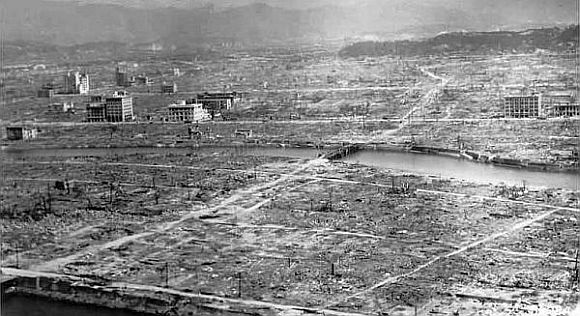
Setsuko Thurlow, who as a 13-year-old girl survived the atomic bombing of Hiroshima, writes: In [President Obama’s] famous speech in Prague, in 2009, he said, “As the only nuclear power to have used a nuclear weapon, the United States has a moral responsibility to act. We cannot succeed in this endeavor alone, but we can lead it, we can start it.”
Why then has the U.S. government, under the Obama administration, pledged $1 trillion over the next 30 years to modernize its nuclear arsenal? Exactly where is the moral responsibility and leadership in that?
Regarding disarmament, Obama stated, “Our efforts to contain these dangers are centered on a global nonproliferation regime, but as more people and nations break the rules, we could reach the point where the center cannot hold.” Why then are the U.S. and other nuclear weapon states actively boycotting the latest international nuclear negotiations? [Continue reading…]
Tim Wright writes: Under the Obama presidency, contrary to perceptions, the pace of nuclear warhead dismantlement has slowed, not hastened. Indeed, the two presidents Bush and Bill Clinton each made greater gains in downsizing the colossal US nuclear stockpile amassed during the cold war.
But more alarming than this failure to destroy old nuclear weapons has been the Obama administration’s aggressive pursuit of new, “smaller” ones, for which the threshold of use would be lower, according to former military commanders.
At great expense, the president has bolstered all three components of the nation’s “nuclear triad”: the strategic bombers, intercontinental ballistic missiles and submarine-launched missiles. This was the price paid for securing Republican support in 2010 for the ratification of a modest bilateral arms reduction treaty with Russia.
Obama’s much-publicised “nuclear security summits” largely ignored the greatest source of nuclear insecurity in the world today: 15,000 nuclear weapons, including 1,800 on hair-trigger alert. Instead, they focused on measures to keep “vulnerable nuclear material” out of terrorists’ hands – a vital endeavour, certainly, but for all the fanfare the results were small.
Now the United States is stridently resisting diplomatic moves by two-thirds of the world’s nations to declare nuclear weapons illegal. It boycotted UN talks in Geneva this month aimed at setting the stage for negotiations on a prohibition treaty. But it cannot veto this initiative, just as it could not veto the processes that led to bans on landmines in 1997 and cluster munitions in 2008.
While a prohibition on nuclear weapons will not result in disarmament overnight, it will powerfully challenge the notion that these weapons are acceptable for some nations. It will place them on the same legal footing as both other types of weapons of mass destruction – namely, chemical and biological weapons. [Continue reading…]
Debates about Hiroshima reduce the victims of 1945 to the role of extras in their own murders
Jeffrey Lewis writes: It’s not clear to me Truman had carefully thought through the implications of using the bomb or really understood that it might be a dramatic escalation from the enormous bombing campaign already underway. It is hard to assign simple motives to any large group of people, like “the United States.” Why “the United States” does anything is always a complicated story involving people working both with and against one other. In the case of Hiroshima, if anything, there was no decision to use the bomb, just an enormous amount of institutional momentum that rolled over haphazardly raised objections and qualms. I have a lot of objections to strategic bombing, and what John Hersey called the “material and spiritual evil” of total war, to say nothing of the racist propaganda required to facilitate killing on such a scale. But to postulate a geopolitical rationale for using the atomic bomb elides the awful human cruelty that was on display in 1945 and not just in Hiroshima.
And the revisionists have something else wrong, too. World War II was over — but it had not ended. If you study war and violence, you know that people continue killing each other even after the original justifications for the killing are obsolete. Japan’s leaders knew the war was lost, but that wasn’t quite enough to convince them to surrender. And Japan’s war cabinet was focused less on an imminent U.S. invasion than the more immediate problem of domestic subversion from the left if the conflict continued and from the right if it did not. The Japanese materials now available to scholars seem to show that Soviet entry into the war was the event that produced the biggest shock. And what turned the tide in Tokyo, which was divided over the issue of surrender, was the diplomatic note issued by U.S. Secretary of State James Byrnes that slightly softened the terms of Japan’s “unconditional” surrender. Even then, the story is a Japanese one. The historian Tsuyoshi Hasegawa argues that Japanese leaders interpreted the Byrnes note in a certain way because the translation into Japanese from the Foreign Ministry had been deliberately phrased to emphasize the possibility that Emperor Hirohito would remain in power.
But that’s a funny interpretation of Japan’s surrender, emphasizing people, places, and, above all, chance. Truman had his friend Jimmy Byrnes send a vague note, and a pair of obscure bureaucrats put a little English on the translation, so to speak. And that’s why your granddad didn’t die on some god-forsaken beach code-named after a car. That kind of account doesn’t really satisfy us, does it? Grand decisions require equally grand reasons. We want the story of the bomb to match the stakes in our own debates about who started the Cold War or the role that nuclear weapons played in our security. That’s because our debates about Hiroshima aren’t about understanding Truman, or the Japanese Foreign Ministry, or even the people who died. They are about ourselves.
Over time, the debate about the meaning of Hiroshima has shifted from responsibility for the Cold War to the question of whether we should plan, indefinitely, to base our security on the threat of nuclear destruction. Ward Wilson, in particular, has argued that the account of Hiroshima plays a central role in our modern myths about deterrence and the bomb as the winning weapon. [Continue reading…]