Category Archives: Analysis

How the event that killed off the dinosaurs wiped out life in Antarctica

By James Witts, University of Leeds

The Cretaceous–Paleogene mass extinction 66m years ago was the most recent of five similar crises to have devastated life on Earth over the last 540m years. It rapidly killed off an estimated 76% of species around the globe, including, most famously, the dinosaurs.

But exactly how this event affected different areas of the globe has not been entirely understood. Some scientists have suggested that creatures living at high latitudes could have been sheltered from the worst effects of the mass extinction. Now our new research, published in the journal Nature Communications, reveals that this wasn’t the case – even marine molluscs in Antarctica were affected.

Scientists are still debating what caused the extinction. Many researchers believe it was a sudden crisis, triggered by a catastrophic asteroid impact. This formed the 200km Chicxulub crater, today buried off Mexico’s Yucatan Peninsula. It also produced a thin layer of rock found all over the world known as the “K–Pg boundary”. This “fallout” layer is rich in debris from the asteroid impact and an element called Iridium, rare on Earth but common in space rocks. It coincides with many of the extinctions in the fossil record to within 32,000 years – a geological blink of an eye.

Continue reading

Facebooktwittermail

The easiest way to guess if someone supports Trump? Ask if Obama is a Muslim

Philip Klinkner writes: You can ask just one simple question to find out whether someone likes Donald Trump more than Hillary Clinton: Is Barack Obama a Muslim? If the answer is yes, 89 percent of the time that person will have a higher opinion of Trump than Clinton.

That’s more accurate than asking people if it’s harder to move up the income ladder than it was for their parents (54 percent), whether they oppose trade deals (66 percent), or if they think the economy is worse now than last year (81 percent). It’s even more accurate than asking them if they are Republican (87 percent).

Those results come from the 2016 American National Election Study (ANES) pilot survey. My analysis indicates that economic status and attitudes do little to explain support for Donald Trump. [Continue reading…]

Facebooktwittermail

The roots of Hitler’s power

Neal Ascherson writes: Thousands of people around us daydream about world conquest, fondle hate fantasies about what they might do to immigrants or jihadists, lap up conspiracy theories or impress their mates – after a pint or six – with bellowing rants about politicians or bankers. Most of them, fortunately, stay below the political radar. They lack a soil in which their urges can swell until they overshadow the earth. They lack the licence of Alasdair Gray’s Law of Inverse Exclusion (outlined in his novel Lanark), which ‘enables a flea in a matchbox to declare itself jailer of the universe’. And they lack a weapon.

But Hitler, hopping mad in his own matchbox, had all three. Fermenting Munich after a lost war and a failed revolution provided the soil, while his weapon was oratory: Hitler’s one tremendous gift and his only natural talent. One day in Munich, as a lecture to demobilised soldiers ended, the speaker noticed a knot of men in the emptying hall. They were listening ‘transfixed by a man who was speaking to them with growing passion and an unusual guttural voice’. The lecturer saw ‘a pale, drawn face underneath a decidedly unmilitary shock of hair, with a trimmed moustache and remarkably large, light-blue, fanatically cold, gleaming eyes’.

Hitler had an excellent voice, and his harsh ‘Austrian’ (actually Lower Bavarian) accent seems to have given North Germans an impression of sincerity rather than provincial uncouthness. But to read or listen to his speeches today is disconcerting: how could anyone have taken seriously such stagy bellowing and preposterous ideas? What we are missing now is not only the desperation and paranoia which his early audiences brought with them into the beer cellar or the stadium, but the tricks of Hitler’s trade. He required a strong warm-up before, deliberately late, he strode into the hall. He insisted where possible on seating that was spread horizontally before him rather than a narrow corridor reaching far back: this gave him as much close impact as possible. Cleverly, he channelled his own tendency to throw tantrums into a speech-style: beginning with long, droning and ostensibly sober recitals of fact and analysis, he would suddenly shift his voice upwards almost an octave, double its pace and explode into yelling demagogy. (I once saw Oswald Mosley do exactly this in the 1950s, and in spite of my contempt for all that he was saying, that sudden gearshift raised all the hairs on my neck.) His old trench comrade Max Amann saw him in 1919: ‘He yelled and indulged in histrionics. I’d never seen the like of it. But everyone said: “This fellow means what he says.” He was drenched in sweat, completely wet. It was unbelievable.’

The discovery of this gift of rhetoric, and the techniques to intensify its impact, set Hitler on his way. [Continue reading…]

Facebooktwittermail

The social scientists who talk to ISIS

Tom Bartlett writes: On a good day, driving to the front line of the war against the Islamic State carries some risk. This is not a good day: High winds have kicked up enough dust to dim the sun and hide nearby mountains, a thick haze that could provide cover for snipers or suicide bombers. While Kurdish soldiers, known as Peshmerga, meaning “those who face death,” have proved adept at keeping a determined foe at bay, they can’t prevent every incursion along a roughly 650-mile border, particularly when those sneaking in are willing, even eager, to die in the attempt.

The road to the front passes through tiny villages of cinderblock houses and over flat, green fields before giving way to rockier terrain as it winds southwest from Erbil, capital of Kurdistan, a country that doesn’t quite exist. It also passes through a series of military checkpoints where increasingly skeptical soldiers, ancient AK-47s slung over their shoulders, peer into a vehicle and ask its occupants — not unreasonably — where, exactly, they think they are going.

Phone calls must be made, documents presented. Satisfied, the soldiers step back and wave the car on.

“I am really worried,” says Lydia Wilson from the back seat. “This is the worst time to be going.” Wilson, a medieval historian by training, is not easily cowed. She’s visited military bases before, and she’s sat across a table from ISIS fighters. She’s just not keen on needless risk. Hoshang Waziri, this group’s translator and cultural ambassador, scans the blurred horizon and doesn’t like what he sees, either. It’s not the lobbed shell or the stray bullet that unnerves him so much as the prospect of getting kidnapped. “That’s what scares me,” he says. “The idea of falling into their hands.”

They spent the morning drinking strong black tea from small glass cups with a Kurdish official who, they hope, will grant them access to captured ISIS fighters, the holy grail of research subjects and, for obvious reasons, the toughest to track down. They explained to the official, as they explain to everyone, that they are not journalists angling for a story or government envoys pushing an agenda, but rather social scientists interested in knotty universal questions regarding the nature of human conflict. Answering such questions is difficult in part because of an established gap between expressed willingness and actual willingness; that is, between what people promise to do and, when it comes down to it, whether they pick up the gun or strap on the vest. Interviewing fighters engaged in combat or plucked from the battlefield has the neat advantage of eliminating that gap. Then the only question is: Why?

But getting to those fighters — that’s the trick. Weeks of planning can evaporate in an instant, forcing the researchers to improvise. Beyond the logistical aggravation, there’s the matter of personal safety. Where there are fighters, there is often fighting, and while the semi-autonomous Kurdish region of northern Iraq remains relatively sheltered compared with Syria or large swaths of southern Iraq, the proximity to bloodshed prompts understandable unease.

The least jittery member of the team is its leader, Scott Atran, an anthropologist who floats among several institutions, including the University of Michigan and the John Jay College of Criminal Justice, part of the City University of New York. He’s also a founder of the Centre for the Resolution of Intractable Conflict, at the University of Oxford. He’s normally the one arguing to go a little farther afield, to challenge the group’s comfort zone, perhaps to cross over into Syria. While sitting around the hotel he appears restless and testy, headed toward ISIS territory he is in his element, enlivened and unfazed. “We don’t want to drive off the road, because it’s probably mined on both sides,” he warns casually from the passenger seat, the way you might note a change in speed limit or a forthcoming rest stop. [Continue reading…]

Facebooktwittermail

What happens after ISIS?

The Daily Beast reports: Troops fighting ISIS appeared to on the verge of another victory over the self-proclaimed Islamic State Wednesday, as they moved into a city that has served as the main thoroughfare for ISIS foreign fighters and weapons. But the potential seizure of the Syrian city of Manbij by U.S.-backed forces is only likely to set off a new battle for control — this time pitting Arabs against Kurds.

The battle Wednesday reflected a growing problem for the U.S. and its push to train local fighters, even as those forces take territory from ISIS. Who exactly will govern those towns now? Will it be the Kurds who have led the fight against ISIS? Or will it be what some in the Pentagon have privately called the “token Arabs” trained by the U.S. to accompany them?

Two defense officials told The Daily Beast Wednesday they don’t know. They believe the Arabs would be in charge. But even these officials admit that asking the 5,000-or-so newly-trained Arab fighters to control three or more formerly ISIS-controlled areas — and at the same time move into the ISIS capital of Raqqa — would be difficult.

On the other hand, some worry that a Kurdish controlled Manbij could be ethnically cleansed, creating the kind of Sunni disenfranchisement that led to the rise of ISIS. The fall of Manbij into Kurdish hands, however, would give the Kurds a contiguous region in northern Syria. Moreover, a Kurdish controlled Manbij could draw the ire of U.S.-allied Turkey, which rejects a Kurdish controlled region on its border.

The question “what happens after ISIS?” looms increasingly over the U.S.-led effort. Indeed, defense officials said how the governance question is answered in Manbij could foreshadow the strategy for Raqqa, ISIS’s capital. Local U.S.-backed forces, accompanied by U.S. forces, have moved within 18 miles of the city in the last week. Over the Memorial Day weekend, one U.S. service member was injured while supporting the local fighters. [Continue reading…]

Facebooktwittermail

Is another Gaza war imminent?

Shane Harris writes: Israel ended its last military operation in Gaza almost two years ago. But among some Israeli military officials, national security experts, and activists here, there is a palpable sense that another war is imminent, and that soon Hamas rockets will again be raining down on Israeli cities, prompting a crushing military response on the beleaguered, 25-mile long strip.

The signs, to hear these people tell it, are plain to see: Despite Israeli efforts to increase the flow of goods in and out of Gaza, its economic health remains desperate. Hamas militants also may be under pressure to move now to strike Israeli neighborhoods along the Gaza border before a network of tunnels that gave them free entry into Israel is sealed up. Recent Israeli intelligence suggests that Hamas fighters have closely studied Israeli tactics from the last war, possibly in preparation for another conflict. And Israel’s new defense minister, sworn in this week, has threatened to assassinate the leader of Hamas, in turn prompting him to dare Israel to enter Gaza again.

“The feeling is now we’re on a countdown. There’s going to be another war,” said Sharon Stav, with the Movement for the Future of the Western Negev, an activist group whose members live in neighborhoods along the Gaza border and have been pressuring the Israeli government to find some diplomatic or humanitarian solution to the conflict with Hamas — anything short of another war. Stav and a colleague met with a delegation of U.S. and European visitors, which I joined, in the town of Netiv HaAsara, which came under daily rocket fire during the 2014 Gaza operations. The house where we met sits just feet from a guarded security barrier — a combination of concrete barricades and barbed wire fences — that seals Gaza off from Israel, at least above ground. [Continue reading…]

Facebooktwittermail

Militias in Libya advance on ISIS stronghold of Surt with separate agendas

The New York Times reports: Fighters aligned with Libya’s United Nations-backed unity government are advancing along the Mediterranean coast toward the Islamic State stronghold of Surt, signaling the first major assault on territory that, since last year, has become the terrorist group’s largest base outside of Iraq and Syria.

Two separate militia forces have fought their way toward the city in recent days, attacking from both the east and the west, in apparently uncoordinated attacks that have reduced the length of Libyan coastline controlled by the Islamic State to 100 miles from about 150 miles. On Wednesday, one of the militias claimed to have seized control of Surt’s power plant, 20 miles west of the city.

Those victories occurred in sparsely populated areas, and it was unclear whether the militias had either the strength or the will to push into Surt, which is thought to be heavily fortified and also harbor several thousand foreign fighters. But the advance did signal a new setback for the Islamic State, also known as ISIS or ISIL, at a time when it is already under concerted attack in Falluja, Iraq, and in parts of Syria.

Analysts and diplomats warn that while the offensive addresses the West’s biggest concern in Libya, it also risks destabilizing the fragile peace effort by fostering violent competition between rival groups.

“Only a year ago, these two groups were battling for control of the so-called oil crescent, and lobbying rockets and shells at one another,” said Frederic Wehrey, a Libya specialist at the Carnegie Endowment for International Peace, who visited that country recently. “Now they are converging on a common enemy, but the great fear is what comes next.” [Continue reading…]

Facebooktwittermail

How the U.S. flooded Iran with weapons

PRI reports: According to the arms transfers database of the independent international think tank, Stockholm International Peace Research Institute (SIPRI), which compiled all transfers of major conventional weapons in the world since 1950, the US was the largest arms exporter to Iran from the 1950s to 1970s.

The supply of arms from the US started to climb in 1953 after Iran’s democratically elected prime minister Mohammad Mosaddegh was overthrown in a coup engineered by the British and American intelligence services. The Iranian shah, Mohammad Reza Shah Pahlavi, returned from exile to rule and become a close ally of the US.

According to a Senate Committee on Foreign Relations staff report in 1976, Iran was the largest single purchaser of US military equipment then. Military sales had increased more than sevenfold from $524 million in 1972 to $3.91 billion in 1974.

SIPRI data shows that the amount rose and peaked in 1977. [Continue reading…]

Facebooktwittermail

Teaching ‘grit’ is bad for children, and bad for democracy

Nicholas Tampio writes: According to the grit narrative, children in the United States are lazy, entitled and unprepared to compete in the global economy. Schools have contributed to the problem by neglecting socio-emotional skills. The solution, then, is for schools to impart the dispositions that enable American children to succeed in college and careers. According to this story, politicians, policymakers, corporate executives and parents agree that kids need more grit.

The person who has arguably done more than anyone else to elevate the concept of grit in academic and popular conversations is Angela Duckworth, professor at the Positive Psychology Center at the University of Pennsylvania. In her new book, Grit: The Power of Passion and Perseverance, she explains the concept of grit and how people can cultivate it in themselves and others.

According to Duckworth, grit is the ability to overcome any obstacle in pursuit of a long-term project: ‘To be gritty is to hold fast to an interesting and purposeful goal. To be gritty is to invest, day after week after year, in challenging practice. To be gritty is to fall down seven times and rise eight.’ Duckworth names musicians, athletes, coaches, academics and business people who succeed because of grit. Her book will be a boon for policymakers who want schools to inculcate and measure grit.

There is a time and place for grit. However, praising grit as such makes no sense because it can often lead to stupid or mean behaviour. Duckworth’s book is filled with gritty people doing things that they, perhaps, shouldn’t. [Continue reading…]

Facebooktwittermail

How Neanderthal DNA helps humanity

Emily Singer writes: Early human history was a promiscuous affair. As modern humans began to spread out of Africa roughly 50,000 years ago, they encountered other species that looked remarkably like them — the Neanderthals and Denisovans, two groups of archaic humans that shared an ancestor with us roughly 600,000 years earlier. This motley mix of humans coexisted in Europe for at least 2,500 years, and we now know that they interbred, leaving a lasting legacy in our DNA. The DNA of non-Africans is made up of roughly 1 to 2 percent Neanderthal DNA, and some Asian and Oceanic island populations have as much as 6 percent Denisovan DNA.

Over the last few years, scientists have dug deeper into the Neanderthal and Denisovan sections of our genomes and come to a surprising conclusion. Certain Neanderthal and Denisovan genes seem to have swept through the modern human population — one variant, for example, is present in 70 percent of Europeans — suggesting that these genes brought great advantage to their bearers and spread rapidly.

“In some spots of our genome, we are more Neanderthal than human,” said Joshua Akey, a geneticist at the University of Washington. “It seems pretty clear that at least some of the sequences we inherited from archaic hominins were adaptive, that they helped us survive and reproduce.”

But what, exactly, do these fragments of Neanderthal and Denisovan DNA do? What survival advantage did they confer on our ancestors? Scientists are starting to pick up hints. Some of these genes are tied to our immune system, to our skin and hair, and perhaps to our metabolism and tolerance for cold weather, all of which might have helped emigrating humans survive in new lands.

“What allowed us to survive came from other species,” said Rasmus Nielsen, an evolutionary biologist at the University of California, Berkeley. “It’s not just noise, it’s a very important substantial part of who we are.” [Continue reading…]

Facebooktwittermail

In America, domestic extremists are a bigger risk than foreign terrorism

By David Alpher, George Mason University

Take America back from those who have stolen it.
Protect America from those who want to destroy it.
Restore the principles that these usurpers betrayed.

These are the messages that have defined the GOP presidential race. They have been used for the past eight years to justify obstruction of the Obama administration, and are now being used to paint the Democratic candidates as dangerous. In the late stages of the GOP primary as the rhetoric became increasingly xenophobic, they were applied to increasingly broad swaths of the American population as well.

Years of constant repetition by members of the GOP have given them an appearance of legitimacy, now strengthened by Donald Trump’s victory in the GOP primary contest and the party’s growing embrace of him as their standard-bearer.

Unfortunately, the Republican Party isn’t alone in using these messages.

Right-wing extremist groups use them as well, and to very specific ends: to define the conditions under which antigovernment violence becomes legitimate in their worldview.

I have spent nearly 15 years studying how the risk of violence grows within societies around the world, and running programs designed to stem the tide. I have seen rhetoric like this used to mobilize violence in countries like Iraq and Kenya.

This same dynamic, I argue, is taking shape within American society now. If it continues, it represents a greater threat than anything we face from terrorist groups outside our own borders.

Continue reading

Facebooktwittermail

Whither Jerry Brown goes, so will many Democrats

trump-bw

Todd S. Purdum writes: When an endorsement is as tepid as Jerry Brown’s — call it a non-endorsement endorsement — does it really make any difference at all? Perhaps not — except as a bellwether. The California governor’s eleventh-hour announcement on Tuesday that he’s supporting Hillary Clinton over Bernie Sanders, only a week before the biggest primary election in the presidential race, is emblematic of the months-long head-heart dilemma that has plagued the many Democrats who have a complicated history with the Clintons.

No one embodies this ambivalence, in fact, more than Jerry Brown himself, who a generation ago was seen more or less as the Bernie Sanders of his time. After all, it was Brown who, in the heat of his insurgent 1992 primary campaign for president against Bill Clinton, denounced him as “the prince of sleaze,” and described the work for the Arkansas state government of Hillary Clinton’s law firm as “a conflict of interest” and “a scandal of major proportion,” while carrying his candidacy to the bitter end at the Democratic National Convention in New York.

“I don’t care what you say about me, but you ought to be ashamed of yourself for jumping on my wife,” Bill Clinton told Brown in an angry Chicago debate in which the rivals pointed fingers in each other’s faces. “You’re not worth being on the same platform with my wife. I never funneled any money to my wife’s law firm. Never.”

Twenty-four years later, politics has once again made strange bedfellows — and Brown’s accommodation points to where many other progressive Democrats will likely end up, whether or not they are directly influenced by his action. It’s not that they like Hillary any better now than they did before, but much as the prospect of hanging concentrates the mind, the looming nomination of Donald Trump appears to supply the necessary nudge. If Hillary Clinton wins, it will be as part of a “Stop Trump” movement by many Democrats, nothing more. [Continue reading…]

Facebooktwittermail

Scientists have found yet another part of Antarctica that may be in trouble

Thwaites-ice-shelf

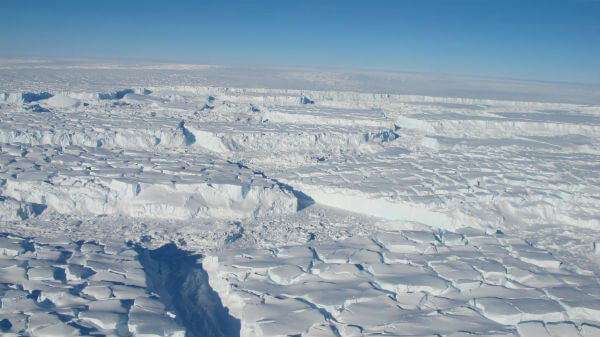
The Washington Post reports: The forces affecting the ice in West Antarctica are an area of urgent focus for climate scientists who are all too aware of the ice sheet’s huge potential contributions to global sea-level rise. A great deal of this attention has centered on a specific region bordering the Amundsen Sea, south of the Antarctic Peninsula, where research has suggested that a set of rapidly retreating glaciers — including the famous Thwaites and Pine Island glaciers — may be increasingly vulnerable to collapse.

But research is increasingly suggesting that the region is not the only area deserving of concern. Just last month, a new study suggested that the Totten Glacier in East Antarctica, which has typically been considered much less of a threat than West Antarctica, is also thinning quickly and has retreated inland by close to two miles in some areas. Overall, the glacier has the potential to raise sea levels by about 13 feet should it collapse.

And now, a new study just published in the journal Geophysical Research Letters has identified a new area of concern. The new research focuses on the Bellingshausen Sea region, an area just above the Amundsen Sea on the west side of the Antarctic Peninsula. Using four decades’ worth of satellite data, researchers have found that ice in this region has also experienced significant retreat, particularly since 1990, and could be a bigger threat than expected. [Continue reading…]

Facebooktwittermail

Nuclear plants, despite safety concerns, gaining support among environmentalists

The New York Times reports: Just a few years ago, the United States seemed poised to say farewell to nuclear energy. No company had completed a new plant in decades, and the disaster in Fukushima, Japan, in 2011 intensified public disenchantment with the technology, both here and abroad.

But as the Paris agreement on climate change has put pressure on the United States to reduce greenhouse gas emissions, some state and federal officials have deemed nuclear energy part of the solution. They are now scrambling to save existing plants that can no longer compete economically in a market flooded with cheap natural gas.

“We’re supposed to be adding zero-carbon sources, not subtracting,” Ernest Moniz, the energy secretary, said recently at a symposium that the department convened to explore ways to improve the industry’s prospects.

As a result, there are efforts across the country to bail out nuclear plants at risk of closing, with important test cases in Illinois, Ohio and New York, as well as proposed legislation in Congress.

Exelon, one of the country’s largest nuclear operators, for example, is deciding whether to close two of its struggling plants in Illinois after efforts to push a bailout through its Legislature fell apart.

Nuclear power remains mired in longstanding questions over waste disposal, its safety record after the catastrophes at places like Fukushima and Chernobyl, and the potential for its plants to be converted into weapon-making factories. In spite of the lingering issues, policy makers, analysts and executives, along with a growing number of environmentalists, say that at stake is the future of the country’s largest source of clean energy.

“Nothing else comes close,” Mr. Moniz, a nuclear physicist, said at the symposium. [Continue reading…]

Facebooktwittermail

Renewable energy surges to record levels around the world

BBC News reports: New solar, wind and hydropower sources were added in 2015 at the fastest rate the world has yet seen, a study says.

Investments in renewables during the year were more than double the amount spent on new coal and gas-fired power plants, the Renewables Global Status Report found.

For the first time, emerging economies spent more than the rich on renewable power and fuels.

Over 8 million people are now working in renewable energy worldwide.

For a number of years, the global spend on renewables has been increasing and 2015 saw that arrive at a new peak according to the report. [Continue reading…]

Facebooktwittermail

Almost all of Israel’s 32 women in parliament have been sexually harassed or assaulted

The Washington Post reports: Out of 32 female members of Israel’s parliament, called the Knesset, 28 say they have been sexually harassed or assaulted, and at least two say those experiences occurred in the Knesset itself, according to a new survey by an Israeli television channel.

The survey comes two weeks after 17 French members of parliament signed a column denouncing widespread sexual harassment and impunity in their workplace. In December, the Israeli interior minister and vice premier, Silvan Shalom, resigned after almost a dozen women, including one of his former employees, came forward with allegations of sexual harassment or assault.

The survey gave the lawmakers a chance to speak publicly about the perils of being a woman in Israeli politics.

“Even today, the fact that I’m a single woman in the Knesset puts me in unpleasant situations,” said Merav Ben Ari, a Knesset member from the centrist Kulanu political party. “Sometimes people make comments. … I don’t want to elaborate, but there was a situation recently in the Knesset, and I took care of it.” [Continue reading…]

Facebooktwittermail

Austerity continues spreading misery through Greece

Greece’s former finance minister, Yanis Varoufakis, writes: After last summer, when the clash between Greece’s Syriza government and the insolvent state’s creditors ended, the world’s media moved on. Greece’s rebellion against the austerity measures imposed on it was snuffed out in July 2015 when Prime Minister Alexis Tsipras folded.

Greece’s disappearance from the financial headlines since then has been seen as a sign that its economy has stabilized. Sadly, it has not.

Lest we forget, Greece had by 2015 already endured years of austerity. By 2013, more than a third of Greeks were living below the poverty line. By 2014, government wages and pensions had been cut 12 times in four years.

In comparative terms, by the proportion of national income diverted to reducing budget deficits, Greece had absorbed austerity measures almost nine times the magnitude of those imposed in Italy and about three times Portugal’s. The result? Between 2009 and 2014, Italy’s economy grew by a paltry 2 percent and Portugal’s contracted by 1 percent; in the same period, Greece’s national income dwindled by a catastrophic 26.6 percent — about the same as for America in the depths of the Great Depression. The result was a humanitarian disaster only a 21st-century John Steinbeck could adequately describe. [Continue reading…]

Facebooktwittermail

How philosophy came to disdain the wisdom of oral cultures

Justin E H Smith writes: A poet, somewhere in Siberia, or the Balkans, or West Africa, some time in the past 60,000 years, recites thousands of memorised lines in the course of an evening. The lines are packed with fixed epithets and clichés. The bard is not concerned with originality, but with intonation and delivery: he or she is perfectly attuned to the circumstances of the day, and to the mood and expectations of his or her listeners.

If this were happening 6,000-plus years ago, the poet’s words would in no way have been anchored in visible signs, in text. For the vast majority of the time that human beings have been on Earth, words have had no worldly reality other than the sound made when they are spoken.

As the theorist Walter J Ong pointed out in Orality and Literacy: Technologizing the Word (1982), it is difficult, perhaps even impossible, now to imagine how differently language would have been experienced in a culture of ‘primary orality’. There would be nowhere to ‘look up a word’, no authoritative source telling us the shape the word ‘actually’ takes. There would be no way to affirm the word’s existence at all except by speaking it – and this necessary condition of survival is important for understanding the relatively repetitive nature of epic poetry. Say it over and over again, or it will slip away. In the absence of fixed, textual anchors for words, there would be a sharp sense that language is charged with power, almost magic: the idea that words, when spoken, can bring about new states of affairs in the world. They do not so much describe, as invoke.

As a consequence of the development of writing, first in the ancient Near East and soon after in Greece, old habits of thought began to die out, and certain other, previously latent, mental faculties began to express themselves. Words were now anchored and, though spellings could change from one generation to another, or one region to another, there were now physical traces that endured, which could be transmitted, consulted and pointed to in settling questions about the use or authority of spoken language.

Writing rapidly turned customs into laws, agreements into contracts, genealogical lore into history. In each case, what had once been fundamentally temporal and singular was transformed into something eternal (as in, ‘outside of time’) and general. Even the simple act of making everyday lists of common objects – an act impossible in a primary oral culture – was already a triumph of abstraction and systematisation. From here it was just one small step to what we now call ‘philosophy’. [Continue reading…]

Facebooktwittermail