Category Archives: Analysis

President Trump fills world leaders with fear: ‘It’s gone from funny to really scary’

The Guardian reports: Dangerous, foolish, irrational, scary, terrifying, irresponsible, a clown, a disaster. These are just some of the words used to describe the prospect of a Donald Trump presidency by politicians, diplomats and analysts around the world.

As the businessman gave his first major policy address since becoming frontrunner for the Republican presidential nomination on Wednesday, Guardian correspondents in Washington and around the globe asked the international community whether it was prepared for the swaggering billionaire to occupy the White House.

Many said they still cannot believe the nation that elected its first black president just eight years ago will now rush to embrace a man who has offended Mexicans, Muslims and others. The possibility that Trump might actually win fills great swaths of the planet with dread – with the apparent and notable exception of Vladimir Putin’s Russia – with concerns over everything from trade to the nuclear trigger. [Continue reading…]

Facebooktwittermail

Trump’s ‘America First’ has ugly echoes from U.S. history

Susan Dunn writes:My foreign policy will always put the interests of the American people, and American security, above all else. That will be the foundation of every decision that I will make. America First will be the major and overriding theme of my administration.”

It is extremely unfortunate that in his speech Wednesday outlining his foreign policy goals, Donald Trump chose to brand his foreign policy with the noxious slogan “America First,” the name of the isolationist, defeatist, anti-Semitic national organization that urged the United States to appease Adolf Hitler.

The America First Committee actually began at Yale University, where Douglas Stuart Jr., the son of a vice president of Quaker Oats, began organizing his fellow students in spring 1940. He and Gerald Ford, the future American president, and Potter Stewart, the future Supreme Court justice, drafted a petition stating, “We demand that Congress refrain from war, even if England is on the verge of defeat.”

Their solution to the international crisis lay in a negotiated peace with Hitler. Other Yale students — including Sargent Shriver, who served in the Kennedy and Johnson administrations, and Kingman Brewster, the chairman of the Yale Daily News, future president of Yale and ambassador to the Court of St. James — joined their isolationist crusade. [Continue reading…]

Facebooktwittermail

Obama’s last chance to end the ‘forever war’

Jennifer Daskal writes: The United States is fighting an unauthorized war. Over the past 19 months, American forces have launched more than 8,800 strikes against the Islamic State in Iraq and Syria and hit the group’s affiliate in Libya. The United States continues aerial assaults against Al Qaeda in the Arabian Peninsula in Yemen, is going after militants in Afghanistan and Pakistan, and killed more than 150 suspected Shabab fighters in Somalia just last month.

This war isn’t limited to drone strikes or aerial bombings. It includes Special Operations forces in Iraq, Syria and Afghanistan — and possibly elsewhere. This past weekend, President Obama announced that he would send an additional 250 such troops to Syria.

The primary legal authority for these strikes and deployments comes from the 60-word Authorization for Use of Military Force, passed almost a decade and a half ago. In the days after Sept. 11, 2001, President George W. Bush asked for an open-ended authorization to fight all future acts of terrorism. Wisely, Congress rejected that request, though it did give the president authority to use force against those responsible for the Sept. 11 attacks, Al Qaeda, and those that harbored them, the Taliban.

Today, the Taliban no longer rules Afghanistan, Osama bin Laden has been killed and the other key participants in the Sept. 11 attacks are either locked up or dead. But the old authorization lives on. [Continue reading…]

Facebooktwittermail

House advances Email Privacy Act, setting the stage for vital privacy reform

Electronic Frontier Foundation: The U.S. House of Representatives passed the Email Privacy Act (H.R. 699) yesterday, which would require the government to get a probable cause warrant from a judge before obtaining private communications and documents stored online with companies such as Google, Facebook, and Dropbox.

The bill provides a long-overdue update to the Electronic Communications Privacy Act (ECPA), first passed in 1986. The bill also codifies the Sixth Circuit’s ruling in U.S. v. Warshak, which held that the Fourth Amendment demands that the government first obtain a warrant before accessing emails stored with cloud service providers.

The House vote is historic, given that H.R. 699 has an amazing 315 cosponsors, almost three quarters of the entire House. The House voted unanimously, following a unanimous vote by the House Judiciary Committee earlier this month. [Continue reading…]

Facebooktwittermail

Power matrix: Ranking Europe’s leaders and ambassadors

Politico reports: Who really sways the room when European Union leaders meet behind the closed doors of a summit?

In the chart below, we’ve plotted which national leaders are effective at combining forces with their ambassadors to the EU, to ensure power and influence.

In this analysis of what one ambassador calls “the conveyer belt between Brussels and national capitals,” you can see the relative strength of a country’s leader and ambassador, where the country is ranked overall, and whether its trajectory in the matrix is positive, neutral or negative based on likely events in the coming months.

The starting premise is the increasing importance in recent years of leaders’ summits and the “Coreper” meetings of ambassadors who prepare those gatherings and keep diplomacy ticking between them, relative to other ministerial meetings.

Among leaders, Germany’s Angela Merkel is without peer. That places an extra burden on ambassadors (known as “Permanent Representatives”) to help their countries keep the pace. Yet outside elite Brussels circles, few know which ambassadors matter or how well they work with their leaders. [Continue reading…]

Facebooktwittermail

Michael Klare: The coming world of ‘peak oil demand,’ not ‘peak oil’

In a Greater Middle East in which one country after another has been plunged into chaos and possible failed statehood, two rival nations, Iran and Saudi Arabia, have been bedrock exceptions to the rule.  Iran, at the moment, remains so, but the Saudi royals, increasingly unnerved, have been steering their country erratically into the region’s chaos. The kingdom is now led by a decrepit 80-year-old monarch who, in commonplace meetings, has to be fed his lines by teleprompter.  Meanwhile, his 30-year-old son, Deputy Crown Prince Mohammed bin Salman, who has gained significant control over both the kingdom’s economic and military decision-making, launched a rash anti-Iranian war in Yemen, heavily dependent on air power.  It is not only Washington-backed but distinctly in the American mode of these last years: brutal yet ineffective, never-ending, a boon to the spread of terror groups, and seeded with potential blowback.

Meanwhile, in a cheap-oil, belt-tightening moment, in an increasingly edgy country, the royals are reining in budgets and undermining the good life they were previously financing for many of their citizens.  The one thing they continue to do is pump oil — their only form of wealth — as if there were no tomorrow, while threatening further price-depressing rises in oil production in the near future.  And that’s hardly been the end of their threats.  While taking on the Iranians (and the Russians), they have also been lashing out at the local opposition, executing a prominent dissident Shiite cleric among others and even baring their teeth at Washington.  They have reportedly threatened the Obama administration with the sell-off of hundreds of billions of dollars in American assets if a bill, now in Congress and aimed at opening the Saudis to American lawsuits over their supposed culpability for the 9/11 attacks, were to pass. (It would, however, be a sell-off that could hurt the Saudis more than anyone.)  Even at the pettiest of levels, on Barack Obama’s recent arrival in Saudi Arabia for a visit with King Salman, they essentially snubbed him, a first for a White House occupant. All in all, a previously sure-footed (if extreme) Sunni regime seems increasingly unsettled; in fact, it has something of the look these days of a person holding a gun to his own head and threatening to pull the trigger. In other words, in a region already aflame, the Saudis seem to be tossing… well, oil onto any fire in sight.

And in a way, it’s little wonder.  The very basis for the existence of the Saudi royals, their staggering oil reserves, is under attack — and not by the Iranians, the Russians, or the Americans, but as TomDispatch energy specialist Michael Klare explains, by something so much larger: the potential ending of the petroleum way of life.  Tom Engelhardt

Debacle at Doha
The collapse of the old oil order
By Michael T. Klare

Sunday, April 17th was the designated moment.  The world’s leading oil producers were expected to bring fresh discipline to the chaotic petroleum market and spark a return to high prices. Meeting in Doha, the glittering capital of petroleum-rich Qatar, the oil ministers of the Organization of the Petroleum Exporting Countries (OPEC), along with such key non-OPEC producers as Russia and Mexico, were scheduled to ratify a draft agreement obliging them to freeze their oil output at current levels. In anticipation of such a deal, oil prices had begun to creep inexorably upward, from $30 per barrel in mid-January to $43 on the eve of the gathering. But far from restoring the old oil order, the meeting ended in discord, driving prices down again and revealing deep cracks in the ranks of global energy producers.

It is hard to overstate the significance of the Doha debacle. At the very least, it will perpetuate the low oil prices that have plagued the industry for the past two years, forcing smaller firms into bankruptcy and erasing hundreds of billions of dollars of investments in new production capacity. It may also have obliterated any future prospects for cooperation between OPEC and non-OPEC producers in regulating the market. Most of all, however, it demonstrated that the petroleum-fueled world we’ve known these last decades — with oil demand always thrusting ahead of supply, ensuring steady profits for all major producers — is no more.  Replacing it is an anemic, possibly even declining, demand for oil that is likely to force suppliers to fight one another for ever-diminishing market shares.

Continue reading

Facebooktwittermail

Why are your gut microbes different from mine?

Ed Yong writes: There are tens of trillions of bacteria in my gut and they are different from those in yours. Why?

This is a really basic question about the human microbiome and, rather vexingly, we still don’t have a good answer. Sure, we know some of the things that influence the roll call of species — diet and antibiotics, to name a few — but their relative importance is unclear and the list is far from complete. That bodes poorly for any attempt to work out whether these microbes are involved in diseases, and whether they can be tweaked to improve our health.

Two new studies have tried to address the problem. They’re the largest microbiome studies thus far published, looking at 1,135 Dutch adults and 1,106 Belgians respectively. Both looked at how hundreds of factors affect the microbiome, including age, height, weight, sleep, medical history, smoking, allergies, blood levels of various molecules, and a long list of foods. Both found dozens of factors that affect either the overall diversity of microbial species, or the abundance of particular ones. And encouragingly, their respective lists overlap considerably.

But here’s the important thing: Collectively, the factors they identified explain a tiny proportion of the variation between people’s microbiomes — 19 percent in the Dutch study, and just 8 percent in the Belgian. Which means we’re still largely in the dark about what makes my microbiome different from yours, let alone whether one is healthier than the other. [Continue reading…]

Facebooktwittermail

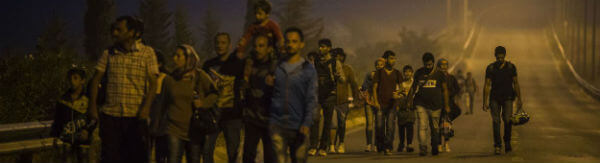
Europe’s failure on refugees echoes the moral collapse of the 1930s

refugees1

Patrick Kingsley writes: In 1938, representatives from 32 western states gathered in the pretty resort town of Evian, southern France. Evian is now famous for its water, but back then, the delegates had something else on their minds. They were there to discuss whether to admit a growing number of Jewish refugees, fleeing persecution in Germany and Austria. After several days of negotiations, most countries, including Britain, decided to do nothing.

On Monday, I was reminded of the Evian conference when British MPs voted against welcoming just 600 child refugees a year over the next half-decade. The two moments are not exactly comparable. History doesn’t necessarily repeat itself. But it does echo, and it does remind us of the consequences of ethical failure. Looking back at their inaction at Evian, delegates could claim they were unaware of what was to come. In 2016, we no longer have that excuse.

Nevertheless, both in Britain and across Europe and America, we currently seem keen to forget the lessons of the past. In Britain, many of those MPs who voted against admitting a few thousand refugees are also campaigning to unravel a mechanism – the European Union – that was created, at least in part, to heal the divisions that tore apart the continent during the first and second world wars.

Across Europe, leaders recently ripped up the 1951 refugee convention – a landmark document partly inspired by the failures of people such as the Evian delegates – in order to justify deporting Syrians back to Turkey, a country where most can’t work legally, despite recent legislative changes; where some have allegedly been deported back to Syria; and still more have been shot at the border.

Emboldened by this, the Italian and German governments have since joined David Cameron in calling for refugees to be sent back to Libya, a war zone where – in a startling display of cognitive dissonance – some of the same governments are also mulling a military intervention. Where many migrants work in conditions tantamount to slavery. Where three separate governments are vying for control. And where Isis runs part of the coastline.

In Greece, Europe’s leaders have forced the bankrupt government to lock up all arriving asylum seekers – and then reneged on a promise to help care for them, or move them to better-resourced countries elsewhere on the continent. The result is a dire situation on the Greek islands, where the world’s richest continent has contrived to jail babies, and then deny them access to adequate amounts of milk formula.

In Denmark, asylum seekers are forced to hand over valuables to pay for their stay, and volunteers have been prosecuted as smugglers for giving them lifts. In America, where boatloads of refugees were turned away from US ports in the 30s, more than 30 governors have refused to accept Muslim refugees. Some called for an outright ban on anyone fleeing a war that is ironically the partial result of catastrophic mistakes in American foreign policy over the past two decades. [Continue reading…]

Facebooktwittermail

Hillsborough: Anatomy of a disaster brought on by a failure in public service

The 1989 tragedy in which 96 Liverpool fans died while attending a football match in the North of England might to some distant observers sound like a local story of concern primarily to the bereaved and their fellow citizens, but what happened in Sheffield that day speaks to the wider issue of state powers and responsibilities as they are exercised in every democracy.

During an era in which politicians never tire of speaking solemnly about their duty for protecting national security against the threat of terrorism, the task of providing public safety now (as in the past) has much less to do with thwarting foreign and domestic threats, than it does with an ongoing commitment to public service. In turn, serving ordinary people hinges on viewing and treating them with respect.

The victims at Hillsborough were betrayed by authorities (and the media) which placed the protection of their own interests above those they were meant to serve.

The events leading up to the disaster are described in this video:

The Guardian reports: It was a year into these inquests, and 26 years since David Duckenfield, as a South Yorkshire police chief superintendent, took command of the FA Cup semi-final at Hillsborough between Liverpool and Nottingham Forest, that he finally, devastatingly, admitted his serious failures directly caused the deaths of 96 people there.

Duckenfield had arrived at the converted courtroom in Warrington with traces of his former authority, but over seven airless, agonisingly tense days in the witness box last March, he was steadily worn down, surrendering slowly into a crumpled heap. From his concession that he had inadequate experience to oversee the safety of 54,000 people, to finally accepting responsibility for the deaths, Duckenfield’s admissions were shockingly complete.

He also admitted at the inquests that even as the event was descending into horror and death, he had infamously lied, telling Graham Kelly, then secretary of the Football Association, that Liverpool fans were to blame, for gaining unauthorised entry through a large exit gate. Duckenfield had in fact himself ordered the gate to be opened, to relieve a crush in the bottleneck approach to the Leppings Lane turnstiles.

The chief constable, Peter Wright, had to state that evening that police had authorised the opening of the gate, but as these inquests, at two years the longest jury case in British history, heard in voluminous detail, Duckenfield’s lie endured. It set the template for the South Yorkshire police stance: to deny any mistakes, and instead to virulently project blame on to the people who had paid to attend a football match and been plunged into hell. [Continue reading…]

Facebooktwittermail

Hillsborough: At last, the shameful truth is out

By Jared Ficklin, University of Liverpool

Following two years of harrowing evidence, the verdicts in the inquest into the Hillsborough disaster in 1989 are a complete vindication of the 27-year campaign for justice for the 96 victims and their families. It is difficult to imagine the fortitude required to continue their fight for justice against the arrayed institutional might of the police, government and even sections of the media for so long.

But this fight for the truth did not take almost three decades, millions of pounds, and the longest court hearing in UK history because of its complexity. It was because within hours, the South Yorkshire police organised a conspiracy to protect themselves by defaming the dead and injured.

It is now clear that the police did not take blood from children to run alcohol tests or send a photographer to find empty beer cans because they wanted to understand what had really happened. It was simply to find any prop that could support the false narrative that the fans were drunk and abusive and were somehow responsible for their own deaths, and that the police had done their best under the circumstances.

We now know, from evidence heard at the inquest and admissions of senior police officers themselves, that this was so far from reality that the police had to collude to invent evidence. But even that wasn’t enough to hide the truth. There were thousands of fans there that day who knew what really happened – even in an age before everyone carried a phone with a camera, images existed that didn’t tally with the police’s claims.

But at the time the police had the most powerful allies there were: South Yorkshire police had been instrumental in breaking the miners’ strikes in 1984-1985, during which then prime minister Margaret Thatcher deployed them like her army in the north of England. The force also had form for blaming victims: we now know that South Yorkshire police had committed perjury during failed prosecutions of miners following the battle between police and strikers at Orgreave in 1984, and that senior officers were well aware of it and said nothing.

In 1989, the police needed support for their cover-up, and the Conservative government was happy to help. Thatcher herself toured the ground the morning after the disaster, and was aware that privately there were serious questions about the police propaganda, but it didn’t stop her government from backing the police. Her press secretary, Bernard Ingham, relied upon what he was told about the disaster by the police and blamed “tanked-up yobs” for the deaths. “Liverpool,” he later said, “should shut up about Hillsborough.”

Continue reading

Facebooktwittermail

Paris terror suspect views life like Grand Theft Auto video game, says his lawyer

Ishaan Tharoor writes: Salah Abdeslam, the 26-year-old French national of Moroccan origin suspected of involvement in November’s terrorist attacks in Paris, was transferred to French custody by Belgian authorities Wednesday. According to French officials, he’ll be placed in solitary confinement in a maximum-security facility as investigative judges determine his eventual charges.

Abdeslam, as my colleague James McAuley noted, was seized March 18 in the troubled Brussels neighborhood of Molenbeek, which is home to a large, impoverished Muslim minority population. He was arrested for his suspected role in the Paris attacks, which claimed 130 lives, but his capture also preceded — and potentially inspired — a grim set of bombings in Brussels on March 22. Both assaults were believed to have been carried out by proxies of the Islamic State extremist group.

In an interview with the French daily Liberation, Sven Mary, Abdeslam’s Belgian attorney, heaped opprobrium on his departing client, whom Mary described as having “the intelligence of an empty ashtray — an abysmal emptiness.” [Continue reading…]

Facebooktwittermail

What cyberwar against ISIS should look like

Fred Kaplan writes: Pentagon officials have publicly said, in recent weeks, that they’re hitting ISIS not only with bullets and bombs but also with cyberoffensive operations. “We are dropping cyberbombs,” Robert Work, deputy secretary of defense, is quoted as proclaiming in Monday’s New York Times. Similar, if less colorful, statements have been made by Secretary of Defense Ash Carter and,a week ago, President Obama.

What does it mean? And what effects are these new weapons having on the overall war? After dropping his “cyberbombs” bombshell, Work said, “We have never done that before.” But in fact, the United States has done it before, against Iraqi insurgents, including al-Qaida fighters, back in 2007. And, as I discovered while researching my book Dark Territory: The Secret History of Cyber War, the effects were devastating.

Standard accounts have credited President George W. Bush’s troop surge and Gen. David Petraeus’ counterinsurgency strategy for turning the Iraq conflict in the coalition’s favor in 2007. These accounts aren’t wrong, as far as they go, but they leave out another crucial factor — cyberoffensive warfare, as conducted by the Joint Special Operations Command and the National Security Agency. [Continue reading…]

Facebooktwittermail

The CIA kidnapper facing jail in Italy

The Daily Beast reports: Former CIA employee Sabrina De Sousa, now fighting extradition from Portugal to Italy, was skiing on a mountainside far away from the action, on Feb. 17, 2003, when Hassan Mustafa Osama Nasr was snatched off a street in Milan on his way to the mosque. The cleric, known as Abu Omar, was first flown by executive jet to Germany and then to Cairo, where he was tortured for nearly seven months, according to his own testimony and Amnesty International accounts.

The kidnap was part of the infamous “extraordinary rendition” program being run at the time by the United States. The CIA was grabbing suspected terrorists from all over the world and shipping them to various countries, including Bashar al-Assad’s Syria, Muammar Gaddafi’s Libya, and Hosni Mubarak’s Egypt, to suffer the tortures of the damned and in some cases execution.

Begun under President Bill Clinton, the rendition program developed with a vengeance under President George W. Bush after the Sept. 11 terrorist attacks in America. And Abu Omar’s kidnapping took place only weeks before the U.S.-led invasion of Iraq, when the Bush administration was anxious to prove some link between Iraqi dictator Saddam Hussein and the 9/11 attacks. (None existed.)

Abu Omar was believed to have funneled jihadists into the ranks of Abu Musab al-Zarqawi, who was then operating out of northern Iraq and later founded the organization Al Qaeda in Iraq, that evolved into the so-called Islamic State. Italian authorities, backed by the CIA, believed he was plotting to blow up a busload of American students who attended an international high school in Milan. [Continue reading…]

Facebooktwittermail

Inside Trump adviser Manafort’s world of politics and global financial dealmaking

The Washington Post reports: Paul Manafort was hired by Donald Trump to bring the wisdom of an old Washington hand to a campaign of political novices and provide expertise on the arcane art of counting convention delegates.

But beneath the image of a campaign wise man is a more complex picture of a veteran consultant who has pursued parallel careers as a lobbyist, political adviser and global dealmaker. He has parlayed political relationships around the world into an array of intricate financial transactions with billionaire oligarchs and other controversial investors that have at times spurred legal disputes.

In one case, Manafort tried unsuccessfully to build a luxury high-rise in Manhattan with money from a billionaire backer of a Ukrainian president whom he had advised.

In another deal, real estate records show that Manafort took out and later repaid a $250,000 loan from a Middle Eastern arms dealer at the center of a French inquiry into whether kickbacks were paid to leading politicians in a 1995 presidential campaign.

And in another business venture, a Russian aluminum magnate has accused Manafort in a Cayman Islands court of taking nearly $19 million intended for investments, then failing to account for the funds, return them or respond to numerous inquiries about exactly how the money was used. [Continue reading…]

Facebooktwittermail

Italy’s most racist politician comes to Philly to help Donald Trump

The Daily Beast reports: Matteo Salvini, Italy’s most openly racist politician and leader of the far-right Northern League party, loves Donald Trump. And The Donald apparently loves him back.

Salvini, who has called German Chancellor Angela Merkel’s policy to accept Syrian refugees a disaster, and who has been pictured with a bulldozer on the edge of Roma camps, tweeted a selection of pictures of himself at a Trump rally in Philadelphia. In one, he poses with the frontrunner for the Republican presidential nomination in what appears to be a somewhat awkward “thumbs up” moment with the caption, “Go, Donald, Go!”

Salvini, who is in the United States to promote Italian culture (as opposed to any other culture), then met with Trump for around 20 minutes after the rally, which was held on April 25—the day Italy celebrates its liberation from fascism and a holiday Salvini does not celebrate. “Matteo, I hope you will soon become the prime minister of Italy,” Trump said, according to ANSA news service. Salvini then returned the sentiment, saying he hoped the Republican hopeful would be elected to the White House on November 8.

The Italian politician is widely known in Italy and throughout Europe for his radical right-wing rallies, during which it is common for him to slip on a black shirt to pay homage to the Fascist era. His rallies have often included people waving photos of Benito Mussolini, who he has praised for his “efficiency” and “dedication” to the country. [Continue reading…]

Facebooktwittermail

Why it’s impossible to actually be a vegetarian

By Andrew Smith, Drexel University

In case you’ve forgotten the section on the food web from high school biology, here’s a quick refresher.

Plants make up the base of every food chain of the food web (also called the food cycle). Plants use available sunlight to convert water from the soil and carbon dioxide from the air into glucose, which gives them the energy they need to live. Unlike plants, animals can’t synthesize their own food. They survive by eating plants or other animals.

Clearly, animals eat plants. What’s not so clear from this picture is that plants also eat animals. They thrive on them, in fact (just Google “fish emulsion”). In my new book, “A Critique of the Moral Defense of Vegetarianism,” I call it the transitivity of eating. And I argue that this means one can’t be a vegetarian.

Continue reading

Facebooktwittermail

How wartime Washington lives in luxury

Kelley Vlahos writes: In no place in America are the abrupt changes in the nation’s security posture so keenly reflected in real estate and lifestyle than the Washington, D.C. metropolitan area. In the decade after 9/11, it has grown into a sprawling, pretentious representation of the federal government’s growth, vices and prosperity, encompassing the wealthiest counties, the best schools, and some of the highest rates of income inequality in the country.

“People hate Washington but they don’t really know why,” says Mike Lofgren, a longtime Beltway inhabitant and arch critic of its culture. But show them what is underneath the dignified facades — particularly the greed and excess financed by the overgrown military-industrial complex — and the populist resentment recently harnessed by insurgent candidates Donald Trump and Bernie Sanders just might have a concrete grievance that can drive real change.

For Lofgren, “Beltwayland” is perhaps best described as analogous to the Victorian novel the Picture of Dorian Gray — a rich, shimmering ecosystem in which all of the ugly, twisted aberrations are hidden away in an attic somewhere, or rather sadly, in the poverty-blighted wards and low income zip codes of “the DMV” (The District, Maryland, and Virginia).

Oscar Wilde might have seen a bit of his Victorian England in Washington’s self-indulgent elite, but unlike the gentry of Dorian Gray, men and women here see not leisure, but amassing personal wealth through workaholism, as a virtue of the ruling class. For them, a two-front war and Washington’s newly enlarged national-security state, much of which is hidden in plain sight, have ushered in a 21st-century gilded age only replicated in America’s few, most privileged enclaves. [Continue reading…]

Facebooktwittermail

Bernie Sanders is profoundly changing how millennials think about politics, poll shows

Max Ehrenfreund writes: After Bernie Sanders’s defeat in New York last week, his chances of winning the Democratic nomination are dwindling. Yet, even if he loses this campaign, a poll published Monday suggests that Sanders might have already won a contest that will prove crucially important in America’s political future.

The poll of Americans between the ages of 18 and 29 finds that Sanders is by far the most popular presidential candidate among the youngest voters. This group’s attitudes on a range of issues have become more liberal in the past year.

The data, collected by researchers at Harvard University, suggest that not only has Sanders’s campaign made for an unexpectedly competitive Democratic primary, he has also changed the way millennials think about politics, said polling director John Della Volpe.

“He’s not moving a party to the left. He’s moving a generation to the left,” Della Volpe said of the senator from Vermont. “Whether or not he’s winning or losing, it’s really that he’s impacting the way in which a generation — the largest generation in the history of America — thinks about politics.” [Continue reading…]

Facebooktwittermail