Category Archives: Analysis

If you want a revolution, you have to vote for it

Derek Thompson writes: Because Generation Y is the largest generation in American history, it’s a big deal if it remains one of the most liberal generations ever. But there’s a huge, inescapable problem with the viability of Millennial politics today: Young people just don’t vote. Between 1964 and 2012, youth voter turnout in presidential elections has fallen below 50 percent, and Baby Boomers now outvote their children’s generation by a stunning 30 percentage points. Millennials might make a lot of noise between presidential elections, but in November, politicians remember what young people are: All throat and no vote.

The liberal revolution would require more than quadrennial thrills. It would require a sustained focus on filling congressional and Senate seats with liberals so that a left-leaning president can sign bills approved by left-leaning majorities. Instead, this generation hasn’t shown that it can sustain interest in politics through non-presidential elections. Voting among people under 30 in non-presidential elections is hovering around its lowest rate in the last half-century.

A lasting revolution would require even more than that. At a time when the federal government is dragging its feet on every issue, the most significant policy decisions often come at the local and state level. But Republicans control more than half of state legislatures and governor’s mansions, in part because Millennials simply don’t show up to vote. One study found that the median age of voters in mayoral elections is 60.You cannot create a national movement around critical local policies, like higher minimum wages, if city hall is elected exclusively by voters born before Dwight Eisenhower’s reelection. [Continue reading…]

Facebooktwittermail

In the fight against ISIS, the effectiveness of the YPG gets overstated

Hassan Hassan writes: A week after ISIL was reportedly expelled from its last stronghold in Hasaka, it launched an assault in Tal Abyad in northern Raqqa in the early hours of Saturday.

The militant group clashed with Kurdish militias affiliated to the People’s Protection Units (YPG), who drove ISIL from this border city in June last year. The attack on Saturday was ISIL’s second infiltration of the city since its defeat there.

During the clashes, ISIL fighters reportedly stormed the house of a tribal sheikh from Deir Ezzor living in Tal Abyad and beheaded him. Khaled Dahham Al Bashir – from the Baggara tribal confederation, one of the largest in Syria – was said to have been working with the YPG as part of the tribal component in the Syrian Democratic Forces, and was therefore an obvious target for ISIL. The ISIL assault on several different locations seemed carefully planned with specific targets.

Of particular significance was the fact that the YPG had to immediately call in US air strikes to repel the attack. The episode reveals a fault line in the way that the United States, the main backer of the YPG, fights ISIL in Syria.

The YPG’s victories against ISIL – in Kobani, Tal Abyad and southern Hasaka – were made possible largely because of intensive US firepower. According to military sources, the YPG lacks the capacity to defeat ISIL without close US air support. One source said that American air strikes account for “more than 90 per cent” of the ISIL defeats in those battles.

This is important if one contrasts the YPG with other forces in northern Syria that have defeated ISIL or repulsed its assaults for more than two years without any air support. Those forces would typically be fighting on two fronts at the same time. Rebel forces in Idlib, for instance, have kept the province free from ISIL despite repeated attempts to infiltrate it since 2014 – including at the peak of ISIL’s strength and morale after it defeated the Iraqi army in Mosul. [Continue reading…]

Facebooktwittermail

Living under business surveillance in America

One of the ironies of Libertarianism in America is its soft-spot for Capitalism — as though anything that brands itself free, like free-enterprise, actually promotes freedom. Libertarians never tire of warning about the threats posed by the NSA and other intrusive government agencies, while the coercive and covert power of commerce generates far less fury.

Yet anyone who is genuinely concerned about infringements on civil liberties through electronic systems of surveillance, probably needs to be more wary of business than they are of government.

Most of the data the government collects gets poured into digital black holes — the data being collected for business applications, however, is constantly being mined to extract all its value.

Government might be watching you, but business is telling you where to go.

The New York Times reports: Pass a billboard while driving in the next few months, and there is a good chance the company that owns it will know you were there and what you did afterward.

Clear Channel Outdoor Americas, which has tens of thousands of billboards across the United States, will announce on Monday that it has partnered with several companies, including AT&T, to track people’s travel patterns and behaviors through their mobile phones.

By aggregating the trove of data from these companies, Clear Channel Outdoor hopes to provide advertisers with detailed information about the people who pass its billboards to help them plan more effective, targeted campaigns. With the data and analytics, Clear Channel Outdoor could determine the average age and gender of the people who are seeing a particular billboard in, say, Boston at a certain time and whether they subsequently visit a store. [Continue reading…]

Facebooktwittermail

Hezbollah is learning Russian

Alexander Corbeil writes: Hezbollah has suffered several setbacks since it began its involvement in the Syrian war — over 1,300 of its fighters have been killed and thousands injured, it has had to cut back on social services it provides to its constituency and had to resort to recruiting teenagers for the fight in Syria. However, the Syrian civil war, especially the recent Russian involvement is also helping enhance the group’s fighting capabilities which is likely to have significant political and security implications in Lebanon and beyond.

Hezbollah has proven to be a forward-thinking and malleable fighting force. In 2012, when the group began to engage more robustly in Syria, it quickly learned that its defensive tactics were not applicable to the fight. Instead of a modern Israeli army, Hezbollah faced an insurgency. These rebel groups applied similar tactics to Hezbollah’s against regime soldiers and further benefited from local knowledge of the terrain in areas crucial to Bashar al-Assad’s survival. For instance, during the capture of Qusayr in 2013 Hezbollah reportedly lost around one-tenth of its fighters, with estimates ranging from 70 to 120 dead and 200 wounded, up to two dozen of whom were killed in a rebel ambush on the first day of that offensive; what Hezbollah leaders thought would be a quick victory instead turned into a drawn-out fight. Fast-forwarding to 2016, Hezbollah has refined its offensive capabilities and—under the cover of a new powerful ally, Russia—continued to help the Syrian regime take back crucial territory with lower casualty rates. [Continue reading…]

Facebooktwittermail

The mysterious fate of the dissident Italian priest snatched by ISIS

Michael Weiss writes: The last time Hind Aboud Kabawat saw her mentor Father Paolo Dall’Oglio alive, she felt her heart “squeeze in pain.”

The Italian priest who had for 30 years made his home and clerical reputation in Syria was depositing her at Ataturk International Airport, in Istanbul, when he forgot the spiritual form their physical leave-taking always took: prayer. Father Paolo would place his crucifix on Kabawat’s head and chin, and then they would ask the divine to guide them in their daily struggles. Perhaps he was in haste to get her onto her return flight to her hometown of Toronto, but the rite this time slipped his mind. So Kabawat, an Orthodox Christian, reminded the gray-bearded Jesuit and hero of the Syrian people of the valedictory benediction. Father Paolo lovingly obliged. That was three years ago.

The priest was snatched by ISIS not long thereafter while walking through the streets of the caliphate’s capital of Raqqa. He had smuggled himself back into Syria after being kicked out by Bashar al-Assad, Kabawat says, to try and negotiate the release of captive journalists, and was convinced he could reason with the jihadists.

Kabawat is a natural-born worrier, and Father Paolo used to call her “Martha,” after the sister described in the Gospel of Luke as “cumbered about many things” whom Jesus visits at her home. Unlike her attentive sibling Mary, Martha neglects the savior’s counsel. But now the roles were somewhat reversed, and the emissary of Christ was the one who wouldn’t listen.

One needn’t have been especially preoccupied or put-upon to fear an audience with ISIS. “This was 2013—we didn’t really know who they were. But still I told him, ‘Don’t do it face to face.’ He said, ‘No, no, no. If, after three days, you don’t hear from me, then something bad will have happened.’”

Something bad did.

The echo here with the resurrection may have been intentional, though it’s hard to associate Father Paolo with the megalomania of one comparing himself to his avowed role model. On this score, Kabawat is definitive: “He was always telling me, ‘Hind, we can’t be sitting and lecturing others. We need to go to the people. Because this is freedom and democracy, from the people to the people. This is exactly what Jesus wants and what Jesus did. He did not sit in his home.’” [Continue reading…]

Facebooktwittermail

Iran reformists cheer election gains, conservatives play down shift

Reuters reports: President Hassan Rouhani and his allies won big gains in elections that could deepen Iran’s engagement with the world after his government ended years of sanctions by agreeing to curb its nuclear program.

The outcome in the results for Tehran on Monday was a blow to the conservative Islamic establishment, although it retains decisive power due to Iran’s unwieldy dual system of clerical and republican rule.

Most of the lawmakers who failed to win re-election to the new parliament strongly opposed the nuclear deal, including Mehdi Kouchakzadeh, who called Foreign Minister Mohammad Javad Zarif a traitor, and Rouhollah Hosseinian, who threatened to bury the negotiators under cement for agreeing to concessions to world powers.

“This election can be a turning point in the history of the Islamic Republic,” said an editorial in reformist newspaper Mardomsalari, whose managing editor, Mostafa Kavakebian, won a parliamentary seat in Tehran.

“The biggest achievement of this election is the return of reformists to the ruling system … so they won’t be called seditionists or infiltrators anymore,” he said, referring to hardliners who accused reformists of links to the West.

Rouhani and allied centrists and moderates won 15 out of the 16 Tehran seats in the 88-member Assembly of Experts, which is tasked with choosing the country’s next supreme leader, final election results for Tehran showed. Some of the 15 elected in Tehran were in both conservative and reformist electoral lists. [Continue reading…]

Barbara Slavin writes: When given the chance, Iranians have generally voted for reformists or pragmatists, from Mohammad Khatami for President in 1997 and 2001, to Rouhani in 2013. The exception was Mahmoud Ahmadinejad, a populist hardliner who defeated a former President, Hashemi Rafsanjani, in 2005 and won again in 2009 in elections marred by fraud. Reformists swept parliamentary elections in 2000 but were disqualified en masse by the Guardian Council in 2004, 2008, and 2012.

The Guardian Council also ruthlessly pruned the candidate roster this year, removing nearly half of the more than 12,000 people who sought seats in the 290-member parliament, including almost all declared reformists. But a surviving reformist leader, a Stanford University-educated engineer and former Khatami Vice President, Mohammad Reza Aref, cobbled together candidates most supportive of Rouhani and the nuclear deal. Bolstered by a social media campaign that included a video of Khatami urging people to vote, this “List of Hope” swept all thirty seats allotted to the capital, Tehran. Among those defeated was the top hardline candidate, Gholam-Ali Haddad-Adel, a former Speaker of parliament whose daughter is married to Khamenei’s son, Mojtaba.

In polling for the eighty-eight-member Assembly of Experts, Rafsanjani, a former Chairman of the body, led the field for sixteen seats in Tehran. Among those who failed to make the cut was Mohammad Taqi Mesbah-Yazdi, who is known as “Ayatollah Crocodile” for his anti-democratic views, and Mohammad Yazdi, the incumbent chair of the Assembly.

While the final tallies depend on runoff elections in some constituencies, the gains for more pragmatic figures, particularly in parliament, should make it easier for Rouhani to implement economic reforms and to appoint and retain qualified cabinet ministers.

As the scope of the mandate became clear, Rouhani told the official Islamic Republic News Agency on February 27: “It’s time to open a new chapter in Iran’s economic development based on domestic abilities and international opportunities…The people showed their power once again and gave more credibility and strength to their elected government.” [Continue reading…]

Facebooktwittermail

Report spells out dangers of killer robots

The New York Times reports: A new report written by a former Pentagon official who helped establish United States policy on autonomous weapons argues that such weapons could be uncontrollable in real-world environments where they are subject to design failure as well as hacking, spoofing and manipulation by adversaries.

In recent years, low-cost sensors and new artificial intelligence technologies have made it increasingly practical to design weapons systems that make killing decisions without human intervention. The specter of so-called killer robots has touched off an international protest movement and a debate within the United Nations about limiting the development and deployment of such systems.

The new report was written by Paul Scharre, who directs a program on the future of warfare at the Center for a New American Security, a policy research group in Washington, D.C. From 2008 to 2013, Mr. Scharre worked in the office of the Secretary of Defense, where he helped establish United States policy on unmanned and autonomous weapons. He was one of the authors of a 2012 Defense Department directive that set military policy on the use of such systems. [Continue reading…]

Facebooktwittermail

Tech companies are eating journalists’ lunch. Shouldn’t they at least pay for it?

Richard Jones, University of Huddersfield

Journalism is in an existential crisis: revenue to news organisations has fallen off a cliff over the past two decades and no clear business model is emerging to sustain news in the digital era.

In the latest in our series on business models for the news media, Richard Jones asks whether tech companies that benefit from journalism should pay a levy to help sustain it.

Twitter was once described as the most significant innovation in journalism since the telephone. More than three quarters of journalists in the UK use it to gather stories, promote their own work and keep up with what’s going on.

But Twitter is in trouble. User growth slows every quarter, and is flat in the US. Squished between Facebook, Google and Apple, and under pressure to do more to tackle abuse, Twitter has lost some of its sparkle, not least to Facebook-owned Instagram and WhatsApp.

Now back at the helm of the company he co-founded, Jack Dorsey recently signalled that Twitter’s most famous feature – the 140-character limit – might soon be lifted.

Continue reading

Facebooktwittermail

If you hate your own government then the crimes of dictators who it vilifies become easy to excuse

Idrees Ahmad writes: On Sunday, when one of Hollywood’s most politically active and humane figures weighed in to condemn the media for “misleading the public on Syria”, one could only welcome the intervention.

Except, Mark Ruffalo, the Oscar-nominated star of Spotlight, was not indicting the media for failing the people of Syria; he was condemning it for being insufficiently sympathetic to the regime and Russia. He was recommending to his 2.23 million Twitter followers an article by Boston Globe columnist Stephen Kinzer in which he alleges that the “American press is reporting the opposite of what is actually happening”; that it unfairly describes everything Russia and Iran do as “negative and destabilizing”; and it fails to report that in the Assad regime and Russia’s assault on Aleppo, its inhabitants are “finally see[ing] glimmers of hope”. Kinzer’s basis for these claims? A comment “on social media” and the opinion of a “Beirut-based analyst” (in reality a pro-Hizbullah activist who is a contributor to the Russian news outlet RT and the Iranian supreme leader’s personal news site).

To compensate for its fact deficit, Kinzer liberally sprinkles his article with straw men. He claims that journalists are misleading the public by describing Jabhat al-Nusra, as “moderates,” not as “the local al-Qaeda franchise”. As a matter of fact, no one refers to Nusra as “moderates”, and a Nexis search of major newspapers reveals virtually no article that doesn’t refer to it without mentioning its al-Qaeda affiliation.

This article was a sequel to another, published three days after Russia started a series of attacks on MSF-run hospitals, which was boldly titled: “On Syria: Thank you, Russia!” In it Kinzer prescribed that “Russia’s policy should be ours: prevent the fall of Bashar al-Assad’s government, craft a new regime that would include Assad or his supporters, and then work for a cease-fire.” However, to accede to the opposition’s demand for a cease-fire, he insisted, would be to “guarantee continued war”. In a subsequent TV interview, Kinzer lauded the foreign policy wisdom of Donald Trump. (Similar sentiments have also been expressed by his Irish counterpart, Patrick Cockburn of The Independent).

Ruffalo wasn’t the only one promoting this nonsense. Beyond the agoraphobic netherworld of internet conspiracists, it was also warmly received by bestselling authors, Daily Show producers, liberal academics, Pulitzer Prize-winners, and think-tankers.

Why do bien pensant liberals like Ruffalo fall for such dross? Ideological blinkers? Or has dissent become all about aesthetics? It seems at any given moment maintaining an adversarial posture is more important than substantive engagement with an issue. Why bother with details when one can derive them from general principles? And if the reality of an issue contradicts one’s preconceived notions, then reality itself must be brought into question. Shooting the messenger is always a reliable option. But dressed up as criticism of “the mainstream media”, “the establishment”, or “Washington”, even a full-throated defence of fascism acquires the sheen of fearless truth-telling.

There are few things more commonplace than an Oedipal disdain for one’s own government. In this solipsistic worldview, one has no need to understand the dynamics of a foreign crisis; they can be deduced remotely. If you hate your own government then, by virtue of being in its bad books, a Putin or an Assad becomes an ally. [Continue reading…]

Facebooktwittermail

The Arab world and the West: A shared destiny

Jean-Pierre Filiu discusses his book, Les Arabes, leur destin et le nôtre, which aims to shed light on struggles in the Arab World today by exploring the entwined histories of the Arab World and the West, starting with Bonaparte’s expedition to Egypt in 1798, through military expeditions and brutal colonial regimes, broken promises and diplomatic maneuvers, support for dictatorial regimes, and the discovery of oil riches. He also discusses the “Arab Enlightenment” of the 19th Century and the history of democratic struggles and social revolts in the Arab world, often repressed.

Filiu is also the author of From Deep State to Islamic State: The Arab Counter-Revolution and its Jihadi Legacy, “an invaluable contribution to understanding the murky world of the Arab security regimes.”

Facebooktwittermail

Brexit has the potential to destroy the EU

Wolfgang Münchau writes: There is now a real possibility that the EU system for border and immigration controls will break down in about 10 days. On March 7, EU leaders will hold a summit in Brussels with Ahmet Davutoglu, the Turkish prime minister.

The idea is to persuade Ankara to do what Greece failed to do: protect the EU’s south-eastern border and halt the flow of immigrants. There is a lot of behind-the-scenes diplomacy going on between Germany and Turkey. The mood in Berlin, however, is not good.

The action taken by Austria, Hungary and other countries to protect their national borders has shut the western Balkan route along which migrants had made their way to Germany.

Refugees now find themselves trapped in Greece. Some may leave for Italy by boat. When those who survive the journey arrive there, I would expect Slovenia, Switzerland and France to close their borders. At that point, we should no longer assume that the European Council of heads of government is a functioning political body.

A refugee crisis that spins out of control could tilt the vote in the British referendum. There is no way the EU will be able to deal with two simultaneous shocks of such size. Coming at a time like this, Brexit has the potential to destroy the EU.

I do not expect such a doomsday scenario, but it is not implausible either. The EU is about to face one of the most difficult moments in its history. Member states have lost the will to find joint solutions for problems that they could solve at the level of the EU but not on their own. The EU’s population of more than 500m can easily absorb 1m refugees a year. No member state can do this alone, even Germany. [Continue reading…]

Facebooktwittermail

After elections, Iranian women’s demands are forgotten

Massoumeh Torfeh writes: Iran’s parliamentary elections this year included the highest number ever of women candidates from the combined reformist-moderate camp. Supporters of President Hassan Rouhani joined forces with the reformists presenting a combined list of 30 candidates for Tehran, eight – less than one-third – of which are women.

More or less, the same pattern was seen across the country. Photos of women candidates were branded around on campaign posters and the reformist media hailed this as a major success.

Despite persistent attempts by women to find a voice in the politics of the Islamic Republic, their presence has been minimal and, for the most part, cosmetic. It is now almost the norm that at important historical junctures, the male-dominated conservative establishment calls upon women to perform their “Islamic duty” and participate in elections. Once the elections are over, however, women’s demands are forgotten.

The encouragement to participate in this year’s elections came first from the spiritual leader Ayatollah Ali Khamenei. [Continue reading…]

Facebooktwittermail

Moktada al-Sadr reemerges at the center of Iraqi politics

The New York Times reports: Once an open client of Iran, Mr. Sadr has in recent years gone his own way, and is widely seen these days as an Iraq-first advocate of cross-sectarian unity. His militia, reconstituted after the extremists of the Islamic State captured Mosul in the summer of 2014, was renamed the Peace Brigades.

Today, as he seeks to redefine himself once again, Mr. Sadr, now 42, has positioned himself as a backer of Mr. Abadi, who is seen as increasingly weak in the face of the growing influence of Iran. Tehran supports Mr. Abadi’s political rivals, who command militias.

“Abadi, as a person, is kindhearted,” said Saad Thamer, 37, a supporter of Mr. Sadr’s who attended the rally. “But he is very weak.”

The militias have become exceedingly popular among the Shiite public, challenging Mr. Abadi’s authority, because they are seen as the protectors of the Shiite majority against the Sunni extremists of the Islamic State.

It has also been a challenge to Mr. Sadr, who has lost of some of his support at the grass-roots level as young men flock to other militias seen as more powerful. His embrace of the Iraqi state has also sometimes worked against him by contradicting his image as a populist figure.

“From an anti-establishment young leader, he compromised his stance by working more with the Iraqi political establishment, which cost him a loss of some popularity among his followers,” said Maria Fantappie, the Iraq analyst for the International Crisis Group.

Iraq is a place where everyone has his enemies, and Mr. Sadr has his share. One of his chief critics is former Prime Minister Nuri Kamal al-Maliki, who once counted on Mr. Sadr’s support to secure a second term after national elections in 2010. [Continue reading…]

Facebooktwittermail

How the White House disregarded mounting evidence of an imminent Russian intervention in Syria

Reuters reports: Last July, Syrian President Bashar al-Assad seemed to be losing his battle against rebel forces. Speaking to supporters in Damascus, he acknowledged his army’s heavy losses.

Western officials said the Syrian leader’s days were numbered and predicted he would soon be forced to the negotiating table.

It did not turn out that way. Secret preparations were already underway for a major deployment of Russian and Iranian forces in support of Assad.

The military intervention, taking many in the West by surprise, would roll back rebel gains. It would also accelerate two shifts in U.S. diplomacy: Washington would welcome Iran to the negotiating table over Syria, and it would no longer insist that Assad step down immediately.

“That involved swallowing some pride, to be honest, in acknowledging that this process would go nowhere unless you got Russia and Iran at the table,” a U.S. official said.

At the heart of the diplomacy shift – which essentially brought Washington closer to Moscow’s position – was a slow-footed realization of the Russian military build-up in Syria and, ultimately, a refusal to intervene militarily.

Russia, Iran and Syria struck their agreement to deploy military forces in June, several weeks before Assad’s July 26 speech, according to a senior official in the Middle East who was familiar with the details.

And Russian sources say large amounts of equipment, and hundreds of troops, were being dispatched over a series of weeks, making it hard to hide the pending operation.

Yet a senior U.S. administration official said it took until mid-September for Western powers to fully recognise Russia’s intentions. One of the final pieces of the puzzle was when Moscow deployed aircraft flown only by the Russian military, eliminating the possibility they were intended for Assad, the official said. [Continue reading…]

Facebooktwittermail

Clear evidence that hospitals and medical workers are deliberate bombing targets in Syria

msf-hospital

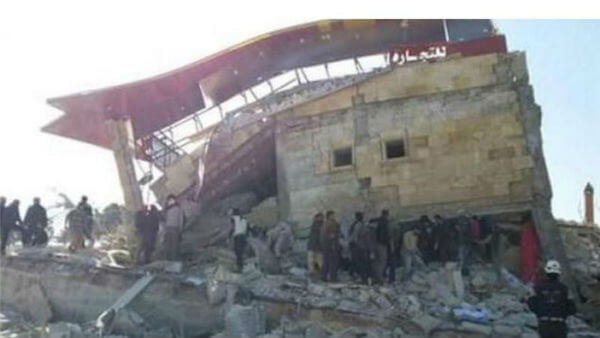
The New York Times reports: The hospital in the northern Syrian town of Maarat al-Noaman was not just grazed, or damaged, by the airstrikes last week. It was destroyed, taking a direct hit that pancaked its three stories into one, entombing and killing 25 people, including nine staff members.

It was struck at around 9:02 a.m., just as day-shift workers and patients were arriving; then again at around 9:05. As rescuers swarmed around, another explosion struck at 9:45, and another at 9:48. That same morning, two airstrikes hit the National Hospital on the other side of town, which was treating nurses injured in the attack on the first facility.

This detailed account, provided by the director of the hospital, which was supported by Doctors Without Borders, is one example of why many Syrian medical workers in insurgent-held areas and human rights groups believe medical facilities are not just being hit by stray bombs or indiscriminate attacks, but have long been deliberately targeted by the Syrian government and its Russian allies. It is a measure of the deep mistrust that gravely challenges prospects for a truce set to begin Saturday.

“I had the feeling they were trying to kill me,” said the director, Dr. Mazen al-Saoud, 55, in a telephone interview from Maarat al-Noaman, his hometown. “Wherever I went, there was bombing.”

According to Doctors Without Borders, there were 94 attacks last year alone on 67 hospitals and clinics the group supports in insurgent-held areas from northern to southern Syria, destroying 12 facilities and killing 23 staff members. In 2016, there have already been 17 attacks on health facilities, including six assisted by the group. [Continue reading…]

Facebooktwittermail

Kurdish ‘democratic confederalism’ or counter-revolution in Syria?

Robin Yassin-Kassab writes: The first fact is this: the Kurds have suffered a terrible historical injustice. The Arabs were rightly enraged when Britain and France carved bilad al-Sham (the Levant) into mini-states, then gave one of them to Zionism.

But the post-Ottoman dispensation allowed the Kurds no state at all – and this in an age when the Middle East was ill with nationalist fever. Everywhere the Kurds became minorities in hyper-nationalist states.

Over the years an estimated 40,000 people have been killed in Turkish-Kurdish fighting, most of them Kurds.

In the late 1980s, Saddam Hussein’s genocidal Anfal campaign murdered somewhere between 50,000 and 200,000 Iraqi Kurds.

In Syria, where Kurds formed about 10 percent of the population – or around two million people – it was illegal to teach in the Kurdish language.

Approximately 300,000 Kurds (by 2011) were denied citizenship by the state, and were therefore excluded from education and health care, barred from owning land or setting up businesses.

While oppressing Kurds at home, President Hafez al-Assad (Bashar’s father) cultivated good relations with Kurdish groups abroad. This fitted into his regional strategy of backing spoilers and irritants as pawns against his rivals. [Continue reading…]

Facebooktwittermail