Joyce Karam writes: “What are you talking about, 7000…No,no. We killed 38,000”, those were the words of former Syrian General Rifaat Assad in1982 as recounted by Thomas Friedman in his book “From Beirut to Jerusalem”. Rifaat, who is now in exile, was exulting about the number of Syrians his forces killed in Hama 34 years ago, quashing a rebellion against his brother’s dictatorship and setting the stage to what has followed.
The ghosts of Hama today hover all over Syria, cementing the pillars of the Assad doctrine to rule by fear and hold on to power at any cost even if it means surrendering the country to devastation, radicalization and ultimate death. From father to uncle to son, the Assad playbook has not changed, copying the narrative of Hama to Homs, Douma, Ghouta, Idlib, Daraa and Aleppo, and in the process leaving behind more than 250 thousands dead, millions displaced, and a society in shambles.
The 3-week assault on Hama in 1982 has laid the ground for how the Assad regime reacts to any signs of rebellion later. Not coincidentally, the same horror tactics utilized in Hama in 1982 with Assad the father were replicated by the son across Syria following the 2011 uprising.
In a chilling report by Amnesty International in 2012, survivors of the Hama massacre give their account of what happened, describing images of the dead splintered in the streets, left to be eaten by dogs and as a red flag for those whose lives were spared. Snipers were on the roofs, neighborhoods were razed and one survivor recalls the the attack on Mas’oud Mosque, where “some 60 men were killed before the security forces cut off their fingers and placed them along the mosque’s walls.” She tells Amnesty “for around two years after the massacre, no one dared remove the fingers. They were so frightened.” [Continue reading…]
Category Archives: Analysis
The worst is yet to come for Syria’s largest city, Aleppo
BuzzFeed reports: With the government of Syrian President Bashar al-Assad moving closer to encircling the rebel-held parts of the city — the most important patch of territory the opposition holds — rebels and analysts expect it to turn to the brutal tactics it has employed throughout the war. As in the past, the primary victims will be civilians.
Sending troops into rebel-held Aleppo would be a costly move for the Syrian military and its allies, said Firas Abi Ali, the head of Middle East and North Africa forecasting at IHS Country Risk in London. Instead, they are likely to attempt to starve out the rebels and civilians inside while using artillery and airstrikes to bring them to their knees. “They’re not going to dedicate the amount of resources required to capture a city of that magnitude. They’re going to go with starvation and bombardment tactics,” he said. “This is the standard military tactic developed by Assad.”
The government has spent years pounding Aleppo with airstrikes, raining chaos down on civilians. It also has notoriously employed a siege strategy in places like Madaya, near Damascus, and the central city of Homs, where starving rebels and civilians eventually agreed to surrender. Yet the potential for civilian suffering in Aleppo is far larger now. “There are still several hundred thousand people in the city and the province. The scale of the suffering here can be much greater,” Abi Ali said. “Assad can do much more damage, and he is willing to inflict enormous pain.”
Rami Jarrah, a Syrian journalist and activist who has worked extensively in Aleppo, said the government plan seemed to be “to promote as much desertion of the city as possible now in build up to performing a total siege of Aleppo. Sieges have proven to be successful in terms of draining the opposition into submission.” [Continue reading…]
The military and political significance of Aleppo
Faysal Itani and Hossam Abouzahr write: Retaking Aleppo city would be a substantial win for the regime. Militarily, it would cut off opposition forces south of the city. It would also allow the regime to further isolate opposition forces in nearby Idlib and Hama. Rebel forces in northwestern Syria receive supplies from Turkey through two border crossings: Bab al-Salama in Aleppo province and Bab al-Hawa in Idlib province. If the regime takes Aleppo city, it could then target supply lines between Idlib- and Hama-based insurgents and Turkey. The regime may opt not to take Aleppo now, however, preferring to bomb and besiege it instead. That would simply freeze the Aleppo city frontlines and allow Assad and his allies to deploy fighters and resources elsewhere, including in Idlib and Hama. Regardless, the regime’s strategy will be isolating the opposition into manageable pockets and dealing with each individually.
Crucially, progress in Aleppo will free up resources against the Islamic State (ISIS). It is true that Assad and his allies have always prioritized fighting the insurgency over ISIS. The changing international environment, however, allows for a more sophisticated regime strategy. Despite frequent accusations, the regime and ISIS are not really allies. The regime simply sees the entire conflict through the prism of ensuring its own survival by any means necessary. Throughout the war, this has meant ignoring ISIS or facilitating its war against the rebels. Now, however, the regime would benefit enormously at the international level by clearing the Aleppo area of insurgents and ISIS alike (or following the Aleppo victory with some anti-ISIS wins elsewhere, such as Palmyra). That would demonstrate to the world that it must choose between Assad and ISIS, and that ISIS and the various insurgent groups are one and the same enemy. Considering the West’s singular focus on ISIS and tolerance of the regime, this would actually be a sound strategy. [Continue reading…]
The Syrian regime is close to a victory that could turn the war
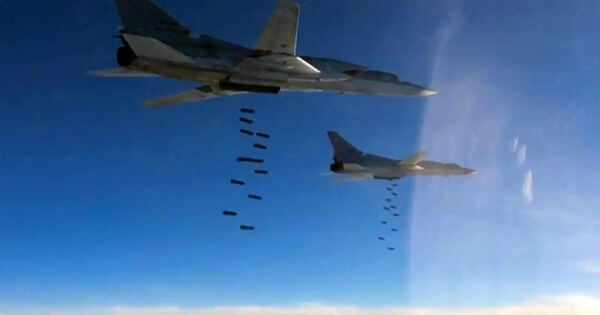
Vice News reports: Rebels north of Aleppo had already been stretched thin, attempting to balance fronts against the regime, the Islamic State, and the Kurdish People’s Protection Units (YPG) and their allies. The latest push by the regime of Bashar al-Assad – and, in particular, relentless Russian bombing from the air – proved too much to handle.
“The regime is relying primarily on the Russian air force. Its jets are in the air constantly,” said Col. Ahmed Uthman, military commander of local rebel faction Firqat al-Sultan Murad.
Locals described the nonstop aerial bombing and the shelling of the area as “scorched earth” tactics.
“There’s no parity between these Russian jets and rebel forces,” said Firas Pasa, commander of Aleppo brigade Liwa al-Mu’tasem Billah. “We need anti-aircraft weapons as soon as possible.”
In addition to Russian airpower, the regime’s Syrian Arab Army is also backed by various paramilitary forces, including Iraqi Shi’ite units. “We’re no longer facing Bashar’s army, the army of Abu Flip-flops,” said a media official with a rebel brigade in the north who requested anonymity, using a derisive nickname for the regime’s exhausted military. [Continue reading…]
Syrian refugees in Jordan: ‘If they cut the coupons, we will probably die’
The Guardian reports: Just look at how we’re living,” says Umm Majd, a Syrian who fled to Jordan. She stands in a tiny single-room apartment in Amman, the capital. It lies deep underground, next to a subterranean car park, and measures just two metres by two and a half. It is here that she, her husband and their two sons live out their exile.
“Just look,” says Umm Majd, gesturing at the room. “That’s enough to understand what’s happening to Syrians here in Jordan.”
There are between 630,000 and 1.27 million Syrian refugees in the country, depending on whose estimate you believe. Like most of them, Umm Majd’s husband does not have the right to work – so he works illegally as a carwasher for 100 Jordanian dinars a month (about £100, half the minimum wage). The family collectively receives 40 dinars in food coupons from the UN – down from 80 a year ago. Their rent is 50 dinars, leaving them just 90 each month for any other living expenses.
“Right now we’re not thinking of going to Europe,” says Umm Majd’s husband. “But if they cut our funding again then we’ll have to. If they cut the coupons we’d probably die.” [Continue reading…]
Turkey’s academics pay heavy price for resisting Erdoğan’s militarised politics
By Celal Cahit Agar, University of Exeter and Steffen Böhm, University of Exeter
While the EU and the US have turned a blind eye to the Turkish government’s brutal clampdown in Kurdish regions, Turkish academics who have spoken out about the regime’s increasingly dictatorial policies have faced punishment and even imprisonment.
A petition published in early January by the Academicians for Peace initiative, criticising the Turkish state’s political and military attacks against the Kurdish people, raised a red flag with its signatories stating: “We will not be a party to this crime.” They wrote:
The Turkish state has effectively condemned its citizens in Sur, Silvan, Nusaybin, Cizre, Silopi, and many other towns and neighborhoods in the Kurdish provinces to hunger through its use of curfews that have been ongoing for weeks. It has attacked these settlements with heavy weapons and equipment that would only be mobilized in wartime. As a result, the right to life, liberty, and security, and in particular the prohibition of torture and ill-treatment protected by the constitution and international conventions have been violated.
In response, Turkish president Recep Tayyip Erdoğan immediately demanded that all institutions in Turkey take action: “Everyone who benefits from this state but is now an enemy of the state must be punished without further delay.”
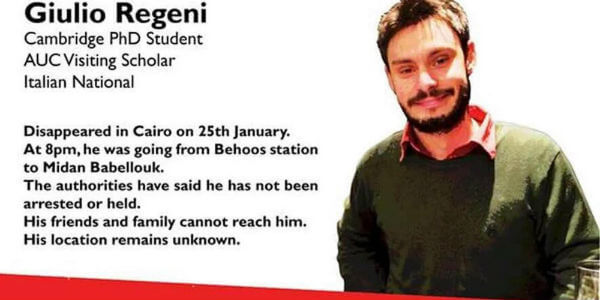
The murder of my friend Giulio Regeni is an attack on academic freedom
By Neil Pyper, Coventry University
The body of Giulio Regeni was discovered in a ditch in Cairo on February 2, showing evidence of torture, and a slow and horrific death. Giulio was studying for a PhD at the University of Cambridge, and was carrying out research on the formation of independent trade unions in post-Mubarak Egypt. There is little doubt that his work would have been extremely important in his field, and he had a career ahead of him as an important scholar of the region.
Giulio, originally from Fiumicello in north-east Italy, had a strong international background and outlook. As a teenager, he won a scholarship that allowed him to spend two formative years studying at the United World College in New Mexico. He was especially passionate about Egypt. Before beginning his doctoral research, he spent time in Cairo working for the United Nations Industrial Development Organisation (UNIDO). At the age of 28, he stood out with his big hopes and dreams, and he was committed to pursuing a career that would allow him to make an impact on the world, which is a poorer place for his passing.
Those of us who worked and spent time with him are grieving – but above all, we are furious about the manner of his death. While murder and torture are inherently of concern, Giulio’s case also has much broader implications for higher education in the UK and beyond.
Giulio Regeni’s last article on unions in Egypt, written shortly before his abduction, torture, and murder

il manifesto editors’ note: We publish posthumously this article by Giulio Regeni, an il manifesto contributor who was based in Cairo while researching his doctoral thesis. On Wednesday, his tortured body was discovered in a ditch in the city. Because independent trade unions are a contentious topic in Egypt, Regeni asked us to publish this article under a pseudonym, as we have done in the past. Today, we publish this last dispatch under the author’s real name.
Giulio Regeni wrote: President Abdel Fattah al-Sisi presides over Egyptian Parliament with the highest number of police and military personnel in the history of the country, and Egypt ranks among the worst offenders with respect to press freedom. Yet independent trade unions are refusing to give up. The Center for Trade Union and Workers’ Services (CTUWS), a beacon of independent Egyptian trade unionism, has just held a vibrant meeting.
Although the largest room at the center has 100 seats, the meeting hall could not contain the number of activists who came from all over Egypt for an assembly that was extraordinary in the current context of the country. On the agenda was a recommendation from Sisi’s ministers for close cooperation between the government and the country’s only official union, the Egyptian Trade Union Federation, with the explicit order to counter the role of independent trade unions and to further marginalize workers. [Continue reading…]
The world’s most cutting-edge renewable tech is powering rural Africa
Quartz reports: Distributed power — where electricity is generated locally, instead of delivered via complex grid infrastructure — makes lots of sense for Africa. About 600 million Africans don’t have electricity. But sunlight is a widely available resource across most of the continent, making distributed solar power one of the more sensible options for electrification.
Plenty of companies see the potential. This has made parts of Africa a testing ground for cutting-edge solar power. Some countries are developing a whole new type of infrastructure not seen elsewhere in the world: mobile-phone-led, flexible, and controlled by the user rather than big utilities and government.
“We are now seeing the first innovation where the leading technologies are actually being deployed in Africa, not being deployed in the mainstream West,” said Simon Bransfield-Garth, CEO of Azuri Technologies. Azuri is based in Cambridge, UK, and installs rent-to-buy solar systems for homes in Tanzania and several other sub-Saharan states. Power from the panels are paid for by mobile phone or scratchcard. The payments also serve as installments towards owning the system outright. After about 18 months the homeowner has typically paid off the cost of the panels, or can buy them for a very small sum (say, $5). [Continue reading…]
Race is a social construct, scientists argue
Scientific American: More than 100 years ago, American sociologist W.E.B. Du Bois was concerned that race was being used as a biological explanation for what he understood to be social and cultural differences between different populations of people. He spoke out against the idea of “white” and “black” as discrete groups, claiming that these distinctions ignored the scope of human diversity.
Science would favor Du Bois. Today, the mainstream belief among scientists is that race is a social construct without biological meaning. And yet, you might still open a study on genetics in a major scientific journal and find categories like “white” and “black” being used as biological variables.
In an article published today (Feb. 4) in the journal Science, four scholars say racial categories are weak proxies for genetic diversity and need to be phased out. [Continue reading…]
Diplomats say the U.S. has handed over Syria to the Russians for free

Following the suspension of UN-led peace talks, Lina Sinjab reports: Teams of diplomats representing countries supporting the opposition are pushing behind the scenes in Geneva for concessions from all parties involved in the war.
But almost everyone, whether diplomats or the opposition, says it is the US which is key to success – by using its leverage on Russia.
Russia is the only world power involved in the Syrian conflict with a military base in the country – therefore it could bring exert significant pressure on the regime of Bashar al-Assad to stop the violence.
But there is a limit to what the US is prepared to do.
A senior US Department of State official told me: “We are not ready to go to World War Three to solve this.”
The US, however, is spending billions of dollars in the battle against the self-proclaimed Islamic State (IS), which controls large parts of Syria.
Many Syrians feel the selective involvement of the US is hypocritical.
The US official was adamant that Secretary of State John Kerry wants to end the violence, and is determined to succeed.
But everyone here thinks the opposite. Almost at every corner, you hear the same thought: The US has handed over Syria to the Russians for free. [Continue reading…]
U.S. and allied support for Syrian opposition is dwindling
The New York Times reports: Four Syrian rebel commanders huddled in a knot, all broad shoulders and shiny gray suits, surveying the hotel lounge. Gigantic portraits of Jim Morrison and Jimi Hendrix gazed down at the carpet, a checkerboard of faux zebra-hide in squares of orange and magenta. On a low sofa, a couple snuggled to the sounds of Amy Winehouse.
The fighters decamped to a smokers’ enclosure behind a plate-glass window, its back wall a trompe-l’oeil image of electric-blue waves that made it seem as though they were submerged in a fish tank. It was an effect that fit their mood. They were in Geneva, notionally at least, for peace talks, but back in Syria, the government and its Russian allies were battering insurgents with scores of airstrikes. With their men under fire, the commanders were asking themselves how much longer they could credibly stay.
“Maybe a day,” one, Maj. Hassan Ibrahim, said on Monday night.
By Wednesday, the talks were indeed suspended, as the intense fighting on the ground proved there was as little to talk about as ever.
In an interview earlier, under the watchful eye of an adviser from Saudi Arabia, Major Ibrahim had dutifully projected strength and determination. But when the Saudi man walked away, the Syrian, who had defected from the government army in 2011, leaned forward and confided that the fighters he led in southern Syria were struggling. Supplies of weapons and salaries from the United States and its allies are dwindling. Moving in and out of Jordan is getting harder.
“They are doing it to put pressure on us to accept a political process,” he said, one in which he doubted that the Syrian government — or Russia, a sponsor of the talks — would make any compromise.
Major Ibrahim was reflecting a growing foreboding among the opposition’s fighters and civilians, mirrored by growing hope on the government side, that Washington, interested only in bombing the Islamic State militant group, is ceding the field to Russia and leaving the opposition on its own. [Continue reading…]
After four months, Russia’s campaign in Syria is proving successful for Moscow
The Washington Post reports: Four months after launching airstrikes in Syria, the Kremlin is confident that Moscow’s largest overseas campaign since the end of the Soviet Union is paying off.
Under the banner of fighting international terrorism, President Vladimir Putin has reversed the fortunes of forces loyal to Syrian President Bashar al-Assad, which were rapidly losing ground last year to moderate and Islamist rebel forces in the country’s five-year-old crisis. Government forces are now on the offensive, and last week, they scored their most significant victory yet, seizing the strategic town of Sheikh Miskeen from rebels who are backed by a U.S.-led coalition.
According to analysts and officials here, the Russian government believes it has won those dividends at a relatively low cost to the country’s budget, with minimal loss of soldiers’ lives and with largely supportive public opinion.
“The operation is considered here to be quite successful,” said Evgeny Buzhinsky, a retired lieutenant general and senior vice president of the Russian Center for Policy Studies in Moscow. It could probably continue for one year or longer, he said, “but it will depend on the success on the ground.”
Whether the benefits of Russia’s gambit to put soldiers on the ground in Syria will continue long term remains to be seen. President Obama warned last year that Russia was entering a “quagmire” reminiscent of the Soviet invasion of Afghanistan, and it is unclear when Moscow could declare victory and whether it has an exit strategy.
But as Assad’s forces push forward and as diplomatic talks in Geneva broke off in recriminations Wednesday after just two days, there is little pressure right now on the Kremlin to pull back. [Continue reading…]
A New Deal for Europe
Thomas Piketty writes: The far right has surged in just a few years from 15 percent to 30 percent of the vote in France, and now has the support of up to 40 percent in a number of districts. Many factors conspired to produce this result: rising unemployment and xenophobia, a deep disappointment over the left’s record in running the government, the feeling that we’ve tried everything and it’s time to experiment with something new. These are the consequences of the disastrous handling of the financial meltdown that began in the United States in 2008, a meltdown that we in Europe transformed by our own actions into a lasting European crisis. The blame for that belongs to institutions and policies that proved wholly inadequate, particularly in the eurozone, consisting of nineteen countries. We have a single currency with nineteen different public debts, nineteen interest rates upon which the financial markets are completely free to speculate, nineteen corporate tax rates in unbridled competition with one another, without a common social safety net or shared educational standards—this cannot possibly work, and never will.
Only a genuine social and democratic refounding of the eurozone, designed to encourage growth and employment, arrayed around a small core of countries willing to lead by example and develop their own new political institutions, will be sufficient to counter the hateful nationalistic impulses that now threaten all Europe. Last summer, in the aftermath of the Greek fiasco, French President François Hollande had begun to revive on his own initiative the idea of a new parliament for the eurozone. Now France must present a specific proposal for such a parliament to its leading partners and reach a compromise. Otherwise the agenda is going to be monopolized by the countries that have opted for national isolationism—the United Kingdom and Poland among them. [Continue reading…]
If Russia started a war in the Baltics, NATO would lose — quickly
Dan De Luce writes: If Russian tanks and troops rolled into the Baltics tomorrow, outgunned and outnumbered NATO forces would be overrun in under three days. That’s the sobering conclusion of war games carried out by a think tank with American military officers and civilian officials.
“The games’ findings are unambiguous: As currently postured, NATO cannot successfully defend the territory of its most exposed members,” said a report by the RAND Corp., which led the war gaming research.
In numerous tabletop war games played over several months between 2014-2015, Russian forces were knocking on the doors of the Estonian capital of Tallinn or the Latvian capital of Riga within 36 to 60 hours. U.S. and Baltic troops — and American airpower — proved unable to halt the advance of mechanized Russian units and suffered heavy casualties, the report said.
The study argues that NATO has been caught napping by a resurgent and unpredictable Russia, which has begun to boost defense spending after having seized the Crimean peninsula in Ukraine and intervened in support of pro-Moscow separatists in eastern Ukraine. In the event of a potential Russian incursion in the Baltics, the United States and its allies lack sufficient troop numbers, or tanks and armored vehicles, to slow the advance of Russian armor, said the report by RAND’s David Shlapak and Michael Johnson. [Continue reading…]
Russia carried out practice nuclear strike against Sweden

The Local reports: When Russian planes carried out a simulated attack against Sweden in 2013, it included nuclear warfare, a Nato report has revealed.
The training mission by the Russian military took place just beyond the eastern edge of the Stockholm archipelago three years ago. It grabbed global headlines because Sweden’s military was slow to react due to staff being on vacation and had to rely on help from Nato.
Several Swedish media outlets had previously speculated that the exercises also included a simulated nuclear attack, but this was never confirmed.
Now, Nato’s Secretary General Jens Stoltenberg has revealed that this was indeed the case – a revelation that appears in the defence alliance’s annual report.
The text, which was released last week but only widely reported in Sweden on Wednesday, also confirmed that four Russian Tupolev Tu-22M3 bombers had participated in the training exercise as well as two Sukhoi Su-27 jets. [Continue reading…]
The war in Ukraine is back — so why won’t anyone say so?
Pierre Vaux reports: Russia’s dirty war in Ukraine is far from frozen, and despite the deteriorating situation, the West appears keen to turn a blind eye.
While the fighting in southeast Ukraine has rumbled on incessantly throughout the winter, inducing conflict fatigue and a drop in media coverage, the last weeks have seen a marked spike in the number of attacks.
Ukrainian officials are reporting up to 71 attacks a day, with most of the fighting concentrated around the separatist-held cities of Donetsk and Gorlovka, as well as the countryside east of the Azov port city of Mariupol.
Both sides accuse each other of daily using heavy mortars, which were supposed to have been withdrawn in accordance over a year ago in accordance with the first Minsk agreement. [Continue reading…]
Drone captures scenes of devastation — the remains of Homs, Syria
The New York Times reports: A video taken by a drone winding its way through the battered city of Homs, Syria, has captured haunting images of the virtually complete destruction after five years of civil war.
The minute-and-a-half video was uploaded on Tuesday to a YouTube channel operated by Alexander Pushin, a cameraman who runs a drone filming company, Russia Works, and who has taken several videos of Syria’s war-torn landscape.
In his latest video, whose date of origin was unclear, the camera travels at low altitude between buildings and alleyways in Homs, a central city that had been home to a prewar population of one million people. It is almost completely empty of life.
The images evoke scenes from a post-apocalyptic video game — an abandoned graveyard, a lone motorcyclist, gutted buildings reduced to pile after pile of rubble — and help explain the desperation driving the country’s spasms of civilian flight. [Continue reading…]
In his YouTube description of the footage, camera operator Alexander Pushin claims the area was destroyed by “radical Islamists and foreign mercenaries,” but Tom Gara offers a more realistic assessment of the kind of fire power that can produce this level of destruction.
The devastation of Homs. Jihadists and rebels can't do this. It takes an army, an airforce, a government. https://t.co/OBqchWxFCt
— Tom Gara (@tomgara) February 3, 2016