Category Archives: Analysis

Marshes can rise to meet flood risks if we don’t disrupt mud flows

marshland

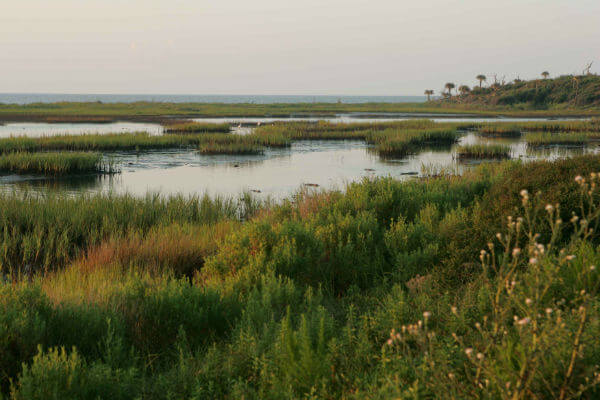
Climate Central reports: In the race to keep their verdure heads above rising seas, marshes that protect coastal regions from floods, storms and erosion harbor the botanical equivalents of nitro boosters: rapid growth fueled by climate-changing pollution.

The same greenhouse gas that’s doing most to warm the planet and uplift its seas can also work as a fertilizer. New research suggests that rising levels of heat-trapping carbon dioxide in the atmosphere could help communities of marsh plants grow quickly enough to keep up with changes that would otherwise inundate them.

“The fertilization effect from increased carbon dioxide in the atmosphere definitely enhances marsh-plant biomass functioning,” said Katherine Ratliff, a PhD candidate at Duke University who led modeling-based research published last month in Proceedings of the National Academy of Sciences.

The findings suggest that mud shortages — not growth rates — could be the greatest challenges for marshes as they strive to grow quickly enough to keep up with rising seas. Sea levels have risen 8 inches since the late 1800s, with several more feet expected this century. The fostering of coastal ecosystems is considered a key defense strategy against future flooding. [Continue reading…]

Facebooktwittermail

Electrifying India, with solar power and small loans

solar-india

The New York Times reports: A few years ago, the hundred or so residents of Paradeshappanamatha, a secluded hamlet in the southern Indian state of Karnataka, gathered along the central pathway between their 22 densely clustered homes, and watched as government workers hoisted a solar-powered streetlamp. As the first display of electricity in the town, it was an object of mild interest, but, being outside, the light didn’t help anyone cook or study, and only attracted moths.

Still, when B. Prasad arrived two years later to encourage people here to abandon kerosene lighting for solar-powered home systems, people had some idea what he was talking about. What sounded preposterous to the village residents was the price. Mr. Prasad, an agent for Solar Electric Light Company, or Selco, was selling a panel and battery that would power three lights and an attached socket for phone charging for approximately 12,800 rupees, or $192.

“There was no way we could afford that,” P. C. Kalayya remembers thinking. He and his neighbors rise early in the morning to walk miles along a nearly impassable dirt road to work on coffee, pepper and betel nut plantations. Mr. Kalayya earns $3 a day — he’d been earning $2.25 until a raise came through this year — and half his wage is withheld by his employer as repayment for various loans.

And yet, despite what seemed on its face an impossibly high cost, Selco agents succeeded in persuading Mr. Kalayya and 10 other village households to make the switch. Now, his wife can better see how much spice she is putting in as she cooks, and Pratima, their 18-year-old daughter, can study long after dark.

The idea behind Selco, and other companies like it, is to create a business model that will help some of the 1.2 billion people in the world who don’t have electricity to leapfrog the coal-dependent grid straight to renewable energy sources.

About a quarter of the world’s off-the-grid people, or 300 million or so, live in India, mostly in remote, rural communities like Paradeshappanamatha, or in informal urban settlements. Hundreds of millions more get electricity for only a few hours a day. Prime Minister Narendra Modi has pledged to achieve universal electrification in India by the end of 2022. His main effort is adding hundreds of new coal plants, which have contributed to near-apocalyptic pollution levels across large swaths of the country. [Continue reading…]

Facebooktwittermail

The war on freedom of expression across the Middle East

Rami G Khouri writes: It is useful to spot meaningful patterns that help us make sense of our bewildering world, and to acknowledge positive developments to be continued alongside negative ones to be avoided.

Applying this principle to the last year in the Middle East reveals several troubling trends that have made life difficult for hundreds of millions of people. One in particular stands out, and strikes me as a root cause of many other negative trends that plague our region. This is the tendency of governments to use increasingly harsh measures to restrict the freedoms of their citizens to express themselves and meaningfully to participate politically and hold power accountable.

Several aspects of this behavior make it especially onerous. It is practiced by all states in the region—Arab, Israeli, Iranian, and Turkish—leaving few people in this part of the world who can live as fully free and dignified human beings. It is justified on the basis of existing constitutional powers, so governments can jail tens of thousands of their citizens, rescind their nationality, or torture and kill them in the worst cases, simply because of the views they express, without any recourse to legal or political challenge. It shows no signs of abating, and indeed may be worsening in lands like Egypt, Turkey, and others. And, it is most often practiced as part of a “war on terror” that seeks to quell criminal terror attacks, but in practice achieves the opposite; the curtailment of citizen rights and freedoms exacerbates the indignities and humiliations that citizens feel against their government, which usually amplifies, rather than reduces, the threat of political violence. [Continue reading…]

Facebooktwittermail

On perilous refugee trail, women often become prey to sexual abuse

The New York Times reports: One Syrian woman who joined the stream of migrants to Germany was forced to pay down her husband’s debt to smugglers by making herself available for sex along the way. Another was beaten unconscious by a Hungarian prison guard after refusing his advances.

A third, a former makeup artist, dressed as a boy and stopped washing to ward off the men in her group of refugees. Now in an emergency shelter in Berlin, she still sleeps in her clothes and, like several women here, pushes a cupboard in front of her door at night.

“There is no lock or key or anything,” said Esraa al-Horani, the makeup artist and one of the few women here not afraid to give her name. She has been lucky, Ms. Horani said: “I’ve only been beaten and robbed.”

War and violence at home, exploitative smugglers and perilous seas along the way, an uncertain welcome and future on a foreign continent — these are some of the risks faced by tens of thousands of migrants who continue to make their way to Europe from the Middle East and beyond. But at each step of the way, the dangers are amplified for women.

Interviews with dozens of migrants, social workers and psychologists caring for traumatized new arrivals across Germany suggest that the current mass migration has been accompanied by a surge of violence against women. From forced marriages and sex trafficking to domestic abuse, women report violence from fellow refugees, smugglers, male family members and even European police officers. There are no reliable statistics for sexual and other abuse of female refugees. [Continue reading…]

Facebooktwittermail

John Kerry won’t call the Islamic State by its name anymore. Why that’s not a good idea.

Shadi Hamid and Will McCants write: Refusing to utter the Islamic State’s name … needlessly complicates the religious fight to discredit the organization. Muslims understandably feel that their religion is being hijacked. But there’s something odd about an American president or Secretary of State opining on what is and isn’t legitimately Islamic. Shouldn’t it go without saying that a murderous extremist group isn’t what Muslims are all about?

There is a place for Muslim apologetics — from Muslims. This is precisely what a group of prominent British figures did when they attempted to rebrand the Islamic State as “the Un-Islamic State.”

But when non-Muslim officials insert themselves into this debate, it sets a negative precedent. It lends itself easily to broader pronouncements on who the good, “moderate” Muslims are, in contrast to the “bad guys,” a category which presumably could include anyone who falls on the Islamist side of the spectrum, regardless of whether they’re actually “extreme.”

And when the West co-opts Muslim talking points about the “true” Islam, it makes it harder for Muslims in the Arab world to make the same claim. Western governments are widely loathed and lack credibility in the region, even when they take care to explain their policies. A 2006 study suggested Arab students’ views of American policy “worsened slightly” the longer they listened to U.S.-sponsored Radio Sawa and al-Hurra TV. When Western officials repeat religious criticisms of the Islamic State, they make it easier for the group’s sympathizers to dismiss the criticisms as mere imperial dictation. [Continue reading…]

Some regular readers here may have noticed that in headlines (the one above being an exception), I have stuck with ISIS, in spite of its official name change and the ongoing debate among outsiders over which is the most appropriate label. My choice has nothing to do with that debate. It’s based instead on the matter of usage.

Whichever happens to be the most commonly used label is “correct” by that virtue alone. That’s why even though ISIS is actually an ambiguous term, you will rarely find yourself in a conversation during which you’ll be asked to clarify whether you’re talking about the terrorist organization, ISIS, or the Egyptian goddess, Isis.

When it comes to determining who’s saying what, where, Google Trends is an indispensable tool.

Facebooktwittermail

Saudi mass execution driven by fear of Sunni militancy

Angus McDowall writes: The Al Saud ruling family regard the expansion of Shi’ite Iran’s influence in the Middle East as a threat to their security and to their ambition of playing the leading role among Arab states.

Inside the kingdom, however, it is the threat of a rebellion by the majority Sunnis that most alarms a dynasty whose rule is based on conservative support at home and an alliance with the West.

All past threats to the Al Saud, from a 1920s tribal rebellion to riots in the 1960s, a siege at Mecca’s Grand Mosque in 1979 and protests in the 1990s, were caused by conservative Sunni anger at modernisation or ties with the West.

That was why the al Qaeda uprising that began in 2003, and attacked the Al Saud by turning its own conservative Salafi brand of Sunni Islam against it, was such a danger. It is why the jihadist movement’s latest iteration, Islamic State, is also a problem.

While Islamic State seems to lack real support among Saudis, some may sympathise with its broader goals, approving of its rhetoric against Shi’ites and the West and its criticism of corruption among the Al Saud.

By executing al Qaeda ideologues and attackers, Riyadh was showing its determination to crush support for the militant cause. By also killing four Shi’ites, angering Iran in the process, it was telling conservative Sunnis it was still on their side. [Continue reading…]

Facebooktwittermail

Saudi execution: Call for West to condemn killing of Shia cleric

Martin Chulov reports: Shia Islamic leaders on Sunday stepped up their condemnation of the Saudi execution of the prominent Shia cleric Sheikh Nimr al-Nimr, urging a robust response from Riyadh’s western backers, who are yet to fully address the issue.

David Gauke, financial secretary to the Treasury, became the most senior UK figure to react to the execution, which has led to clashes in Tehran, and prompted widespread denunciation elsewhere. He said al-Nimr’s death was a “worrying development”. The US State Department had said earlier that the move risked “exacerbating sectarian tensions at a time when they urgently need to be reduced”.

Anger remained palpable on the streets of the Lebanese capital, and in Bahrain and Baghdad, hours after the Saudi embassy in Tehran was torched by protesters angered by the execution of a senior cleric who had been championed by Iranian leaders.

However, in what appeared to be a move to calm tensions, the Iranian president, Hassan Rouhani, said the attack on the embassy was unjustifiable, and urged that the perpetrators be dealt with.

“I have no doubt that the Saudi government has damaged its image, more than before, among the countries in the world – in particular (among) Islamic countries – by this un-Islamic act,” Rouhani said.

Taking a cautionary tone, he added: “We will not allow rogue elements” to use the incident and “carry out illegal actions that damage the dignity of the Islamic republic establishment”.

“I call on the interior minister to identify the perpetrators of this attack with firm determination and introduce them to the judiciary … so that there will be an end to such appalling actions once and for all.”

Iran’s supreme leader, Ayatollah Ali Khamenei, called on Saudi Arabia’s western backers to directly condemn the execution, which came three years after al-Nimr was arrested following his vocal support for anti-government protests in Bahrain and Riyadh.

“This oppressed cleric did not encourage people to join an armed movement, nor did he engage in secret plotting, and he only voiced public criticism … based on religious fervour,” said Khamenei, who criticised “the silence of the supposed backers of freedom, democracy and human rights” over the execution. [Continue reading…]

The New York Times reports: Sheikh Nimr, said to be in his mid-50s, was from Awamiyah, a poor town surrounded by palm groves in eastern Saudi Arabia and known for opposition to the monarchy.

He studied in Iran and Syria, but rose to prominence for fiery sermons after his return in which he criticized the ruling family and called for Shiite empowerment, even suggesting that Shiites could secede from the kingdom.

This gained him a following mostly among young Shiites who felt discriminated against by Persian Gulf governments. When these young people joined Arab Spring protests in Bahrain and eastern Saudi Arabia in 2011, Sheikh Nimr became a leading figure.

During a sermon in 2012, Sheikh Nimr mocked Prince Nayef bin Abdulaziz, who had been the Saudi interior minister and had recently died.

“He will be eaten by worms and suffer the torments of hell in the grave,” Sheikh Nimr said. “The man who made us live in fear and terror; shouldn’t we rejoice at his death?”

Prince Nayef’s son, Mohammed bin Nayef, is now the crown prince and runs the Interior Ministry, which carries out death sentences. [Continue reading…]

Facebooktwittermail

Saudi Arabia’s mounting security challenges

Bruce Riedel writes: The kingdom announced its new budget Dec. 28 with a record $87 billion deficit. Revenues are projected at $137 billion and spending at $224 billion.

Riyadh’s immediate priority is the war in Yemen. The war costs an estimated $200 million a day, or $6 billion a month. The Saudi coalition and the Houthi rebels both violated the last United Nations-sponsored cease-fire. The Saudis did gain control of the capital of Jawf province along the Saudi border during the supposed truce. The talks in Biel, Switzerland, did not produce a breakthrough, but are to resume Jan. 14.

The Houthis show no sign of giving up. Their leadership remains hard-line and defiant. The war appears to be a bloody stalemate that has catastrophic humanitarian costs for Yemenis. The outside world pays little if any attention. [Continue reading…]

Facebooktwittermail

Saudi execution of Shia cleric poses a direct challenge to Iran

Simon Tisdall writes: The consequences of Saudi Arabia’s mass execution of 47 people will be felt far beyond its Eastern Province, which was home to Nimr al-Nimr, the leading Shia Muslim cleric who was the most prominent figure among those to die.

Unlike many of the Sunni Muslims executed for alleged complicity in al-Qaida terrorism, Nimr was an advocate of non-violent resistance to the unelected Saudi regime. He was arrested in 2012 for criticising the royal family.

His plight reflected the trials and tribulations of Saudi Arabia’s Shia minority, which accounts for 15% of the country’s 29 million people and has suffered, historically, from institutionalised discrimination and periodic security crackdowns.

The al-Qatif governorate of Eastern Province, bordering the Gulf, has been the setting for anti-regime agitation since at least 1979, when Saudi Shias demonstrated in support of Ayatollah Ruhollah Khomeini, whose Islamic revolution in Iran that year toppled the shah. Trouble erupted again in 2011-13, triggered by the Arab Spring uprising of the Shia majority in nearby Bahrain and its subsequent brutal, Saudi-assisted suppression. [Continue reading…]

Mark Townsend adds: In October 2014, Saudi Arabia’s specialised criminal court sentenced Nimr to death for seeking ‘foreign meddling’ in the kingdom along with ‘disobeying’ its rulers and taking up arms against the security forces”. His brother, Mohammad al-Nimr, tweeted information about the death sentence and was promptly arrested on the same day.

As news of the sentence travelled, the head of Iran’s armed forces warned Saudi Arabia that it would “pay dearly” if it dared execute the cleric. Powerful and prominent in life, it is the nature of Nimr’s death that could shape his legacy. [Continue reading…]

Facebooktwittermail

Meltdowns, crises and ISIS: A terrible year in the Middle East

By Simon Mabon, Lancaster University

As we approach the fifth anniversary of the Arab Uprisings, it’s hard to remember the days of popular protests, of democratic revolutions and of dreams of a better future that rocked the Middle East in 2011. Nearly five years on, tensions between rulers and the ruled have exploded across the region – and the ensuing struggles for survival have continued to take all manner of ugly forms.

At the centre of things, the Syrian conflict has deepened – and while the brutality of Islamic State (IS) has been responsible for much of the recent chaos and tragedy across Syria, the regime of Bashar al-Assad has been responsible for seven times as many Syrian deaths as IS. Assad’s position was strengthened by continued support from Russia, Iran and Lebanon’s Hezbollah, antagonising powerful states in the West and the Gulf – particularly Saudi Arabia. The Gulf states also faced domestic threats from IS, with the group carrying out a number of attacks on Shia sites and communities across the region.

The Syrian conflict became ever more internationalised in 2015. The number of foreign fighters on the ground – on all sides – continued to grow, while on the diplomatic level, the Vienna talks tried to resolve the seemingly intractable conflict – though they have yet to yield any decisive action.

The task of dealing with IS was further complicated by a batch of new wilayats, groups who declared allegiance to IS. Wilayat Sinai in particular was purportedly responsible for a range of acts, allegedly including a massive bomb attack in Cairo and the downing of a Russian passenger jet over Egypt’s Sinai Peninsula.

Continue reading

Facebooktwittermail

ISIS owns headlines, but Nigeria’s Boko Haram kills more than ever

NBC News reports: One terror group killed nearly 11,000 people in 2015 — and it wasn’t ISIS.

While the Sunni militants in Syria and Iraq dominated the headlines in 2015, Boko Haram was killing more people than ever — potentially eclipsing the tally of its partner in terror.

Nigeria’s new government pledged to oust Boko Haram and has boasted of successfully retaking territory from the extremists, but experts warn this might merely have forced the group to change tactics and possibly prompted a higher civilian casualty toll. [Continue reading…]

Facebooktwittermail

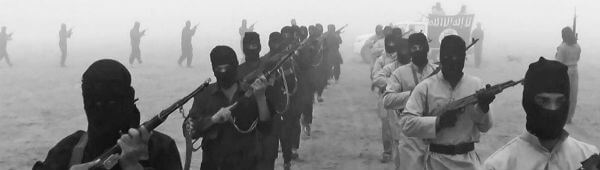
ISIS is here: Return of the jihadi

ISIS-catwalk-bw

Bruce Hoffman writes: “This is sort of the new normal,” FBI Director James Comey observed after the most recent Fourth of July. Comey was talking about the ten persons who were arrested in connection with a variety of plots linked to ISIS in the weeks leading up to that national holiday. But while the threat of homegrown violent extremism inspired by either ISIS or Al Qaeda is now accepted as fact, there is still surprisingly little consensus on the potentially far greater danger posed by radicalized foreign fighters trained by ISIS, returning to their native or adopted homelands in the West, ready to carry out terrorist actions—despite the attacks that occurred in Paris last November.

Indeed, long before the latest incidents, the May 2014 killing of four people at the Jewish Museum of Belgium appeared to validate fears of the potential for violence imported from abroad. The alleged perpetrator, a twenty-nine-year-old French national of Algerian origin named Mehdi Nemmouche, reportedly had spent more than a year in Syria. When he was arrested in Marseilles days after the attack, French police found in his possession an ISIS flag and a tape recording claiming responsibility for the incident. An interview with a French hostage previously held captive in Syria by ISIS subsequently revealed that Nemmouche had not only fought with the group, but also had tortured prisoners and boasted of having committed worse atrocities.

The only other well-publicized terrorist incident in Europe involving a veteran of the fighting in Syria was the fracas last August on a high-speed train traveling from Belgium to France. A passenger discovered Ayoub El Khazzani in the train’s lavatory while the twenty-five-year-old Moroccan-born resident of Spain was trying to load a Kalashnikov assault rifle. A scuffle ensued as other passengers tackled and disarmed El Khazzani, who was also carrying a Luger pistol, nearly three hundred rounds of ammunition, a Molotov cocktail and a box cutter. Already on the watch lists of at least four European security services because of his ties to Islamist groups and to radical mosques in Spain, El Khazzani is believed to have traveled to Syria where he was trained by, and fought for, ISIS. [Continue reading…]

Facebooktwittermail

Why has the AK-47 become the jihadi terrorist weapon of choice?

The Guardian reports: In the early years after 9/11 the suicide belt, the car bomb and the homemade explosive device were the weapons of choice for jihadis: hidden, brutal and hard to counter.

But as 2015 heaves to a close, its atrocities littered across the calendar – Charlie Hebdo, Sousse, Garissa, Tunis, Copenhagen and Paris – it is the AK-47 that has come to the fore.

Across Europe more terrorist attacks have been carried out with Kalashnikov-type assault rifles this year than with any other device. In the 13 November Paris attacks, suicide bombers killed few but gunmen killed many. Further afield, in Tunisia and Kenya, it was also automatic weapons that did the damage.

The widespread availability of these guns has been known for years. But it took the scale of death meted out in Paris last month to force Europe to address the threat.

Now law enforcement officers across the continent are trying to establish some basic truths. Where do they come from? Who are the middlemen that deal in these deadly weapons? And why have they become so popular again? [Continue reading…]

Facebooktwittermail

When my Japanese-American family was treated as less than human

Mike Honda writes: In the aftermath of the Paris and San Bernardino, California, terrorist attacks, the dangerous and destructive discourse about Muslims and Muslim Americans has reached a tipping point. Some Republican presidential candidates are calling for a ban of Muslims entering the country, and a Democratic mayor in Virginia is demanding the internment of Syrian refugees.

I can’t help but fear that history could be on the verge of repeating itself.

I am a third-generation American of Japanese ancestry, born in Walnut Grove, California. Yet my family and I were classified as enemy aliens simply because we looked like the enemy. In the days before we were taken from our communities, the life we knew was ripped from us.

In the aftermath of the attack on Pearl Harbor, on Dec. 7, 1941, the United States blamed us for the Japanese attack. Because of what the 1988 Civil Liberties Act labeled “war hysteria, racism and a failure of political leadership,” President Franklin D. Roosevelt signed Executive Order 9066, which confined the Japanese-American community in internment camps — and forever changing our lives and our community. [Continue reading…]

Facebooktwittermail

Stranger than Strangelove: How the U.S. planned for nuclear war in the 1950s

By Paul Lashmar, University of Sussex

Those who have written about the nuclear Cold War remain grateful to Stanley Kubrick for giving us the satirical 1964 film Dr Strangelove which captures the madness that swept the world for 40 years. The name Strangelove may be overused but the United States has now released a secret file that really does justify the sobriquet: “Stranger than Strangelove”. Almost anodyne in title, Atomic Weapons Requirements Study for 1959 is a truly shocking document, revealing the scale of the holocaust that would have been unleashed in a nuclear war.

But a little context first. Back in 2006, the journalist Michael Dobbs filed requests for the declassification of many Pentagon Cold War documents. Dobbs optimistically hoped these documents would illuminate his book on the Cuban Missile Crisis. After years in the review system, in October 2014, some 2,200 documents were released – and with Dobbs’ help, the not-for-profit National Security Archive in Washington DC (not to be confused with the National Security Agency) has been working on the bundle ever since.

The archive has recently released its assessment and the highlights are that major cities in the Soviet Bloc, including East Berlin, were high priorities in “systematic destruction” for nuclear attack and that H-bombs were to be used against priority “air power” targets in the Soviet Union, China, and Eastern Europe. The report also found that plans to target people (“population”) were in violation of international legal norms.

The cover of the SAC assessment.
National Security Archive, George Washington University

Meanwhile, Strategic Air Command (SAC) wanted a 60-megaton bomb – a weapon with the equivalent destructive power of over 4,000 Hiroshima devices.

Continue reading

Facebooktwittermail

Iran’s plan for Syria without Assad

assad-dumped

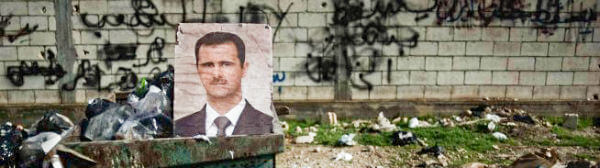
Joyce Karam writes: On February 25, 1987, late Syrian President Hafez al-Assad sent his troops to the Fathallah barracks in West Beirut, where they killed twenty-seven members of Hezbollah in a move designed to show Syria’s upper hand over Iran in Lebanon. Almost three decades later, this modus operandi is completely reversed under Assad the son, as Syria sinks into a war of attrition and Tehran gains the upper hand in Damascus.

For Iran, Bashar al-Assad has been a valuable ally but not an indispensable one. His coming to power in 2000, followed by the Iraq war in 2003 and Syria’s withdrawal from Lebanon in 2005, freed Iran’s hand in the Levant. Hezbollah under Bashar al-Assad has received weaponry and political backing unthinkable in his father’s time, including long-range Scud missiles and a 2010 Damascus visit by the party’s chief Hassan Nasrallah. But while Tehran has worked since the beginning of the Syrian war in 2011 to prolong Assad’s hold on power, it has also planned from the very early stages of the conflict for the day after, should its ally fall or should the regime lose Damascus.

Even as Iran sits at the negotiating table in Vienna, its strategy overlooks the political debate and the successive failed processes. It is instead rooted in creating new realities and proxies on the ground in Syria, looking beyond Assad and preserving its core interests. These interests are defined today by three goals: (1) Ensuring arms shipments continue to Hezbollah; (2) Gaining a strategic foothold in Levant and against Israel; (3) Preventing a stable government opposed to Iran from fully ruling over Syria. [Continue reading…]

Facebooktwittermail

Will Green Movement haunt Iran’s upcoming elections?

green-movement

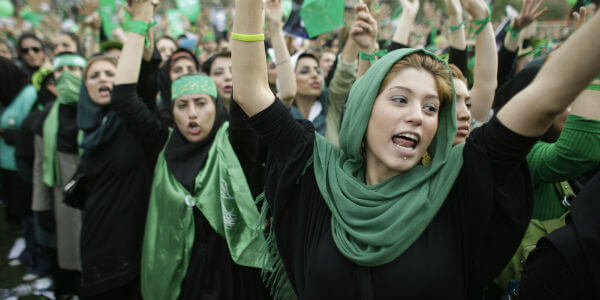
Arash Karami reports: The registration process for the February 2016 parliamentary and Assembly of Experts elections has come to end with a record number of candidates: Nearly 12,000 individuals registered to compete for a seat in the 290-member parliament. It will be the job of the conservative Guardian Council to determine which candidates pass through their filters and ultimately will be allowed to run. While the council is not obligated to specify publicly why the candidates are qualified or disqualified, it seems the 2009 presidential elections will be a central factor in their decision-making process.

Guardian Council spokesman Nejatollah Ebrahimian told Tasnim News Agency on Dec. 27 that the council will review all the comments and actions of the candidates during 2009 postelection protests. He said that the behavior of the candidates should not have been such that it could be construed that they participated in the illegal activities during 2009, adding they should have “clear and specific lines drawn with the sedition of 2009.”

The contested 2009 presidential elections, which hard-liners refer to as the “2009 sedition,” was a turning point in Iranian elections. The incumbent, controversial hard-liner Mahmoud Ahmadinejad, was announced the victor. The Reformist candidates, Mir Hossein Mousavi and Mehdi Karroubi, challenged the results and encouraged their supporters to hold street protests — the largest since the 1979 Islamic Revolution. Despite hundreds of arrests, dozens of deaths and the house arrest of the so-called Green Movement leaders, Iranian officials responsible for the crackdown continue to raise the issue of the 2009 elections as a sort of dividing line between those who should be allowed to be part of the political process and those who should not. [Continue reading…]

Facebooktwittermail

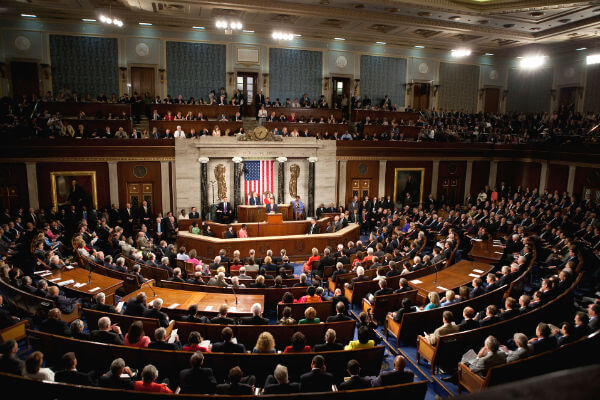
Is U.S. Congress empowering Iranian hard-liners?

congress

Mahmoud Pargoo writes: [In 2013] Hassan Rouhani, who sternly criticized Ahmadinejad’s nuclear policies, won the election and appointed Mohammad Javad Zarif as foreign minister. Consequently, and as a result of the softening of the rhetoric and engagement in talks with the United States, the Joint Comprehensive Plan of Action (JCPOA) was signed between Iran and six world powers in July. The agreement was seen as evidence that if Iran engages in serious talks with the United States, issues can be gradually solved. Even Supreme Leader Ayatollah Ali Khamenei pointed to the likelihood of extending negotiations to other non-nuclear issues if the United States proves to be trustworthy.

This line of thinking, however, is changing with the recent series of US measures — including the recent congressional vote to restrict visa-free travel to the United States for those who have visited Iran in the past five years. Indeed, many in Iran are coming to the conclusion that no matter what rhetoric or action the Islamic Republic may assume, the United States will continue its enmity with Iran. Thus, a new consensus is being formed — but this time, against the United States. People from almost all political orientations have interpreted the new Visa Waiver Program (VWP) changes as running counter to the JCPOA. Ali Larijani, the parliament speaker and a powerful conservative supporter of the nuclear negotiations, has criticized the law, while many Reformist politicians have also condemned it as being against Iranian goodwill in engaging with the United States. Zarif, the foreign minister and chief nuclear negotiator, has additionally said that the new law breaches the JCPOA.

When seen in the light of historical parallels, the recent developments could be an alarming sign that certain elements in the US foreign policy establishment are seeking to paralyze any effort to normalize relations with Iran. [Continue reading…]

Facebooktwittermail